
Bowker M., Davies P.R. (Eds.) Scanning Tunneling Microscopy in Surface Science, Nanoscience and Catalysis
Подождите немного. Документ загружается.


8 Point Defects on Rutile TiO
2
(1 1 0): Reactivity, Dynamics,
and Tunability 219
Chi L. Pang and Geoff Thornton
8.1 Introduction 219
8.2 Methods 220
8.3 Water Dissociation at Oxygen Vacancies and the Identification
of Point Defects 221
8.4 O
2
Dissociation at Oxygen Vacancies 229
8.5 Alcohol Dissociation at Oxygen Vacancies 229
8.6 Diffusion of Oxygen Vacancies and Surface Hydroxy 232
8.7 Tuning the Densities of Oxygen Vacancies and Surface
Hydroxyl on TiO
2
(1 1 0) 234
8.8 Outlook 236
References 236
Index 239
VIII Contents

Preface
The objective of this book is to highlight the important strides being made toward a
molecular understanding of the processes that occur at surfaces through the unique
information provided by the proximal scanning probe family of techniques: this
principally involves scanning tunneling microscopy (STM) but some atomic force
microscopy (AFM) experiments are also included.
The chapters in this book describe several state-of-the-art examples where an
atomic understanding of surface processes is developing out of atomically resolved
information provided by STM and AFM. The focus of much of the work is on
understanding the fundamentals of catalysis, a reflection of the huge significance of
heterogeneous catalysis in society today, but the discoveries being made in this field
will undoubtedly have a much wider significance in the field of nanoscience/
technology.
Reaction equations are derived from the results of global reaction measurements
and considerations of stoichiometry. Until recently, the intermediates (and in
particular the surface species) involved in the mechanism and their spatial location
have remained largely theoretical. The advent of STM has, for the first time, allowed
us the possibility of getting direct insight into this area. An example is the molecular
identification of the sequence of reaction steps and of the species involved in the
reaction of gas-phase methanol with oxygen on a copper surface. This produces
methoxy groups as the first step, in which the slightly acidic hydrogen from the
alcohol is stripped by surface oxygen leading to water desorption, as shown below,
where the subscript ‘‘ a’’ refers to an adsorbed species.
CH
3
OH
g
þO
a
!CH
3
O
a
þOH
a
CH
3
OH
g
þOH
a
!CH
3
O
a
þH
2
O
g
In this case, as in many others, STM has enabled us to identify the active sites at
which reaction between methanol and adsorbed oxygen takes place, and has also
allowed us to verify, at the atomic and the molecular scale, that the reaction does
indeed occur in the way the above stoichiometric equations describe. This is
invaluable information in the quest to understand and improve catalytic processes.
IX

The principal advantage of the probe methods is their extraordinary spatial
resolution (<0.1 nm) that does not, by necessity, require large areas of order. Their
potential is further expanded by the ability to study surfaces under conditions that
range from ultrahigh vacuum at cryogenic temperatures to industrially relevant
pressures and temperatures to aggressive liquid phases. A major aim is to identify
surface structures and intermediates present during operation in situ and in oper-
ando. There are three principal requirements to achieve these objectives: (i) high-
pressure operation (already demonstrated by a number of individual groups in the
field); (ii) the ability to image at high temperature while at high pressure (to some
degree, this has been achieved, although there are limitations to the temperature
range that can be studied, especially at above ambient pressure); (iii) fast scanning
(of the order of 1–10 images per second) since catalytic turnover rates are often very
high (e.g., 10 s
1
). This is also important for the ultimate aim of determining the
statistics of the reaction (e.g., determining directly, in situ, the turnover number for
the reaction). The authors believe that these aims will be realized in the next 10 years
or so, but we are not quite there yet. There is plenty of room in the field for further
developments.
It is fitting that this book should include a contribution from the laboratory of
Somorjai, one of the principal exponents of the surface science approach to catalysis,
who has developed a number of new approaches to the field and who, in recent years,
has looked, in particular, at adsorption and surface reactions at high gas pressures.
He reviews this work with some considerable and helpful focus on equipment
developments. Similarly, Goodman has been a strong advocate of in situ high-
pressure studies and has been at the forefront of developments in the field for
some considerable time. He reviews the state of the art and generously acknowl-
edges the contribution of colleagues in the field, some of whom have contributed to
this volume.
Kolb and Simeone discuss the application of STM to samples in the liquid
environment and deposition of metal from the STM tip itself, via reaction and
neutralization of cations from solution, generating reproducible patterns at nan-
ometer scales. The ability to control nanoparticle formation in terms of constant
spacing, spatial arrangement, and monosized dispersion is a crucial one for future
nanotechnology developments and Becker and Wandelt have also concerned them-
selves with the synthesis of reproducible patterns of particles at the nanoscale. They
illustrate the potential of a bottom-up process, by gas-phase metal deposition, for
generating model catalysts that can be studied both by spatially averaging techniques
and by scanning tunneling microscopy.
Netzer and Surnev consider the problem of generating model catalyst systems for
study using STM from a different direction. They examine the growth of thin oxide
films on metal substrates, the ‘‘ inverse’’ catalyst approach, and show the intrinsic
beauty in the geometrical arrangements of thin-layer oxides that can be obtained
when high-quality imaging is pursued. They also report the formation of new types
of oxide structure in the 2D regime. Importantly, they give consideration to the
particular problems of interpretation posed by STM images of thin oxide layers.
Since STM images involve a convolution of the substrate, adsorbate, and STM tip
X Preface

electronic states, interpretation of STM images is critical to all of the work presented
in this book and the contribution by Hofer, Lin, and Teobaldi is particularly welcome
since it provides a detailed review of the advances made in the theory of STM
imaging, highlighting areas where theory now has a good grasp of the issues and
where further development is needed.
The ability of STM to image at the atomic scale is particularly exemplified by the
two other chapters in the book. Thornton and Pang discuss the identification of point
defects at TiO
2
surfaces, a material that has played an important role in model
catalyst studies to date. Point defects have been suggested to be responsible for
much of the activity at oxide surfaces and the ability to identify these features and
track their reactions with such species as oxygen and water represents a major
advance in our ability to explore surface reactions. Meanwhile, Baddeley and
Richardson concentrate on the effects of chirality at surfaces, and on the important
field of surface chirality and its effects on adsorption, in a chapter that touches on
one of the fundamental questions in the whole of science – the origins of life itself!
In recent years, studies using STM have expanded from the use of the atomically
flat metal single crystals that have been the mainstay of surface science since the
mid-1960s to complex oxide surfaces and to 3D nanoparticles, often grown on
representative catalyst supports. The improvement in the technology and interpreta-
tion of imaging, and the increasing complexity of the surfaces being studied,
ensures a pivotal role in the future for surface science, particularly in the context
of the increasing practical importance of nanoscience in technological development.
Cardiff University, Michael Bowker and Philip R. Davies
December 2009
Preface XI

List of Contributors
XIII
Chris J. Baddeley
University of St Andrews
EaStCHEM School of Chemistry
St Andrews
Fife, KY16 9ST
UK
Conrad Becker
Université de la Méditerranée
CINaM – CNRS – UPR3118
Campus de Luminy
Case 913
13288 Marseille Cedex 9
France
Derek Butcher
Lawrence Berkeley National
Laboratory
Materials Science and Chemistry
Divisions
Berkeley, CA 94720
USA
and
University of California
Department of Chemistry
Berkeley, CA 94720
USA
D. Wayne Goodman
Texas A&M University
Department of Chemistry
P.O. Box 30012
College Station, TX 77843-3012
USA
Werner Hofer
The University of Liverpool
Surface Science Research Centre
Liverpool, L69 3BX
UK
Dieter M. Kolb
University of Ulm
Institute of Electrochemistry
89069 Ulm
Germany
Haiping Lin
The University of Liverpool
Surface Science Research Centre
Liverpool, L69 3BX
UK
Falko P. Netzer
Karl Franzens University Graz
Institute of Physics, Surface and
Interface Physics
8010 Graz
Austria

Chi L. Pang
University College London
London Centre for Nanotechnology
and Department of Chemistry
London, WC1H 0AJ
UK
Neville V. Richardson
University of St Andrews
EaStCHEM School of Chemistry
St Andrews
Fife, KY16 9ST
UK
Felice C. Simeone
University of Ulm
Institute of Electrochemistry
89069 Ulm
Germany
Gabor A. Somorjai
Lawrence Berkeley National
Laboratory
Materials Science and Chemistry
Divisions
Berkeley, CA 94720
USA
and
University of California
Department of Chemistry
Berkeley, CA 94720
USA
Svetlozar Surnev
Karl Franzens University Graz
Institute of Physics, Surface and
Interface Physics
8010 Graz
Austria
Feng Tao
Lawrence Berkeley National
Laboratory
Materials Science and Chemistry
Divisions
Berkeley, CA 94720
USA
and
University of California
Department of Chemistry
Berkeley, CA 94720
USA
Gilberto Teobaldi
The University of Liverpool
Surface Science Research Centre
Liverpool, L69 3BX
UK
Geoff Thornton
University College London
London Centre for Nanotechnology
and Department of Chemistry
London, WC1H 0AJ
UK
Klaus Wandelt
Universität Bonn
Institut für Physikalische und
Theoretische Chemie
Wegelerstrasse 12
53115 Bonn
Germany
Fan Yang
Texas A&M University
Department of Chemistry
P.O. Box 30012
College Station, TX 77843-3012
USA
XIV List of Contributors
1
Chirality at Metal Surfaces
Chris J. Baddeley and Neville V. Richardson
1.1
Introduction
Since the mid-1990s, the number of surface science investigations of chirality at
surfaces has increased exponentially. Advances in the technique of scanning tunnel-
ing microscopy (STM) have been crucial in enabling the visualization of single chiral
molecules, clusters, and extended arrays. As such, STM has facilitated dramatic
advances in the fundamental understanding of the interactions of chiral molecules
with surfaces and the phenomena of chiral amplification and chiral recognition.
These issues are of considerable technological importance, for example, in the
development of heterogeneous catalysts for the production of chiral pharmaceuticals
and in the design of biosensors. In addition, the understanding of chirality at surfaces
may be a key to unraveling the complexities of the origin of life.
1.1.1
Definition of Chirality
The word chirality is derived from the Greek kheir meaning hand. It is the
geometric property of an object that distinguishes a right hand from a left hand.
Lord Kelvin provided a definition of chirality in his 1884 Baltimore Lectures, I call
any geometrical figure or group of points chiral and say it has chirality, if its image
in a plane mirror, ideally realized, cannot be brought into coincidence with itself. For
an isolated object, for example, a molecule, the above statement can be interpreted as
being equivalent to requiring that the object possesses neither a mirror plane of
symmetry nor a point of symmetry (center of inversion). If a molecule possesses
either one of these symmetry elements, it can be superimposed on its mirror image
and is therefore achiral. A chiral molecule and its mirror image are referred to as
being a pair of enantiomers. Many organic molecules possess the property of chirality.
Chiral centers are most commonly associated with the tetrahedral coordination of
four different substituents. However, there are many examples of other rigid
j
1
structures that have chiral properties where a signi ficant barrier exists to confor-
mational change within the molecule.
1.1.2
Nomenclature of Chirality: The (R),(S) Convention
Most of the physical properties (e.g., boiling and melting point, density, refractive
index, etc.) of two enantiomers are identical. Importantly, however, the two enantio-
mers interact differently with polarized light. When plane polarized light interacts
with a sample of chiral molecules, there is a measurable net rotation of the plane of
polarization. Such molecules are said to be optically active. If the chiral compound
causes the plane of polarization to rotate in a clockwise (positive) direction as viewed
by an observer facing the beam, the compound is said to be dextrorotatory. An
anticlockwise (negative) rotation is caused by a levorotatory compound. Dextroro-
tatory chiral compounds are often given the label
D or ( þ) while levorotatory
compounds are denoted by
L or ().
In this chapter, we will use an alternative convention that labels chiral molecules
according to their absolute stereochemistry. The (R),(S) convention or Cahn–
Ingold–Prelog system was first introduced by Robert S. Cahn and Sir Christopher
K. Ingold (University College, London) in 1951 and later modified by Vlado Prelog
(Swiss Federal Institute of Technology) [1]. Essentially, the four atomic substituents at
a stereocenter are identified and assigned a priority (1 (highest), 2, 3, 4 (lowest)) by
atomic mass. If two atomic substituents are the same, their priority is defined by
working outward along the chain of atoms until a point of difference is reached.
Using the same considerations of atomic mass, the priority is then assigned at the
first point of difference. For example, a CH
2
CH
3
substituent has a higher priority
than a CH
3
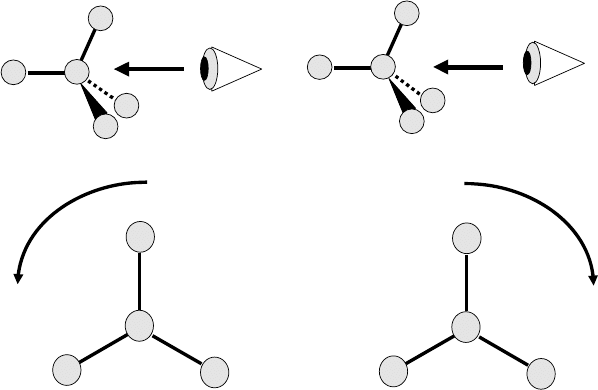
substituent. Once the priority has been assigned around the stereo-
center, the tetrahedral arrangement is viewed along the bond between the central
atom and the lowest priority (4) substituent (often a CH bond) from the opposite
side to the substituent (Figure 1.1). If the three other substituents are arranged
such that the path from 1 to 2 to 3 involves a clockwise rotation, the stereocenter is
labeled (R) (Latin rectus for right). By contrast, if the path involves an anticlockwise
rotation, the stereocenter is labeled (S) (Latin sinister for left). It is important to
note that the absolute stereochemistry cannot be predicted from the
L or D labels and
vice versa.
In nature, a remarkable, and so far unexplained, fact is that the amino acid building
blocks of all proteins are exclusively left-handed and that the sugars contained within
the double helix structure of DNA are exclusively right-handed. The consequences of
the chirality of living organisms are far reaching. The human sense of smell, for
example, is able to distinguish between pure (R)-limonene (smelling of oranges) and
(S)-limonene (smelling of lemons). More significantly, two enantiomeric forms of an
organic molecule can have different physiological effects on human body. In many
cases, one enantiomer is the active component while the opposite enantiomer has no
effect (e.g., ibuprofen where the (S)-enantiomer is active). However, often the two
enantiomers have dramatically different effects. Forexample, (S)-methamphetamine
2
j
1 Chirality at Metal Surfaces
is a psychostimulant while (R)-methamphetamine is the active ingredient in many
nasal decongestants (Figure 1.2).
In the pharmaceutical industry, about half of all of the new drugs being tested
require the production of exclusively one enantiomeric product. Thermodynamically,
this is a challenging problem since the two isolated enantiomers have identical Gibbs
energies; the reaction from prochiral reagent to product should therefore result in a
50 : 50 (racemic) mixture at equilibrium. To skew the reaction pathway to form one
product with close to 100% enantioselectivity is nontrivial. Knowles [2], Noyori [3],
and Sharpless [4] were awarded the Nobel Prize in Chemistry in 2001 for developing
enantioselective homogeneous catalysts capable of producing chiral molecules on an
industrial scale. Typically, these catalysts consist of organometallic complexes with
chiral ligands. Access to the metal center by the reagent is strongly sterically
influenced by the chiral ligands resulting in preferential formation of one enantio-
meric product. There are many potential advantages of using heterogeneous cata-
lysts, not least the ease of separation of the catalyst from the products. However,
despite extensive research over several decades, relatively few successful catalysts
have been synthesized on a laboratory scale and the impact on industrial catalysis is
essentially negligible. One of the primary motivations behind surface science studies
of chirality at surfaces is to understand the surface chemistry underpinning chiral
catalysis and to develop methodologies for the rational design of chiral catalysts.
Similarly, those interested in issues related to the origin of life are investigating the
possibility that surfaces were responsible for the initial seeding of the chiral building
blocks of life and that, presumably via some chiral amplification effects, this ledto the
overwhelming dominance of left-handed amino acids and right-handed sugars in
1
3
2
4
1
2
3
4
1
3
2
1
2
3
(S)
(R)
Figure 1.1 Schematic diagram explaining the
Cahn–Ingold–Prelog convention for determining the absolute
stereochemistry of a chiral molecule.
1.1 Introduction
j
3