
Bowker M., Davies P.R. (Eds.) Scanning Tunneling Microscopy in Surface Science, Nanoscience and Catalysis
Подождите немного. Документ загружается.

stepped single-crystal surfaces were used to make the role of monoatomic high steps
in the substrate visible [57]. Likewise, surfaces with a regular roughness, that is,
surfaces covered with islands or clusters of a narrow size distribution, may serve as
model systems, for which size-reactivity relations can be derived.
The application of oxidation–reduction cycles, repetitively applied to an electrode
to create rough or facetted surfaces, has a long tradition in electrochemistry [58–62].
Particularly worth noting are the works of Arvia and his group [59, 60], in which
faceting of polycrystalline Pt by ultrafast potential cycling has been described. It was
shown that cycling in the kHz-region for an extended period of time (typically for
about 1 h) caused either (1 1 1)- or (1 0 0)-type of facets to grow, depending on the
negative and positive potential limits.
In a systematic study on the influence of conventional ORCs, that is, with scan rates
on the order of 10–100 mV s
1
, on the surface structure of Au(1 1 1), it was
demonstrated that slow potential cycling from the oxide formation region back to
the reduced state caused monoatomic deep holes in the surface, whereas fast cycling
or potential stepping led to clusters on the surface in addition to the holes [63].
The place exchange between metal and oxygen during oxide formation leads to metal
adatoms on the surface upon oxide reduction. In the first case (slow potential cycling),
the adatoms apparently are given enough time to be incorporated at nearby monoa-
tomic high steps of the substrate (the Ehrlich–Schwoebel barrier would prevent
them to fall into the advacancies), whereas the advacancies condense to vacancy
islands (holes that are visible in STM images). Fast oxide reduction, for example, due
to potential stepping leads to cluster formation on flat terraces because of the quickly
established large supersaturation potential.
Repetitive potential cycling or stepping enhances the above-described effect and
surface roughnesses emerge that should be of interest in the study of model catalysts.
It has been demonstrated for gold that specifically adsorbing ions such as Cl
drastically enhance surface diffusion, which is the basis of the so-called electro-
chemical annealing [64, 65]. Hence, by selecting the appropriate parameters for the
ORC and choosing the right electrolyte composition, a tailoring of surface roughness
seems feasible. Figure 5.14 shows the STM image of an originally flat Au(1 1 1)
terrace, which was subjected to 100 potential cycles at 100 mV s
1
between 0.7 and
1.3 V versus SCE in 0.1 M H
2
SO
4
. The clusters have an average height of six–eight
layers (K
€
ontje et al., in preparation).
5.4.2
Surface Modification by an STM: An Overview
Inspired by the amazing successes of surface scientists in nanostructuring
surfaces with the tip of an STM, albeit at UHV conditions and often at low
temperatures [66–68], electrochemists began to use an STM or AFM as a tool for
nanostructuring electrode surfaces, most ly by spatially con fined metal deposition.
Figure 5.15 summarizes the various routes, which are currently employed in the
community for electrochemical nanostruct uring. In the f ollowing, we shall b riefly
address seven of them, a nd devote a separate chapter to the case sketched in
134
j
5 Characterization and Modification of Electrode Surfaces by In Situ STM
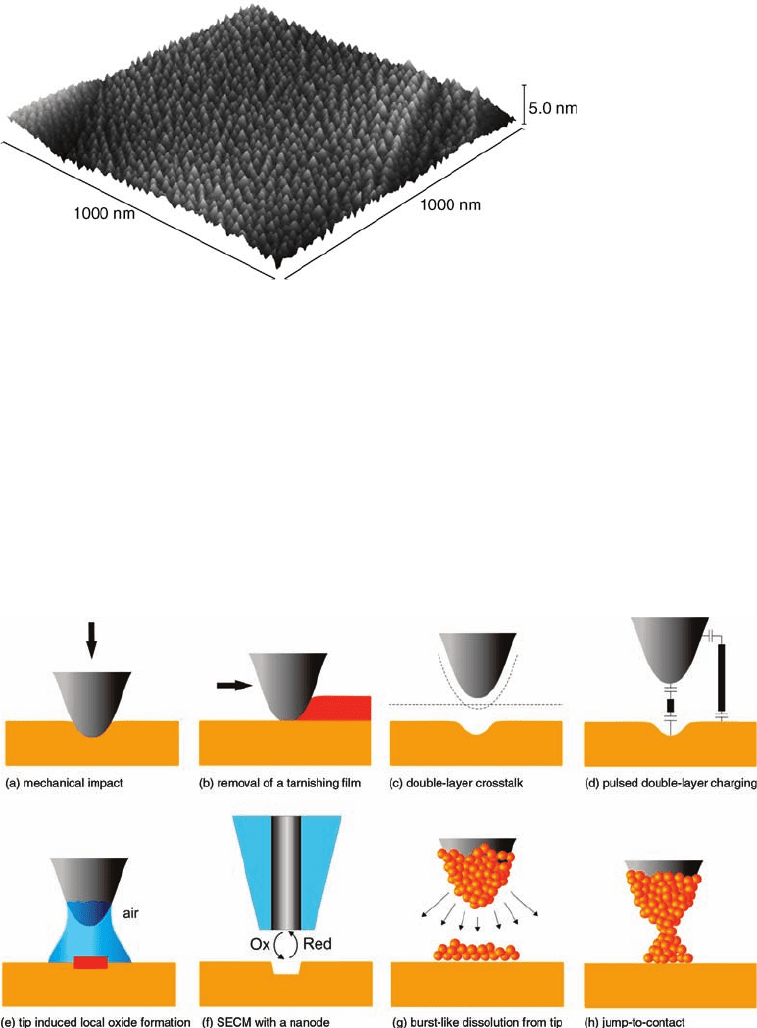
Figure 5.15h because this approach is intensively pursued in the authors
laboratory.
The first successful attempts of electrochemical nanostructuring, pioneered by
Penner et al. [69], involved the generation of surface defects by the tip at predeter-
mined positions, which were created either by a mechanical contact between tip and
substrate (tip crash) or by some sort of sputtering process, initiated by high-voltage
Figure 5.15 Various approaches to electrochemical nano-
structuring with an STM, currently employed by the community.
Figure 5.14 STM image of a Au(1 1 1) electrode, roughened
by about 100 oxidation–reduction cycles at 100 mV s
1
in 0.1 M
H
2
SO
4
. Cycling between 0.7 and 1.3 V versus SCE. Image taken
at þ0.05 V versus SCE. (Reproduced with permission from
K
€
ontje et al., in preparation.)
5.4 Strategies for Nanostructuring Surfaces
j
135
pulses applied to the tip [70]. These artificially created defects then acted as very
effective nucleation centers for metal deposition, which allowed the decoration of
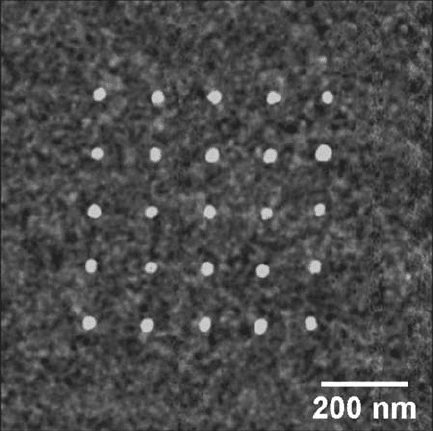
electrode surfaces by metal clusters on a nanometer scale (Figure 5.15a). While in the
beginning, this technique had been applied almost exclusively to metal substrates,
studies were extended more recently to semiconductor surfaces. Impressive exam-
ples of patterned nanostructures made of metals such as Cu, Ag, or Au on silicon
wafers were given by Homma et al. [71, 72]. In those cases, however, the defects that
acted as nucleation centers were generally made by a nanoindentation process via
an AFM tip (Figure 5.16).
A slightly different approach to spatially confined metal deposition, which is less
harmful to the substrate, is sketched in Figure 5.15b. It is the local removal of an
overlayer that causes a high overpotential for metal deposition. By choosing an
electrode potential slightly negative of the Nernst potential, where no metal depo-
sition will take place on top of the overlayer, deposition will immediately set in upon
removal of the tarnishing film by the tip of an STM or AFM sliding across the surface,
at the freed portion of the surface only. The applicability of this approach has been
demonstrated in an AFM study for Cu deposition onto an oxide-covered Cu
surface [73] and in an STM study for Cu deposition onto Au(1 1 1) covered by a
monolayer of sodium dodecyl sulfate (SDS) [74]. Although the precision of the metal
nanostructures generated in such a way was far from being satisfactory [74], this
method again reveals the potential of decorating semiconductor surfaces with
metal nanostructures, while so far the studies have been restricted to metal on
Figure 5.16 Tapping-mode AFM image of a 25 Cu nanodot array
on H-terminated p-Si(1 0 0), formed by nanoindentation.
(Reproduced with permission from Ref. [72].)
136
j
5 Characterization and Modification of Electrode Surfaces by In Situ STM
metal. This, however, will require suitable, preferably organic molecules, which will
adsorb strongly enough on the semiconductor electrode to form a dense monolayer
with sufficient inhibition for metal deposition, but which can be removed by the tip
without damaging the substrate.
An obvious way of generating metal structures of nanometer dimensions via an
STM tip is sketched in Figure 5.15g: It is the burst-like dissolution of metal from the
tip, onto which it had been deposited from solution, and the redeposition onto the
substrate within a narrow region directly underneath the tip [75]. In a systematic
study by Schindler et al., it was demonstrated how to achieve redeposition of the
metal dissolved from the tip and at the same time prevent metal deposition from
solution onto the substrate directly [76]. The key lies in the momentarily high metal
ion concentration after the sudden metal dissolution at the tip that causes a more
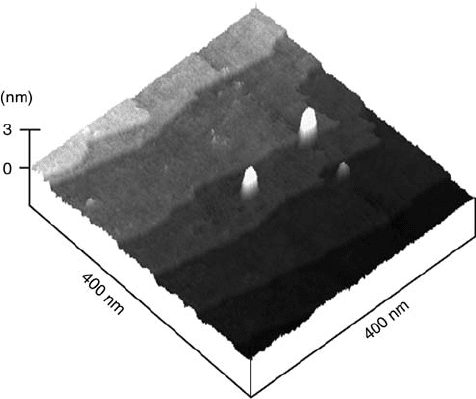
positive Nernst potential for the surface region underneath the tip. Figure 5.17 shows
the STM image of two Pb clusters, about 3 nm in height, generated by the burst-
like dissolution of Pb from the STM tip and by redeposition onto H-terminated
n-Si(1 1 1) [77]. The potential of this technique lies in the ability to decorate
semiconductor surfaces with metal clusters.
A conceptually different approach to nanostructuring electrode surfaces by tip-
generated metal clusters is sketched in Figure 5.15h. This approach, which facil-
itates a so-called jump-to-contact between tip and substrate for generating metal
clusters, has been developed by our group and will be described in more detail in
Section 5.4.3.
Figure 5.17 STM image of H-terminated n-Si(1 1 1) in 0.1 M
HClO
4
þ 1 mM Pb(ClO
4
)
2
, onto which two Pb clusters have been
deposited by a burst-like dissolution of Pb from the STM tip.
(Reproduced with permission from Ref. [77].)
5.4 Strategies for Nanostructuring Surfaces
j
137
The remaining methods sketched in Figure 5.15 either deal with spatially confined
oxidation/dissolution of the substrate or describe means of studying electrochemical
reactions on a nanometer scale.
We will first refer to what could be termed as double-layer crosstalk (Figure 5.15c).
As mentioned already in Section 5.2.3, commonly employed tunnel parameters for
imaging (e.g., I
T
¼2 nA and U
T
¼50 mV) lead to tip–substrate distances around
0.6 nm. This implies that the double layers of tip and substrate begin to merge, and
the assumption of a noninteracting tip is no longer valid. For example, the close
proximity of the tip may cause a change in potential for the imaged area directly
underneath the tip because direct contact with the reference electrode is lost. It was
demonstrated that spatially confined copper dissolution directly underneath the tip
can be achieved by applying to the tip a potential positive of the Cu/Cu
2 þ
reversible
potential E
0
, despite the fact that the sample potential was held clearly negative of
E
0
[30]. Hence, copper was oxidatively dissolved by a tip–sample interaction under-
neath the tip and there only, although this process should not be possible at that
sample potential. Later, this double-layer crosstalk was used to selectively dissolve Ag
overlayers [78], demonstrating that this tip-induced metal dissolution is by no means
restricted to Cu only as has been claimed in the literature [79]. It was also shown [30]
that there is actually a smooth transition between imaging without much tip
interference and tip-induced surface processing. Depending on the potentials of
tip and sample, the following three regimes could be distinguished: (1) tip-enhanced
copper deposition; (2) mere surface imaging; and (3) tip-induced copper dissolution.
In several publications, Schuster and coworkers have shown the use of STM tips
(or other thin metal wires) as tools for electrochemical machining of electrode
surfaces on a micrometer scale [80–82]. Spatially confined etching was achieved by
applying nanosecond voltage pulses between tool and sample making use of the
vastly different time constants for double-layer charging for different parts of the tool.
As is sketched in Figure 5.15d, the variation of the time constant t ¼RC for double-
layer charging is solely due to the electrolyte resistance R, which increases tremen-
dously when comparing that part of the tip (or tool) next to the sample surface with
those higher up parts. The voltage pulse duration is now chosen in such a way that
only for the forefront of the tool, that is, in a spatially very defined region, an electrode
potential is established at the sample surface large enough for oxidative dissolution.
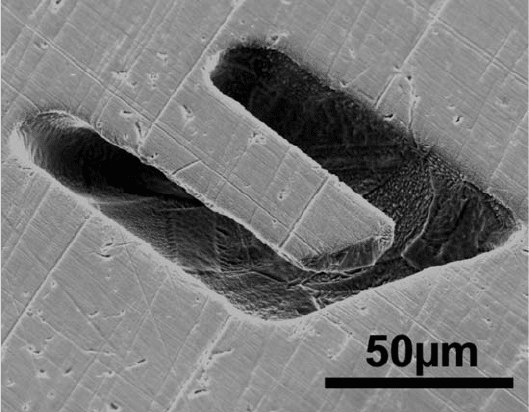
In a series of impressive images, the viability of this route to electrochemical micro-
and nanostructuring has been demonstrated (Figure 5.18).
A clever design for local oxide formation on silicon surfaces is depicted in
Figure 5.15e. Operation of an STM in humid air leads to a neck of liquid due to
capillary forces. Applying a voltage between tip and sample will trigger simple
electrochemical processes in such a miniature electrochemical cell. Avouris et al.
have used this method for pattering a Si surface with oxide [83].
The creation of nanostructured surfaces is one thing, the study of electrochemical
reactions on such nanostructures is another one. Especially in electrocatalysis, where
size effects on reactivity are often discussed, there have been attempts to use the tip of
an STM as a detector electrode for reaction products from, say, catalytically active
metal nanoclusters [84]. However, such ring-disk-type approaches are questionable,
138
j
5 Characterization and Modification of Electrode Surfaces by In Situ STM
when it comes to a quantitative analysis because of the ill-defined (if not to say
unknown) geometry of the tip, which does not allow reliable mass transport
calculations. On the other hand, scanning electrochemical microscopy has
been demonstrated to ideally fulfill all these requirements, albeit on a micrometer
scale [85, 86]. A major breakthrough in applying SECM for nanostructuring was
achieved by Heinze and coworkers [87, 88], who developed Pt nanodes with active
diameters down to 20 nm and glass insulation around them that ensure defined
diffusion conditions, which are essential for a quantitative evaluation of reaction rates
(Figure 5.15f). The potential of SECM for electrocatalytic studies on a nanoscale may
even exceed that of the STM, provided the miniaturization of the electrodes will
routinely reach the nanometer length scale. For a recent review, see Ref. [6].
5.4.3
Metal Nanocluster Deposition via Jump-to-Contact
Most of the work on nanostructuring electrode surfaces, which can be found in the
literature, deals with the deposition of small metal clusters at predetermined
positions. Over the years, we have developed a technique that is based on the
jump-to-contact between tip and substrate [89] (Figure 5.15h) and that allows the
formation of metal clusters in quick succession and without destroying the single
crystallinity of the substrate. The principle behind this method is sketched in
Figure 5.19 [90, 92]: By applying an electrode potential to the STM tip that is slightly
Figure 5.18 Scanning electron microscopy image of a
microcantilever, electromachined into a stainless steel sheet by
ultrashort voltage pulses (100 ns, 2 V, 1 MHz repetition rate) in
3 M HCl þ 6 M HF. The tool electrode was a tiny loop of a 10 mm
thick Pt wire. (Reproduced with permission from Ref. [80].)
5.4 Strategies for Nanostructuring Surfaces
j
139
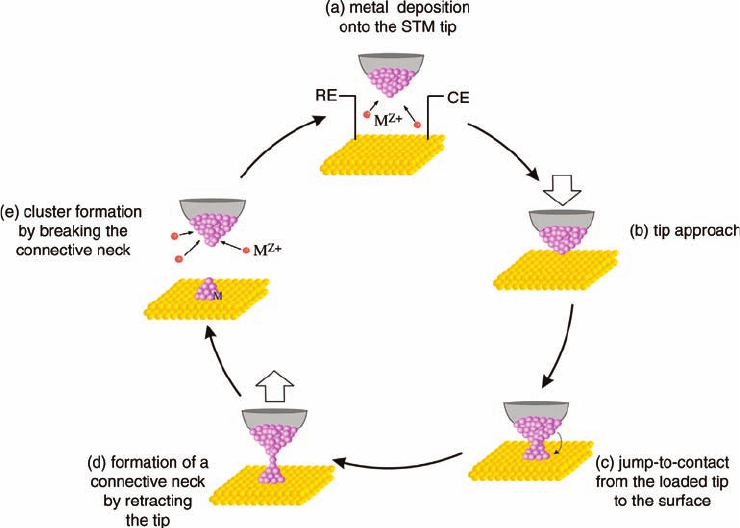
Figure 5.19 Schematic diagram for continuous cluster generation
by the tip of an STM via jump-to-contact.
negative of the bulk deposition potential for the metal ions in solution, metal is
deposited from the electrolyte onto the tip. Then, the metal-loaded tip is made to
approach the surface close enough so that the jump-to-contact can occur.This leads to
the formation of a connective neck, a metal bridge between tip and substrate, which
will break upon the subsequent retreat of the tip, leaving a small metal cluster on the
substrate surface. The tip is automatically reloaded because of the ongoing metal
deposition and hence is ready for the next cluster formation.
The jump-to-contact requires an approach of the tip down to about 0.3 nm tunnel
gap, which must be externally controlled. Actually, in our case all three spatial
coordinates of the tip are externally controlled by a microprocessor, which makes the
nanodecoration of an electrode surface with metal clusters a fully automated process,
allowing even complex patterns to be fabricated rapidly and reproducibly. Two
examples of tip-induced cluster formation are given in Figure 5.20, both referring
to Cu on Au(1 1 1) in sulfuric acid solution [93]. Image (a) shows a circle of 12 Cu
clusters on Au(1 1 1), all 0.8 nm in height. The pattern in image (b) not only proves the
feasibility of complex structure formation but also demonstrates that monoatomic
high steps in the substrate surface are no obstacles for nanostructuring, as the
feedback control of the STM is not switched off. Although we have described various
aspects of this method in a number of publications [91, 92], some technical details are
briefly mentioned again for the sake of convenience:
140
j
5 Characterization and Modification of Electrode Surfaces by In Situ STM
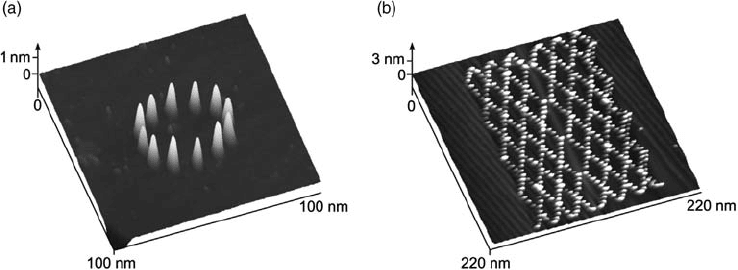
Figure 5.20 Two examples for the nanodecoration of a Au(1 1 1)
electrode by tip-generated Cu clusters. Electrolyte: 0.05 M
H
2
SO
4
þ 1 mM CuSO
4
. (Reproduced with permission from
Refs [90, 93].)
.
If metal deposition is fast (as in the case of Cu in sulfuric acid solution), cluster
generation can be performed at kHz rates. Obtaining an array of 10 000 Cu clusters
on Au(1 1 1) takes a couple of minutes [15]. Typical parameters are 10–20 ms pulses
at a rate of 50–80 Hz.
.
Despite cluster formation via the STM tip, the imaging quality of the latter
surprisingly remains high. Hence, writing and reading is possible with one and
the same tip.
.
The cluster size can be varied at will within a given range by changing the tip
approach, the latter being controlled externally. Variation of cluster size with tip
approach has been demonstrated for several metals on Au(1 1 1) [92, 94, 95].
.
The high stability of the metal clusters allows one to hold the sample potential
slightly positive of the Nernst potential, typically at þ10 mV versus Cu/Cu
2 þ
in
the case of copper. Thus, normal electrodeposition onto the sample directly
from solution is prevented, whereas the tip-generated Cu clusters remain on the
surface [96].
.
Depending on the cohesive energies of cluster and substrate material, the jump-
to-contact occurs from the tip to the substrate (e.g., for Cu and a gold electrode) or
from the substrate to the tip (e.g., for Ni on the tip and a gold electrode) [93].
.
So far, more than a dozen systems have been investigated and tested for nano-
structuring [97]. While in the beginning most studies dealt with Cu clusters for
testing and developing the method, our more recent work focused on Pd clusters
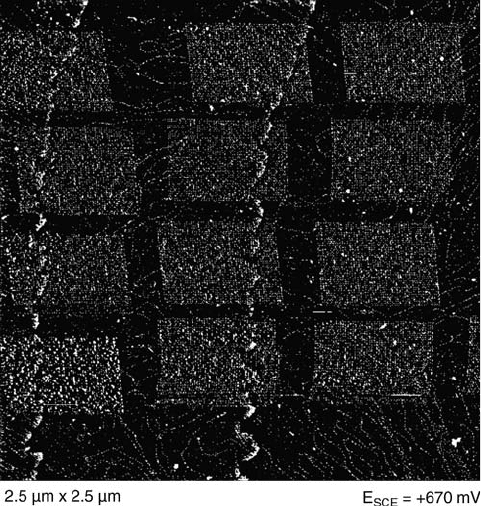
for electrocatalytic investigations. A Au(1 1 1) surface with 12 arrays, each contain-
ing 2500 Pd clusters, is shown in Figure 5.21. Although such seemingly very large
number of clusters are not sufficient for characterization by ordinary cyclic
voltammetry, there may be a good chance to do so with an SECM, using a nanode
that matches the cluster field in dimension.
5.4 Strategies for Nanostructuring Surfaces
j
141
Two aspects deserve particular mention as they are of great practical relevance.
The first deals with the unexpectedly high stability of the tip-generated clusters
against anodic dissolution, which was briefly addressed above [96]. This is again
demonstrated for Cu clusters on Au(1 1 1) in Figure 5.22, where the height of a tip-
generated cluster is shown as a function of potential, as the latter is scanned from
þ10 mV versus Cu/Cu
2 þ
to þ250 mV. While bulk Cu would be quickly dissolved
at an overpotential of 10 mV, and Cu upd is completely desorbed at þ250 mV, the
Cu cluster is still seen to exist, albeit at reduced height. Note that this information
was obtained by scanning the tip in x-direction at constant y-position. Hence, a
falsification of the potential values caused by possible tip-shielding effects can be
ruled out. Although a reasonable explanation of the high cluster stability still has to be
found, alloy formation as an obvious cause can safely be ruled out: Cluster dissolution
brings back a perfectly flat, bare surface (see STM images in Figure 5.22 before and
after anodic cluster dissolution [93]), whereas monoatomic deep holes are generally
found on the surface for those cases where clusters did form an alloy with the
substrate. The second aspect deals with room-temperature salt melts, the so-called
ionic liquids (ILs), which open up many new and interesting perspectives for
electrochemical studies [98]. The main advantage of ILs over aqueous solutions is
their extremely wide stability range of almost 4 V, which has to be compared with the
1.23 V for water. Hence, electrodeposition of very unnoble, that is, reactive metals
Figure 5.21 STM image of 12 cluster fields on Au(1 1 1), each field
containing 2500 Pd clusters. Electrolyte: 0.1 M H
2
SO
4
þ 1mM
PdSO
4
.
142
j
5 Characterization and Modification of Electrode Surfaces by In Situ STM
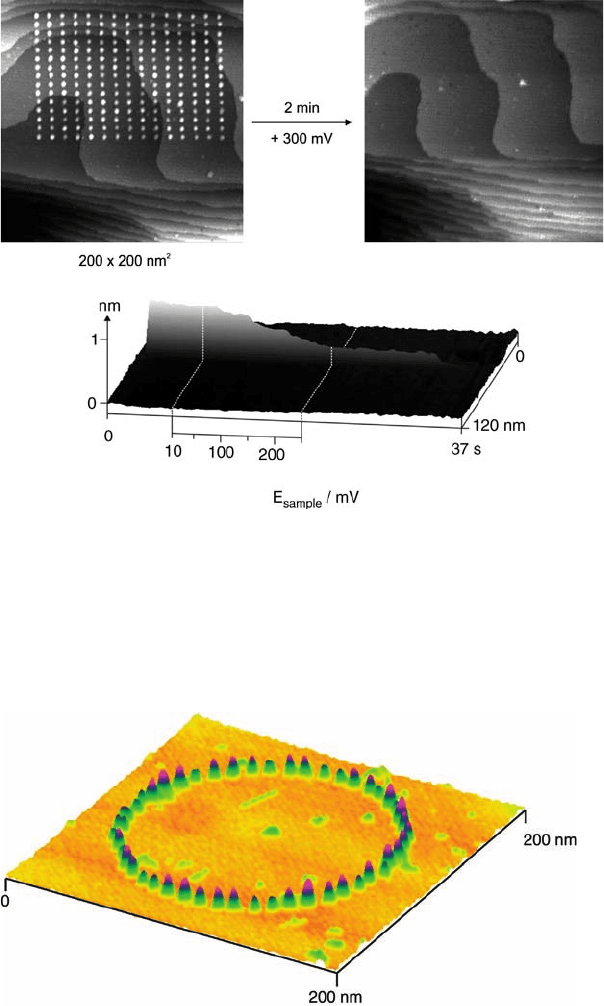
Figure 5.23 Ring of 48 tip-generated Fe clusters on Au(1 1 1)
in 1-butyl-3-methyl-imidazolium BF
4
þ approximately 50 mM
FeCl
3
. (Reproduced with permission from Ref. [95].)
Figure 5.22 (a) STM image of an array of 225 tip-generated
Cu clusters on Au(1 1 1) in 0.05 M H
2
SO
4
þ 0.1 mM CuSO
4
.
(b) Same area, but after dissolution of the Cu clusters at þ300 mV
versus SCE. (c) Height of a single tip-generated Cu cluster as a
function of potential and time, demonstrating the unusually
high stability of the cluster against anodic dissolution.
(Reproduced with permission from Ref. [93].)
5.4 Strategies for Nanostructuring Surfaces
j
143