
Bowker M., Davies P.R. (Eds.) Scanning Tunneling Microscopy in Surface Science, Nanoscience and Catalysis
Подождите немного. Документ загружается.

biological systems on Earth. As such, the surface chemistry of chiral solids, chiral
amplification, and chiral recognition are all important subtopics of chiral surface
science. STM has proved to be the single most important tool of researchers in this
field.
1.2
Surface Chirality Following Molecular Adsorption
1.2.1
Achiral Molecules on Achiral Surfaces
When a molecule is adsorbed on a surface, the symmetry of the combined
adsorbate–substrate system is very likely to be reduced compared to that of the
isolated gas-phase species or the bare adsorption site. This raises the possibility that,
if mirror planes present in the isolated achiral molecule and those at the relevant
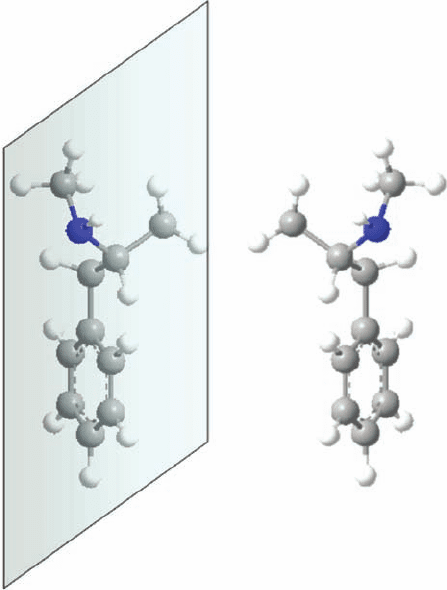
Figure 1.2 The two mirror equivalent forms of the drug
methamphetamine. On the right is shown the (S)-form of the
molecule; on the left is the (R)-enantiomer.
4
j
1 Chirality at Metal Surfaces
adsorption site of the clean surface are not coincident, then the combined system of a
single adsorbed molecule and the substrate will be locally chiral; that is, mirror planes
of the isolated molecule are lost on adsorption and chirality is induced by the
adsorption process. Note that a center of symmetry, also capable of ensuring
superimposability of an object and its mirror image, is necessarily incompatible
with the presence of a nearby surface [5]. A commonly observed case of such
adsorption-induced chirality is that of a planar molecule with C
s
symmetry (a single
mirror plane) in the gas phase adsorbing on a surface such that the molecular plane is
parallel to the substrate, as favored, for example, by van der Waals (vdW) interactions,
thereby destroying the mirror plane symmetry. The molecule can then exist in two
enantiomeric forms, although necessarily as a racemic mixture in the absence of
any other influences that might lead to a preference of one rather than the other.
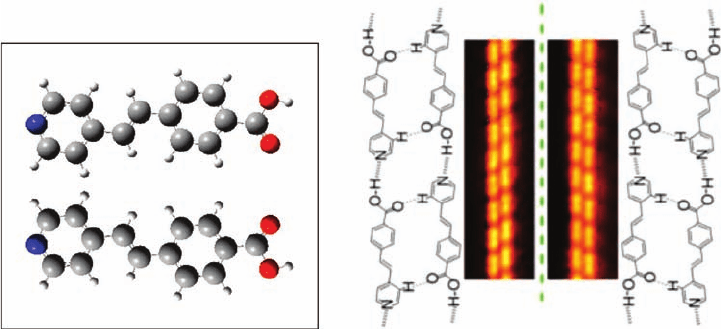
Figure 1.3 illustrates this possibility for 4-[trans-2-(pyrid-4-yl-vinyl)]benzoic acid
(PVBA) adsorbed parallel to an idealized, unstructured surface [6]
Interconversion of the two enantiomers is possible only if the molecule is removed
from the surface and rotated by 180
around an axis parallel to the substrate surface.
In the case of PVBA adsorbed on Ag{1 1 1}, hydrogen bonding leads to a preference
for homochiral double chains based on head-to-tail NHO bonds and a C
2
axis
relating the two strands of the chains. The chirality of the chain can be recognized in
the STM images by the stagger of one strand relative to the other that arises from
CHO bonds, as shown in Figure 1.3 [6].
The example described above is that of the separation of enantiomers into 1D
chains following adsorption-induced chirality. In addition to forming chirally seg-
Figure 1.3 Molecular models showing the two enantiomers
resulting from the loss of mirror plane symmetry on adsorption
with the molecular plane parallel to the substrate. The separation
of enantiomers observed by STM is identified by the relative
displacement of adjacent monomers within the double chain.
(Reprinted with permission from Ref. [6]. Copyright 2001,
American Physical Society.)
1.2 Surface Chirality Following Molecular Adsorption
j
5
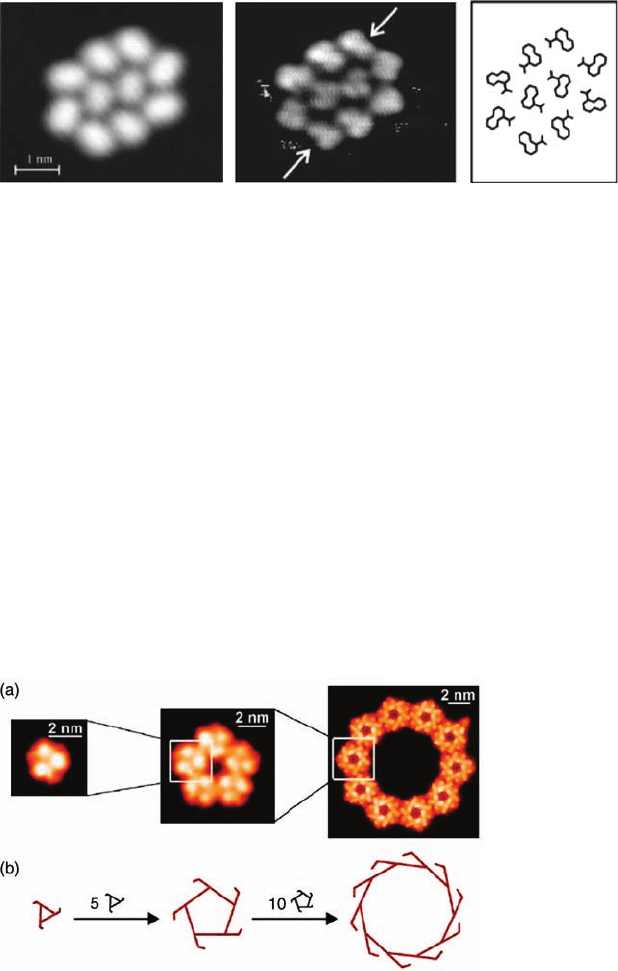
regated chains, 1-nitronaphthalene is able to form chiral decamers [7]. Figure 1.4
shows a cluster of ten 1-nitronapthalene molecules [8]. The adsorption process on Au
{1 1 1} imposes chirality on the molecule and the clusters can be seen to have a
pinwheel, chiral conformation, although within the cluster not all the individual
molecules have the same handedness. Each cluster contains six molecules of one
enantiomer and four of the other. The overall surface is expected to be racemic as
regard to both molecules and clusters.
A particularly elegant example of cluster formation involving chiral recognition
and retention of chirality through an increasingly complex hierarchical series of
clusters is that of rubrene on Au{1 1 1} [9] illustrated in Figure 1.5
The above discussion refers to the loss of mirror symmetry on adsorption leading
to chirality at the level of the individual molecule. It is also common for oblique
lattices to be formed following molecular adsorption, hence global chirality, even
Figure 1.4 Low- and high-resolution STM images of a decamer of
1-nitronaphthalene, together with the minimum structure
optimized from a force model, showing individual enantiomers in
a 6 : 4 ratio. (Reprinted with permission from Ref. [7]. Copyright
1999, American Physical Society.)
Figure 1.5 (a) Hierarchy of clusters of rubrene on Au{1 1 1},
showing the evolution from trimers to pentamers of trimers and
eventually 150 molecules per cluster as a decamer of the
pentamers. (b) Illustration of the preservation of chirality through
the hierarchy. (Adapted with permission from Ref. [9]).
6
j
1 Chirality at Metal Surfaces
when the local site retains one or more mirror planes. A speci fic example of the
relationship between local and organizational chirality for a highly symmetric
molecule is discussed in some detail in Section 1.2.2.
It is relevant at this point to note that chemistry frequently employs a rather weaker,
arguably less precise, definition of chirality than the more mathematical definition
put forward by Lord Kelvin. A species, which in its most stable conformation has no
mirror plane or center of symmetry, is formally chiral but, if there were a low-energy
pathway to the enantiomer, for example, by a low-frequency vibrational mode, then,
in chemical terminology, this would not normally be considered to be chiral.
However, if adsorption of such a species raises the frequency of the vibration
substantially, then the energy barrier between the two enantiomers may become
chemically significant such that the adsorbed molecule is meaningfully described as
chiral. An early example of this is the case of the deprotonated glycine species
adsorbed on copper surfaces. An isolated glycinate anion, although lacking any
mirror plane or center of symmetry, is nevertheless readily converted to its enan-
tiomer principally by a rotation around the CN bond, with an energy barrier of
approximately 35 kJ mol
1
, which might readily be overcome at room temperature,
such that glycine or glycinate are not generally considered chiral. However, on
Cu{1 1 0}, for example, adsorption takes place through both O atoms and the N atom
in a tridentate interaction with the copper surface, each atom in an approximately
atop site [10, 11]. This inhibits the interconversion of enantiomers, and surface-
induced chirality leads to distinct mirror image species on the surface [12]. Never-
theless, unlike the examples discussed above, segregation of enantiomers into
clusters, chains, or arrays does not occur. Instead, one molecule of each enantiomer
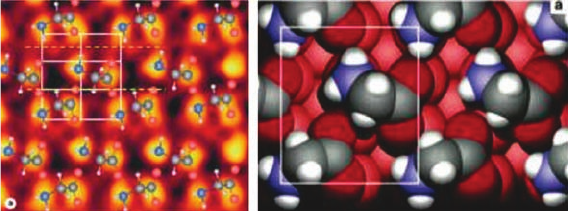
gives rise to a heterochiral (3 2) unit cell and is interrelated by glide lines as shown
in Figure 1.6. This proposal based on LEED, STM, and IR data [10] has been
confirmed by photoelectron diffraction [11] and by DFT calculations [13]. A sugges-
tion that a second phase consists of homochiral unit cells [12] has not been confirmed
by photoelectron diffraction [11, 14] or theory, although the energy difference of this
Figure 1.6 The left-hand panel shows a
molecular model of the glycinate/Cu{1 1 0}
structure with both enantiomers present in the
heterochiral (3 2) unit cell, superimposed on
an STM image of this surface. (Adapted with
permission from Ref. [12]. Copyright 2002,
Elsevier.) The right-hand panel shows the
confirmation of this structure calculated by DFT,
clearly indicating the atop adsorption sites
occupied by the N and both O atoms in this
system. (Reprinted with permission from
Ref. [13]. Copyright 2004, Elsevier.)
1.2 Surface Chirality Following Molecular Adsorption
j
7
phase is calculated to be small (6 kJ mol
1
) [13]. It is likely that the different phases
imaged by STM [12] result from the two rotational domains of the heterochiral
structure appearing distinct because of anisotropy in the tip. Interestingly, intrin-
sically chiral amino acids such as alanine or phenylglycine can adsorb on the
Cu{1 1 0} surface also in a (3 2) structure with an apparent glide line indicated
by the LEED pattern, although only a single enantiomer is present [15–17].
1.2.2
Lattice Matching
It would seem inherently unlikely that a highly symmetric (D
6h
) molecule such as
coronene, C
24
H
12
, could give rise to chiral surfaces and indeed diastereoisomeric
interactions, particularly when adsorbed on a hexagonal substrate such as graphite or
an fcc{1 1 1} face. Nevertheless, we show in this section that lattice matching between
an adsorbate overlayer and the substrate can readily give rise to surface chirality, and
while this might be unsurprising in systems of lower symmetry, it is still distinctly
likely in adsorbate/substrate systems in which both components have inherently
high symmetry. To emphasize this aspect, we choose coronene and a related
derivative to illustrate how these effects arise from simple interadsorbate interactions
and their simple geometric consequences. To simplify matters further, we restrict the
adsorption of coronene and its analogues to atop adsorption sites, where symmetry
matching with a hexagonal fcc substrate (also locally D
6h
) would seem to be
optimized.
Nondissociative adsorption of coronene on a late transition or coinage metal is
likely to be dominated by van der Waals interactions and rather weak p–d interac-
tions, both of which favor a flat-lying and probably atop adsorption geometry again
optimizing the symmetry matching. Although relatively weak, these interactions are
strong enough to permit stable monolayers to be formed in UHV at room temper-
ature. Interactions between adsorbed coronene molecules are highly isotropic and
again dominated by vdW terms. These, therefore, favor hexagonal close packing in an
isolated (no substrate) monolayer of planar coronene molecules. Nevertheless,
despite all the apparent symmetry matching, it is the subtle energy balance between
interadsorbate interactions and those favoring a specific adsorption site, even an atop
one, that gives rise to chiral structures and diastereoisomeric effects.
Coronene (Figure 1.7a), considered as a circle, has a vdW diameter of 11.6 A
, which
corresponds to a molecular area of 105.7 A
2
and leads, with hexagonal but non-space
filling close packing, to a unit cell area of 116.5 A
2
. However, coronene on some
hexagonal surfaces has an intermolecular separation somewhat less than 11.6 A
, for
example, 11.27 A
[18] on graphite and 11.18 A
on MoS
2
[19], suggesting that it is better
considered as having a hexagonal, space filling shape with a vdW width of 11.26 A
.
Even this, however, is insufficient to rationalize the intermolecular separations found
on other, admittedly nonhexagonal, surfaces such as Cu{1 0 0} [19] and Cu{1 1 0} [20].
In such systems, intermolecular spacings significantly less than 11 A
can be found.
The explanation, while retaining a flat-lying coronene molecule, since there is no
evidence to the contrary, lies in recognizing that the 12 H atoms are almost equally
8
j
1 Chirality at Metal Surfaces
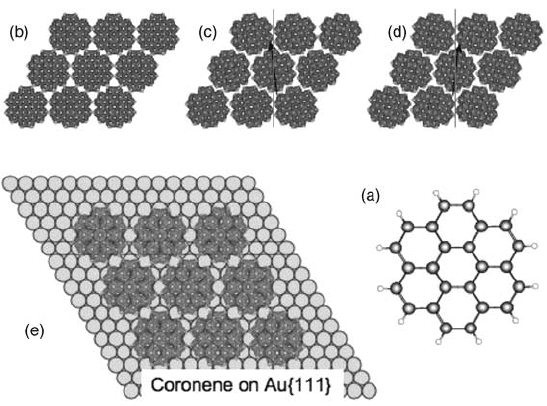
spaced around the periphery of the molecule and confer C
12
rotational symmetry on
the molecule. A concerted rotation of all molecules on the hexagonal lattice by 8.4
about their centers then allows interdigitation of the H atoms on neighboring
molecules (Figure 1.7c and d). This permits a 3% reduction of the intermolecular
spacing to around 10.9 A
. Herein lies one element of the surface chirality of this
molecule.
When the molecules on an isolated hexagonal lattice are rotated in concert away
from their initial positions to allow interdigitation and closer packing, the 2D site
symmetry is reduced, all mirror planes are lost, and the molecule becomes chiral
through the lack of mirror symmetry in the interactions with its neighbors. Rotation
to the left or right gives energetically equivalent enantiomers.
There is also a second source of chirality when the adsorbate hexagonal lattice is
matched with that of the substrate. For a hexagonal substrate, characterized by unit
cell vectors a
1
and a
2
aligned along close-packed directions, at 120
to each other and
of length a, there are larger hexagonal unit cells defined by unit cell vectors b
1
and b
2
,
where b
1
¼ma
1
þ na
2
and b
2
¼na
1
þ (m n)a
2
with m and n integers. These have
lengths b ¼aH(m
2
mn þ n
2
) and are rotated q ¼tan
1
(H3n/(2m n)) relative to
the substrate unit cell vectors. Many of the smaller ones, based on m and n values up
to 6, are familiar overlayers for atomic and molecular adsorbates on fcc{1 1 1}
substrates, for example, (H3 H3)R30
,(H7 H7)R19.1
, and so on. For those
overlayers where m ¼0, n,or2n, corresponding to rotations of 0
,60
, and 30
,
Figure 1.7 (a) Molecular model of coronene;
(b) hexagonal close packing at the van der
Waals diameter; parts (c) and (d) illustrate
the packing advantage, which can be obtained
by a concerted rotation, counterclockwise
or clockwise, of all molecules to allow
interdigitation of the CH bonds on adjacent
molecules; part (e) illustrates the (4 4) model
of coronene on Au{1 1 1} where the adsorption
site dominated separation of molecules is such
that interdigitation is unnecessary.
1.2 Surface Chirality Following Molecular Adsorption
j
9
respectively, the structure is achiral since a mirror plane is retained along either the
h110i or the h211i direction. Conversely, if this condition is not met, there is no
coincidence of mirror planes between the substrate and overlayer lattices: enantio-
meric structures will exist, for example, based on m, n being 3, 1 or 3, 2, that is,
(H7 H7)R19.1
and (H7 H7)R40.9
, respectively, or perhaps more helpfully
described as (H7 H7)R 19.1
. Lattice matching of this type giving rise to chiral
lattices is common in overlayers on hexagonal substrates, such as the pinwheel
structure found for Pd on (1 2) reconstructed TiO
2
{1 1 0} surfaces [21].
In the case of coronene adsorbed on either Ag{1 1 1} [22] or Au{1 1 1} [23, 24], an
achiral (4 4) structure is observed (Figure 1.7e). This is perhaps unsurprising since
this is the hexagonal superlattice that, with a lattice vector of approximately 11.5 A
,is
the closest match to the coronene dimensions. Although this lattice is achiral, it
demonstrates that the balance between interadsorbate interactions and those favor-
ing a specific adsorption site and hence a commensurate overlayer is important. In
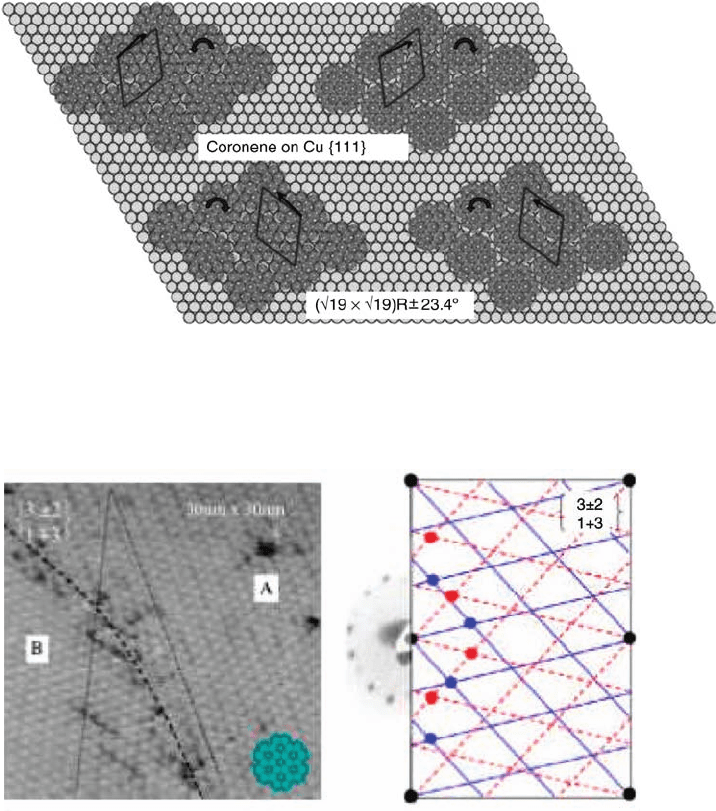
contrast, for adsorption of coronene on Cu{1 1 1}, a chiral lattice is predicted based on
either (H19 H19)R 23.4
or (H21 H21)R 10.9
lattices. The latter with a unit
cell vector of length 11.7 A
might be favored if site preference is strong relative to
intermolecular close packing but would not require the concerted rotation of
coronene molecules to reduce the intermolecular separation since this is below
even the circular diameter of coronene (11.6 A
). Chirality would be limited to that
derived solely from the lattice matching and molecules would be free to adopt
whatever rotation optimized the energy based on an atop local site geometry. Of
course, a twist away from a high-symmetry azimuthal orientation, which might be
clockwise or anticlockwise, introduces a second chiral element and hence the need to
consider diastereoisomerism. There are four possible choices of lattice/molecular
twist that might conveniently be designated þ/ þ, / for one pair of enantiomers
and þ/, / þ for the other pair. In principle, a particular sense of rotation could
favor a particular lattice orientation such that one pair is energetically more favorable
than the other. However, since intermolecular interactions are likely tobe weak at this
separation, the energy difference is likely to be small. This contrasts with the
situation if the former lattice, (H19 H19)R 23.4
, were preferred because of the
importance of intermolecular interactions. In this case, since the substrate imposed
lattice dimension is only 11.14 A
, molecular rotation imposed within the 2D
adsorbate lattice is required, with CH interdigitation to achieve this reduced
separation as shown in Figure 1.8. The second element of chirality is again a
molecular rotation but one that has its origin in the intermolecular interactions
rather than molecule–substrate site interactions. The energy preference between the
two diastereoisomer pairs is now dictated by which pair leads to the more favorable
orientation of the molecule on the atop adsorption site. Notable, perhaps, is that for
one diastereoisomer pair the azimuthal orientation of the molecule with respect to
the substrate is such that a local high symmetry is recovered because the lattice
rotation of 23
, combined with the optimum interdigitation rotation of 8
, realigns
the mirror planes of the molecule very closely (<2
) with those of the substrate. To our
knowledge, coronene adsorption on Cu{1 1 1} has not been studied, but clearly this
system would provide an interesting model for investigating the subtle energy
10
j
1 Chirality at Metal Surfaces
balance between coronene/coronene interactions and those determining coronene
orientation on an atop site.
On fcc {1 1 0} and {1 0 0} surfaces, pseudohexagonal lattices can be found [25].
Coronene adsorption on Cu{1 1 0} leads to a h3 2|13istructure and its enantiomer
h32|13i, shown in Figure 1.9, corresponding to a pseudohexagonal lattice with
Figure 1.8 Diastereoisomeric effects predicted to arise for
coronene adsorption on Cu{1 1 1} from a combination of
molecular rotation (curved arrows) within the 2D adsorbate lattice
to allow CH bond interdigitation and the (H19 H19)R 23.4
lattice. The black arrows indicate a high symmetry within the
molecule bisecting CH bonds.
Figure 1.9 UHV-STM image of coronene adsorbed on Cu{1 1 0}
showing the two mirror domains A and B. On the right, the
LEED pattern showing the contribution of the mirror domains.
(Adapted with permission from Ref. [20]. Copyright 2007, IOP
Publishing Ltd and Deutsche Physikalische Gesellschaft.)
1.2 Surface Chirality Following Molecular Adsorption
j
11
nearest-neighbor distances of H17a, H18a, and H19a. Interestingly, it is predicted
that the distortion to a pseudohexagonal lattice creates a second element of chirality in
the isolated adsorbate monolayer along with the rotation of the molecule that allows
interdigitation. Two diastereoisomer pairs therefore exist within this monolayer even
in the absence of the substrate due to the coupling of the two possible directions of
rotation and the sense of the sequence of distortions around the hexagon, although of
course it is not strictly independent of the substrate since it is the mapping onto the
substrate that determines this sequence and the mirror lattice has the mirror
sequence of distortion. On Cu{1 0 0}, the structure of adsorbed coronene was
originally suggested to be rotational, achiral domains of p(4 7), but that would
require an extremely short intermolecular separation of 10.2 A
and a very small unit
cell of only 91.4 A
[2, 19]. A more likely interpretation of the LEED is that the structure
corresponds tothe pseudohexagonal, but still achiral, lattice with nearest neighbors at
H17a, H17a, and H18a [25].
The most well-characterized example of the interplay between these various chiral
elements, which can arise in molecular adsorption in a constrained pseudohexagonal
lattice, is that of 2,5,8,11,14,17-hexa-tert-butylhexabenzo[bc,ef,hi,kl,no,qr]coronene
(HtB-HBC), on Cu{1 1 0} [26]. HtB-HBC is a larger derivative of coronene with a
further sequence of aromatic rings around a coronene core and six t-butyl sub-
stituents instead of hydrogen on the outer periphery. The molecule has a shape close
to that of a six-pointed star and gives greater scope for close packing through
interdigitation of the t-butyl groups by rotation on a hexagonal or pseudohexagonal
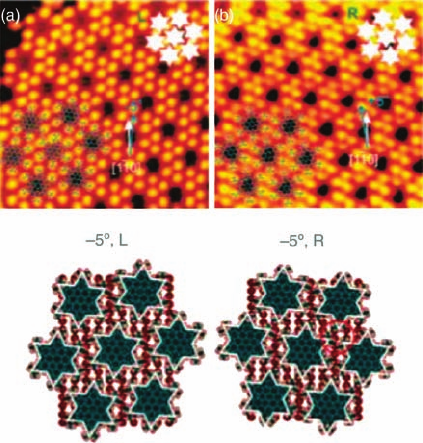
lattice. Elegant, high-resolution STM studies by Schrock et al. [26] reveal a h72|1
5i termed L lattice and mirror image h7 2| 15iR lattice, which are pseudohex-
agonal and exactly H3 times larger than the coronene lattice at H51a, H54a, and
H57a as the distorted hexagonal nearest neighbors. These dimensions demand a
clockwise or anticlockwise rotation of the molecules on a 2D isolated pseudohex-
agonal lattice to avoid overlap of the vdWenvelopes and, when this is mapped onto the
substrate R or L lattices, diastereoisomerism results (see Figure 1.10). For the
observed pair of enantiomers, the molecules find themselves rotated by 5
relative
to the close-packed h110idirection of the substrate, while for the alternative pairing,
which is not favored, a rotation by an equivalent amount but in the opposite sense
relative to the hexagonal unit cell results in 21
rotation relative to the h110i
direction. Studies of an isolated molecule adsorbed on Cu{1 1 1} favor the 5
rotation
rationalizing the observed behavior [26]. More detailed discussion of chirality and
diastereoisomerism in this system can be found in the paper by Schrock et al. [26] and
in the work of Richardson [25], where consideration is also given to an alternative
chiral structure for HtB-HBC/Cu{1 1 0}, which differs from that observed by Schrock
et al. [26] only in the orientation of the pseudohexagonal lattice to the substrate.
1.2.3
Chiral Molecules on Achiral Surfaces
An isolated molecule, which is chiral in the gas phases, will necessarily be chiral on
adsorption if the basic structure and conformation of the molecule are retained.
12
j
1 Chirality at Metal Surfaces
Adsorption of the opposite gas-phase enantiomer is necessary to generate the mirror
image adsorbate system. STM has been widely used to investigate how substrate-
mediated interactions and intermolecular hydrogen bonding influence the growth
of 1D and 2D clusters and long-range ordered structures. In many cases, if
chiral molecules form ordered structures on metal surfaces, the adsorbate forms
an oblique unit cell such that the ordered adsorbate structure itself is chiral. In this
case, the surface possesses both local chirality (determined by the molecule–surface
complex) and global chirality (determined by the chirality of the ordered adsorbate
domains).
One of the most extensively studied examples of the adsorption of a simple chiral
molecule on an achiral metal surface involves the adsorption of tartaric acid onto Cu
{1 1 0}. Tartaric acid (H
2
TA) (HOOC
CHOH
CHOHCOOH) can exist in the (R,R),
(S,S), and (R,S) forms. The initial work was motivated by a desire to understand why
(R,R)-tartaric acid is the most successful chiral modifier in the Ni-catalyzed en-
antioselective hydrogenation of b-ketoesters. Work from the catalysis community had
proposed that ordered, nanoporous 2D arrays of chiral molecules may be important
in defining the active site for chiral catalytic reactions [27]. The shape of the chiral
nanopores could favor the adsorption of a reactant molecule in a geometry favoring
the production of one enantiomeric product. Alternatively, it was proposed that a
direct interaction between a prochiral reagent and a single chiral modifier may be
Figure 1.10 UHV-STM images of HtB-HBC
adsorption on Cu{1 1 0} showing the correla-
tion between the orientation of the adsorbate
lattice vectors and the local rotation of the
molecule away from its high symmetry
azimuthal orientation atop a copper atom.
The 5
,L(þ5
, R) gives an improved
interdigitation of t-butyl groups compared to
the diastereoisomers þ5
,L(5
, R).
(Reprinted with permission from Ref. [25].
Copyright 2006, American Chemical Society.
1.2 Surface Chirality Following Molecular Adsorption
j
13