
Bowker M., Davies P.R. (Eds.) Scanning Tunneling Microscopy in Surface Science, Nanoscience and Catalysis
Подождите немного. Документ загружается.

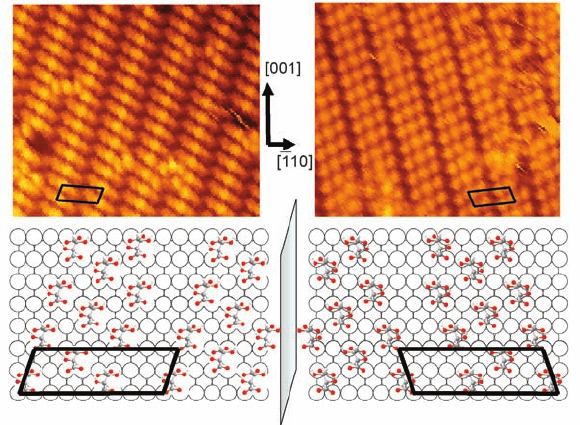
sufficient to direct the reaction along one enantiomeric route [28]. Hence, it was
important to investigate how tartaric acid binds to a metal surface and the extent to
which it forms ordered 2D arrays. On Cu{1 1 0}, a range of ordered structures were
identified with STM following (R,R)-tartaric acid adsorption [29] as functions of
tartaric acid coverage and temperature. At 300 K and above, tartaric acid adsorption
occurred via deprotonation of either one or both COOH functionalities to produce
monotartrate (HTA) or bitartrate (TA) species. Some of the ordered structures gave
unit cells such as c(4 6) that would be indistinguishable from that produced by (S,
S)-tartaric acid. The h90|12i structure was particularly significant from the point of
view of surface chirality. This structure was observed exclusively, with no evidence
being found for the mirror image structure h90|12i. By contrast, the adsorption of
(S,S)-tartaric acid gave only the h90|12i structure under similar preparation
conditions (Figure 1.11) [30]. In these structures, tartaric acid is adsorbed across the
troughs of the Cu{1 1 0} surface in the doubly deprotonated bitartrate form. Barbosa
and Sautet used DFT calculations to examine the preference by one enantiomer to
form one of the two mirror equivalent domains [31]. It was found that there is an
approximately 10 kJ mol
1
preference for one ordered arrangement over the other.
The energy preference is believed to be derived from an optimization of intramo-
lecular H-bonding interactions involving the two OH groups at the chiral centers
and was not believed to be related to intermolecular H-bonding interactions since
adjacent molecular species are too far apart for any significant H-bonding interac-
tions to occur. Fasel et al. carried out a detailed XPD characterization of the adsorption
Figure 1.11 STM images (13.5 nm 11.5 nm) of the h90|12i
(left) and h90|12i (right) phases of (R,R)- and (S,S)-tartaric
acid, respectively, on Cu{1 1 0}. (Adapted with permission from
Ref. [29]. Copyright 2000, Macmillan Publishers Ltd.)
14
j
1 Chirality at Metal Surfaces
geometry of (R,R)- and (S,S)-tartaric acid in the h90|12iphase and concluded that
individual TA species were adsorbed with the planes defined by the two carboxylate
OCO planes of each TA species being distorted away from the h110iazimuth. The
distortion observed by (R,R)-TAwas exactly mirrored for (S,S)-TA [32]. An interesting
feature of the h90|12istructure is the tendency for clusters with three molecular
features to be observed in the STM images. It is implicitly assumed in the proposed
structural models that the adsorption site of each TA species is essentially equivalent.
If this was the case, then it is not obvious why TA species from clusters of three
species separated by channels in the surface. Under certain tip conditions, the three
features of the cluster appear to give different z-contrast. This may suggest that
the three species are in slightly different adsorption sites and that it is energetically
more favorable to have an empty channel between rows of clusters than to
accommodate an additional TA species in a less favorable adsorption site. There
is some evidence from STM images of the Ni{1 1 0}/tartaric acid system that the
TA species influence the electronic structure of the underlying Ni in the vicinity of
the adsorbed TA species perhaps via some local restructuring of Ni atoms [33, 34].
The formation of clusters and channels in the Cu{1 1 0} experiments may be related
to a release of strain in the surface copper atoms. This proposed mechanism is
supported by a combined DFT and kinetic Monte Carlo study by Hermse et al. [35].
1.2.4
Chiral Molecules on Chiral Surfaces
One of the central features of many geochemical models for the origin of life is the
proposal that abiotic processes that select left-handed molecules versus right-handed
molecules could occur on the surfaces of chiral minerals [36]. There are many
examples of minerals whose bulk structures are intrinsically chiral. The most
naturally abundant chiral mineral is quartz (SiO
2
) that belongs to the trigonal space
group P3
2
21. The structure of quartz contains a helical arrangement of corner-linked
SiO
4
tetrahedra. The sense of the helix determines left- or right-handed quartz. In
addition, more than 200 chiral metal oxide structures are known [37]. Face-centered
cubic metallic elements (e.g., Cu, Ni, Pt, etc.) are intrinsically achiral. However,
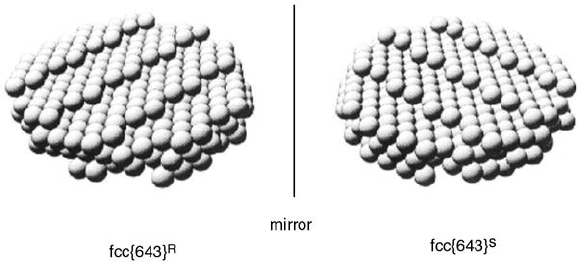
Gellman and coworkers [38] highlighted that certain surfaces of fcc single crystals are
chiral (Figure 1.12). Those surfaces displaying kinked steps with uneven step lengths
either side of the kink are not superimposable on their mirror image. They proposed
that surfaces could be denoted (R)or(S) by assessing whether the sequence of
microfacets in order of decreasing atomic density {1 1 1} > {1 0 0} > {1 1 0} is
clockwise (R) or anticlockwise (S) about the kink atom. STM imaging of step–kink
surfaces such as Cu{6 4 3} show a high degree of atom mobility at the step edges [39].
Sholl et al. used DFT simulations to show that naturally chiral metal surfaces retain
their net chirality even after their local structure is disrupted by thermal step
roughening [40]. More recently, Jenkins and Pratt showed that stepped bcc and hcp
surfaces may be chiral in the absence of kinks [41].
It was realized at an early stage that the adsorption of two enantiomers at chiral
step–kink sites was likely to occur with slightly different adsorption energies. In
1.2 Surface Chirality Following Molecular Adsorption
j
15
catalysis, such small modifications to the reaction pathway can be amplified to make
significant changes in selectivity. Attard, with an elegant series of cyclic voltammetry
experiments, displayed not only a difference between the behavior of
D- and L-glucose
at the (R)-Pt{6 4 3} surface but also an equivalence between the behavior of
D-glucose/
(R)-Pt{6 4 3} and
L-glucose/(S)-Pt{6 4 3} [42]. Temperature-programmed desorption
(TPD) has been used to identify subtle differences in adsorption energy for
enantiomers at chiral surfaces. For example, Gellman and coworkers reported
enantiospecific behavior of (R)- and (S)-propylene oxide on Cu{6 4 3} [43]. However,
the adsorption of (R)- and (S)-butanol (the simplest chiral alcohols) produced TPD
data that were indistinguishable on Ag{6 4 3} [38].
STM studies of the adsorption of chiral molecules on chiral surfaces are surpris-
ingly sparse. Zhao and Perry showed that (R)-3-methylcyclohexanone forms ordered
structures on Cu{6 4 3} with a molecular spacing consistent with the spacing of kinks
on the ideal Cu{6 4 3} surface [39]. Kuhnle et al. were able to probe, with atomic
resolution, the interaction of chiral molecules with kink sites in the case of cysteine
on Au{1 1 0} [44]. Although the surface is achiral, it displays both (S)- and (R)-kinks in
approximately equal numbers. Kuhnle et al. showed that dimers formed from (R)-
cysteine adopt different adsorption geometries at (S)-kinks from (S)-cysteine dimers,
demonstrating enantiospecific adsorption at these chiral centers. Furthermore,
dense, homochiral cysteine islands are found to preferentially grow from kink sites
of a specific chirality [44].
1.2.5
Chiral Etching
For an fcc crystal, the low-index faces (e.g., {1 1 1}, {1 0 0}, and {1 1 0}) are
thermodynamically the most stable, having the lowest surface free energies.
Figure 1.12 Schematic diagram showing the mirror equivalent
step–kink arrangements of the fcc {6 4 3}
R
and fcc{6 4 3}
S
surfaces
(Adapted with permission from Ref. [37]. Copyright 1996,
American Chemical Society.)
16
j
1 Chirality at Metal Surfaces
Chemisorption can lead to large changes in surface free energies. There are many
examples where chemisorption of organic molecules on a low-index crystal face
results in faceting of a metal surface. A number of factors influence the formation of
facets including face-specific adsorption energies, the energy difference between
kinks, steps, and terraces, substrate-mediated intermolecular interactions, and
surface diffusion barriers. Recent studies of organic molecules adsorbed on low-
index surfaces have found that high-index facets can be formed with complex organic
molecular adsorbates containing electronegative elements such as O and N atoms in
their functional groups. In these systems, the energy gain, which drives the
morphology change, could originate from the molecule–substrate interactions and
substrate-mediated interadsorbate interactions, which stabilize the steps and kinks of
the substrates.
Organic molecules with carboxylic acid functionalities commonly exhibit faceting
on metal surfaces. For example, STM investigations have revealed that formic
acid [45], benzoic acid [46], and p-aminobenzoic acid [47] all exhibit faceting behavior
on Cu{1 1 0}. It has been well established that at room temperature the carboxylic acid
group is deprotonated to the carboxylate. Apreferential alignment of step edges along
the [1 1 2] directions can be easily identified for both formate and acetate. It seems
likely that the driving force for the formation of this orientation of step edge is the
ordering of the molecular species into c(2 2) arrangements. Surface structures
formed by the adsorption of benzoic acid are much more complicated [46]. Benzoate
species can adopt either flat-lying or upright geometries and may form several
different periodic structures depending on coverage and annealing temperature.
The related molecule p -aminobenzoic acid also displays extensive faceting on the
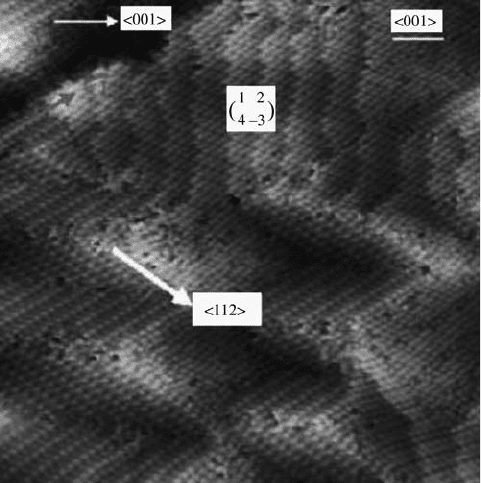
Cu{1 1 0} surface as shown in Figure 1.13 [47]. In these cases, it is possible to identify
two symmetrically equivalent (11 13 1) facets giving the characteristic sawtooth
arrangement of facets. The fact that similar facets are observed for both benzoic and
p-aminobenzoic acid leads to the conclusion that the formation of facets is directed by
the flat-lying carboxylate units. In the case of formate and acetate, where vibrational
spectroscopy reveals upright carboxylate units, step bunching is not observed leading
to the proposal that the adsorbate-mediated step–step interaction required for step
bunching is at best only weakly attractive when the carboxylate is perpendicular to the
surface [48].
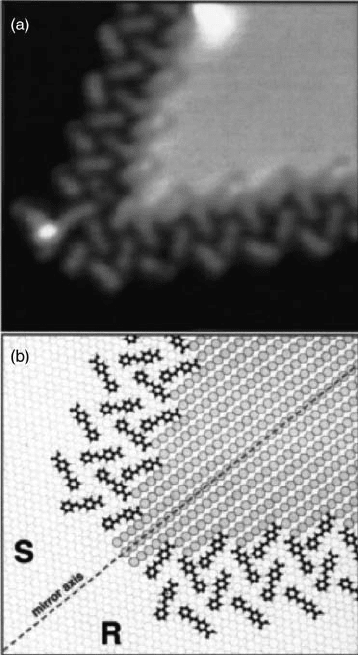
Pascual et al. [49] investigated the adsorption of the prochiral carboxylic acid 4-
[trans-2-(pyrid-4-yl-vinyl)]benzoic acid on Ag{1 1 0}. Following exposure to submo-
nolayer coverages of PVBA and thermal processing, similar sawtooth facets were
observed as for benzoic acid on Cu{1 1 0} (Figure 1.14). It was proposed that the
formation of facets was driven by the interaction between the carboxylate and the
{1 0 0} microfacets at step edges. The microfacets then act as chiral templates
nucleating the growth of supramolecular PVBA structures. The chirality of the PVBA
species at the microfacet determined the structure of the first four assembled rows of
molecules. It is perhaps unsurprising that when a chiral adsorbate is used containing
the carboxylate functionality, the distribution of facets produced becomes chiral.
Zhao and coworkers carried out studies of the adsorption of a range of amino acids on
1.2 Surface Chirality Following Molecular Adsorption
j
17
Cu{0 0 1} [49–52]. In the case of the achiralglycinemolecule, a tendency was foundfor
the formation of (3 1 17) facets. Since there is neither rotational nor reflectional
symmetry within individual facets, eight symmetry-related facets should be expected,
thatis,(13 17),(1317),(3117),(3 1 17),(3117),(3117),(1 3 17),and(1317)
The first four facets are rotationally equivalent to each other as are the final four.
The two sets are related by reflectional symmetry to each other. When a chiral
adsorbate, for example, S-lysine, is used, the reflectional symmetry is no longer valid
and only rotationally equivalent facets should be formed. This was demonstrated
elegantly by Zhao with STM [53]. The driving force for facet formation is proposed
to be a three-point interaction involving the carboxylate group, the a-amino
group, and the amino-terminated side chain. The simultaneous optimization of
adsorbate–adsorbate and adsorbate–substrate interactions determines the stereo-
chemistry of the facet.
Surface faceting may be particularly significant in chiral heterogeneous catalysis,
particularly in the Ni/b-ketoester system. The adsorption of tartaric acid and glutamic
acid onto Ni is known to be corrosive and it is also established that modifiers are
leached into solution during both the modification and the catalytic reaction [28]. The
preferential formation of chiral step–kink arrangements by corrosive adsorption
could lead to catalytically active and enantioselective sites at step–kinks with no
requirement for the chiral modifier to be present on the surface.
Figure 1.13 High-resolution STM image (50 nm 50 nm, bias
1.14 V, tunneling current 6.1 nA) showing the faceted structure
of p-aminobenzoic acid on Cu(1 1 0). (Reprinted with permission
from Ref. [47]. Copyright 2003, Elsevier.)
18
j
1 Chirality at Metal Surfaces
1.3
Chiral Amplification and Recognition
1.3.1
Chiral Amplification in Two Dimensions
In Section 1.2.1, we discussed the phenomenon of adsorbate-induced chirality
whereby the adsorption of achiral species (e.g., glycine) results in the formation of
two mirror equivalent domains on the surface. It has recently been shown that the
presence of relatively small mole fractions of chiral dopants can result in the exclusive
Figure 1.14 (a) STM image (10 nm 10 nm, tip bias þ0.52 V,
tunneling current 0.5nA) of a PVBA-induced sawtooth blade in
a restructured Ag(1 1 0) surface terrace. (b) Structural model of
the chiral kink arrangements induced by lateral interaction of
molecular carboxylate end groups with Ag{1 0 0} microfacets.
(Reprinted with permission from Ref. [48]. Copyright 2004,
American Institute of Physics.)
1.3 Chiral Amplification and Recognition
j
19
formation of one of the two mirror equivalent domains of the achiral species. For
example, succinic acid (HOOCCH
2
CH
2
COOH), an achiral molecule, forms two
mirror equivalent domains h90|22i and h 90|22i on Cu{1 1 0} [54]. The doubly
deprotonated succinate species are bound via both carboxylate groups to the Cu
surface– the mirrorrelationshipbetween the twodomainsis thought toarisefrom the
twist of the carbon backbone of succinate with respect to the [0 0 1] surface direction.
When as little as 2 mol% (R,R)-tartaric acid is coadsorbed with succinic acid, LEED
beams associated with the h90|22i structure are extinguished. The opposite
behavior is observed when the dopant is (S,S)-tartaric acid [55]. This behavior is
analogous to the sergeants and soldiers principle observed for helical polyisocya-
nate copolymers [56]. The mechanism for this effect is proposed to be substrate-
mediated. Succinate species are unable to form intermolecular H-bonds, so a chiral
footprint imposed on the surface by a tartrate species is thought to control the
adsorption geometry of the surrounding complex creating an effect that is amplified
over 30–50 molecules in a given domain [55].
1.3.2
Chiral Switching
In discussing adsorption-induced chirality, it is generally assumed that interconver-
sion of enantiomers is highly unlikely since such an interconversion, for example,
under thermal excitation, requires a reduced interaction with the surface and
desorption is a more probable outcome. However, if the molecule is relatively large
and the chiral center does not make a large contribution to the molecule–substrate
binding, then there is the possibility that a low-frequency mode can be excited
sufficiently on heating that a bond rotation is possible leading to a chiral switching
even without the molecule fully leaving the surface. This effect has been observed by
Linderoth and coworkers [57]. The molecule consists of a linear backbone formed out
of three benzene rings connected by ethynylene spokes and is functionalized at each
end with an aldehyde, a hydroxyl, and a tert-butyl group. The molecule is achiral in the
gas phase but adsorption on Au{1 1 1}, with the main molecular backbone parallel to
the surface, creates, by restricting rotation around the ethynylene spokes, two
equivalent chiral centers such that molecules can be classified as LL, RR, or RL,
the latter being internally racemic. The tert-butyl group can be readily identified in the
STM image and its position relative to the molecular backbone determined, thereby
permitting the chirality properties of the molecule to be determined. Thermal
switching of conformations was noted and ascribed to a partial loss of binding at
one end of the molecule. Detailed temperature-dependent studies allowed the barrier
to switching to be determined as approximately 0.3 eV. More subtly, it is found that
the internally racemic LR/RL conformation has a relatively low probability on the
surface and that it is more likely to switch than the LL or RR enantiomers: the
difference in barrier heights being 0.04 eV. This is related to the interadsorbate
interactions, which favor the LL/RR molecules over LR/RL. The possibility for chiral
switching of this type provides a new mechanism for the growth of large homochiral
domains as an alternative to separation relying on interdiffusion.
20
j
1 Chirality at Metal Surfaces
1.3.3
Chiral Recognition
Perhaps the simplest form of chiral recognition is that in which one enantiomer, for
example, A, of a chiral object displays a stronger interaction with a particular
enantiomer of a second chiral object, for example, B, rather than its mirror image,
B
. Of the four possible diastereoisomeric interactions AB, A
B
;A
B, AB
, the first two
form a mirror equivalent, enantiomeric pair as do the latter. However, the cross-
relationships are inequivalent, nonmirror images, for example, AB and AB
, and in a
chemical system, there would be an energetic preference for one pair of enantiomers
over the other. This is the key to the significance of chirality in biology and, therefore,
in the need to develop chiral products in the pharmaceutical and agrochemical
industries. Studying chiral recognition processes at surfaces is therefore relevant to a
better understanding of the separation of enantiomers, for example, following their
preparation in an insufficiently enantioselective reaction. It is also relevant to the
development of biosensors and biocompatible materials. Wehave already covered the
interaction of chiral molecules with chiral surfaces, which is an important example of
chiral recognition and diastereoisomerism. In this section, attention is focused on
chiral recognition between molecules adsorbed on surfaces and it is useful to
distinguish between self-recognition processes and those involving different mo-
lecular species. The latter can be described by the AB system introduced above while
extending the analogy to self-recognition; it is the energy differences between the
species AA, A
A
;A
A, AA
that is of interest. Here, AA is the mirror image of A
A
,
so these form a pair of enantiomers. Similarly, A
A and AA
are also enantiomers but
somewhat trivially since they are also equivalent and might be described as internally
racemic.
We have already discussed examples of what is effectively chiral self-recognition,
when we described the formation of chiral clusters, chains, and arrays following
adsorption involving induced chirality in otherwise achiral species in Section 1.2.1.
Now, we show examples of self-recognition between intrinsically chiral molecules
adsorbed as a racemic mixture on achiral surfaces leading to segregation of
enantiomers if the homochiral (AA/A
A
) pairing is preferred over the heterochiral
interaction (AA
). A nice example of this is revealed in the work of Besenbacher and
coworkers [58] on the adsorption of a racemic mixture of
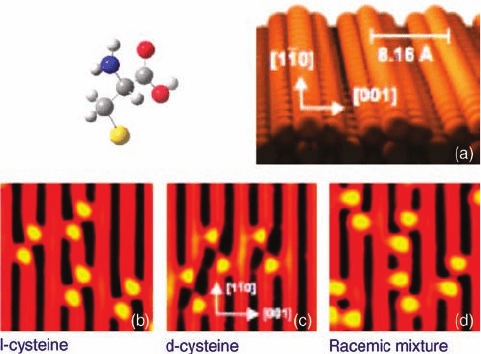
D- and L-cysteine on Au{1 1
0}. At low coverages, STM shows the molecules are present in pairs and, on the basis
of the alignment of any given pair with respect to the h110i direction, it can be
identified as being either
DD or LL. Notably, DL heterochiral pairs are not observed
(Figure 1.15). The reason for the homochiral preference lies in the orientation of the
cysteine molecules on the gold surface determined by AuS and AuN interactions.
The carboxylic acid functionality is not involved in any significant interaction with the
gold substrate but rather dominates the pairing interaction between enantiomers.
This three-point bonding of each molecule, AuS, AuN, and OHO, drives the
self-recognition preference for homochiral pairs [58].
A more subtle example of homochiral preference, which draws attention to the
conformational changes in the molecules needed to achieve self-recognition, is that
1.3 Chiral Amplification and Recognition
j
21
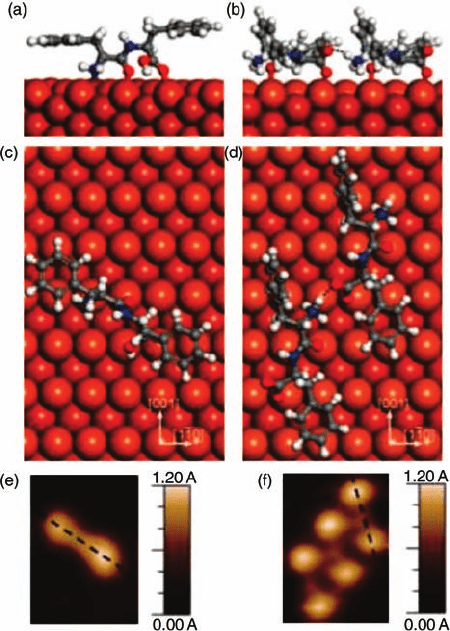
of the dipeptide D-phenylalanine-D-phenylalanine (D-Phe-D-Phe) and its enantiomer
L-Phe-L-Phe adsorption on Cu{1 1 0} [59]. Following adsorption of a racemic mixture
at low coverage, isolated species are recognizable by the orientation of their principal
axis with respect to the h110i azimuth of the substrate; the
LL (DD) enantiomer is
rotated 34
(counter) clockwise as shown in Figure 1.16. Density functional and
molecular dynamics calculations support an interpretation that the molecule adopts a
conformation similar to the gas phase, in which the amine and carboxylic acid
functionalities lie on the same side of the principal molecular axis, the peptide
backbone. In contrast, homochiral chains (
D-Phe-D-Phe)
n
and (L-Phe-L-Phe)
n
are observed by STM to have the principal axis rotated by 74
and heterochiral
chains are not observed. Calculations suggest that the conformation of each
molecule in a chain is dramatically changed relative to the isolated molecules with,
inter alia, the amine and carboxylic functionalities now lying on opposite sides of
the backbone to optimize intermolecular zwitterion formation between the amine
of one molecule and the carboxylic acid of its neighbor. The need to consider
the dynamic nature rather than simple lock–key models of chiral recognition is
thereby emphasized.
Adenine as an isolated molecule has no symmetry elements and therefore might
mathematically be considered chiral; however, as in the case of glycine (Sec-
tion 1.2.1), this description is not useful in chemistry since the enantiomers differ
only by inversion through the weakly pyramidal nitrogen atom of the amine
functionality, the main body of the molecule being planar. The inversion corresponds
to a low-frequency vibration and a low-energy barrier such that single enantiomers
Figure 1.15 Adsorption of cysteine on Au{1 1 0}.Molecular model
shows the deprotonated thiolate surface species. (a) Model
of the reconstructed (1 2)-Au{1 1 0} surface; (b–d) show,
respectively, dimers of
L-cysteine, D-cysteine, and the two together
characteristically rotated relative to the h110iazimuth. (Adapted
with permission from Ref. [57]. Copyright 2002, Macmillan
Publishers Ltd.)
22
j
1 Chirality at Metal Surfaces
cannot be realized. However, adsorption of adenine on a Cu{1 1 0} surface gives rise
to flat-lying molecules, which then have a high barrier to interchange of enantiomers;
that is, chirality is induced by adsorption [60]. At coverages up to one monolayer,
adenine forms homochiral dimers that link into homochiral chains, whose direction
on the Cu{1 1 0} substrate is correlated with their chirality [60] as shown in the left
panel of Figure 1.17.
Subsequent adsorption of one enantiomer of phenylglycine leads to an intermo-
lecular recognition process that favors the decoration of chains running in the (1, 2)
direction by S-phenylglycine (right-hand panel of Figure 1.17) while R-phenylglycine
decorates the mirror image (1, 2) adenine chains [61]. The origin of the strong
interaction between the amino acid, which adsorbs on Cu{1 1 0} as the anion, and the
nucleic acid base is electrostatic favoring the close approach of the carboxylate
functionality of phenylglycine to the nitrogen of the adenines amine group, which
Figure 1.16 Comparison of the structure of an
isolated (
L-Phe-L-Phe) on Cu{1 1 0} rotated 34
clockwise with respect to the h110i azimuth
(a, c, e) and that of the molecules found in rows
that are rotated by 74
(b, d, f) based on STM
images. The superimposed models indicate
that the change in rotation is linked to a major
change of conformation to enable strong
intermolecular bonding. (Adapted with
permission from Ref. [58].)
1.3 Chiral Amplification and Recognition
j
23