
Carson Ph., Mumford C. Hazardous Chemicals Handbook (Справочник по опасным химическим веществам)
Подождите немного. Документ загружается.


Table 12.3 Checklist for major deviations from normal operation
Start-up and shutdown;
What else, apart from normal operation, can happen?
Is suitable provision made for such events?
Can start-up and shutdown of plant, or placing of plant on hot standby, be expedited easily and safely?
Can the plant pressure or the inventory of process materials, or both, be reduced effectively and safely in a major emergency?
Are the operating parameter limits which require remedial action, known and measured, e.g. temperature, pressure, flow,
concentration?
Should plant be shutdown for any deviation beyond the operating limits?
Does this require the installation of alarm, trip, or both, i.e. to what externt is manual intervention expected?
Does material change phase from its state in normal operation, during the start-up, and shutdown of plant? Is this acceptable,
e.g. does it involve expansion or contraction, solidification, etc.?
Can effluent and relief systems cope with large or abnormal discharges, during start-up, shutdown, hot standby, commissioning
and fire-fighting?
Are adequate supplies of utilities and miscellaneous chemicals available for all activities, e.g. absorbents for spillage control?
Is inert gas immediately available in all locations where it may be required urgently?
Is there a standby supply?
Is any material added during start-up and shutdown, which can create a hazard on contact with process or plant materials?
Is the means of lighting flames, e.g. on burners and flares, safe on every occasion?
Table 12.4 Key words for use in HAZOP studies
Typical property words
Common Application-dependent
Flow Viscosity
Temperature Flash point
Pressure Vapour pressure
Level Heat transfer
Concentration Separate
Absorb
etc.
Guide words for HAZOP studies
Guide words Meaning Comment
NO/NOT The complete negation of these No part of the intentions is achieved but nothing
intentions else happens
MORE/LESS Quantitative increase or decrease Refer to quantities and properties such as flowrates
and temperatures as well as activities like ‘heat’,
‘react’
AS WELL AS Qualitative increase All the design and operating intentions are achieved
together with some additional activity
PART OF Qualitative decrease Only some of the intentions are achieved: some are
not
REVERSE The logical opposite of the intention Mostly applicable to activities, e.g. reverse flow,
chemical reaction. Can also be applied to
substances, e.g. ‘poison’ instead of ‘antidote’, ‘D’
instead of ‘L’ optical isomers
OTHER THAN Complete substitution No part of the original intention is achieved;
something quite different happens
LAYOUT 399

400 SAFETY BY DESIGN
Table 12.5 Features of intrinsically safe plants
Examples
Characteristic Friendliness Hostility
Low inventory
Heat transfer Miniaturized Large
Intermediate storage Small or nil Large
Reaction Vapour phase Liquid phase
Tubular reactor Pot reactor
Liquids separation Centrifugal Gravity settling
Substitution
Heat transfer media Non-flammable Flammable
Solvents Non-flammable/low toxicity Flammable/high toxicity
Attenuation
Liquefied gases Refrigerated Under pressure
Explosive powders Slurried Dry
Runaway reactants Diluted Neat
Any material Vapour, superheated liquid Liquid
Any process Low pressure High pressure/vacuum
Moderate temperature High or very low temperature
Simplification
Hazards avoided Hazards controlled by added
equipment
Single stream Multistream with many
crossovers
Dedicated plant Multipurpose plant
Liquid or powder transfer One big plant Many small plants
By gravity Pressurized
Domino effects
Open construction Closed buildings
Fire breaks No fire breaks
Tank roof Weak seam Strong seam
Horizontal cylinder Pointing away from other Pointing at other equipment or
equipment and buildings buildings
Incorrect assembly impossible
Compressor valves Non-interchangeable Interchangeable
Device for adding water to oil Cannot point upstream Can point upstream
Obvious state
Rising spindle valve or ball Non-rising spindle valve
valve with fixed handle
Figure-8 plate Spade
Tolerant of maloperation or poor Continuous plant Batch plant
maintenance Spiral-wound gasket Fibre gasket
Expansion loop Bellows
Fixed pipe Hose
Articulated arm Hose
Bolted arm Quick-release coupling
Metal Glass, plastic
Self-sealing couplings Standard couplings
Low leak rate Spiral-wound gasket Fibre gasket
Tubular reactor Pot reactor
Vapour-phase reactor Liquid-phase reactor

or effects on site of fire, explosion, toxic release or similar incident. Selected sources of information
are summarized in Table 12.7.
Storage
Chemicals in packages
The design of any building or outside compound for the storage of chemicals in packages (e.g.
drums, cylinders, sacks) will depend upon their hazardous characteristics (pages 228, 248 and
272).
For a storage building the considerations include:
• Siting to minimize risk to nearby premises on and off site in a fire.
• Access for delivery and transfer of chemicals and for emergency purposes.
• Fire-proof construction.
Table 12.6 Electrical zoning
Classification of hazard areas according to the probability of a flammable concentration of vapour occurring
(to BS 5345 Part 1)
Zone 0 Area in which an explosive gas–air mixture is continuously present, or present for long periods
Zone 1 Area in which an explosive gas–air mixture is likely to occur in normal operation
Zone 2 Area in which an explosive gas–air mixture is not likely to occur in normal operation, and if it occurs will
exist only for a short time
Safe area By implication, an area that is not classified Zone 0, 1 or 2 is deemed to be a non-hazardous or safe area
with respect to BS 5345
Examples of electrical area classification for various operations
Vapour source Extent of classified area Area classification
Vapour space inside Within the vapour space of the tank Zone 0
storage tank
Storage tank outside Vertically from ground level up to 2 m above the Zone 2
buildings tank connections and horizontally within 2 m
from the tank connections or shell
Discharge from vent (a) Where liquids or vapours discharged from the Fixed electrical equipment
line vent may impinge should not be installed
(b) Within 2 m in all other directions from point of Zone 2
discharge
Tank vehicle loading (a) Vertically from ground level up to 2 m above, Zone 1
and horizontally outwards for 2 m from any
point where connections are regularly made or
disconnected for product transfer
(b) Vertically and horizontally between 2 m and Zone 2
4 m from the points of connection or
disconnection
Pumps and sample Within 2 m in all directions Zone 2
points in the open air
Pump house building Within the building Zone 1
Notes
1. Where any area is classified under more than one factor, the higher classification should prevail.
2. Any bunded area, pit, trench, depression or drain falling within a Zone 1 or Zone 2 area should be treated as being a Zone
1 area throughout.
3. Pump seals should be properly maintained.
STORAGE 401

402 SAFETY BY DESIGN
• Security, i.e. control of access by staff and means to prevent entry by vandals or trespassers.
• General ventilation provisions, particularly if volatile toxic or highly flammable liquids, or
toxic or flammable pressurized gases are stored.
• Lighting, and emergency lighting, provisions.
• Correct selection of heating equipment and zoning of electrical equipment to reduce the chance
of an ignition source arising.
• Provision of fire detection and extinguishment equipment.
The same factors arise for a dedicated compartment of a building. In either case identification and
warning notices need to be provided.
Operation of the store (see Chapter 13) then needs to account for:
• A system for checking that all packages entering the store have identifiable labels which
indicate their contents and any hazardous characteristics.
• A system for inspecting all packages received, and routinely in-store, for leaks, damage,
external corrosion, etc.
Table 12.7 Selected sources of spacing distances with hazardous chemicals (see Bibliography)
Preliminary minimum distances
Liquid oxygen
A Code of Practice for the Bulk Storage of Liquid Oxygen at
Production Sites
(HSE, 1977)
Liquefied flammable gases
Process Plant Layout
page 562 (Mecklenburgh, 1985)
Liquids stored at ambient temperature
Process Plant Layout
page 564
and pressure
Electrical area classification distances
Process Plant Layout
pages 568–577
Distances for storage of explosives
Explosive and Toxic Hazard Materials
page 370 (Meidl, 1970)
Safe Handling Requirements during Explosive, Propellant and
Pyrotechnic Manufacture
(HSE, SIR 31)
General recommendations for spacing G
eneral Recommendations for Spacing in Refineries, Petrochemical
Plants, Gasoline Plants, Terminals, Oil Pump Stations and
Offshore Properties
(Oil Insurance Association, No. 361)
‘Consultation’ distances (in relation to HSE assessments for consultation distances for major hazard
major hazard and other sites, e.g. LPG, installations, Chapter 5 in
Safety Cases
(Lees and Ang, 1989)
chlorine, for land use planning)
Minimum recommended spacing distances
Flammable liquids
Storage of Flammable Liquids in Tanks
(HSE, HSG 176)
Storage of Flammable Liquids in Containers
(HSE, HSG 51)
Storage of Highly Flammable Liquids
(HSE, CS2)
Highly Flammable Materials on Construction Sites
(HSE, HSG 3)
Storage of Flammable Liquids in Fixed Tanks, up to 10 000 m
3
Total
Capacity
(HSE, HSG 50)
Liquefied petroleum gas
Storage of LPG at Fixed Installations
(HSE, HSG 34)
Storage and Use of LPG at Metered Estates
(HSE, CS11)
Storage and Use of LPG on Construction Sites
(HSE, CS6)
Keeping of LPG in Cylinders and Similar Containers
(HSE, CS4)
Distances for storage and handling of
Storage and Handling of Organic Peroxides
(HSE, CS21)
dangerous chemicals C
hemical Warehousing Storage of Packaged Dangerous Substances
(HSE, HS(G) 71)
Safety Advice for Bulk Chlorine Installations
(HSE, HSG 28)
Storage and Handling of Industrial Nitrocellulose
(HSE, HSG 135)
Storage and Handling of Ammonium Nitrate
(HSE, CS18)

• A system for the segregation of chemicals, following the principles explained on page 136 and
248.
• In-store handling of packages. Manual handling should be eliminated or reduced as far as
possible. Fork-lift trucks should be regularly maintained, be provided with adequate access
ways; driving should be restricted to fully-trained personnel.
• Safe stacking practice. This will include provision of suitable racking, limitations on stack size
and height, e.g. having regard to the potential severity of a fire.
• Specification of a storage capacity and a procedure to avoid overfilling.
• Good housekeeping.
• Fire precautions including control of ignition sources, e.g. smoking, maintenance activities,
vehicular access (see Chapter 6) and limitation of combustible materials, e.g. packaging.
Drum storage
Drums containing flammable liquids are preferably stored outside, so that any flammable vapour
can readily disperse. Similar considerations may apply to the dispersion of any vapour/fumes
from drums of toxic liquids or solids. In some cases weather protection is provided by a roof.
If outdoor storage is not reasonably practical a specially designed storeroom, preferably in a
separate building, may be used.
A summary of recommendations for outdoor drum storage is given in Table 12.8.
Table 12.8 Outdoor drum storage recommendations
• If possible, situate area remote from buildings and plant. Avoid location beneath pipe bridges or electric cable runs.
• Secure the area to prevent tampering or trespassing.
• Limit permissible fire load to 79 × 10
5
kJ or 250 tons of hydrocarbon.
• Label each drum; affix appropriate warning, e.g. ‘Highly Flammable’, ‘Corrosive’.
• Provide suitable absorbent materials to deal with spillages.
• Limit stack heights, e.g. 4.5 m for 200 litres drums., 5 m high for drums stored on end or 4 m high on pallets,
4 m high for drums on their sides.
• Segregate highly flammable liquids and mark the stack; classify the area as Zone 2. Place material >15 m from any
working building, amenity building or plant and >7.5 m from plant boundary and boundary fence.
• Space combustible material stacks >7.5 m from buildings and 4 m from plant boundary fences.
• Limit areas for any stack of drums to 250 m
2
with generally a maximum length of 18.5 m. (A reduced area applies to
particularly hazardous chemicals.)
• Restrict number of 180 litre drums to 1500.
• Ground should be impervious, and sloped and drained, with demarcation lines.
• Spillages from this area should be contained in a bund, or similar arrangement.
• Provide >5 m clearance between adjacent stacks with access on three sides for fire-fighting, etc.
• Provide an adequate number of fire hydrants for fixed monitors for drenching the stacks with water. Stack drums 2 m from
any hydrants and leave clear access.
• Leave space for possible hose runs for a fire in any stack and provide dry powder extinguishers around the area.
LPG in cylinders
The risk with liquefied petroleum gas in cylinders is significantly greater than with a highly
flammable liquid in drums because of the potential for rapid release of heavy flammable gas. In
a fire around a cylinder there is a potential BLEVE hazard (see p. 178); ignition of a leak from
a valve will cause a jet fire.
Therefore detailed recommendations relate to the keeping of liquefied petroleum gas in cylinders
and similar containers. General recommendations for storage, other than on rooftops, are summarized
in Tables 9.16–9.18.
STORAGE 403

404 SAFETY BY DESIGN
Equipment design
The design and instrumentation of individual equipment items are beyond the scope of this text.
It is important to note, however, that:
• All work equipment must be constructed or adapted to be suitable for its use, and its selection
should have regard to the working conditions and risks to health and safety of persons where
it is used and any additional risks it poses (Provision and Use of Work Equipment 1998
Reg. 2).
• In addition to guarding dangerous machinery (Reg. 11) measures are required to prevent or
adequately control hazards from work equipment due to:
– any article or substance falling or being ejected;
– rupture or disintegration of parts;
– it catching fire or overheating;
– the unintended discharge or premature discharge of any gas, dust, liquid, vapour or other
substance; consideration should also be given to fugitive emissions or leaks from valves,
flanges, connections, seals, pumps, agitators, etc. by, for example, using average emission
factors for common plant equipment such as those given in Table 12.9. (Such assessments
may be important in reducing material loss or in estimating potential employee exposure or
environmental pollution levels);
– the unintended or premature explosion of it or any substance in it (Reg. 12).
• The selection of materials of construction is subject to the considerations of corrosion summarized
on page 54.
• Consideration should be given to the safety features listed in Table 7.21.
• For any pressure system there are obligatory requirements summarized on page 423.
Table 12.9 Average emission factors for plant items
Equipment Service Emission factors (kg/hr)*
Refineries Synthetic organic
chemical manufacturing
Valves Gas 0.27 0.0056
Light liquid 0.11 0.0071
Heavy liquid 0.00022 0.00023
Pump seals Light liquid 0.11 0.0494
Heavy liquid 0.021 0.0214
Compressors Gas/vapour 0.64 0.228
Pressure relief valves Gas/vapour 0.16 0.104
Flanges All 0.00025 0.00083
Open-ended lines All 0.0023 0.0017
Sampling connections All 0.015 0.015
*Multiplying the total number of items in a unit by the factor provides an indication of the emission rate.
Piping arrangements
Complex piping systems may be required for the transfer of chemicals, balancing of pressures,
venting, drainage, supply of services, etc.

Safe operation is generally assisted by simplification of piping and valve arrangements, and by
their identification, e.g. by colour coding or tags. Logical arrangement can also serve as a prompt
in identification.
Design of piping systems is a special discipline but some guidance is given in Table 12.10.
Table 12.10 Design measures to reduce leaks from pipework
• Minimize the number of branches and deadlegs.
• Minimize the number of small drain lines.
• Design small diameter lines to the same codes, and test to the same standards, as main lines; reinforce junctions as
necessary.
• Provide flexibility to allow for thermal expansion, or contraction, of pipework and connected equipment.
• Direct discharges from automatic drains to visible locations.
• Provide gaskets compatible with the internal fluid over the full range of temperatures and pressures.
• Provide removable plugs on valve sample points.
• Provide adequate pipe supports.
• Minimize the number of flanges on vacuum lines.
• Consider duplication, locking, temporary blanking of valves on ‘open’ discharge lines.
• Either avoid pipe runs along routes subject to possible mechanical damage, e.g. from fork-lift trucks or tankers, or provide
shields and barriers.
• Provide walkways, ladders, etc. to avoid pipework being clambered over.
• Minimize the use of flexible hoses; if used:
– ensure hose and couplings are to the appropriate standard;
– provide for rapid isolation in any emergency;
– use bolted, not jubilee, clips;
– consider self-sealing couplings;
– provide adequate support and protection whilst in use;
– protect from crushing or contamination when not in use.
Services and utilities
Ensure the adequacy (in terms of quality, quantity and reliability) of services/utilities, e.g. steam,
process/cooling water, electricity, compressed air, inert gas, fire suppression systems, ventilation.
Stand-by or emergency services may be required. Some general safety design considerations are
summarized in Table 12.11.
Ventilation can be provided as general dilution ventilation or local extraction ventilation.
Dilution ventilation (general ventilation)
Open construction is preferable wherever practicable for areas processing hazardous chemicals,
to provide general ventilation and assist in the dispersion of leaking gas or vapour, to maximize
explosion-venting area and to facilitate fire-fighting. Local dilution ventilation is provided to
flush the workplace atmosphere with clean air and thus dilute the level of contaminant in ambient
air to acceptable levels. The siting of the extract fans and the air inlets require careful consideration
to minimize operator exposure (Figure 12.1). The general rules are:
• Site the exhaust fan near to the source of contaminant.
• Ensure that fresh air movement is from worker to leak source and not vice versa.
• Ensure that air inlet supply is not contaminated with exhaust effluent.
• Provide back-up for air inlet where necessary.
PIPING ARRANGEMENTS 405

406 SAFETY BY DESIGN
For continuous release of gas or vapour the steady-state dilution ventilation required to reduce the
atmospheric pollutant to a level below its hygiene standard is given by
Q
SG ER K
MW HS
=
3.34 10
××××
×
where Q is the ventilation rate (m/min)
SG is the specific gravity of the evaporating liquid
ER is the rate of evaporation (l/hr)
MW is the molecular weight
K is the design factor
HS is the hygiene standard.
In general, dilution ventilation alone is inappropriate for highly-toxic substances, carcinogens,
dusts or fumes or for widely fluctuating levels of pollutants. Since hygiene standards are often
revised (usually downwards), specifications of existing systems may prove inadequate. An inherent
problem is that contaminants may have to pass through a worker’s breathing zone before dilution.
Local exhaust ventilation
Local exhaust ventilation serves to remove a contaminant near its source of emission into the
atmosphere of a workplace. A system normally comprises a hood, ducting which conveys exhausted
air and contaminants, a fan, equipment for contaminants collection/removal and a stack for
dispersion of decontaminated air. Hoods normally comprise an enclosure, a booth, a captor hood
or a receptor hood. Those relying on other than complete enclosure should be as close as practicable
to the source of pollution to achieve maximum efficiency.
Total enclosure may be in the form of a room with grilles to facilitate air flow; this functions
as a hood and operates under a slight negative pressure with controls located externally. Entry is
restricted and usually entails use of comprehensive personal protective equipment. Ancillary
requirements may include air filters/scrubbers, atmospheric monitoring, decontamination procedures
and a permit-to-work system (see page 417).
Partial enclosure allows small openings for charging/removal of apparatus and chemicals. The
requisite air velocity to prevent dust or fumes leaking out determines the air extraction rate, e.g.
Table 12.11 Safety considerations for plant services design
• The need to duplicate power supplies to equipment.
• The need to duplicate or triplicate equipment.
• Selection between steam, or electricity, or a combination for pumps and compressors.
• Provision of automatic start for spare pumps.
• Provision of voltage protection for key equipment which must be kept on-line or be restarted quickly.
• Order for restarting equipment after a power failure.
• Extent of emergency power supplies for lighting, communication systems, and key items of equipment (e.g. cooling
facilities, reactor agitators, exhaust ventilation) and instruments/alarms.
• Provision for cooling emergency equipment, e.g. diesel generators if cooling water is disrupted.
• Required positioning of control valves (i.e. shut, open or ‘as is’) upon power failure.
• Provision of compressed air, inert gas from reservoirs for a limited period.
• Provision for alternative fire water supply.
• Provision of efficient drift eliminators of water cooling towers; consideration of replacement by air cooling systems.
• Thermal insulation to protect personnel from contact with hot or cold surfaces; prevention of water supply disruption by
freezing.
• Design of hot and cold water services to avoid water standing undisturbed for long periods. Use of covered tanks and
cisterns with approved fittings and materials.
• Avoidance of cold water temperatures of 20°C–45°C, storage of hot water at 60°C and circulation at 50°C.
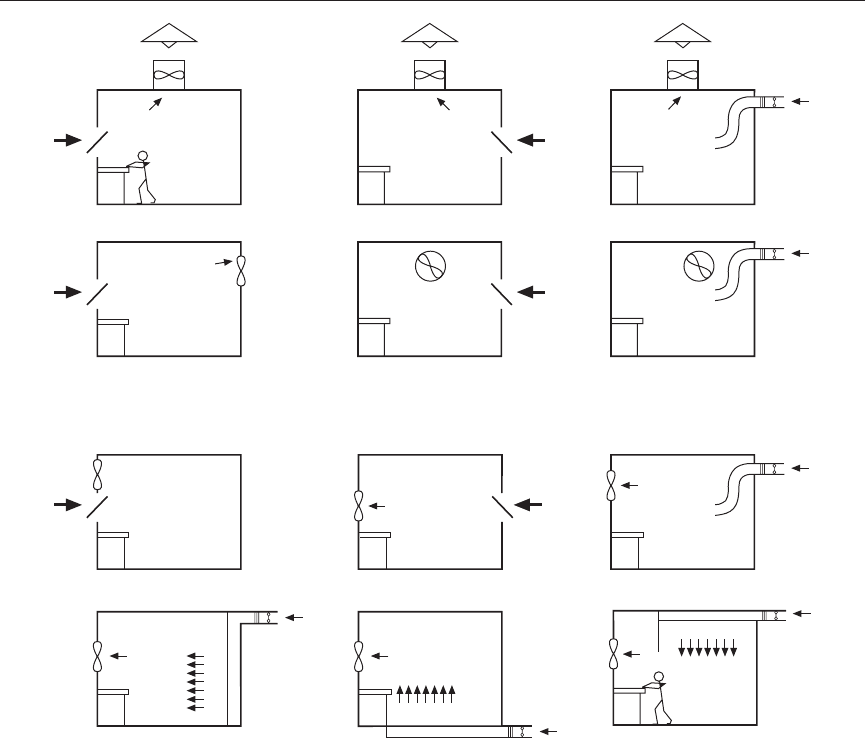
Poor air inlet Fair air inlet
Good air inlet
Best air inlet
Best air inlet
Best exhaust (local)
Best air inlet
Good fan locations
Plenum
Plenum
Plenum
Poor air inlet Fair air inlet
Good air inlet
Poor air inlet Fair air inlet
Good air inlet
Poor fan locations
in the range 0.28 to 0.56 m/s. A higher velocity is required if there is significant dispersion inside
the enclosure.
A booth should be of sufficient size to contain any naturally occurring emissions and so
minimize escape via the open face. An air velocity of 0.56 m/s is required over the whole open
face; a higher velocity is needed if there is significant air movement within the booth or to cope
with convection currents. Booths should be deep enough to contain eddies at the rear corners;
baffle plates or multiple offtakes may be necessary with shallow booths.
No operator should work between the source of pollutant and the rear of the booth (i.e. all work
should be handled from the front open face, as illustrated by Figure 12.1).
If enclosure or use of a booth is impracticable, a captor hood is used. This is placed some
distance from the source of pollution and the rate of air flow needs to be such as to capture
contaminants at the furthermost point of origin.
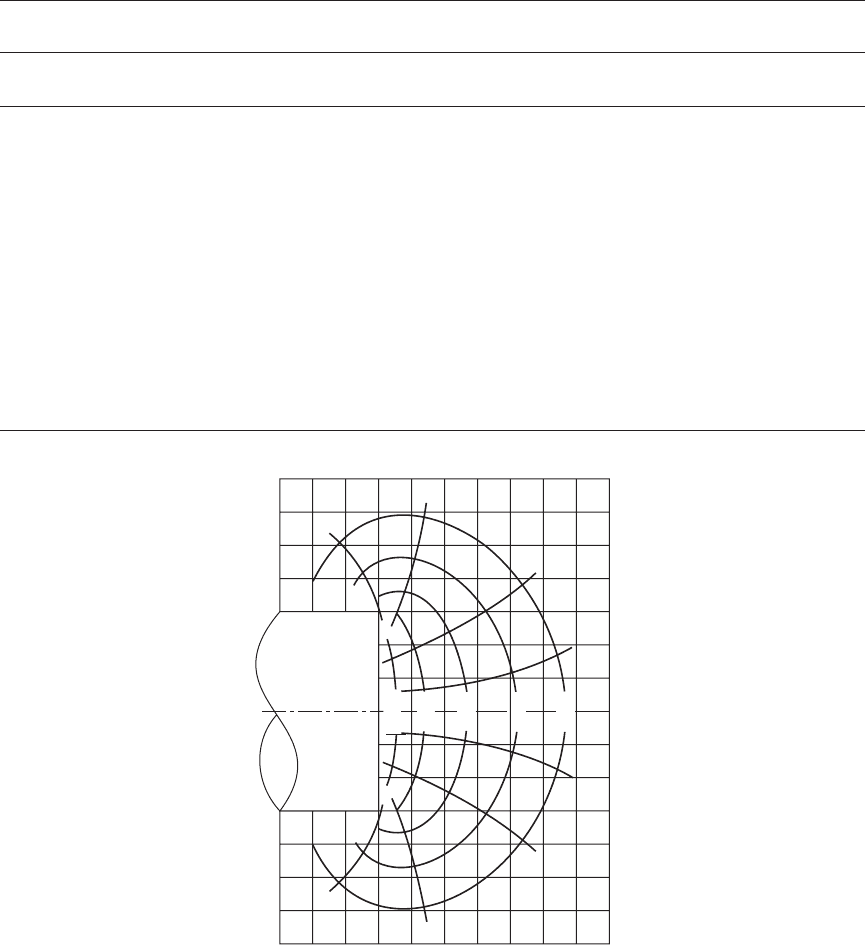
Typical capture velocities are given in Table 12.12. Since velocity falls off rapidly with distance
from the face of the hood, as shown in Figure 12.2, any source of dust should be within one hood
Figure 12.1
Dilution ventilation: inlet air may require tempering according to outside conditions
PIPING ARRANGEMENTS 407
408 SAFETY BY DESIGN
100%
50%
30%
15%
7.5%
0 50 100
% of diameter
Table 12.12 Range of capture velocities
Condition of dispersion of contaminant Examples Capture velocity
(m/s)
Released with practically no velocity into quiet air Evaporation from tanks 0.25–0.51
Degreasing vats etc.
Released at low velocity into moderately still air Spray booths 0.51–1.02
Intermittent container filling
Low-speed conveyor transfers
Welding
Plating
Pickling
Active generation into zone of rapid air motion Spray painting in shallow booths 1.02–2.54
Barrel filling
Conveyor loading
Crushers
Released at high initial velocity into zone of very Grinding 2.54–10.2
rapid air motion Abrasive blasting
Tumbling
Figure 12.2
Reduction in air velocity with distance from captor hood (distance given as % of hood diameter)
diameter. Efficiency can be significantly improved by the use of flanges and by avoiding abrupt
changes in direction of the ducting.
A receptor hood receives a contaminant driven into it by the source of generation. The flowrate
needs to ensure that the hood is emptied more rapidly than the process fills it and to overcome
draughts. No operator should work between the hood and the source of the contaminants.