
Carson Ph., Mumford C. Hazardous Chemicals Handbook (Справочник по опасным химическим веществам)
Подождите немного. Документ загружается.

Hydroquinone I 75 1000 C
Indium and compounds (as ln) F (0.8 µm MCEF) 300 1500 C
Iodine I 15 1000 C
Iron oxide fume (NOC) F (0.8 µm MCEF) 30 1500 AAS
Iron pentacarbonyl F (0.8 µm MCEF) 175 1500 AAS
Iron salts, soluble (as Fe) F (0.8 µm MCEF) 4 1500 AAS
Isoamyl acetate CT 10 200 GLC
Isoamyl alcohol CT 10 200 GLC
Isobutyl acetate CT 10 200 GLC
Isobutyl alcohol CT 10 200 GLC
Isophorone CT 12 200 GLC
Isopropyl acetate CT 9 200 GLC
Isopropyl alcohol CT 3 200 GLC
Isopropylamine I 100 1000 GLC
Isopropyl ether CT 3 50 GLC
Isopropyl glycidyl ether CT 10 200 GLC
Kaolin F G (nuisance dust)
Ketene I 50 1000 C
Lead, inorg., fumes and dusts (as Pb) F (0.8 µm MCEF) 100 4000 AAS
Limestone F G (nuisance dust)
Lindane F + 1 90 1500 GLC
Lithium hydride F (0.8 µm MCEF) 720 1500 AAS
LPG (liquefied petroleum gas) M direct reading combustible gas meter
Magnesite F G (nuisance dust)
Magnesium oxide fume (as Mg) F (0.8 µm MCEF) 150 1500 AAS
Malathion F (GF) 120 1000 GLC
I
Manganese and compounds (as Mn) F (0.8 µm MCEF) 22.5 1500 AAS (1500 cc/min only)
Manganese cyclopentadienyl tricarbonyl (as Mn) F (0.8 µm MCEF) 25 1500 AAS
Marble/calcium carbonate F G (nuisance dust)
Mercury (alkyl compounds) (as Hg) OT 3 50 AAS (chromosorb)
Mesityl oxide CT 10 200 GLC
Methanethiol,
see
Methyl mercaptan
Methoxychlor I 100 1000 GLC
2-Methoxyethanol (methyl cellosove) CT 50 1000 GLC
Methyl acetate CT 7 200 GLC
Methyl acetylene (propyne) CT 2 50 GLC
Methyl acetylene propadiene mixture CT 2 50 GLC
Methyl acrylate CT 5 200 GLC
Methylal (dimethoxymethane) CT 2 200 GLC
Methyl alcohol (methanol) ST 3 50 GLC
Methylamine I 50 2000 C
Methyl amyl alcohol,
see
Methyl
isobutyl carbinol
Methyl
n
-amyl ketone (2-heptanone) CT 10 200 GLC

Methyl bromide CT 11 1000 GLC (2 large charcoal
tubes in series)
Methyl butyl ketone,
see
2-Hexanone
Methyl cellosolve,
see
2-Methoxyethanol
Methyl cellosolve acetate,
see
Ethylene glycol
monomethyl ether acetate
Methyl chloroform (1,1,1-trichloroethane) CT 6 200 GLC
Methylcyclohexane CT 4 200 GLC (for
methylcyclohexane)
Methylcyclohexanol CT 10 200 GLC
o
-Methylcyclohexanone CT 10 200 GLC
Methylene bisphenyl isocyanate (MDI) I 20 1000 C
Methylene chloride (dichloromethane) CT 5 1000 GLC
4,4′-Methylene bis (2-chloraniline) (MOCA) ST 3 500 GLC (use prefilter)
Methyl ethyl ketone (MEK),
see
2-Butanone
Methyl formate CT 10 200 GLC
Methyl iodide CT 50 1000 GLC
Methyl isoamyl ketone CT 5 200 GLC
Methyl isobutyl carbinol CT 10 200 GLC
Methyl isobutyl ketone,
see
Hexone
Methyl mercaptan CT 15 1000 GLC
I 30 2000 C
Methyl methacrylate CT 5 200 GLC
Methyl parathion I 50 2800 GLC
Methyl propyl ketone,
see
2-Pentanone
α-Methyl styrene CT 3 200 GLC
Molybdenum (as Mo)
soluble compounds F (0.8 µm MCEF) 90 1500 AAS
insoluble compounds F (0.8 µm MCEF) 90 1500 AAS
Monomethyl aniline I 100 1000 GLC
Monomethyl hydrazine I 22.5 1500 C
Morpholine ST 20 200 GLC
Naphtha (coal tar) CT 10 200 GLC
Naphthalene CT 200 1000 GLC
β-Naphthylamine
Nickel carbonyl I 200 2000 AAS
Nickel, metal
Nickel, soluble compounds (as Ni) F (0.8 µm MCEF) 90 1500 AAS
Nicotine OT 100 1000 GLC (XAD-2 resin tube)
Nitric acid I 200 2800 C (2800 cc/min only)
Table 10.30 Cont’d
Substance Sampling method
(1)
Min. sample size
(2)
Suggested max. sample Analytical technique
(4)
(I)
rate
(3)
(ml/min)
Nitric oxide OT 1 20 C (LDDT)
1 50 (MOL sieve tube)
p
-Nitroaniline ST 15 1000 GLC
Nitrobenzene ST 50 1000 GLC
p
-Nitrochlorobenzene ST 50 1000 GLC
Nitroethane CT 10 200 GLC
Nitrogen dioxide OT 1 20 (LDDT)
OT 1 50 (MOL sieve tube)
I 10 4000 C
Nitrogen trifluoride P PC
Nitroglycerine OT 15 1000 GLC (Tenax tube)
Nitromethane CT 10 200 GLC
1-Nitropropane CT 10 200 GLC
2-Nitropropane CT 10 200 GLC
Nitrotoluene ST 20 200 GLC
Nitrotrichloromethane,
see
Chloropicrin
Octachloronaphthalene F (0.8 µm MCEF) 30 1000 GLC
Octane CT 4 200 GLC
Oil mist, mineral F (0.8 µm MCEF) 100 1500 C (fluor. spect.)
Ozone I 45 1000 C
Paraffin wax fume F (SM) 200 2000 G
Paraquat, respirable sizes F (0.8 µm MCEF) 150 1500 C
Parathion I 25 1500 GLC
F (GF) 120 1500 GLC
Particulate polycyclic aromatic hydrocarbons F (0.8 µm SM) 720 1500 G (use GF prefilter)
(PPAH), as benzene solubles
Pentachloronaphthalene F + I (GF) 250 1500 GLC
Pentachlorophenol F (0.8 µm MCEF) 150 1500 GLC
Pentaerythritol F G (nuisance dust)
Pentane CT 2 50 GLC
2-Pentanone CT 10 200 GLC
Perchloroethylene CT 1 200 GLC (10 min allowed
at 300 ppm)
Perchloromethyl mercaptan CT 30 200 GLC
Perchloryl fluoride I 30 1000 ISE
Petroleum distillates (naphtha)
Phenol I 100 1000 GLC
p
-Phenylene diamine I 101 1000 C
Phenyl ether (vapour) CT 10 200 GLC
Phenyl ether–diphenyl mixture (vapour) ST 10 200 GLC
Phenylethylene,
see
Styrene, monomer
Phenyl glycidyl ether CT 50 1000 GLC
Phenylhydrazine I 100 1000 C
Phosdrin (Mevinphos
®
) I 100 1000 GLC
Phosgene (carbonyl chloride) I 25 1000 C

Phosphine F (0.8 µm MCEF) 5 50 C (GF prefilter)
Phosphoric acid F (0.8 µm MCEF) 15 1500 C (four 2 hr samples)
Phosphorus (yellow)
Phosphorus pentachloride I 100 1000 C
ISE
Phosphorus trichloride I 100 1000 C
ISE
Phthalic anhydride F (0.8 µm MCEF) 100 1500 GLC
Picric acid
Pival
®
(2-pivalyl-1,3-indandione) I 100 1000 GLC
Plaster of Paris F G (nuisance dust)
Platinum, soluble salts (as Pt) F (0.8 µm MCEF) 720 1500 AAS
Polychlorobiphenyls,
see
Chlorodiphenyls
Polytetrafluoroethylene decomposition products
Propane
see
Fluoride procedure
Propargyl alcohol CT 30 200 GLC
n
-Propyl acetate CT 10 200 GLC
Propyl alcohol CT 10 200 GLC
n
-Propyl nitrate CT 70 1000 GLC
Propylene dichloride (1,2-dichloropropane) CT 10 200 GLC
Propylene glycol monomethyl ether CT 10 200 GLC
Propylene oxide CT 5 200 GLC
Propyne,
see
Methyl acetylene
Pyrethrum I 100 1000 GLC
Pyridine CT 100 1000 GLC
Quinone I 100 1000 C
RDX F (0.8 µm MCEF) 150 1500 UV
Rhodium (as Rh)
metal fume and dusts F (0.8 µm MCEF) 720 1500 AAS
soluble salts F (0.8 µm MCEF) 370 1500 AAS
Ronnel I 100 1000 GLC
Rosin core solder pyrolysis products I 25 1000 C
(as formaldehyde)
Rotenone (commercial) I 60 1000 UV
Rouge F G (nuisance dust)
Selenium compounds (as Se) F (0.8 µm MCEF) 360 1500 AAS
Selenium hexafluoride (as Se) I 60 1000 AAS
Sevin
®
(
see
carbaryl)
Silica
respirable F (5 µm PVC) 816 1700 (cyclone, X-ray diffraction)
total
Table 10.30 Cont’d
Substance Sampling method
(1)
Min. sample size
(2)
Suggested max. sample Analytical technique
(4)
(I)
rate
(3)
(ml/min)
Silicon F (SM, 1.2, 25) G (nuisance dust)
Silicon carbide F G (nuisance dust)
Silver, metal and soluble compounds (as Ag) F (0.8 µm MCEF) 45 1500
Sodium fluoroacetate
Sodium hydroxide I 350 1000 C (for titration)
Starch F G (nuisance dust)
Stibine CT 100 200 AAS
C
Stoddard solvent CT 3 200 GLC
Strychnine F (0.8 µm MCEF) 360 1500 UV
Styrene, monomer (phenylethylene) CT 1 200 GLC
Succinaldehyde,
see
Glutaraldehyde
Sucrose F G (nuisance dust)
Sulphur dioxide OT 1 20 LDDT
F + I (0.8 µm MCEF) 100 2000 C (titration)
P PL
Sulphur hexafluoride I 15 1000 UV
Sulphuric acid F (0.8 µm MCEF) 10 1500 C (titration)
Sulphur monochloride I 15 1000 ISE
Sulphuryl fluoride I 15 1000 GLC
2,4,5-T I 100 1000 GLC
Tantalum F (0.8 µm MCEF) 720 1500 AAS
TEDP I 100 1000 GLC
Teflon
®
decomposition products
see
Fluoride procedure
Tellurium and compounds (as Te) F (0.8 µm MCEF) 670 1500 AAS
Tellurium hexafluoride (as Te) CT 360 1000 AAS (MCEF prefilter)
TEPP I 100 1000 GLC
Terphenyls F (0.8 µm MCEF) 15 1000 GLC
1,1,1,2-Tetrachloro 2,2-Difluoroethane CT 2 35 GLC
1,1,2,2-Tetrachloro 1,2-Difluoroethane CT 2 50 GLC
1,1,2,2-Tetrachloroethane CT 10 200 GLC
Tetrachloroethylene,
see
Perchloroethylene
Tetrachloromethane,
see
Carbon tetrachloride
Tetrachloronaphthalene F + 1 (GF) 100 1300 GLC
Tetraethyl lead (as Pb) CT 60 1000 AAS
F + I (0.8 µm MCEF) 60 2000 C
Tetrahydrofuran CT 9 200 GLC
Tetramethyl lead (as Pb) CT 60 1000 AAS
F + I (0.8 µm MCEF) 60 2000 C
Tetramethyl succinonitrile CT 50 1000 GLC
Tetranitromethane I 250 1000 GLC
Tetryl (2,4,6-trinitrophenylmethylnitramine) F (0.8 µm MCEF) 100 1500 C
F (0.8 µm MCEF) 540 1500 AAS
Thallium, soluble compounds (as TI) F (0.8 µm MCEF) 180 1500 AAS
Thiram F (0.8 µm MCEF) 180 1500 C

Tin, inorganic compounds, except SnH
4
and F (0.8 µm MCEF) 240 1000 AAS
SnO
2
(as Sn)
Tin, organic compounds (as Sn)
Tin oxide (as Sn) F G (nuisance dust)
Titanium dioxide (as Ti) F (0.8 µm MCEF) 100 1500 AAS (nuisance dust)
Toluene (toluol) CT 2 1000 GLC (10 min allowed
at 500 ppm)
Toluene-2,4-diisocyanate (TDI) I 20 2000 C
o
-Toluidine ST 50 1000 GLC
Toxaphene,
see
Chlorinated camphene
Tributyl phosphate F (0.8 µm MCEF) 100 1500 GLC
1,1,1-Trichloroethane,
see
Methyl chloroform
1,1,2-Trichloroethane CT 10 200 GLC
Trichloroethylene CT 10 1000 GLC (10 min allowed
at 300 ppm)
Trichloromethane,
see
Chloroform
Trichloronaphthalene F + I (GF) 100 1300 GLC
1,2,3-Trichloropropane CT 10 200 GLC
1,1,2-Trichloro 1,2,2-Trifluoroethane CT 1.5 50 GLC
Triethylamine I 100 1000 GLC
Trifluoromonobromomethane CT 1 50 GLC (2 charcoal tubes)
Trimethyl benzene CT 5 200 GLC
2,4,6-Trinitrophenol,
see
Picric acid
2,4,6-Trinitrophenyl-methylnitramine,
see
Tetryl
2,4,6-Trinitrotoluene (TNT) F (0.8 µm MCEF) 360 1500 C
Triorthocresyl phosphate F (0.8 µm MCEF) 100 1500 GLC
Triphenyl phosphate F (0.8 µm MCEF) 100 1500 GLC
Tungsten and compounds (as W)
soluble
insoluble
Turpentine CT 10 200 GLC
Uranium, natural (as U)
soluble F (0.8 µm MCEF) 45 1500 (fluorometric)
insoluble compounds F (0.8 µm MCEF) 45 1500 (fluorometric)
Vanadium (V
2
O
5
) (as V)
dust F (0.8 µm MCEF) 25 1700 AAS
fume
Vinyl acetate CT 10 200 GLC
Vinyl benzene,
see
Styrene
Vinyl chloride CT 5 50 GLC (use 2 tubes)
OT 1 20 LDDT
Table 10.30 Cont’d
Substance Sampling method
(1)
Min. sample size
(2)
Suggested max. sample Analytical technique
(4)
(I)
rate
(3)
(ml/min)

Vinyl cyanide,
see
Acrylonitrile
Vinylidene chloride
Vinyl toluene CT 10 200 GLC
VM and P naphtha
Warfarin
Welding fumes (total particulate) (NOC) F (0.8 µm MCEF) 720 1500 G
Xylene (
o
-,
m
-,
p
-isomers) CT 12 1000 GLC
Xylidene ST 20 200 GLC
Yttrium F (0.8 µm MCEF) 500 1500 AAS
Zinc chloride fume F (0.8 µm MCEF) 25 1500 AAS
Zinc oxide fume F (0.8 µm MCEF) 360 1500 AAS (also X-ray
diffraction)
F (PVC)
Zinc stearate F G (nuisance dust)
Zirconium compounds (as Zr) F (0.8 µm MCEF) 720 1500 AAS
Based on
Sampling and Analytical Guide for Airborne Health Hazards
, Du Pont Company, Applied Technology Division.
(1)
Sampling methods
AT Alumina tube
CT Charoal tube or PRO-TEK
TM
organic vapour
F Filter
F + I Impinger preceded by filter
GF Glass fibre filter
I Impinger or fritted bubbler
M Miscellaneous sampler (dosimeter etc.)
MCEF Mixed cellulose ester membranes filter
OT Other tubes (long duration detector tubes, porous polymer tubes etc.)
P PRO-TEK
TM
Colorimetric Air Monitoring Badge System
PVC Polyvinyl chloride filter
SM Silver membrane filter
ST Silica gel tube
(2)
The minimum air sample (litres) that will provide enough of the substance for the most accurate analysis at the TLV concentrations using the analytical procedures
listed.
(3)
The maximum flowrate recommended for the given collection method. Sampling may be done at lower rates as long as minimum sample size is met.
(4)
Analytical technique
AAS Atomic adsorption spectroscopy
C Colorimetric
G Gravimetric
GLC Gas–liquid chromatography
ISE Ion-specific electrode
LDDT Long-duration detector tubes
PC PRO-TEK
TM
PT
3
Colorimetric Readout
UV Ultraviolet
386 MONITORING TECHNIQUES
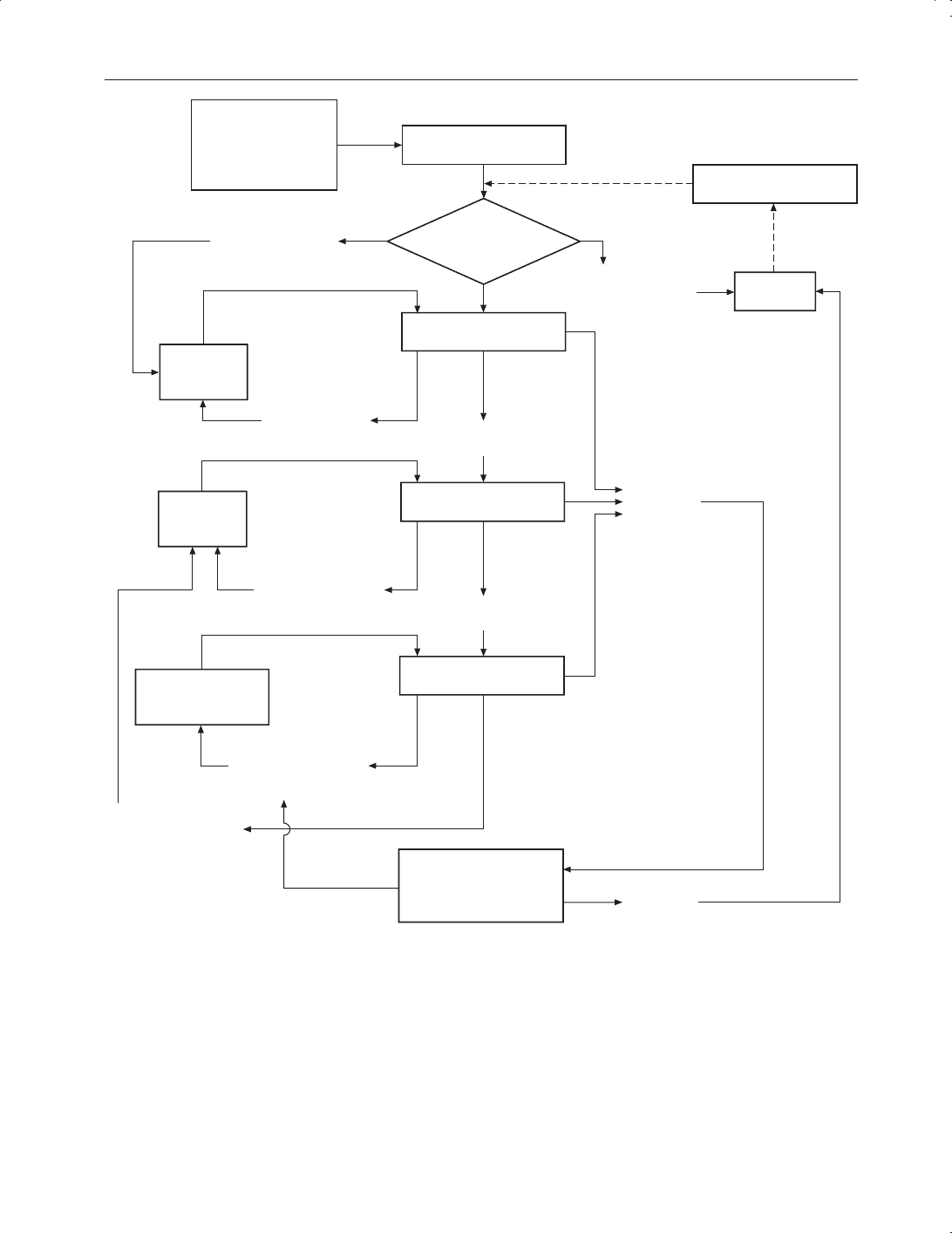
Figure 10.1
Monitoring strategies flow diagram
Existing process
New process
New exposure limit
Change in operation/
process/composition
Exposures assessed
as requiring immediate
action
Immediate
remedial
action
Some exposures
significantly in
excess of limit
Immediate
remedial
action
Some exposures in
excess of limit, or not
as low as reasonably
practicable
Corrective action
planned
improvements
Exposures below limit
but rising, or not as low
as is reasonably
practicable
Significant increase in
exposure with some
in excess of limit
Routine
monitoring
Low level
routine
(‘watchdog’)
monitoring
Exposures
decreasing
below level
of significance
Detailed survey
Exposures significant
but below limit
Exposures well
below limit and
as low as is
reasonably
practicable
Exposures mostly
below limit
Preliminary
survey
Exposures assessed
as below level of
significance
No further
sampling
Periodic
reassessment
Initial
assessment
Is an air sampling
study needed?
No No
Ye s

Table 10.31 Values for the range
Number of results k
32 0
10–31 0.1
6–9 0.2
5 0.3
4 0.4
3 0.8
20.9
Table 10.32 Recommended guidance for routine monitoring
Survey Results Action
Preliminary All <0.1 × OEL
(1)
None if exposures are as low as reasonably practical.
0.1–1.5 × OEL Investigate and carry out a more detailed survey.
Some >1.5 × OEL Investigate, take remedial action and repeat survey.
Detailed All <0.25 × OEL None if exposure is as low as reasonably practical.
≤1.25 × OEL Investigate, take remedial action and repeat survey.
Arithmetic mean <0.5 × OEL Consider routine monitoring and the appropriate frequency.
Mean >0.5 × OEL (or with Investigate, assess control measures, improve where
individual results scattered possible, repeat survey and consider routine monitoring.
above the limit)
Routine All Check values, mean, range, etc. Is there compliance with
OEL and if so what is confidence?
Differ significantly from Investigate, consider remedial action detailed survey or
previous survey change protocols.
(1)
Higher values can be used if standard is based on nuisance or odour and there are no known effects of the maximum
exposure concentration measured.
Pollution monitoring strategies in incident investigation
Industrial accidents involving hazardous chemicals include release of gas or vapour (including
deposition to land), fire, explosion, spillages to land, and discharges to water courses (including
surface waters, ground water, spring waters, saline waters, estuaries, potable waters, industrial
waste waters). Fires in storage facilities housing even apparently non-toxic chemicals such as
plastics can have an ecological impact because of plastic components or their pyrolytic breakdown
products, e.g. PAHs, or combustion products (Table 5.48).
In such accidents it may be imperative to determine:
• the severity of the incident;
• those chemicals that may have entered the environment;
• whether long-term problems are posed.
Personal safety, e.g. during the collection of samples for accident investigation purposes is the
joint responsibility of employers and employees, e.g. sampling at heights or in deep or fast-
flowing waters or close to fires. For fires, the distance downwind for sampling will be dictated by
the scale of the disaster as illustrated by Table 10.33 whereas for releases not involving a fire the
sampling points will be dictated by the gas, i.e. whether lighter or heavier than air.
POLLUTION MONITORING STRATEGIES IN INCIDENT INVESTIGATION 387

388 MONITORING TECHNIQUES
Table 10.33 Downwind distances to sample based on size of fire
Scale of fire Sample distances
Major 100 m, 350 m, 700 m, 1.25 km, 2.30 km, 4.25 km,15 km, 50 km
Large 50 m, 180 m, 350 m, 600 m, 1 km, 2 km, 7.5 km, 25 km
Medium 20 m, 70 m, 250 m, 850 m, 3 km, 10 km
Small 5 m, 20 m, 60 m, 200 m, 750 m, 2.5 km
Minor 2 m, 10 m, 25 m, 85 m, 300 m, 1 km
For releases to land, influencing factors include:
• duration and extent of release;
• type of release (liquid or solid);
• hydrogeology;
• soil permeability;
• soil vulnerability;
• land use;
• screening techniques;
• levels and characteristics of historic contamination;
• depth to take sample.
The aims of sampling are to establish whether contaminants are present, their distribution and
concentrations. Commonly-used sampling regimes include square grid, stratified random or simple
random techniques. Evenly-spaced sampling points may be appropriate if the contamination is
visible otherwise judgement is required based on whether the land slopes or is flat. Samples are
also taken near to the point of release.
Table 10.34 Data to record during accident investigation
• Information about the accident, e.g. date, time, magnitude and nature of release.
• Speed of response/dates of actions.
• Sample numbers and history, e.g. date, time of collection.
• Ecosystems, structures and individuals potentially affected.
• Number of samples collected and sampling pattern.
• Sample quality and sample programme.
• Resources.
• Analytical techniques (including method, accuracy, precision, reproducibility, robustness, limits of detection).
• Sample package, storage, transport and security to ensure integrity.
• List of sample equipment and calibration record.
• Names and training records of staff involved in sampling and analysis, or details of contract analysts and any quality
standards/accreditation schemes with which they comply.
• Physical and chemical properties of the chemical (
see
Chapter 12).
• The form in which it was released, and subsequent forms.
• Characteristics of the receiving ecosystem (e.g. solid type, ground water, drinking water, fish/shellfish water, bathing
water) and how it migrates from one environment to another.
• Meteorology during and after the accident.
• Topography.
• Environmental, health, or safety properties of the pollutants including their acute and chronic effects and any synergistic
effects.
• Visible environmental impact on site.
• Recorded quality of ecosystem prior to accident.
• Site plan with marked release points, sample points, detailed dimensions.
• Temperature of chemicals released.