
Charles D. Maginnis. Pen Drawing. An Illustrated Treatise
Подождите немного. Документ загружается.


on the whole it is most valuable as a curiosity. Though somewhat out of fashion for general use,
the quill of our fathers is favored by many illustrators. It is splendidly adapted for broad,
vigorous rendering of foreground effects, and is almost dangerously easy to handle. Reed pens,
which have somewhat similar virtues, are now little employed, and cannot be bought. They have
to be cut from the natural reed, and used while fresh. For many uses in decorative drawing one
of the most satisfactory instruments is the glass pen, which gives an absolutely uniform line. The
point being really the end of a thin tube, the stroke may be made in any direction, a most unique
characteristic in a pen. It has, however, the disadvantages of being friable and expensive; and, as
it needs to be kept clean, the patent water-proof ink should not be used with it unless absolutely
necessary. A flat piece of cork or rubber should be placed inside the ink-bottle when this pen is
used, otherwise it is liable to be smashed by striking the bottom of the bottle. The faculty
possessed by the Japanese brush of retaining its point renders it also available for use as a pen,
and it is often so employed.
Inks In drawing for reproduction, the best ink is that which is blackest and least shiny. Until a
few years ago it was the custom of penmen to grind their India ink themselves; but, besides the
difficulty of always ensuring the proper consistency, it was a cumbersome method, and is now
little resorted to, especially as numerous excellent prepared inks are ready to hand. The better
known of these prepared inks are, "Higgins' American" (general and waterproof), Bourgeois'
"Encre de Chine Liquide," "Carter's," "Winsor & Newton's," and "Rowney's." Higgins' and
Carter's have the extrinsic advantages of being put up in bottles which do not tip over on the
slightest provocation, and of being furnished with stoppers which can be handled without
smearing the fingers. Otherwise, they cannot be said to possess superiority over the others,
certainly not over the "Encre de Chine Liquide." Should the student have occasion to draw over
salt-prints he will find it wise to use waterproof ink, as the bleaching acid which is used to fade
the photographic image may otherwise cause the ink to run.
Papers Bristol-board is probably the most popular of all surfaces for pen drawing. It is
certainly that most approved by the process engraver, whose point of view in such a matter,
though a purely mechanical one, is worthy of consideration. It has a perfectly smooth surface,
somewhat difficult to erase from with rubber, and which had better be scratched with a knife
when any considerable erasure is necessary. As the cheap boards are merely a padding veneered
on either side with a thin coating of smooth paper, little scraping is required to develop a fuzzy
surface upon which it is impossible to work. Only the best board, such as Reynolds', therefore,
should be used. Bristol-board can be procured in sheets of various thicknesses as well as in
blocks.
Whatman's "hot-pressed" paper affords another excellent surface and possesses some
advantages over the Bristol-board. It comes in sheets of various sizes, which may be either
tacked down on a board or else "stretched." Tacking will be satisfactory enough if the drawing is
small and is to be completed in a few hours; otherwise the paper is sure to "hump up," especially
if the weather be damp. The process of stretching is as follows: Fold up the edges of the sheet all
around, forming a margin about an inch wide. After moistening the paper thoroughly with a
damp sponge, cover the under side of this turned-up margin with photographic paste or strong
mucilage. During this operation the sheet will have softened and "humped up," and will admit of
stretching. Now turn down the adhesive margin and press it firmly with the fingers, stretching
the paper gently at the same time. As this essential part of the process must be performed
quickly, an assistant is requisite when the sheet is large. Care should be taken that the paper is
not strained too much, as it is then likely to burst when it again contracts.

Although generally employed for watercolor drawing, Whatman's "cold-pressed" paper has
some advantages as a pen surface. Slightly roughish in texture, it gives an interesting broken
line, which is at times desirable.
A peculiar paper which has considerable vogue, especially in France and England, is what is
known as "clay-board." Its surface is composed of China clay, grained in various ways, the top
of the grain being marked with fine black lines which give a gray tone to the paper, darker or
lighter according to the character of the pattern. This tone provides the middle-tint for the
drawing. By lightly scraping with a sharp penknife or scratcher, before or after the pen work is
done, a more delicate gray tone may be obtained, while vigorous scraping will produce an
absolute white. With the pen work added, it will be seen that a good many values are possible;
and, if the drawing be not reduced more than one-third, it will print excellently. The grain,
running as it does in straight lines, offers a good deal of obstruction to the pen, however, so that
a really good line is impossible.
Thin letter-paper is sometimes recommended for pen and ink work, chiefly on account of its
transparency, which obviates the necessity of re-drawing after a preliminary sketch has been
worked up in pencil. Over the pencil study a sheet of the letter-paper is placed on which the final
drawing may be made with much deliberation. Bond paper, however, possesses the similar
advantage of transparency besides affording a better texture for the pen.
CHAPTER III
TECHNIQUE
The Individual Line The first requirement of a good pen technique is a good Individual Line, a
line of feeling and quality. It is usually a surprise to the beginner to be made aware that the
individual line is a thing of consequence,—a surprise due, without doubt, to the apparently
careless methods of some successful illustrators. It is to be borne in mind, however, that some
illustrators are successful in spite of their technique rather than because of it; and also that the
apparently free and easy manner of some admirable technicians is in reality very much studied,
very deliberate, and not at all to be confounded with the unsophisticated scribbling of the
beginner. The student is apt to find it just about as easy to draw like Mr. Pennell as to write like
Mr. Kipling. The best way to acquire such a superb freedom is to be very, very careful and
painstaking. To appreciate how beautiful the individual line may be one has but to observe the
rich, decorative stroke of Howard Pyle, Fig. 66, or that of Mucha, Fig. 65, the tender outline of
Boutet de Monvel, the telling, masterly sweep of Gibson, or the short, crisp line of Vierge or
Rico. Compared with any of these the line of the beginner will be either feeble and tentative, or
harsh, wiry, and coarse.
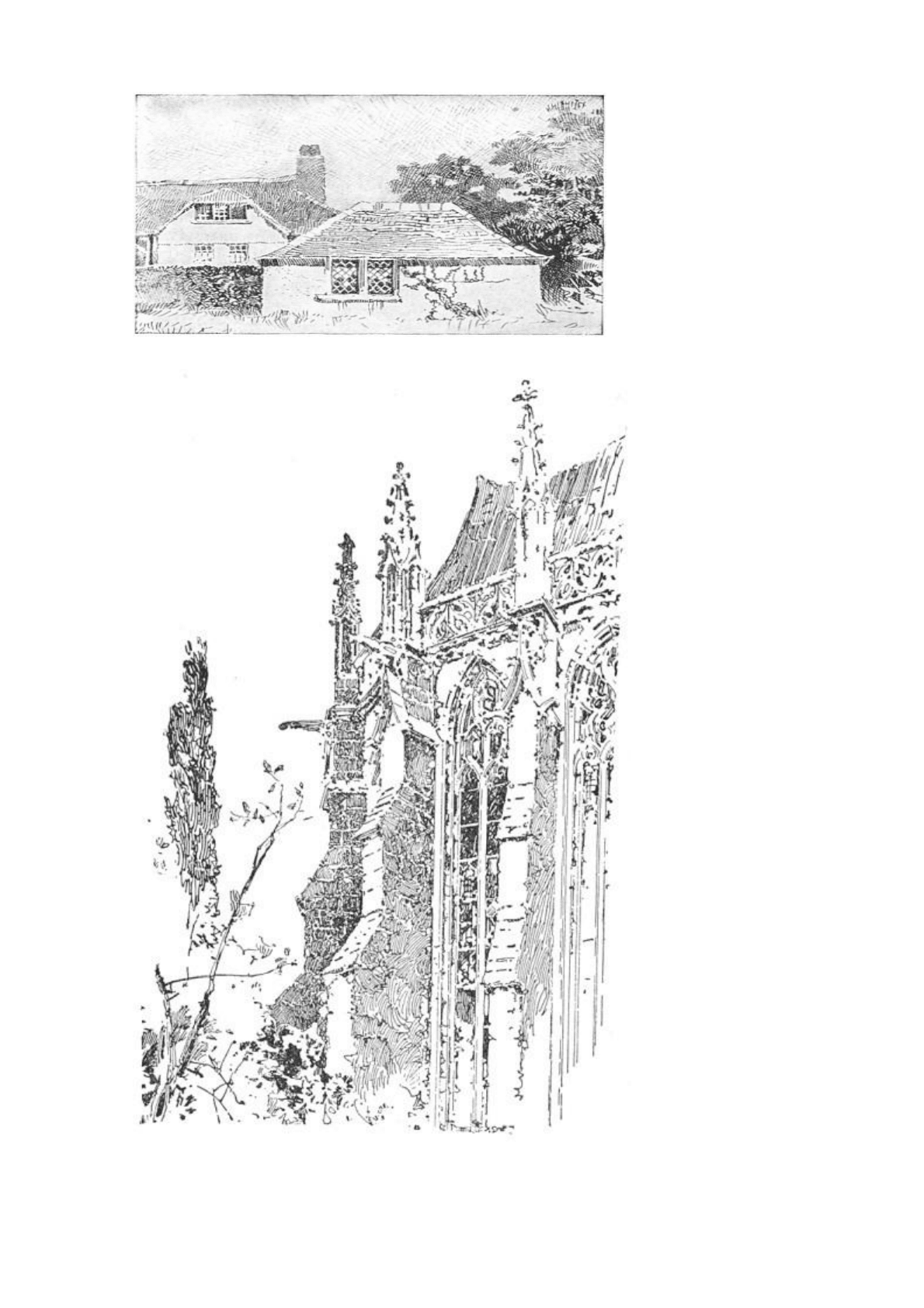
FIG. 6
B. G. GOODHUE
FIG. 7
HERBERT RAILTON
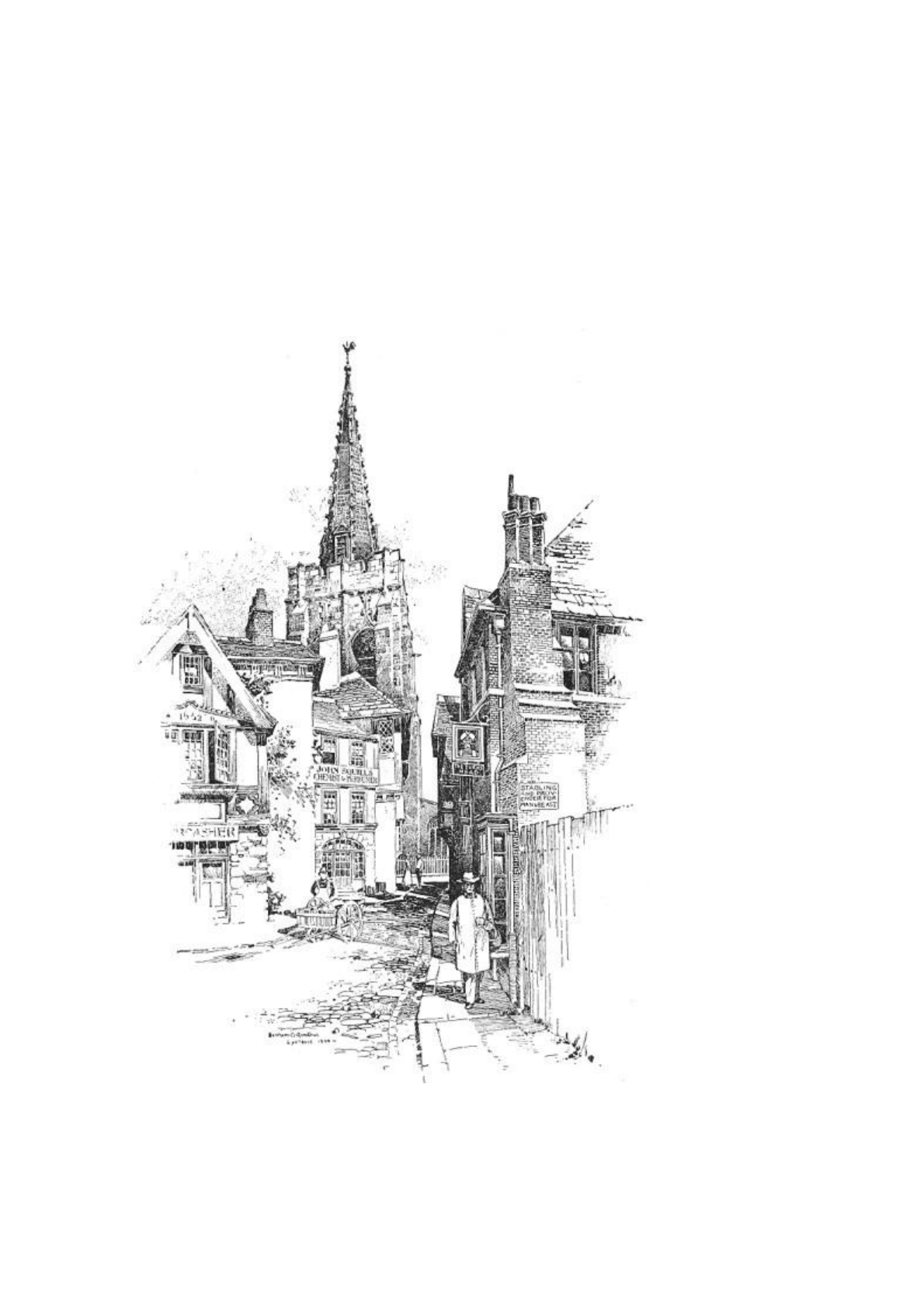
Variety of Line The second requisite is Variety of Line,—not merely variety of size and
direction, but, since each line ought to exhibit a feeling for the particular texture which it is
contributing to express, variety of character. Mr. Gibson's manner of placing very delicate gray
lines against a series of heavy black strokes exemplifies some of the possibilities of such variety.
Observe, in Fig. 6, what significance is imparted to the heavy lines on the roof of the little
foreground building by the foil of delicate gray lines in the sky and surrounding roofs. This
conjunction was employed early by Mr. Herbert Railton, who has made a beautiful use of it in
his quaint architectural subjects. Mr. Railton's technique is remarkable also for the varied
direction of line and its expression of texture. Note this characteristic in his drawing of
buttresses, Fig. 7.
FIG. 8
B. G. GOODHUE
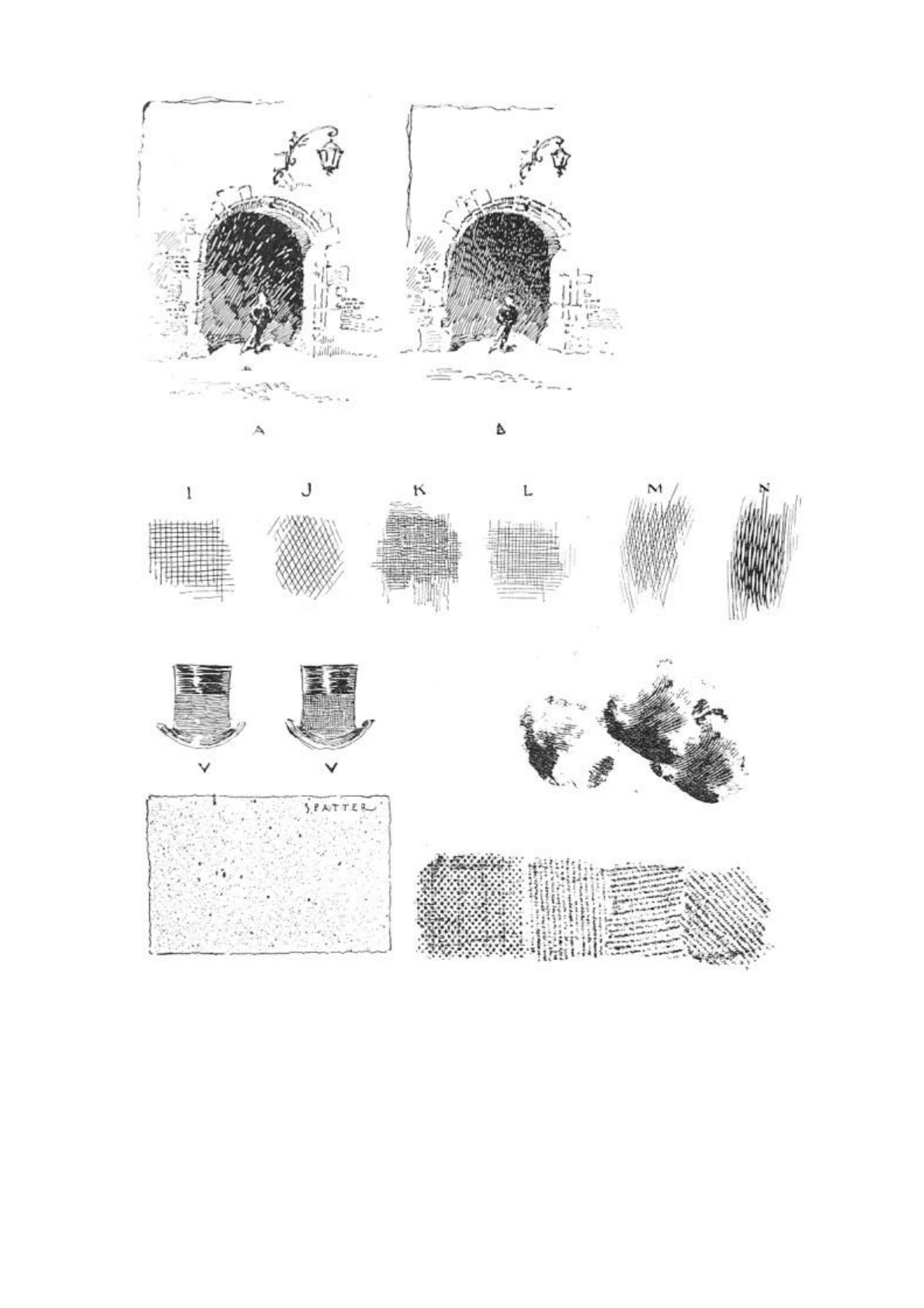
FIG. 9
C. D. M.
FIG. 10
C. D. M.
Economy of Method The third element of good technique is Economy and Directness of
Method. A tone should not be built up of a lot of meaningless strokes. Each line ought, sensibly
and directly, to contribute to the ultimate result. The old mechanical process of constructing
tones by cross-hatching is now almost obsolete. It is still employed by modern pen draughtsmen,
but it is only one of many resources, and is used with nice discrimination. At times a cross-hatch
is very desirable and very effective,—as, for example, in affording a subdued background for
figures having small, high lights. A very pretty use of it is seen in the tower of Mr. Goodhue's
drawing, Fig. 8. Observe here how the intimate treatment of the roofs is enhanced and relieved

by the foil of closely-knit hatch on the tower-wall, and how effective is the little area of it at the
base of the spire. The cross-hatch also affords a satisfactory method of obtaining deep, quiet
shadows. See the archway "B" in Fig. 9. On the whole, however, the student is advised to
accustom himself to a very sparing use of this expedient. Compare the two effects in Fig. 9,
Some examples of good and bad cross-hatching are illustrated in Fig. 10. Those marked "I" and
"J" may be set down as bad, being too coarse. The only satisfactory cross-hatch at a large scale
would seem to be that shown in "N," where lines cross at a sharp angle; and this variety is
effectively employed by figure illustrators. Perhaps no better argument against the necessity for
thus building up tones could be adduced than the little drawing by Martin Rico, shown in Fig.
11. Notice what a beautiful texture he gives to the shadow where it falls on the street, how it
differs from that on the walls, how deep and closely knit it all is, and yet that there is absolutely
no cross-hatching. Remark, also, how the textures of the walls and roof and sky are obtained.
The student would do well to copy such a drawing as this, or a portion of it, at least, on a larger
scale, as much can be learned from it.
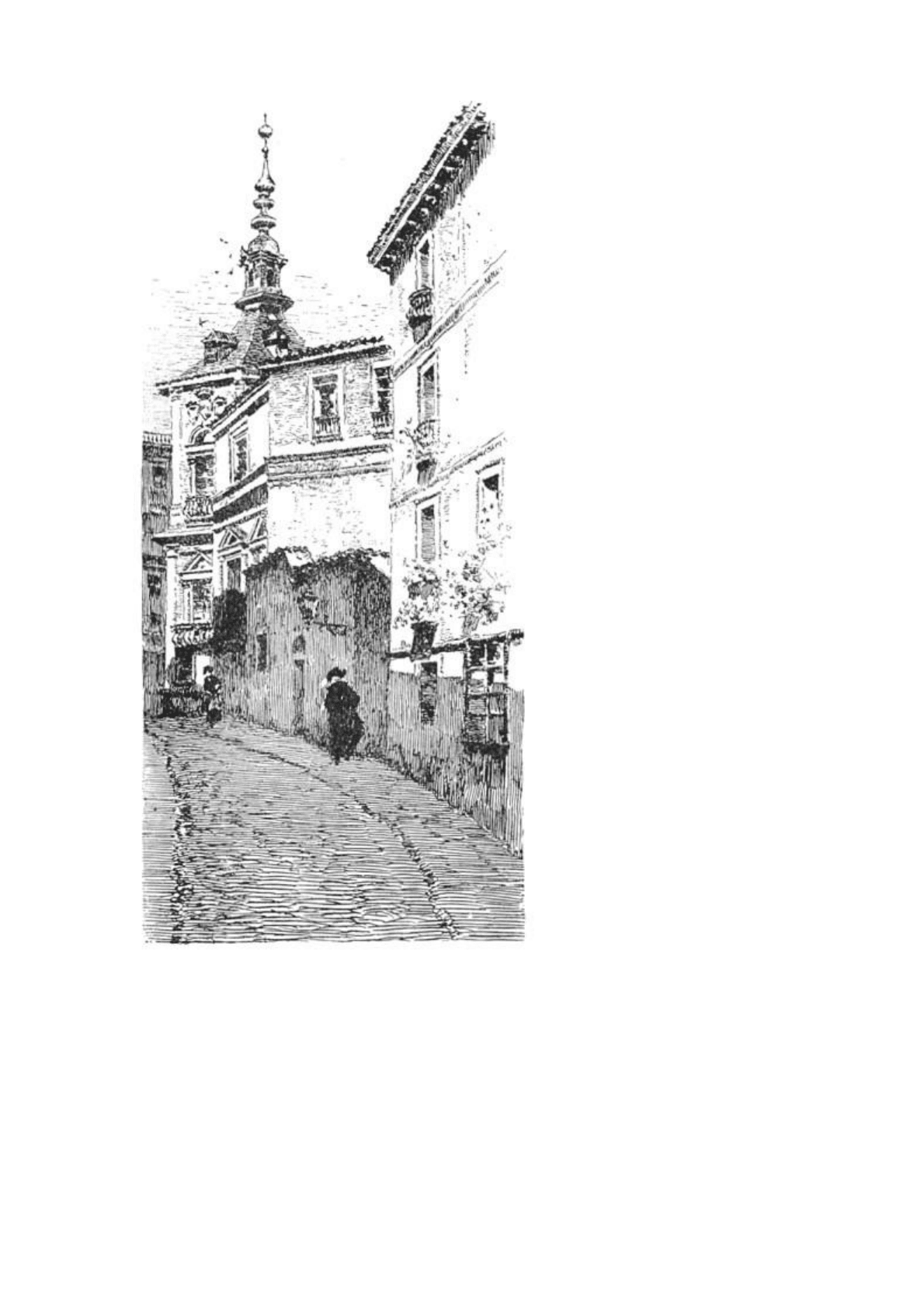
FIG. 11
MARTIN RICO
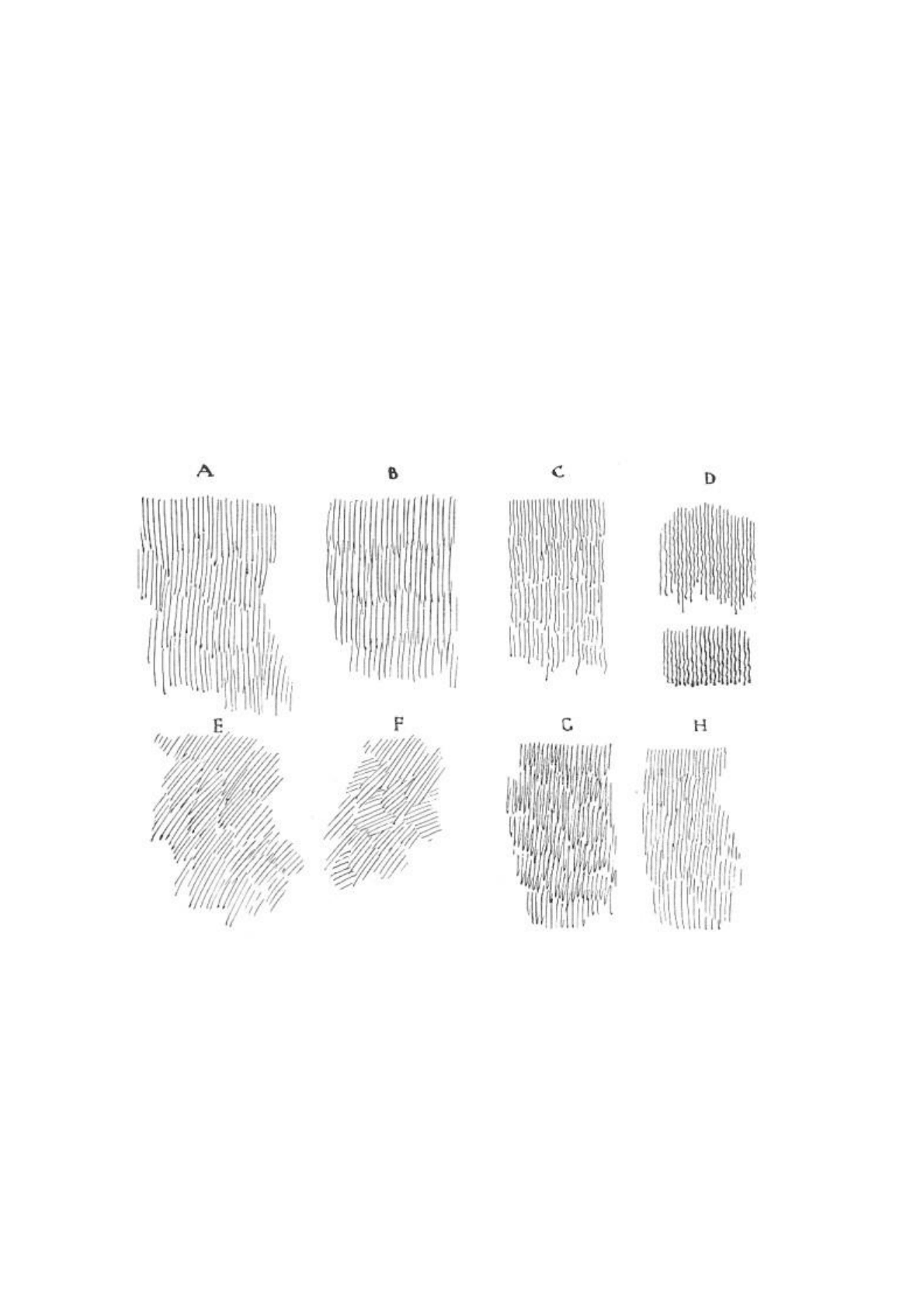
Methods of Tone-Making I have shown various methods of making a tone in Fig. 12. It will be
observed that Rico's shadow, in Fig. 11, is made up of a combination of "B" and "C," except that
he uses "B" horizontally, and makes the line heavy and dragging. The clear, crisp shadows of
Vierge are also worthy of study for the simplicity of method. This is beautifully illustrated in the
detail, Fig. 13. It would be impossible to suggest atmosphere more vibrating with sunlight; a
result due to the transparency of the shadows, the lines of which are sharp and clean, with never
a suggestion of cross-hatch. Notice how the lines of the architectural shadows are stopped
abruptly at times, giving an emphasis which adds to the brilliancy of the effect. The drawing of
the buildings on the canal, by Martin Rico, Fig. 14, ought also to be carefully studied in this
connection. Observe how the shadow-lines in this drawing, as in that previously mentioned, are
made to suggest the direction of the sunlight, which is high in the heavens. An example of all
that is refined and excellent in pen technique is the drawing by Mr. Alfred Brennan, Fig. 15. The
student would do well to study this carefully for its marvellous beauty of line. There is little
hatching, and yet the tones are deep and rich. The wall tone will be found to be made up
similarly to "A" and "H" in Fig. 12. The tone "B" in the same Figure is made up of lines which
are thin at the ends and big in the middle, fitting into each other irregularly, and imparting a
texture somewhat different from that obtained by the abrupt ending of the strokes of "A." This
method is also employed by Brennan, and is a very effective one. A good example of the use of
this character of line (unknitted, however) is the drawing by Mr. Leslie Willson, Fig. 16. The
irregular line "C" has good possibilities for texture, and the wavy character of "D" is most
effective in the rendering of shadows, giving a certain vibration to the atmosphere. "E" and "F"
suggest a freer method of rendering a tone; while "G" shows a scribbling line that is sometimes
employed to advantage. The very interesting texture of the coat, Fig. 17, is made with a
horizontal line having a similar return stroke, as may be noticed where the rendering ends. There
are times when an irresponsible sort of line is positively desirable,—say for rough foreground
suggestion or for freeing the picture at the edges.
FIG. 12
C. D. M.
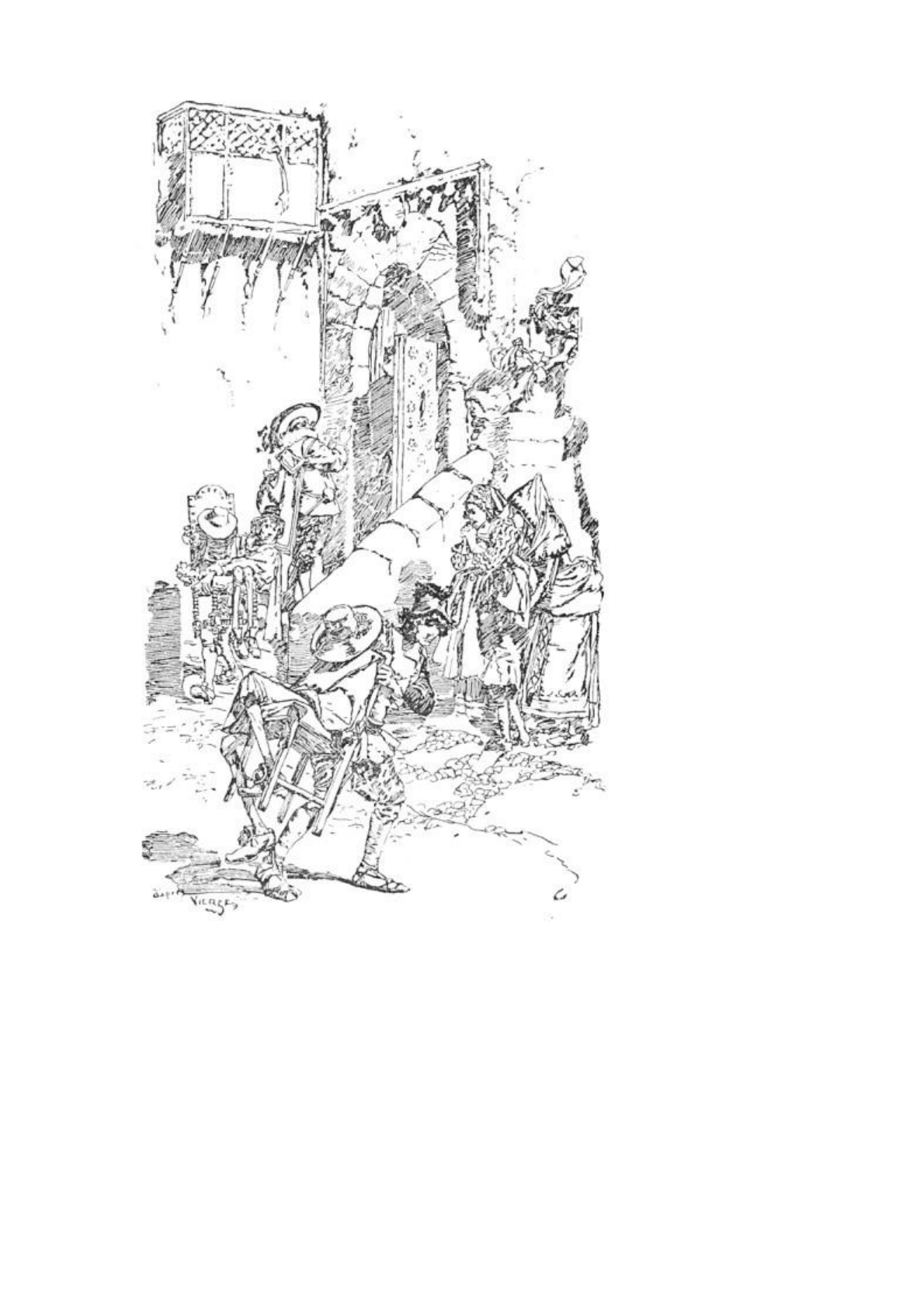
FIG. 13
DANIEL VIERGE
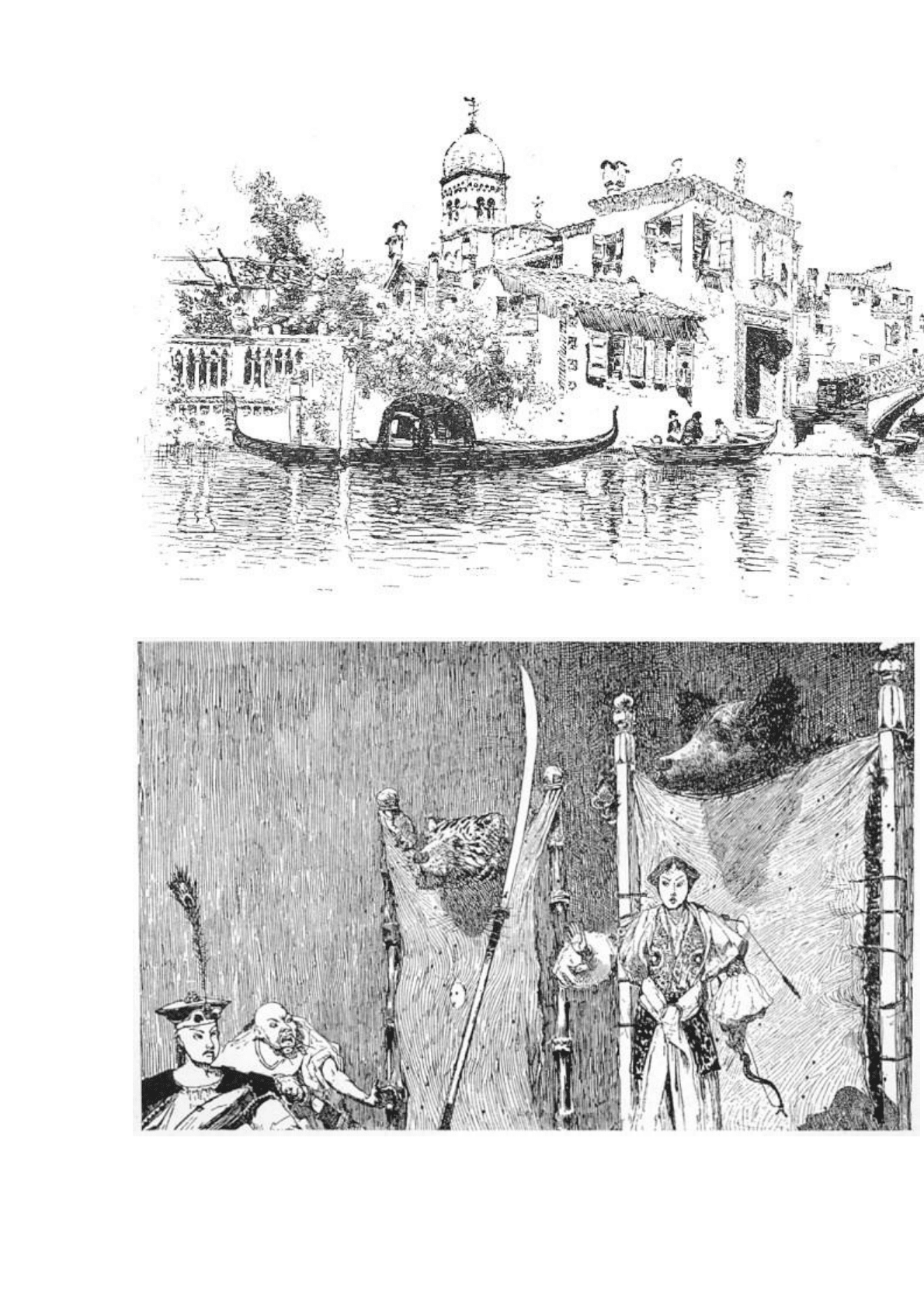
FIG. 14
MARTIN RICO
FIG. 15
ALFRED BRENNAN