
Charles D. Maginnis. Pen Drawing. An Illustrated Treatise
Подождите немного. Документ загружается.

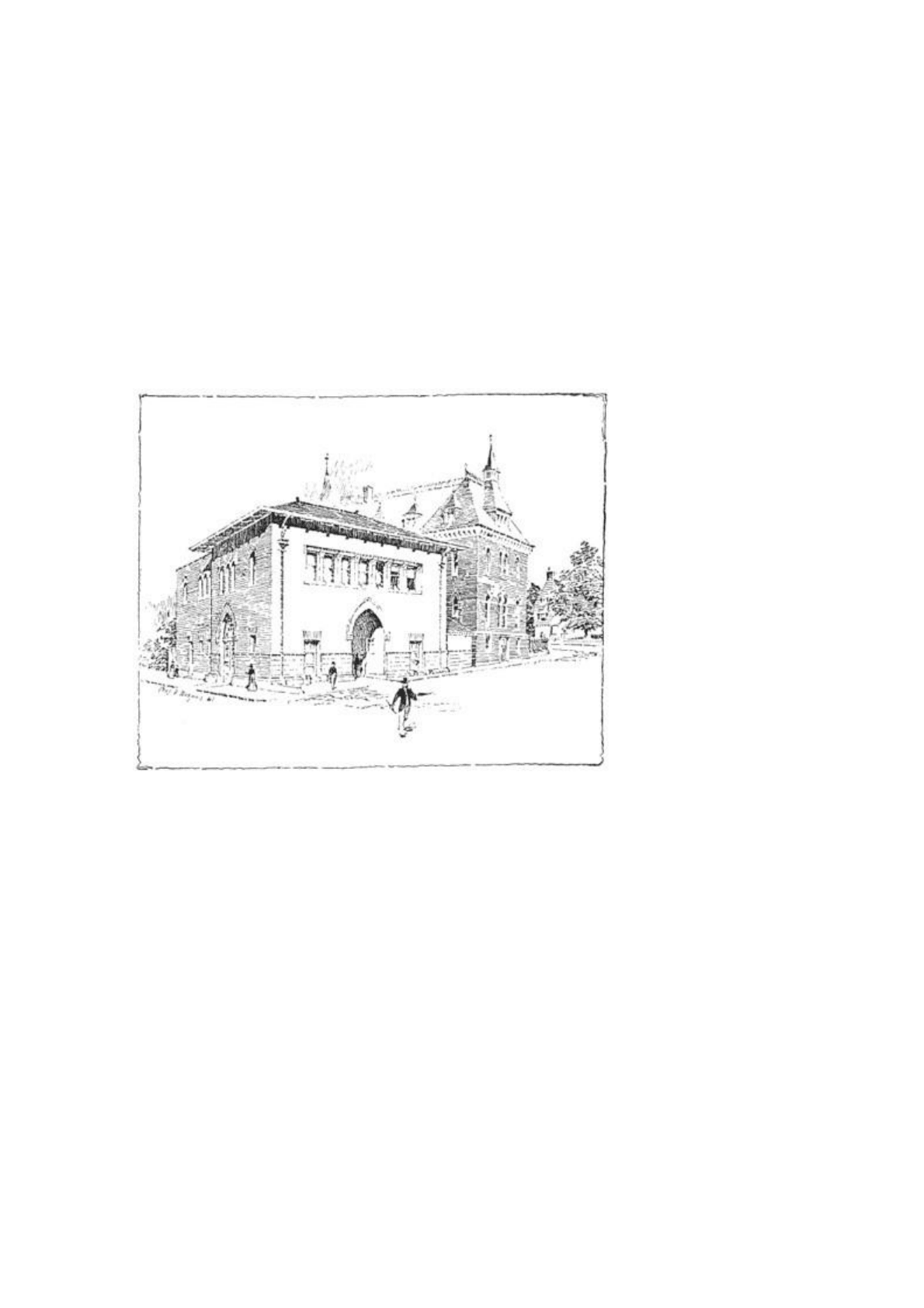
it.* As it is, the difficulty lies in the long crested roof-line which takes the same oblique angle as
the line of the street, and the influence of this line must be, as far as possible, counteracted. Now
the heavy over-hang of the principal roof will naturally cast a shadow which will be an
important line in the composition, so we arrange our accessories at the right of the picture in
reference to this. Observe that the line of the eaves, if continued, would intersect the top of the
gable chimney. The dwelling and the tree then form a focus for the converging lines of sidewalk
and roof, thus qualifying the vertical effect of the building on the right. As the obliquity of the
composition is still objectionable, we decide to introduce a foreground figure which will break
up the line of the long sidewalk, and place it so that it will increase the influence of some
contrary line, see Fig. 59. We find that by putting it a little to the right of the entrance and on a
line with that of the left sidewalk, the picture is pleasingly balanced.
[Footnote *: See footnote on page 62.]
FIG. 59
C. D. M.
We are now ready to consider the disposition of the values. As I have said before, these are
determined by the scheme of light and shade. For this reason any given subject may be variously
treated. We do not necessarily seek the scheme which will make the most pictorial effect,
however, but the one which will serve to set off the building to the best advantage. It is apparent
that the most intelligible idea of the form of the structure will be given by shading one side; and,
as the front is the more important and the more interesting elevation, on which we need sunlight
to give expression to the composition, it is natural to shade the other, thus affording a foil for the
bright effects on the front. This bright effect will be further enhanced if we assume that the local
color of the roof is darker than that of the walls, so that we can give it a gray tone, which will
also make the main building stand away from the other. If, however, we were to likewise assume
that the roof of the other building were darker than its walls, we should be obliged to emphasize
the objectionable roof line, and as, in any case, we want a dark effect lower down on the walls to
give relief to our main building, we will assume that the local color of the older walls is darker
than that of the new. The shadow of the main cornice we will make quite strong, emphasis being
placed on the nearer corner, which is made almost black. This color is repeated in the windows,
which, coming as they do in a group, are some of them more filled in than others, to avoid an
effect of monotony. The strong note of the drawing is then given by the foreground figure.
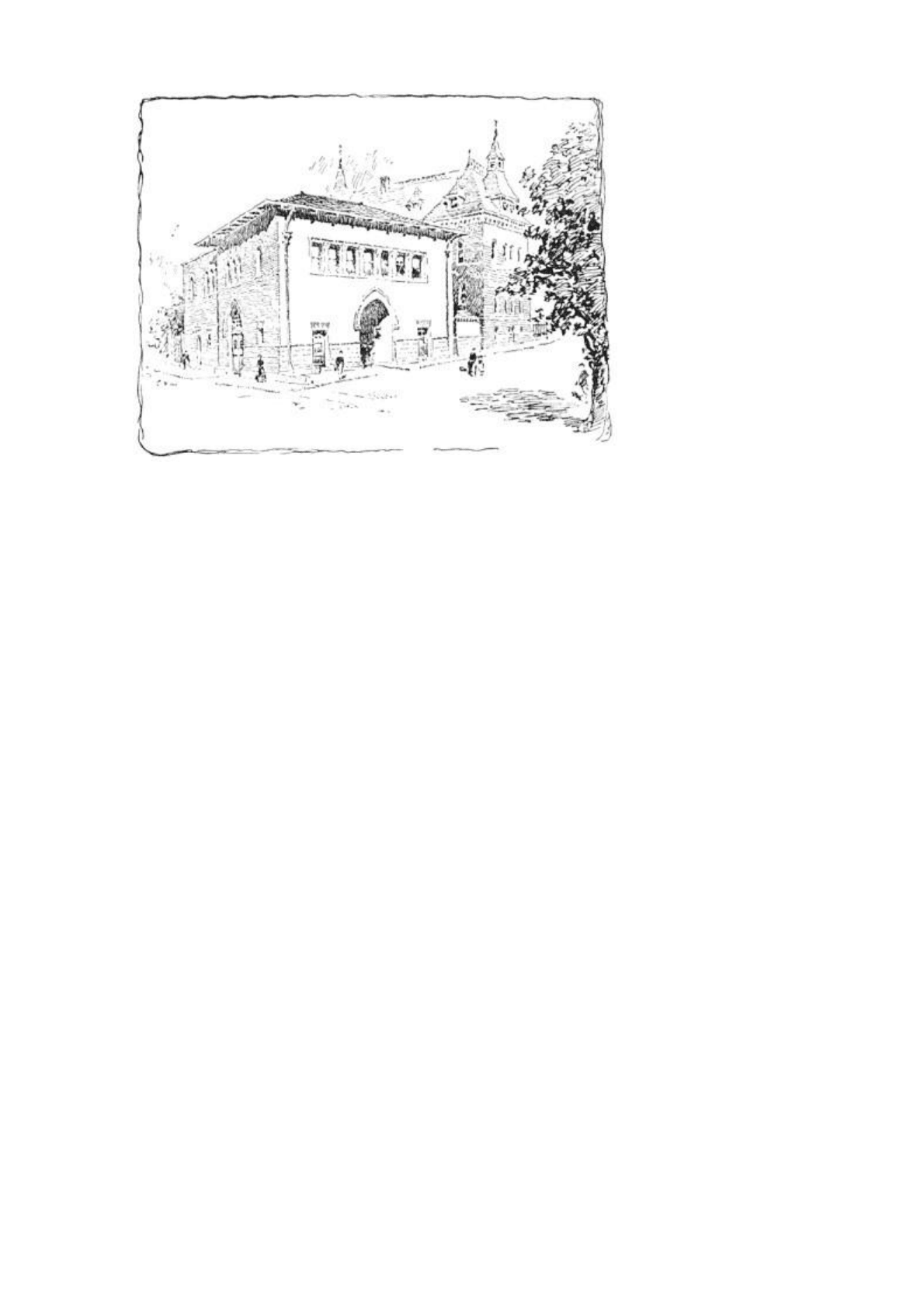
FIG. 60
C. D. M.
Another scheme for the treatment of this same subject is illustrated by Fig. 60. Here, by the
introduction of the tree at the right of the picture, a triangular composition is adopted. Observe
that the sidewalk and roof lines at the left side of the building radiate to the bottom and top of
the tree respectively. The shadow of the tree helps to form the bottom line of the triangle. In this
case the foreground figure is omitted, as it would have made the triangularity too obvious. In the
color-scheme the tree is made the principal dark, and this dark is repeated in the cornice shadow,
windows and figures as before. The gray tone of the old building qualifies the blackness of the
tree, which would otherwise have made too strong a contrast at the edge of the picture, and so
detracted from the interest of the main building.
CHAPTER VII
DECORATIVE DRAWING
In all modern decorative illustration, and, indeed, in all departments of decorative design, the
influences of two very different and distinct points of view are noticeable; the one demanding a
realistic, the other a purely conventional art. The logic of the first is, that all good pictorial art is
essentially decorative; that of the second, that the decorative subject must be designed in organic
relation to the space which it is to occupy, and be so treated that the design will primarily fulfil a
purely ornamental function. That is to say, whatever of dramatic or literary interest the
decorative design may possess must be, as it were, woven into it, so that the general effect shall
please as instantly, as directly, and as independently of the meaning, as the pattern of an Oriental
rug. The former, it will be seen, is an imitative, the latter an inventive art. In the one, the
elements of the subject are rendered with all possible naturalism; while, in the other, effects of
atmosphere and the accidental play of light and shade are sacrificed to a conventional rendering,
by which the design is kept flat upon the paper or wall. One represents the point of view of the
painter and the pictorial illustrator; the other that of the designer and the architect. The second,
or conventional idea, has now come to be widely accepted as a true basic principle in decorative
art.
The New Decorative School The idea is not by any means novel; it has always been the
fundamental principle of Japanese art; but its genesis was not in Japan. The immediate
inspiration of the new Decorative school, as far as it is concerned with the decoration of books,
at least, was found in the art of Dürer, Holbein, and the German engravers of the sixteenth
century,—interest in which period has been lately so stimulated by the Arts and Crafts
movement in England. This movement, which may fairly be regarded as one of the most
powerful influences in latter-day art, was begun with the aim of restoring those healthy
conditions which obtained before the artist and the craftsman came to be two distinct and very
much extranged workers. The activities of the movement were at first more directly concerned
with the art of good book-making, which fructified in the famous Kelmscott Press (an institution
which, while necessarily undemocratic, has exerted a tremendous influence on modern printing),
and to-day there is scarcely any sphere of industrial art which has not been influenced by the
Arts and Crafts impetus.
Criticisms of the School This modern decorative renaissance has a root in sound art principles,
which promises for it a vigorous vitality; and perhaps the only serious criticism which has been
directed against it is, that it encourages archaic crudities of technique which ignore the high
development of the reproductive processes of the present day; and, moreover, that its sympathies
tend towards mediæval life and feeling. While such a criticism might reasonably be suggested by
the work of some of its individual adherents, it does not touch in the least the essential principles
of the school. Art cannot be said to scout modernity because it refuses to adjust itself to the
every caprice of Science. The architect rather despises the mechanically perfect brick (very
much to the surprise of the manufacturer); and though the camera can record more than the
pencil or the brush, yet the artist is not trying to see more than he ever did before. There are, too,
many decorative illustrators who, while very distinctly confessing their indebtedness to old
examples; are yet perfectly eclectic and individual, both in the choice and development of
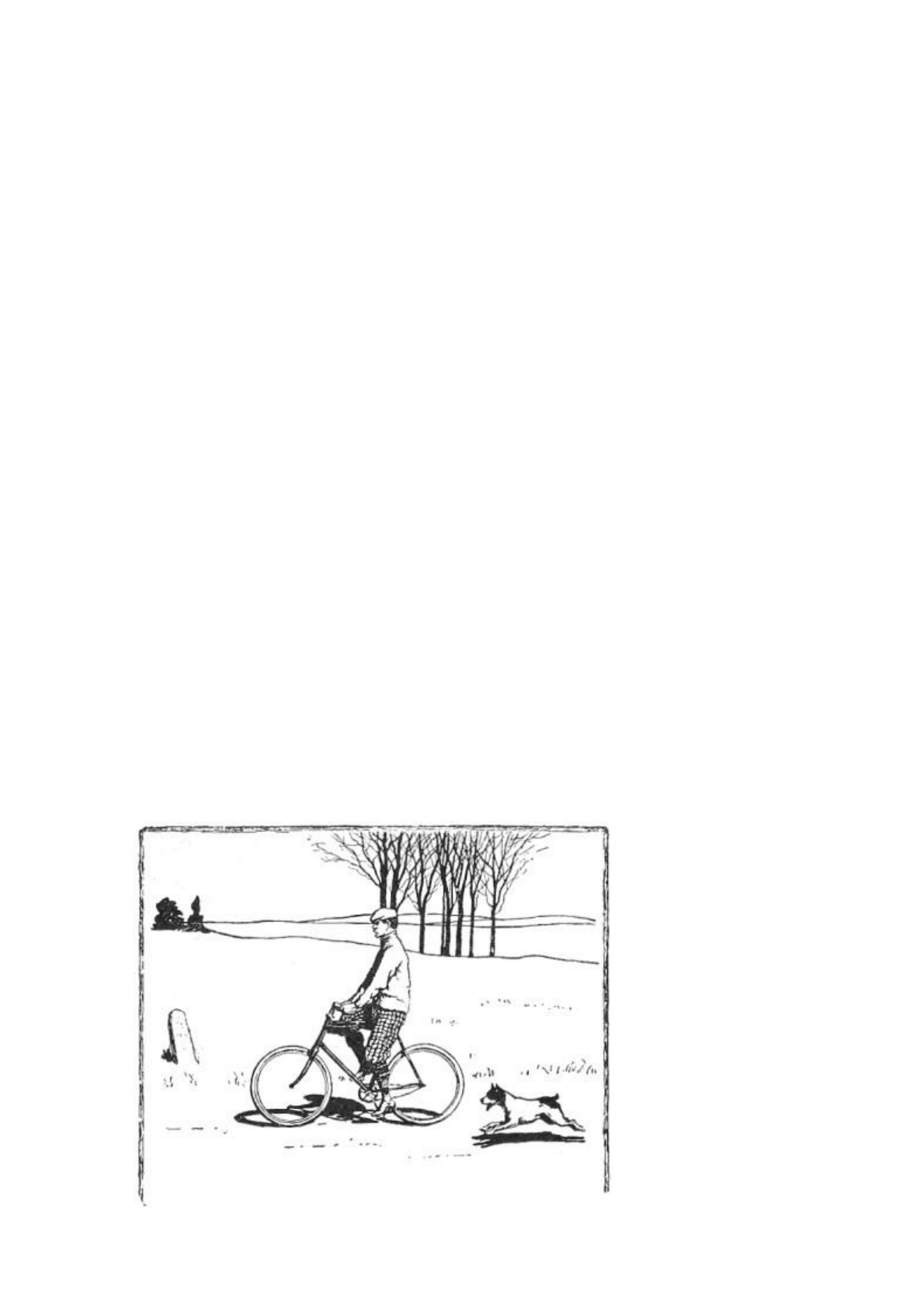
motive. Take, for example, the very modern subject of the cyclist by Mr. A. B. Frost, Fig. 61.
There are no archaisms in it whatever. The drawing is as naturalistic and just as careful as if it
were designed for a picture. The shadows, too, are cast, giving an effect of strong outdoor light;
but the treatment, broad and beautifully simple so as to be reconcilable with the lettering which
accompanied it, is well within conventional lines. That the character of the technical treatment is
such as to place no tax on the mechanical inventiveness of the processman is not inexcusable
archæology.

FIG. 61
A. B. FROST
A valuable attribute of this conventional art is, that it puts no bounds to the fancy of the
designer. It is a figurative language in which he may get away from commonplace statement.
What has always seemed to me a very logical employment of convention appears in the Punch
cartoons of Sir John Tenniel and Mr. Lindley Sambourne. Even in those cartoons which are
devoid of physical caricature (and they are generally free from this), we see at a glance that it is
the political and not the personal relations of the personæ that are represented; whereas in the
naturalistic cartoons of Puck, for example, one cannot resist the feeling that personalities are
being roughly handled.
Relation A chief principle in all decorative design and treatment is that of Relation. If the
space to be ornamented be a book-page the design and treatment must be such as to harmonize
with the printing. The type must be considered as an element in the design, and, as the effect of a
page of type is broad and uniformly flat, the ornament must be made to count as broad and flat
likewise. The same principle holds equally in mural decoration. There the design ought to be
subordinate to the general effect of the architecture. The wall is not to be considered merely as a
convenient place on which to plaster a picture, its structural purpose must be regarded, and this
cannot be expressed if the design or treatment be purely pictorial—if vague perspective
distances and strong foreground accents be used without symmetry or order, except that order
which governs itself alone. In other words, the decoration must be organic.
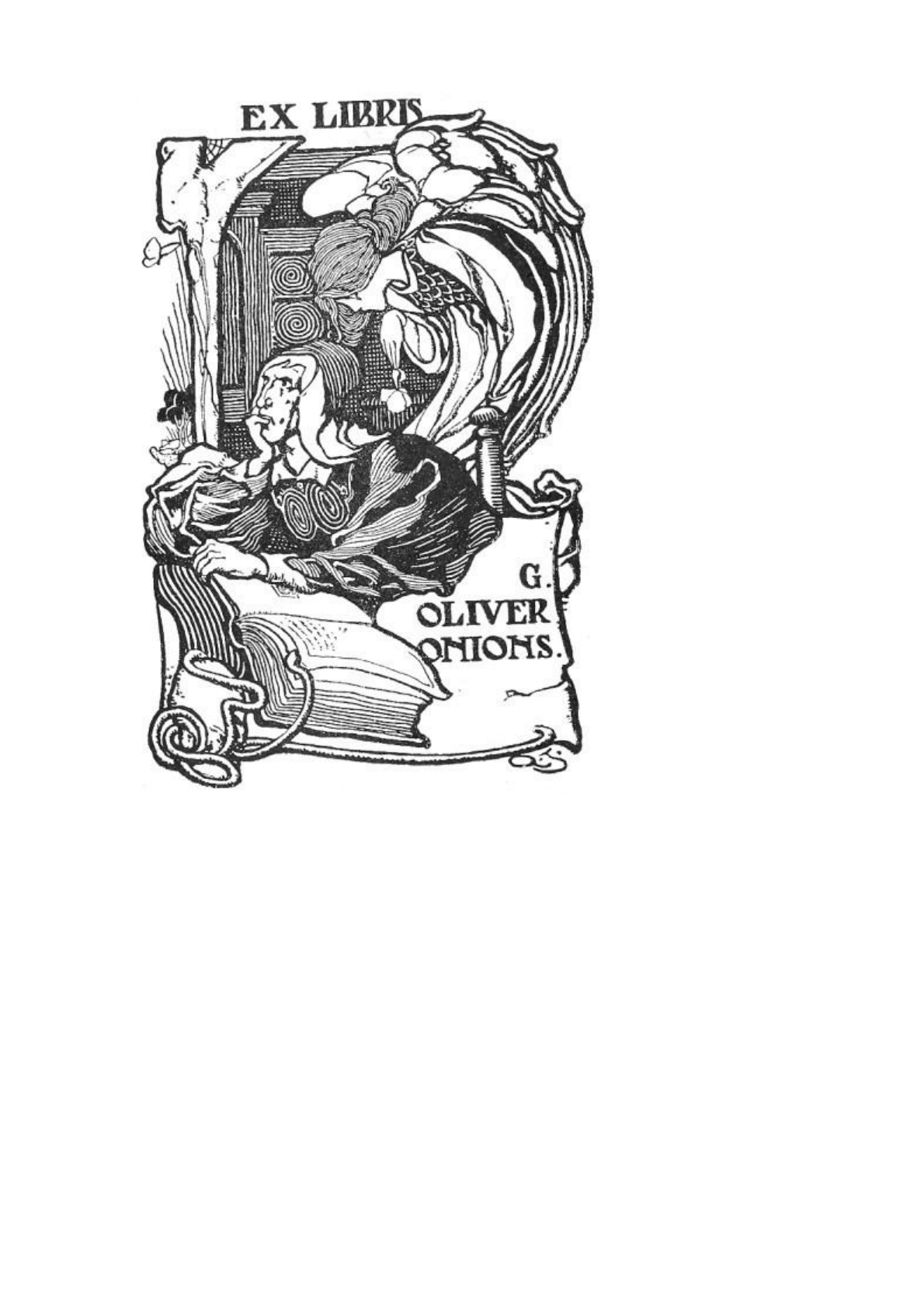
FIG. 62
ALFRED G. JONES
Classes of Decorative Design Decorative illustrations may be broadly classified under three
heads as follows: First, those wherein the composition and the treatment are both conventional,
as, for example, in the ex-libris by Mr. A. G. Jones, Fig. 62. Second, where the composition is
naturalistic, and the treatment only is conventional, as in Mr. Frost's design. Third, where the
composition is decorative but not conventional, and the treatment is semi-natural, as in the
drawing by Mr. Walter Appleton Clark, Fig. 63. (The latter subject is of such a character as to
lend itself without convention to a decorative effect; and, although the figure is modeled as in a
pictorial illustration, the organic lines are so emphasized throughout as to preserve the
decorative character, and the whole keeps its place on the page.) Under this third head would be
included those subjects of a pictorial nature whose composition and values are such as to make
them reconcilable to a decorative use by means of borders or very defined edges, as in the
illustration by Mr. A. Campbell Cross, Fig. 64.
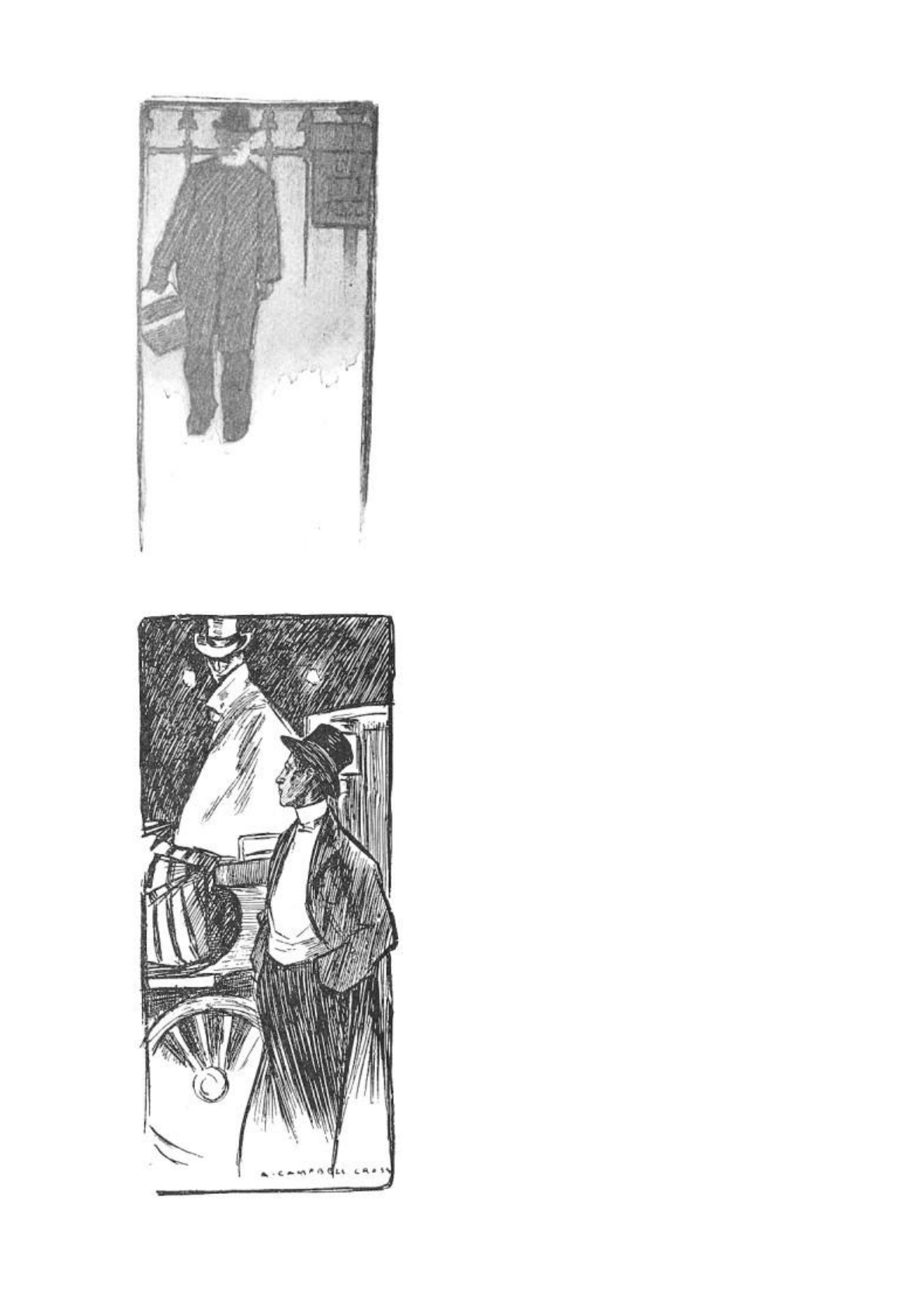
FIG.
63
W. APPLETON
CLARK
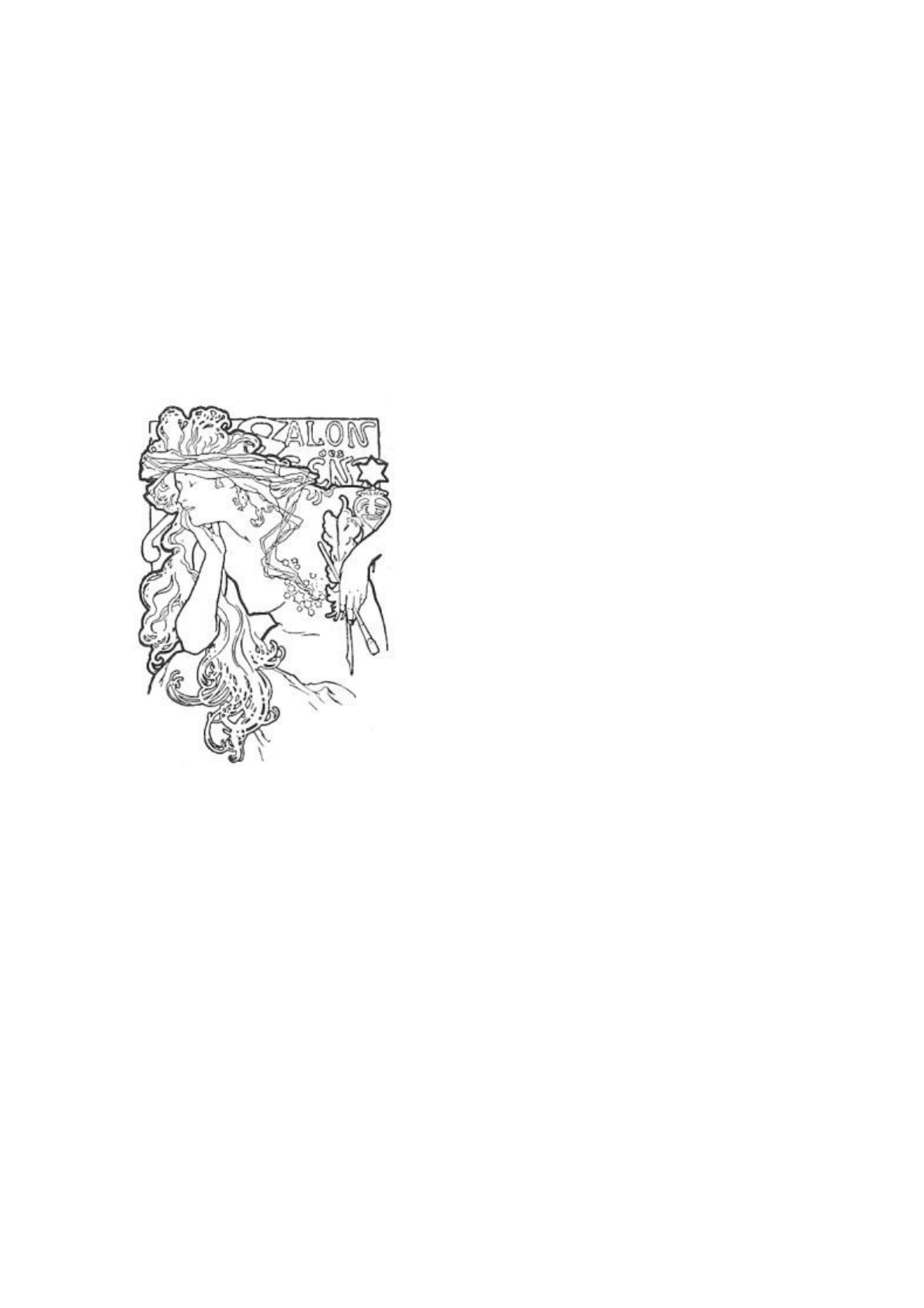
FIG. 64
A. CAMPBELL CROSS
The Decorative Outline Another essential characteristic of decorative drawing is the
emphasized Outline. This may be heavy or delicate, according to the nature of the subject or
individual taste. The designs by Mr. W. Nicholson and Mr. Selwyn Image, for instance, are
drawn with a fatness of outline not to be obtained with anything but a brush; while the outlines
of M. Boutet de Monvel, marked as they are, are evidently the work of a more than usually fine
pen. In each case, however, everything is in keeping with the scale of the outline adopted, so that
this always retains its proper emphasis. The decorative outline should never be broken, but
should be kept firm, positive, and uniform. It may be heavy, and yet be rich and feeling, as may
be seen in the Mucha design, Fig.65. Generally speaking, the line ought not to be made with a
nervous stroke, but rather with a slow, deliberate drag. The natural wavering of the hand need
occasion no anxiety, and, indeed, it is often more helpful to the line than otherwise.
FIG. 65
MUCHA
Perhaps there is no more difficult thing to do well than to model the figure while still
preserving the decorative outline. Several examples of the skilful accomplishment of this
problem are illustrated here. Observe, for instance, how in the quaint Dürer-like design by Mr.
Howard Pyle, Fig. 66, the edges of the drapery-folds are emphasized in the shadow by keeping
them white, and see how wonderfully effective the result is. The same device is also to be
noticed in the book-plate design by Mr. A. G. Jones, Fig. 62, as well as in the more conventional
treatment of the black figure in the Bradley poster, Fig. 67.
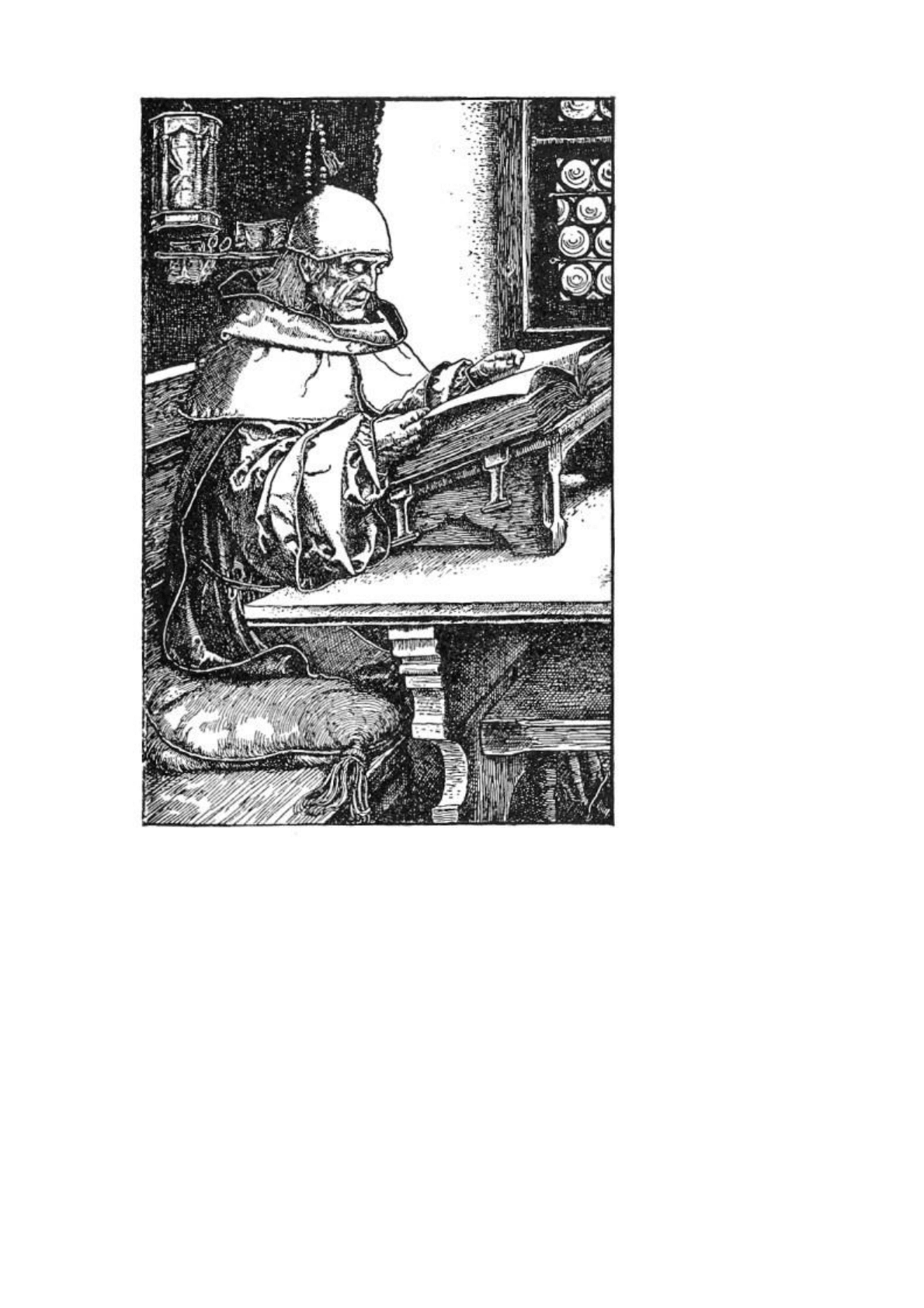
FIG. 66
HOWARD PYLE
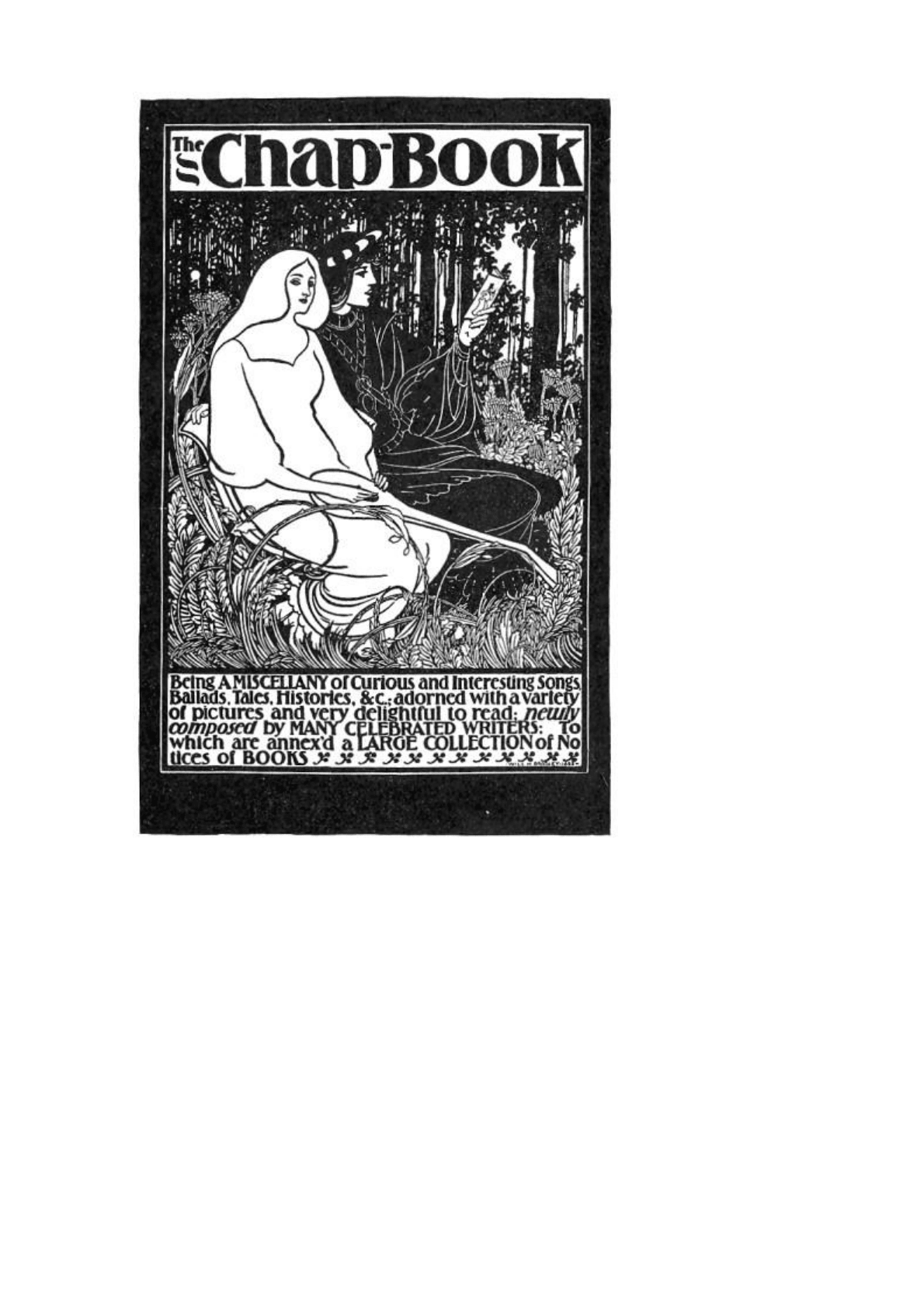
FIG. 67
WILL H. BRADLEY
Color In the rendering of decorative subjects, the Color should be, as much as possible,
designed. Whereas a poster, which is made with a view to its entire effect being grasped at once,
may be rendered in flat masses of color, the head- or tail-piece for a decorative book-page
should be worked out in more detail, and the design should be finer and more varied in color.
The more the color is attained by means of pattern, instead of by mere irresponsible lines, the
more decorative is the result. Observe the color-making by pattern in the book-plate by Mr. P. J.
Billinghurst, Fig. 68. A great variety of textures may be obtained by means of varied patterns
without affecting the breadth of the color-scheme. This may be noticed in the design last
mentioned, in which the textures are extremely well rendered, as well as in the poster design by
Mr. Bradley for the Chap-Book, just referred to.
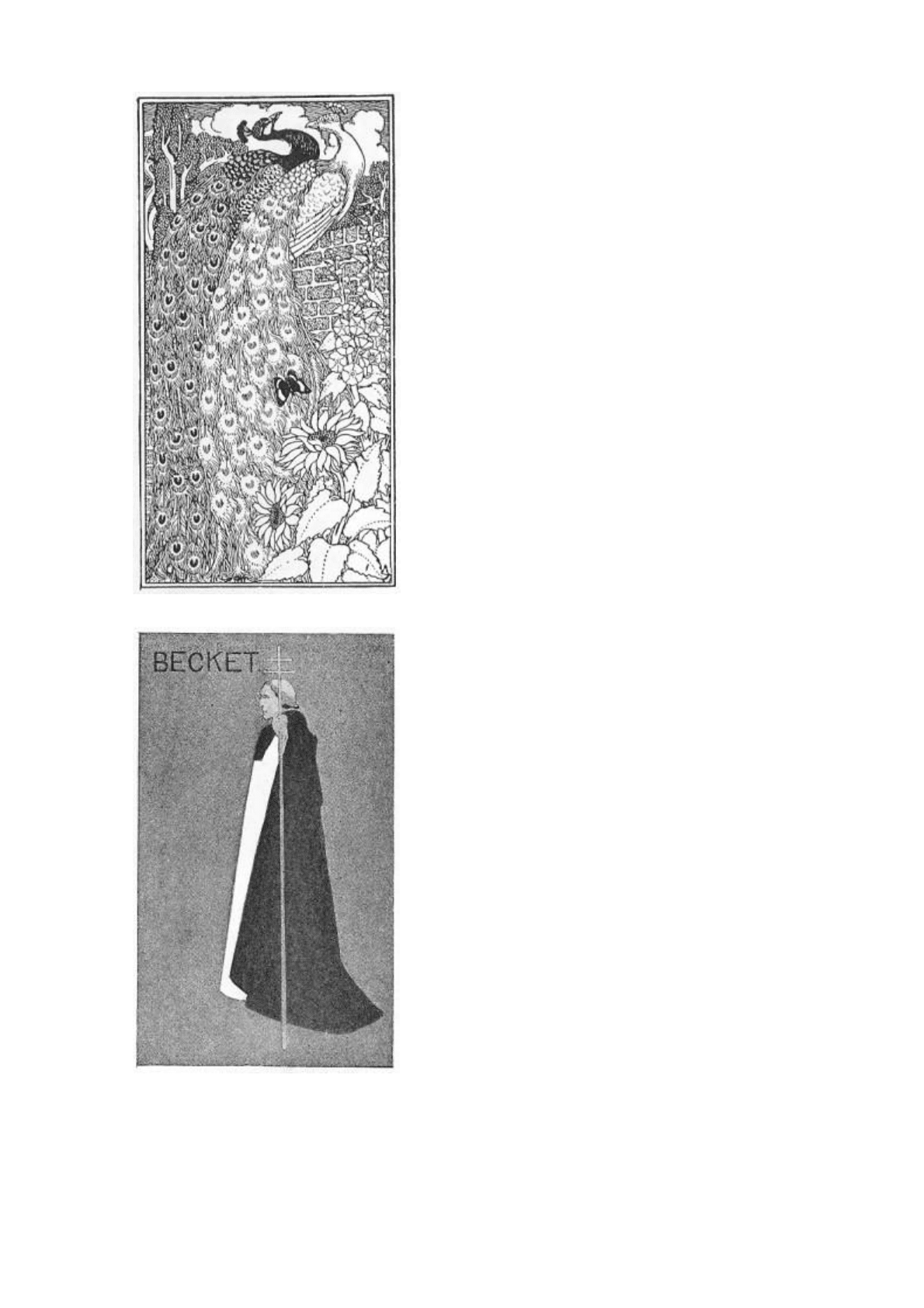
FIG. 68
P. J. BILLINGHURST
FIG.
69
"BEGGARSTAFF
BROTHERS"
The color-scheme ought to be simple and broad. No set rules can be laid down to govern its
disposition, which must always have reference to the whole design. The importance of
employing such a broad and simple scheme in decorative drawing needs no better argument than