
Charles D. Maginnis. Pen Drawing. An Illustrated Treatise
Подождите немного. Документ загружается.

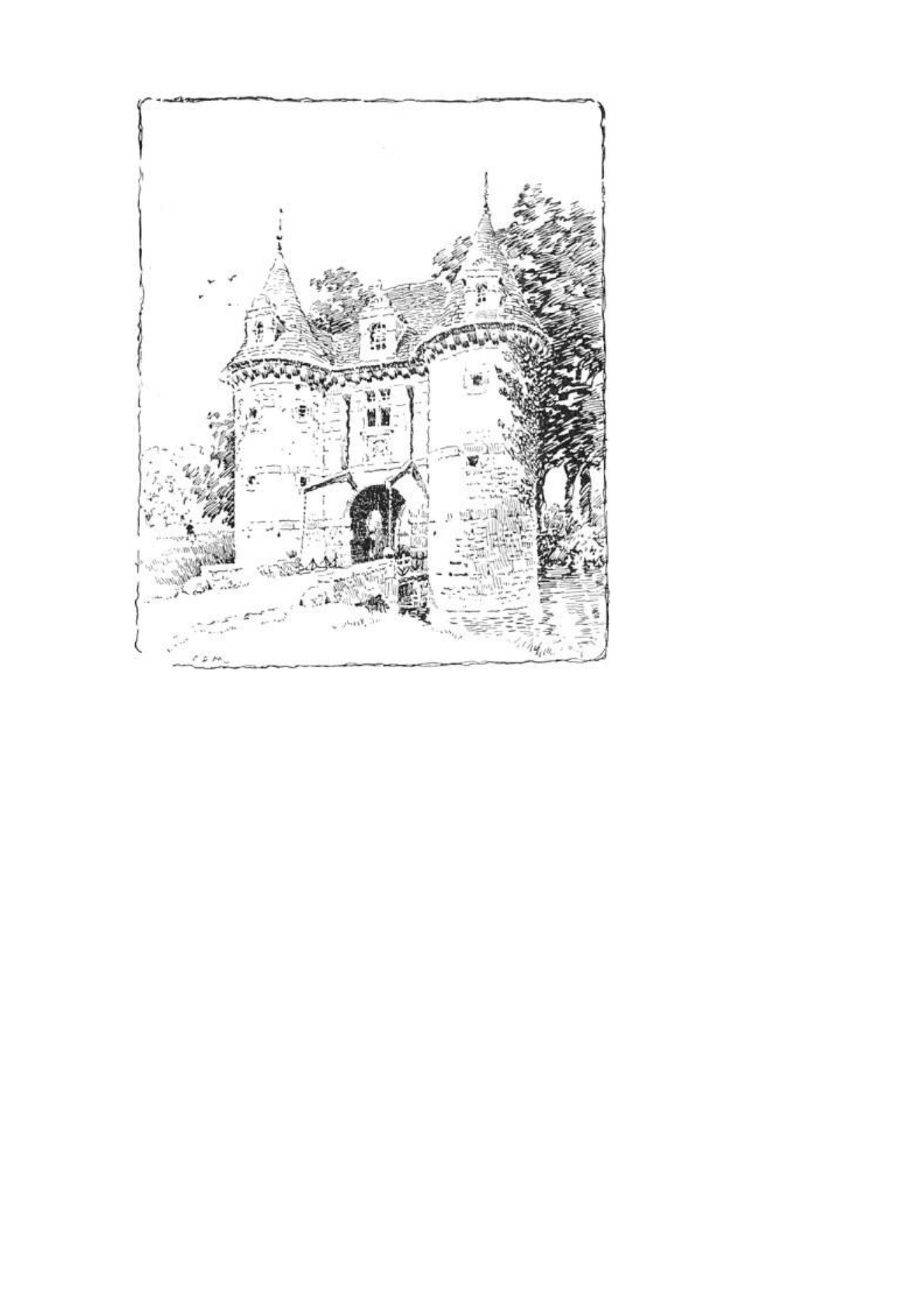
FIG. 38
C. D. M.
It will be noticed that the trees are not nearly so dark as in the photograph. If they were, they
would be overpowering in so large an area of white. It was thought better, also, to change the
direction of the light, so that the dark ivy, instead of acting contradictorily to the effect, might
lend character to the shaded side. The lower portion of the nearer tower was toned in, partly to
qualify the vertical line of the tower, which would have been unpleasant if the shading were
uniform, and partly to carry the gray around to the entrance. It was thought advisable, also, to cut
from the foreground, raising the upper limit of the picture correspondingly. (It is far from my
intention, however, to convey the impression that any liberties may be taken with a subject in
order to persuade it into a particular scheme of composition; and in this very instance an artistic
photographer could probably have discovered a position for his camera which would have
obviated the necessity for any change whatever;—a nearer view of the building, for one thing,
would have considerably lowered the trees.)
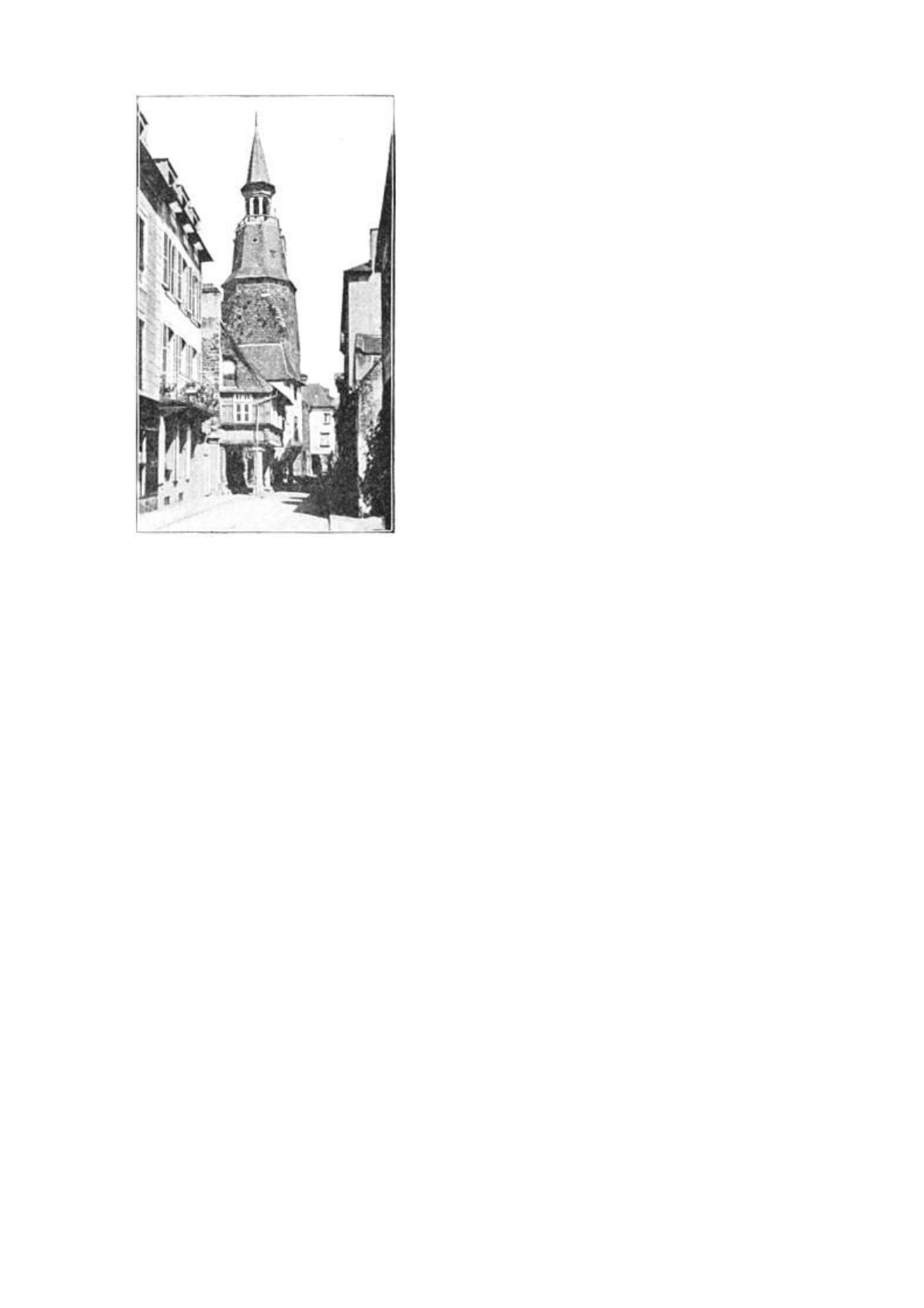
FIG.
39
FROM A PHOTOGRAPH
Third Problem We will consider still another subject. The photograph, Fig. 39, shows a street
in Holland. In this case, the first thing we have to determine is where the interest of the subject
centres. In such a perspective the salient point of the picture often lies in a foreground building;
or, if the street be merely a setting for the representation of some incident, in a group of
foreground figures. In either case the emphasis should be placed in the foreground, the distant
vanishing lines of the street being rendered more or less vaguely. In the present subject,
however, the converging sky and street lines are broken by the quaint clock-tower. This and the
buildings underneath it appeal to us at once as the most important elements of the picture. The
nearer buildings present nothing intrinsically interesting, and therefore serve no better purpose
than to lead the eye to the centre of interest. Whatever actual values these intermediate buildings
have that will hinder their usefulness in this regard can, therefore, be changed or actually ignored
without affecting the integrity of the sketch or causing any pangs of conscience.
The building on the extreme left shows very strong contrasts of color in the black shadow of
the eaves and of the shop-front below. These contrasts, coming as they do at the edge of the
picture, are bad. They would act like a showy frame on a delicate drawing, keeping the eye from
the real subject. It may be objected, however, that it is natural that the contrasts should be
stronger in the foreground. Yes; but in looking straight at the clock-tower one does not see any
such dark shadow at the top of the very uninteresting building in the left foreground. The camera
saw it, because the camera with its hundred eyes sees everything, and does not interest itself
about any one thing in particular. Besides, if the keeper of the shop had the bad taste to paint it
dark we are not bound to make a record of the fact; nor need we assume that it was done out of
regard to the pictorial possibilities of the street. We decide, therefore, to render, as faithfully as
we may, the values of the clock-tower and its immediate surroundings, and to disregard the
discordant elements; and we have no hesitation in selecting for principal emphasis in our
drawing, Fig. 40, the shadow under the projecting building. This dark accent will count
brilliantly against the foreground and the walls of the buildings, which we will treat broadly as if
white, ignoring the slight differences in value shown in the photograph. We retain, however, the
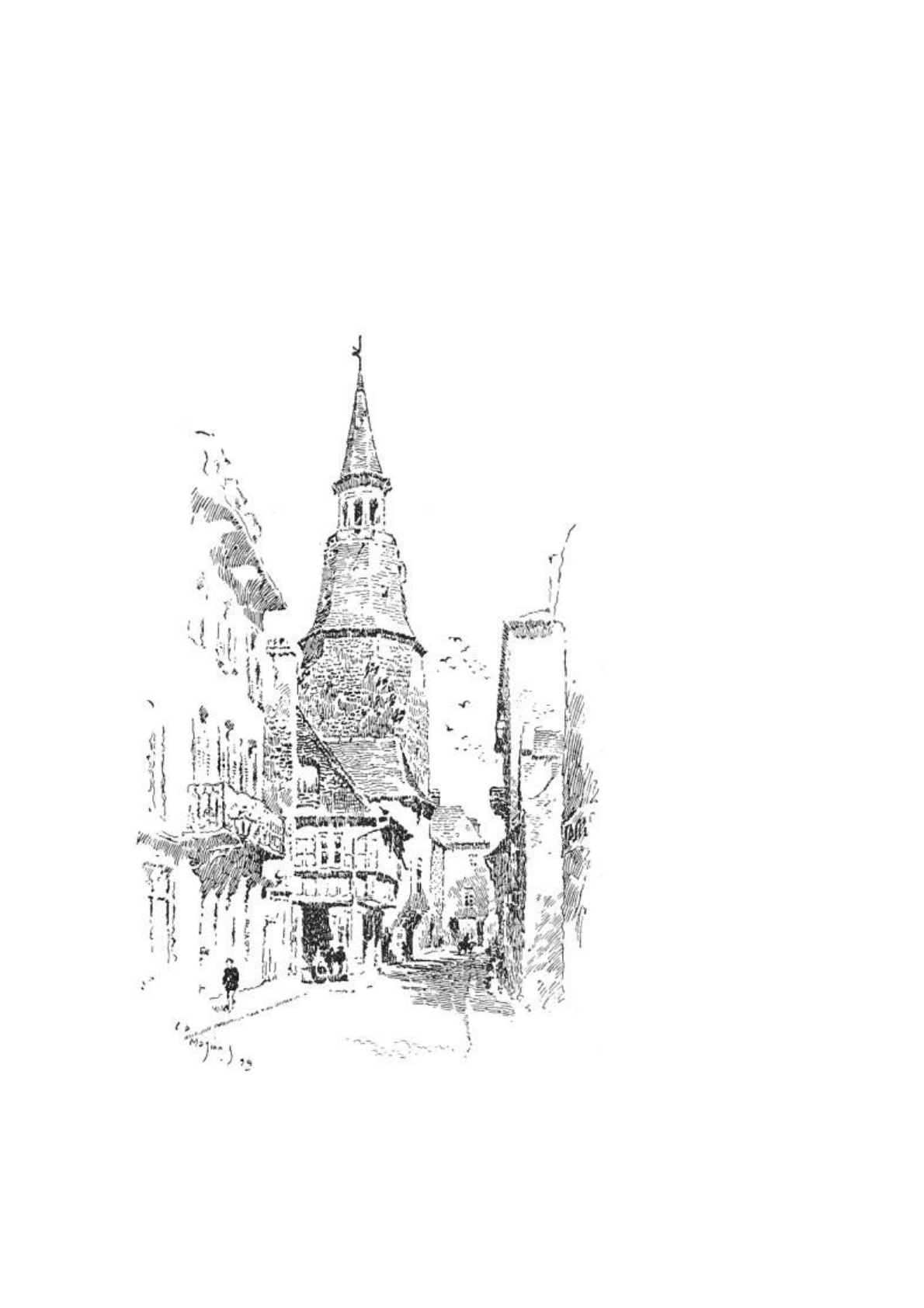
literal values of the clock-tower and the buildings underneath it, and express as nearly as we can
their interesting variations of texture. The buildings on the right are too black in the photograph,
and these, as well as the shadow thrown across the street, we will considerably lighten. After
some experiment, we find that the building on the extreme left is a nuisance, and we omit it.
Even then, the one with the balcony next to it requires to be toned down in its strong values, and
so the shadows here are made much lighter, the walls being kept white. It will be found that
anything like a strong emphasis of the projecting eaves of the building would detract from the
effect of the tower, so that the shadow under the eaves is, therefore, made grayer than in the
photograph, while that of the balcony below is made stronger than the shadow of the eaves, but
is lightened at the edge of the drawing to throw the emphasis toward the centre.
FIG. 40
C. D. M.
To add interest to the picture, and more especially to give life to the shadows, several figures
are introduced. It will be noticed that the cart is inserted at the focal point of the drawing to
better assist the perspective.

CHAPTER VI
ARCHITECTURAL DRAWING
It is but a few years since architects' perspectives were "built up" (it would be a mistake to say
"drawn") by means of a T-square and the ruling pen; and if architectural drawing has not quite
kept pace with that for general illustration since, a backward glance over the professional
magazines encourages a feeling of comparative complacency. That so high a standard or so
artistic a character is not observable in architectural as in general illustration is, I think, not
difficult to explain. Very few of the clever architectural draughtsmen are illustrators by
profession. Few, even of those who are generally known as illustrators, are anything more—I
should perhaps say anything less—than versatile architects; and yet Mr. Pennell, who would
appear to assume, in his book on drawing, that the point of view of the architect is normally
pictorial, seems at a loss to explain why Mr. Robert Blum, for instance, can illustrate an
architectural subject more artistically than any of the draughtsmen in the profession. Without
accepting his premises, it is remarkably creditable to architecture that it counts among its
members in this country such men as Mr. B. G. Goodhue and Mr. Wilson Eyre, Jr., and in
England such thorough artists as Mr. Prentice and Mr. Ernest George—men known even to
distinction for their skill along lines of purely architectural practice, yet any one of whom would,
I venture to say, cause considerable displacement did he invade the ranks of magazine
illustrators. Moreover (and the suggestion is not unkindly offered), were the architects and the
illustrators to change places architecture would suffer most by the process.
The Architects' Case That the average architect should be incapable of artistically illustrating
his own design, ought, I think, to be less an occasion for surprise than that few painters, whose
point of view is essentially pictorial, can make even a tolerable interpretation in line of their own
paintings. Be it remembered that the pictures made by the architect are seldom the records of
actualities. The buildings themselves are merely contemplated, and the illustrations are worked
up from geometrical elevations in the office, very, very far from Nature. Moreover, the subjects
are not infrequently such as lend themselves with an ill grace to picturesque illustration. The
structure to be depicted may, for instance, be a heavy cubical mass with a bald uninteresting sky-
line; or it may be a tall office building, impossible to reconcile with natural accessories either in
pictorial scale or in composition. These natural accessories, too, the draughtsman must, with an
occasional recourse to his photograph album, evolve out of his inner consciousness. When it is
further considered that such structures, even when actualities, are uncompromisingly stiff and
immaculate in their newness, presenting absolutely none of those interesting accidents so dear to
the artist, and perhaps with nothing whatever about them of picturesque suggestion, we have a
problem presented which is somewhat analogous to that presented by the sculpturesque
possibilities of "fashionable trousering." That, with such uninspiring conditions, architectural
illustration does not develop so interesting a character nor attain to so high a standard as
distinguishes general illustration is not to be wondered at. It is rather an occasion for surprise
that it exhibits so little of the artificiality of the fashion-plate after all, and that the better part of
it, at least, is not more unworthy than figure illustration would be were it denied the invaluable
aid of the living model. So much by way of apology.
The Architects' Point of View The architectural perspective, however, is not to be regarded
purely from the pictorial point of view. It is an illustration first, a picture afterwards, and almost
invariably deals with an individual building, which is the essential subject. This building cannot,
therefore, be made a mere foil for interesting "picturesqueries," nor subordinated to any scenic
effect of landscape or chiaroscuro. Natural accessories or interesting bits of street life may be

added to give it an appropriate setting; but the result must clearly read "Building, with
landscape," not "Landscape, with building."
Much suggestion for the sympathetic handling of particular subjects may be found in the
character of the architecture itself. The illustrator ought to enter into the spirit of the designer,
ought to feel just what natural accessories lend themselves most harmoniously to this or that
particular type. If the architecture be quaint and picturesque it must not have prosaic
surroundings. If, on the other hand, it be formal or monumental, the character and scale of the
accessories should be accordingly serious and dignified. The rendering ought also to vary with
the subject,—a free picturesque manner for the one, a more studied and responsible handling for
the other. Technique is the language of art, and a stiff pompous phraseology will accord ill with
a story of quaint humor or pathos, while the homely diction that might answer very well would
be sure to struggle at a disadvantage with the stately meanings and diplomatic subtleties of a
state document.
Rendering of Detail It would be well for the student, before venturing upon whole subjects, to
learn to render details, such as windows, cornices, etc. Windows are a most important feature of
the architectural drawing, and the beginner must study them carefully, experimenting for the
method which will best represent their glassy surfaces. No material gives such play of light and
shade as glass does. One window is never absolutely like another; so that while a certain
uniformity in their value may be required for breadth of effect in the drawing of a building, there
is plenty of opportunity for incidental variety in their treatment.
A few practical hints on the rendering of windows may prove serviceable. Always emphasize
the sash. Where there is no recess, as in wooden buildings, strengthen the inner line of sash, as in
Fig. 41. In masonry buildings the frame and sash can be given their proper values, the area of
wood being treated broadly, without regard to the individual members. The wood may, however,
be left white if required, as would be the case in Colonial designs. In either case the dark shadow
which the sash casts on the glass should be suggested, if the scale of the drawing be such as to
permit of it. Do not try to show too much. One is apt to make a fussy effect, if, for instance, one
insists on always shading the soffit of the masonry opening, especially if the scale of the drawing
be small. Besides, a white soffit is not a false but merely a forced value, as in strong sunlight the
reflected light is considerable. If the frame be left white, however, the soffit ought to be shaded,
otherwise it will be difficult to keep the values distinct. In respect of wooden buildings there is
no need to always complete the mouldings of the architrave. Notice in Fig. 41 that, in the
window without the muntins, the mouldings have been carried round the top to give color, but
that in the other they are merely suggested at the corners so as to avoid confusion. Care should
be taken to avoid mechanical rendering of the muntins. For the glass itself, a uniformly flat tone
is to be avoided. The tones should soften vaguely. It will be found, too, that it is not advisable to
have a strong dark effect at the top of the window and another at the bottom; one should
predominate.
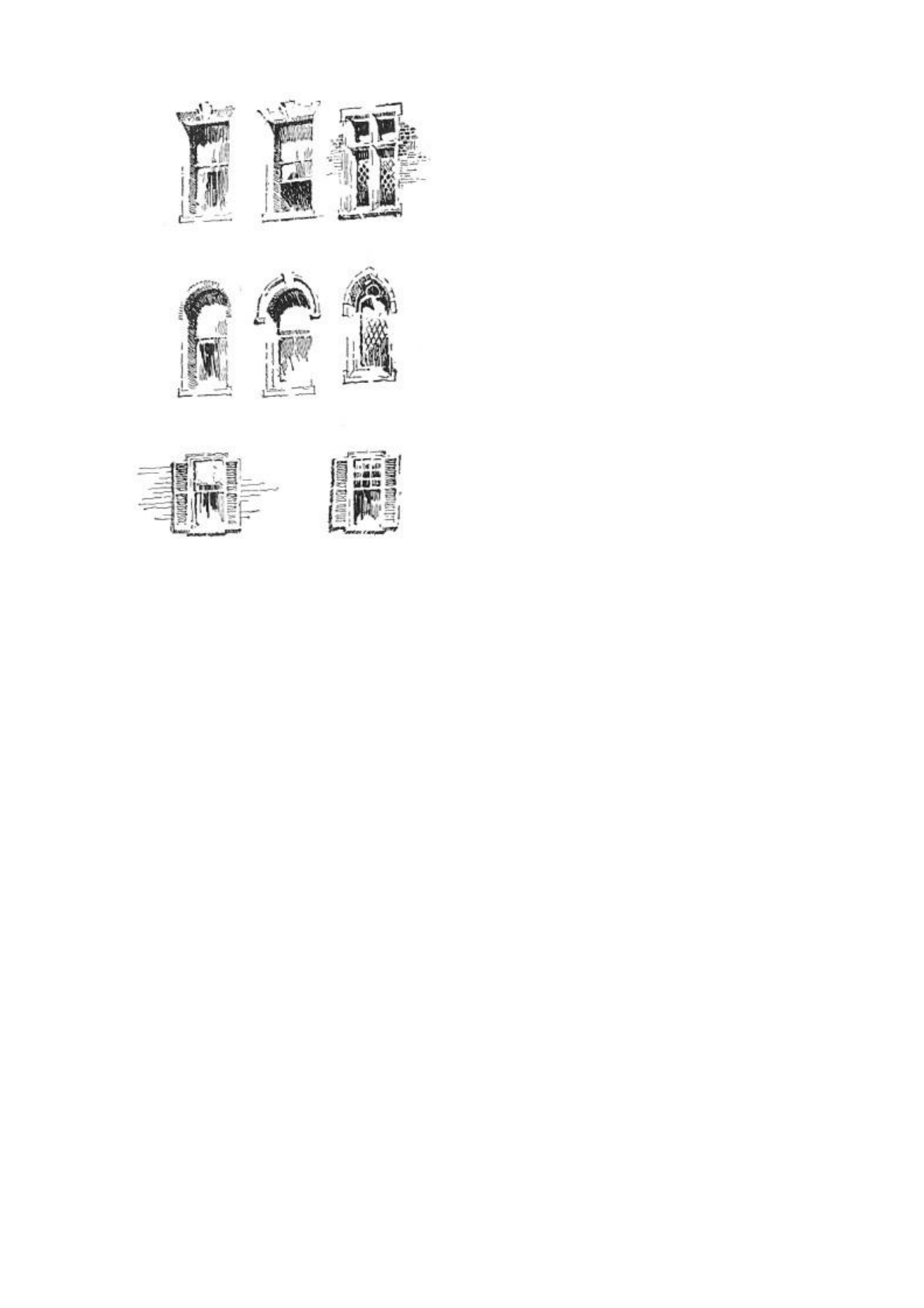
FIG. 41
C. D. M.
The student after careful study of Fig. 41 should make from it enlarged drawings, and
afterwards, laying the book aside, proceed to render them in his own way. When he has done so,
let him compare his work with the originals. This process ought to be repeated several times, the
aim being always for similarity, not for literalness of effect. If he can get equally good results
with another method he need not be disconcerted at the lack of any further resemblance.
The cornice with its shadow is another salient feature. In short shadows, such as those cast by
cornices, it is well, if a sunny effect be desired, to accent the bottom edge of the shadow. The
shadow lines ought to be generally parallel, but with enough variation to obviate a mechanical
effect. They need not be vertical lines,—in fact it is better that they should take the same slant as
the light. If they are not absolutely perpendicular, however, it is well to make them distinctly
oblique, otherwise the effect will be unpleasant. A clever sketch of a cornice by Mr. George F.
Newton is shown in Fig. 42. Notice how well the texture of the brick is expressed by the
looseness of the pen work. Some of the detail, too, is dexterously handled, notably the bead and
button moulding.
The strength of the cornice shadow should be determined by the tone of the roof above it. To
obtain for this shadow the very distinct value which it ought to have, however, does not require
that the roof be kept always much lighter than it. In the gable roof in Fig. 57, the tone of the roof
is shaded lighter as it approaches the eaves, so that the shadow may count more emphatically.
This order may be reversed, as in the case of a building with dark roof and light walls, in which
case the shadow may be grayer than the lower portion of the roof, as in "B" in Fig. 44.
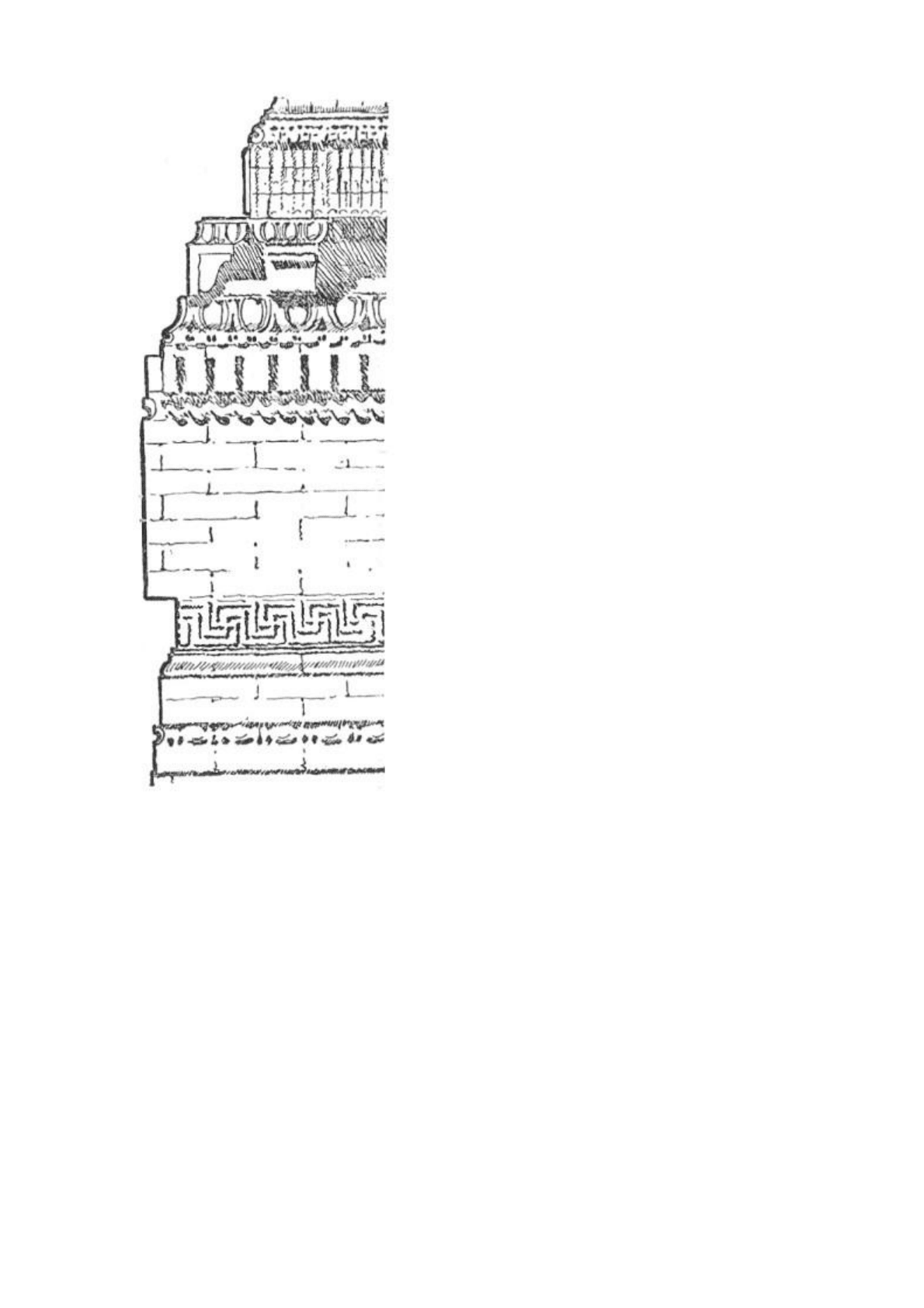
FIG. 42
GEORGE F. NEWTON
But the beginner should not yet hurry on to whole subjects. A church porch, as in Fig. 35, or a
dormer with its shadow cast on a roof, as in Fig. 43, will be just as beneficial a study for him as
an entire building, and will afford quite as good an opportunity for testing his knowledge of the
principles of pen drawing, with the added advantage that either of the subjects mentioned can be
mapped out in a few minutes, and that a failure or two, therefore, will not prove so discouraging
as if a more intricate subject had to be re-drawn. I have known promising beginners to give up
pen and ink drawing in despair because they found themselves unequal to subjects which would
have presented not a few difficulties to the experienced illustrator. When the beginner grows
faint-hearted, let him seek consolation and encouragement in the thought that were pen drawing
something to be mastered in a week or a month there would be small merit in the
accomplishment.
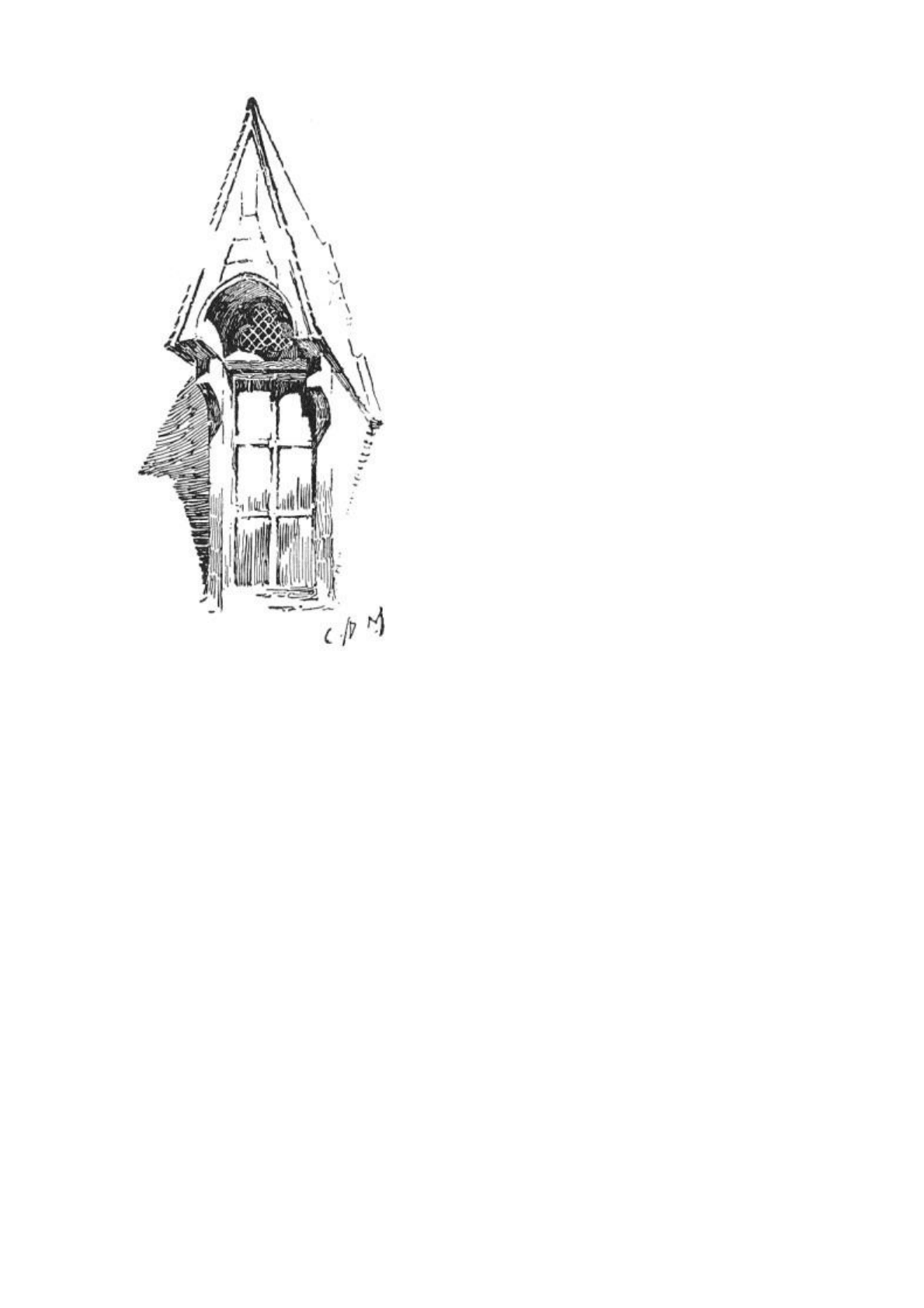
FIG. 43
C. D. M.
A General System It is a common fault of students to dive into the picture unthinkingly,
beginning anywhere, without the vaguest plan of a general effect, whereas it is of the utmost
importance that every stroke of the pen be made with intelligent regard to the ultimate result.
The following general method will be found valuable.
Pencil the outline of the entire subject before beginning the pen work. It will not do to start on
the rendering as soon as the building alone is pencilled out, leaving the accessories to be put in
as one goes along. The adjacent buildings, the foliage, and even the figures must be drawn—
carefully drawn—before the pen is taken up. The whole subject from the very beginning should
be under control, and to that end it becomes necessary to have all the elements of it pre-arranged.
Arrangement of the Values Next scheme out the values. This is the time to do the thinking. Do
not start out rashly as soon as everything is outlined in pencil, confident in the belief that all
windows, for instance, are dark, and that you may as well make them so at once and be done
with them. This will be only to court disaster. Besides, all windows are not dark; they may be
very light indeed. The color value of nothing is absolute. A shadow may seem almost black till a
figure passes into it, when it may become quite gray by comparison. So a window with the sun
shining full upon it, or even one in shade, on which a reflected light is cast, may be brilliantly
light until the next instant a cloud shadow is reflected in it, making it densely black. Arrange the
values, therefore, with reference to one general effect, deciding first of all on the direction of the
light. Should this be such as to throw large areas of shadow, these masses of gray will be
important elements in the color-scheme. An excellent way to study values is to make a tracing-
paper copy of the line drawing and to experiment on this for the color with charcoal, making
several sketches if necessary. After having determined on a satisfactory scheme, put fixatif on
the rough sketch and keep it in sight. Otherwise, one is liable, especially if the subject is an
intricate one, to be led astray by little opportunities for interesting effects here and there, only to
discover, when too late, that these effects do not hang together and that the drawing has lost its
breadth. The rough sketch is to the draughts man what manuscript notes are to the lecturer.
Treatment of Detail Do not be over-conscious of detail. It is a common weakness of the
architectural draughts man to be too sophisticated in his pictorial illustration. He knows so much
about the building that no matter how many thousand yards away from it he may stand he will
see things that would not reveal themselves to another with the assistance of a field-glass. He is
conscious of the fact that there are just so many brick courses to the foot, that the clapboards are
laid just so many inches to the weather, that there are just so many mouldings in the belt
course,—that everything in general is very, very mathematical. This is not because his point of
view is too big, but because it is too small. He who sees so much never by any chance sees the
whole building. Let him try to think broadly of things. Even should he succeed in forgetting
some of these factitious details, the result will still be stiff enough, so hard is it to re-adjust one's
attitude after manipulating the T-square. I strongly recommend, as an invaluable aid toward such
a re-adjustment, the habit of sketching from Nature,—from the figure during the winter
evenings, and out of doors in summer.
FIG. 44
C. D. M.
The beginner is apt to find his effects at first rather hard and mechanical at the best, because he
has not yet attained that freedom of handling which ignores unimportant details, suggests rather
than states, gives interesting variations of line and tone, and differentiates textures. A good part
of the unpleasantness of effect will undoubtedly be found to be due to a mistaken regard for
accuracy of statement, individual mouldings being lined in as deliberately as in the geometrical
office drawings, and not an egg nor a dart slighted. Take, for example, the case of an old
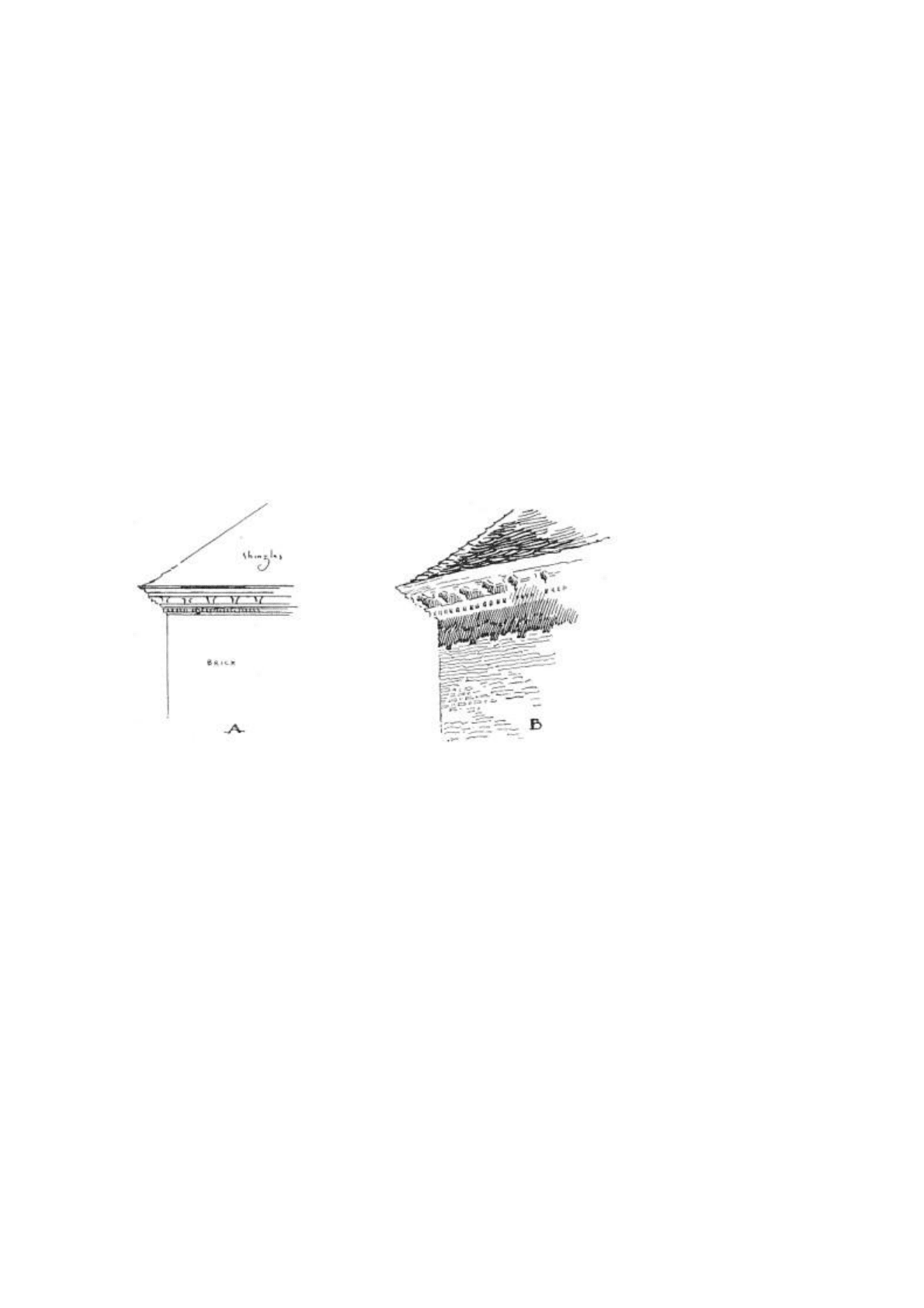
Colonial building with its white cornice, or any building with white trimmings. See the effect of
such a one in an "elevation" where all the detail is drawn, as in "A," Fig. 44. Observe that the
amount of ink necessary to express this detail has made the cornice darker than the rest of the
drawing, and yet this is quite the reverse of the value which it would have in the actual building,
see "B." To obtain the true value the different mouldings which make up the cornice should be
merely suggested. Where it is not a question of local color, however, this matter of elimination is
largely subject to the exigencies of reproduction; the more precisely and intimately one attempts
to render detail, the smaller the scale of the technique requires to be, and the greater the
difficulty. Consequently, the more the reduction which the drawing is likely to undergo in
printing, the more one will be obliged to disregard the finer details. These finer details need not,
however, be absolutely ignored. Notice, for instance, the clever suggestion of the sculpture in the
admirable drawing by Mr. F. E. Wallis, Fig. 45. The conventional drawing of the façade, Fig. 46,
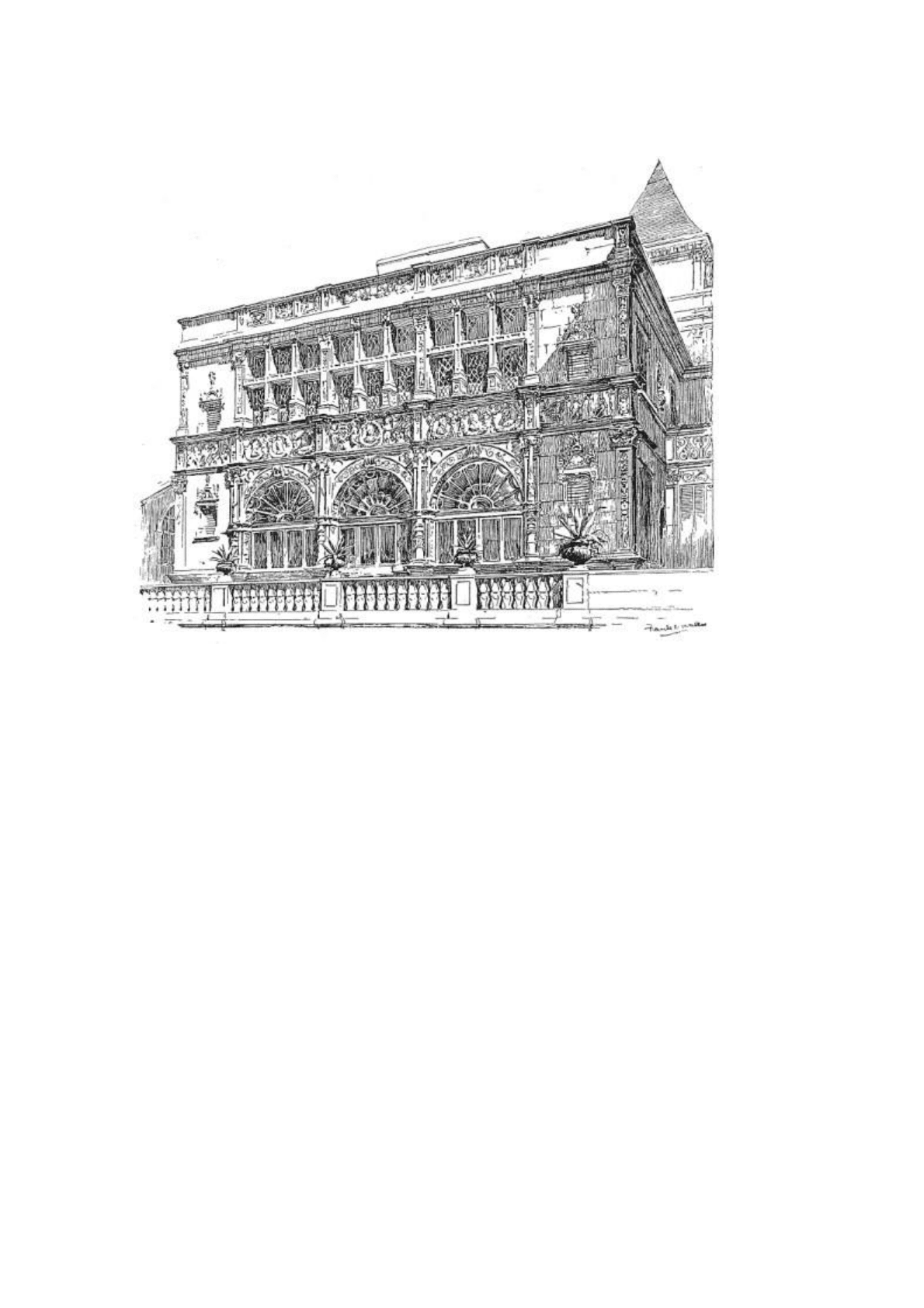
is a fine illustration of the decorative effect of color obtainable by emphasizing the organic lines
of the design.
FIG. 45
FRANK E. WALLIS
Foliage and Figures The elements in a perspective drawing which present most difficulties to
the architectural draughtsman are foliage and figures. These are, however, most important
accessories, and must be cleverly handled. It is difficult to say which is the harder to draw, a tree
or a human figure; and if the student has not sketched much from Nature either will prove a
stumbling-block. Presuming, therefore, that he has already filled a few sketch-books, he had
better resort to these, or to his photograph album, when he needs figures for his perspective.
Designing figures and trees out of one's inner consciousness is slow work and not very
profitable; and if the figure draughtsman may employ models, the architect may be permitted to
use photographs.