
Claverie J-M., Notredame C. Bioinformatics for Dummies
Подождите немного. Документ загружается.


Understanding the Importance
of Similarity
Similar sequences often derive from the same ancestral sequence. This
means that if your sequences are similar, they probably have the same ances-
tor, share the same structure, and have a similar biological function. This
principle even works when the sequences come from very different organ-
isms. For you, this means you can extrapolate something you know about a
particular DNA or protein sequence to all similar DNA and protein sequences.
For example, imagine that your favorite sequence looks very much like
another one that somebody has studied in another lab. Because these two
sequences are similar, you can say, “If something is true for that sequence, it
is probably true for mine as well!” Just imagine how much time you can save:
Studying a gene in the lab takes years; searching a database for similarity
takes seconds. And you’re not even cheating!
When two proteins or gene sequences are very similar, biologists call them
homologues, which is a fancy word for two proteins or gene sequences that
have the same ancestor, similar functions, and similar structures. The snag
comes in deciding how similar is “very” similar. If your sequences are more
than 100 amino acids long (or 100 nucleotides long), the rule says you can
label proteins as “homologous” if 25 percent of the amino acids are identical,
for DNA you will require at least 70 percent identity to draw the same conclu-
sion. If your values are below those stated values, then your guess is as good
as any. You’ve entered that range of protein identity below 25 percent —
known (fans of Rod Serling take note) as the
twilight zone — where
Nothing is sure about the meaning of observed similarities.
For instance, some proteins whose amino acids are less than 15 percent
identical have exactly the same 3-D structure — while some proteins
with residues that are 20 percent identical have different structures.
Homology or non-homology is never granted.
The 25-percent figure that defines the twilight zone is mostly a common-sense
indicator. In reality, things are slightly more complicated. In most cases, to
make sure that two sequences are true homologues, you also need to use
some other information reported by the search. These bits of data include
The Expectation value (E-value), which tells you how likely it is that the
similarity between your sequence and a database sequence is due to
chance
The length of the segments similar between the two sequences
200
Part III: Becoming a Pro in Sequence Analysis
13_089857 ch07.qxp 11/6/06 3:58 PM Page 200

The patterns of amino-acid conservation
The number of insertions and deletions
Do not confuse homology and similarity. Homology is a binary relationship
whereas similarity is a quantifiable property. In other words, two sequences
are either homologous or non-homologous — while they will always have a
measurable level of identity. As a consequence, you cannot say that two
sequences are 40 percent homologous, just like you cannot say someone is
40 percent pregnant.
In the rest of this chapter, we show you how to interpret this information
when you conduct a database search.
The Most Popular Data-Mining
Tool Ever: BLAST
Thirty years ago, biologists would search a database by printing its whole
content on paper, taping the printout to the office wall, writing down their
own query sequence on a piece of paper, and spending a few hours manually
scanning the wall and drinking coffee. With the millions of sequences now
available, those days are gone. Fortunately, now you can use computers to
run the most successful bioinformatics tool ever: BLAST, the
Basic Local
Alignment and Search Tool, which is expressly designed to do the paper-on-
the-wall scanning for you.
In this section, we show you two simple ways to do a BLAST search (by using
a protein or a DNA sequence), and, most importantly, we show you how to
interpret your results. At the end of the section, we also give you plenty of
ideas on how to use BLAST for doing most of the things you could need
(except making coffee).
BLASTing protein sequences
BLASTing protein sequences is what you want to do if you already have a pro-
tein sequence and you want to find other, similar protein sequences in a
sequence database. You should be happy to know that BLAST is at its best
with proteins. Two flavors of BLAST that exist and deal with proteins are
blastp: Compares a protein sequence with a protein database.
tblastn: Compares a protein sequence with a nucleotide database.
201
Chapter 7: Similarity Searches on Sequence Databases
13_089857 ch07.qxp 11/6/06 3:58 PM Page 201
If you aren’t sure what to do with your protein sequence, use blastp. When in
doubt, always use blastp! Nevertheless, if you suspect that blastp may not be
the best choice, determine what you’re trying to discover and see Table 7-1.
Table 7-1 Choosing the Right BLAST Flavor for Proteins
What You Want The Right BLAST Flavor
I want to find out something about Use blastp to compare your protein with
the function of my protein. other proteins contained in the databases.
I want to discover new genes Use tblastn to compare your protein with
encoding simple proteins. DNA sequences translated into their six pos-
sible reading frames (three on each strand).
In this section, we show you how to use two of the most popular blastp
online services:
The blastp server from its home, the National Center for Biotechnology
Information (NCBI) in the USA
The blastp server from the Swiss EMBnet server
These two servers have slightly different interfaces. If you know how to use
them both, you’re sure to feel at ease using any of the BLAST servers that we
list at the end of this chapter.
Two good reasons for knowing how to use many BLAST servers are
The databases: The BLAST servers don’t give you access to the same
databases. If you don’t find the database you need on one server, you
can always look for it on another server.
The speed: The most popular servers are often overcrowded. When this
happens, searching somewhere else is always an option.
It is a rarity for two different BLAST servers to return the same answer when
you do the same query. The main reason is that the database versions often
differ a little, although differences in the BLAST program version can have an
effect as well. Results rarely change dramatically, but they do change a little.
It’s just one of those discrepancies that you must learn to live with.
Running the NCBI blastp
In this example, you are asking the following question: “Are there any pro-
teins similar to the hamster nucleolin in the protein database Swiss-Prot?”
Good question. Here’s how you find the answer:
202
Part III: Becoming a Pro in Sequence Analysis
13_089857 ch07.qxp 11/6/06 3:58 PM Page 202
1. Point your browser to the NCBI BLAST server at www.ncbi.nlm.nih.
gov/BLAST
.
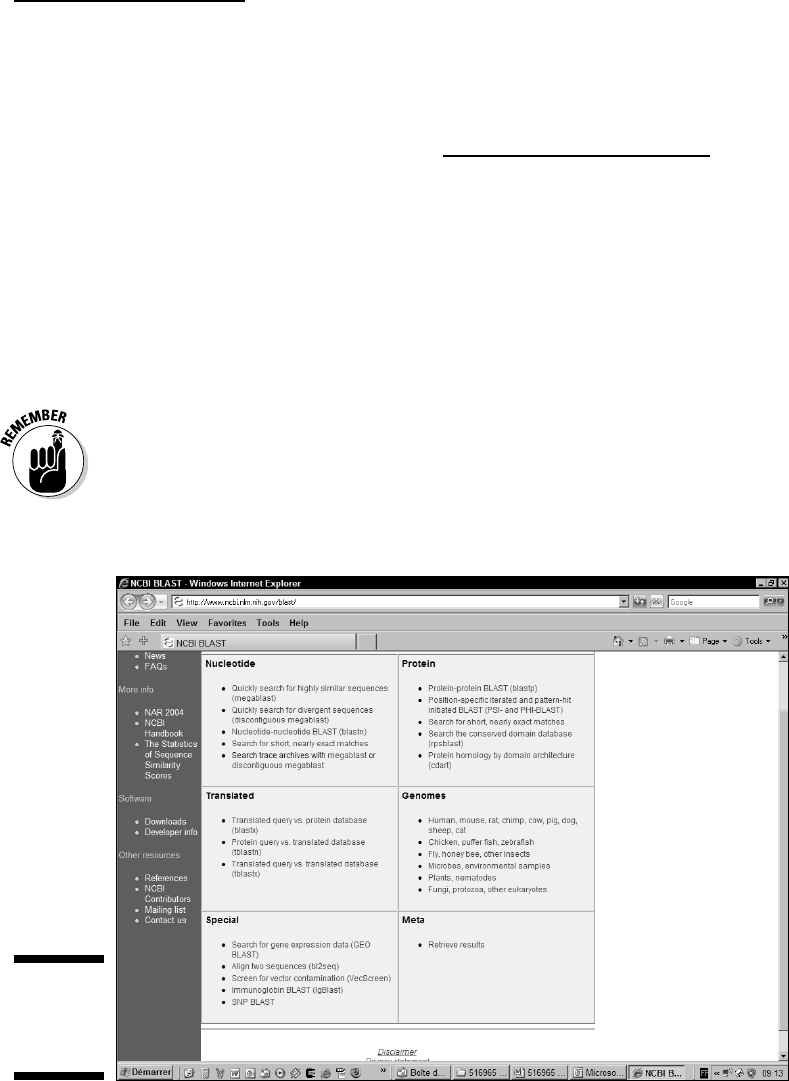
The BLAST page at the NCBI appears, as shown in Figure 7-1.
2. In the Protein section, click the protein-protein BLAST (blastp) link.
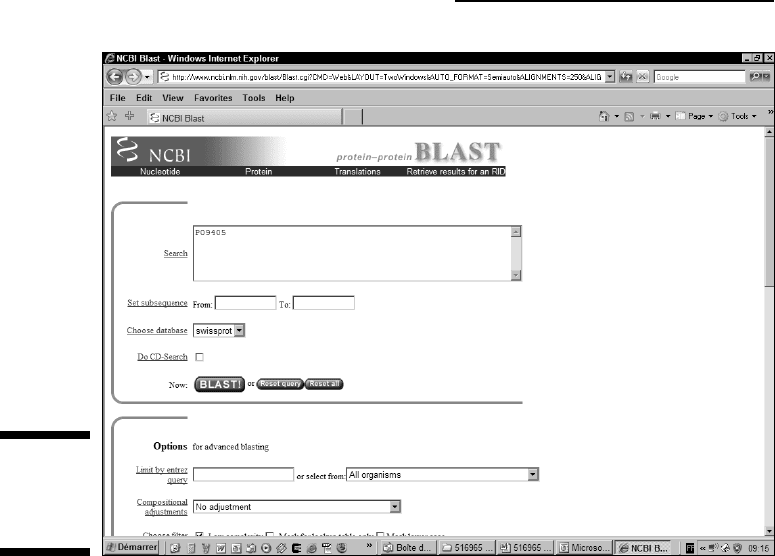
A search page similar to the one in Figure 7-2 appears.
3. Paste your sequence in the search window.
You have two ways to pass on a sequence to the blastp server:
• If your sequence is already in a database, you can give its ID number
to blastp. For our example, we use the hamster
nucleolin, a protein
from Swiss-Prot whose accession number is P09405. To use the
nucleolin, enter
P09405 in the sequence box, as shown in Figure 7-2.
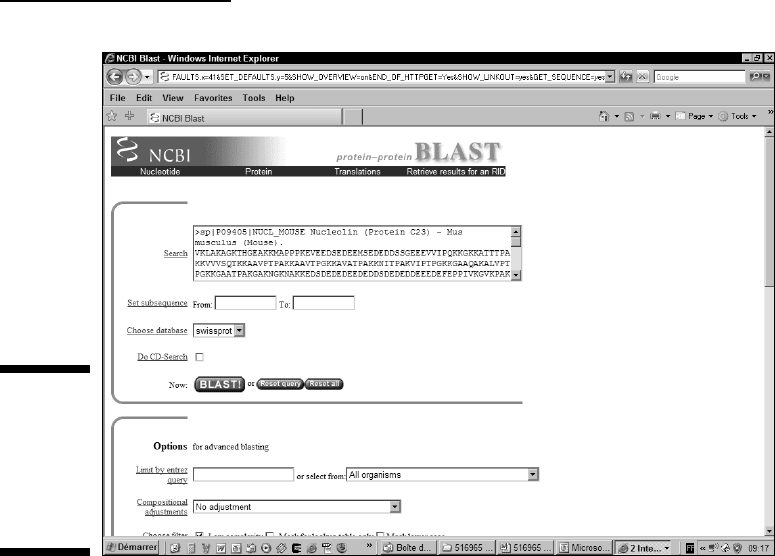
• If your sequence is not in a database, you must provide it in the
FASTA format. Figure 7-3 shows you what the hamster nucleoline
sequence looks like in FASTA format.
The sequence you give to blastp is the
query sequence.
Sequences similar to the query that blastp returns are the hits or matches.
The database you search is the target database.
Figure 7-1:
The BLAST
home page
at NCBI.
203
Chapter 7: Similarity Searches on Sequence Databases
13_089857 ch07.qxp 11/6/06 3:58 PM Page 203
4. Choose Swiss-Prot from the Choose Database pull-down menu.
5. Deselect the Do CD-Search box.
CD search is a feature for searching Conserved Domains. We recom-
mend you deselect this box if this is one of your first BLAST searches
because the output may be confusing. (We explain CD search in detail
in Chapter 6.)
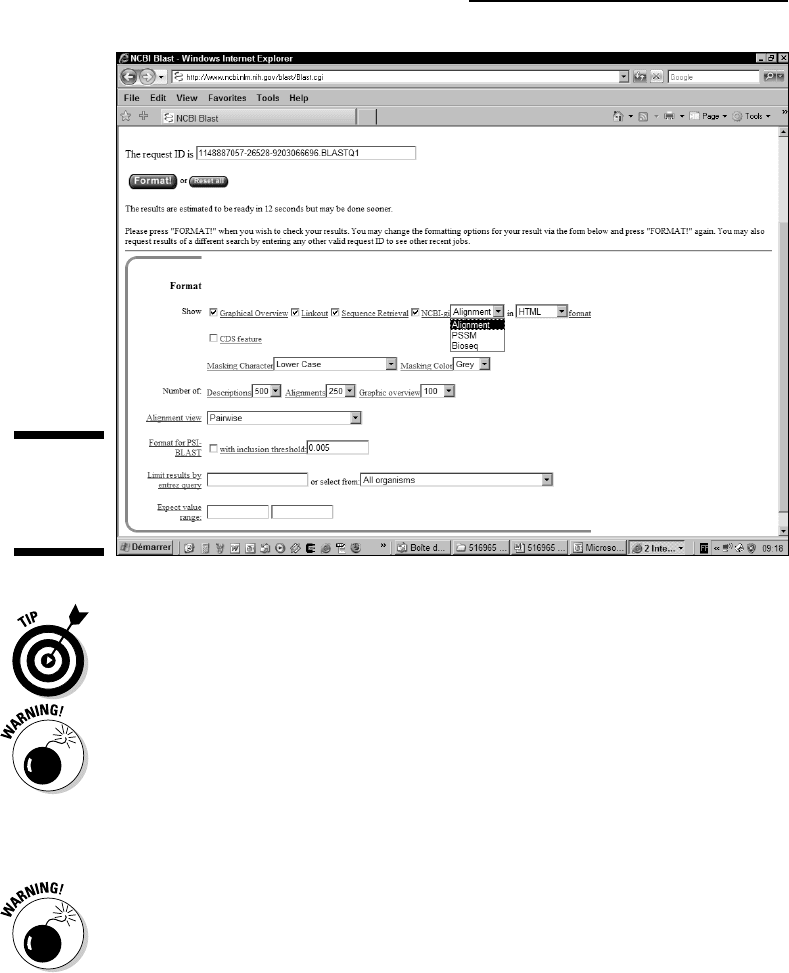
6. Click the BLAST! button (and wait).
An intermediate page similar to Figure 7-4 appears.
Sometimes the NCBI BLAST server gets very busy. For instance, it is
notorious for scientists to dump a large number of jobs just before they
go home and let them run at night. This explains why BLAST can be
uncomfortable to use in the evening. Fortunately, NCBI is not the only
BLAST server around; you can always try your luck on another server.
(See Table 7-6, at the end of this chapter, for a listing of BLAST servers
around the world.)
Figure 7-2:
The blastp
server at
NCBI.
204
Part III: Becoming a Pro in Sequence Analysis
13_089857 ch07.qxp 11/6/06 3:58 PM Page 204
If the server nearest you is too slow, you can take advantage of the
world’s various time zones. The following table indicates the part of the
world that’s sleeping while you do your work in the morning or in the
afternoon.
Your Location Morning Afternoon
USA Japan Europe
Europe USA Japan
Japan Europe USA
7. Click the Format! button on the intermediate page and wait for the
results.
When you click the Format! button, a new browser window opens. As
soon as the search is complete, BLAST displays your results in this new
window. Unfortunately, the search may take more time than the form
indicates.
Figure 7-3:
Providing
the NCBI
server with
a sequence
in FASTA
format.
205
Chapter 7: Similarity Searches on Sequence Databases
13_089857 ch07.qxp 11/6/06 3:58 PM Page 205
A typical search against NR or Swiss-Prot takes a few minutes. If BLAST
tells you that the completion of your search may take more than 20 min-
utes, you’re probably better off trying your luck some other time — or
on another BLAST server.
DO NOT press any button while you wait!
If you get no reply, DO NOT resubmit the same query several times in a
row — it will only make things worse for everybody (including you)!
8. Save your results.
Do not try to print the results; the alignment section may be HUGE. If
you want to keep a trace of this search, save it in a file by using the
File
➪Save As option of your browser.
Unfortunately, saving a complete NCBI BLAST page isn’t easy. Saved pages
usually can’t redisplay their active graphics when you reload them in
your browser. Here are two (still rather unsatisfactory) solutions:
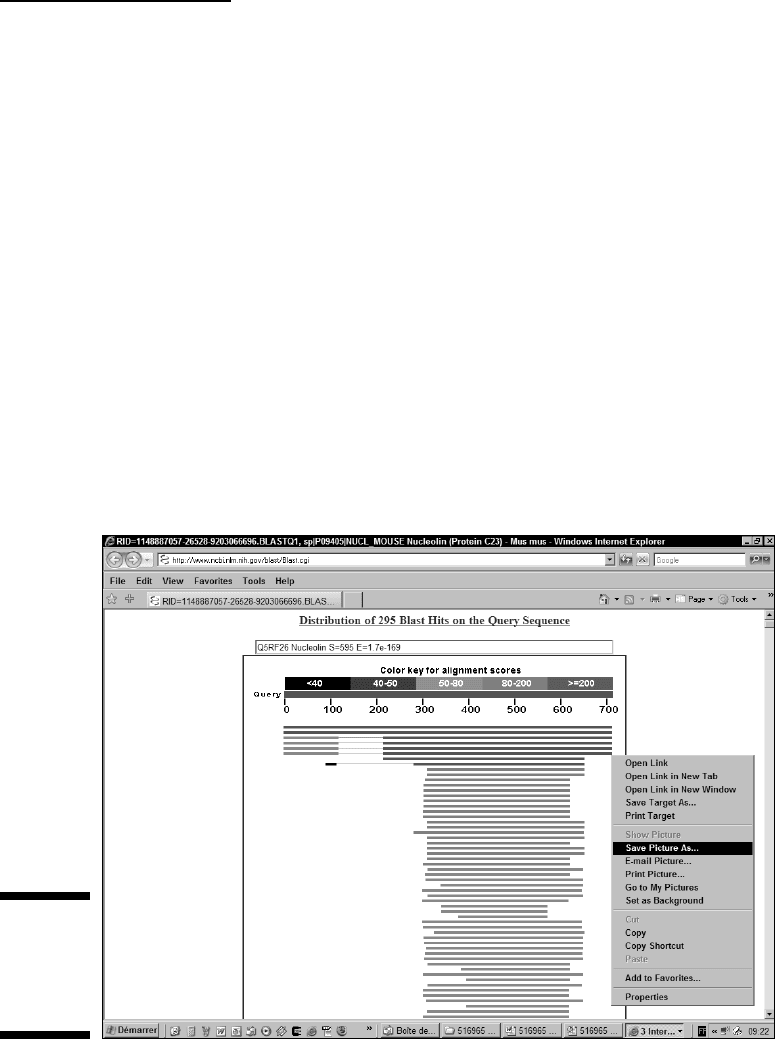
•
Save the graphic display: Pass the mouse over the graphic dis-
play, right-click, and then choose Save Picture As from the context
menu that appears, as shown in Figure 7-5. The saved image is in
GIF format. Although you can then include the display in electronic
documents, be aware that all active hyperlinks are now lost.
Figure 7-4:
The BLAST
intermediate
result page.
206
Part III: Becoming a Pro in Sequence Analysis
13_089857 ch07.qxp 11/6/06 3:58 PM Page 206
• Print your output to a PDF file: If you have a PDF printer installed,
you can print your output to a PDF file. Depending on the PDF
printer you use, hyperlinks may be lost.
Running the EMBnet blastp
The BLAST server running on the EMBnet-ExPASy server is similar to the one
running at NCBI, but it uses a different interface — very similar to the one
used by many BLAST servers around the world. If you know how to use the
EMBnet blastp, you know how to use almost any blastp server in the world.
The main difference between the NCBI blastp interface and the EMBnet inter-
face (shown in Figure 7-6) is that the EMBnet blastp interface gives you many
more choices. The downside is that you are the one who has to make sure
that the various selected parameters are compatible. In the following steps,
we show you how to avoid any confusion.
1. Point your browser to
www.ch.embnet.org/software/bBLAST.html.
The EMBnet Basic BLAST page appears.
Figure 7-5:
Saving the
NCBI
graphic
display.
207
Chapter 7: Similarity Searches on Sequence Databases
13_089857 ch07.qxp 11/6/06 3:58 PM Page 207
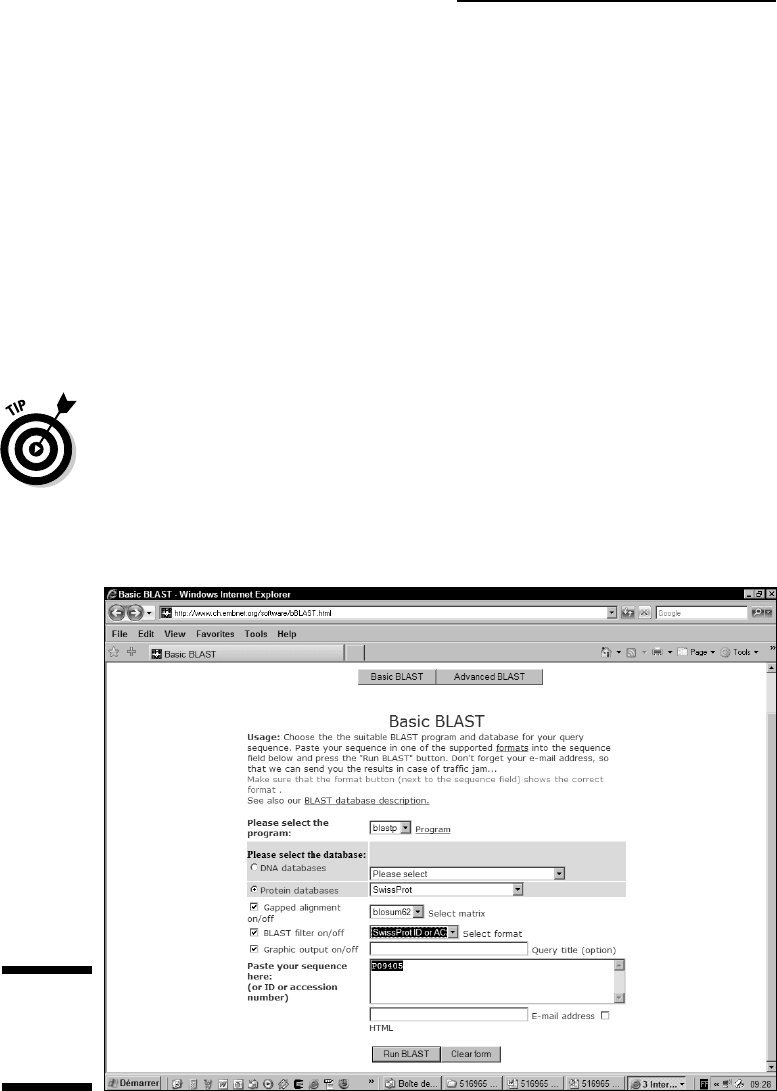
2. Choose blastp from the Select the Program pull-down menu.
The pull-down menu lets you select the flavor of BLAST that you want
to use.
3. After making sure that you’ve selected the Protein Databases radio
button, select a protein database from the accompanying menu.
The database you select must be compatible with the BLAST program
that you choose in Step 2; the EMBnet server does not check this for
you. The kind of database you can search with a protein sequence as a
query depends on which flavor of BLAST you selected in Step 2:
BLAST flavor Database type
blastp,blastx Protein
blastn,tblastn,tblastx DNA
Selecting a genome database can make it easier to analyze your results.
Genome databases are those with a species name and the word
genome
in their names, such as C.Elegans Genome. This can be especially useful
if the subject of your query belongs to a very large family. If you know
which species you’re interested in, choose it there. If you can’t find it,
use the advanced version of this server at
www.ch.embnet.org/
software/aBLAST.html
.
Figure 7-6:
The EMBnet
BLAST
interface.
208
Part III: Becoming a Pro in Sequence Analysis
13_089857 ch07.qxp 11/6/06 3:58 PM Page 208

If you can’t find the database you need there, either, then look for it on
other BLAST servers — such as the one maintained by the European
Bioinformatics Institute at
www.ebi.ac.uk/blast/.
4. Choose Swiss-Prot ID or AC from the Select Format pull-down menu.
You have the choice between several formats: Plain text is a FASTA
format without the first line (the one that starts with
>). All the other
formats refer to accession numbers, not sequences.
It is best to keep the default in the various selectors in the boxes on the
right side of the form:
•
Gapped Alignments On/Off: Makes it possible to force BLAST to
behave like some more ancient version of this program that did
not allow for gaps. To get the same behavior as the NCBI Blast,
keep this box checked.
•
BLAST Filter On/Off: Switches off the low complexity filter. This is
to prevent regions where an amino-acid is repeated many times
from biasing your search. Having this on is the default, and you
should keep it that way unless you have a good reason. (See the
section “Controlling the sequence masking,” later in this chapter.)
•
Graphic Display On/Off: Keep this on if you want the same
graphic display as the NCBI.
5. Enter the ID number (or the sequence itself) in the sequence box.
We’re using P09405 as our ID number. If you have a sequence, paste it
from the Clipboard into the same window.
6. Click the Run BLAST button.
7. Save your results.
BLAST outputs can be HUGE: Never print them out (unless you plan to
rid your whole department of its stock of paper).
When saving BLAST results, preserving the graphic display is notori-
ously difficult. If you want to keep this display, save it separately: Put the
mouse pointer over the image, right-click, and then choose Save Picture
As from the context menu that appears.
If you have access to a PDF printer program, print your result into a PDF
file; this is the best way to keep a printable electronic record.
Understanding your BLAST output
All the flavors of BLAST return a similar output. This output is rather compli-
cated and can be confusing, even for experienced users. Figure 7-7 shows you
209
Chapter 7: Similarity Searches on Sequence Databases
13_089857 ch07.qxp 11/6/06 3:58 PM Page 209