
Claverie J-M., Notredame C. Bioinformatics for Dummies
Подождите немного. Документ загружается.


your pattern. For instance, myristillation only happens in eukaryotes. If you
find a myristillation site in a protein that comes from a prokaryote, you can
safely ignore it.
Weak signals add up to give strong signals
Further along the output that ScanProsite returns, the pattern list contains
two matches that are specific of coagulation factors:
FA58C_1 and FA58C_2.
If you look at them individually, neither pattern is really significant. On the
other hand, the fact that you find two related patterns at so close a distance
is very exciting: It’s a good indication that both patterns are probably genuine.
This is a good example of the fact that two weak indications can make up for
strong evidence when they are consistent (and independent!). It’s a bit like
two shortsighted witnesses telling you exactly the same thing about what
they saw. For an investigator, this is even more interesting than the report of
one eagle-eye witness, as long as the investigator can be sure that the two
shortsighted witnesses never had a chance to talk with each other.
Eliminating weak patterns
When you have too many weak patterns, a good strategy is to build a multi-
ple sequence alignment with related sequences. A pattern that corresponds
to a genuine post-translational modification is normally well conserved. We
provide you with a brief session on multiple alignments in Chapter 2 and
most of what you need to know to build high-quality multiple sequence align-
ments is in Chapter 9.
Everything is not in PROSITE
Also important to know is that the PROSITE pattern collection doesn’t con-
tain a description for every known post-translational modification. If you
can’t find what you need in PROSITE, the ExPASy server gives you links to
other tools that are specialized for this type of analysis. (The links are located
in the Post-Translational Modification Prediction section of PROSITE at
www.
expasy.org/tools/#ptm
.)
Finding Known Domains in Your Protein
Gurus define domains as “independent globular folding units.” For the rest of
us, a
domain is a portion of protein that can keep its shape if you remove it
from the rest of the protein. A domain consists of at least 50 amino acids.
Domains are like the various components of your kitchen: the oven, the
microwave, the fridge, and so on. All together they constitute the complete
180
Part II: A Survival Guide to Bioinformatics
11_089857 ch06.qxp 11/6/06 3:57 PM Page 180
kitchen, but they can also exist separately: You’re allowed to remove the
microwave from your kitchen if you just have to have that late-night popcorn
in your lab.
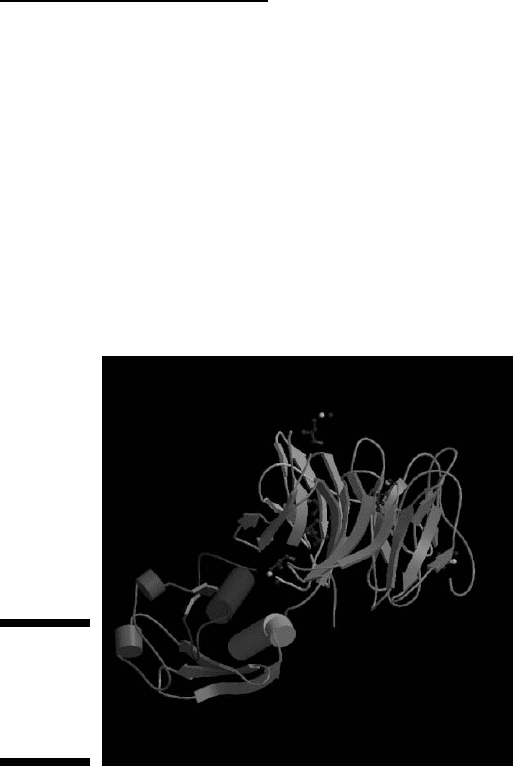
Your average protein consists of two or three domains. Figure 6-12 is a snap-
shot of the TolB, a protein that is made up of two domains. Usually, each
domain plays a specific role in the function of the protein. It may interact
with other proteins, it may bind an ion like calcium or zinc, or it may contain
an active site. It is common to have a catalytic domain associated with a
binding domain and a regulatory domain. Imagine, if you will, a toaster,
where you have the grill (catalytic), the toast holder (binding), and the
switch (regulation).
In principle and in practice, little difference lies between searching patterns
and searching domains in your sequence, and once a domain is character-
ized, it is easy to check whether your protein contains it or not. A dozen or
so domain collections exist around the world (Table 6-1). For some of these
collections, a bunch of specialists handcrafted the domains one by one, like
Swiss watches. These collections give very precise results but are sometimes
a bit incomplete. (See the entries marked Manual in Table 6-1.) In other col-
lections, a computer crunches all known sequences and splits them into a
bunch of domains. These collections are more extensive but less informative.
(See the entries marked Automatic in Table 6-1.)
Figure 6-12:
The TolB
protein is
made of two
domains.
181
Chapter 6: Working with a Single Protein Sequence
11_089857 ch06.qxp 11/6/06 3:57 PM Page 181

Choosing the right collection of domains
Domains are so useful and important in biology that biologists have been
trying to build nice collections of them for quite some time already. The prob-
lem is twofold: (a) it can be tricky to define a specific domain unambiguously,
and (b) gurus often find it hard to agree with each other. (So now you know
why various authors have described most of the important domains in
slightly different ways.)
For us, the consequences are that there’s a large redundancy among the eight
major collections of domains available today (Table 6-1). Life would be sim-
pler if we could tell you that TastyDom (r) is the best and that you must not
use PooPooDom (r)! Unfortunately, this isn’t the way it works. Each collection
has its pros and cons — and eventually, if you really want to understand your
protein, you need to look at each collection! It takes time, but in the end, it
can be truly worth the effort.
The InterPro project has made it possible to search many domain databases
simultaneously. In Table 6-1, (IP) indicates the domain databases that can be
accessed by InterPro. InterPro helps you make sure that you’re not missing
even the tiniest bit of information. You can also find out easily when some
domain collections disagree on your sequence.
Unfortunately, InterPro is not exhaustive. The only way to make complete
analyses of the domains contained in your sequence is to use the three major
domain servers:
InterProScan
CD-Search
Motif-Scan
It is highly probable that one, and
only one, of these servers contains the bit
of information that helps you make sense of your protein — meaning that
you’ll have to check out each server in turn. The rest of this chapter shows
you how to use each of these servers and get the best out of each.
Table 6-1 The Main Domain Collections
Name Web Address Number of Generation
Domains
PROSITE-Profile (IP) www.expasy.org/ 616 Manual
prosite
PfamA (IP) www.sanger.ac.uk/ 7973 Manual
Software/Pfam
182
Part II: A Survival Guide to Bioinformatics
11_089857 ch06.qxp 11/6/06 3:57 PM Page 182

Name Web Address Number of Generation
Domains
PRINTs (IP) www.bioinf.man. 1900 Manual
ac.uk/dbbrosers/
PRINTS
PRODOM (IP) protein.toulouse. 736000 Automatic
inra.fr/prodom/
current/html/
home.php
SMART (IP) smart.embl- 685 Manual
heidelberg.de
COGs www.ncbi.nlm.nih. 4852 Manual
gov/COG/new/
TIGRFAM (IP) www.tigr.org/ 2453 Manual
TIGRFAMs
BLOCKs blocks.fhcrc. 12542 Automatic
org/
Finding domains with InterProScan
You want to use the InterProScan server if you have a protein sequence and
you want to know which domain this sequence may contain. InterProScan
allows you to compare your sequence with InterPro, a domain database that
includes most of the major domain collections available online. In a way,
InterProScan is for protein sequences and domains what metasearch engines
are for the World Wide Web!
Here’s how you can get InterProScan working for you:
1. Point your browser to www.ebi.ac.uk/InterProScan/.
The InterProScan home page appears.
2. Enter your sequence in the search text box.
Most legal formats are recognized here (including the raw format), but
the accession numbers don’t work.
In the following example, we use the protein sequence FOSB_HUMAN.
Here’s how to obtain this sequence from Swiss-Prot:
a. Open a new Internet browser window.
b. Open the page
www.expasy.ch/cgi-bin/get-sprot-fasta?
FOSB_HUMAN
, which contains FOSB_HUMAN in format FASTA.
183
Chapter 6: Working with a Single Protein Sequence
11_089857 ch06.qxp 11/6/06 3:57 PM Page 183
c. Copy the sequence.
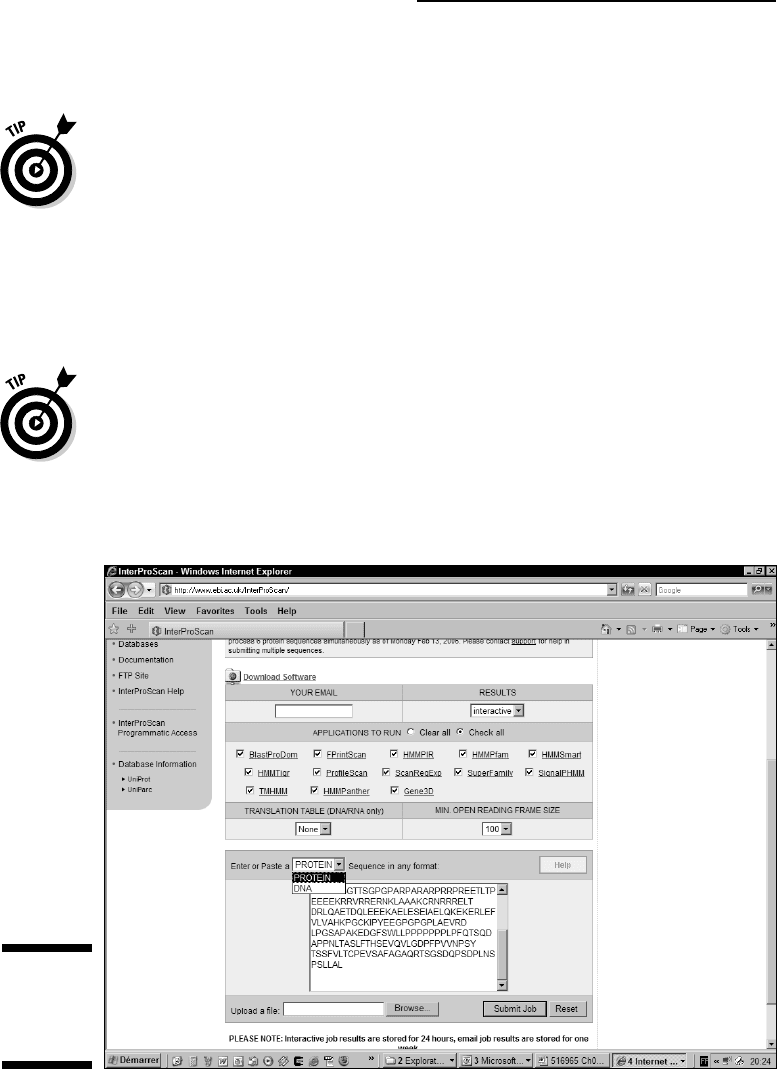
d. Paste your sequence in the InterProScan search text box, as shown
in Figure 6-13.
You can also scan a nucleotide sequence. If you want to do so, select
DNA instead of PROTEIN in the selector just above the sequence.
3. In the Applications to Run section, choose the domain databases you
are interested in.
Interpro lets you search domain databases, but it also lets you run some
specific prediction applications, such as
TMHMM (for trans-membrane
predictions) and
SignalPHMM, which runs a prediction to determine
whether your sequence contains a
signal peptide (a short N-terminus
segment that causes your protein to reach its destination in the cell, as
precisely as a Zip code.)
You can obtain your results faster if you remove some of the largest
databases (ProDom, for example) from your search.
4. Click the Submit Job button.
An intermediate page pops up and informs you of how long your search
has been running.
Figure 6-13:
The Inter
ProScan
home page.
184
Part II: A Survival Guide to Bioinformatics
11_089857 ch06.qxp 11/6/06 3:57 PM Page 184

Do not click any button while you wait; the results are automatically displayed
when they’re ready, using SRS (the Sequence Retrieval System).
5. Save your results.
To save the nice color display, the easiest thing to do is to press the Prt Sc (Print
Screen) key on your keyboard, and then cut and paste (Ctrl-V) the display into
your favorite application (Powerpoint, for instance). To keep your exact results
for further reference, the simplest thing to do is to save the raw output:
a. Click the handy Raw Output button.
A new window appears, displaying just the raw data.
b. Use your browser’s File
➪Save As command.
Interpreting InterProScan results
Because InterProScan returns a large amount of information, interpreting its results
correctly is something of an art form. Before clicking any hyperlink, make sure that
you understand exactly what the result page contains.
Understanding the InterProScan output
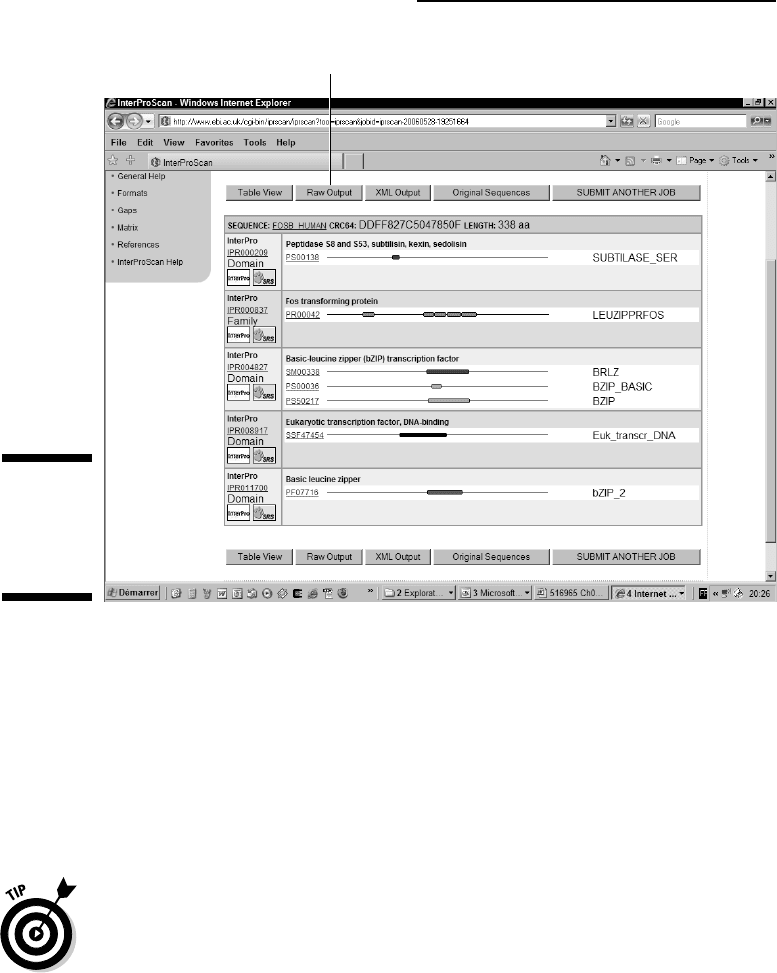
Figure 6-14 shows the results you obtain when scanning the protein FOSB_
HUMAN with the InterProScan server. It illustrates well the variety of results one can
expect when you compare a sequence with domain databases.
In the output, each line represents a match with some type of InterPro domain.
The first entry in each column indicates the type of diagnosis provided:
Family or Domain.
Some domains or signatures are specific of a complete pro-
tein family while others are simply specific of a domain. When several domains
from different domain databases describe the same thing, the InterPro database
groups them in the same box, like the IPR 004827 domain.
The IPR#### hyperlink points to the InterPro documentation. Here InterPro
attempts to summarize the information spread in the documentations of various
domain databases. It’s always a good idea to read the InterPro documentation,
but don’t stop there — be sure to read the documentation for the individual
sequences as well.
In front of each line is a hyperlink that can take you to the domain entry in its
database.
For instance, if you click the PS00138 link, your browser takes you to
the entry 138 of the PROSITE database, where you can find the individual
PROSITE documentation.
On every line, little colored boxes show you where the match occurred on
your sequence.
Their size is proportional to the size of the domain. If you pass
the mouse pointer over these rectangles, the coordinates of the match (in your
sequence) appear on-screen.
185
Chapter 6: Working with a Single Protein Sequence
11_089857 ch06.qxp 11/6/06 3:57 PM Page 185
Making sense of the inconsistencies in the InterProScan output
You can see in Figure 6-14 that all domain databases agree on the presence of
a series of Leucine zippers that are roughly in the middle of the sequence.
On the other hand, the domain databases do
not agree exactly on the bound-
aries of these matches. Deciding who is right and who is wrong is always a bit
of an art, but in this case a majority vote could be a good indication. (Now
you know why using all the domain collections — and not just one — is so
important.)
Another reason why seven databases are better than one is that there’s
always a good chance that one of the databases may contain a domain that
isn’t in the others. This is especially true with exotic domains that are not yet
included in all domain collections.
Of course, the fact that a domain is or is not reported isn’t 100 percent proof
of anything. (See the sidebar “A common mistake when scanning domains.”)
To make sure that a reported hit is genuine, we recommend taking a close
Raw Output button
Figure 6-14:
Output of
the Inter
ProScan
Server.
186
Part II: A Survival Guide to Bioinformatics
11_089857 ch06.qxp 11/6/06 3:57 PM Page 186

look at the alignment between the profile and your sequence. Unfortunately,
InterProScan doesn’t let you do this, which is why you also need to use the
other servers (such as CD-Search and Motif-Scan) that we describe in the
next section.
Finding domains with the CD server
The CD (Conserved Domain) server of the NCBI follows the same principle as
the InterProScan. The main advantage of the CD server is that reported hits
come with a score that helps you discriminate the good from the spurious
matches. On the downside, the CD server doesn’t integrate as many data-
bases as InterProScan, although it contains quite a few domains contributed
by the NCBI that you can’t find anywhere else.
If you’re interested in giving the CD server a try, here’s how you’d go about it:
1. Point your browser to www.ncbi.nlm.nih.gov/Structure/cdd/
wrpsb.cgi
.
You can also access this server from the main NCBI BLAST page. Point
your browser to
www.ncbi.nlm.nih.gov/BLAST/ and click the
Sear
ch the Conserved Domain Database using RPS-BLAST link. This
hyperlink is the fourth one in the second column.
187
Chapter 6: Working with a Single Protein Sequence
A common mistake when scanning domains
Don’t forget that when a domain server reports
some hits between your sequence and a domain,
this information always results from an alignment
between the domain (profile) you’ve found and
the sequence you’re using for comparison. If the
program believes the alignment is good enough,
it will report the match. Otherwise it will not.
Unfortunately, neither the profile nor the pro-
grams are perfect — and mistakes occur. The
server can tell you that your protein contains a
specific domain when that isn’t true, or it may
fail to report a domain that
is
present in your
protein. If you trust the results blindly, there’s
always a chance you may get it wrong.
The InterProScan server isn’t very helpful when
it comes to avoiding that type of mistake: It
doesn’t report the score of the hits and does not
even display the alignments. The other servers
we show you in this chapter (CD-Search and
Motif Scan) give you a score along with the hits.
This score has a statistical meaning, and it
informs you how likely it is that your match may
have occurred by chance only and is devoid of
a biological meaning.
Conservative interpretations (that is, only
believing very high scores) are almost always
correct. On the other hand, if the score isn’t so
good — or if only a portion of the domain matches
your sequence — you need additional evidence
to make sure that what you see is real.
11_089857 ch06.qxp 11/6/06 3:57 PM Page 187
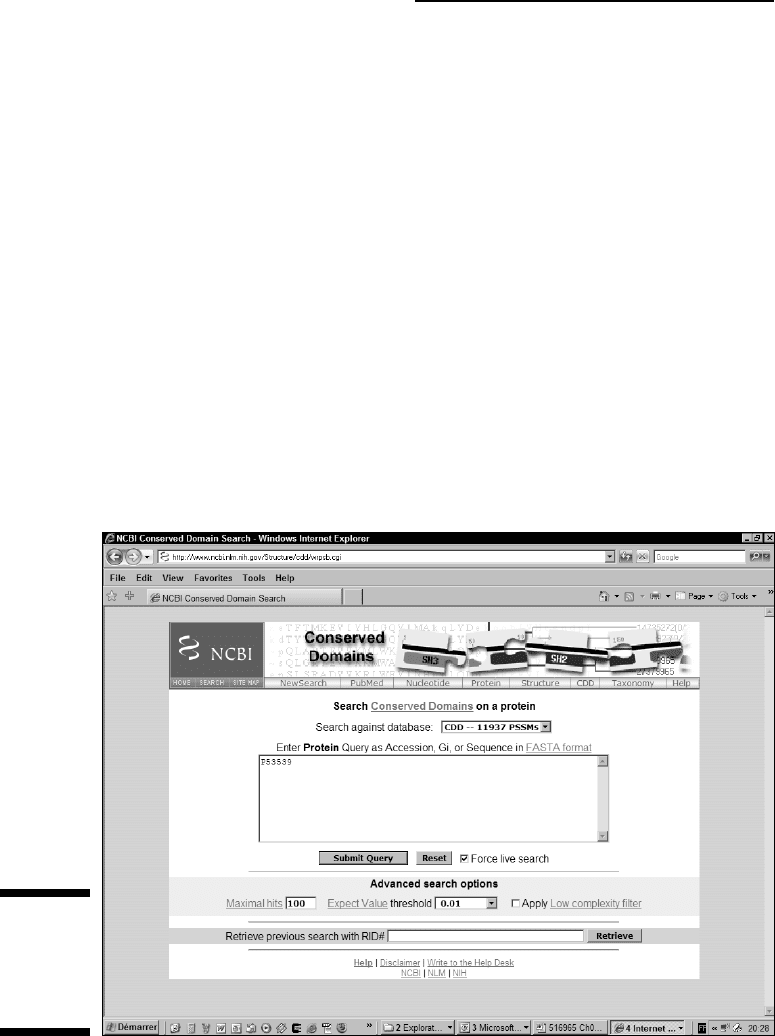
2. Paste your sequence or its identifier in the large box near the top.
For this example, we chose the protein FOSB_HUMAN (P53539). If you
want to use this sequence: Type
P53539 in the Sequence box, as shown
in Figure 6-15.
3. Deselect the Apply Low Complexity Filter check box, located under
the Advanced Search Options heading.
In many interesting domains, a particular type of amino acid is over-
represented. For instance, there are more leucines than expected by
chance in the leucine zippers, or more glycines than expected by chance
in the glycine-rich domains — and so on — for many domains.
Because repeated residues make a sequence simpler, sequences that
contain them are described as
low-complexity. If you keep the Apply Low
Complexity Filter box checked, you may lose these domains.
4. Set the Expect Value Threshold to 1.
The default value (0.01) can be too stringent, especially when consider-
ing low complexity domains.
5. Click the Submit Query button.
Figure 6-15:
The CD
search
server at
NCBI.
188
Part II: A Survival Guide to Bioinformatics
11_089857 ch06.qxp 11/6/06 3:57 PM Page 188

6. Save your results.
The easiest way to save your graphic display is to do a screen dump by
pressing Prt Sc key, and then cutting and pasting your result into a
PowerPoint presentation.
Interpreting and understanding
CD server results
The principle of the output from the NCBI CD server is very similar to that of
InterPro, and is divided into two sections:
The Graphic: The Graphic display, as shown in Figure 6-16, shows the
regions of your protein that match a domain:
• Red domains are from SMART.
• Ragged ends indicate partial matches.
If you pass the mouse pointer over a domain, its complete name appears
in the little window along with its score. The score is an
E-value: It tells
you how many times you can expect a hit that good by sheer chance
only, given your sequence and the database you scanned.
You can interpret your score by using the following rules:
• The lower the E-value, the better the score — and the more likely
your hit is to be genuine.
• E-values need to be below 0.01 to mean something.
• The E-value may need to be much lower than 0.01 if you remove
the low-complexity filtering (Step 3).
• Treat ragged-end matches with suspicion, especially if they occur
in low-complexity regions. In our example, none of the ragged-end
matches is significant.
The Hit List: The hit list (as shown in Figure 6-17) reports the domains
that match your sequence, sorted by E-value. The best hits come first,
shown at the top. If you click the hyperlink, a page pops up that contains
the documentation associated with this entry.
Clicking the (+) sign next to the hit will extend it into an alignment
between your query and some estimated consensus of the domain
sequences. This consensus is something like the average domain
sequence.
189
Chapter 6: Working with a Single Protein Sequence
11_089857 ch06.qxp 11/6/06 3:57 PM Page 189