
Claverie J-M., Notredame C. Bioinformatics for Dummies
Подождите немного. Документ загружается.


At the top of the page in Figure 6-3, you can find a list of the features
contained in your sequence. (This isn’t a prediction, but rather a display
of the information contained in the Swiss-Prot entry.) Below are two
boxes that you can fill with the coordinates of the segment you’re inter-
ested in. If you leave these two boxes blank, ProtParam analyzes the
complete sequence.
7. Click the Submit button to proceed with the analysis, and then wait
for your browser to return the results.
8. When the Results page appears, click
Image in GIF format at the
bottom of the page.
A new page should appear on your browser, containing only the graph.
Of the three formats proposed here, the GIF (
Graphic Interchange
Format) is the most convenient if you want to include your graph in a
presentation.
9. Choose File➪Save As from your browser’s main menu to save your
results.
Interpreting ProtScale results
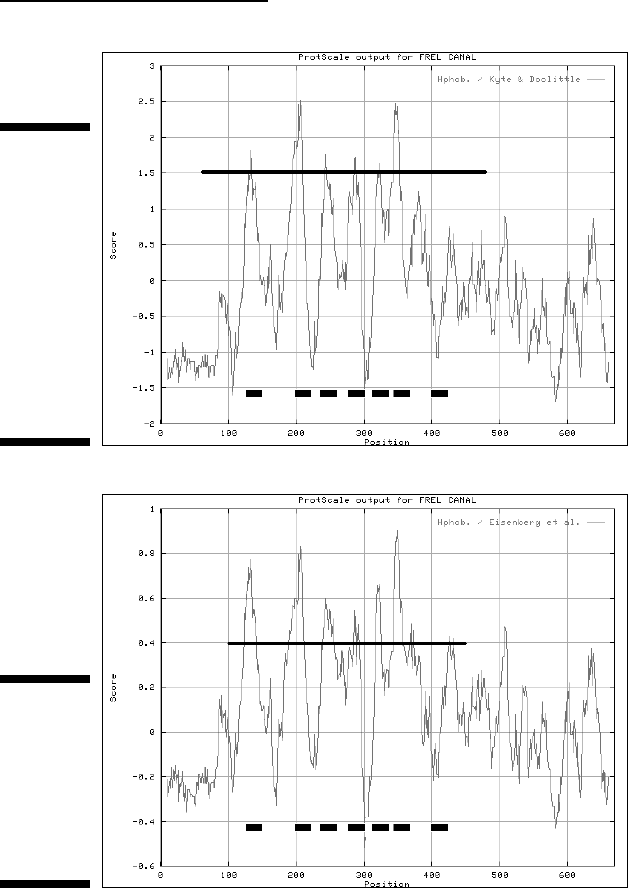
A good signal is strong and not very sensitive to the parameters. For
instance, Figure 6-5 shows the (strong) results you obtain on the Swiss-Prot
protein P78588 when using the Kyte and Doolittle Hydrophobicity Scale.
In order to convince yourself that this result is meaningful, redo the compari-
son with another hydrophobicity scale — like the one from Eisenberg, with
the results you see in Figure 6-6. The details differ very little between these
two graphs, but you can clearly see that the main features are well conserved
and that the strongest peaks come at roughly the same positions.
In Figure 6-5, we’ve drawn a bold line that gives you a hint on how to inter-
pret your results.
The recommended threshold value when using Kyte and Doolittle is 1.6 —
but if you’re like us and you keep forgetting this magic value, here is a simple
recipe:
1. Place a piece of paper over your results.
2. Lower this piece of paper until the tips of the strongest peaks appear.
3. Keep lowering this threshold as long as you can see nice sharp peaks.
With this simple method, you can identify unambiguously five out of seven
transmembrane regions. On a sixth one, we could make an adventurous
guess — It’s easy to guess like this when you know the answer! — but the sev-
enth transmembrane domain is impossible to find.
170
Part II: A Survival Guide to Bioinformatics
11_089857 ch06.qxp 11/6/06 3:57 PM Page 170
That isn’t so surprising: Many proteins contain these seven transmembrane
regions — in which six are easy to find and the seventh domain is notoriously
difficult to predict.
Running TMHMM
TMHMM is maintained by the Center for Biological Sequence Analysis (CBS) at
the Technical University of Denmark. The CBS (
www.cbs.dtu.dk/services/)
Figure 6-6:
Hydropho-
bicity profile
returned by
ProtScale
using the
Eisenberg
Scale.
Figure 6-5:
Hydropho-
bicity profile
returned by
ProtScale
by using the
Kyte &
Doolittle
Scale. The
boxes mark
known trans
membrane
segments.
171
Chapter 6: Working with a Single Protein Sequence
11_089857 ch06.qxp 11/6/06 3:57 PM Page 171
offers many interesting services for sequence analysis that we encourage you
to explore.
TMHMM is a state-of-the-art method that uses sophisticated mathematical
models (Hidden Markov Models) to predict transmembrane regions. For a bit
of sophistication, give it a try:
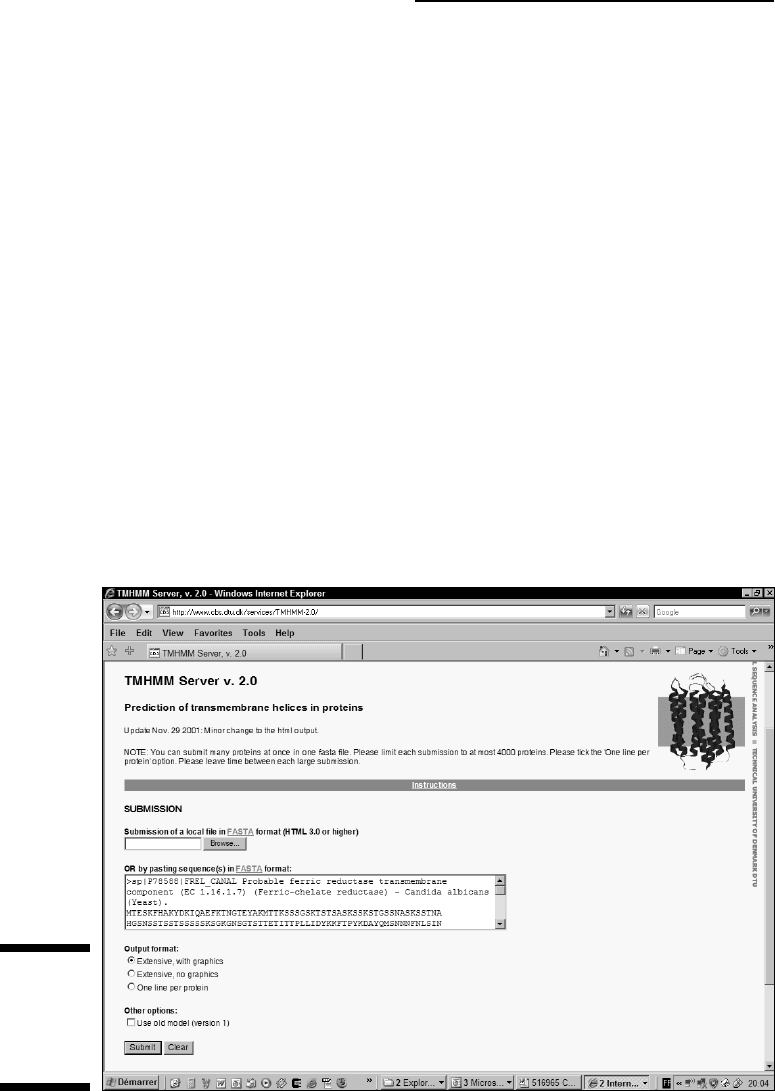
1. Point your browser to www.cbs.dtu.dk/services/TMHMM-2.0.
The TMHMM page of the CBS site appears (Figure 6-7).
2. Scroll down the page a bit to enter your sequence in the TMHMM
search box.
TMHMM only recognizes the sequence in FASTA format. For the follow-
ing example, we use the protein sequence FREL_CANAL. To obtain this
sequence from Swiss-Prot:
a. Open a new browser window.
b. Open the page
www.expasy.ch/cgi-bin/get-sprot-fasta?
FREL_CANAL
, which contains REL_CANAL in FASTA format.
c. Copy the sequence onto the Clipboard.
d. Paste the sequence in the TMHMM window (refer to Figure 6-7).
Figure 6-7:
The bottom
half of the
TMHMM
page.
172
Part II: A Survival Guide to Bioinformatics
11_089857 ch06.qxp 11/6/06 3:57 PM Page 172
3. Keep the Output Format radio buttons to their default value (Extensive
with Graphics).
4. Press the Submit button.
5. When the Results page appears, choose File
➪Save As from your
browser main menu to save your results.
If you are using Internet Explorer, the Save As Type pull-down menu
appears; choose Web Page, Complete (
*.htm, *.html). Your file is
saved along with a directory that has the same name. Don’t separate
your file from this directory.
Interpreting results from TMHMM
Although results from TMHMM are slightly different from those you get from
ProtScale, they are nevertheless in rough agreement. This is good news
because the two methods use very different principles.
There are two major differences between ProtScale and TMHMM:
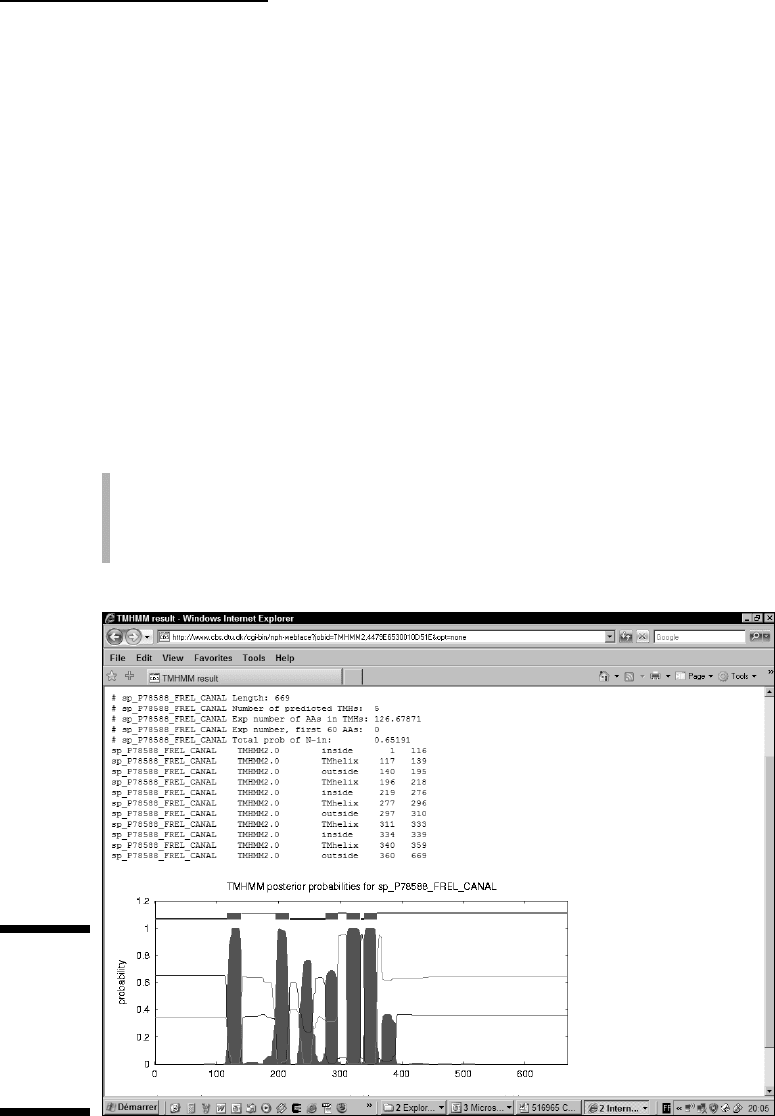
TMHMM returns a precise prediction. This prediction is at the top of the
output — just before the plotted graph — as shown in Figure 6-8.
TMHMM predicts the segments that are inside the cell and the segments
that are outside the cell.
Figure 6-8:
TMHMM
results on
the Swiss-
Prot Protein
FREL_
CANAL.
173
Chapter 6: Working with a Single Protein Sequence
11_089857 ch06.qxp 11/6/06 3:57 PM Page 173

In this case, TMHMM fails to predict the segment that is in the middle (the
one between amino acids 234 and 255), but it gives a fairly good estimation
for five of the segments.
For each residue of your sequence, the graph in Figure 6-8 displays the proba-
bility of it being either in a transmembrane domain, inside the cell, or outside
the cell.
This probability is only a prediction; it’s not necessarily correct.
If you really need an accurate prediction because you’re about to design an
experiment, we recommend running many predictions using different meth-
ods. Very different methods that give you the same results are usually a good
indication that you’re on the right track.
Looking for coiled-coil regions
Coiled-coil regions are portions of a protein formed by the intertwining of two
or three alpha-helices. One reason it’s considered interesting to find coiled-
coil regions is that they’re often involved in protein-protein interactions.
Another (less glorious) reason is that these coiled-coil regions can give false
matches when you do a database search (see Chapter 7) — and it can be a
good thing to filter them out. If you want to predict these regions in your pro-
tein of interest, you can use the conveniently named COILS server at EMBnet.
Check them out at
www.ch.embnet.org/software/COILS_form.html
Predicting Post-Translational
Modifications in Your Protein
Proteins often need to be modified before they become active in the cell.
Biologists call such operations
post-translational modifications because they
occur after the translation (synthesis) of the protein. These modifications
may involve adding sugars, modifying amino acids, or removing pieces of the
newly synthesized protein. If you’re studying a new protein, you probably
want to know about such matters. This may be very important if you want to
clone and express a human protein in bacteria — because, in order to be
active, your protein may require some post-translational modifications that
the bacterium itself cannot make.
One of the most useful tools for analyzing post-translational modifications is
PROSITE — a database you can find on the ExPASy site. It contains a list of
short sequence motifs (also some named patterns) that experiments have
174
Part II: A Survival Guide to Bioinformatics
11_089857 ch06.qxp 11/6/06 3:57 PM Page 174

associated with particular biological properties. Many of these patterns are
associated with post-translational modifications. On the ExPASy server
(
www.expasy.org), you can compare your protein sequence with the collec-
tion of patterns in PROSITE — and find out which modifications your protein
is likely to undergo.
When you do sequence analysis, there is something you must ALWAYS remem-
ber: Similar short sequences (such as those with less than 20 amino acids)
don’t ALWAYS have the same function. Thus, if a small sequence has been
shown to function as an ATP binding in a protein — and if the protein you’re
analyzing contains a short segment with EXACTLY the same sequence — it
doesn’t NECESSARILY mean that your protein is also an ATP binding protein.
What you have is an indication that it
may be an ATP binding protein. Of
course, the longer the segment, the stronger the indication.
This warning on the meaning of short similarity regions also applies to
PROSITE patterns — patterns listed there are often quite short. That said, we
can show you how to check your sequence to see whether it contains any
known PROSITE pattern.
Looking for PROSITE patterns
ScanProsite is a server that allows you to compare your protein with the list
of patterns contained in the PROSITE database. Highly trained specialists
designed each pattern in this database. If you find that your protein contains
a PROSITE pattern, this one fact can (often) give you a pretty clear indication
of its function.
175
Chapter 6: Working with a Single Protein Sequence
The PROSITE patterns
When biologists first started having access to
protein sequences, one of their first discoveries
was that some small conserved sequences are
often associated with important properties —
such as cellular localization, ligand binding, and
so on.
Amos Bairoch, the creator of Swiss-Prot,
started exploiting this discovery while building
his protein database. To help organize and
annotate the proteins, he created a collection
of small, well-conserved segments that he
could use to classify and analyze new proteins.
These special segments are known as
patterns
—
and they are still widely used today as a means
of characterizing new proteins. PROSITE is the
name Amos gave to this particular pattern data-
base. These days, PROSITE no longer contains
only patterns; it also includes a new, more
sophisticated type of model: the
profile.
Profiles
describe every position of an entire protein
family — not just a few highly conserved posi-
tions, as patterns do. (These domain profiles are
very different from the property profiles we also
describe in this chapter.)
11_089857 ch06.qxp 11/6/06 3:57 PM Page 175
Here’s how you can get ScanProsite working for you:
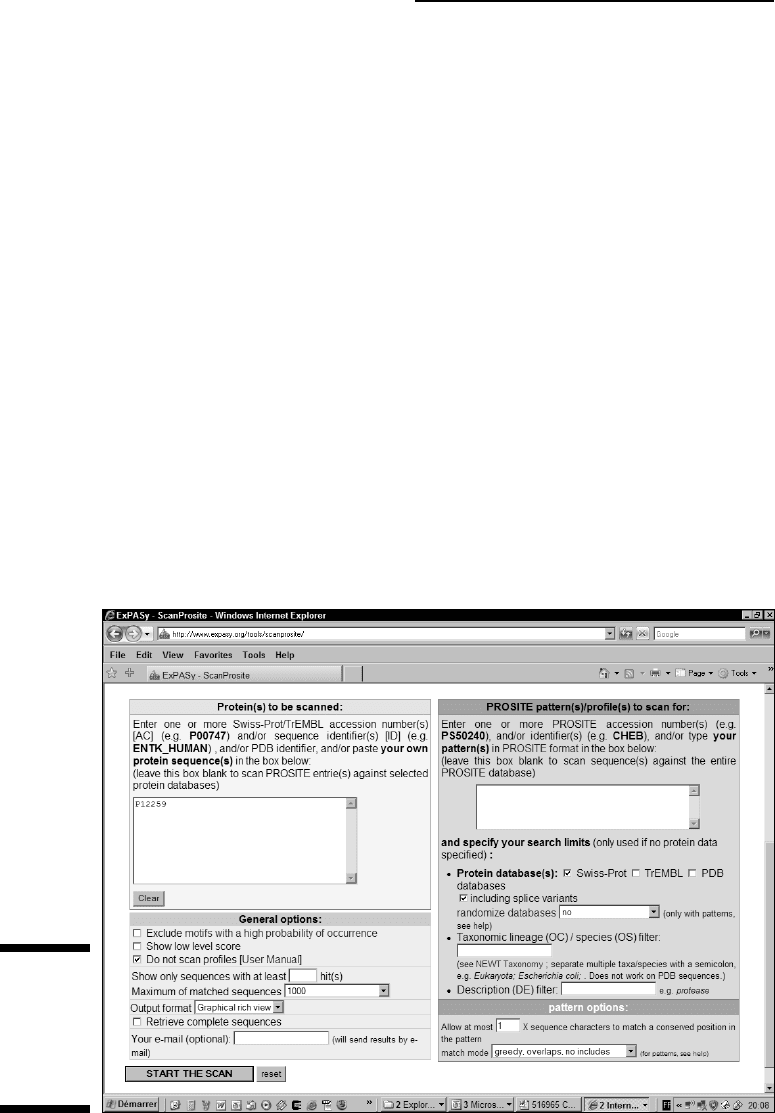
1. Point your browser to www.expasy.org/tools/scanprosite/.
The ScanProsite page of the ExPASy site appears. If you scroll down the
page, you’ll see two distinct sections:
• The right section in Figure 6-9 is the place to go if you already have
a pattern and you want to check whether other proteins in Swiss-
Prot contain this pattern.
• The left section in Figure 6-9 is right up your alley if you have a pro-
tein sequence and you want to find out which PROSITE pattern it
contains.
2. Paste your sequence or enter its accession number into the search
text box on the left (in the Protein[s] to be Scanned section).
We want to go from a protein sequence to a pattern, so we’re staying
with the search box on the left. You can use
• Raw format (amino acids only, space and numbers are tolerated
but removed automatically).
• An accession number. For this example we use the Swiss-Prot pro-
tein
P12259, which is the precursor of the Human Coagulation
factor V.
Figure 6-9:
The
ScanProsite
Interface on
the ExPASy
Server.
176
Part II: A Survival Guide to Bioinformatics
11_089857 ch06.qxp 11/6/06 3:57 PM Page 176
3. Uncheck the Exclude Motifs with a High Probability of Occurrence box.
By default, the server ignores small patterns that may not be statistically
meaningful. If you want these small patterns to be considered, be sure
you uncheck this box.
4. Check the Do Not Scan Profiles box.
For the purposes of this steps list, it’s okay not to select to scan the profiles;
that takes more time. Furthermore, when it comes to post-translational
modifications, patterns are usually more interesting than profiles.
5. Press the Start the Scan button and wait.
An intermediate page appears. Keep waiting until your browser displays
a Results page like the one shown in Figure 6-10.
Wait for the results! Don’t click any of the hyperlinks that appear on the
intermediate page. The ScanProsite server can be very slow at some
times of the day.
If your results never arrive, you have the alternative of using any ExPASy
site that is closer to you or running in a part of the world that is sleep-
ing. (See the listing at the end of this chapter for alternative ExPASy
addresses.)
6. Choose File➪Save As from your browser’s main menu to save the
information on the Results page.
Interpreting ScanProsite results
The main problem with most post-translational patterns is that they are
short. The short sequences these patterns match may occur by chance, and
could have no real biological significance.
The rule is that similarities between short sequences must always be treated
with suspicion. A good way to rule out many unlikely modifications is to read
carefully the documentation associated with the pattern (the PDOC).
Understanding the ScanProsite output
The first section of the output is named “Hits by Patterns” and shows the
location of every type of pattern found on your protein. It is basically a sum-
mary where each pattern family has its own color code. Pass the mouse
pointer over one of the colored rectangles to see its name displayed.
In moving down through the Hits by Patterns section, you can see the details
of each pattern found in your sequence. Documentation is available via the
hyperlink displayed in the output. A portion of this output is shown in Figure
6-10. For each pattern found in PROSITE, ScanProsite reports the following
information:
177
Chapter 6: Working with a Single Protein Sequence
11_089857 ch06.qxp 11/6/06 3:57 PM Page 177
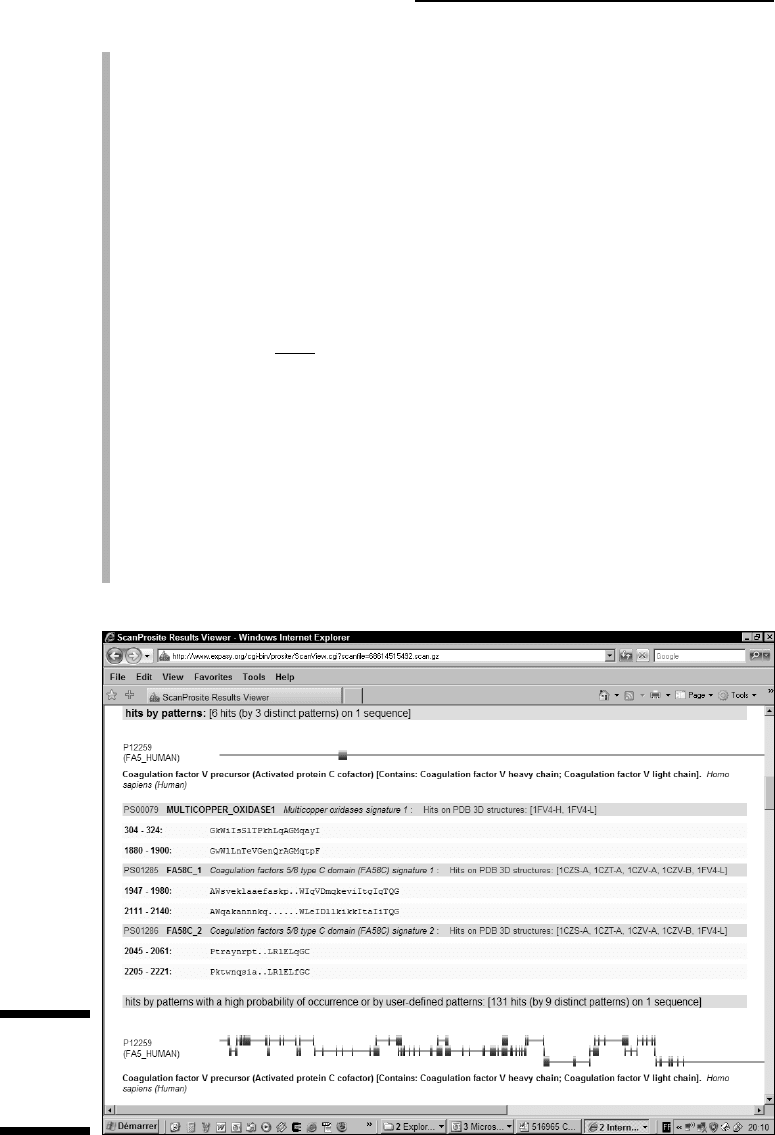
PS#####: The first hyperlink leads you to the pattern documentation, a
high-quality documentation that contains a lot of relevant information
on your pattern and its potential biological function.
The pattern name, in bold characters.
Structure: Some patterns have been identified in proteins with a known
3-D structure. If this is the case with the pattern you’re looking at, you
can find the PDB name of the structure(s) here — as well as a hyperlink
to the 3-D representation of this structure. PDB stands for the
Protein
Data Base, a database that contains all the known protein 3-D structures.
(See Chapter 11 for more information on the PDB.) If you click one of
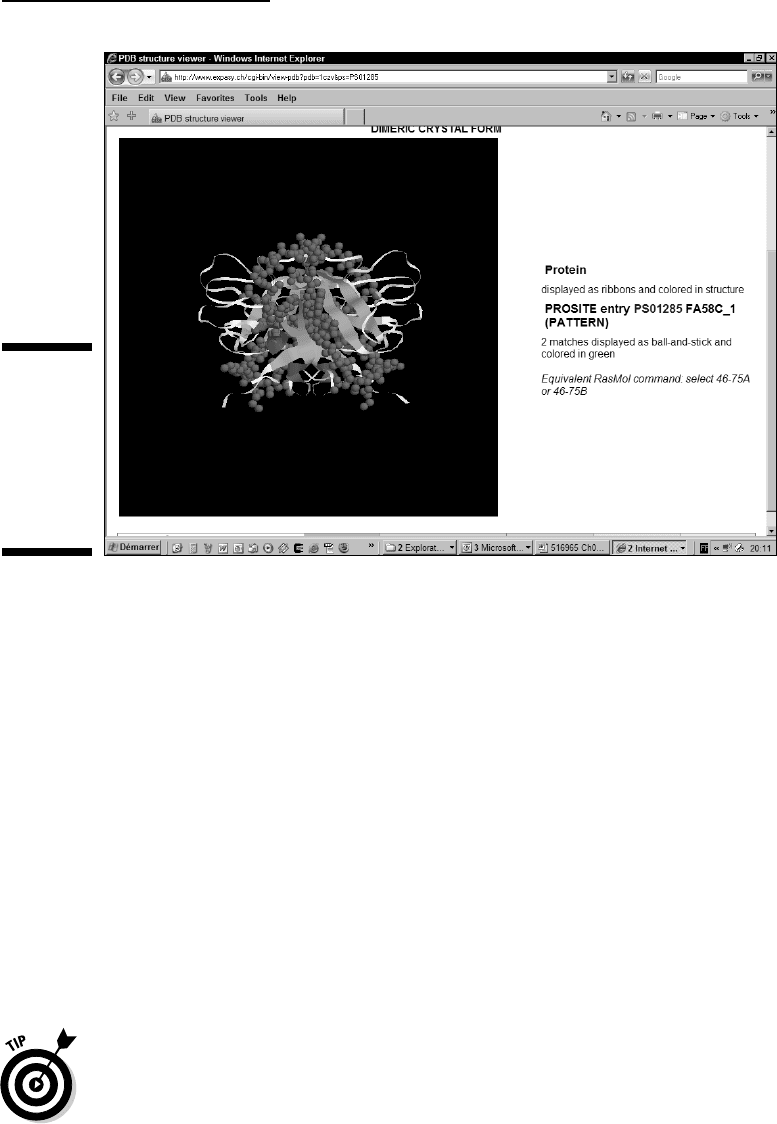
these hyperlinks, a static GIF image of the corresponding structure
appears in your browser. Figure 6-11 shows the image you can obtain
by clicking the 1czv hyperlink (or use the address
www.expasy.org/
cgi-bin/view-pdb?pdb=1czv&ps=PS01285
). The image contains
• A 3-D structure of your protein using a ribbon representation
• The location of this particular pattern (marked in green) in the
structure as a whole
The list: A list of the segments that contain the patterns within your
protein. The numbers indicate the position of the match within your
sequence. Capital letters indicate residues that were specified by the
pattern; lowercase letters indicate residues that weren’t specified by
the pattern.
Figure 6-10:
The
ScanProsite
Output.
178
Part II: A Survival Guide to Bioinformatics
11_089857 ch06.qxp 11/6/06 3:57 PM Page 178
The next section of the output (titled “Hits by Patterns with a High Probability
of Occurrence”) is similar to this one, and shows you the location of short
common patterns in your sequence.
Being careful with short patterns
The complete output obtained from P12259 gives us a good illustration of the
irrelevance of most short patterns: This output indicates that 19 sites of
myristillation exist in the Human Coagulation Factor V. Is this information you
can trust or not?
If you click on the link PS0008 near the end of the “Hits by Patterns with a
High Probability of Occurrence” section, it will take you to the documenta-
tion where you will discover that myristate is a fatty acid attached to the N-
terminus (left end of the sequence) of a protein, anchoring it into the
membrane. None of the hits reported here are on the N-terminus. So you can
safely conclude that none of these matches are genuine.
Using the species information
When you find a post-translational modification, make sure that this modifi-
cation is consistent with the species the sequence comes from. The modifica-
tions that occur in prokaryotes are usually different from those that occur in
eukaryotes. You must look for this information in the PDOC corresponding to
Figure 6-11:
Localization
of a
PROSITE
pattern on
the 3-D
structure of
a protein.
179
Chapter 6: Working with a Single Protein Sequence
11_089857 ch06.qxp 11/6/06 3:57 PM Page 179