
Claverie J-M., Notredame C. Bioinformatics for Dummies
Подождите немного. Документ загружается.


Table 13-1
(continued)
Problem Reason and Solution
Try to make a small set Phylogenetic reconstruction is one of the only
cases where you’re allowed to align very simi-
lar sequences — as many as you want.
Unfortunately, it isn’t because you need it that
you can do it. If you’ve been through Chapter 9,
you know this is not a good thing because most
methods find it hard to deal with large datasets.
Analyzing large sets means that you may not
be able to use the most powerful methods, or
that you will need to install these programs on
your computer.
Add an outgroup to your dataset An
outgroup
is a sequence that you know has
diverged long ago from the rest of the set. For
instance, horse hemoglobin would be an out-
group if you’re analyzing primate hemoglobin.
This outgroup helps you by adding a root to
your tree that symbolizes the first common
ancestor of all your sequences.
The choice of an outgroup relies mostly on
biological criteria, yet you must also make
sure that this sequence is similar enough to
the rest of the set so your multiple-sequence-
alignment method can align it (see Chapter 9).
Living fossils do not exist! Unless you are using fossil DNA sequences, the
sequences you are comparing all have the same age. Even if one of the species
has retained more similarity with the common ancestor, its sequences have
accumulated as many neutral mutations as the most sophisticated member
of the family.
Preparing your multiple
sequence alignment
Many phylogenetic tree-reconstruction methods require a special table called
distance matrix. This table contains the distances (or counts the number of
evolutionary events) that separate each pair of sequences in your dataset.
In theory, you can build this matrix by comparing all your sequences two by
two and then filling up the distance matrix. In practice, that doesn’t work — the
380
Part IV: Becoming a Specialist: Advanced Bioinformatics Techniques
20_089857 ch13.qxp 11/6/06 4:03 PM Page 380
pairwise comparison methods aren’t accurate enough. (For more on pairwise
comparisons, see Chapter 8.) The only way to accurately measure the dis-
tances between two sequences is a two-step process:
1. Make a multiple sequence alignment that includes the two sequences.
2. Measure the distances on the sequences’ pairwise projection.
The pairwise projection is a pairwise alignment that you extract from the
multiple sequence alignment. It benefits from the information contained
in ALL the other sequences.
The quality of your multiple sequence alignment is the real limiting factor
when you make a tree; there is no way you can make a good tree with a bad
alignment. (If you aren’t sure what a multiple sequence alignment
really is,
make your way through Chapter 9.)
Computing your multiple sequence alignment
To compute your multiple sequence alignment, you can use ANY of the meth-
ods we introduce in Chapter 9. These online servers include
ClustalW: www.ebi.ac.uk/clustalw
MUSCLE: phylogenomics.berkeley.edu/cgi-bin/muscle/
input_muscle.py
Tcoffee: www.tcoffee.org
Making sure you have the right multiple sequence alignment
Before using your multiple sequence alignment for building a tree, you want
to make sure that it’s as accurate as possible. In this section, we give you a
few criteria — and a list of things to do — to improve the suitability of your
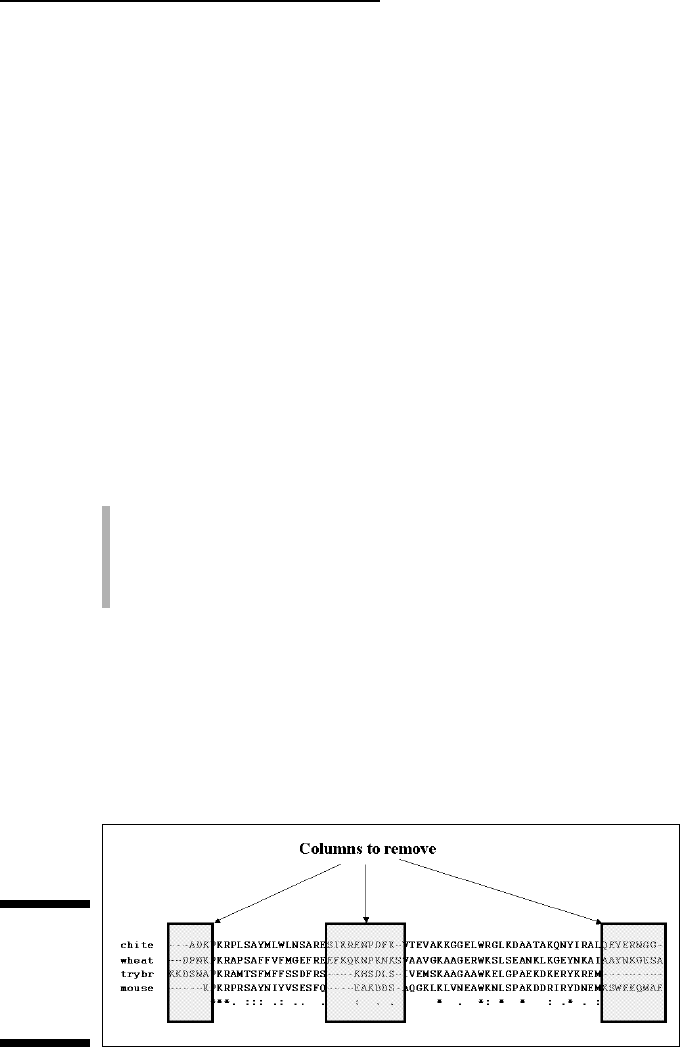
multiple alignment. (Figure 13-2 shows you the kinds of regions our handy
steps list below targets for removal from your alignment.)
Figure 13-2:
Preparing a
multiple
sequence
alignment.
381
Chapter 13: Building Phylogenetic Trees
20_089857 ch13.qxp 11/6/06 4:03 PM Page 381

To ensure that your multiple alignment is both accurate and suitable, follow
these steps:
1. Make sure there are as many gap-free columns as possible.
Gaps cause trouble for most phylogeny reconstruction methods. Some
of these methods, such as ClustalW, can use the
complete-deletion tech-
niques and ignore every column that contains a gap.
2. Remove the extremities of your multiple alignment.
The N-terminus and the C-terminus tend to be poorly conserved —
and therefore poorly aligned. You can safely remove them (refer to
Figure 13-2).
3. Remove the gap-rich regions of your alignment.
Internal, gap-rich regions in a multiple sequence alignment often corre-
spond to loops. Even if your program returns an alignment, it does not
mean that this alignment is meaningful.
4. Be sure to keep the most informative blocks.
The ideal multiple alignment for building a tree would be a high-quality
alignment of sequences with a low level of identity, so that each position
contains a trace of the family history. Here are some pointers:
• In Chapter 9, we show you what a good block looks like in a multi-
ple sequence alignment. It’s typically 20 to 30 amino acids long,
and contains a few conserved positions. Such blocks are ideal for
producing high-quality trees.
• If you want, you can use the Tcoffee server to evaluate your multi-
ple sequence alignment and remove columns that are unlikely to
be correctly aligned. (See Chapter 9 for more on how to do this.)
• The best way to edit your multiple alignment is to use Jalview, the
multiple alignment editor that we introduce in Chapter 10.
If you want a quick-and-dirty solution, here’s a way to use Microsoft
Word to remove blocks very efficiently.
a. While pressing the Alt key on your keyboard, use the mouse to
select entire columns in your alignment.
b. When you’ve selected everything you want to remove, press the
Delete key to remove the selected block.
Don’t even
try to do anything else to your sequences and alignments while
using a word processor! If you need to edit your sequences, use a proper
alignment editor like Jalview (Chapter 10):
382
Part IV: Becoming a Specialist: Advanced Bioinformatics Techniques
20_089857 ch13.qxp 11/6/06 4:03 PM Page 382

Building the Kind of Tree You Need
There are three major groups of methods you can use to build a tree: distance
methods, parsimony methods, and likelihood methods. None of these meth-
ods is almighty. They all have their particular weaknesses and strengths.
This chapter shows you how to make distance-based and maximum-likelihood
trees. Distance-based trees aren’t necessarily the most accurate, but they are
generally applicable and easy to set up. You can apply distance-based tree-
reconstruction methods on most situations; they tend to generate very rea-
sonable results. Maximum Parsimony and Maximum Likelihood methods are
(in theory) the most accurate — but they take more time to run. Experts tend
to give a slight hedge to Maximum Likelihood, but the debate is still largely
open.
When you decide to use a distance-based method to compute your phyloge-
netic tree, consider these four major ingredients:
Your multiple alignment: Which method? Which sequences?
The distance measure: Which substitution matrix?
The tree-reconstruction algorithm: UPGMA, NJ, Fitch, or Kitsch?
The type of tree you want to display: A tree without distances (called a
cladogram) or a tree displaying distances (called a phenogram)? A rooted
or an unrooted tree?
In this section, we show you how you can use the Internet to compute a tree
and to display it in any format you need.
Computing your tree
Combining the right ingredients for making your tree is much like cooking.
There is really no such thing as
the best recipe ever; the best tree you can pro-
duce is mostly a matter of taste and the mood of the day.
As when it comes to food, there are two very different ways to produce trees.
The first one uses ClustalW; it’s quick, hassle-free, and somehow very similar
to (good) fast food. We show you in a steps list how you can simply cut and
paste your sequences to obtain a tree while avoiding embarrassing questions.
The second step list is for those of you out there who love to buy fresh veg-
etables on the market and make your own salad dressing — sticklers for detail,
if you catch our drift. With these steps, you can control every ingredient that
383
Chapter 13: Building Phylogenetic Trees
20_089857 ch13.qxp 11/6/06 4:03 PM Page 383

goes into the making of your tree. Phylip is the name of this package that you
can use to do state-of-the art phylogeny. This is serious stuff; world-renowned
phylogeny specialists use it to do their work. Despite this intimidating intro-
duction, Phylip is surprisingly easy to use.
Producing an (almost) instant phylogenetic tree with ClustalW
If you need a tree and you have firmly decided that you do not want to know
anything about this barbaric kind of gardening, ClustalW is definitely for you.
ClustalW is, above all, a multiple-sequence-alignment package, but some of
the ClustalW servers let you use this program to produce phylogenetic trees.
On the EBI ClustalW server — and on most ClustalW Web servers — if you
feed ClustalW some unaligned sequences, the program returns a tree. This
tree you get, however, is
NOT a phylogenetic tree; it is a guide tree that
ClustalW uses to assemble the multiple sequence alignment. In general, any
tree with a .dnd extension returned by ClustalW is NOT a phylogenetic tree.
You CANNOT use this tree in place of a phylogenetic tree. Doing so would be
a mistake (as in: incorrect results and a false sense of security).
In this section, we show you how you can use the EBI ClustalW server to pro-
duce a phylogenetic tree. We assume you have already generated your multi-
ple sequence alignment; if you have not, you can download a dummy
alignment from
www.tcoffee.org/dummy_aln2.html.
Our dummy alignment contains homologous fragments of the gamma fibrino-
gen. They have been sequenced in several species for comparative studies.
We can use fragments rather than entire sequences because these fragments
are all homologous on their entire length. We have renamed the fragments
with the species names, since trees with species names are much easier to
read — unless, of course, you have a formidable memory,
O12957 (Sheep), O02672 (Moose), O02683 (Giraffe)
O02690 (Chevrotain), O02681 (Beluga) O02687 (Sperm_whale)
O02673 (Rorqual), O02688 (Pig), O12959 (Peccary)
O02677 (Dromedary), O02689 (Tapir), O02682 (Horse)
O02676 (Hyena), O02680 (Coyote), O12954 (Hippopotamus)
Of course, you could use any set of sequences aligned with any of the servers
we described in Chapter 9.
1. Point your browser to www.ebi.ac.uk/clustalw/.
384
Part IV: Becoming a Specialist: Advanced Bioinformatics Techniques
20_089857 ch13.qxp 11/6/06 4:03 PM Page 384
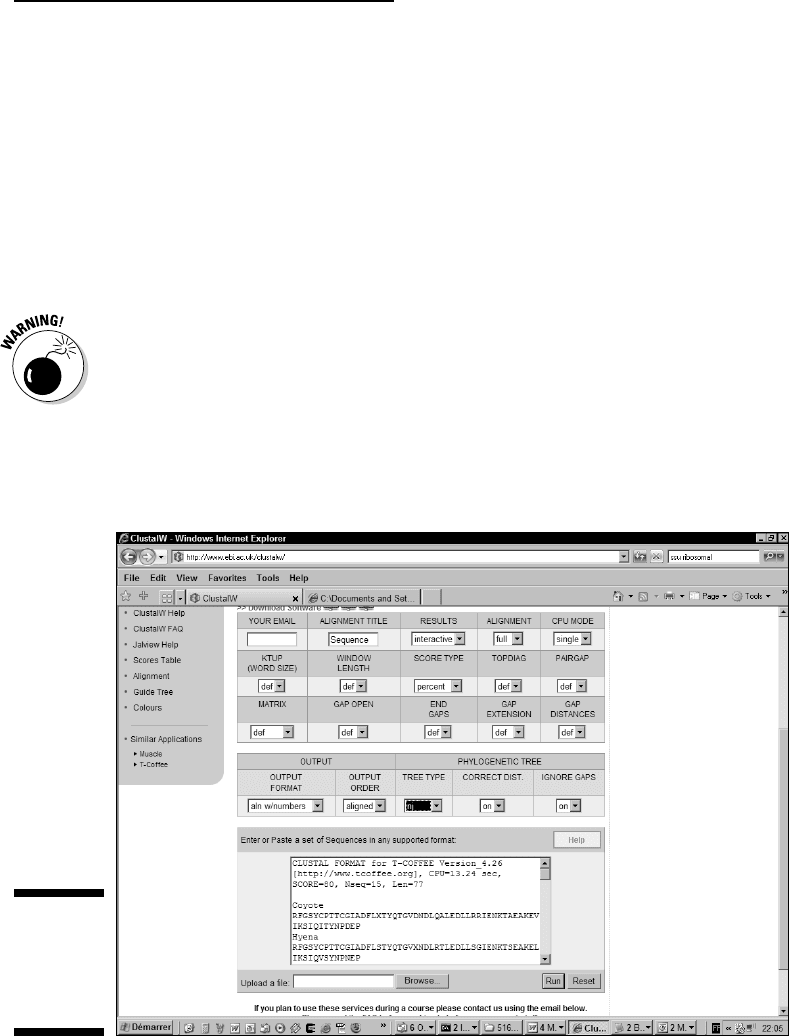
2. Paste your multiple alignment into the Sequence window, as shown in
Figure 13-3.
You can enter your alignment in any format you like, including ALN (the
ClustalW format), MSF, or FASTA. If you use an ALN alignment, make sure
you include the first line that reads “CLUSTAL W ...(etc.)”
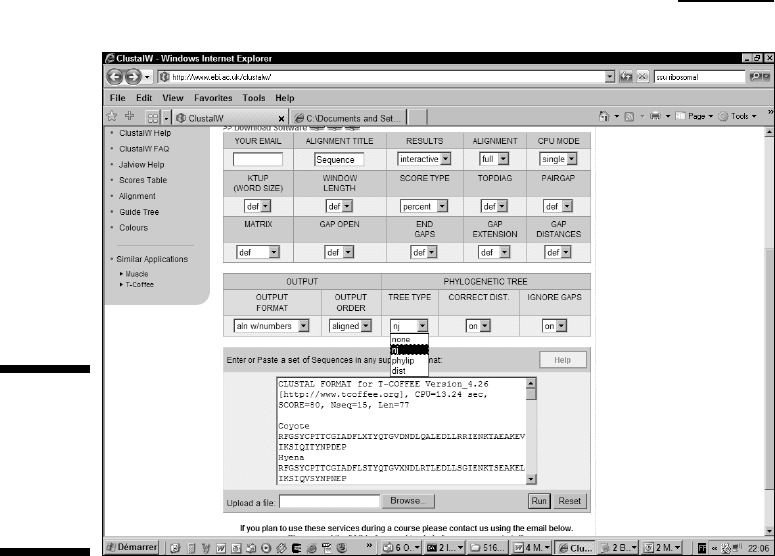
3. Choose NJ from the Tree Type drop-down menu in the Phylogenetic
Tree section, as shown in Figure 13-4.
This menu enables you to choose any of several different methods for
computing your tree. Specialists generally agree that NJ, the Neighbor
Joining method, is the best one for the task at hand.
If you set the Phylogenetic Tree: Tree Type drop-down menu to anything
other than None, you must provide ClustalW with aligned sequences.
“Why?” you might ask? Well, when you choose anything but None from
the drop-down menu, ClustalW
stops computing alignments and assumes
that you have provided it with aligned sequences. If you don’t do as it
assumes — and simply give the server unaligned FASTA sequences — it
assumes the sequences
are aligned and computes a tree. Of course (unless
your sequences can be aligned without gaps), this tree will be wrong!
Figure 13-3:
Computing a
phylogenetic
tree with
ClustalW.
385
Chapter 13: Building Phylogenetic Trees
20_089857 ch13.qxp 11/6/06 4:03 PM Page 385
4. Choose On from the Correct Dist. drop-down menu (located directly
to the right of the Phylogenetic Tree: Tree Type drop-down menu).
This option makes it possible to correct for multiple substitutions. It
tends to elongate the branches of your tree; it’s mostly useful for dis-
tantly related sequences.
5. Choose On from the Ignore Gaps drop-down menu.
This causes ClustalW to ignore every column of your multiple alignment
that contains gaps. Turning this option on ensures that
all sequences are
compared on the same number of residues. Keep in mind that phylogeny
gurus usually prefer to ignore positions (columns) that contain gaps.
6. Click the Run button.
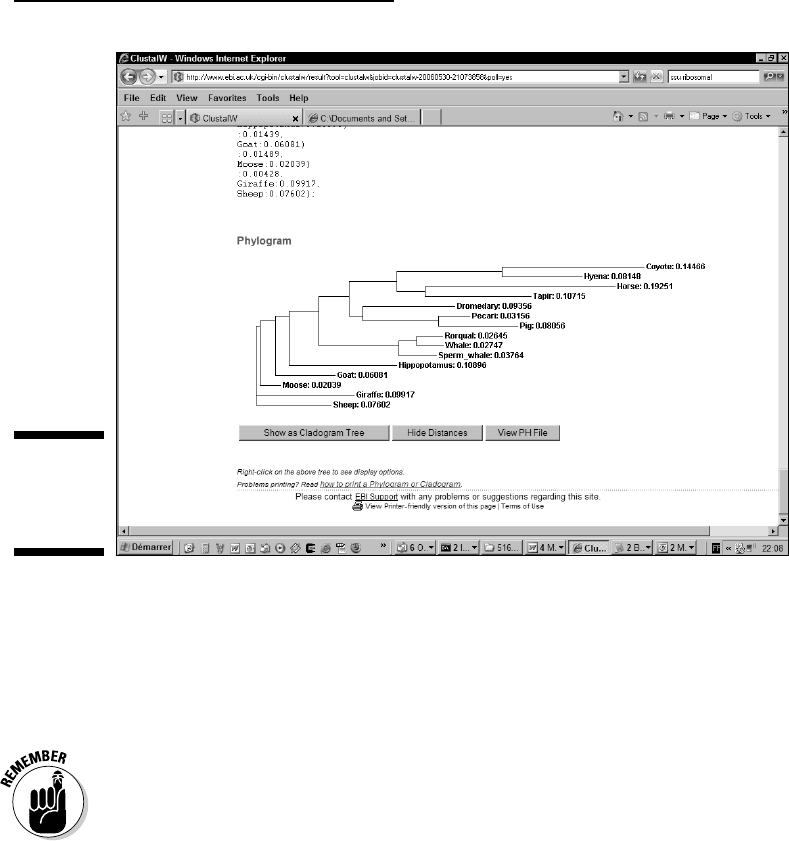
Wait until ClustalW returns your NJ tree, as shown in Figure 13-5.
This tree is much more accurate than a guide tree, and this one clearly
shows the genetic relationship between the hippopotamus and the
whale, as postulated by Higgins and Grauer a few years ago.
7. Save the graphical representation of your tree.
The easiest way to save your tree is to make a screen capture with the
print-screen (Prt Sc) key on your keyboard. You can then cut and paste
this image into your favorite application (PowerPoint, Paint. etc.).
Figure 13-4:
The
Phylogenetic
Tree: Tree
Type drop-
down menu
in ClustalW.
386
Part IV: Becoming a Specialist: Advanced Bioinformatics Techniques
20_089857 ch13.qxp 11/6/06 4:03 PM Page 386
8. Scroll to the bottom of the page and click on View PH File.
9. Use the File
➪Save As option of your browser to save a text version of
your tree.
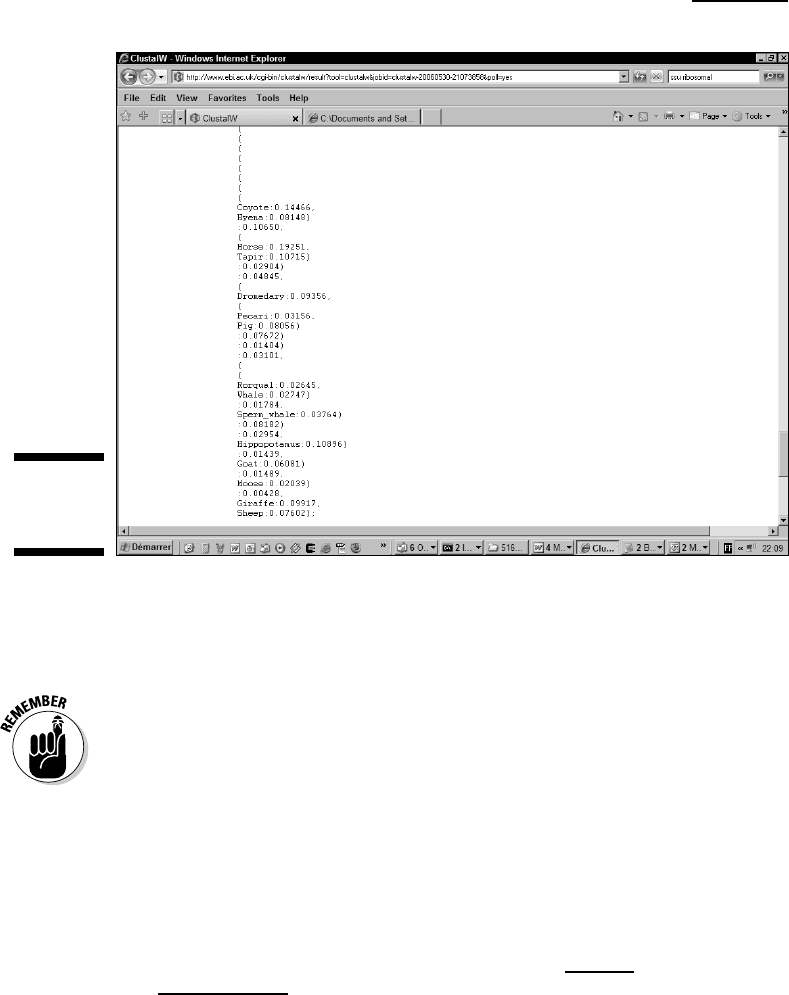
ClustalW presents your tree in the Newick text format — shown in Figure
13-6 — famous for its many parentheses. When you save the file, you’re
saving this Newick-formatted version of your tree.
The Newick format is the most standard way to store phylogenetic trees,
and most phylogenetic packages can use this format. If you want to keep
only one file related to your tree, keep this one!
Making a tree with Phylip
When it comes to phylogenetic trees, Phylip is a household name. Along with
PAUP, it is one of the most widely used resources for computing highly accu-
rate phylogenetic trees.
One of the nice things with Phylip is that it makes it easy for you to
bootstrap
your tree (check its reliability; see the sidebar, “What is bootstrapping?”).
What that does for you is make sure that the topology you’re looking at is
well supported by your multiple sequence alignment.
Figure 13-5:
An NJ tree
produced by
ClustalW.
387
Chapter 13: Building Phylogenetic Trees
20_089857 ch13.qxp 11/6/06 4:03 PM Page 387
If you decide to become a specialist, Phylip has all you need; you can use it to
build almost any kind of tree with any method you like. To demonstrate,
here’s a set of steps that shows how to produce a phylogenetic tree with
bootstrap information:
Before going onto this server, you must have a high-quality multiple sequence
alignment ready. For the purpose of these steps, we have prepared one for
you, available from
www.tcoffee.org/dummy_aln2.html.
1. Point your browser to bioweb.pasteur.fr/seqanal/phylogeny/
phylip-uk.html
.
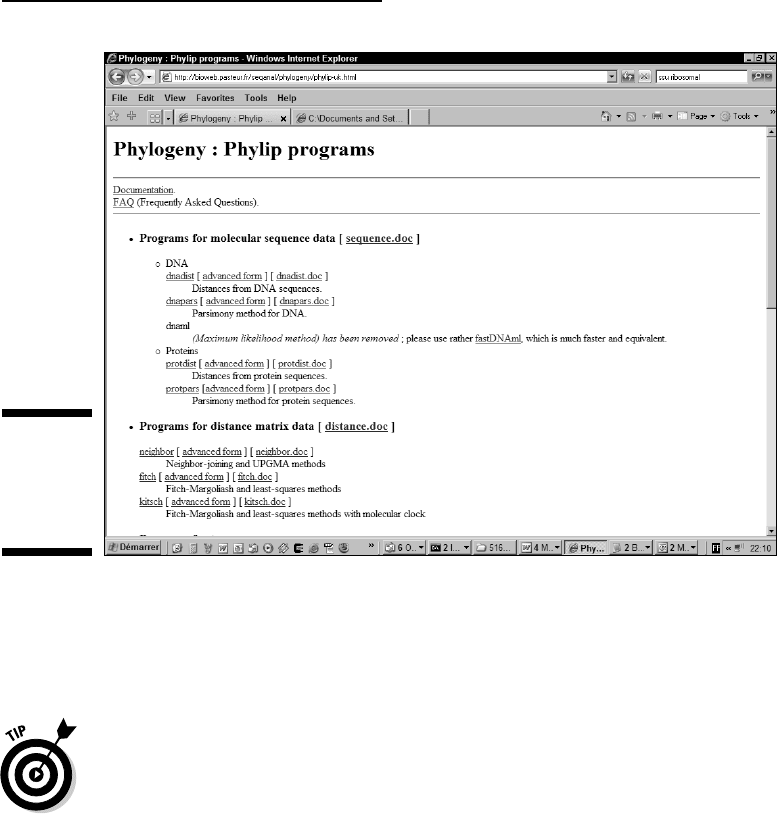
The Phylogeny: Phylip Programs page appears, as shown in Figure 13-7.
This page shows all the Phylip programs installed on this server. You
can produce a phylogenetic tree by using these programs one after the
other. The only trick is to use them in the right order.
2. Under the Proteins heading, right next to the protdist link, click the
advanced for
m
link.
The Phylip: Protdist page appears. Here’s what you need to know:
• To make a distance-based tree, you first need to generate a dis-
tance matrix that contains the pairwise distances between
sequences, as measured on the multiple sequence alignment.
Figure 13-6:
The Newick
tree format.
388
Part IV: Becoming a Specialist: Advanced Bioinformatics Techniques
20_089857 ch13.qxp 11/6/06 4:03 PM Page 388
• Some methods enable you to measure pairwise distances on DNA
or on proteins. There are also different programs for closely or dis-
tantly related sequences.
• Protdist is a method that uses a substitution matrix to measure the
distance between your aligned sequences.
• Protpars does the same thing, but it tries to evaluate the number
of mutations at the DNA level required for the observed amino-acid
differences. Protpars works better with closely related sequences.
3. Enter your e-mail address in the Your E-Mail field of the Phylip:
Protdist page.
Again, a little briefing is in order:
• If the server is overloaded or if you are analyzing a large alignment,
Phylip sends you your results by e-mail rather than giving them to
you online.
• The e-mail you receive contains a URL. When you open this URL,
your browser takes you to a page similar to what’s shown in
Figure 13-10.
Figure 13-7:
Phylip
online at the
Pasteur
Institute.
389
Chapter 13: Building Phylogenetic Trees
20_089857 ch13.qxp 11/6/06 4:03 PM Page 389