
Claverie J-M., Notredame C. Bioinformatics for Dummies
Подождите немного. Документ загружается.

• Colored diagonals indicate suboptimal secondary structures. The
color ranges from red (the best) to yellow (the worst).
The View Individual Structures section: This section contains data rela-
tive to the various structures mfold has computed. The optimal struc-
ture is the top one.
This section also indicates the free energy of your structure. This energy
must be as low as possible. For a molecule that’s around 200 bases long,
you should expect a free energy lower than –50 Kcal to consider the
reported fold as plausible.
The Dot Plot Folding Comparisons section: This very interesting sec-
tion makes it possible to compare the fold of several suboptimal solu-
tions. In order to do so, follow these steps:
1. Choose .jpg from the Image Format drop-down menu.
2. From the Compare Selected Foldings line, select all the alterna-
tive structures you want to compare.
3. Click the Do the Comparison button, as shown in Figure 12-6.
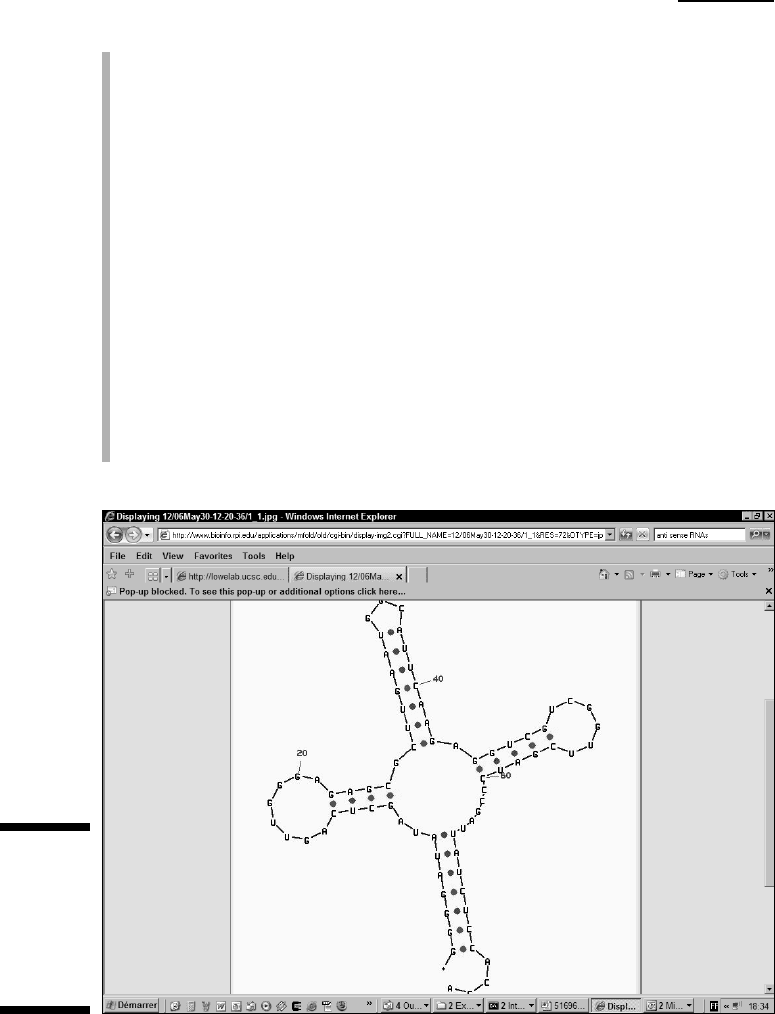
Figure 12-5:
Representa-
tion of an
RNA
secondary
structure
prediction.
360
Part IV: Becoming a Specialist: Advanced Bioinformatics Techniques
19_089857 ch12.qxp 11/6/06 4:03 PM Page 360
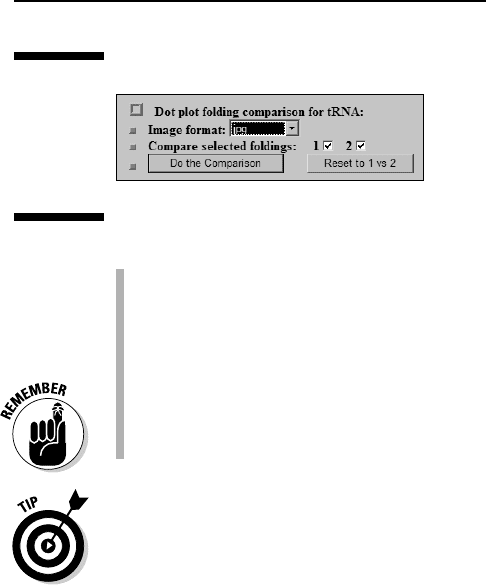
A graph similar to the one displayed in Figure 12-5 appears. It indi-
cates the elements of predicted secondary structures that are
common to the selected suboptimal solutions.
Colored elements correspond to stems that occur only in subopti-
mal secondary structure predictions.
Finding a high consistency between the optimal solution and the
suboptimal ones makes it more likely that the optimal solution is,
in fact, biologically correct.
The predictions you make on a single sequence can yield interesting results.
RNA is at its best, however, when you make the prediction on a multiple align-
ment rather than on a single sequence, thanks to what is known as the
covari-
ance phenomenon
.
Unfortunately, multiple-sequence-based predictions are not available for free
over the Internet, but if you are ready to install some software — and you
have a powerful machine — you can use a handy bit of software called Cove,
available for download at
www.genetics.wustl.edu/eddy/software/
#cove.
or some of the methods available through registration in Robin Gutell’s labo-
ratory at
www.rna.icmb.utexas.edu.
Forcing interaction in mfold
If you have some experimental data and you know that specific base pairs
occur in your RNA sequence, you can force mfold to use this information. For
example, you can tell mfold that nucleotides 10, 11, and 12 interact respectively
Figure 12-6:
Comparing
alternative
secondary
structures
with mfold.
361
Chapter 12: Working with RNA
19_089857 ch12.qxp 11/6/06 4:03 PM Page 361
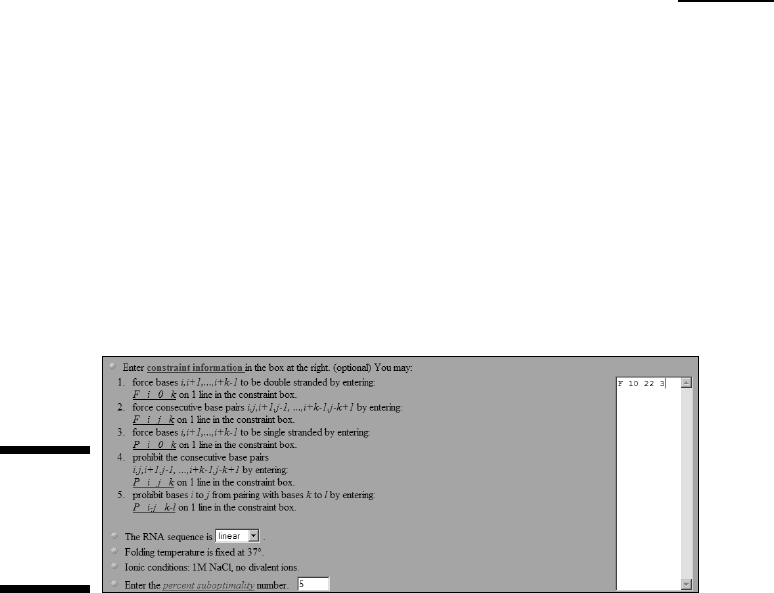
with nucleotides 22, 21, and 20. To do this, you write a line of instruction in
the interaction form of mfold that says
F, 10, 22, 3
This means that you (F)orce an interaction to start with nucleotide 10 —
paired with nucleotide 22 — and that you want this interaction to be the
beginning of a stem that is 3 nucleotide pairs long (nucleotide 10 with 22, 11
with 21, and 12 with 20).
Figure 12-7 shows you what the interaction form of mfold looks like when it is
filled out correctly.
Searching Databases and Genomes
for RNA Sequences
In a cell, all genes are transcribed into RNA molecules so the cell can use
them. One thing we all forget sometimes is that there are two kinds of RNAs:
those that the cell turns into a protein (using the ribosome machinery) and
those the cell uses directly. The latter are known as
non-coding RNAs.
Non-coding RNAs constitute a rich family, with new members discovered
every year. The more we understand the basic mechanisms that govern the
life of a cell, the more we realize that non-coding RNAs are everywhere. They
help with transcribing, splicing, replicating, and probably many other things
we aren’t yet aware of. It seems that every basic mechanism of life heavily
relies on these little guys — and arguing that a big chunk of biology’s future
belongs to them is probably the safest bet we’ll make in this book.
Unfortunately, with the exception of the ribosomal RNA, these small non-
coding RNAs tend to be rather short and poorly conserved. Their most
Figure 12-7:
Forcing
secondary
interaction
in mfold.
362
Part IV: Becoming a Specialist: Advanced Bioinformatics Techniques
19_089857 ch12.qxp 11/6/06 4:03 PM Page 362

common feature is often their secondary structure. This makes it difficult to
find them using any of the homology-based methods we routinely use for
finding proteins. (For more on such methods, see Chapter 7.)
The methods we show you in this section initiate database searches using
not only the sequence of RNAs but also information related to the known sec-
ondary structures. If you have just used mfold to predict the fold of the RNA
family you’re interested in, you can now use the fold you’ve discovered to
look for new members of the family. In this section, we first show you how to
use tRNAscan to look only for tRNAs, and we also introduce PatScan, a method
that allows you to look for RNAs with a secondary structure that you can
specify yourself.
Finding tRNAs in a genome
tRNAs are small non-coding RNAs that the cell uses to assemble proteins.
They constitute one of the best examples of important non-coding genes that
are difficult to localize in a genome. All the bacterial and eukaryotic genomes
contain tRNAs. Unfortunately, these ubiquitous genes are just as difficult to
identify as any small non-coding RNA. They require database search tech-
niques much more sophisticated than BLAST.
The good news here is that there are some very efficient programs out there
for predicting tRNA genes in a eukaryotic or a prokaryotic genome. The state-
of-the-art method is RNAscan-SE that you can access from the server at
Washington University in St. Louis:
selab.janelia.org/tRNAscan-SE/.
Using PatScan to look for RNA patterns
tRNAscan is perfect if you’re interested only in tRNAs. However, if your inter-
est lies in a specific RNA family, you want to use a tool that’s more general
and enables you to use your own knowledge of the secondary structure of
your RNA family. PatScan is ideal for this purpose.
PatScan lets you search databases with patterns that can accurately describe
RNA secondary structures. From a computational point of view, this type of
search is quite expensive, which is why PatScan requires your e-mail address
and returns a result after a few hours. (In our experience, however, PatScan
has never taken more than half an hour to return the result.)
363
Chapter 12: Working with RNA
19_089857 ch12.qxp 11/6/06 4:03 PM Page 363

If PatScan is not the route you want to go — perhaps because you don’t want
your sequences traveling across the Internet — you can use RNAmot, an alter-
native program that’s similar to PatScan. To use the program, however, you’ll
need to install the software on your own computer. If you want to do this, be
aware that this is not really a tool for novices. RNAmot is available for down-
load at
www.esil.univ-mrs.fr/~dgaut/download/.
Designing a PatScan pattern is the trickiest step when using PatScan. It is
something that may require a bit of thought. If you want to know the exact
rules that govern the PatScan patterns, you can read the excellent online
documentation of this program, available at
www-unix.mcs.anl.gov/compbio/
PatScan/HTML/matching_nucleotides.html.
To help design your pattern, start by identifying the elements you’re inter-
ested in. Use the following checklist as a guide:
On the primary structure, report the secondary structure elements.
Identify the corresponding stems and name them. The name of the left
side of the first stem is
p1 and the name of its right side is ~p1.
Count the length of each of these elements.
In each stem element, identify non-canonical Watson and Crick base pairs.
Write this structure down with your own vocabulary.
For instance:
[stem p1 of length 8 to 9] [Loop of length 3 to 8] [stem ~p1 of length 8 to
9, complementary to the left stem p1]
Turn your secondary structure into a PatScan Pattern.
p1=8...9 defines the stem p1 that contains 8 to 9 nucleotides. [Note the
3 periods (...) between the 8 and 9.]
3...8 defines a pattern of 3 to 8 nucleotides.
~p1 defines a stem reverse complementary to p1.
You can then write your pattern like this: p1=8...9 3...8 ~p1.
If you want to define several stems, give them different names, such as
p1, p2, p3, and so on.
If you need to, you can have nested stems, like p1=8...9 3...8 p2=5...7 4...5
~p2 3...8 ~p1.
364
Part IV: Becoming a Specialist: Advanced Bioinformatics Techniques
19_089857 ch12.qxp 11/6/06 4:03 PM Page 364

You can accommodate in PatScan almost anything you need to describe
complex RNA structures. The ability to describe pseudo-knots — long-
range interactions between a loop and another portion of the RNA mole-
cule, as shown in Figure 12-1 — makes PatScan a very powerful program.
Table 12-1 lists some of its possibilities.
Table 12-1 RNA-Specific Pattern Rules in PatScan
Rule Example Description
Pairing rule r1={au,gc} p1=10...12 3...8 r1~p1 Indicates that the p1 pairing
only involves au and gc
pairs.
Mismatches p1=10...12 3...8 r1~p1[1,4,2] The pairing between the two
p1 stems can involve at
most:
1 mismatch in p1 Vs ~p1
4 unpaired symbols in p1
2 unpaired symbols in ~p1.
Specify patterns p1=10...12 AUGC~p1 Specifies that the loop
MUST contain only AUGC.
Note that this pattern must
be in uppercase, as opposed
to the pairing rules.
With these guidelines, take PatScan on a trial run:
1. Prepare your PatScan pattern.
2. Point your browser to
www-unix.mcs.anl.gov/compbio/PatScan/
HTML/scanner.html.
The PatScan server page appears, as shown in Figure 12-8.
3. Choose the database you want to search from the Database
drop-down menu.
In our example, we chose DNA: Human.
The default database on this server is Swiss-Prot. In most cases, this data-
base is
not appropriate for searching RNA secondary structure patterns.
You must change this database to a DNA database.
365
Chapter 12: Working with RNA
19_089857 ch12.qxp 11/6/06 4:03 PM Page 365
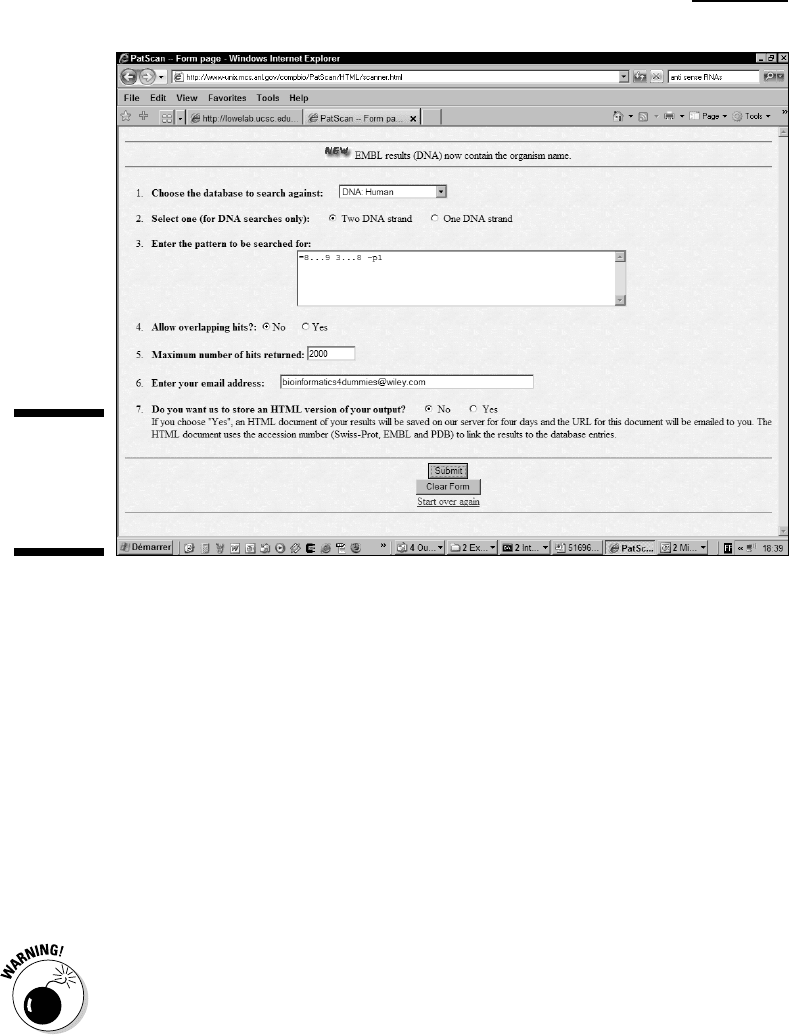
4. Paste or enter your pattern into the Pattern window.
We entered p1=8...9 3...8 ~p1.
5. Enter your e-mail address into the appropriate field.
6. Click the Submit button.
Depending on the size of the database you have selected — and on
the length and complexity of your pattern — your search can take up to
an hour.
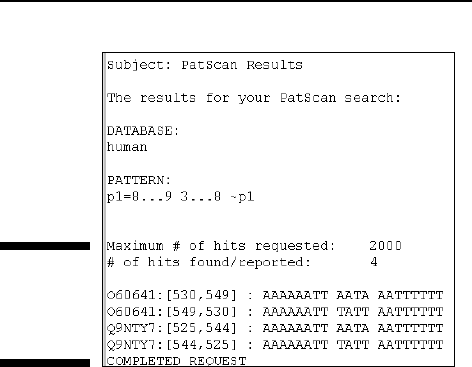
7. Analyze your results. (See Figure 12-9.)
In Figure 12-9, we have used PatScan to search the Human section of
GenBank. Each occurrence of a DNA pattern that matches our request
appears on a specific line, which indicates the GenBank/EMBL/DDBJ
accession number and the coordinates of this match in the sequences.
The fact that a sequence corresponds to your pattern does
not neces-
sarily mean that it adopts the secondary structure you had in mind!
PatScan checks that the hits are compatible with the specified secondary
structure, but it doesn’t make sure that this structure is the
most stable
one for these hits.
Figure 12-8:
Home page
of the
PatScan
server.
366
Part IV: Becoming a Specialist: Advanced Bioinformatics Techniques
19_089857 ch12.qxp 11/6/06 4:03 PM Page 366
Finding the “New” RNAs:
miRNAs and siRNAs
One of the most stunning discoveries in biology during recent years was the
extent of a phenomenon known as
RNA interference (RNAi) in eukaryotic cells —
the possibility for a small, short, non-coding RNA to interfere with a larger,
coding RNA — preventing the expression of the corresponding gene. This
interference occurs through the binding made possible by complementarity
between the small and the long RNA. This is why these small RNAs are some-
times named
antisense RNAs. (See Chapter 1 and 2 for the basics of nucleic-
acid complementarities.) While the possibility of RNA interference had been
known for a while in the lab, what stunned everybody was the discovery that
nature seems to use it extensively.
Since then, natural short RNAs that can inactivate genes have started popping-
up everywhere. They were first discovered in plants and named
silencing
RNAs
(siRNAs) for their ability to inactivate (silence) genes. These siRNAs are
not restricted to plants, and scientists have now found them in most eukary-
otic cells. While looking for siRNAs, biologists have started to find a wealth of
equally small and unknown RNAs. They have given them the generic name of
micro-RNA (miRNA). Nobody really knows what miRNAs really do in the cell,
although it’s suspected they probably regulate the genes. To make matters
worse, not only don’t we know exactly what they do, but we also don’t know
how many of them do it! The reason is that finding miRNAs in a genome is
much harder than finding proteins. Nothing makes miRNAs special except for
the fact that they are so small. As a consequence, we still don’t know how
many miRNA genes exist in the human genome. The main distinction between
Figure 12-9:
Results of
the PatScan
server.
367
Chapter 12: Working with RNA
19_089857 ch12.qxp 11/6/06 4:03 PM Page 367
siRNAs and miRNAs is that siRNAs are double-stranded and miRNAs are
single-stranded (and usually fold into a stem-loop).
In any case, thanks to the RNA interference phenomenon and the possibility
they present of inactivating genes quite specifically, these small antisense
RNAs have become one of the favorite tools of molecular biologists and one
of the most promising (potential) medical innovations on the horizon —
provided somebody ever finds a way to efficiently and accurately send these
little guys wherever and whenever they are needed in the human body.
Covering miRNAs, siRNAs, and the phenomenon of RNA interference goes
well beyond the
For Dummies scope — but Table 12-2 gives you enough to
start hunting for miRNAs in your favorite genome.
Table 12-2 Hunting Micro RNAs (miRNAs) over the Web
Address Description
sirna.cgb.ki.se/ An extensive collection of resources on
silencing RNAs.
itb.biologie.hu-berlin. A database of all known human silencing
de/~nebulus/sirna/v2/ RNAs.
microrna.sanger. The home of miRNAs at the Sanger Center in
ac.uk/sequences the UK. Probably one of the most extensive
resources on micro-RNAs.
cbit.snu.ac.kr/~ProMiR2/ A resource for predicting miRNAs using
probabilistic methods.
pictar.bio.nyu.edu Prediction of the potential target of your
miRNA on complete genomes.
bibiserv.techfak. A resource for predicting the potential target
uni-bielefeld.de/ of your miRNA on a user-provided genomic
rnahybrid/ sequence.
mirna.imbb.forth.gr/ Runs your genomic sequence against an
microinspector/ exhaustive database of miRNAs.
Doing RNA Analysis for Free
over the Internet
If you’re interested in RNA, everything you need is on the Internet. Make your
way through this section to get a better sense of the many excellent resources
available online for you.
368
Part IV: Becoming a Specialist: Advanced Bioinformatics Techniques
19_089857 ch12.qxp 11/6/06 4:03 PM Page 368

Studying evolution with ribosomal RNA
To study evolution, you need a gene that exists in all living organisms so you
can compare the rate of evolution of these organisms. For many years, biolo-
gists have used ribosomal RNA (rRNA) for this purpose. This has become so
commonplace that any time you find a new bacterium, the first thing you
want to do is sequence its ribosomal RNA so you can see where it fits on the
big tree of life.
Several laboratories have dedicated their entire work to helping the scientific
community use rRNA sequences. Table 12-3 lists some of the most famous of
these resources.
Table 12-3 Ribosomal RNA Resources on the Internet
Address Description
rdp.cme.msu.edu Provides data and services, including the
possibility to make online phylogenetic
analysis.
www.psb.ugent. A European database on the larger of the
be/rRNA/lsu/ two ribosomal subunits. It contains pre-
dicted structures. It is possible to query
the database online. Features lots of online
software.
www.psb.ugent. The “other” European database, this time
be/rRNA/ssu/ dedicated to the small ribosomal subunit.
Finding the small, non-coding
RNA you need
Small, non-coding RNAs are poorly represented in major databases.
Fortunately, excellent alternative databases make it possible to access the
genes you’re interested in. Table 12-4 is a partial list of these resources.
Table 12-4 Some Non-Coding RNA Resources
Address Description
condor.bcm.tmc. Dedicated to small non-coding RNAs.
edu/smallRNA/
smallrna.html
(continued)
369
Chapter 12: Working with RNA
19_089857 ch12.qxp 11/6/06 4:03 PM Page 369