
Claverie J-M., Notredame C. Bioinformatics for Dummies
Подождите немного. Документ загружается.

Table 12-4
(continued)
Address Description
rna.wustl.edu/tRNAdb/ Dedicated to tRNAs.
bighost.area.ba.cnr. Dedicated to the untranslated regions of
it/BIG/UTRHome/ genes.
www.indiana.edu/~tmrna/ Dedicated to the recently discovered
tmRNAs
that are both transfer and messen-
ger RNAs. (If you don’t yet know what this is,
you MUST take a look at this fascinating
Web site!)
Generic RNA resources
Well-maintained and usually up to date, these generic RNA resources (see
Table 12-5) make it easy for you to locate the server that corresponds to your
needs. On these lists of links you can find databases, software, and online
servers.
Table 12-5 A List of Generic RNA Resources
Address Description
bioinfo.lifl.fr/rna/ A site dedicated to the detection of non-
coding RNAs
www.imb-jena.de/ RNA World, one of the most complete sites
RNA.html currently available
www.rnabase.org/links/ Another very complete list of sites
370
Part IV: Becoming a Specialist: Advanced Bioinformatics Techniques
19_089857 ch12.qxp 11/6/06 4:03 PM Page 370

Chapter 13
Building Phylogenetic Trees
In This Chapter
Finding out what phylogenetic trees can do for you
Making the right multiple sequence alignment for the right tree
Estimating distances between your sequences
Building a Neighbor Joining Tree
Evaluating the quality of a tree by bootstrapping
Finding tree resources on the Internet
Nothing in biology makes sense except in the light of evolution.
— Theodosius Dobzhansky (1973)
T
he purpose of this chapter is to show you how you can use a computer and
a few online services to run a
phylogenetic analysis, the scientific procedure
that lets you reconstruct the evolutionary history of a group of organisms or
sequences. If you know what phylogenetic trees are all about — but you don’t
have a clue how to generate one with a computer — this chapter is for you.
Here we show you how you can select sequences, turn them into a multiple
sequence alignment, and then turn this alignment into a tree (well, okay, a
diagram that
looks like a tree). We show you three methods:
ClustalW: This is an easy method that you must use as a black box. You
cannot really control ClustalW, but it is reassuring to know that it uses
Neighbor Joining, a fairly well-established tree method.
Phylip: A more sophisticated method that enables you to control every
parameter that plays a part in the making of your tree.
phyML: A very accurate reconstruction method that uses maximum like-
lihood, a method that specialists often consider to be the most accurate.
As its name implies, Maximum Likelihood methods try to reconstruct
the tree that more likely to correspond to your alignment.
20_089857 ch13.qxp 11/6/06 4:03 PM Page 371

Whatever choice you make, bear in mind that a high-quality multiple
sequence alignment is usually the actual limiting factor. (If you’re not sure
what a multiple sequence alignment is, be sure to check out Chapter 9.)
Finding Out What Phylogenetic
Trees Can Do for You
The purpose of phylogeny is to reconstruct the history of life and explain the
present diversity of living creatures. This can be represented as a huge
genealogic tree (the tree of life). The underlying principle of phylogeny is to
try to group living creatures according to their level of similarity. In this con-
text, we assume that the more similar two species are (such as human and
ape), the closer they are to their common ancestor. Phylogeny is not a new
subject, and whether you trace back the birth of modern biology to Darwin
and
The Origin of Species or to Aristotle and his notion of categories, you
can’t escape this daunting fact: Biology is very much about classifying — and
the best means of classification we have is phylogeny.
Phylogenetics is a special kind of phylogeny that relies on the comparison of
equivalent genes coming from several species for reconstructing the genealogic
tree of these species and finding out who is the closest relative of whom in
the family. If necessary, you can also apply phylogenetic methods to the vari-
ous genes of a gene family to reconstruct the history of the gene family by
the same means. (Take note that these trees make sense only if you believe in
evolution!)
The molecular stories you can uncover with phylogenetics are incredibly
rich. In fact, we find it difficult
not to see a parallel between the destiny of
famous families (such as the Medicis, the Borgias, or the Kennedys) and the
fates of gene families. When we unravel the chain of events that makes the
story of a protein family, we find tales of mutations and deletions, duplica-
tions or speciation, loss and gain of function, inactivation, and all the other
traumatic events that shaped the world as it is today. Nothing is ever taken
for granted while life evolves!
Phylogenetics is here to let you discover all this. Phylogenetics is not a tech-
nique, nor even a discipline; phylogenetics is a science — and a major one.
The mere task of laying out the general ideas of phylogenetics is way beyond
the scope of this chapter, so if this subject is new to you, we urge you to con-
sult some of the excellent textbooks available on this subject.
372
Part IV: Becoming a Specialist: Advanced Bioinformatics Techniques
20_089857 ch13.qxp 11/6/06 4:03 PM Page 372

In the context of bioinformatic analysis, there are three major reasons why
you may want to use phylogenetics:
Determining the closest relatives of the organism that you’re inter-
ested in:
For instance, if you’re studying a new bacterium, you can
sequence its ribosomal RNA and place it on a phylogenetic tree com-
puted with all known ribosomal RNAs. This can give you a fairly good
idea of who this bacterium really is.
Discovering the function of a gene: If you’re studying a gene, you can
use phylogenetic trees to be sure that the gene you’re interested in is
orthologous (more about that in a minute) to another well-characterized
gene in another species.
Retracing the origin of a gene: Most genes within a genome travel
together through evolutionary time. However, from time to time, individ-
ual genes may jump from one species to another — for instance, piggy-
backing a virus infection. Phylogenetic trees are a great way to reveal
such events, which are called
horizontal (or lateral) transfers.
Two genes are orthologous if they come from two different organisms, derive
from a common ancestor gene, and have been separated only by speciation
events (as opposed to gene duplications). In theory, two genes that are
orthologous often have the same exact function (have similar roles) in the
two different organisms they come from. On the other hand, when the two
genes arose from gene duplication, we say that they are
paralogous. Two
genes that are paralogous belong to the same family but are more likely to
have different functions than they would if they were orthologous.
To give you an image, if the joystick of a Boeing 747 were a gene, it would be
orthologous with the steering wheel of your car. In contrast, the left front
wheel of your car is paralogous with the right front wheel.
Preparing Your Phylogenetic Data
Biologists have been dealing with phylogeny for many decades now, hence
the large number of different techniques available. Things have become a bit
simpler since people started doing
phylogenetics (phylogeny applied to gene
data). Nonetheless, there are still many schools of thought around — and
ancient fights are still raging in the world of phylogeny. Be aware that when
you choose a method, you’re also choosing sides! In this chapter, we try to
focus on the methods that have attracted the smallest amount of controversy
over the past few years.
373
Chapter 13: Building Phylogenetic Trees
20_089857 ch13.qxp 11/6/06 4:03 PM Page 373
The one thing upon which everybody agrees is that data quality is critical. If
you have very good data that’s suitable for phylogenetic analysis, any reason-
able method will lead to a reasonable tree. On the other hand, if your data
isn’t good, no method — however good — can rescue the story your data
tells. A brutal summary of this observation exists:
Garbage in, garbage out.
This is true of most data-analysis methods.
Phylogenetics uses genes to reconstruct evolutionary history. This type of
data is much easier to interpret than the
morphology data — derived from an
analysis of an organism’s form and structure — that biologists used to rely
on. It’s possible to compare gene sequences in a much more objective fash-
ion than it is to compare morphological characteristics.
When you do phylogenetics, good data means
a highly accurate multiple
sequence alignment that contains properly chosen sequences.
In the first part of
this section, we show you how you can prepare this kind of data.
Choosing the right sequences
for the right tree
When you build a phylogenetic tree, you make the assumption that the
sequences you are comparing have a common ancestor. If your sequences
are similar enough, this is a reasonable hypothesis. You want to use your tree
to reconstitute the history of these sequences to find out who is the closest
relative to whom.
Of course, this vision implies that evolution is always divergent — thus if
two sequences are similar, we rule out the possibility that this similarity may
result from convergent evolution. In the vast majority of cases, this rule makes
sense. At the molecular level, convergent evolution does exist — but it seems
to be the exception rather than the rule.
Using DNA or protein sequences
To establish the relationship between two sequences, you want to measure
the time that separates their divergence from their common ancestor. How
long ago did they part? To answer this question, compare your sequences
and measure a distance or establish an evolutionary scenario. Should you do
this on the protein or on the DNA sequence? We have a complex answer to
this seemingly simple question:
If your DNA sequences are more than 70 percent identical:
You can make a DNA multiple sequence alignment. If your sequences are
coding for proteins, however, this is not recommended.
374
Part IV: Becoming a Specialist: Advanced Bioinformatics Techniques
20_089857 ch13.qxp 11/6/06 4:03 PM Page 374
The problem with DNA sequence alignments is that the substitution
matrices are not very good — and the alignments take more time to
compute because of the sequence lengths.
If your DNA sequences are less than 70 percent identical:
If your sequences code for proteins, it is much safer to translate them into
proteins and to build the multiple sequence alignment with the proteins.
If your sequences are too similar at the protein level, you can thread the
DNA sequences back onto the protein alignment. Use pal2nal for that
purpose — like this:
coot.embl.de/pal2nal
If you do not have the DNA sequence that corresponds to your proteins,
you can use Protogene to automatically fetch the bona-fide DNA
sequences of your proteins. Protogen is a Tcoffee tool, available at
www.
tcoffee.org
After you’ve completed the DNA to protein threading, you have two
possibilities:
•
If most synonymous mutation sites are different: This is a typical
case of saturation. In this case, the distance measurements you
make at the protein level are more accurate.
•
If synonymous sites are not saturated: Distance measurements
made at the DNA level are more accurate in theory.
In practice, unless your sequences are almost identical, it is easier to
keep working at the protein level. This may not be as accurate as work-
ing with DNA sequences, but, in most cases, you can expect the results
to be reasonably good.
375
Chapter 13: Building Phylogenetic Trees
White T-shirts, spaghetti, evolution, and phylogeny
When we think of evolution, we tend to think of
natural selection, survival of the fittest, struggle
for life, and all these testosterone-loaded con-
cepts. In molecular terms, gurus name this
neo-
Darwinism.
This popular (though ancient) theory
states that the only reason mutations stay in a
population is because they are helpful and
increase the fitness of the individuals that carry
them. But this theory doesn’t account very well
for synonymous mutations or other harmless
DNA alterations.
In the 1960s, the increased availability of mole-
cular data led to Motoo Kimura’s elaboration of
neutralism.
Neutralism,
also known as the neu-
tral theory, challenges neo-Darwinism by stat-
ing that most mutations are either lethal or
neutral. Everybody agrees that lethal mutations
are disposed of right away — but for neutralists,
the possibility of a new non-lethal mutations
spreading (or not spreading) in a population
depends mostly on chance. Even if these muta-
tions are advantageous, chance is the driving
(continued)
20_089857 ch13.qxp 11/6/06 4:03 PM Page 375

376
Part IV: Becoming a Specialist: Advanced Bioinformatics Techniques
force. Keep in mind that neutral mutations aren’t
necessarily silent at the protein level; some
such mutations change a protein slightly with-
out altering its function. Of course, after these
harmless-but-useless mutations are fixed, they
can also find a niche — and give some advan-
tage to the individuals who carry them — later
on. Neutralism is a very powerful theory
because it accounts well for the way in which
species build their adaptation potential before
they need it.
If you’re doing phylogeny, these neutral muta-
tions are really the ones you’re interested in.
You do not want to see adaptation; you want to
measure evolutionary distances and the best
measure of evolutionary distance you have
is counting the number of random and quasi-
neutral events that occurred on your sequences
since they separated from their ancestor. You
can think of these mutations like each tick of a
clock that has been working, one mutation at a
time, for a million years.
To give you an image, imagine that this morning,
like every day, you took a white T-shirt and
duplicated it for your two kids (Dave and
Benny), and off they went. It was a long day;
Dave and Benny both ate their spaghetti bolog-
nese, both proving especially adept at emulat-
ing Michelangelo with the verve and passion
with which they sketched out — in brilliant red
sauce — a few Last Judgments on their white
T-shirts. Now suppose that each drop of colored-
something landing on the immaculate shirts is a
mutation — and the number of spots indicates
how far the day has progressed. If you want to
know how long Dave and Benny have been
wearing these shirts, you can simply count the
spots. This is true neutralism, and this is the
ideal situation when you compare sequences.
Imagine now that there is a bit of selection
going on: Dave and Benny may be very anxious
about your reaction when they come back
(okay, okay, probably unlikely, but bear with us
for the sake of argument), and they carefully
clean off every bit of color that lands on their
shirts — except for those you can’t see or those
that look “coooool.” This would be the equiva-
lent of selected mutations. When this goes on,
you can no longer tell how long the shirt has
been worn.
Non-selected mutations (neutral) are much
better for evaluating distances because they
accumulate smoothly. In coding DNA, the
synonymous mutations are the more typical
non-selected mutations. This is why DNA is
better for measuring distances than protein
sequences whose evolution is much more con-
strained. (These protein guys have work to do!)
Imagine now that the kids have had a second or
third go at the spaghetti bolognese. Drops of
sauce have landed on previous spots, and the
shirts are now completely saturated with
tomato sauce. What can you tell from this? How
many spaghetti meals have Benny and Dave
had? One? Two? Five? It’s impossible to say!
This analogy is typical of how our evolutionary
time measure becomes saturated — when
there have been one or more mutations on
every neutral site of our DNA sequence. Deter-
mining how long this has been going on
becomes impossible. Of course, the closer you
are to saturation, the more imprecise your mea-
surements are going to be.
One more thing before we rush to wash these
filthy T-shirts: What if, on a certain day, Benny
and Dave have not been doing the same thing?
One may come home sparkling clean and the
other muddy. Will you assume that they have
spent their days in different time dimensions, or
would you rather conclude that their shirts have
evolved at different paces (or places)? Different
paces sound more likely — although, if you ask
the kids, you may get a more confusing answer.
Such differences also occur with genes — and
although we like to think that there is a univer-
sal molecular clock, we know it tends to tick at
a different pace in every gene.
(continued)
20_089857 ch13.qxp 11/6/06 4:03 PM Page 376

Choosing sequences to make either a gene tree or a species tree
Homologous genes are genes that derive from a common ancestor. They can
have three types of relationships:
Orthologs: They’re only separated by speciation — is the phenomenon
during which a common ancestor gives birth to two subgroups that
slowly drift away from their common genetic makeup to become distinct
species. Assuming that the genomes are not rearranged in the two new
species, two genes are orthologous when they correspond to the same
ancestral gene in the ancestral genome. Biologists usually expect
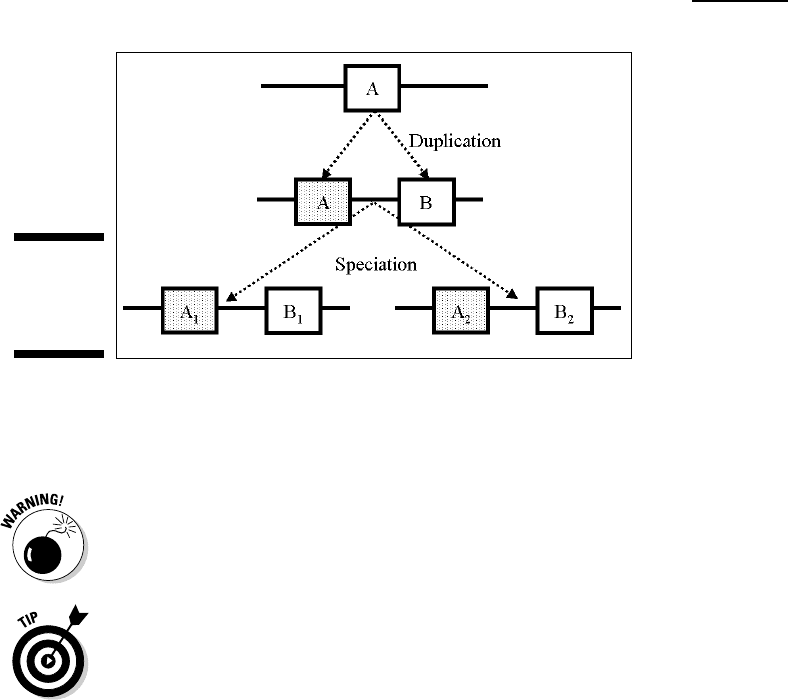
orthologs to have similar functions and structure. In Figure 13-1, A1 and
A2 are orthologs, and so are B1 and B2.
Paralogs: Paralogs are homologues separated by a duplication event,
meaning that within a genome, a gene was duplicated. One of the dupli-
cates may have kept the original function while the other duplicate
could have acquired a new function. You can expect paralogs to have dif-
ferent but related functions. For instance, A1 and B1 are paralogs in
Figure 13-1.
Xenologs: Xeno is a Greek word that means “foreigner.” Xenologs result
from a
lateral transfer between two organisms — a direct DNA transfer
between two species. This means that one of the species contains a gene
that does not have the same history as the genome in which it is inserted.
A typical case of lateral transfer (or xenologs) is the acquisition of the
isoleucyl-tRNA sytnthase from their host by several bacteria. The isoleucyl-
tRNA sytnthase is a protein involved in the synthesis of other proteins,
and its acquisition by bacteria seems to help them becoming antibiotic
resistant. When this happens, the newly acquired isoleucyl-tRNA sytnthase
is a xenolog of the other tRNA synthases contained in the bacteria.
When you select a group of homologous genes to make a phylogenetic tree,
you always make what biologists call a
gene tree. It is a tree that tells the
story of the genes it contains.
If you select all the
paralogous members of a large human gene family, your
gene tree tells the story of this gene family only. You can only use it to recon-
struct the chain of duplications that led from one single ancestral gene to the
current situation.
If you select a group of genes that are all
orthologous from different species,
the gene tree you get looks very much like a species tree — which lets you
reconstruct the speciations that occurred while the species you’re looking at
(or their ancestors) were diverging. The best example of this type of gene
tree is the ribosomal RNA phylogenetic tree that biologists use to reconstruct
the big tree of life. Ribosomal RNA genes exist in every species and are
clearly orthologous between species.
377
Chapter 13: Building Phylogenetic Trees
20_089857 ch13.qxp 11/6/06 4:03 PM Page 377
You can do things the other way round, of course, and use the tree to ask
whether your sequences can be called orthologs or paralogs. This is a valid
strategy if you know the true species tree.
Two genes that are homologous and come from two different species are not
necessarily orthologous.
They can also be paralogous — as A1 and B2 are in
Figure 13-1. Mixing orthologs and paralogs in a phylogenetic tree is a major
source of trouble. Unfortunately, avoiding it is difficult.
In theory, there’s no simple solution to the problem of establishing orthology —
and demonstrating it is virtually impossible. However, in practice, authors
have been using an empirical criterion that works reasonably well: the recip-
rocal BLAST best match. Here’s how it’s done:
1. Choose a sequenceA from genomeA.
2. Carry out a BLAST search comparing your sequenceA and every
sequence in another complete genomeB. (For more on BLAST
searches, see Chapter 7.)
The BLAST search returns sequenceB as a top hit.
3. Carry out a BLAST search comparing sequenceB and every sequence
in genomeA.
If this search returns sequenceA as a top hit, you can treat sequenceA
and sequenceB as orthologs from genomeA and genomeB.
This result doesn’t demonstrate that sequenceA and sequenceB actually
are orthologous, but it does mean you won’t be doing something very
wrong if you consider them so.
Figure 13-1:
Orthology
and
paralogy.
378
Part IV: Becoming a Specialist: Advanced Bioinformatics Techniques
20_089857 ch13.qxp 11/6/06 4:03 PM Page 378

This strategy makes sense only when your two genomes are complete and
have roughly the same proteome size.
Eugene Koonin has assembled a high-quality collection of orthologous genes
at NCBI. To do so, he used similar (but slightly more sophisticated) criteria. This
collection is known as the COG (Clusters of Orthologous Groups), and you can
find it online at
www.ncbi.nlm.nih.gov/COG/. Other collections of homolo-
gous genes include HOGENOM (former HOBACGEN) and HOVERGEN developed
by the Pôle Bioinformatique Lyonnais (
http://pbil.univ-lyon1.fr/).
Creating the perfect set
“Perfect” is meant to be ironic here, but we’ve listed in Table 13-1 a few points
you should take into account when assembling your sequence set.
Table 13-1 Preparing a Set of Sequences for
Making a Phylogenetic Tree
Problem Reason and Solution
Avoid sequence fragments Incomplete sequences make multiple
sequence alignments and tree reconstruction
methods very sick! You want to avoid these at
all costs — or you at least want to use the
same fragment for all the sequences.
Avoid Xenologs Unless your purpose is to study them, avoid
including genes that result from lateral
transfer.
Avoid recombinant sequences Some proteins result from the combination of
several proteins. This is especially common in
viruses. In terms of phylogeny, such proteins
have two ancestors rather than one — and
standard tree methods are not equipped to
represent this kind of relationship.
Avoid large complex families Very large families that contain various
domains and repeats can be very tricky to
analyze. The ABC transporter is a good exam-
ple of this kind of troubled family. If you can,
stay away from these protein gangs — or try
to work on smaller, more uniform subsets.
(continued)
379
Chapter 13: Building Phylogenetic Trees
20_089857 ch13.qxp 11/6/06 4:03 PM Page 379