
Claverie J-M., Notredame C. Bioinformatics for Dummies
Подождите немного. Документ загружается.

You can click to select any residue or group of residues in the sequence
viewer.
What can we tell about our invariant segment from all this? It’s quite an inter-
esting story, actually. Figure 11-11 shows that our segment occurs in a loop,
well exposed at the surface of the molecule. Surface loops are notorious for
being the most variable parts of proteins. (They are freer to mutate.) The
strict conservation of these residues suggests that they may have a specific
role in the protein function, such as participating in an interaction with
another protein or a small molecule.
Beyond This Chapter
In this chapter, we’ve provided you with a very general idea of what biolo-
gists do when they analyze the structure of their proteins with their comput-
ers. The applications shown in this chapter probably cover 90 percent of
what nonspecialists do when they study the relationships between their
sequences and its potential structure.
However, we haven’t even mentioned the many other tools and sophisticated
approaches that exist for studying protein structures. So here we give you a
quick list of what we have
not talked about, with some related URLs if you’re
curious about delving deeper into 3-D structures.
Finding proteins with similar shapes
Following the determination of the 3-D structure of your preferred protein,
you’ll want to know if its shape is unique (what the specialists refer to as a
“new fold”) or if there are many like it. Just prepare a PDB file with the atomic
coordinates of your protein and submit it to NCBI’s structure-structure simi-
larity search service (VAST) at
www.ncbi.nlm.nih.gov/Structure/VAST/
vastsearch.html
.
Finding other PDB viewers
There are many ways to spin molecules around; you should be aware that,
apart from Cn3D, other very powerful structure viewers are available over
the Internet, such as
RasMol: www.rasmol.org
DeepView, Swiss-PdbViewer: swissmodel.expasy.org/spdbv/
350
Part IV: Becoming a Specialist: Advanced Bioinformatics Techniques
18_089857 ch11.qxp 11/6/06 4:02 PM Page 350

Classifying your PDB structure
The classification of protein structures in categories of prototype folds and
domain topologies is a hot topic. This is related to the problem of identifying
and quantifying structural homologies between very distantly related pro-
teins, as well as the threading problem (see the upcoming section “Threading
sequences onto PDB structures”). The three main structure classification
sites are
The CATH classification: www.cathdb.info
The Dali 3D neighbor finding server: www.ebi.ac.uk/dali/
The SCOP classification: scop.mrc-lmb.cam.ac.uk/scop/
Doing homology modeling
The detailed modeling of the 3-D structure of a protein with significant
sequence similarity to a homologous protein of known structure can go much
beyond the simple example we have presented here. Specialists use energy
minimization techniques to replace the residues in the original model and
refine their positions. A couple of good entry points to find out more about
this homology modeling approach are
Modeller: salilab.org/modeller/modeller.html
SWISS-MODEL: swissmodel.expasy.org
Folding proteins in a computer
Some groups are making constant progress in their attempts to generate a
structural model for a protein solely from its sequence by simulating its fold-
ing process. This is referred to as the
ab initio (or in silico) folding approach.
The successes are still limited to a certain type of small protein sequences.
Find out more about it at the Folding@home project Web site (
folding.
stanford.edu/
).
Threading sequences onto PDB structures
Other groups have taken up the inverse problem of finding out which of the
known structures might be best suited as a folding mold to a given protein
sequence. This research field is known as
threading. In the context of a grow-
ing database of structures, threading methods might perform increasingly
351
Chapter 11: Working with Protein 3-D Structures
18_089857 ch11.qxp 11/6/06 4:02 PM Page 351
well and expand the range of homology modeling to the case of sequences
without any significant similarities in the PDB. To find out more about thread-
ing, check out these sites:
FUGUE: www-cryst.bioc.cam.ac.uk/~fugue/
UCLA Fold recognition: www.doe-mbi.ucla.edu/Services/FOLD/
The PROSPECT server: compbio.ornl.gov/structure/prospect/
Looking at structures in movement
Some specialists are developing techniques to simulate the movements known
to occur in protein structures, when stably folded. Understanding molecular
dynamics is an important part of understanding the details of protein-protein
interaction, or (for that matter) of enzymatic reactions. Find out more about
molecular dynamics and protein movements at
The Brooks Lab site: brooks.Scripps.edu/
The El Nemo site: www.igs.cnrs-mrs.fr/elnemo/
The Database of Macromolecular Movements site:
molmovdb.mbb.yale.edu/MolMovDB/
Predicting interactions
Finally, researchers are tackling the difficult problem of predicting whether —
and how — two different protein molecules (or a protein and a small mole-
cule) might interact with each other. This is technically referred to as molecu-
lar docking.
The top performance in this field is still very inadequate. In most
cases, the 3-D structures of the complex of two interacting proteins cannot
yet be computationally derived from their individual structures. Visit the fol-
lowing Web sites to find out more about docking:
AutoDock: www.scripps.edu/mb/olson/doc/autodock/
FlexX: www.biosolveit.de/FlexX/
FTDock: www.bmm.icnet.uk/docking/
Hex: www.csd.abdn.ac.uk/hex/
HotDock: wwwcs.uni-paderborn.de/~lst//HotDock/index.html
352
Part IV: Becoming a Specialist: Advanced Bioinformatics Techniques
18_089857 ch11.qxp 11/6/06 4:02 PM Page 352
Chapter 12
Working with RNA
In This Chapter
Searching databases for RNA molecules
Predicting the secondary structure of an RNA molecule
Publishing an RNA secondary structure
Finding non-coding RNAs over the Internet
Biology has at least 50 more interesting years.
— James D. Watson
I
n this chapter, we show you that it’s possible to use a computer to analyze
the most fascinating molecule of them all: the RNA molecule. RNA is
incredible because it does almost anything you can think of — including
transporting and transmitting genetic information (just like DNA) and per-
forming catalytic functions (just like proteins). (The sidebar “RNA secondary
structures” provides a closer look.) In fact, the more that biologists study
RNA, the more they wonder why nature bothered inventing DNA and proteins!
There are sound arguments that support the belief that RNA is the true
ancestral support of life, but we don’t plan to go so far back in time in this
chapter! We want to concentrate on another really exciting fact about RNA: It
is one of the most clear-cut successes in bioinformatics. If you use them well,
RNA computer-based methods can tell you as much as any million-dollar
experiment, simply because RNA is much more predictable than DNA or
proteins — and thus lends itself well to computer analysis.
This chapter is not here to give you an accurate view of the RNA world. This
is simply too complex a subject. (You’ll have to go back to your textbooks if
you want the full story.) What we show here are the few things that you can
easily do on a computer if you know what you’re looking for and if you want
to find out whether detailed RNA analysis could play a role in your project.
In the first section of this chapter, we show you how you can use mfold, a
famous online server, to predict and display the secondary structure of your
19_089857 ch12.qxp 11/6/06 4:03 PM Page 353
RNA sequence. We also show you how to make sure that you actually have
the correct structure.
The second section focuses on database search methods that are RNA-specific.
If you know the secondary structure of an RNA molecule, you can use this
information to scan databases for sequences that have a similar fold, even if
their sequence similarity is very low. This is a very powerful technique that
you can use to discover new members of an established gene class — or new
members of an RNA family you’ve discovered yourself.
The last section gives you a very brief overview of one of the most active
field of these last years: the study of small RNA molecules that are known as
miRNAs or siRNAs. We show you resources you can use to look for these little
guys and use them efficiently in your research.
Sadly, the big players, such as NCBI or the EBI, haven’t put as much effort on
the RNA side of things as they have in other fields. The good news is that the
RNA community is very active and open. On the Internet, you can find a
wealth of high-quality resources available to anyone who needs them, includ-
ing specialized databases and powerful software. We introduce some of those
resources in the last section of this chapter.
Predicting, Modeling, and Drawing
RNA Secondary Structures
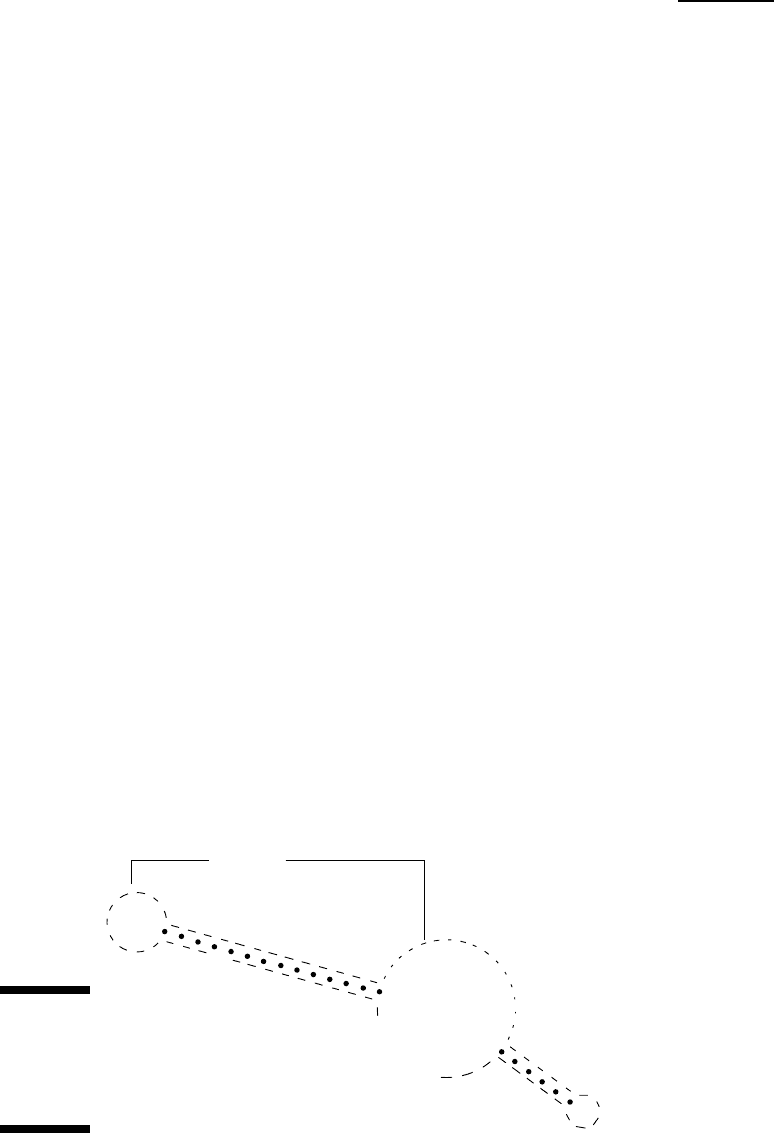
A major biological advance of the 1970s was the discovery that RNA can have
complex 2-D and 3-D structures, as shown in Figure 12-1. The very exciting
thing about these structures is that they obey laws that seem much simpler
and much more predictable than the laws that reign in the world of proteins.
Many of the RNA short- and long-range secondary structures rely on standard
Watson and Crick base pairing, just as DNA does.
C
C
C
C
C
C
C
C
C
C
C
C
C
C
C
C
C
C
C
Pseudo-Knot
Loop
Stem
A
A
A
A
A
A
A
A
A
A
A
A
A
A
A
A
A
A
A
G
G
G
G
G
G
G
G
G
G
G
G
G
G
G
G
G
G
U
U
U
U
U
U
U
U
U
U
U
U
U
U
U
U
U
5º
3º
U
Figure 12-1:
Typical
secondary
structures
in RNA.
354
Part IV: Becoming a Specialist: Advanced Bioinformatics Techniques
19_089857 ch12.qxp 11/6/06 4:03 PM Page 354

Using Mfold
Mfold is an implementation of the Zuker algorithm that makes it possible to
predict the energetically optimal secondary structure of an RNA molecule. It
uses a sophisticated model that can take into account many realistic physical
parameters that affect the RNA folding — such as pH, temperature, and the
local composition bias of your RNA.
355
Chapter 12: Working with RNA
RNA secondary structures
A single-stranded RNA molecule works exactly
like sticky tape. It will not be stable unless some
of its exposed bases are protected from water.
A good way to protect an RNA base from the
solvent is to pair it with another RNA base. Of
course, all possible base-pair combinations are
not equally good. Pairing a guanine with a cyto-
sine (for example) is more stabilizing than pair-
ing an adenine with a uracile.
The pairing of these bases forms the
RNA sec-
ondary structure.
When a molecule contains
two long stretches that are complementary,
they yield a nice stable stem. (Refer to Figure
12-1.) The unpaired bases between the stem
strands make up a loop. Stems don’t have to
be perfect; they can also contain unpaired
residues (which RNA gurus name
bulges
)
.
We assume that the natural tendency of the
RNA molecule is to reach its most stable con-
formation by assembling a nice collection of
pairwise interactions, giving the molecule the
highest stability it can have. This concept is
what we call the
lowest-energy model.
Such a
stable RNA structure always has a negative
energetic value (such as –70 Kcal/mol); if you
want to unfold it, you need to provide some
energy (heat).
As is true for proteins, we don’t know exactly
how the RNA molecule finds this lowest energy
form — but we know this happens very rapidly
in the cell. The stability of an RNA fold doesn’t
completely depend on the number of GC pairs it
contains. Many parameters — such as the
stacking of base pairs (making some stems
much more stable than others) and loop sizes —
influence the fold. Sophisticated algorithms (like
that found in the mfold program) can take these
subtle effects into account when computing an
optimal fold.
Tertiary interactions also play a role in overall
stability. These include
pseudo-knots
(again,
refer to Figure 12-1) that are usually long-range
interactions between a loop and another
portion of the RNA molecule. The interaction
between the RNA molecule and other chemical
elements — such as ions, proteins, or other
RNAs — also plays an important role in its
stabilization.
Unfortunately, we have difficulties predicting
tertiary interactions or the effect of the proteins
on the folding of an RNA molecule. So, when
you predict the secondary structure of your
RNA, this prediction usually depends on the
assumption that this RNA folds on its own in the
cell. Because this is almost never true, there is
always a chance for your prediction to be partly
or totally incorrect. The general rule is that the
most energetically stable features tend to be
reasonably close to the truth.
19_089857 ch12.qxp 11/6/06 4:03 PM Page 355
Keep in mind that the energetic model that mfold uses ignores 3-D interac-
tions or protein-RNA interactions that could stabilize a suboptimal fold.
There is always a chance that a prediction from mfold does not correspond
to the true biological fold of your RNA.
To help you make a decision, mfold returns suboptimal models so you can
judge the stability of the optimal fold. It is also possible to force mfold to
respect an interaction that you know is correct.
You cannot force pseudo-knots in mfold.
To try mfold, you’ll need to do a couple of things. First and foremost, you’ll
need to fetch an RNA sequence. “Where?” you might ask. Well, some hunting
is in order; when it comes to non-coding RNA, standard DNA databases are
poorly equipped. A few specialized databases exist, but most of them are
dedicated to ribosomal RNA. The last section of this chapter gives you the
Internet address of a few of these resources (see Table 12-2).
What’s the best length for your RNA sequence? Good question. The time
mfold needs to analyze sequences increases very rapidly with their length.
For instance, if it takes 1 second to fold a molecule that’s 100 bases long, it
takes about 10 seconds to fold a sequence that’s 200 bases long.
The current limit of the server we’re going to use for our example is 3,000
bases. This is convenient for most non-coding RNAs except the largest ribo-
somal ones.
With the preliminaries out of the way, it’s time to do some mfolding. We’re
going to use a sample RNA sequence, but you’re free to use one of your own if
you want:
1.
Point your browser to lowelab.ucsc.edu/GtRNAdb/Haem_infl/
Haem_infl-tRNAs.fa.
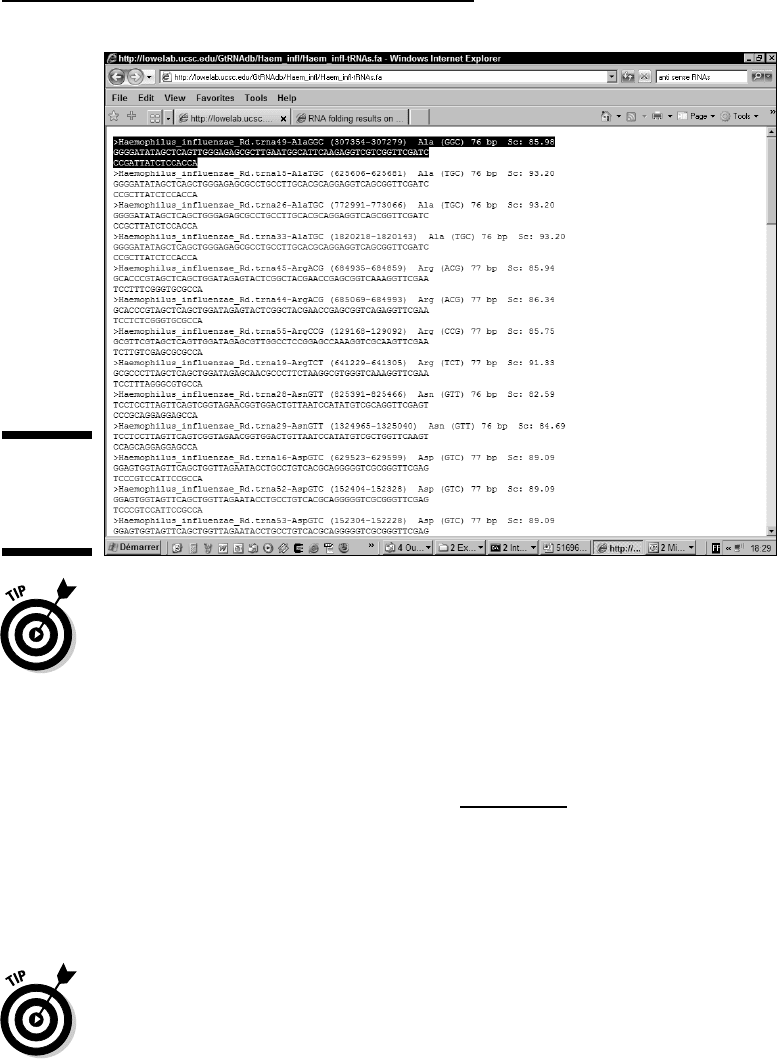
This returns a list of tRNA sequences predicted by Sean Eddy’s tRNA
scan server of the Haemophilus influenza genome. The sequences are
ordered according to the reliability of their predictions. Sequences at
the top of the list are almost 100 percent sure.
2. Select the first tRNA sequence, as shown in Figure 12-2, and copy it to
the Clipboard.
3. Point your browser to
www.bioinfo.rpi.edu/applications/
mfold/
.
The Applications page of the Center for Bioinformatics (Rensselaer
Polytechnic Institute) duly appears.
356
Part IV: Becoming a Specialist: Advanced Bioinformatics Techniques
19_089857 ch12.qxp 11/6/06 4:03 PM Page 356
As an alternative, you can also use one of the two European mirrors of
mfold:
bibiserv.techfak.uni-bielefeld.de/cgi-bin/mfold_submit
bioweb.pasteur.fr/seqanal/interfaces/mfold-simple.html
or its Australian counterpart:
mfold.burnet.edu.au
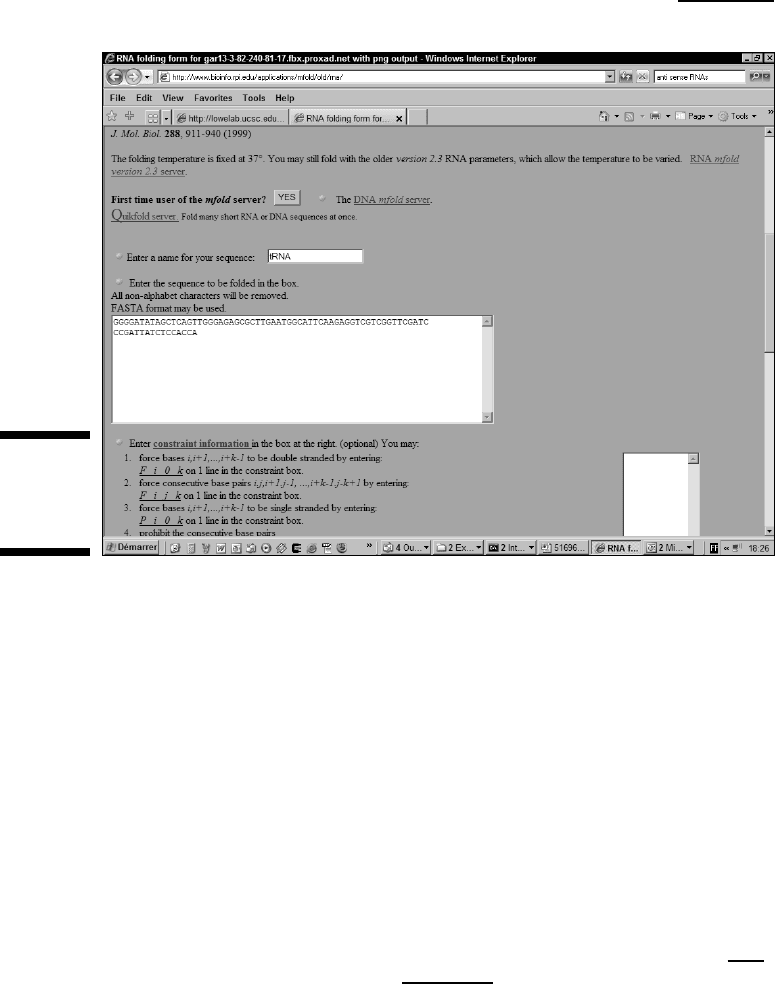
4. Scroll down the page and click the RNA Folding link.
The mfold server page appears, as (partially) shown in Figure 12-3.
5. Enter a title for your sequence in the Name field.
For our example, we named our sequence tRNA.
6. Paste your tRNA sequence into the Sequence window.
You can safely keep all the other default parameters.
See the next step list (in the “Forcing interaction in mfold” section) if
you want to provide the program with some predefined constraints.
Figure 12-2:
Selection of
a tRNA
sequence.
357
Chapter 12: Working with RNA
19_089857 ch12.qxp 11/6/06 4:03 PM Page 357
7. Scroll down the page and click the Fold RNA button near the bottom
of the form.
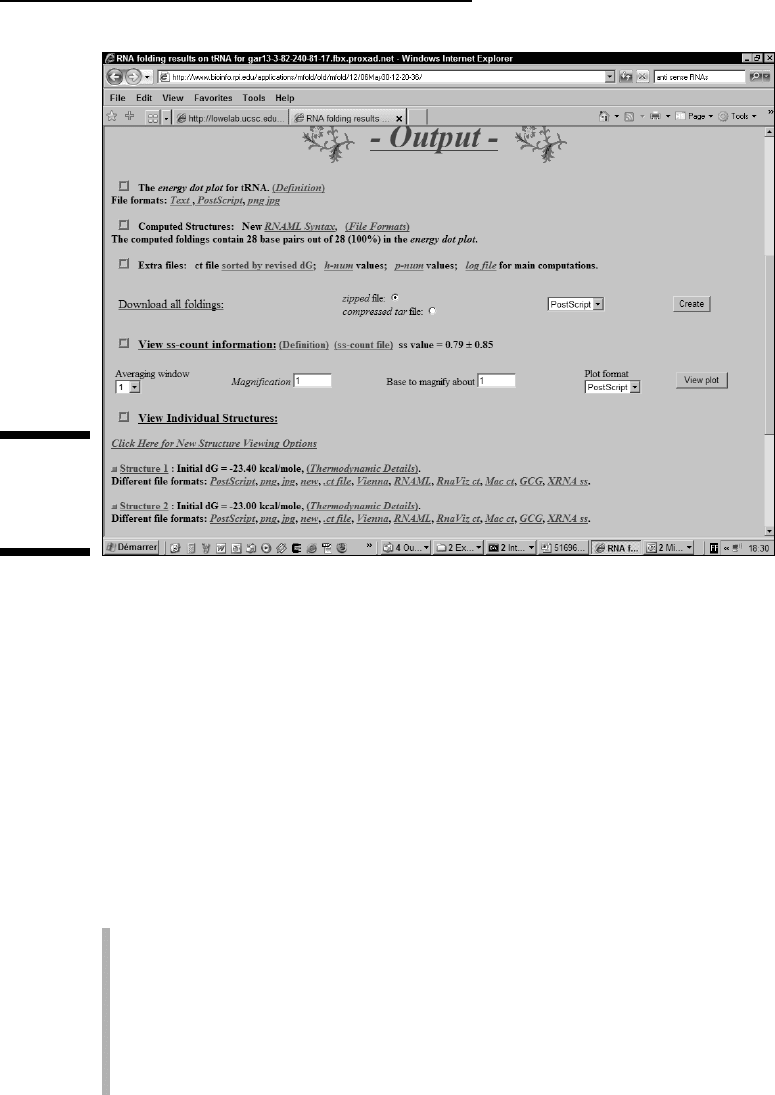
The Output page (eventually) appears, as shown in Figure 12-4. The
output itself looks rather complicated because it contains links to your
results in almost any format you can think of. It also contains thermo-
dynamic information concerning your model, so that you can tell how
stable they are.
8. Display the jpg picture of the best-scoring model.
a. Scroll down the Output page until you find the section titled View
Individual Structures (refer to Figure 12-4).
The structures are ranked according to their stability. For instance,
Structure1 is the most stable model, Structure2 is the second best,
and so on.
b. Look for the listing of different file formats, and then click the jpeg
link associated with the Structure1 link. This will load a new page,
containing the most stable secondary structure of your sequence
(Figure 12-5). This is not necessarily the correct one, but a good
candidate.
9. Save your secondary structure prediction by right-clicking on the
image that has just appeared and then choosing the Save As option.
Figure 12-3:
Mfold
server home
page.
358
Part IV: Becoming a Specialist: Advanced Bioinformatics Techniques
19_089857 ch12.qxp 11/6/06 4:03 PM Page 358
Interpreting mfold results
After you’ve given mfold your sequence, it looks for the arrangement that
yields the secondary structures with the lowest possible energy. Of course,
the correctness of this secondary structure depends on the correctness of
the energy model; if the model is wrong, the structure is wrong. (See the
“RNA secondary structures” sidebar.)
The general rule is that the more stable the conformation mfold predicts, the
more likely this interaction is to be correct. To help you get an idea of the
nature of this stability, mfold’s Output page displays several results related to
the stability of your RNA. Among these, you may want to give further atten-
tion to the following:
The Energy Dot Plot: The energy dot plot shows the stems that are part
of the optimal fold of your sequence.
• A stem shows up as a black diagonal, perpendicular to the main
diagonal.
• Distal interaction (that is, pairs that involve nucleotides very far
from each other) appears as diagonals close to the top-right (or
bottom-left) corner.
Figure 12-4:
Output of
the mfold
server.
359
Chapter 12: Working with RNA
19_089857 ch12.qxp 11/6/06 4:03 PM Page 359