
Claverie J-M., Notredame C. Bioinformatics for Dummies
Подождите немного. Документ загружается.

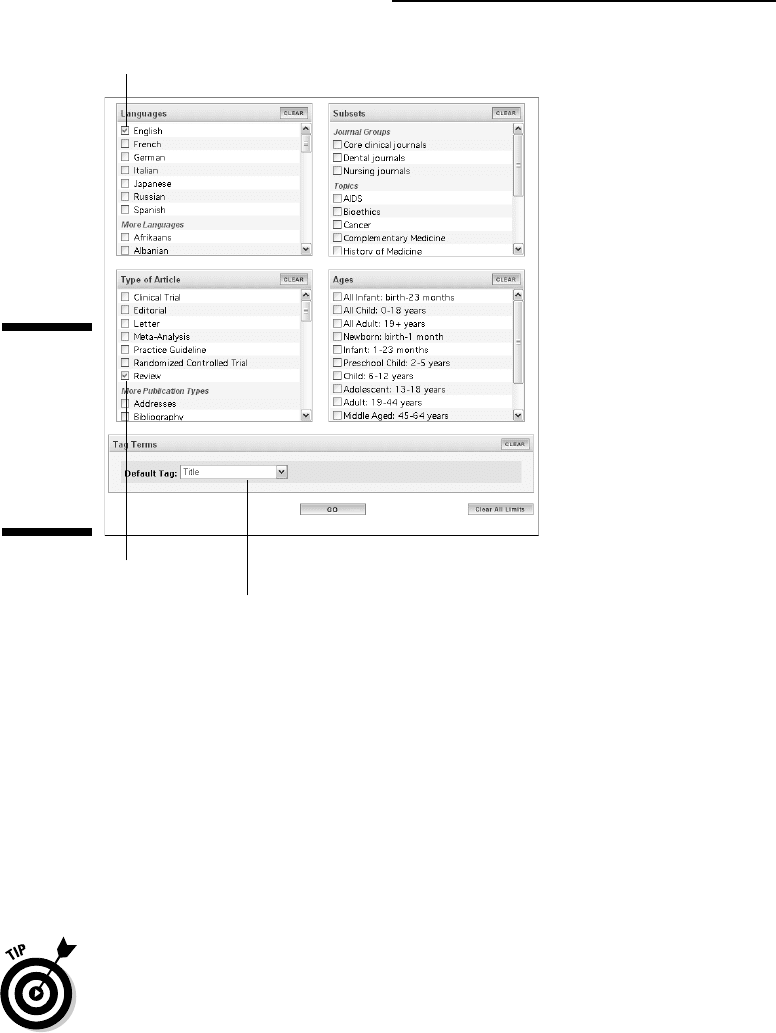
6. Choose Title from the Default Tag drop-down menu.
Choosing Title restricts the search to articles for which the topic of
dUTPase is central.
7. Finally, click the Go button.
Your (new and more concise) Results page appears.
In our hands, searching for dUTPase using these limits resulted in five
articles — much better than the 200 hits we would have gotten without the
limits. More important, we’ve limited the search to
review articles, which
hopefully contain — in concise form — all we’d ever want to know about this
subject.
A common use of the Limit menu is also to restrict the search for papers
published within a given date range (such as the most recent).
Language
Restricted field title
Type of article
Figure 2-9:
Limiting a
search for
dUTPase to
the titles of
review
articles in
English.
40
Part I: Getting Started in Bioinformatics
06_089857 ch02.qxp 11/6/06 3:52 PM Page 40

A few more tips about PubMed
Finding out how to use PubMed to its full extent is certainly worth your time
because PubMed can be useful in many different ways. Remember that you
cannot break anything, and you risk nothing by exploring what all these
buttons — especially the ones we haven’t talked about — might do. Here
are a few last-minute tips:
How to get the most out of your query:
• Quoted queries (for example, “down syndrome”) behave as a single
word, and are a great way to improve the relevance of your search.
• Impress your colleagues by starting using logical connectors (
AND,
OR, NOT) in your queries, as in
dUTPase[TI] OR pyrophosphatase[TI] NOT Smith[AU]
• Adding initials to proper names (for example,
“Abergel C”) can
greatly reduce the number of hits.
• Write down the PubMed Identifier (the number in the PMID field)
of that interesting paper you just found. It can be very useful in any
subsequent searches for related items, such as associated gene
and protein sequences.
• Don’t forget to deselect the Limit box when starting a new search.
• Don’t put too much initial faith in a search that produces no
results. Spelling mistakes, wrong field restrictions, or improper
limits settings can all throw off an effective search.
• As a beginner researching a new subject, read through a couple of
abstracts to enlarge your initial “jargon” vocabulary — and look for
synonyms. For example, if you don’t know that some papers on
dUTPase might use the term “dUTP pyrophosphatase” instead, you
may miss out on some interesting papers.
• Try the Related Ar
ticles link — the one to the extreme right of the
PubMed output — to enlarge a search that isn’t giving you enough
references.
Things you (unfortunately) won’t find in PubMed:
• Names ranking beyond the 10th place in the author’s list for
older papers (before 1995).
This is a significant problem for many
pioneering articles in genomics.
•
Papers recorded before 1965. PubMed doesn’t have any. Don’t
rely on PubMed as a primary source if you’re writing an historical
article in your field.
•
Abstracts for most references recorded before 1976. Don’t expect
great results from PubMed searches involving these.
41
Chapter 2: How Most People Use Bioinformatics
06_089857 ch02.qxp 11/6/06 3:52 PM Page 41

Retrieving Protein Sequences
If putting PubMed to use for bibliographic searches is the most common
bioinformatics thing biologists want to do, then the
next most popular thing
is to retrieve relevant protein sequences from the Web to find out more about
the subject at the molecular level. Although PubMed provides you with a
direct link to the protein world, we find that it’s sometimes confusing to use.
So here we introduce you to another site, where finding protein sequences is
really easy.
ExPASy: A prime Internet site
for protein information
Created and managed by one of the pioneers of protein bioinformatics, Prof.
Amos Bairoch, the ExPASy server is a world-leading resource for protein
information. In addition to the Swiss-Prot protein sequence database, the
ExPASy site provides numerous analysis tools that we use throughout this
book. It also provides a wealth of outside links for more specialized analyses
on other servers.
After using PubMed to acquire some preliminary information about a particu-
lar function that you’re interested in — dUTPase, for example — go ahead
and find out more about it by retrieving a few examples of protein sequences
that perform this function. (Don’t worry — we show you how.) Because
Escherichia coli (abbreviated E. coli) is one of the most studied organisms,
we use it in our example to show you how to retrieve the sequence of the
protein performing the dUTPase function in this bacterium.
1. Point your browser to www.expasy.org/sprot/, the Swiss-Prot data-
base home page (Figure 2-10).
2. Type dUTPase coli in the Search window, and then click the Search
button.
A list of three relevant protein sequences (as shown in Figure 2-11)
appears.
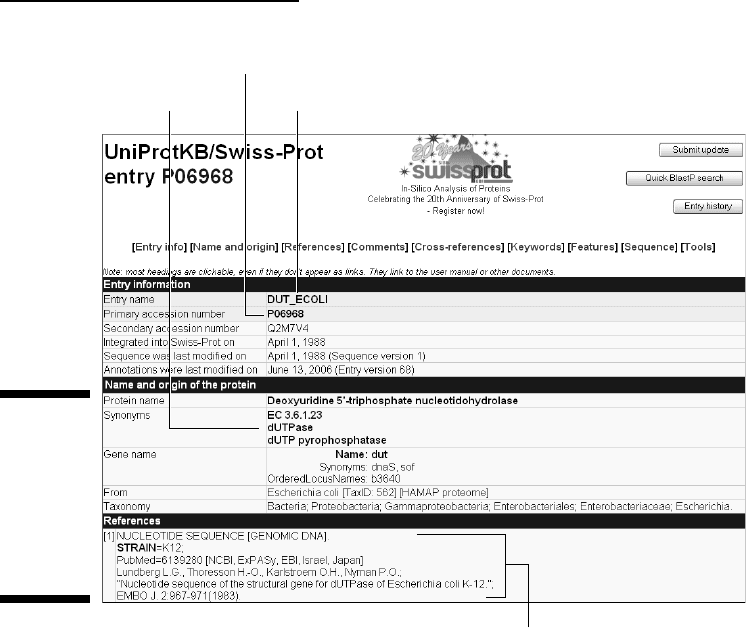
Now, when you click the last DUT_ECOLI (P06968)
link, a full page of
information about this dUTPase protein
of E. coli appears on-screen, as
shown in Figures 2-12 and 2-13. (No single browser window can hold
such a wealth of information, so we’ve broken up the Results page into
two figures.)
42
Part I: Getting Started in Bioinformatics
06_089857 ch02.qxp 11/6/06 3:52 PM Page 42
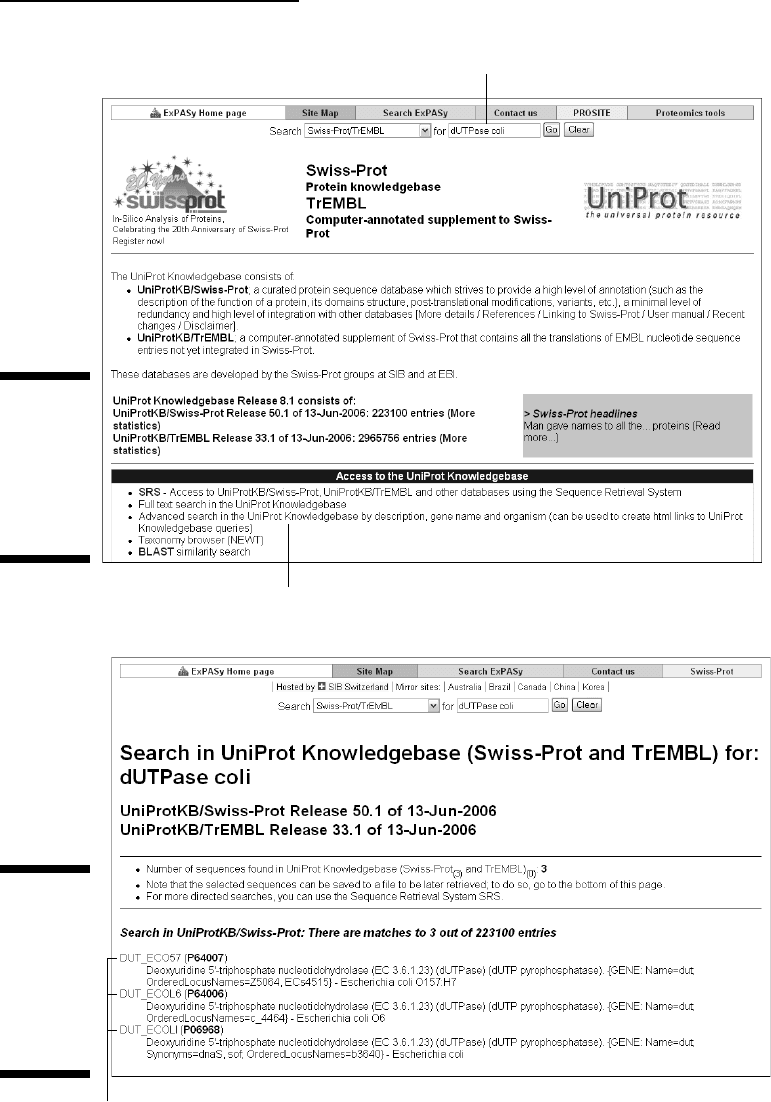
3 relevant dUTPase entries found.
Figure 2-11:
Three
dUTPase
sequences
from the
Escherichia
coli
bacterium.
Search window
Click here for Advanced Search.
Figure 2-10:
The Search
window at
the top of
the Swiss-
Prot home
page.
43
Chapter 2: How Most People Use Bioinformatics
06_089857 ch02.qxp 11/6/06 3:52 PM Page 43

A typical Swiss-Prot entry is made up of four parts. Here’s how that
looks for our example of dUTPase:
• The top of the entry contains the entry name
DUT_ECOLI on the
first line and the unique identifier
P06968 (called a primary acces-
sion number
) on the second line. As with PubMed identifiers, these
codes are worth writing down; they’re used to cross-reference
related entries in other databases.
• The top section offers a biochemical description of the protein,
including its standard name, its international Enzyme Committee
number (“E.C.” does not mean “E. coli”), as well as a couple of syn-
onyms. These synonyms can be very useful to broaden your
search for relevant articles in Medline. Then comes a list of biblio-
graphic references relevant to the sequencing of the protein or
some functional studies. Note that the PubMed ID is given for all
cited articles to allow for easy cross-referencing.
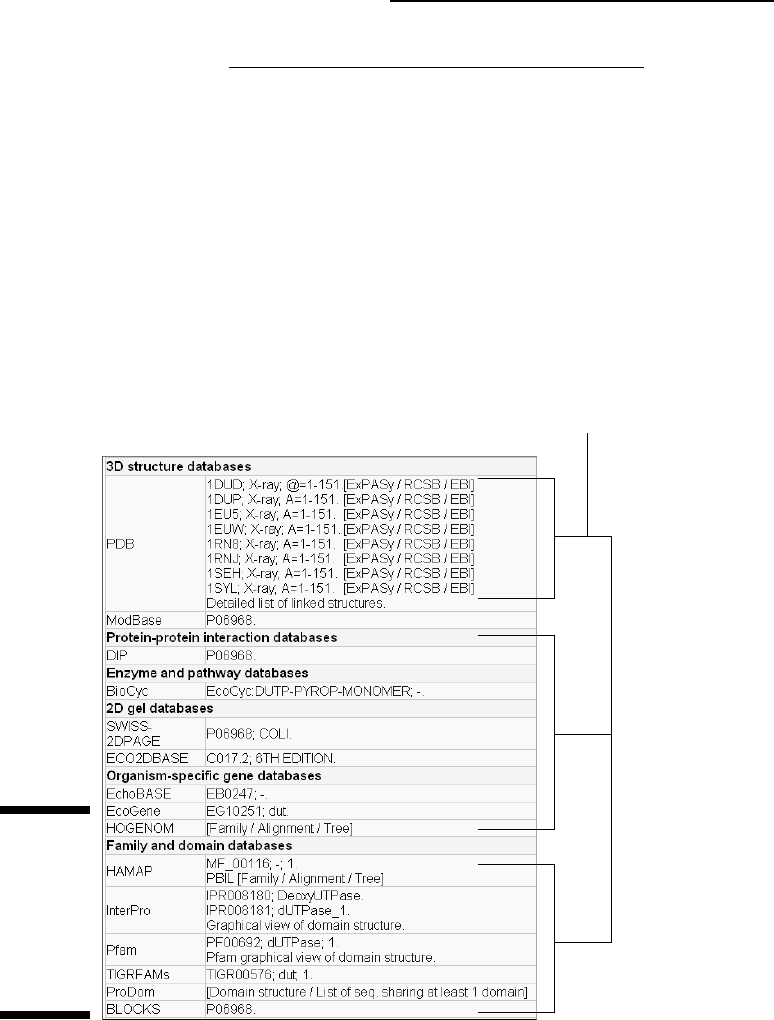
• The middle section offers a whole series of links to various func-
tional classification schemes — including relevant protein
domains, 3-D structures, and functional signatures. (We describe
this section in more detail in Chapter 4.)
• The bottom section — the
sequence section — provides you with
the actual amino-acid sequence of the protein. In Figure 2-14, you
can see that the
E. coli dUTPase is made up of 151 amino acids,
corresponding to a predicted molecular weight of 16,155 Da. (The
sequence shown in Figure 2-14 uses the one-letter code format for
describing amino acids. For more on the different formats used,
see Chapter 1.)
For further studies, you need this amino-acid sequence in the FASTA
format — a much simpler format that doesn’t bother with punctuation.
See the sidebar “The FASTA (and RAW) format,” elsewhere in this chap-
ter, for more information.
3. To get the FASTA format, click the F
ASTA Format link, on the extreme
right of the very bottom of the entry.
The FASTA format for your sequence is shown in Figure 2-15.
In just three easy steps, you’ve gone all the way from an informal definition
such as dUTPase to the complete description of the protein that performs
this function in everybody’s “favorite” bacterium. (And you thought bioinfor-
matics was complicated?)
44
Part I: Getting Started in Bioinformatics
06_089857 ch02.qxp 11/6/06 3:52 PM Page 44
More advanced ways to retrieve
protein sequences
Identifying the right protein in Swiss-Prot isn’t always so easy because the
information you start with may not be specific enough. For instance, the
Search feature we outline in the previous section may not work particularly
well if the same term is found in different sections of the Swiss-Prot entry. To
get better results, you have to use some field restriction (which we describe
in the context of PubMed searches).
This type of restricted search always depends on the organization of each
particular database, as well as on the idiosyncrasies of search software. For
Swiss-Prot, the steps are as follows:
1. Point your browser to www.expasy.org/sprot/.
You’ll see the by-now-familiar Swiss-Prot database home page (refer to
Figure 2-10).
Synonyms Swiss-Prot name
Accession number
Bibliography
Figure 2-12:
Swiss-Prot
entry for the
E. coli
dUTPase
protein
(upper
section).
45
Chapter 2: How Most People Use Bioinformatics
06_089857 ch02.qxp 11/6/06 3:52 PM Page 45
2. Click the Advanced Search in the UniProt Knowledgebase link (located
near the bottom of the opening screen, below the
Access
to the UniProt Knowledgebase
banner).
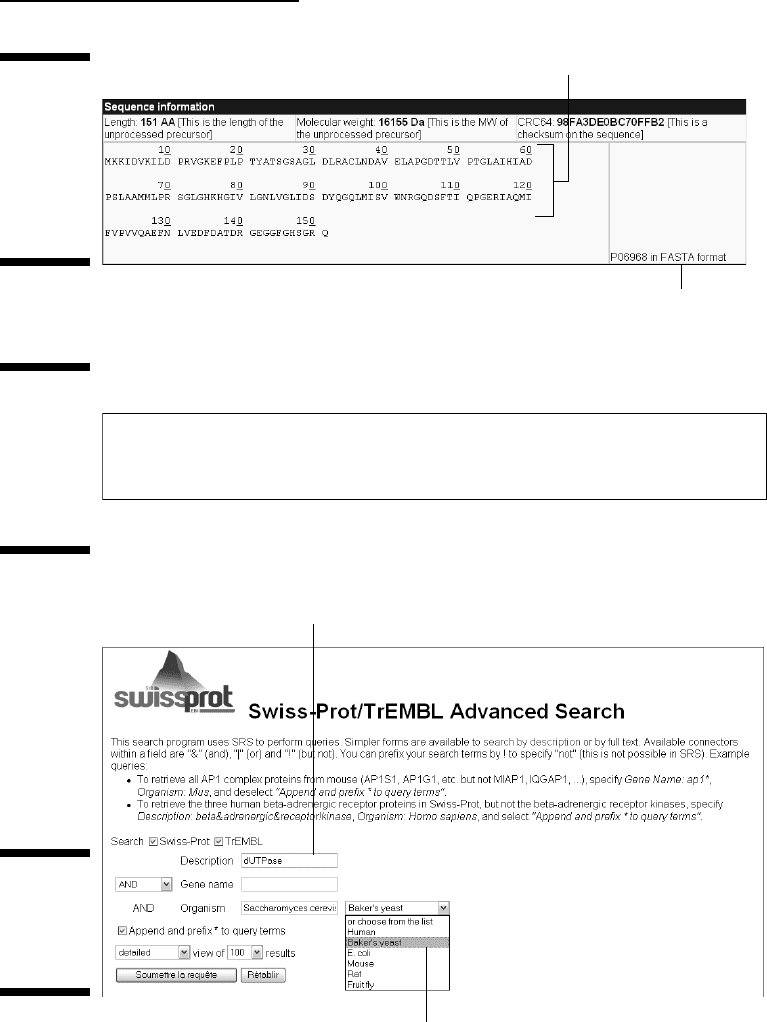
The Advanced Search page appears (Figure 2-16). Using this electronic
form, you can retrieve protein sequences by using keywords associated
with three specific fields: Description, Gene name, and Organism.
3. For the purposes of our example, type dUTPase in the Description
field, choose baker’s yeast from the Organism drop-down menu, and
click the Submit Query button. (Refer to Figure 2-16.)
Your results appear on a new page. If you use the dUTPase example,
you’ll successfully retrieve the yeast dUTPase protein, no ifs, ands, or
buts — that’s to say, exactly the protein you were looking for. Its Swiss-
Prot entry name is
DUT_YEAST, and its accession number is P33317.
Links to relevant entries in other databases (structure, biochemistry, signatures, . . . , etc.)
Figure 2-13:
Swiss-Prot
entry for the
E. coli
dUTPase
protein
(middle
section).
46
Part I: Getting Started in Bioinformatics
06_089857 ch02.qxp 11/6/06 3:52 PM Page 46
Protein description
Organism
Figure 2-16:
Using
Swiss-Prot
Advanced
search.
>sp | P06968 | DUT_ECOLI Deoxyuridine 5’ -triphosphate nucleotidohydrolase (EC 3.6.1.23) (dUTPase)
MKKIDVKILDPRVGKEFPLPTYATSGSAGLDLRACLNDAVELAPGDTTLVPTGLAIHIAD
PSLAAMMLPRSGLGHKHGIVLGNLVGLIDSDYQGQLMISVWNRGQDSFTIQPGERIAQMI
FVPVVQAEFNLVEDFDATDRGEGGFGHSGRQ
Figure 2-15:
E. coli
dUTPase
protein
sequence
in FASTA
format.
Sequence
Fasta
Figure 2-14:
Amino-acid
sequence of
the E. coli
dUTPase
protein
(bottom
section).
47
Chapter 2: How Most People Use Bioinformatics
06_089857 ch02.qxp 11/6/06 3:52 PM Page 47

Retrieving a list of related
protein sequences
Many questions in molecular biology (your dissertation topic, your own
research, or your personal interests) require downloading a large collection
of similar protein sequences, all related to the same function, rather than just
one sequence. These biological questions typically include the detection of
conserved functional motifs (segments of sequences that look the same in
proteins with the same function), the simultaneous alignment of multiple
sequences, the assessment of their variability, or
phylogenetic studies — how
sequences relate to each other through evolution.
48
Part I: Getting Started in Bioinformatics
The FASTA (and RAW) format
FASTA is the name of a popular sequence-
alignment-and-database-scanning program cre-
ated by W.R. Pearson and D.J. Lipman in 1988
(you can use your brand new PubMed skills to
find the original article). The sequences used by
FASTA have to obey the following format:
>My_Sequence_Name
ARCGTCRGCKINTANDRGCKINTAND
CKINTANDARCGTCRGCKINTANDRG
CKINTAND
The line starting with > (the
definition line
) con-
tains a unique identifier followed by an optional
short definition. The lines that follow it contain
the DNA or protein sequence (in one-letter
code) until the next
> character in the file indi-
cates the beginning of a new sequence.
Because FASTA is easy to parse, this format has
become hugely popular — and is now the
default input format for much sequence analy-
sis software, including BLAST and CLUSTALW.
Be aware, though, that programs using FASTA-
formatted sequences as input are sometimes
case-sensitive. Here are some pointers:
Always use CAPITAL letters for the one-
letter codes.
When using FASTA-formatted sequences
on a PC, always use the TEXT option of your
preferred word-processing software (that
is, skip the formatting and use nothing but
ASCII characters).
When displaying these sequences as
a word-processing document, use the
Courier font for easy alignment.
Some programs analyzing one sequence at a
time work with the
RAW
format. This is simply
the sequence part of the FASTA format, without
the definition line — but machines can be
finicky. Using the FASTA format when the RAW
format is required may cause an error — or
some of the definition line may end up included
in the protein or DNA sequence (!).
06_089857 ch02.qxp 11/6/06 3:52 PM Page 48

Building your own specialized sequence data file, right on your PC is easy
and enables you to use it with other analysis programs accessible from other
bioinformatic sites. To continue with our previous example, we now show
you how to build a file containing all well-documented dUTPase protein
sequences. To make it usable by other programs, you generate this file in
FASTA format. Here’s the procedure:
First, go back to the Advanced Search page of the ExPASy server:
1. Point your browser to www.expasy.org/sprot/ and click the
Advanced Search in the UniPr
ot Knowledgebase
link.
2. In the Search line — directly above the Description window — keep
the Swiss-Prot box checked but deselect the TrEMBL box.
TrEMBL is a database made up of unsupervised computer translations
of new DNA sequences, Swiss-Prot only includes entries validated by
expert curators. Restricting the search to Swiss-Prot thus ensures — to
the best of our knowledge — that all returned proteins are
actual
dUTPases.
3. Type dUTPase in the Description window.
Be sure that you don’t type in anything else. In particular, don’t put
anything in the Organism window.
4. Click the Submit Query button.
A Results page appears, as shown in Figure 2-17. This particular search
(at the time of writing) yielded 211 Swiss-Prot entries. (You may get
more entries when you get around to doing your own search.) Scrolling
down the list, you can see that all the entries look like fine and upstand-
ing dUTPase protein sequences. At this point, you can click each of the
individual names (such as
DUT_ADEG1) to access a complete ID card.
(For a sense of what you can find on such an ID card, refer to Figures
2-12, 2-13 and 2-14.)
But to complete your assignment on dUTPases, for instance, you now have to
gather all these sequences into a single file. This is easy; just do the following:
1. Perform Steps 1 through 4 in the preceding list, and then click the Select
All button at the top-right of the Results screen (refer to Figure 2-17) or
check the boxes for some specific sequences you are interested in.
2. Don’t waste any time here and don’t change anything; simply click the
Send query button (that’s
soumettre la requête in French).
The Download page appears, as shown in Figure 2-18. Your sequences
are ready to be saved to your hard drive.
49
Chapter 2: How Most People Use Bioinformatics
06_089857 ch02.qxp 11/6/06 3:52 PM Page 49