
Claverie J-M., Notredame C. Bioinformatics for Dummies
Подождите немного. Документ загружается.


second-generation nucleotide-sequence databases have adopted a more gene-
centric
perspective, where all the sequence information relevant to a given
gene is made accessible at once. In addition to unraveling the mysteries of
the more traditional GenBank, then, we also show you how to use NCBI’s
Entrez Gene, a good example of a gene-centric database.
These days, nucleotide sequences are routinely determined at the whole-
genome or chromosome scale — at least for microorganisms. We now have
information not only about individual gene sequences, but also about their
relative positions, strand orientation, and the presence or absence of bio-
chemical functions within an entire organism. To take advantage of this more
global information, researchers have had to design state-of-the-art
genome-
centric
sequence-information management systems that can connect special-
ized sequence collections with browsing tools. As an added bonus, this
chapter presents some of the great genome-centric resources dealing with
viruses, bacteria, or (you guessed it) human beings.
However, before you start delving into these information-management systems
in earnest, you may find it useful to read the next section. There, we quickly
summarize the fundamentals of genes and genomes and introduce the vocabu-
lary you need to read GenBank fluently. If you’re an experienced biologist, you
can skip this section completely — or read it word for word in hopes of finding
some embarrassing mistake. Go ahead. We dare you! Conversely, if you want to
learn much more, we advise you to go get
Genetics For Dummies, by Tara
Rodden Robinson, a great companion book for would-be bioinformaticians.
Reading into Genes and Genomes
True, nucleotide sequences are universal, but the structure of the genes they
encode is markedly different between
prokaryotic organisms (organisms lack-
ing a true nucleus) and
eukaryotic organisms (the kind lucky enough to have
a true nucleus). You have to know the basic architecture of both types of
genomes and genes to make sense of a simple GenBank entry. Remember that
we need to define a
gene as the contiguous genome segment encompassing
all the nucleotide-sequence information necessary to bring about its success-
ful
expression — that is, the production of protein or RNA. This handy defini-
tion includes both the coding and regulatory parts of a gene.
Prokaryotes: Small bugs, simple genes
The three most basic classes of living organisms are the prokaryotes (usually
bacteria), the
archaea (bacteria-like organisms living in extreme conditions),
and the
eukaryotes. Eukaryotes go all the way from microscopic yeast to
humans, animals, and plants.
70
Part II: A Survival Guide to Bioinformatics
08_089857 ch03.qxp 11/6/06 3:54 PM Page 70

For bioinformatic purposes, prokaryotes and archaea are very much the
same. With few exceptions — far beyond the realm of this book — they have
the following properties in common:
They are microscopic organisms.
Their genome is a single, circular DNA molecule.
Their genome size is in the order of a few million base pairs [0.6–8].
Their gene density — the number of genes per base pairs in the genome —
is approximately one gene per 1,000 base pairs.
Their genome is lean and mean, containing few useless parts (70 percent
is coding for proteins).
Their genes do not overlap.
Their genes are transcribed (copied into messenger RNA) right after a
control region called a
promoter.
These messenger RNA (mRNA) are collinear with the genome sequence.
In other words, genes are in a single piece, not interrupted by noncoding
patches (called
introns).
Protein sequences are derived by translating the longest open reading
frame (from ATG to STOP) spanning the gene-transcript sequence.
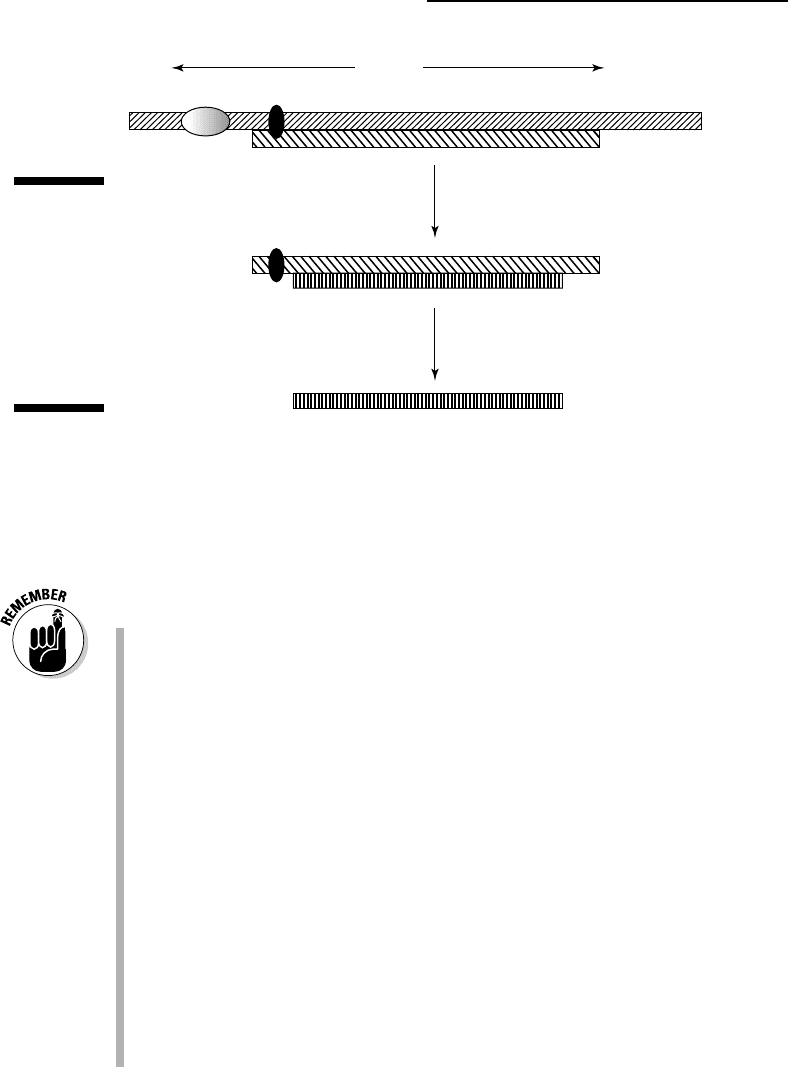
Figure 3-1 illustrates the simple collinear relationship between a bacterial
genomic (gene) sequence, the transcript (mRNA), the open reading frame
(ORF), and the final protein. (For a peek at a typical [small] bacterial genome,
flip to Figure 1-10 in Chapter 1.) The mRNA sequence gets translated into a
protein right after a special signal, called the Ribosome Binding Site (RBS in
Figure 3-1). The ribosome is the main piece of machinery of the cell’s protein-
translation apparatus.
Accordingly, database entries describing a coding prokaryotic sequence
should include three important features:
The coordinates of some promoter elements
The coordinates of the RBS
The coordinates of the ORF boundaries
That’s about all there is to say regarding the simple architecture of prokary-
otic genes. Not all genes encode proteins; for some of them, the function is
directly carried out by the transcribed RNA molecule. This includes transfer
RNA (tRNA), ribosomal RNA (rRNA), and a few other fancy RNAs that shall
remain nameless.
71
Chapter 3: Using Nucleotide Sequence Databases
08_089857 ch03.qxp 11/6/06 3:54 PM Page 71
Eukaryotes: Bigger bugs, complex genes
Eukaryotes encompass a wide variety of organisms, from microscopic yeasts
and fungi to elephants, plants, and humans. Yet eukaryotes, too, have basic
properties in common — properties that end up making them a bit more
challenging when it comes to genomic and bioinformatic analysis:
Their genome consists of multiple linear pieces of DNA called
chromosomes (up to a hundred million base pairs long).
Their genome size (10–670,000 million base pairs), especially for ani-
mals, plants, and amoebae (!), is
much bigger than in prokaryotes.
Their gene density is much lower than that for prokaryotes (one
human gene per 100,000 base pairs).
Their genome is no model of efficiency, containing many useless parts
(less than 5 percent of the human genome code for proteins).
Genes on opposite DNA strands might overlap — although that’s a rela-
tively rare occurrence.
Their genes are transcribed right after a control region called a promoter,
but sequence elements located far away can have a strong influence on
this process.
Gene sequences are not collinear with the final messenger RNA (mRNA)
and protein sequences. Only small bits (the
exons) are retained in the
mature mRNA that encodes the final product.
Genes often exhibit more than one mRNA (and protein) form.
Genes of higher eukaryotes (animals) may span up to millions of base pairs —
the human dystrophin gene (the mutation of which causes a dreadful disease),
Gene
Promoter
RBS
ATG STOP
mRNA
ORF
Protein
Figure 3-1:
Relationship
between
gene,
mRNA, and
protein
sequence
for
prokaryotes.
72
Part II: A Survival Guide to Bioinformatics
08_089857 ch03.qxp 11/6/06 3:54 PM Page 72

for example, is 2.2 million base pairs long. The relationships among a gene
DNA sequence, its primary transcript, the various forms of mature mRNA,
and the final protein sequence can be very complex. This is why understand-
ing a database entry that describes all these things may take a bit of work. In
addition, a lot of database entries correspond to partial gene sequences, or
different gene-related objects (such as promoter regions, mRNA, or genome
fragments). Throughout the rest of this chapter, we show you several exam-
ples so that, after a bit of study, you can decipher the most intricate GenBank
entries by yourself.
Making Use (and Sense) of GenBank
For prokaryotes, the limited size of the genes involved — as well as the
simple (linear) relationship among the gene DNA sequence, the mRNA, the
ORFs, and the final protein sequence — make all that information relatively
easy to annotate and store in database records. This is why database entries
corresponding to bacterial genes are relatively easy to read and understand.
In this section, we take you through the entry of the
Escherichia coli dUTPase
gene step by step (handy GenBank ID X01714).
Making sense of the GenBank entry
of a prokaryotic gene
First things first, we have to fetch our sample GenBank entry, as follows:
1. Point your browser to www.ncbi.nlm.nih.gov/entrez/.
The NCBI PubMed home page appears.
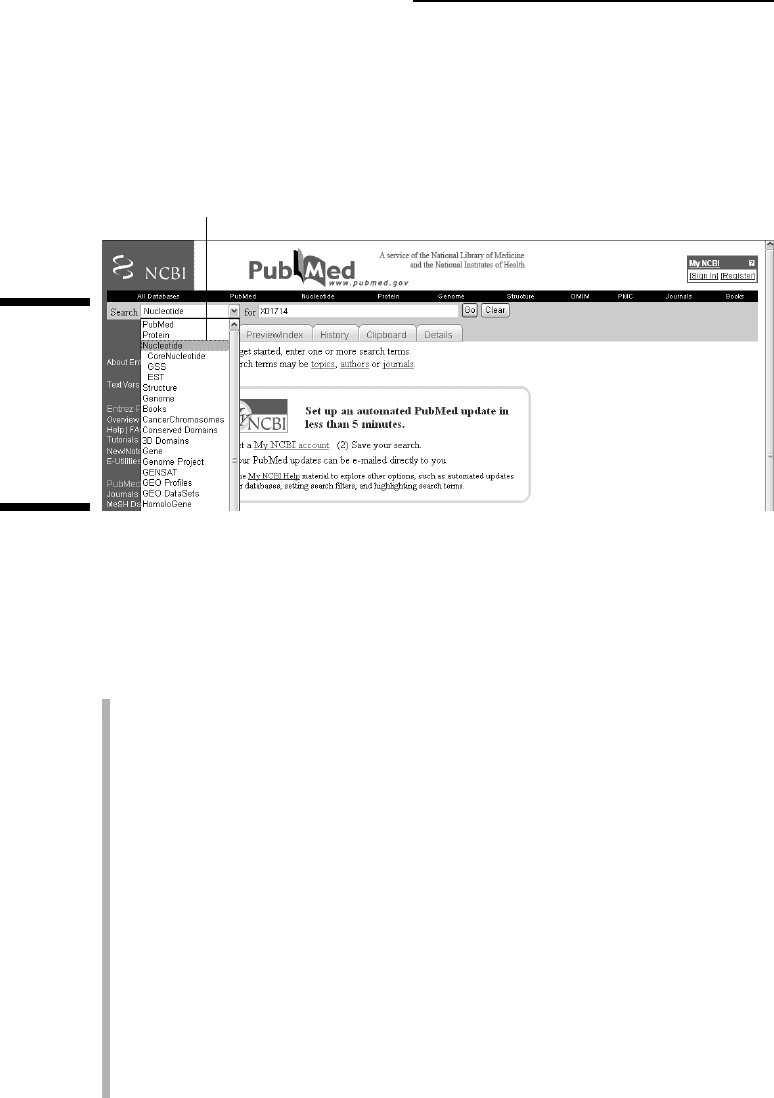
2. From the Search pull-down menu, choose Nucleotide (as in Figure 3-2).
3. Type the GenBank ID X01714 in the For field, and then click Go.
A Results page appears, displaying a short definition for the nucleotide
sequence entry, preceded by its ID X01714 (underlined in blue).
4. Click the X01714 hyperlink. (Alternatively, you can change the display
option from Summary to GenBank.)
The X01714 GenBank entry appears in the default GenBank format, as
shown in Figure 3-3.
Gurus refer to this as the GenBank
flat-file format because you can read it
in a linear fashion, and it doesn’t involve indexes, pointers, or accessory
information (which are customary in the structure of more sophisticated
databases).
In fact, what you have here isn’t totally “flat” because it contains a few
hyperlinks.
73
Chapter 3: Using Nucleotide Sequence Databases
08_089857 ch03.qxp 11/6/06 3:54 PM Page 73
5. Select the Text option from the Send To pull-down menu to generate a
true flat file (text) format of the X01714 entry.
6. Save your entry as a text document on your hard drive by choosing
File
➪Save As from your browser’s main menu.
Reading the header of a GenBank prokaryotic entry
The entry text saved in the preceding steps is divided into sections, with key-
words introducing each section. Typical keywords include LOCUS, DEFINI-
TION, ACCESSION, VERSION, KEYWORDS, and SOURCE. Refer to Figure 3-3 as
we go through these keywords step by step:
LOCUS gives us the locus name (an arbitrary name; here it’s ECDUT),
the size of the nucleotide sequence in base pairs, the nature of the mole-
cule (here it’s DNA), and its topology (
linear or circular molecule — in
this particular case, linear).
DEFINITION provides a short definition of the gene that corresponds to
the entry sequence. Here, it’s the
E. coli dUTPase gene.
ACCESSION lists the accession number — a unique identifier within and
across various databases (such as the protein-sequence databases).
Here, the accession number is X01714.
VERSION fills you in on synonymous or past ID numbers.
KEYWORDS introduces a list of terms that broadly characterize the entry.
You can use these terms as keywords for certain database searches. (For
more on using keywords in database searches, check out Chapter 2,
where we discuss using PubMed with limits.)
SOURCE divulges the common name of the relevant organism to which
the sequence belongs.
Choose Nucleotide.
Figure 3-2:
Searching
for
nucleotide
sequence
X01714 at
NCBI
PubMed.
74
Part II: A Survival Guide to Bioinformatics
08_089857 ch03.qxp 11/6/06 3:54 PM Page 74
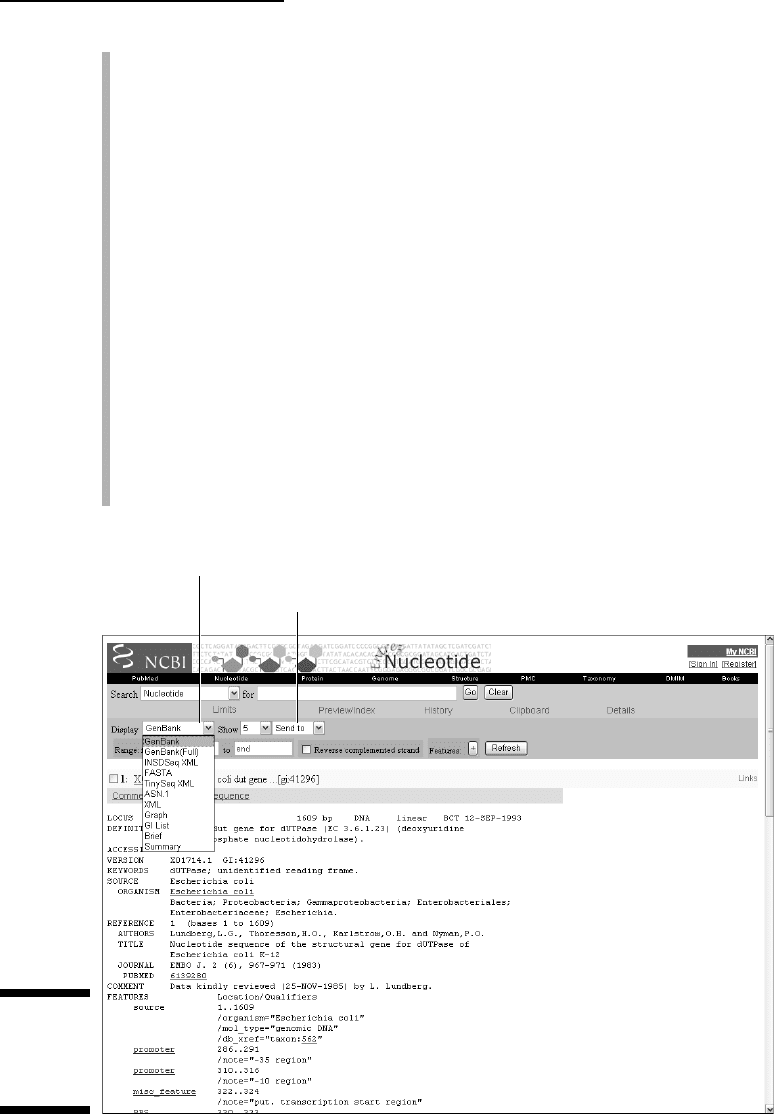
ORGANISM gives a more complete identification of the organism,
complete with its technical taxonomic classification.
Notice that ORGANISM is set in a bit from the left margin of the page —
more so, at least, than the other keywords. This isn’t a mistake; com-
puter scientists call this arrangement
indentation. The precise position
where a keyword begins on the various lines denotes its subordination
to other keywords. Keywords starting at the same position are said to be
at the same level. The leftmost position delimits sections of the GenBank
entry that are independent, such as the preceding six sections.
In contrast, ORGANISM is indented to indicate that it’s part of the
SOURCE section. (The same thing happens in the REFERENCE section.)
REFERENCE introduces a section where the credits for the sequence
determination are given (different parts of the sequences can be cred-
ited to different authors). The REFERENCE section contains multiple
parts as denoted by the indentation of the following self-explanatory
keywords: AUTHORS, TITLE, JOURNAL, and PUBMED.
COMMENT introduces the last line of the top of the X01714 GenBank
entry. It contains free-formatted text, such as acknowledgments or info
that doesn’t fit in the previous sections.
Use this menu for FASTA format.
Click here for text format.
Figure 3-3:
GenBank
entry
X01714.
75
Chapter 3: Using Nucleotide Sequence Databases
08_089857 ch03.qxp 11/6/06 3:54 PM Page 75

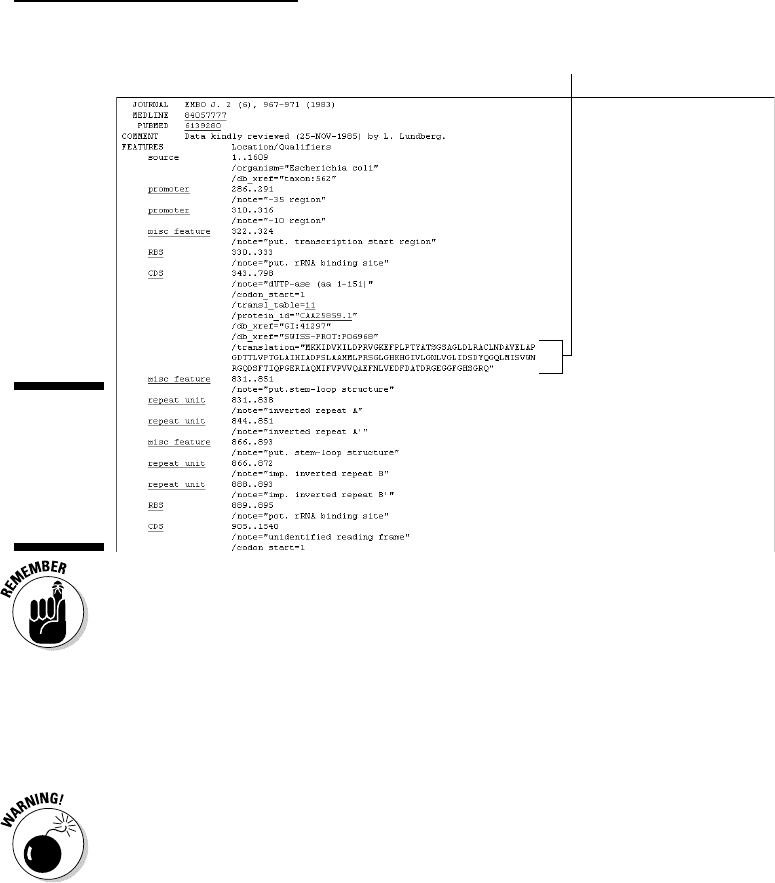
The next (middle) section of the entry is the FEATURES table (see Figure 3-4).
It describes precisely the gene regions and the associated biological proper-
ties that have been identified in the nucleotide sequence. This entire section
is under the control of the FEATURES keyword. A large variety of biologically
related keywords are subordinated to FEATURES, as we make clear in the
following list:
source indicates the origin of specific regions of the sequence. This is
useful when you want to distinguish cloning vectors from host sequences.
In X01714, the whole sequence comes from
E. coli genomic DNA.
promoter shows the precise coordinates of a promoter element. In
X01714, a
–35 region is indicated from position 286 to 291 (indicated by
286..291) in the nucleotide sequence.
promoter introduces another line that contains the coordinates of
another promoter element, this time a
–10 region at positions 310 to 316.
misc feature (miscellaneous feature) indicates the putative location
of the transcription start (mRNA synthesis). For X01714, this is from
positions 322 to 324.
RBS (Ribosome Binding Site) indicates the location of the last upstream
element. For X01714, this is at position 330 to 333.
CDS (CoDing Segment) introduces a complex section that describes the
gene’s
open reading frame (ORF):
• The first line indicates the coordinates of the ORF from its initial
ATG to the last nucleotide of the first stop codon TAA. (For
X01714, it’s 343 to 798.) See Chapter 1 if you don’t remember what
a codon is.
• Each of the following lines (indented at the same level) gives the
name of a protein product, indicates the reading frame to use
(here, 343 is the first base of the first codon), the genetic code to
apply, and a number of IDs for the protein sequence.
•
/translation, the final keyword of the CDS section, introduces
the conceptual amino-acid sequence of the coding segment. This
sequence is a computer translation that uses the coordinates,
reading frame, and genetic code indicated in the preceding lines.
Another misc feature follows the CDS section. It contains lines that
point out putative stem-loop structures and repeats. These are potential
regulatory elements of the dUTPase gene.
The FEATURES section of entry X01714 is typical of a simple, well-annotated
bacterial nucleotide sequence, centered on a well-identified gene. However,
this straightforward entry includes a complication: a putative additional
reading frame. We selected this entry because we were interested in one
gene: the dUTPase. However, the entry exhibits an extra putative gene, indi-
cated by an additional RBS element and a second CDS section.
76
Part II: A Survival Guide to Bioinformatics
08_089857 ch03.qxp 11/6/06 3:54 PM Page 76
GenBank entries containing more than one gene are frequent.
Using the Sequence section of a prokaryotic entry
The last section of GenBank entry X01714 is the nucleotide sequence section.
It starts with the
ORIGIN keyword and finishes with the end-of-entry line intro-
duced by two slash marks (
//). Each line of nucleotide sequence starts with
the position number of the first nucleotide in that line. Each line contains 60
nucleotides.
Because the sequence section of a GenBank entry mixes numbers and
nucleotides, you
cannot directly use it as an input on most sequence analysis
servers. You first need to generate a FASTA-formatted sequence, as follows:
1. On your GenBank entry page, choose FASTA from the Display pull-
down menu. (Refer to Figure 3-3.)
You’ll find the Display pull-down menu at the top-left of the page.
2. Select the Text option from the Send To pull-down menu.
The nucleotide sequence appears now in a form suitable for most
sequence-analysis programs.
3. Save this entry by choosing File➪Save As from your browser’s main
menu or by copying/pasting it into an empty Word document.
Protein sequence
Figure 3-4:
GenBank
entry
X01714: the
FEATURES
table part.
77
Chapter 3: Using Nucleotide Sequence Databases
08_089857 ch03.qxp 11/6/06 3:54 PM Page 77
Making sense of the GenBank entry
of an eukaryotic mRNA
We now continue with the dUTPase gene because it’s quite ubiquitous and
present in both prokaryotes and eukaryotes: Humans have it, too. Looking
at the GenBank entries describing the human version of dUTPase clearly
illustrates the increased complexity of higher eukaryotes compared to
prokaryote genes. We start here with a simple one, GenBank entry U90223:
1. Point your browser to www.ncbi.nlm.nih.gov/entrez/.
The NCBI PubMed home page appears on cue.
2. From the Search pull-down menu, choose Nucleotide.
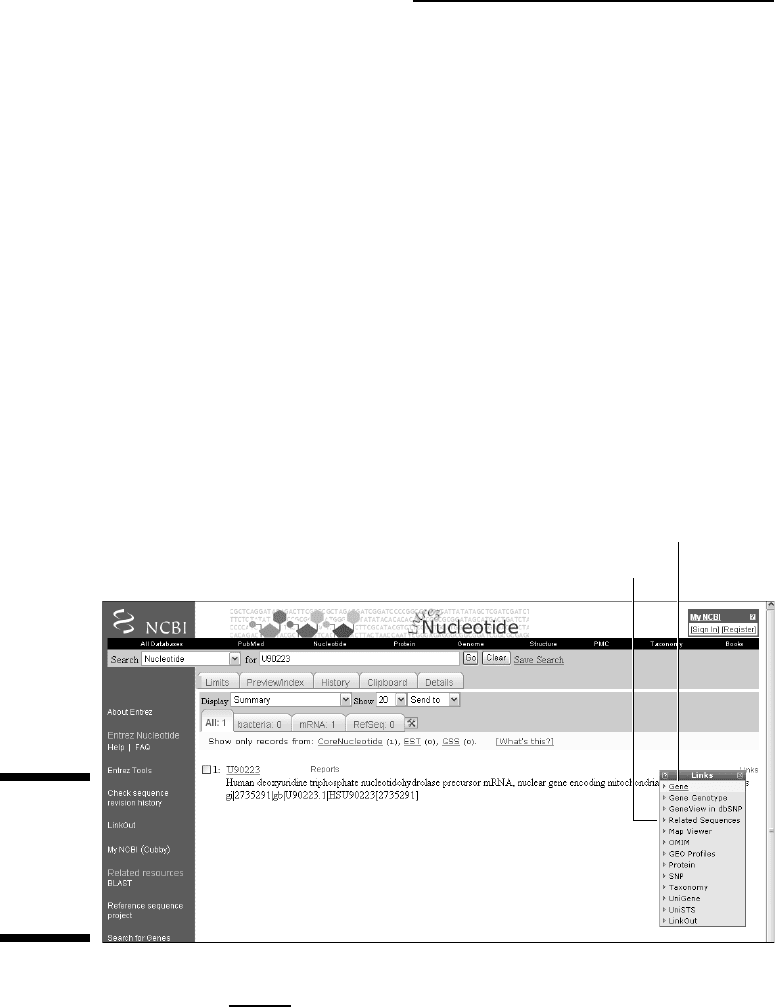
3. Type in GenBank ID U90223 in the For window, and click Go.
A Results page appears, displaying a short definition for the nucleotide
sequence entry, preceded by its ID U90223 (underlined in blue) as
shown in Figure 3-5.
4. Click the U90223 hyperlink. (Alternatively, you can change the Display
option from Summary to GenBank.)
You’re now ready to read your first human GenBank entry.
Jump to the corresponding gene.
Get related sequences.
Figure 3-5:
Initial
display for
GenBank
entry
U90223.
78
Part II: A Survival Guide to Bioinformatics
08_089857 ch03.qxp 11/6/06 3:54 PM Page 78

5. Select the Text option from the Send To pull-down menu to generate a
true flat-file (text-format) entry.
6. Save your result by choosing File
➪Save As.
Although it’s related to a human gene, GenBank entry U90223 doesn’t look
very different from entry X01714, the one that describes its bacterial homo-
logue. The top part of the entry follows the general information keywords
order: LOCUS, ACCESSION, DEFINITION, and VERSION.
The KEYWORD line, which is supposed to list readily relevant and searchable
terms (such as dUTPase), is empty for entry U90223. Unfortunately, this isn’t a
fluke. It illustrates a common problem in sequence databases — annotations
may be incomplete. As a result, keyword-based database searches usually
don’t retrieve all the relevant sequences in GenBank. On a related note, the
information slated for the SOURCE and REFERENCE sections may also be miss-
ing or incomplete. The U90223 entry, for example, says that the sequence here
comes from an unpublished source. However, a simple PubMed search (see
Chapter 2) using the author’s names — Ladner RD and Caradonna SJ — brings
us the relevant article in the
Journal of Biological Chemistry — from 1997! A
word to the wise: You should never expect GenBank (or any sequence data-
base) annotations to be up to date; no wonder it’s sometimes impossible to
retrieve some sequences with PubMed searches.
Figure 3-6 displays the FEATURES section of the U90223 entry. The CDS key-
word indicates a coding region (63-821) sequence that corresponds to the
mitochondrial form of human dUTPase. Following the conceptual amino-acid
translation of the ORF, the
sig peptide keyword indicates the location of a
mitochondrial targeting sequence, and the
mat peptide keyword provides the
exact boundaries of the mature peptide.
This human GenBank entry isn’t really more complex than its bacterial homo-
logue because we carefully selected an entry describing an
mRNA sequence,
not a
genomic one. At the level of the mature mRNA, the relationship between
a eukaryotic protein and its encoding nucleotide sequences is as collinear as
its prokaryotic counterpart. As the next section shows, genuine genomic data
can be a bit trickier.
Making sense of a GenBank
eukaryotic genomic entry
The previous section described the GenBank entry corresponding to the
mRNA sequence of the human dUTPase gene. In this case, we want to look at
the GenBank entry AF018430 related to the
gene sequence (as it is on the
chromosome) from which this mRNA originated.
79
Chapter 3: Using Nucleotide Sequence Databases
08_089857 ch03.qxp 11/6/06 3:54 PM Page 79
@Spy