
Claverie J-M., Notredame C. Bioinformatics for Dummies
Подождите немного. Документ загружается.

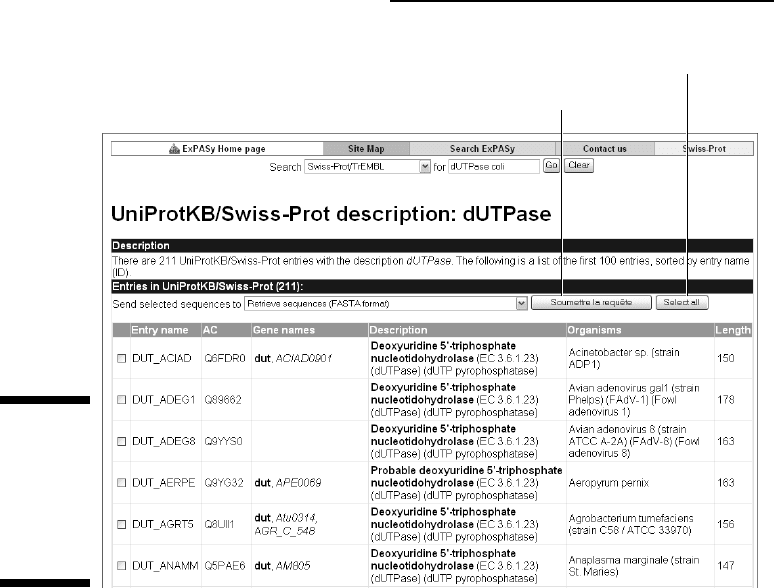
You can save the content of this page in various ways, depending on the
Internet browser version you’re using. We recommend the following proce-
dure because it always works — and it doesn’t add mysterious extra charac-
ters to the resulting file!
1. Choose the Select All feature from your browser menu (in Internet
Explorer, choose Edit
➪Select All) and then choose Copy. (Again, in
Internet Explorer you choose Edit
➪Copy.)
2. Open a new document in your word-processing program (Microsoft
Word, for example).
3. Choose Paste from the Edit menu of your word-processing program.
4. Reformat the whole document with a Courier font (8 or 10 point) to
realign the sequences.
5. Finally, save your document as
dUTPaseDB.txt, using the Save As
type option
text only (*.txt).
You now have, on your own personal computer, all the well-characterized
dUTPase protein sequences known to man. Keep this file on your hard drive;
you need it later in this chapter.
Retrieve selected entries.
Click here to select all entries.
Figure 2-17:
Top of the
list of all
dUTPase
proteins
found in
Swiss-Prot.
50
Part I: Getting Started in Bioinformatics
06_089857 ch02.qxp 11/6/06 3:52 PM Page 50
Retrieving DNA Sequences
Protein sequences are simple objects with a relatively narrow range of sizes
(they’re about 300 amino acids long, plus or minus 200, except for a few
giant ones), clearly defined boundaries, and specific functional attributes.
Furthermore, proteins of microbes or higher
eukaryotes (animal and plants)
have roughly the same properties.
As you might expect, the corresponding gene (DNA) sequences get more
varied and complex in higher animals. Gene sizes in humans may vary from
microbe-like lengths (a few thousand bp) to several hundred thousand bp.
Not all DNA is coding for protein
Various types of DNA sequences are involved in defining a gene:
Regulatory regions (usually preceding the coding region)
Untranslated regions that precede and follow the coding regions
The protein-coding region
In eukaryotes (yeast, plants, animals), the protein-coding region is divided
into a variable number of
exons — gene segments that contribute to the final
protein — interspersed with
introns — gene segments that do not.
As a consequence, working with DNA sequences is always trickier than work-
ing with protein sequences. Go to Chapters 3 and 5 to find out more about
the architecture of genes.
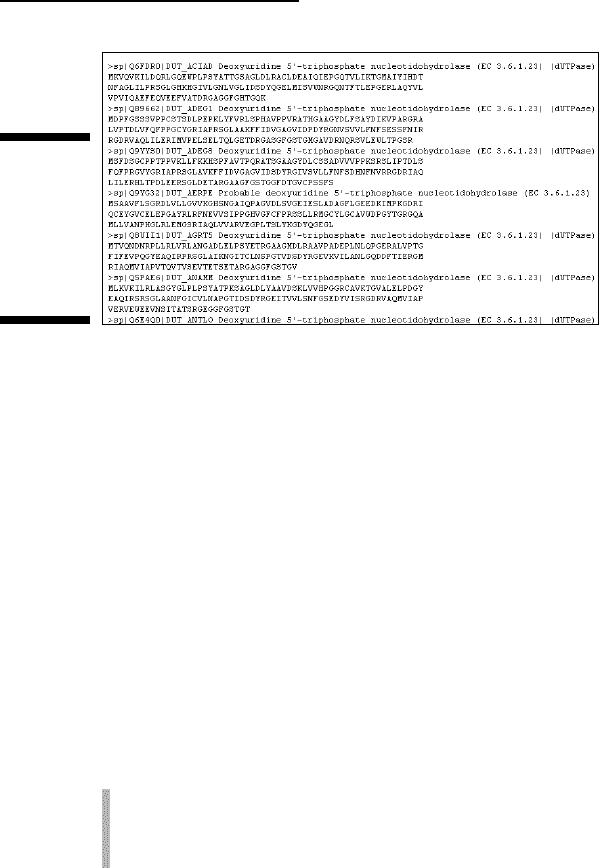
Figure 2-18:
FASTA
sequences
ready to be
saved to
your hard
drive.
51
Chapter 2: How Most People Use Bioinformatics
06_089857 ch02.qxp 11/6/06 3:52 PM Page 51

Going from protein sequences
to DNA sequences
In databases, the correspondence between protein and DNA sequences is not
one-to-one. Many different — even non-overlapping — DNA sequences can be
linked to the same protein or gene name, as the following list makes clear
(flip ahead to Figures 3-1 and 3-2):
52
Part I: Getting Started in Bioinformatics
Beware of parasite characters
in downloaded sequence files
In the dUTPAse example, we didn’t use the
File
➪Save As command on the Internet browser
main menu to download the content of the
window because files saved using the File
➪
Save As command have some problems:
They may contain some hidden
para-
site characters
— Control/Alt/Shift +
something — often displayed as
<PRE> at
the beginning of the file — which corrupts
the FASTA format.
They’re trickier to reopen by your PC word-
processing software, because they don’t
have the right extension (for instance
.doc),
or ask you to choose an obscure encoding
scheme (about which we know nothing, so
we can’t advise you) to load the file.
It is our experience that using a browser’s
File
➪Save As option produces unpredictable
results, depending on the browser type, version,
or implementation. In general, it’s a good and
wise practice to inspect the sequence data files
that you download from the Internet for un-
expected leading or trailing signs. For most
sequence-analysis programs, FASTA-formatted
sequence files must begin with a definition line,
such as
>P0343456
My_Sequence_definition
and nothing else! Any leading character (even
blank ones) that differs from
> may produce an
error. (For instance, the definition line might be
considered part of the protein sequence.)
Sequence-data files also have to end with a
final
<New Line> character (showing as a
blank line).
The good news is that usually no constraints
restrict the length of the definition and sequence
lines (but use reasonable numbers, no more
than about 60 to 100 characters long, to be safe).
Except for the constraint of having
> as the first
character of any definition line, you can freely
use blank characters, such as
<Space>,
<Tab>
, and line delimiters without interfering
with the parsing of the sequences.
Finally, do not use characters that are not
among the standard amino-acid codes such as
<-> or <*>. They aren’t treated in a consistent
way by different analysis programs. They’re
skipped (deleting a position), replaced by
X, or
may simply cause an error. (For more on stan-
dard amino-acid codes, see Chapter 1.)
06_089857 ch02.qxp 11/6/06 3:52 PM Page 52

The primary transcript — that is generated by copying the DNA sequence
of a gene from beginning to end, (including exons + introns)
The mature transcript — the mRNA, generated from the primary tran-
script by discarding the introns)
The strict protein-coding region — the open reading frame or ORF
Numerous types of partial sequences
Life is a lot simpler if you can stick to working with just protein sequences,
but we realize that situations will arise that will require you to go back to the
DNA sequence. The most common situation of this kind is when you want to
amplify a gene to transfer it to another organism — using a technique called
Polymerase Chain Reaction or PCR — and then either synthesize the corre-
sponding protein or induce specific mutations. Your problem, succinctly
stated, is this:
Given a protein sequence, how can I retrieve the DNA sequence
encompassing its coding region?
Retrieving the DNA sequence relevant
to my protein
Imagine that you want to retrieve enough DNA sequence to clone the
dUTPase gene of
E. coli. Sounds tricky, right? We show you how it’s done in
the following steps:
1. Point your browser to www.expasy.org/sprot/.
2. To access the
E. coli dUTPase entry quickly, simply enter the accession
number (
P06968) in the Search window at the top of the page and then
click the Search button.
Again, we have the information page devoted to protein P06968 at hand
(refer to Figure 2-12.).
3. Click the Cross-References link near the top of the form.
Your browser jumps to the relevant section, as shown in Figure 2-19. The
Cross-References section consists of successive groups of lines intro-
duced by keywords such as
EMBL, PIR, PDB, and so on. All these key-
words correspond to databases of various kinds that can give you
additional information about your protein sequence. By clicking the dif-
ferent underlined words, you jump right to the corresponding entry in
those different databases. This web of links between different sites that
concern the same object is, in fact, a web of cross-references. Take the
EMBL group of lines, for instance: There are four of them, starting with
obscure numbers and followed by a set of four underlined links to EMBL,
GenBank, DDBJ (those are databases), and CoDingSequence (the precise
DNA segment coding for the protein). Let’s see what happens when we
use them.
53
Chapter 2: How Most People Use Bioinformatics
06_089857 ch02.qxp 11/6/06 3:52 PM Page 53
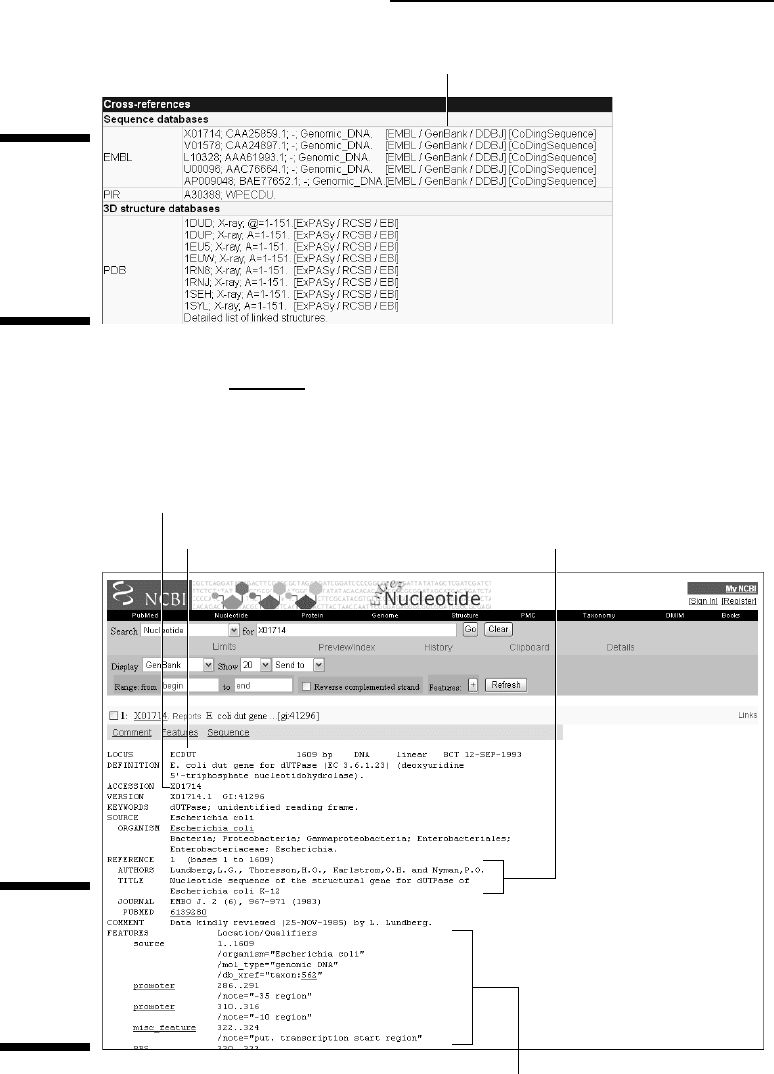
4. Click the GenBank link in the EMBL row’s first line.
The GenBank record (Accession # X01714) corresponding to protein
P06968 appears, as shown in Figure 2-20. It is several pages long.
Accession number
GenBank name
Bibliography
Features
Figure 2-20:
Top of
GenBank
entry
ECDUT/
X01714.
Click here to get the DNA sequence.
Figure 2-19:
Cross-
References
section of
the P06968
information
page.
54
Part I: Getting Started in Bioinformatics
06_089857 ch02.qxp 11/6/06 3:52 PM Page 54
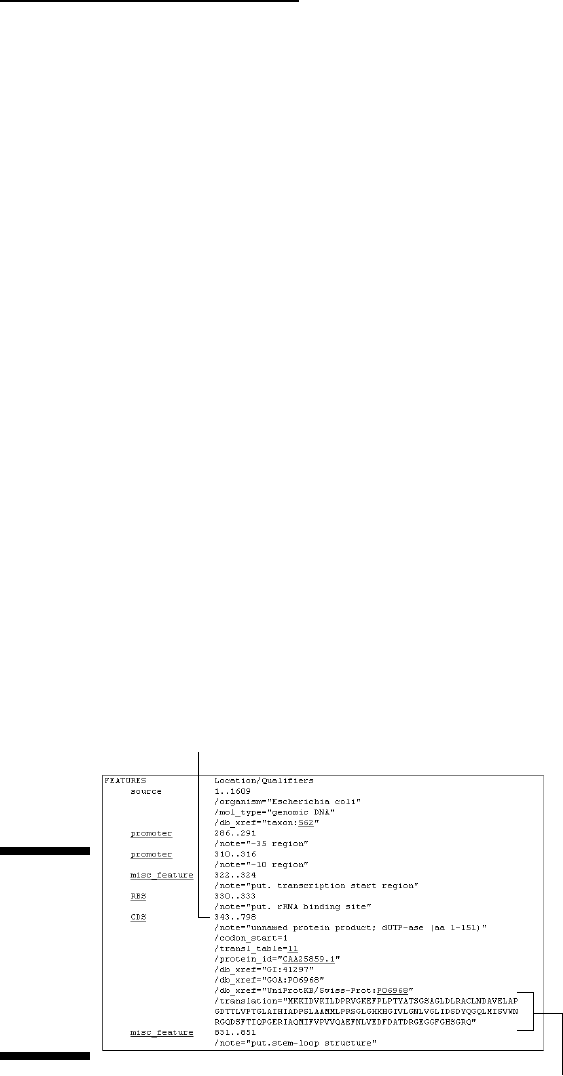
Roughly speaking, a GenBank entry consists of four parts. Here’s how
they look for our dUTPase example:
• The
locus name (ECDUT) — an arbitrary identifier — is followed by
a short definition line and a unique accession number (
X01714).
This number is the most stable identifier for the entry; we recom-
mend that you write it down because it’s used to cross-reference
related entries in other databases (which is what we did with
Swiss-Prot). A few lines below, the
SOURCE and ORGANISM fields
describe the biological origin of the DNA sequence.
• The
Reference section lists article(s) relevant to the sequence
determination. This list can be quite long for large sequences.
• The
Features section lists the definitions and exact ranges of multi-
ple types of elements that have been recognized in the sequence.
Our example — the X01714 entry — includes promoter elements,
ribosome binding sites (RBS), and protein coding segments (CDS).
Figure 2-21 shows — right next to the keyword CDS — the limits of
the dUTPase ORF as
343..798. The CDS range is followed by the
name and the amino-acid translation of the corresponding protein.
• The
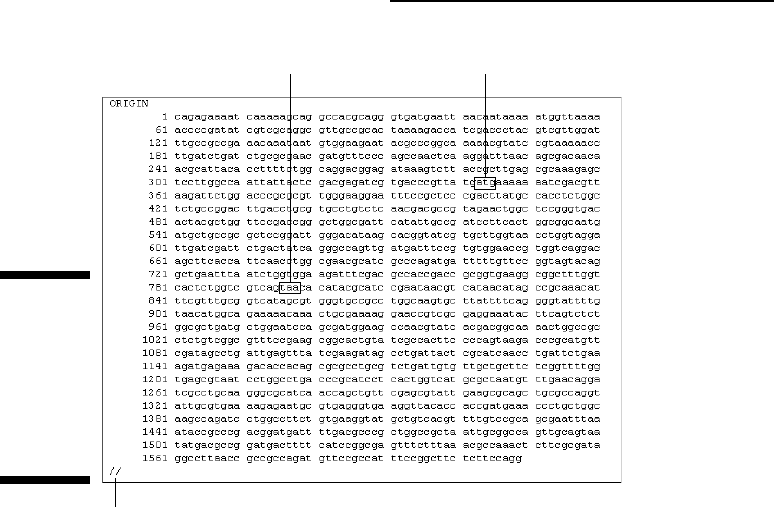
Sequence section rounds out the GenBank entry, where the
nucleotides are listed between the Origin keyword and the final
//
that signals the very end of the entry. Numbering is provided to
help relate the location of the dUTPase ORF (343-798) to the actual
nucleotide sequence. (See Figure 2-22.)
When you’ve read through the entry, you can save the whole thing to your
hard drive by using the steps we defined in the preceding list for saving
Swiss-Prot sequences.
Range of dUTPase ORF (CDS).
ORF translation
Figure 2-21:
The
Features
section of
GenBank
entry
ECDUT/
X01714.
55
Chapter 2: How Most People Use Bioinformatics
06_089857 ch02.qxp 11/6/06 3:52 PM Page 55
However, to use the nucleotide sequence as input for other programs (for
instance, to design primers), you may need to isolate it from the text part
of the entry and convert it in FASTA format. Here’s how that’s done:
1. Scroll back to the top of the page for the ECDUT/X01714 entry.
Refer to Figure 2-20 for what your screen should look like.
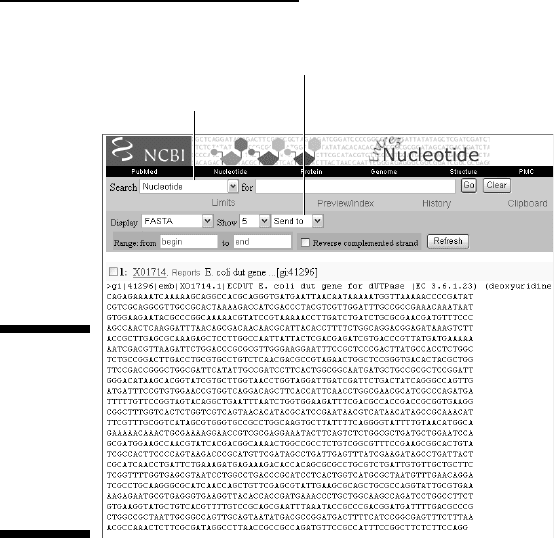
2. Choose FASTA from the Display drop-down menu, as shown in
Figure 2-23.
3. Transform the content of this window into plain text by choosing
Text from the drop-down menu located on the far right of the
menu bar.
4. Save the FASTA sequence by using the following protocol:
a. In the Edit menu of your Web browser, click Select All and then
click Copy.
b. Open a default Word document and, in the Edit menu of Word, click
Paste. Then select a Courier font (8 or 10).
c. Finally, save your document as dUTPaseDNA.txt by choosing the
Save as type option text only (
*.txt).
End of the dUTPase ORF
Start of the dUTPase ORF
End of the X01714 entry
Figure 2-22:
The
Sequence
section of
GenBank
entry
ECDUT/X017
14.
56
Part I: Getting Started in Bioinformatics
06_089857 ch02.qxp 11/6/06 3:52 PM Page 56
Using BLAST to Compare My Protein
Sequence to Other Protein Sequences
After you know the basics of retrieving a protein sequence from a database
(see the earlier, aptly named “Retrieving Protein Sequences” section), you’re
ready to perform your first analysis with it. For most people, the next step is
to perform a BLAST search.
BLAST (short for
Basic Local Alignment Search Tool — with a name like
that, no wonder they shortened it to BLAST) is a great sequence-comparison
tool that quickly tells you which of the other known proteins out there has a
sequence similar to yours. You can then use this information for a variety of
purposes — including the prediction of protein function, 3-D structure and
domain organization, or the identification of homologues (similar proteins)
in other organisms. (In Chapter 7, we show you how to use BLAST in great
detail. At this point, we only want to get you started and show you how easy
it is to use.)
Select FASTA format.
Send to TEXT for printer-friendly display.
Figure 2-23:
Nucleotide
sequence of
GenBank
entry
ECDUT/X017
14 in FASTA
format.
57
Chapter 2: How Most People Use Bioinformatics
06_089857 ch02.qxp 11/6/06 3:52 PM Page 57
BLAST comes to us under the auspices of the National Center for
Biotechnology Information (NCBI), already familiar to us as the hosts for the
PubMed bibliographic database we cover at the beginning of this chapter.
You’ll soon discover that using BLAST is just as easy as using PubMed. To
start off, follow these steps:
1. Point your favorite Internet browser to
www.ncbi.nlm.nih.gov/BLAST/
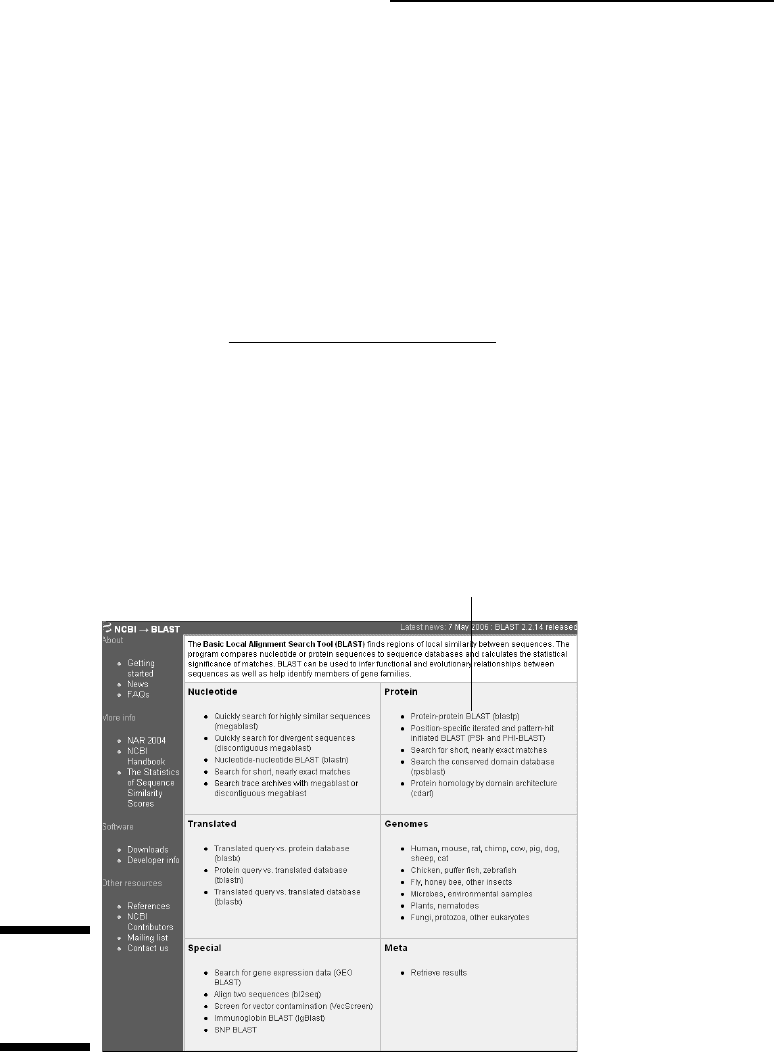
The BLAST home page — probably the most frequented bioinformatic
Web page in the world — appears, as shown in Figure 2-24. Because this
is your first time here, keeping things simple is best.
2. Click the Pr
otein-Protein BLAST (blastp)
link in the top right.
A Query screen appears, as shown in Figure 2-25. At this point, you need
a FASTA-formatted protein sequence.
3. Open the file that contains your dUTPase FASTA-formatted protein
sequence.
This is the file that you (hopefully) created on your PC by using the
steps shown earlier in the “Retrieving a list of related protein
sequences” section of this chapter.
Standard protein BLAST
Figure 2-24:
NCBI
BLAST entry
page.
58
Part I: Getting Started in Bioinformatics
06_089857 ch02.qxp 11/6/06 3:52 PM Page 58
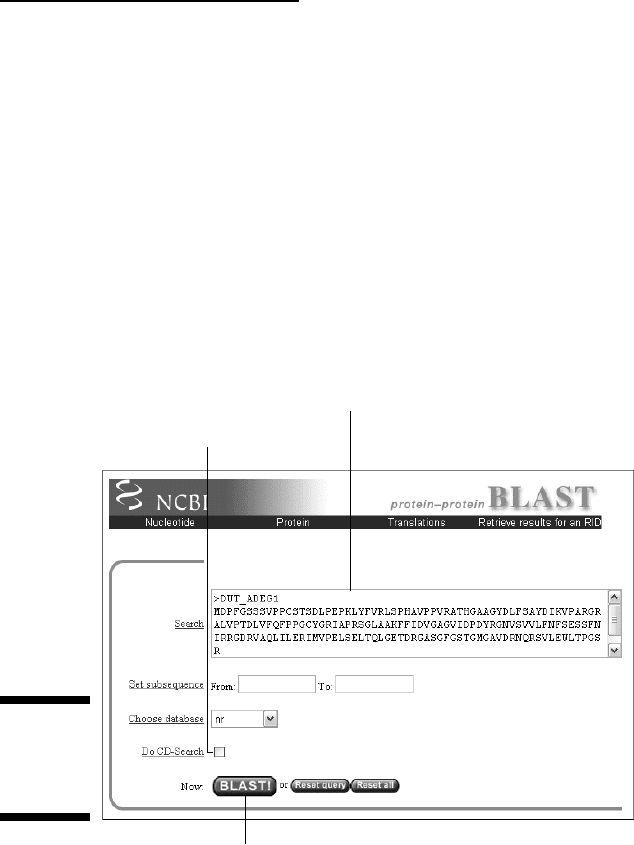
4. Using your browser’s Edit menu, copy and paste ONE of the protein
sequences (with its definition line) into the BLAST Search window.
We used DUT_ADEG1. If you don’t have the protein sequence ready, open
a new navigation window and go get this sequence on the ExPASy server.
Here’s the quick detour:
a. Point your browser to
www.expasy.org/sprot/.
b. Enter
DUT_ADEG1 in the Search window at the top, and then click
Search.
d. Copy the protein sequence with its header line.
e. Close that navigator window, and paste the sequence in the BLAST
Search window.
5. Deselect the Do CD-Search box, but don’t change the Choose
Database setting.
The nr (for nonredundant) default database includes all protein
sequences known to man — so you don’t have to bother about
selecting a specific organism or subset.
6. Click the BLAST! button.
You just launched your first BLAST search. Welcome to the club!
Paste your query sequence in here.
Uncheck the CD search box.
Click here to run the search.
Figure 2-25:
NCBI
BLAST
query form.
59
Chapter 2: How Most People Use Bioinformatics
06_089857 ch02.qxp 11/6/06 3:52 PM Page 59