
Coker A.K. Fortran Programs for Chemical Process Design, Analysis, and Simulation
Подождите немного. Документ загружается.

Equipment Sizing 277
The Equations
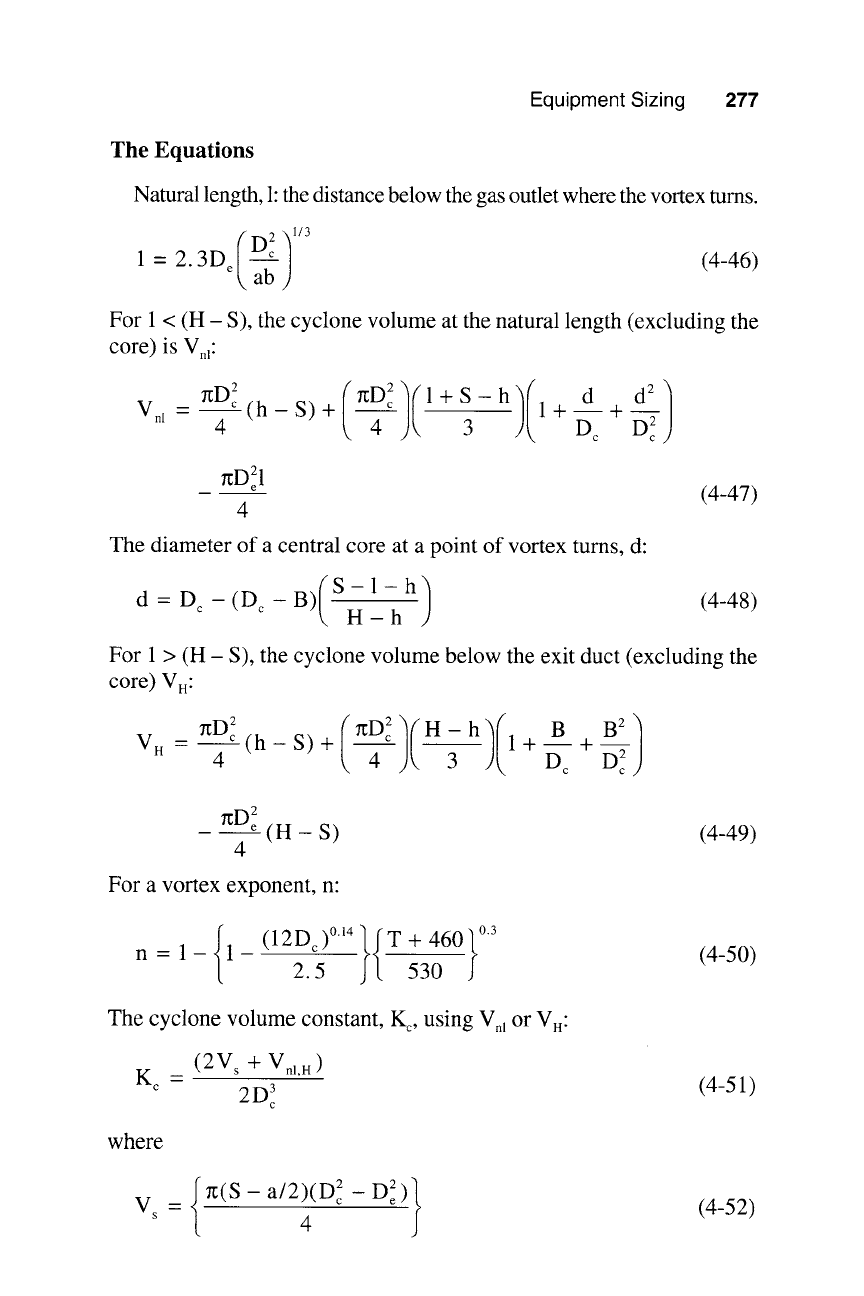
Natural length, 1: the distance below the gas outlet where the vortex turns.
/1/3
1-2 3D D~
9 e
--~
(4-46)
For 1 < (H- S), the cyclone volume at the natural length (excluding the
core) is Vn~"
Vn 1
=n:D~4 (h- S) + [TrD~4 ](1+$3- h)[l+ Dcd
+ ~2-c2 )d 2
~D~I
(4-47)
The diameter of a central core at a point of vortex turns, d:
d- Dc-(D c-B)( S-l-h)H-h
(4-48)
For 1 > (H- S), the cyclone volume below the exit duct (excluding the
core) VH:
4 (h - S) + - B
B 2
4 3 D c D c
7'l~--eD2 (n- S)
4
For a vortex exponent, n:
(4-49)
n-1-{1-(12Dc)~ ~ 530
(4-50)
The cyclone volume constant, K c, using
Vnl or
VH:
KC ---
(2V s
+ Vnl,H )
2D~
(4-51)
where
c -De) t
Vs _ rt(S- a/2)(D 2 2
r/
(4-52)
278
Fortran Programs for Chemical Process Design
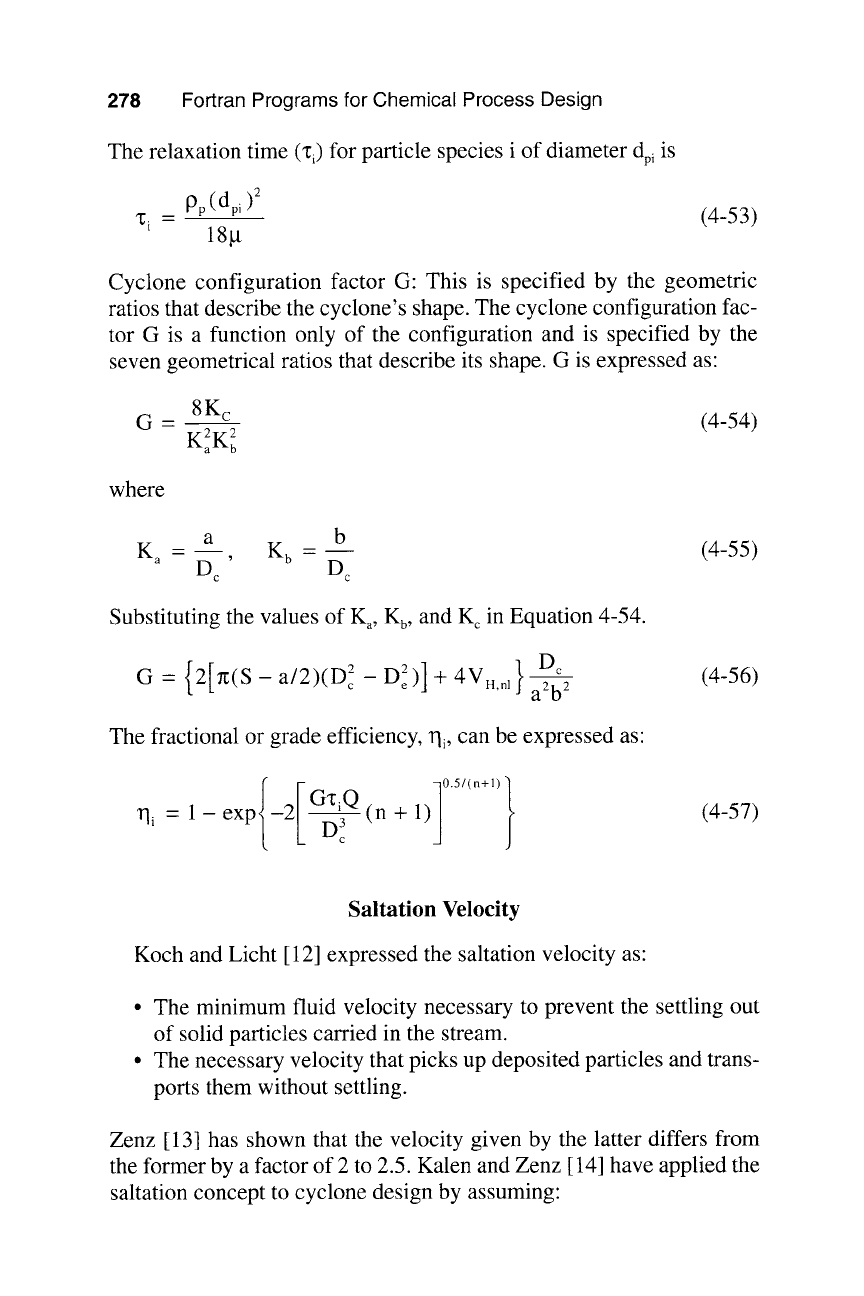
The relaxation time
(~i)
for particle species i of
diameter dpi
is
~i
pp(dpi)2
- (4-53)
18la
Cyclone configuration factor G: This is specified by the geometric
ratios that describe the cyclone's shape. The cyclone configuration fac-
tor G is a function only of the configuration and is specified by the
seven geometrical ratios that describe its shape. G is expressed as:
G - 8K c (4-54)
2 2
KaKb
where
a b
K a = --,
K b - (4-55)
Dc Dc
Substituting the values of K a,
K b,
and K c in Equation 4-54.
Oc
(4-56)
The fractional or grade efficiency,
r~i , can
be expressed as"
qi -1-exp -2 GI: (n+l)
Dc
/(n+l)
(4-57)
Saltation Velocity
Koch and Licht [12] expressed the saltation velocity as"
9 The minimum fluid velocity necessary to prevent the settling out
of solid particles carried in the stream.
9 The necessary velocity that picks up deposited particles and trans-
ports them without settling.
Zenz [ 13] has shown that the velocity given by the latter differs from
the former by a factor of 2 to 2.5. Kalen and Zenz [14] have applied the
saltation concept to cyclone design by assuming"
Equipment Sizing 279
9 There is no slippage between fluid and particles. The cyclone inlet
width is the effective pipe diameter for calculating saltation effects.
9 Grain loading (dust concentration) is less than 10 grains/ft 3.
9 The diameter effect on the saltation velocity is proportional to the
0.4 power of the inlet width.
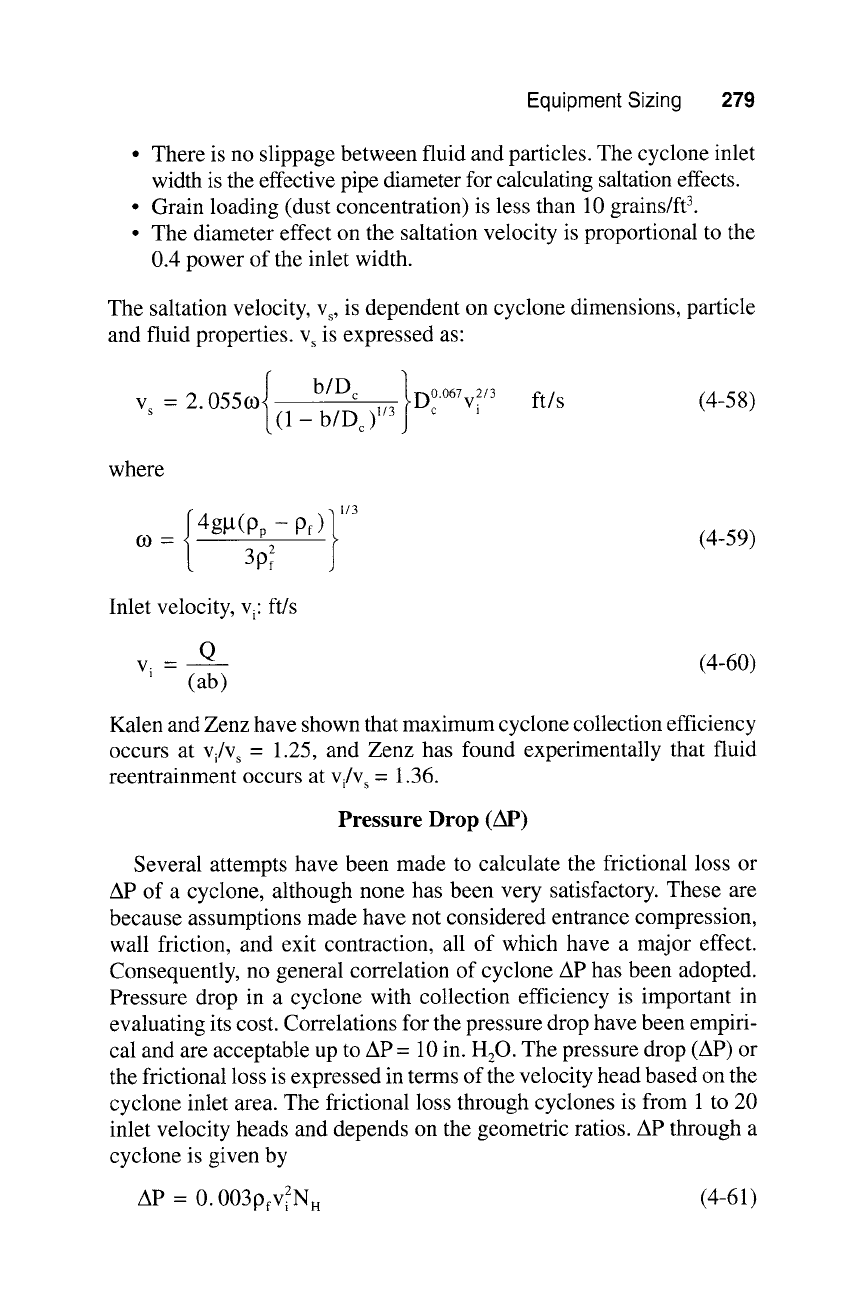
The saltation velocity, v~, is dependent on cyclone dimensions, particle
and fluid properties, v s is expressed as:
V~ - 2. 0550){ b/Dc }
0.067_ 2/3
(1 - b/D c)l/3 D c vi
ft/s (4-58)
where
4gla(9 p
_ Pf ) }1/3
O) m 2
3pf
(4-59)
Inlet velocity,
Vi: ft/s
W i "- Q (4-60)
(ab)
Kalen and Zenz have shown that maximum cyclone collection efficiency
occurs at vi/v s = 1.25, and Zenz has found experimentally that fluid
reentrainment occurs at vi/v s = 1.36.
Pressure Drop (AP)
Several attempts have been made to calculate the frictional loss or
AP of a cyclone, although none has been very satisfactory. These are
because assumptions made have not considered entrance compression,
wall friction, and exit contraction, all of which have a major effect.
Consequently, no general correlation of cyclone AP has been adopted.
Pressure drop in a cyclone with collection efficiency is important in
evaluating its cost. Correlations for the pressure drop have been empiri-
cal and are acceptable up to AP = 10 in.
H20.
The pressure drop (AP) or
the frictional loss is expressed in terms of the velocity head based on the
cyclone inlet area. The frictional loss through cyclones is from 1 to 20
inlet velocity heads and depends on the geometric ratios. AP through a
cyclone is given by
AP - 0 003 2
9 9fviNn
(4-61)
280
Fortran Programs for Chemical Process Design
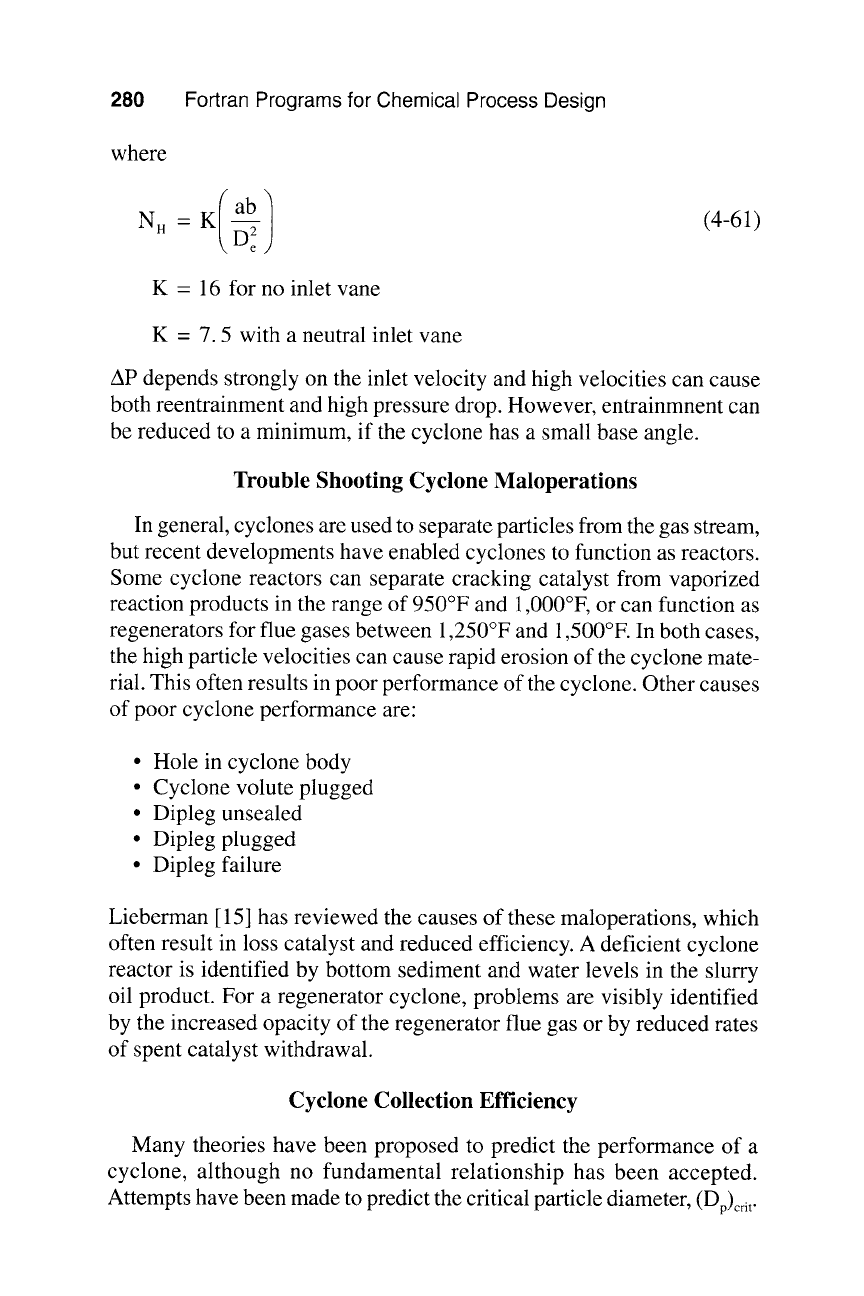
where
(ab /
N.-K ~-7
D e
(4-61)
K = 16 for no inlet vane
K = 7.5 with a neutral inlet vane
AP depends strongly on the inlet velocity and high velocities can cause
both reentrainment and high pressure drop. However, entrainmnent can
be reduced to a minimum, if the cyclone has a small base angle.
Trouble Shooting Cyclone Maloperations
In general, cyclones are used to separate particles from the gas stream,
but recent developments have enabled cyclones to function as reactors.
Some cyclone reactors can separate cracking catalyst from vaporized
reaction products in the range of 950~ and 1,000~ or can function as
regenerators for flue gases between 1,250~ and 1,500~ In both cases,
the high particle velocities can cause rapid erosion of the cyclone mate-
rial. This often results in poor performance of the cyclone. Other causes
of poor cyclone performance are:
9 Hole in cyclone body
9 Cyclone volute plugged
9 Dipleg unsealed
9 Dipleg plugged
9 Dipleg failure
Lieberman [ 15] has reviewed the causes of these maloperations, which
often result in loss catalyst and reduced efficiency. A deficient cyclone
reactor is identified by bottom sediment and water levels in the slurry
oil product. For a regenerator cyclone, problems are visibly identified
by the increased opacity of the regenerator flue gas or by reduced rates
of spent catalyst withdrawal.
Cyclone Collection Efficiency
Many theories have been proposed to predict the performance of a
cyclone, although no fundamental relationship has been accepted.
Attempts have been made to predict the critical particle diameter,
(Dp)crit.
Equipment Sizing 281
This is the size of the smallest particle that is theoretically separated
from the gas stream with 50 percent efficiency. The critical particle di-
ameter is defined by [ 16]
i
]0.5
9~tDc
(Dp)cnt - 4rtN,vi(P- 98)
(4-62)
where
N t =
effective number of turns made by the gas stream in the
cyclone, and is defined by
2
N t - (vi)[0.1079- 0.00077v i + 1.924(10-6)vi ]
(4-63)
and v i = is the inlet linear velocity.
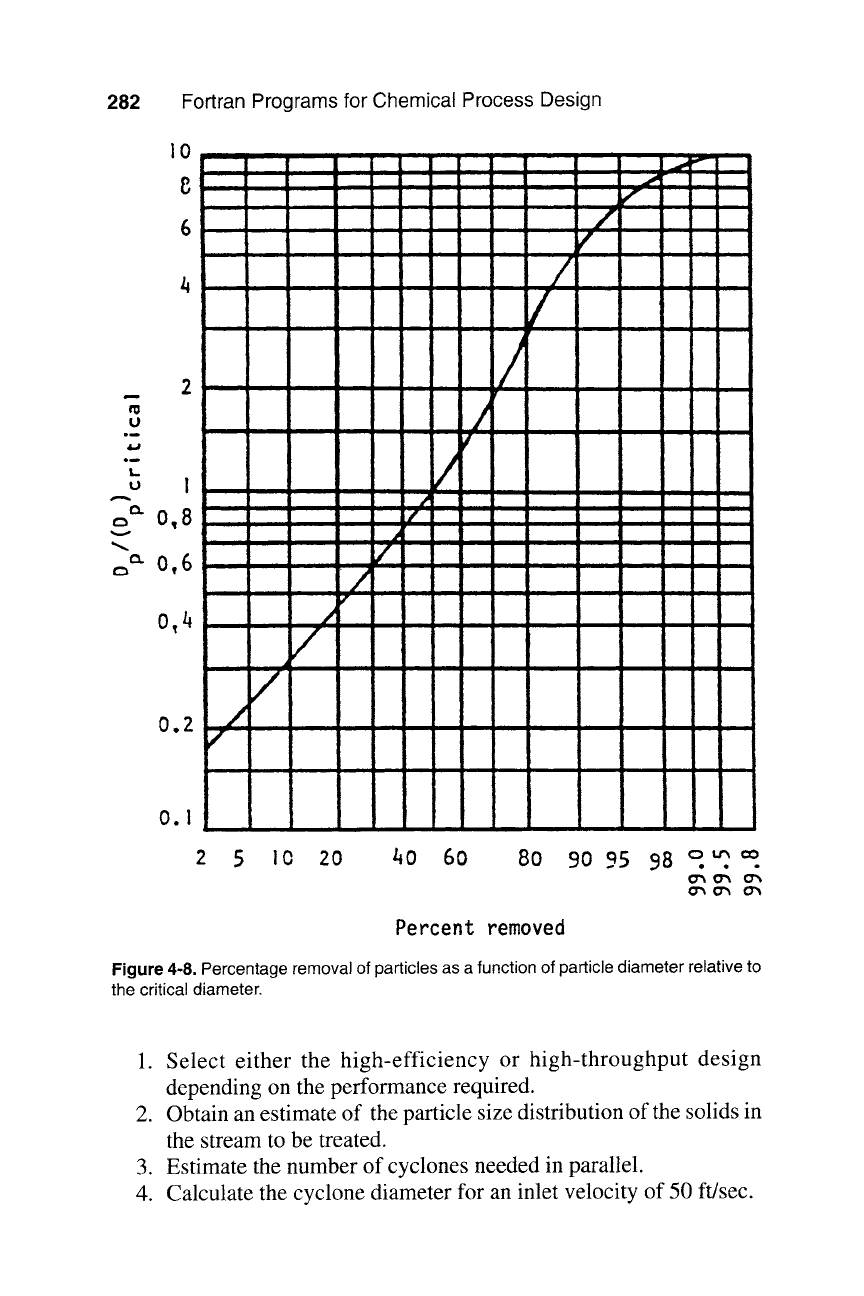
Figure 4-8 shows the percentage removal of particles in a cyclone as
a function of the ratio of the particle to the critical diameter.
Cyclone Design Factor
Cyclones are designed to meet specified AP limitations. The factor
that controls the collection efficiency is the cyclone diameter, and a
smaller diameter cyclone at a fixed AP will have a higher efficiency.
Therefore, small diameter cyclones require a multiple of units in parallel
for a given capacity. Reducing the gas outlet diameter results in an
increased collection efficiency and AE High-efficiency cyclones have
cone lengths in the range of 1.6 to 3.0 times the cyclone diameters.
Collection efficiency increases as the gas throughput increases. Kalen
and Zenz [ 14] reported that collection efficiency increases with increas-
ing gas inlet velocity to a minimum tangential velocity. This reaches
the point where the dust is re-entrained or not deposited because of
saltation. Koch and Licht [ 12] showed that saltation velocity is consis-
tent with cyclone inlet velocities in the range of 50 to 90ft/sec.
Cyclones offer the least expensive means of dust collection. They
give low efficiency for collection of particles smaller than 5~tm. A high
efficiency of 98 percent can be achieved on dusts with particle sizes of
0.1 to 0.2~tm that are highly flocculated.
Cyclone Design Procedure
The following design procedures can be used to size a cyclone with a
specified fluid flow rate and physical property data:
282
Fortran Programs for Chemical Process Design
JO mm
J
m~
6 - i
I|
I
_ ,
m
ro
U
.e
4,.a
, ill
"
8
"06
0,4
mmmmm(
mmmml
~ ~ mpm~'. ;,,iN m
m~~v~mm
immmlm!
mm,,immm
mmm,,Jmmm
/
/
/
/inN/iilnmilill
i~~mm~Rnm~~~mnl
i~~miv~nmm~~~mnl
n~~i~Rnmm~~~inl
mmmmvAmmmmimmimnlm
mmmmmmmmmmmmmmt
imuimnmmmiimmmil
immimilimmmmili
mlimmmmmmmimmml
0.2 ~~i, -
0. I
2 5 I0 20 40 60 80 90 95 98 o.~
co.
0% 0"~ 0"%
Percent removed
Figure
4-8. Percentage removal of particles as a function of particle diameter relative to
the critical diameter.
1. Select either the high-efficiency or high-throughput design
depending on the performance required.
2. Obtain an estimate of the particle size distribution of the solids in
the stream to be treated.
3. Estimate the number of cyclones needed in parallel.
4. Calculate the cyclone diameter for an inlet velocity of 50 ft/sec.
Equipment Sizing 283
5. Calculate the scale-up factor for the transposition of grade effi-
ciency and particle size.
6. Calculate the cyclone performance and overall efficiency
(recovery of solids). If unsatisfactory, try a smaller diameter.
7. Calculate the cyclone pressure drop and, if required, select a suit-
able blower.
8. Cost the system and optimize to make the best use of the pressure
drop available or, if a blower is required, to give the lowest oper-
ating cost.
Nomenclature
a = inlet height, ft
b = inlet width, ft
B = cyclone dust-outlet diameter, ft
d = diameter of central core at a point where vortex turns, ft
dpi- diameter of particle in size range i, ft
D c = cyclone diameter, ft
D e = cyclone gas-outlet diameter, ft
g = acceleration due to gravity, 32.2 ft/s 2
G = cyclone configuration factor
h = cylindrical height of cyclone, ft
i = subscript denotes interval in particle size range
Ka= a]O c
K b =
b/D c
K c = cyclone volume constant
1 = natural length (distance below gas outlet where vortex turns), ft
n = vortex exponent
N H - number of inlet velocity heads
AP = pressure drop, in
H20
Q = total gas flowrate, actual ft3/s
S = gas outlet length, ft
T = temperature, ~
v~ = inlet velocity, ft/s
v s = saltation velocity, ft/s
V H = volume below exit duct (excluding core), ft 3
Vn~ = volume at natural length (excluding core), ft 3
V s = annular volume above exit duct to middle of entrance duct, ft 3
rli = grade efficiency for particle size at midpoint of interval i, %
/.t- fluid viscosity, lbm/ft.s
9f = fluid density, lbm/ft 3
284
Fortran Programs for Chemical Process Design
13p - particle density, lbm/ft 3
I: = relaxation time, s
= Equation 4-59
GAS DRYER (DEHYDRATION) DESIGN
Liquid water and sometimes water vapor are removed from natural
gas to prevent corrosion and formation of hydrates in transmission lines
and to attain a water dew point requirement of the sales of gas. Many
sweetening agents employ an aqueous solution for treating the gas. There-
fore dehydrating the natural gas that normally follows the sweetening
process involves:
9 dehydration by refrigeration
9 absorption by liquid desiccants
9 adsorption by solid desiccants
Adsorption is a process that involves the transfer of a material from
one phase to a surface where it is bound by intermolecular forces. The
process involves the transfer from a gas or liquid to a solid surface. It
could also involve the transfer from a gas to a liquid surface. The adsor-
bate is the material being concentrated on the surface and the material
that it accumulates is defined as the adsorbent.
The oil and chemical industries use the adsorption process in the
cleanup and purification of wastewater streams and for the dehydration
of gases. The process is also used in gas purification involving the
removal of sulfur dioxide from a stack gas. In addition, adsorption is
employed to fractionate fluids that are difficult to separate by other sepa-
rating methods. The amount of adsorbate that is collected on a unit of
surface area is negligible. Therefore, porous desiccants (adsorbent) hav-
ing a large internal surface area are used for industrial applications.
There are many solid desiccants that can adsorb water from natural
gas. The common commercial desiccants are alumina, silica gel, and
molecular sieves. The molecular sieves possess the highest water
capacity, will give the lowest water dew points, and can be applied to
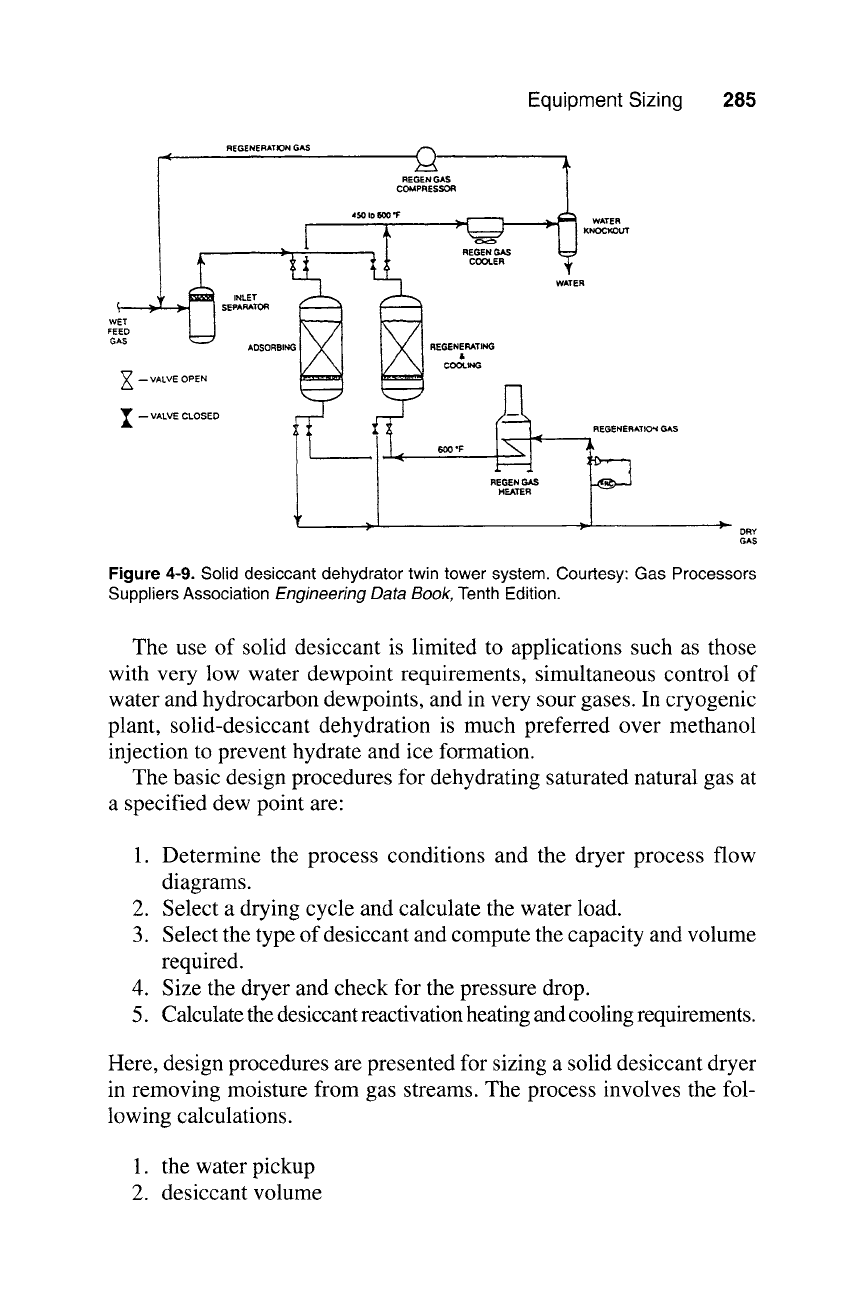
sweeten dry gases and liquids. Figure 4-9 shows how desiccants can be
used in dehydrators containing two or more towers. One of the towers
operates using steam to adsorb water from the gas, while the other tower
is regenerated and cooled. The regenerated gas is heated to a range of
450~ and 600~ depending on the type of solid desiccant and the
nature of service [ 17].
Equipment Sizing
285
..,,t REGENERATION GAS
r REGEN GAS
| |
w "~c~ w~.
~g,~' ..............
1
REGENERATING
COOLING
600 "F
Z
-- VALVE OPEN
'-- VALVE CLOSED
REGENERATION GAS
REGEN GAS i~
HEATER
DRY
GAS
Figure
4-9. Solid desiccant dehydrator twin tower system. Courtesy: Gas Processors
Suppliers Association Engineering Data Book, Tenth Edition.
The use of solid desiccant is limited to applications such as those
with very low water dewpoint requirements, simultaneous control of
water and hydrocarbon dewpoints, and in very sour gases. In cryogenic
plant, solid-desiccant dehydration is much preferred over methanol
injection to prevent hydrate and ice formation.
The basic design procedures for dehydrating saturated natural gas at
a specified dew point are:
1. Determine the process conditions and the dryer process flow
diagrams.
2. Select a drying cycle and calculate the water load.
3. Select the type of desiccant and compute the capacity and volume
required.
4. Size the dryer and check for the pressure drop.
5. Calculate the desiccant reactivation heating and cooling requirements.
Here, design procedures are presented for sizing a solid desiccant dryer
in removing moisture from gas streams. The process involves the fol-
lowing calculations.
1. the water pickup
2. desiccant volume
286 Fortran Programs for Chemical Process Design
3. desiccant bed
4. gas velocity through the bed
5. vessel weight
6. dryer regeneration requirements
The design is based upon the following assumptions [2]"
1. The temperature difference between the heater outlet temperature
and the peak vessel outlet temperature is 50~
2. The average bed temperature is based on 75 percent of the bed at
heater outlet temperature and 25 percent at the peak vessel outlet
temperature Equation 4-73.
3. Specific heats: steel, 0.12 Btu/lb ~ and desiccant 0.25 Btu/lb ~
4. Heat of water desorption 1400 Btu/lb
H20
adsorbed.
5. Flat heads used on vessel ends; steel density is 480 lb/ft 3.
6. Total vessel weight increased by 10 percent for supports.
7. Heat losses to the dryer during heating period calculated at 5 percent.
The Equations
The equations used for calculating these requirements are:
The total water adsorbed, lb
H20
load -
(Flow)(Cycle)(H20 Cont)
24
MMstd
ft 3 /(
day
( lb )
h) MMstd ft3
(h/day)
(4-64)
Desiccant volume
VDES =
(H20
load)(100) (4-65)
(pickup) (9D)
The calculated area based on desiccant volume
V
ApES = DES (4-66)
L
The bed diameter