
Coker A.K. Fortran Programs for Chemical Process Design, Analysis, and Simulation
Подождите немного. Документ загружается.

Equipment Sizing 257
minimum, e.g., in relief systems or in fouling service. It is unsuitable if
a mist is being separated or if high separating efficiency is required.
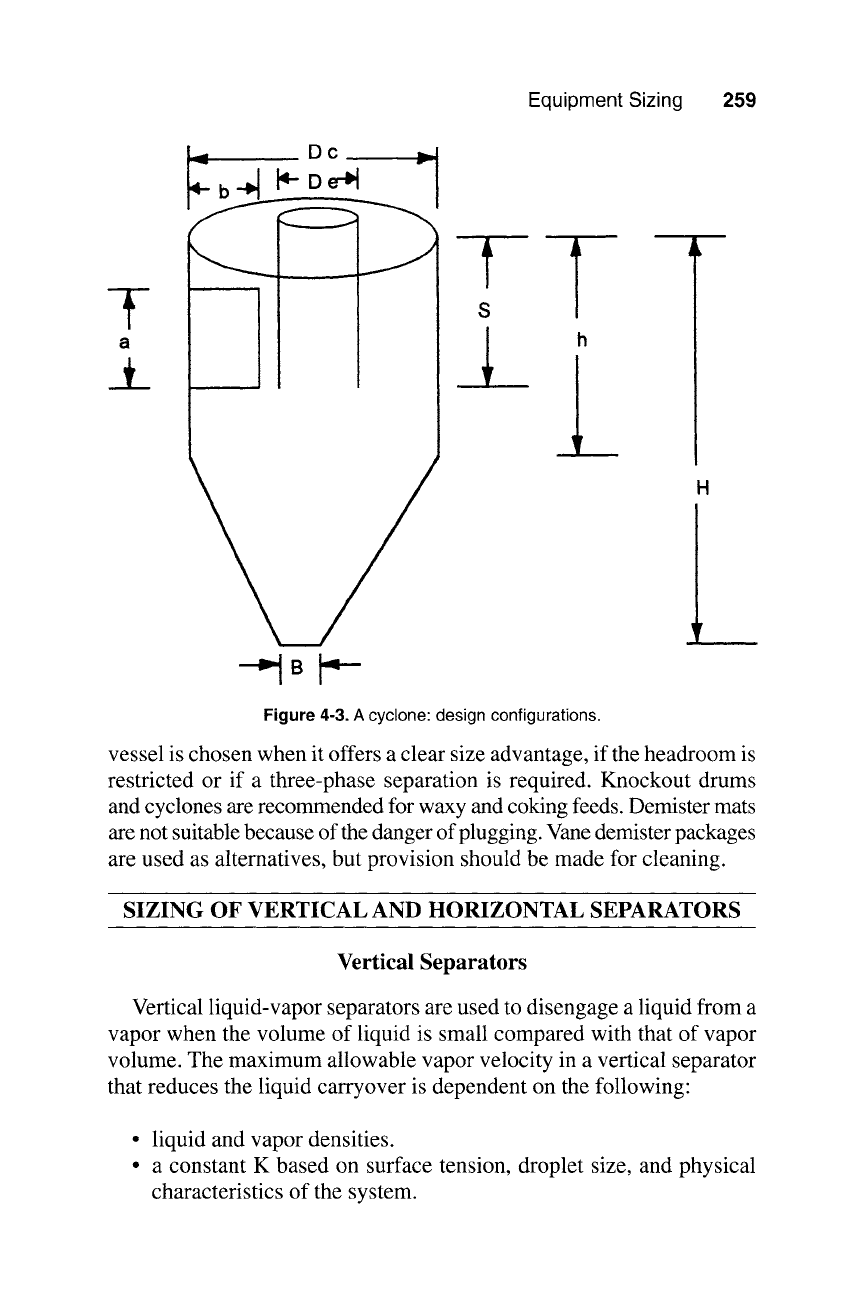
Cyclones (Figure
4-3). These are robust and not susceptible to foul-
ing or wax. Multicyclones are compact and are reasonably efficient for
foam, but not for slugs. The efficiency of a cyclone decreases with
increasing diameter, and cyclones are not applicable above 5 ft. diam-
eter. They possess a good efficiency for smaller flow rates. However,
cyclones are expensive to operate, especially under vacuum conditions,
because they have a higher pressure drop than either a knockout drum
or a demister separator.
Demister Separators.
A demister separator is fitted either with a
vane demister package or with a wire mesh demister mat. The latter
type is much preferred, although it is unsuitable for fouling service. The
wire mesh demister is a widely applied type of separator, and is adequate
for all gas-liquid flow regimes over a wide range of gas flow rates.
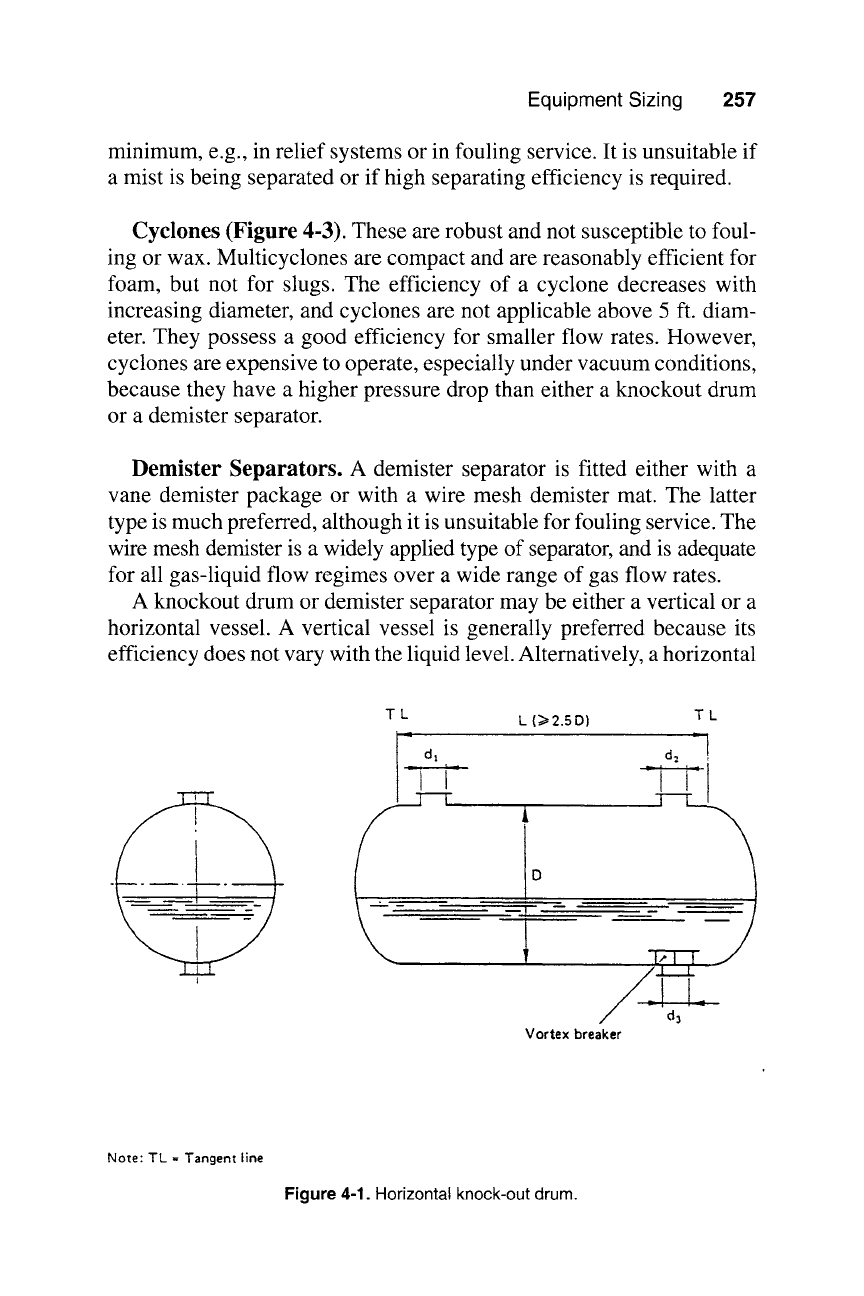
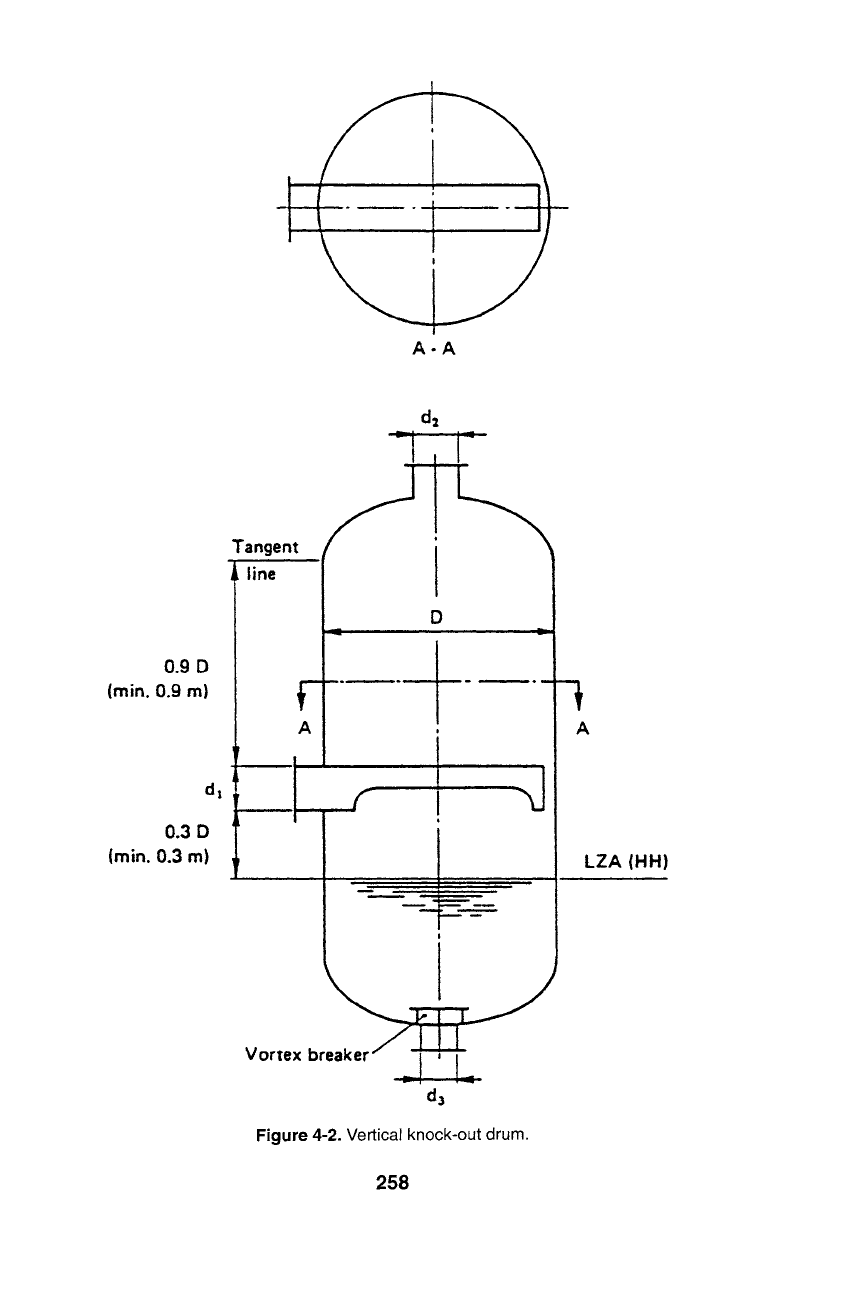
A knockout drum or demister separator may be either a vertical or a
horizontal vessel. A vertical vessel is generally preferred because its
efficiency does not vary with the liquid level. Alternatively, a horizontal
T L L (>I 2.5D)
i~
1
!
TL
d:
~i
b'! I
d3
Vortex breaker
Note:
TL = Tangent line
Figure
4-1. Horizontal knock-out drum.
A-A
0.g D
(rain. 0.g m)
Tangent
..
line
F
dt
0.3 D I
(rain. 0.3 m)
d2
~, i ~
D
I
I
--_~--
Vortex br
~l ,-----.. '
d~
1
A
LZA (HH)
Figure 4-2. Vertical knock-out drum.
258
Equipment Sizing
259
f
a
L.
Dc ,.J
-t
' S
-..I B ! -
h
Figure 4-3. A cyclone: design configurations.
vessel is chosen when it offers a clear size advantage, if the headroom is
restricted or if a three-phase separation is required. Knockout drums
and cyclones are recommended for waxy and coking feeds. Demister mats
are not suitable because of the danger of plugging. Vane demister packages
are used as alternatives, but provision should be made for cleaning.
SIZING OF VERTICAL AND HORIZONTAL SEPARATORS
Vertical Separators
Vertical liquid-vapor separators are used to disengage a liquid from a
vapor when the volume of liquid is small compared with that of vapor
volume. The maximum allowable vapor velocity in a vertical separator
that reduces the liquid carryover is dependent on the following:
9 liquid and vapor densities.
9 a constant K based on surface tension, droplet size, and physical
characteristics of the system.
260
Fortran Programs for Chemical Process Design
The proportionality constant, K, is 0.35 for oil and gas systems with
at least 10-inch disengaging height between the mist eliminator bottom
and gas liquid interface. For vertical vessels, K can vary between 0.1
and 0.35, if mist eliminators (demisters) are used to enhance
disentrainment. The value of K also depends on the operating pressure
of the vessel. At pressures above 30 psig, the K value decreases with
pressure with an approximate value of 0.30 at 250 psig and 0.275 at 800
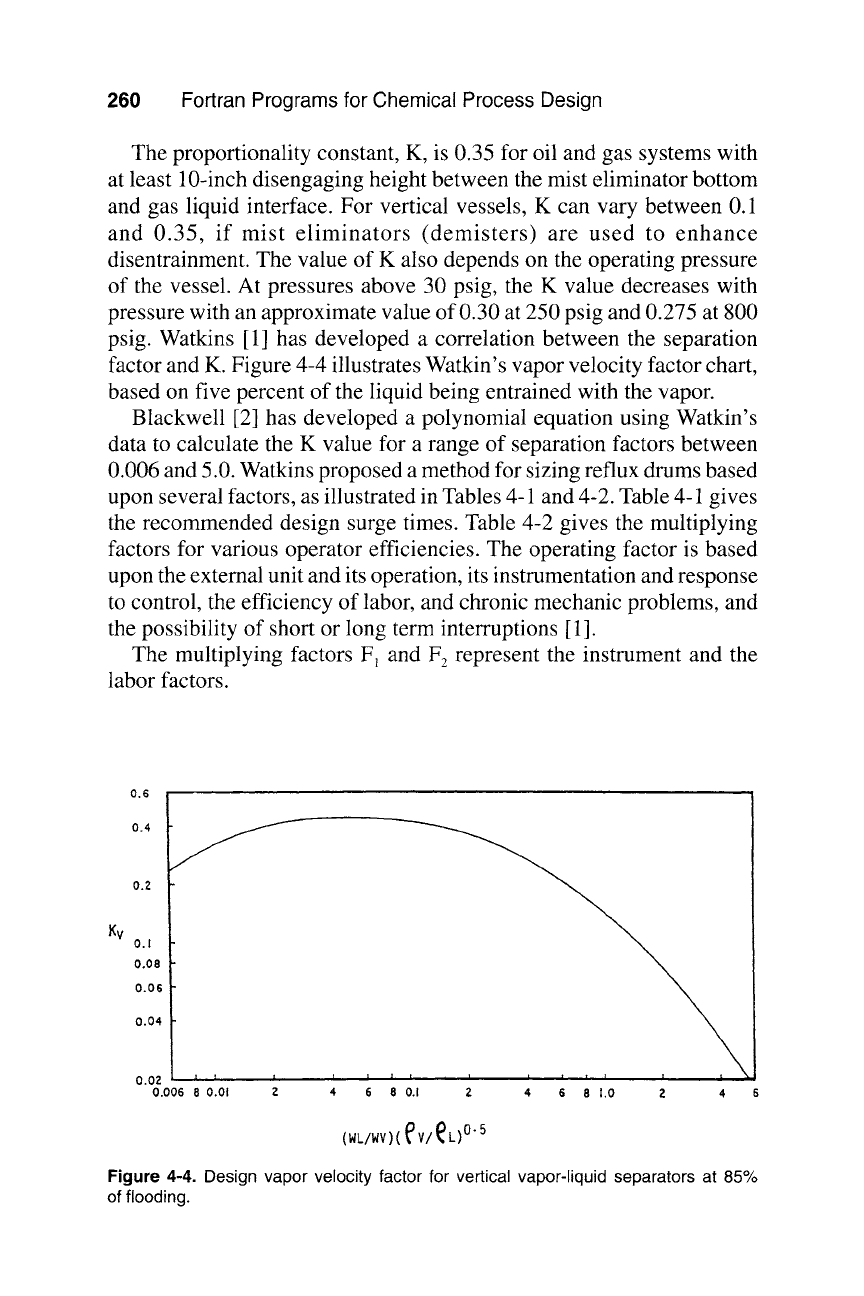
psig. Watkins [1] has developed a correlation between the separation
factor and K. Figure 4-4 illustrates Watkin's vapor velocity factor chart,
based on five percent of the liquid being entrained with the vapor.
Blackwell [2] has developed a polynomial equation using Watkin's
data to calculate the K value for a range of separation factors between
0.006 and 5.0. Watkins proposed a method for sizing reflux drums based
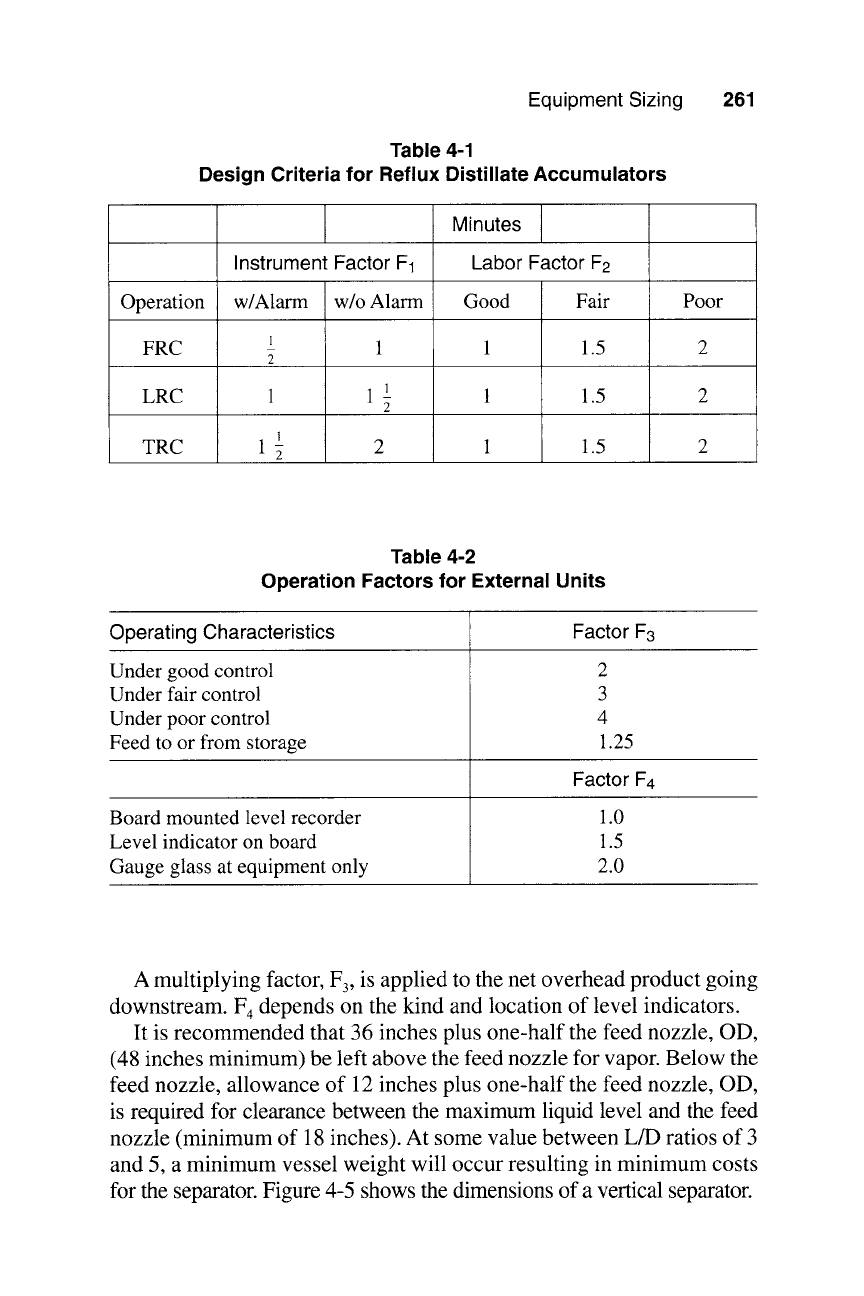
upon several factors, as illustrated in Tables 4-1 and 4-2. Table 4-1 gives
the recommended design surge times. Table 4-2 gives the multiplying
factors for various operator efficiencies. The operating factor is based
upon the external unit and its operation, its instrumentation and response
to control, the efficiency of labor, and chronic mechanic problems, and
the possibility of short or long term interruptions [ 1 ].
The multiplying factors F~ and
F 2
represent the instrument and the
labor factors.
Kv
0.6
0.4 ~r
/
0.?.
0.1
0.08 -
0.06
0.04,
O.OZ I L ~ ....
0.006 8 0.01 Z
I I I I
4 6 8 0.1
2 4 6 8 1.0 Z 4 6
(.,/.v)( e v/e,) ~ s
Figure 4-4. Design vapor velocity factor for vertical vapor-liquid separators at 85%
of flooding.
Equipment Sizing
Table 4-1
Design Criteria for Reflux Distillate Accumulators
261
Operation
FRC
LRC
TRC
Instrument Factor
F1
w/Alarm
1
12
w/o Alarm
1 •
2
Minutes
Labor Factor
F2
Good
Fair
1.5
1.5
1.5
Poor
Table 4-2
Operation Factors for External Units
Operating Characteristics
Under good control
Under fair control
Under poor control
Feed to or from storage
Board mounted level recorder
Level indicator on board
Gauge glass at equipment only
Factor
F3
2
3
4
1.25
Factor
F4
1.0
1.5
2.0
A multiplying factor,
F3,
is applied to the net overhead product going
downstream.
F 4
depends on the kind and location of level indicators.
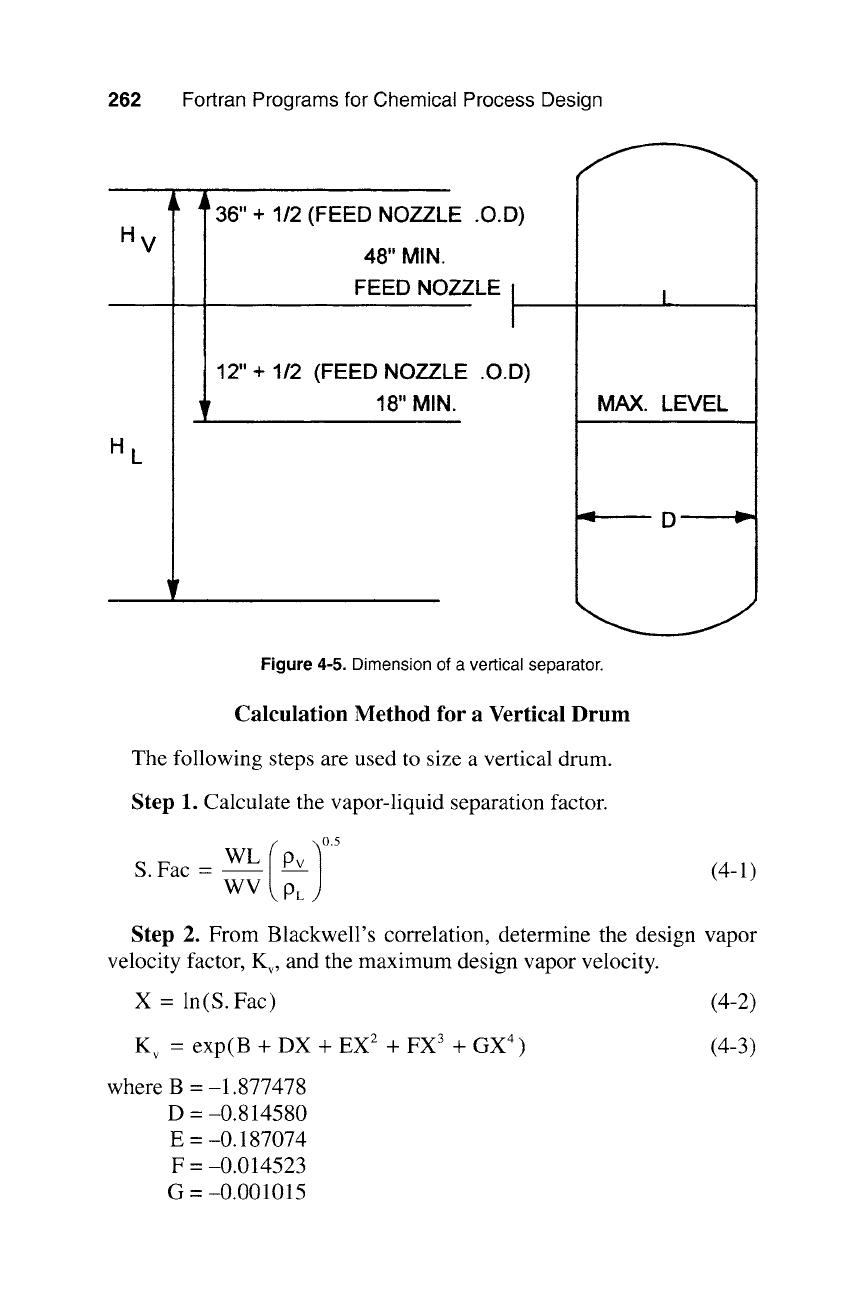
It is recommended that 36 inches plus one-half the feed nozzle, OD,
(48 inches minimum) be left above the feed nozzle for vapor. Below the
feed nozzle, allowance of 12 inches plus one-half the feed nozzle, OD,
is required for clearance between the maximum liquid level and the feed
nozzle (minimum of 18 inches). At some value between L/D ratios of 3
and 5, a minimum vessel weight will occur resulting in minimum costs
for the separator. Figure 4-5 shows the dimensions of a vertical separator.
262 Fortran Programs for Chemical Process Design
H V
H L
k36" * 1/2 (FEED NOZZLE .O.D)
48" MIN.
FEED
NOZZLE
,,
12"+ 1/2 (FEED NOZZLE .O.D)
18" MIN.
f
MAX.
LEVEL
4------- D ----.-~
Figure
4-5. Dimension of a vertical separator.
Calculation Method for a Vertical Drum
The following steps are used to size a vertical drum.
Step 1. Calculate the vapor-liquid separation factor.
/0.5
S. Fac- WL 9v (4-1)
w--V
Step 2. From Blackwell's correlation, determine the design vapor
velocity factor, K v, and the maximum design vapor velocity.
X - In (S. Fac) (4-2)
K v - exp(B + DX
+ EX 2 + FX 3 + GX 4)
(4-3)
where B =-1.877478
D = -0.814580
E = -0.187074
F = -0.014523
G = -0.001015
Equipment Sizing 263
)0.5
V max __
Kv
PL - Pv
Pv
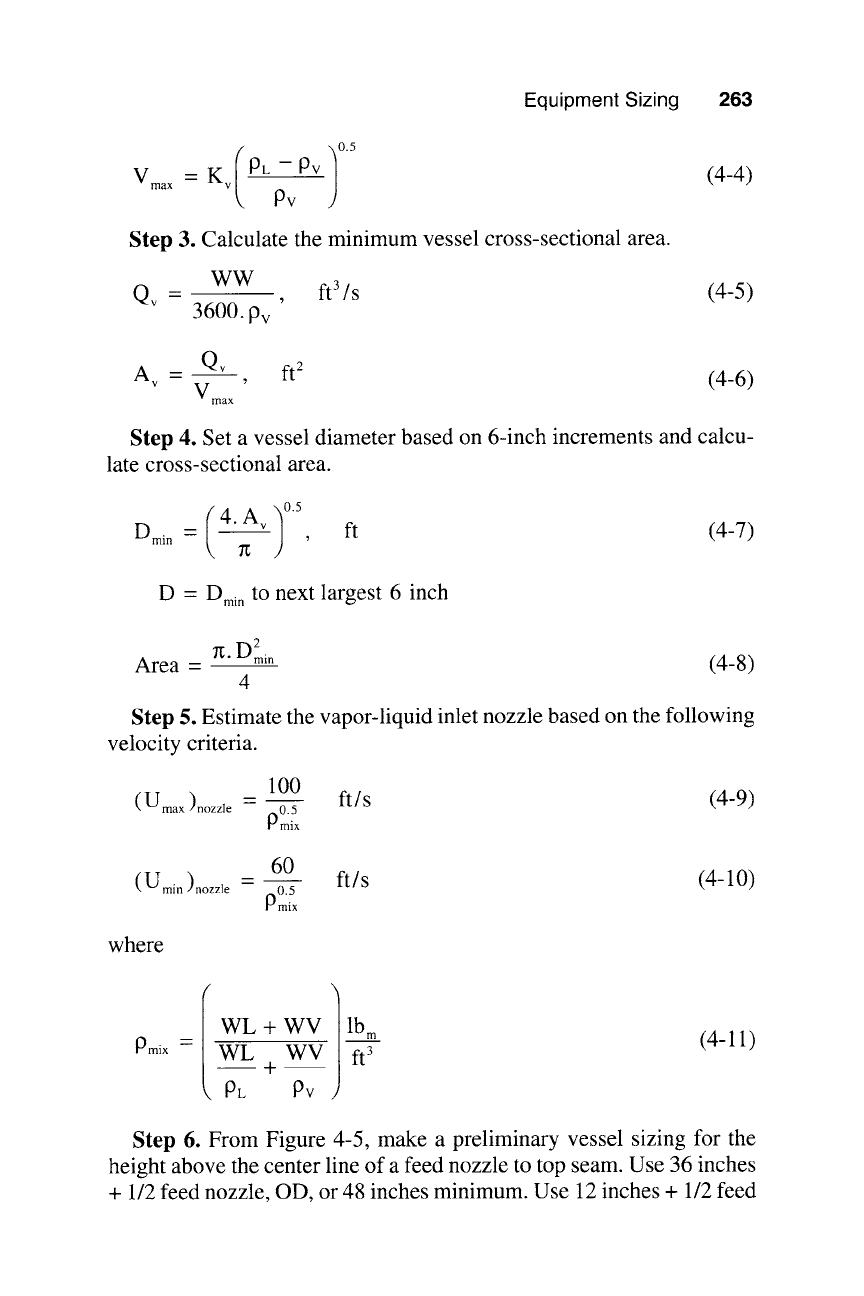
Step 3. Calculate the minimum vessel cross-sectional area.
(4-4)
Qv = ww
, ft 3/s
(4-5)
3600. Pv
Av _- ~Qv, ft 2 (4-6)
V max
Step 4. Set a vessel diameter based on 6-inch increments and calcu-
late cross-sectional area.
4 Av) ~
- " , ft (4-7)
D
min
D
=
D mi n tO next largest 6 inch
]--)2
/1;.
Area
- ~-" min
(4-8)
4
Step 5. Estimate the vapor-liquid inlet nozzle based on the following
velocity criteria.
100
(Umax)nozzle -- 05 ft/s
(4-9)
Pmix
60
(gmin)nozzle -- 05 f[/s
(4-10)
Pmix
where
WL + WV
lb m
(4-11)
9 mix --
WL WV ~,,----5-
It
+--
PL Pv
Step 6. From Figure 4-5, make a preliminary vessel sizing for the
height above the center line of a feed nozzle to top seam. Use 36 inches
+ 1/2 feed nozzle, OD, or 48 inches minimum. Use 12 inches + 1/2 feed
264
Fortran Programs for Chemical Process Design
nozzle, OD, or 18 inch minimum to determine the distance below the
center line of the feed nozzle to the maximum liquid level.
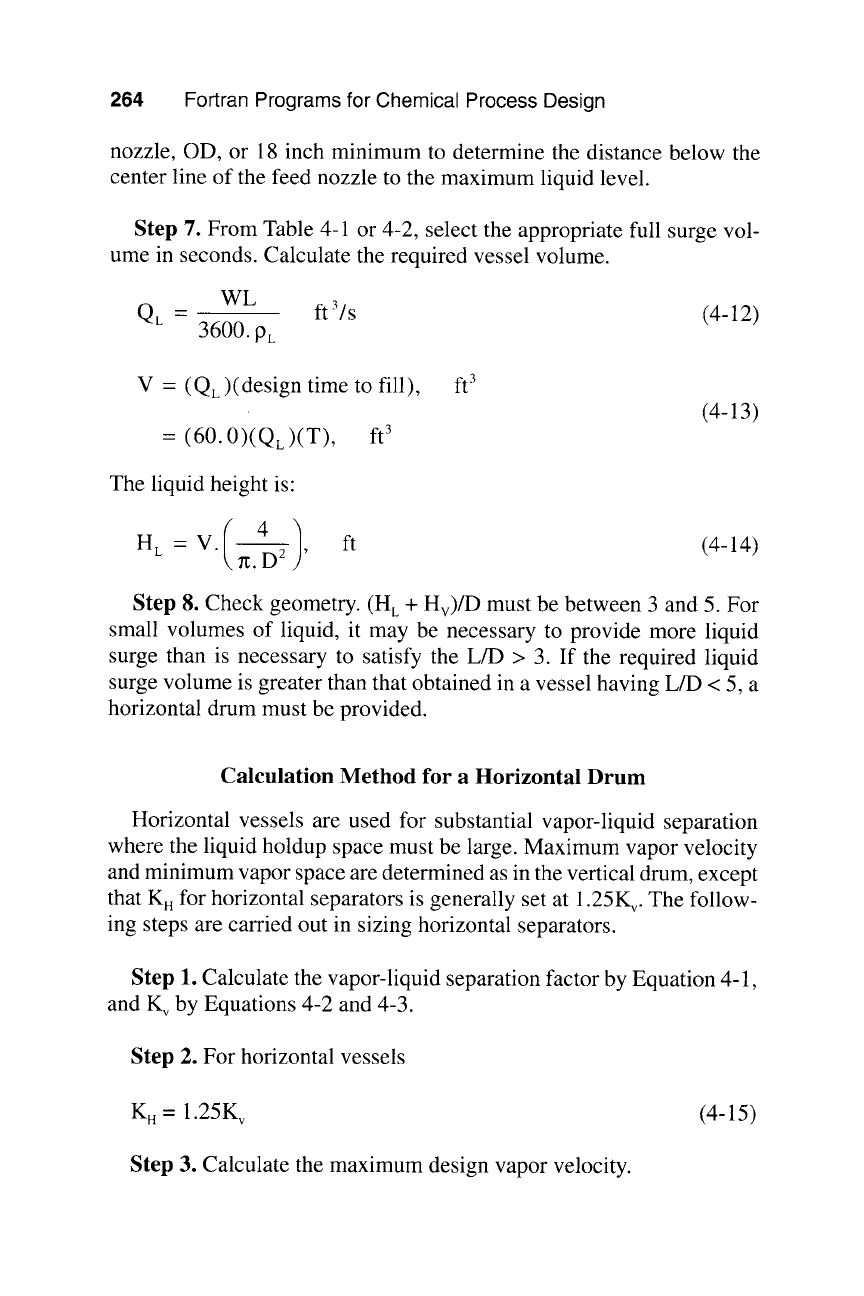
Step 7. From Table 4-1 or 4-2, select the appropriate full surge vol-
ume in seconds. Calculate the required vessel volume.
QL = WL ft3/s (4-12)
3600. p L
V - (QL)(design time to fill), ft 3
= (60.0)(QL)(T), ft 3
(4-13)
The liquid height is:
"L V(4)
rt'D 2 , ft (4-14)
Step 8. Check geometry. (H E + Hv)/D must be between 3 and 5. For
small volumes of liquid, it may be necessary to provide more liquid
surge than is necessary to satisfy the L/D > 3. If the required liquid
surge volume is greater than that obtained in a vessel having L/D < 5, a
horizontal drum must be provided.
Calculation Method for a Horizontal Drum
Horizontal vessels are used for substantial vapor-liquid separation
where the liquid holdup space must be large. Maximum vapor velocity
and minimum vapor space are determined as in the vertical drum, except
that K H for horizontal separators is generally set at 1.25K v. The follow-
ing steps are carried out in sizing horizontal separators.
Step 1. Calculate the vapor-liquid separation factor by Equation 4-l,
and K v by Equations 4-2 and 4-3.
Step 2. For horizontal vessels
K H = 1.25K v (4-15)
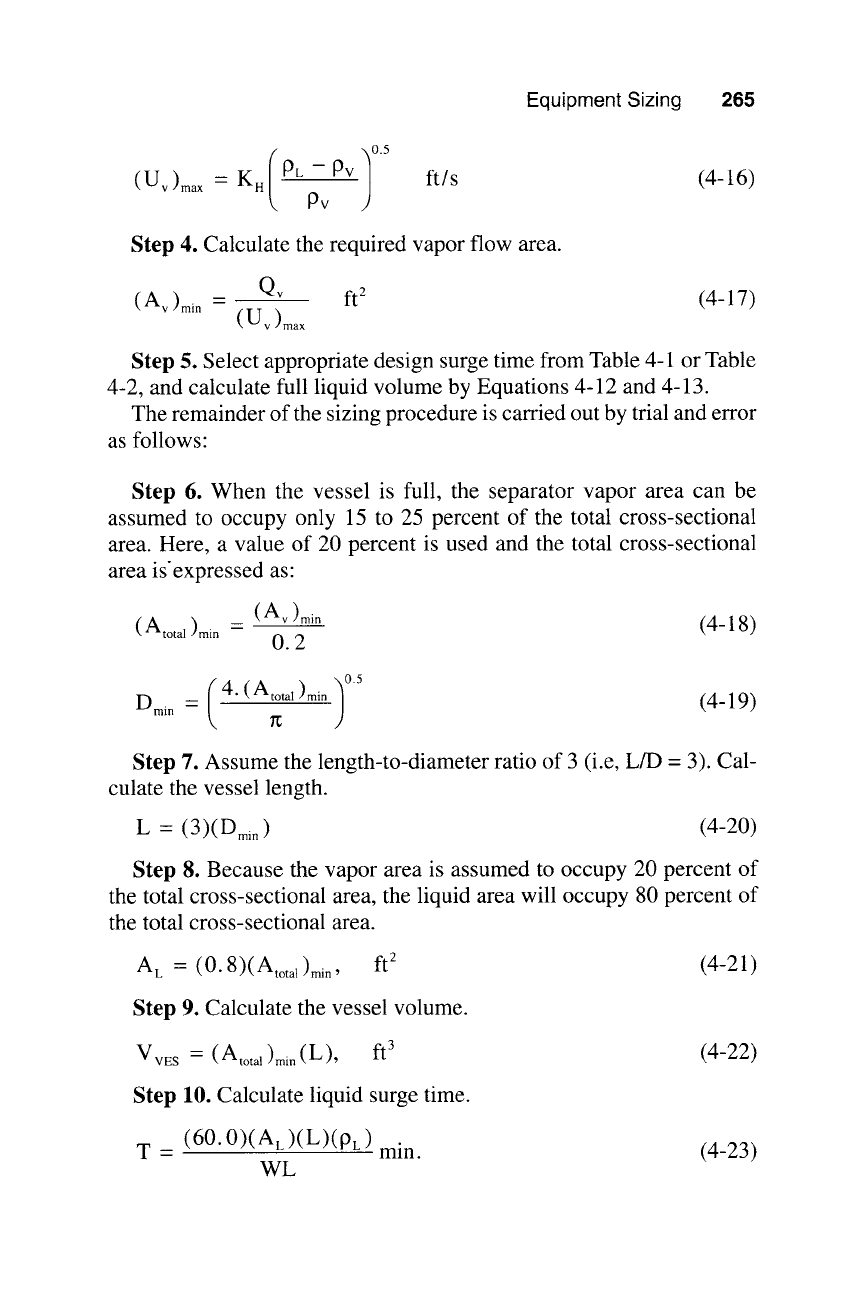
Step 3. Calculate the maximum design vapor velocity.
Equipment Sizing 265
)O.5
(U) -K.
9L-Pv
v max PV
ft/s (4-16)
Step 4. Calculate the required vapor flow area.
(Av)mi.
-'-
Qv ft 2 (4-17)
(Uv)max
Step 5. Select appropriate design surge time from Table 4-1 or Table
4-2, and calculate full liquid volume by Equations 4-12 and 4-13.
The remainder of the sizing procedure is carried out by trial and error
as follows:
Step 6. When the vessel is full, the separator vapor area can be
assumed to occupy only 15 to 25 percent of the total cross-sectional
area. Here, a value of 20 percent is used and the total cross-sectional
area is'expressed as"
(Atotal)min
--
( A v )min (4-18)
0.2
4 (A total
) min "~0"5
- " ) (4-19)
Dmin
Step 7. Assume the length-to-diameter ratio of 3 (i.e, L/D = 3). Cal-
culate the vessel length.
L = (3)(D min ) (4-20)
Step 8. Because the vapor area is assumed to occupy 20 percent of
the total cross-sectional area, the liquid area will occupy 80 percent of
the total cross-sectional area.
A L - (0.8)(Atota
1 )min'
ft2 (4-21)
Step 9. Calculate the vessel volume.
VVES -- (Atotal)rain (L), ft 3 (4-22)
Step 10. Calculate liquid surge time.
T- (60"0)(AL)(L)(gL) min. (4-23)
WL
266
Fortran Programs for Chemical Process Design
Liquid Holdup and Vapor Space Disengagement
The dimensions of both vertical and horizontal separators are based
on rules designed to provide adequate liquid holdup and vapor disengag-
ing space. For instance, the desired vapor space in a vertical separator is
1
at least 1 ~ times the diameter, with 6 inches as the minimum above the
top of the inlet nozzle. In addition, a 6-inch minimum is required
between the maximum liquid level and the bottom of the inlet nozzle.
For a horizontal separator, the minimum vapor space is equal to 20 per-
cent of the diameter or 12 inches.
Wire Mesh Pad
Pads of fine wire mesh induce coalescence of impinging droplets into
larger ones, which then separate freely from the gas phase. No standard
equations have been developed for the pressure drop across wire mesh
because there are no standardized mesh pads. However, as a rule of thumb,
the pressure drop of a wire mesh is AP = 1.0 in
H20.
Every manufacturer
makes a standard high efficiency, very-high efficiency, or high-throughput
mesh under various trade names, each for a specific requirement.
Standards for Horizontal Separators
The following specifications are generally standard in the design of
horizontal separators [3]:
1. The maximum liquid level shall provide a minimum vapor space
height of 15 inches, but should not be below the center line of
the separator.
2. The volume of dished heads is not considered in vessel sizing
calculations.
3. The inlet and outlet nozzles shall be located as closely as practical
to the vessel tangent lines. Liquid outlets shall have anti-vortex baffles.
Piping Requirements
Pipes that are connected to and from the process vessels must not
interfere with the good working of the vessels. Therefore, the following
guidelines should be observed:
9 There should be no valves, pipe expansions or contractions within
10-pipe diameters of the inlet nozzle.