
Coker A.K. Fortran Programs for Chemical Process Design, Analysis, and Simulation
Подождите немного. Документ загружается.

Equipment Sizing 267
9 There should be no bends within 10-pipe diameters of the inlet
nozzle except:
for knockout drums and demisters, a bend in the feed pipe is per-
mitted if this is in a vertical plane through the axis of the feed nozzle.
for cyclones, a bend in the feed pipe is allowed if this is in a hori-
zontal plane and the curvature is in the same direction as the
cyclone vortex.
9 A pipe reducer may be used in the vapor line leading from the
separator, but it should be no nearer to the top of the vessel than
twice the outlet pipe diameter.
9 A gate or ball type valve that is fully opened in normal operation
should be used, where a valve in the feed line near the separator
cannot be avoided.
9 High pressure drops that cause flashing and atomization should be
avoided in the feed pipe.
9 If a pressure reducing valve in the feed pipe cannot be avoided, it
should be located as far upstream of the vessel as practicable.
Nomenclature
A = cross-sectional area of vertical separator,
ft 2
A L = cross-sectional area of horizontal vessel occupied by liquid
phase, fff
A T - total cross-sectional area of horizontal vessel,
ft 2
A v = minimum cross-sectional area of vertical separator,
ft 2
D = vessel diameter, ft
H L = liquid height, ft
H v - vapor height, ft
K = proportionality constant
K H = vapor velocity factor for horizontal separator
K v = vapor velocity factor for vertical separator
L = horizontal vessel level, ft
S.Fac = separation factor
QL = liquid volumetric flow, ft3/s
Qv = vapor volumetric flow, ft3/s
T- liquid surge time, min.
Vma x --
maximum vapor velocity, ft/s
VVE s = horizontal vessel volume, ft 3
WL = liquid flow rate, lb/h
WV = vapor flow rate, lb/h
268 Fortran Programs for Chemical Process Design
X = In (S.Fac)
9L = liquid density, lb/fl 3
9v = vapor density, lb/ft 3
SIZING OF PARTLY FILLED VESSELS AND TANKS
Cylindrical vessels and horizontal tanks are used for the storage of
fluids in the chemical process industries. Various level instruments are
employed to determine the liquid level in process vessels. The exact
liquid volume can be obtained either by calibration of the vessels or by
tedious calculations. Partial volumes for horizontal, cylinders with flat,
dished, elliptical, and hemispherical ends, and for vertical cylinders are
employed for storing process fluids.
Kowal [4] presented charts that allow designers to determine the vol-
ume of vessels for different dimensions. In addition, parameters for tray
designs and tray layout in distillation columns, such as chord length and
circle area, are computed in this chapter.
The Equations
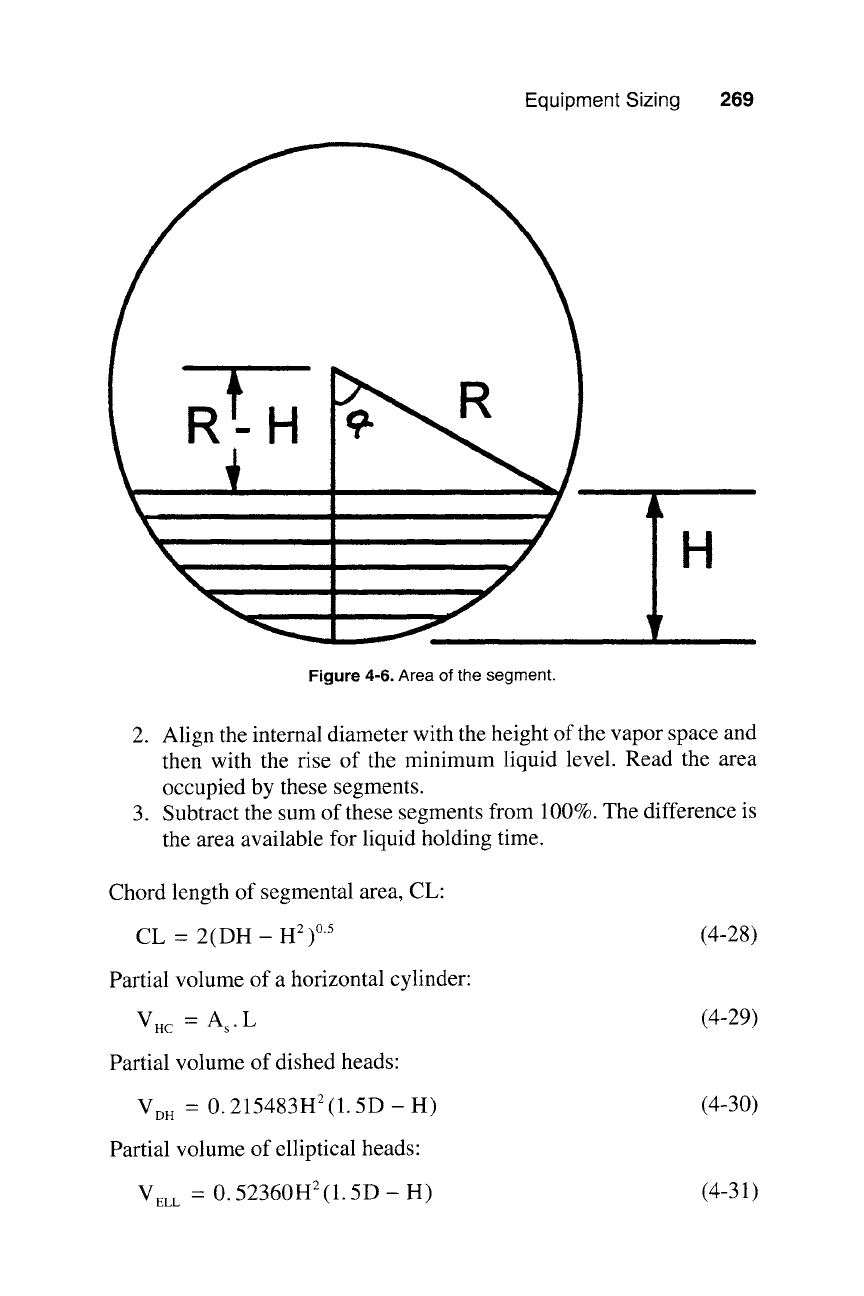
Calculate the area of the segment of a circle from Figure 4-6:
R-H
Cos(c~) = (4-24)
R
or-C~
(4-25)
Area of the triangle:
Area of A = (R - H)(2RH - H 2)
(4-26)
Therefore, area of the segment of a circle from Figure 4-6 is:
A~ -R2Cos-'(R-H/-(R-H)(2RH-H2)~
(4-27)
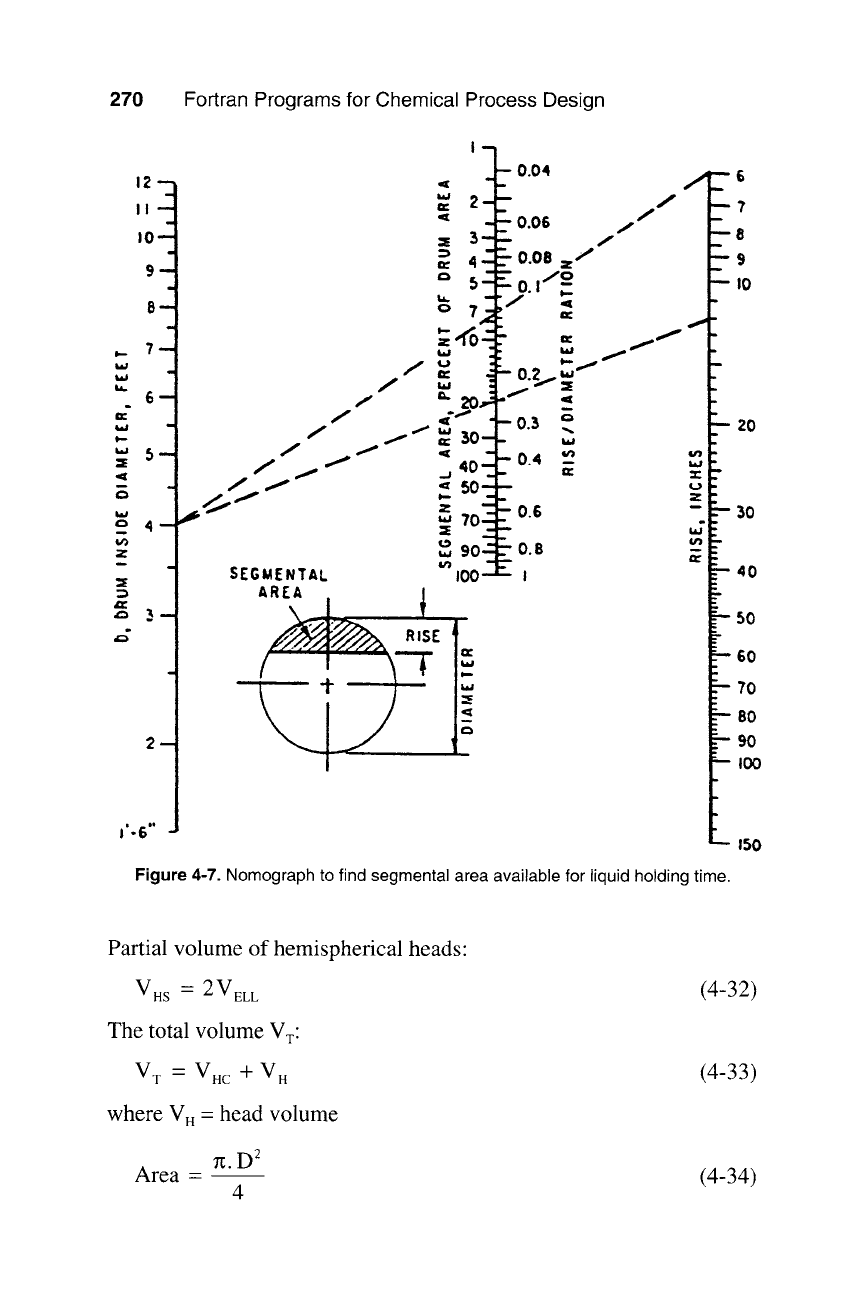
Figure 4-7 is a nomograph based upon the area of the segment of a
circle [5]. The nomograph converts the height (rise) over diameter ratios
directly to percent of area. The procedure in using the nomograph is:
1. Start at the left-hand side of the nomograph with the trial diameter.
Equipment Sizing
269
-- I
R _H
R
Figure
4-6. Area of the segment.
H
2. Align the internal diameter with the height of the vapor space and
then with the rise of the minimum liquid level. Read the area
occupied by these segments.
3. Subtract the sum of these segments from 100%. The difference is
the area available for liquid holding time.
Chord length of segmental area, CL:
CL = 2(DH - H 2)~
Partial volume of a horizontal cylinder:
VHC = A~.L
Partial volume of dished heads:
VDH -- 0.215483H 2(1.5D - H)
Partial volume of elliptical heads:
VECL -- 0. 52360H 2 (1.5D - H)
(4-28)
(4-29)
(4-30)
(4-31)
270
Fortran Programs for Chemical Process Design
12--
u
I I ""
m
I0"
m
9--
m
8--
m
7"-"
6--
=:"
w 5-"
,~. ,=
W
4-"
Z
m
==
=E
.n,
,~ 3--
2
1'-6" -
I
0.04
z
'~ 0.06
~ 3
0: 4 O.OB z "~
5~/t.i 1-~
/
20.,,:
,,~
.
//
//~
30-
tG//
_j 40--
== 70 0.6
o =
w 90 0.8
SEGMENTAL I00 I
AREA
I
- 0.2~,,, w I
--0.3 ~
" W
--0.4 v~
f
/
I
/
/
I f
i
W
U
z
m
U')
--s
---7
m
"-'8
m
--'9
m
"- I0
.=
=m
"--
20
,=
3O
B
~--4o
~
5o
"-60
7O
-:--
80
9O
~ IIX)
--
150
Figure 4-7. Nomograph to find segmental area available for liquid holding time.
Partial volume of hemispherical heads:
VHs = 2VEL L (4-32)
The total volume VT:
V T = VHc q-V
H
(4-33)
where
V H =
head volume
/~.D 2
Area
= (4-34)
4
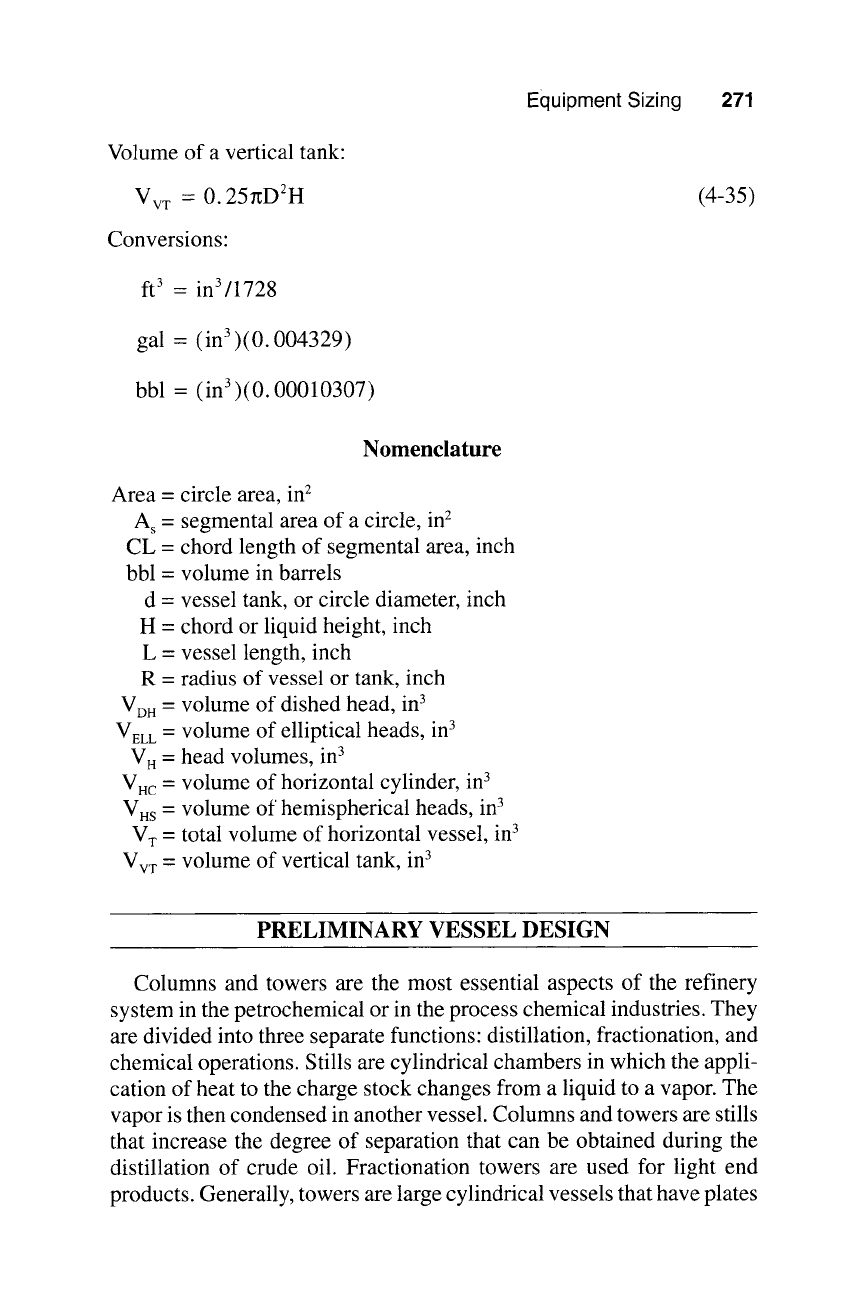
Volume of a vertical tank:
VvT - 0.25rtD2H
Conversions:
ft 3 --"
in 3/1728
gal - (in 3)(0. 004329)
bbl = (in 3)(0. 00010307)
Nomenclature
Area = circle area, in 2
A~ = segmental area of a circle, in 2
CL = chord length of segmental area, inch
bbl = volume in barrels
d = vessel tank, or circle diameter, inch
H = chord or liquid height, inch
L = vessel length, inch
R = radius of vessel or tank, inch
VD~ = volume of dished head, in 3
VEL L = volume of elliptical heads, in 3
V H - head volumes, in 3
VHC = volume of horizontal cylinder, in 3
Vus = volume of hemispherical heads, in 3
V T = total volume of horizontal vessel, in 3
VvT = volume of vertical tank, in 3
Equipment Sizing 271
(4-35)
PRELIMINARY VESSEL DESIGN
Columns and towers are the most essential aspects of the refinery
system in the petrochemical or in the process chemical industries. They
are divided into three separate functions" distillation, fractionation, and
chemical operations. Stills are cylindrical chambers in which the appli-
cation of heat to the charge stock changes from a liquid to a vapor. The
vapor is then condensed in another vessel. Columns and towers are stills
that increase the degree of separation that can be obtained during the
distillation of crude oil. Fractionation towers are used for light end
products. Generally, towers are large cylindrical vessels that have plates
272
Fortran Programs for Chemical Process Design
(trays spaced inside the shell) to promote mixing of the downward flow
of liquid with the upward flow of the vapors. These vessels require
self-supporting, especially when they are exposed to high winds or to
seismic risk.
Process conditions in the CPI often change, and a tower that is ini-
tially designed for vacuum operation may at a later stage be employed
at pressure greater than atmospheric. Therefore, thin-walled vessels are
often rated for both pressure and vacuum conditions. If the vessel is
thick-walled and designed for high pressure service, no vacuum rating
will be required. Tall vessels have one of a number of closures such as
hemispherical, ellipsoidal, torispherical, conical, or flat ends.
The ellipsoidal shape is usual for closures of vessels that are six feet
in diameter or greater. The hemispherical shape is preferred for vessels
of a lesser diameter. The basic relationships for thin cylindrical shells
under internal pressure assume that circumferential stress is dependent
on the pressure and vessel diameter, but independent of the shell thickness.
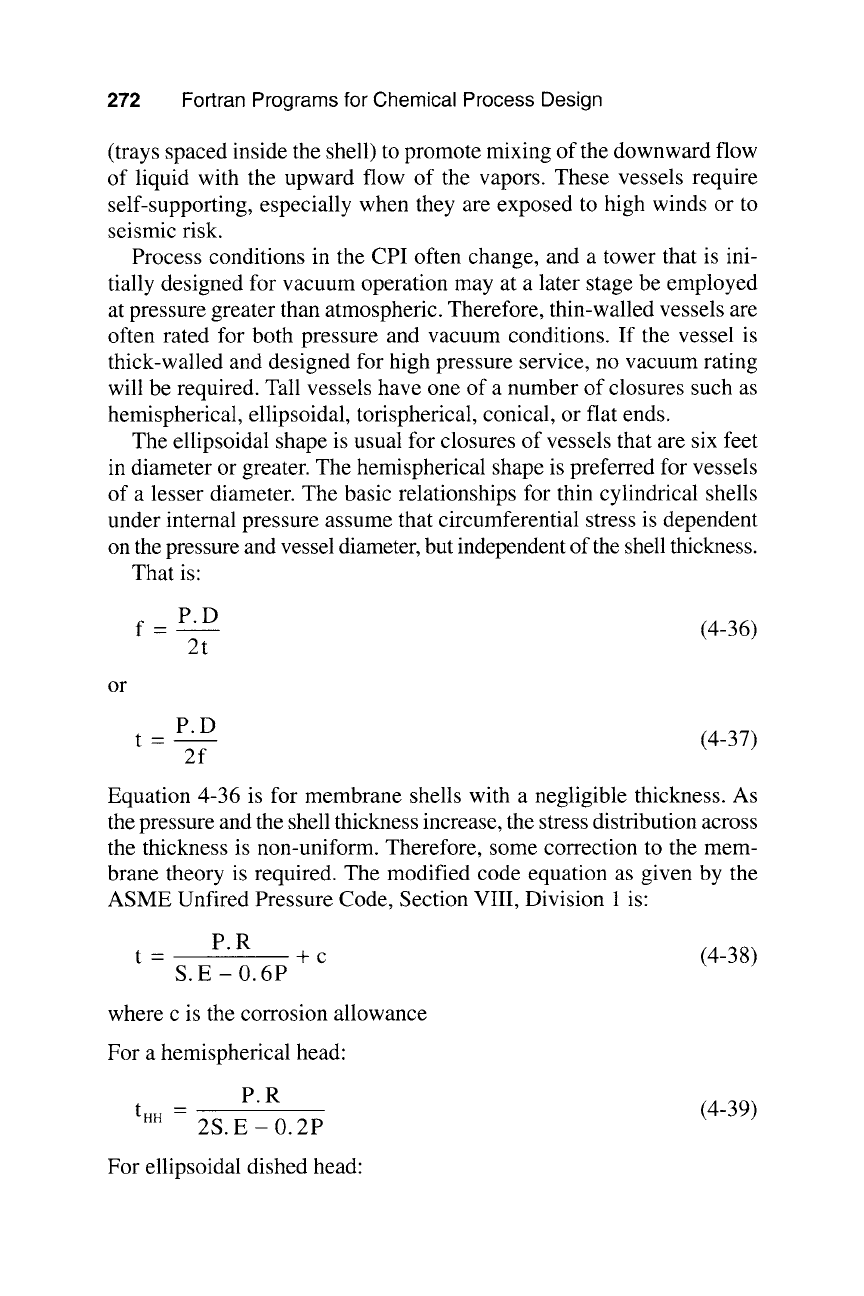
That is:
P.D
f - (4-36)
2t
or
P.D
t - (4-37)
2f
Equation 4-36 is for membrane shells with a negligible thickness. As
the pressure and the shell thickness increase, the stress distribution across
the thickness is non-uniform. Therefore, some correction to the mem-
brane theory is required. The modified code equation as given by the
ASME Unfired Pressure Code, Section VIII, Division 1 is"
P.R
t - + c (4-38)
S.E- 0.6P
where c is the corrosion allowance
For a hemispherical head:
P.R
t.. = (4-39)
2S.E- 0.2P
For ellipsoidal dished head:
Equipment Sizing 273
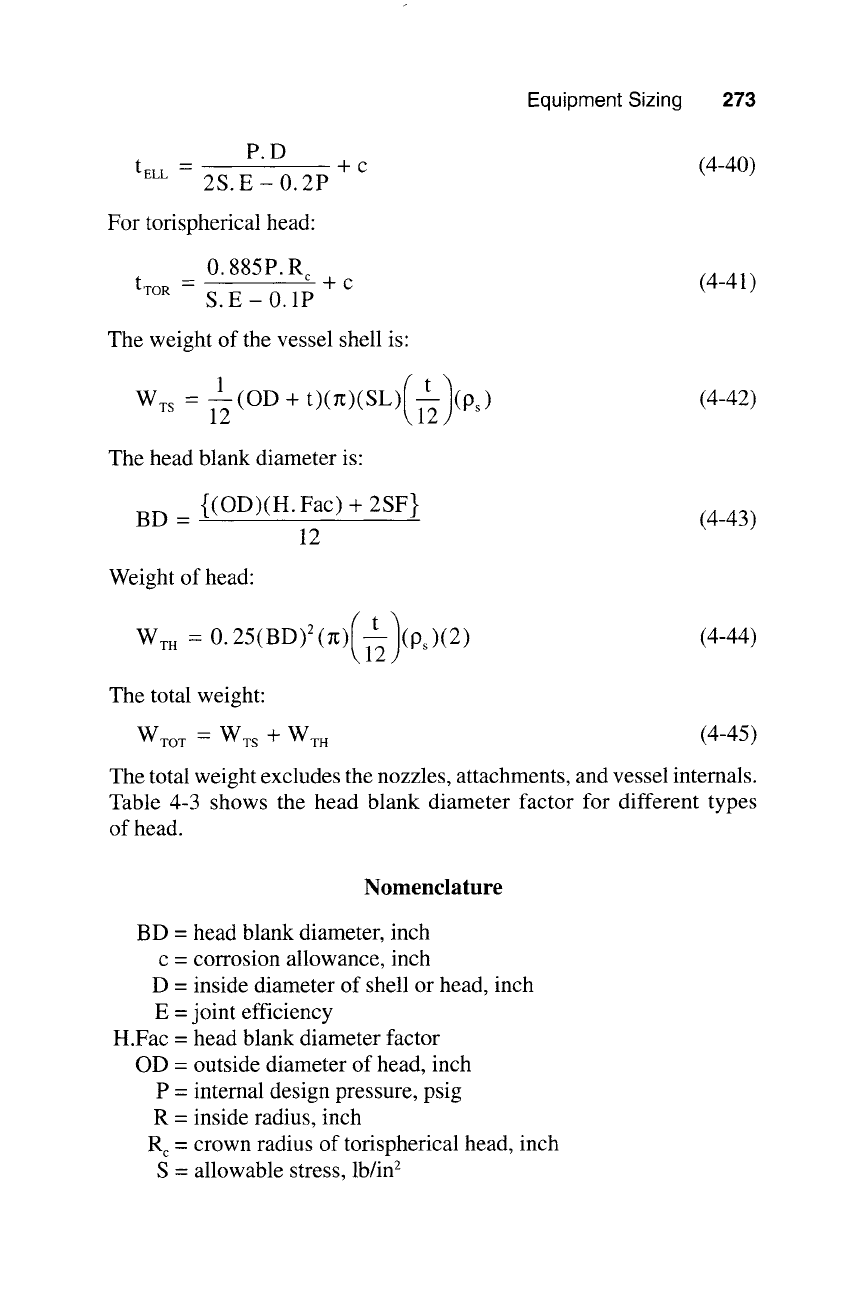
P.D
t
ELL -- "1-
c (4-40)
2S.E- 0.2P
For torispherical head"
0.885P R c
t TOR = " + C (4-41)
S.E- 0.1P
The weight of the vessel shell is:
(t)
WTS =
Z(OD--~-t)(rt)(SL) ~ (gs) (4-42)
12
The head blank diameter is:
BD - {(OD)(H. Fac) + 2SF}
12
(4-43)
Weight of head:
It/
WT.
-
0.25(BD) z(rt) ~ (ps)(2)
(4-44)
The total weight"
WTOT -- Wvs + WTH
(4-45)
The total weight excludes the nozzles, attachments, and vessel internals.
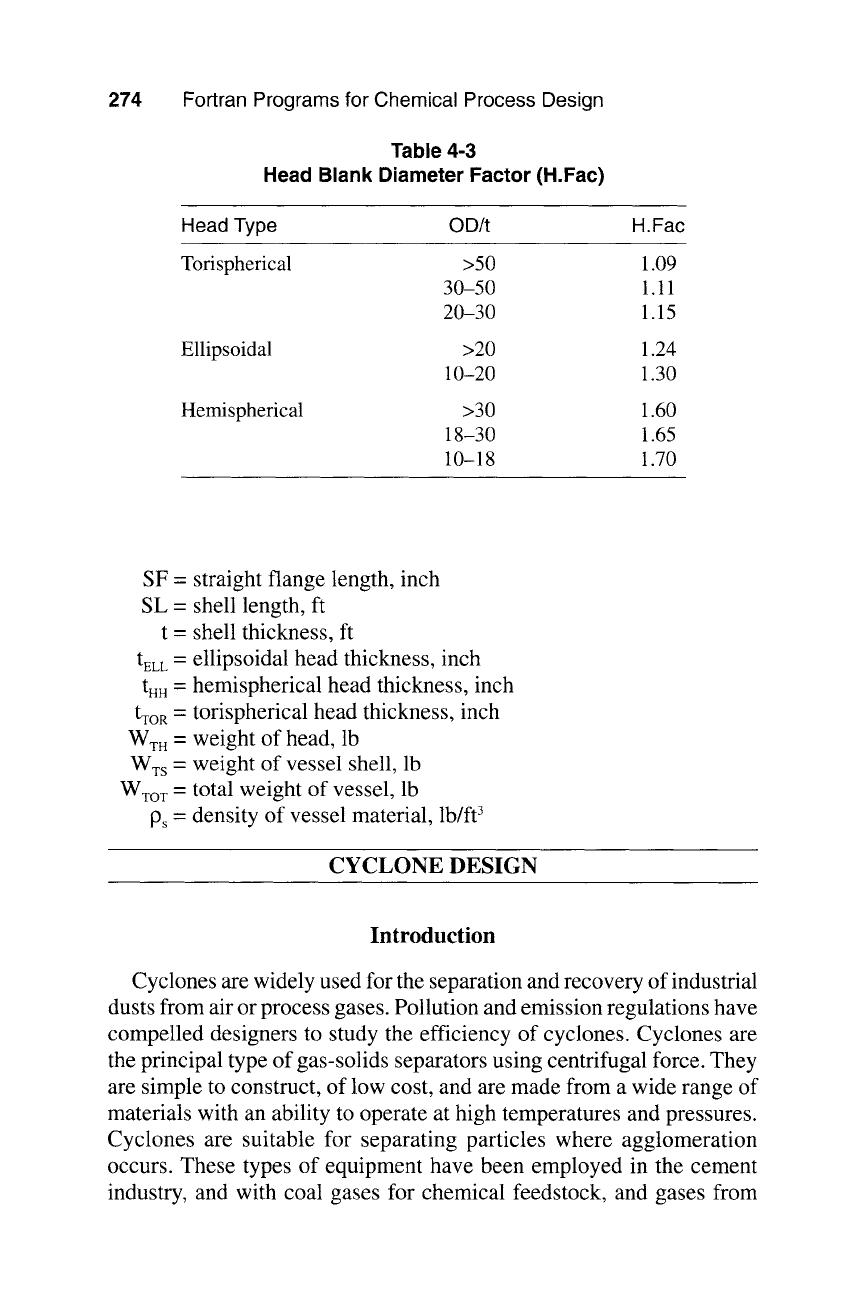
Table 4-3 shows the head blank diameter factor for different types
of head.
Nomenclature
B D = head blank diameter, inch
c = corrosion allowance, inch
D - inside diameter of shell or head, inch
E = joint efficiency
H.Fac = head blank diameter factor
OD - outside diameter of head, inch
P- internal design pressure, psig
R = inside radius, inch
R c = crown radius of torispherical head, inch
S = allowable stress, lb/in 2
274
Fortran Programs for Chemical Process Design
Table 4-3
Head Blank Diameter Factor (H.Fac)
Head Type OD/t
H.Fac
Torispherical
Ellipsoidal
Hemispherical
>50
30-50
20-30
>20
10-20
>30
18-30
10-18
1.09
1.11
1.15
1.24
1.30
1.60
1.65
1.70
SF = straight flange length, inch
SL = shell length, ft
t = shell thickness, ft
tEL L = ellipsoidal head thickness, inch
tHH = hemispherical head thickness, inch
tTo R = torispherical head thickness, inch
WTH = weight of head, lb
WTs = weight of vessel shell, lb
WTo T = total weight of vessel, lb
P~- density of vessel material, lb/ft 3
CYCLONE DESIGN
Introduction
Cyclones are widely used for the separation and recovery of industrial
dusts from air or process gases. Pollution and emission regulations have
compelled designers to study the efficiency of cyclones. Cyclones are
the principal type of gas-solids separators using centrifugal force. They
are simple to construct, of low cost, and are made from a wide range of
materials with an ability to operate at high temperatures and pressures.
Cyclones are suitable for separating particles where agglomeration
occurs. These types of equipment have been employed in the cement
industry, and with coal gases for chemical feedstock, and gases from
Equipment Sizing 275
fluidized-bed combustion, as well as in the processing industry for the
recovery of spray-dried products, and recently, in the oil industry for
separating gas from liquid.
Cyclone reactors permit study of flow pattern and residence time dis-
tribution [6,7]. See for example, the studies by Coker [8,9] of synthetic
detergent production with fast reaction. Reactor cyclones are widely
used to separate a cracking catalyst from vaporized reaction products.
Reverse flow cyclones, in which the dust-laden gas stream enters the
top section of the cylindrical body either tangentially or via an involute
entry, are the most common design. The cylindrical body induces a spin-
ning, vortexed flow pattern to the gas-dust mixture. Centrifugal force
separates the dust from the gas stream; the dust travels to the walls of
the cylinder and down the conical section to the dust outlet. The spin-
ning gas also travels down the wall toward the apex of the cone, then
reverses direction in an air-core and leaves the cyclone through the gas
outlet tube at the top. This tube consists of a cylindrical sleeve and the
vortex finder, whose lower end extends below the level of the feed port.
Separation depends on particle settling velocities, which are governed
by size, density, and shape.
Stairmand [10], Strauss [11 ], Koch and Licht [12] have given guide-
lines for designing cyclones. The effects of feed and cyclone param-
eters on the efficiency are complex, because many parameters are
interdependent. Figure 4-3 shows the design dimensions of a cyclone
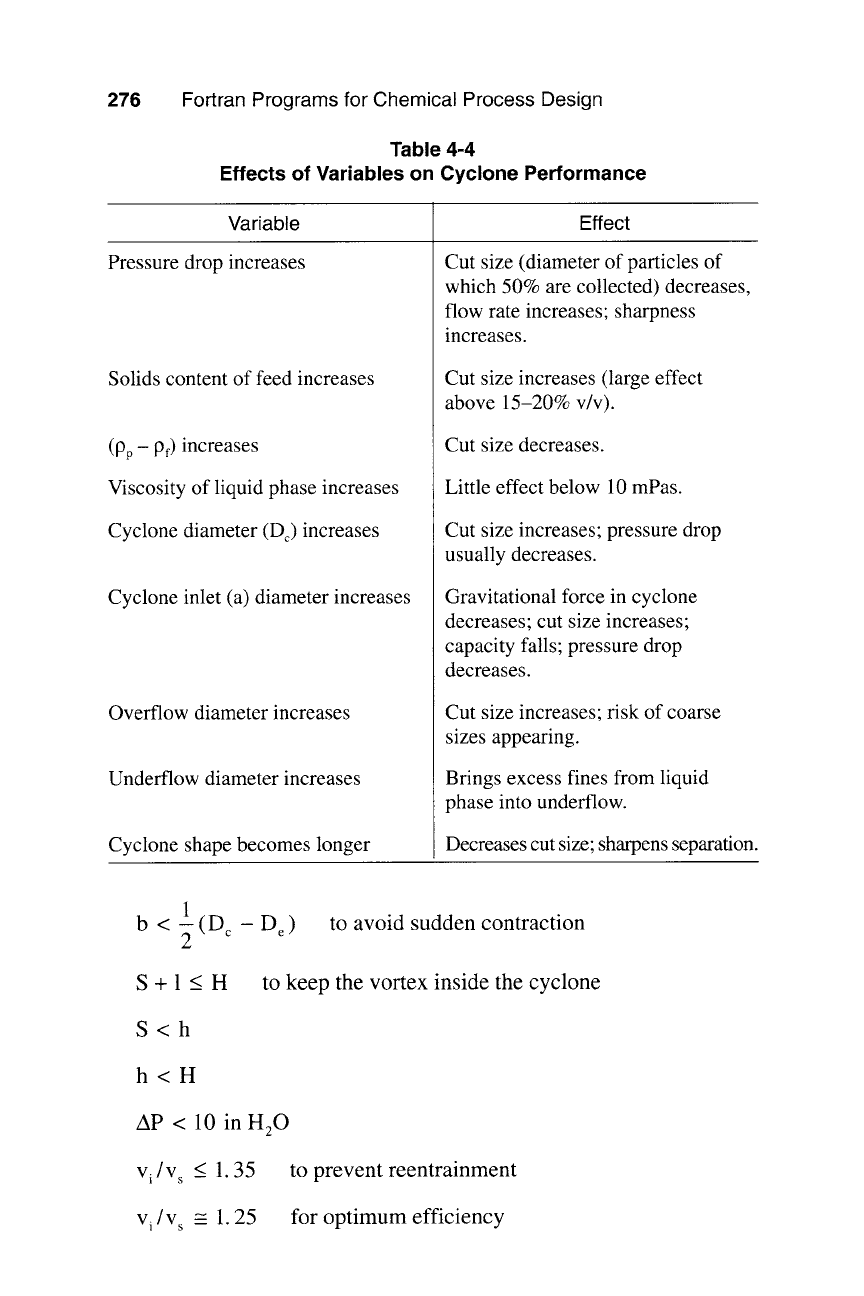
and Table 4-4 gives the effects on cyclone performance in the important
operating and design parameters.
Cyclone Design Procedure
The computation of a cyclone fractional or grade efficiency depends
on cyclone parameters and flow characteristics of particle-laden gases.
The procedure involves a series of equations containing exponential
and logarithmic functions. Koch and Licht [12] described a cyclone using
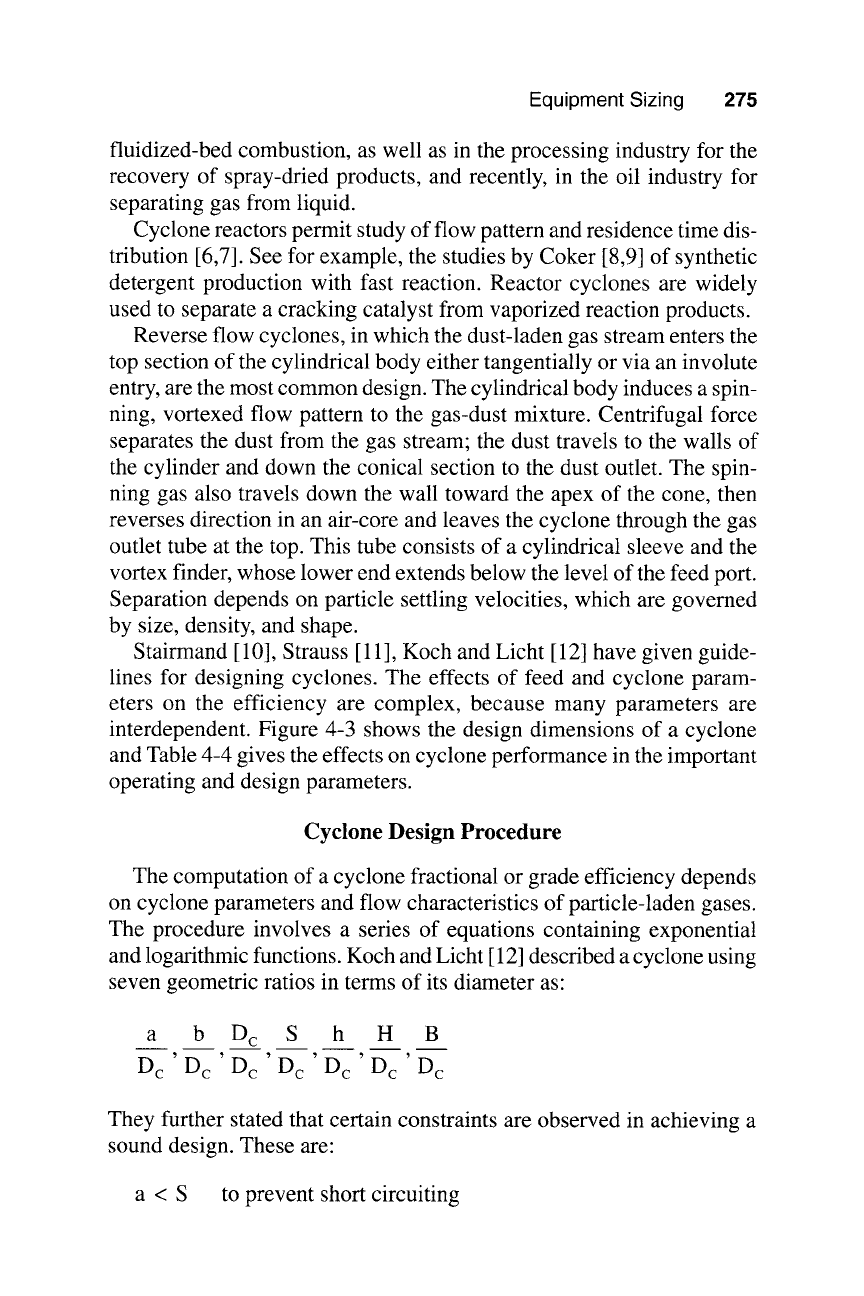
seven geometric ratios in terms of its diameter as:
a b D c S h H B
Dc Dc Dc Dc Dc Dc Dc
They further stated that certain constraints are observed in achieving a
sound design. These are:
a<S to prevent short circuiting
276 Fortran Programs for Chemical Process Design
Table 4-4
Effects of Variables on Cyclone Performance
Variable
Pressure drop increases
Solids content of feed increases
(Pp- Of)
increases
Viscosity of liquid phase increases
Cyclone diameter (D c) increases
Cyclone inlet (a) diameter increases
Overflow diameter increases
Underflow diameter increases
Cyclone shape becomes longer
Effect
Cut size (diameter of particles of
which 50% are collected) decreases,
flow rate increases; sharpness
increases.
Cut size increases (large effect
above 15-20% v/v).
Cut size decreases.
Little effect below 10 mPas.
Cut size increases; pressure drop
usually decreases.
Gravitational force in cyclone
decreases; cut size increases;
capacity falls; pressure drop
decreases.
Cut size increases; risk of coarse
sizes appearing.
Brings excess fines from liquid
phase into underflow.
Decreases cut size; sharpens separation.
1
b < -(D c
- De)
2
to avoid sudden contraction
S+I<H
to keep the vortex inside the cyclone
S<h
h<H
AP < 10 in
H20
v~/v~ < 1.35
to prevent reentrainment
V i/V s ~ 1.25
for optimum efficiency