
Coker A.K. Fortran Programs for Chemical Process Design, Analysis, and Simulation
Подождите немного. Документ загружается.

Compressors 427
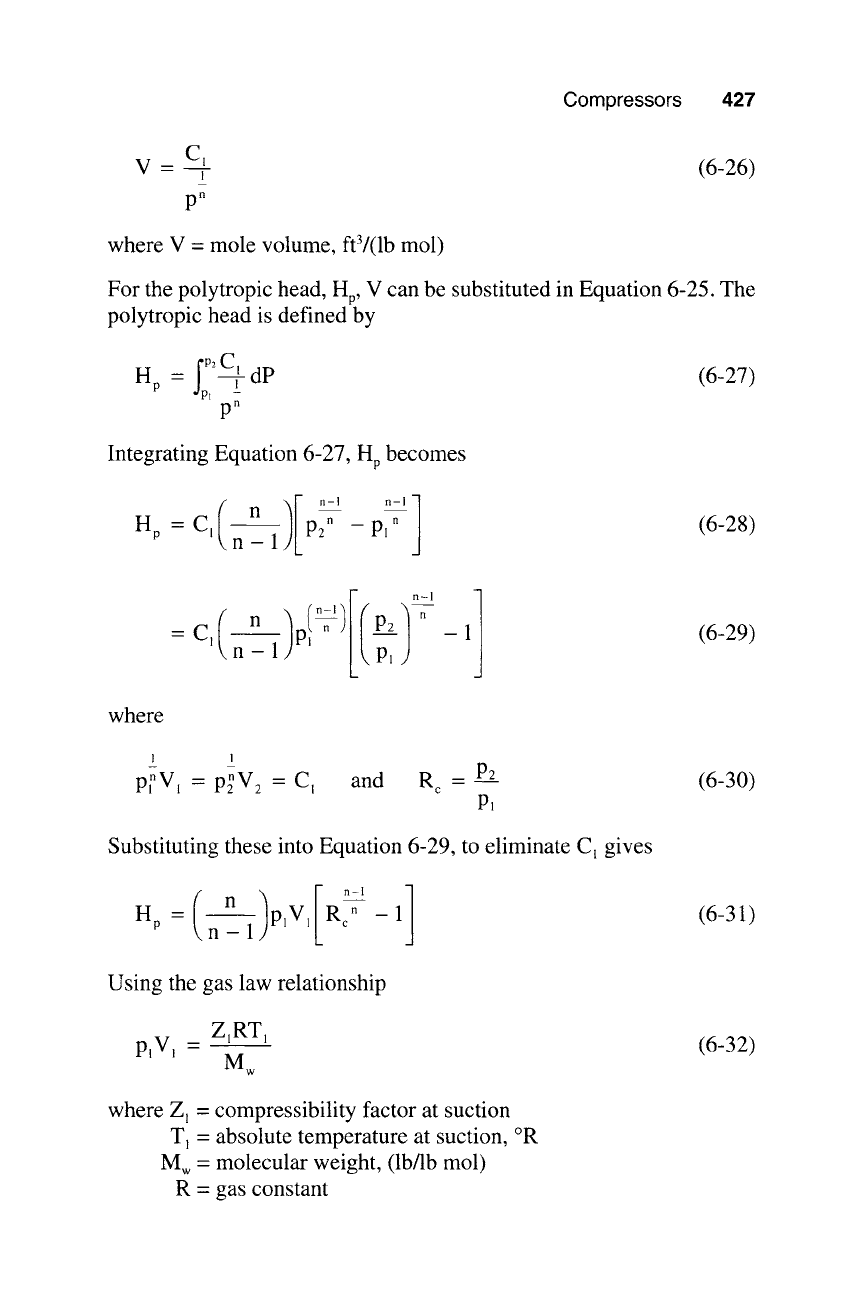
V- C, (6-26)
1
p"
where V = mole volume, ft3/(lb mol)
For the polytropic head,
Hp,
V can be substituted in Equation 6-25. The
polytropic head is defined by
Hp - fpP: C__~_~ dP
pn
(6-27)
Integrating Equation 6-27,
Hp
becomes
n En-' n-, n
Hp - C 1
P2 n -- Pl
n-1
(6-28)
1
__tin )!~/ p2 n
n-1 p -1
(6-29)
where
1 I
p~'V~ - p~V 2 - C~ and Rc = P__z_2 (6-30)
Pl
Substituting these into Equation 6-29, to eliminate C~ gives
n --
Hp -
n - 1 PlVI
Rcn --
1 (6-31)
Using the gas law relationship
plVi- -- ZIRTI (6-32)
Mw
where Z~ = compressibility factor at suction
T~ = absolute temperature at suction, ~
M w = molecular weight, (lb/lb mol)
R = gas constant
428
Fortran Programs for Chemical Process Design
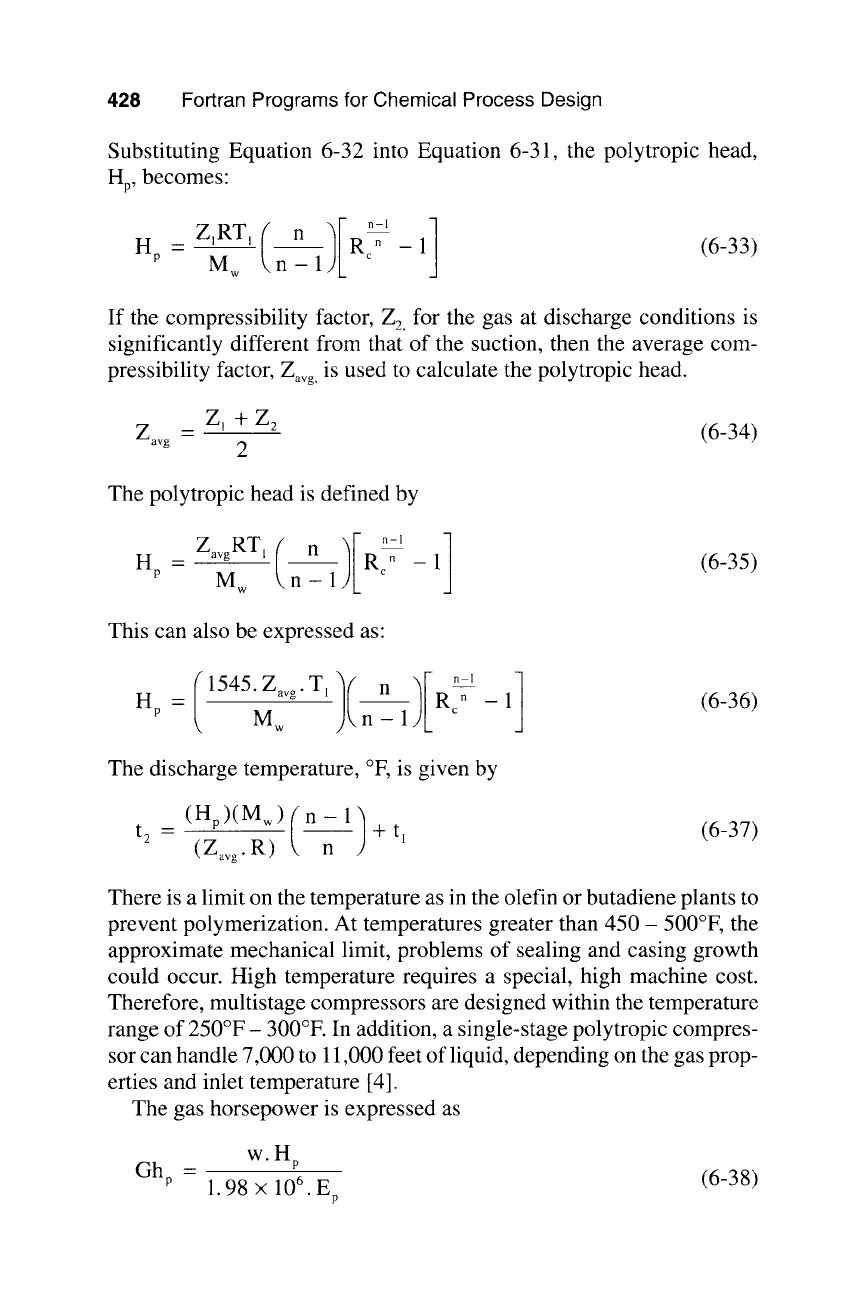
Substituting Equation 6-32 into Equation 6-31, the polytropic head,
Hp,
becomes"
Z~RT~ n --
Hp - Mw n-1 Re n -1 (6-33)
If the compressibility factor, Z2, for the gas at discharge conditions is
significantly different from that of the suction, then the average com-
pressibility factor, Zavg ' is used to calculate the polytropic head.
Z - _ Z~ + Z 2 (6-34)
avg
2
The polytropic head is defined by
Z avgRTl n R n -- 1 (6-35)
Hp
=
Mw n-1 c
This can also be expressed as:
1545. Z~vg. Tl n -
n
H p M w n-1 Re -1 (6-36)
The discharge temperature, ~ is given by
(Hp)(Mw) (n- l/+ t (6-37)
t2=
(Zavg~R ~ n '
There is a limit on the temperature as in the olefin or butadiene plants to
prevent polymerization. At temperatures greater than 450 - 500~ the
approximate mechanical limit, problems of sealing and casing growth
could occur. High temperature requires a special, high machine cost.
Therefore, multistage compressors are designed within the temperature
range of 250~ 300~ In addition, a single-stage polytropic compres-
sor can handle 7,000 to 11,000 feet of liquid, depending on the gas prop-
erties and inlet temperature [4].
The gas horsepower is expressed as
w.H
m P
Ghp -
1.98 x 10⁶.
gp
(6-38)
Compressors 429
The polytropic efficiency is used to compare adiabatic with polytropic
performance. This is defined by
n /k/E
n 1 k 1
P
(6-39)
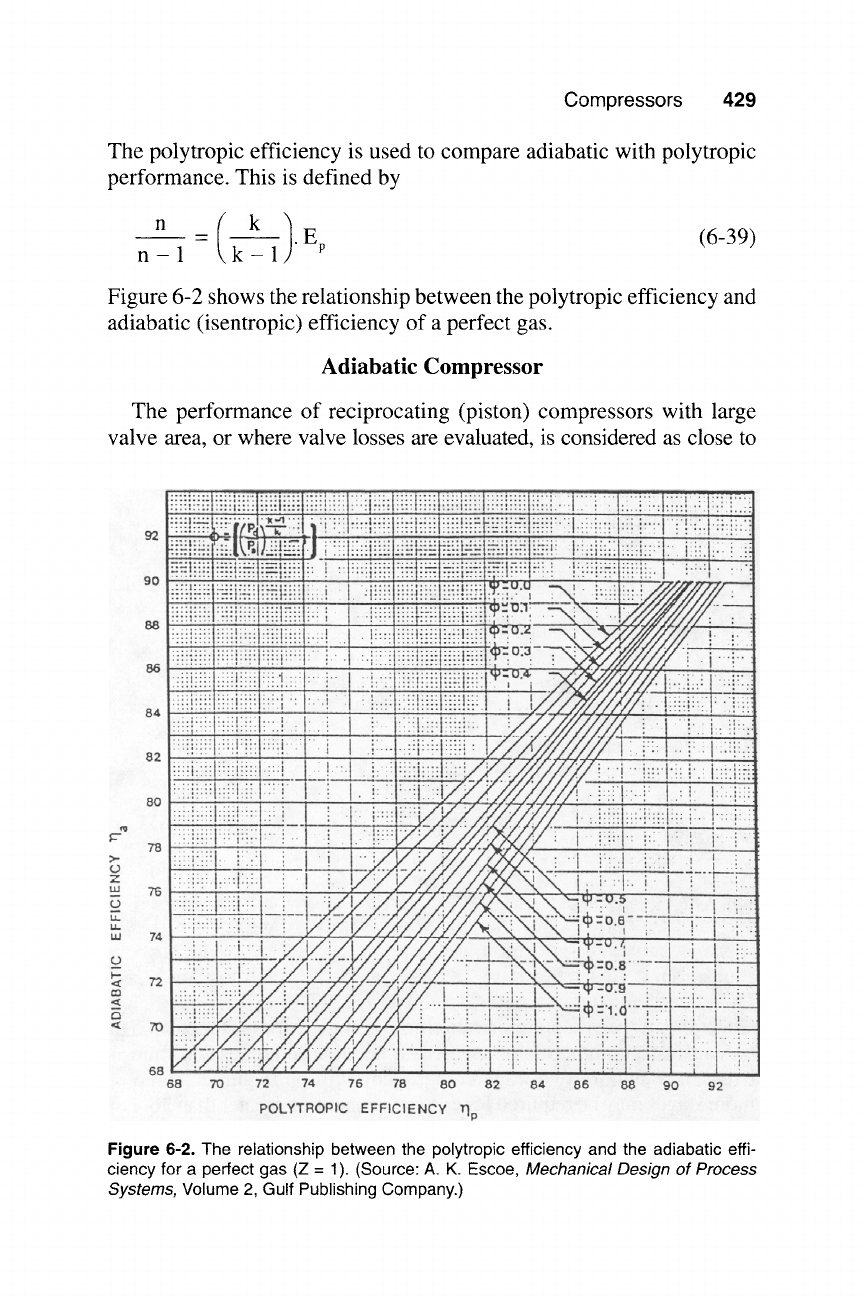
Figure 6-2 shows the relationship between the polytropic efficiency and
adiabatic (isentropic) efficiency of a perfect gas.
Adiabatic Compressor
The performance of reciprocating (piston) compressors with large
valve area, or where valve losses are evaluated, is considered as close to
Figure 6-2. The relationship between the polytropic efficiency and the adiabatic effi-
ciency for a perfect gas (Z = 1 ). (Source: A. K. Escoe,
Mechanical Design of Process
Systems,
Volume 2, Gulf Publishing Company.)
430
Fortran Programs for Chemical Process Design
adiabatic behavior as can be measured. The thermodynamic definition
of an adiabatic process requires that no heat be added or removed from
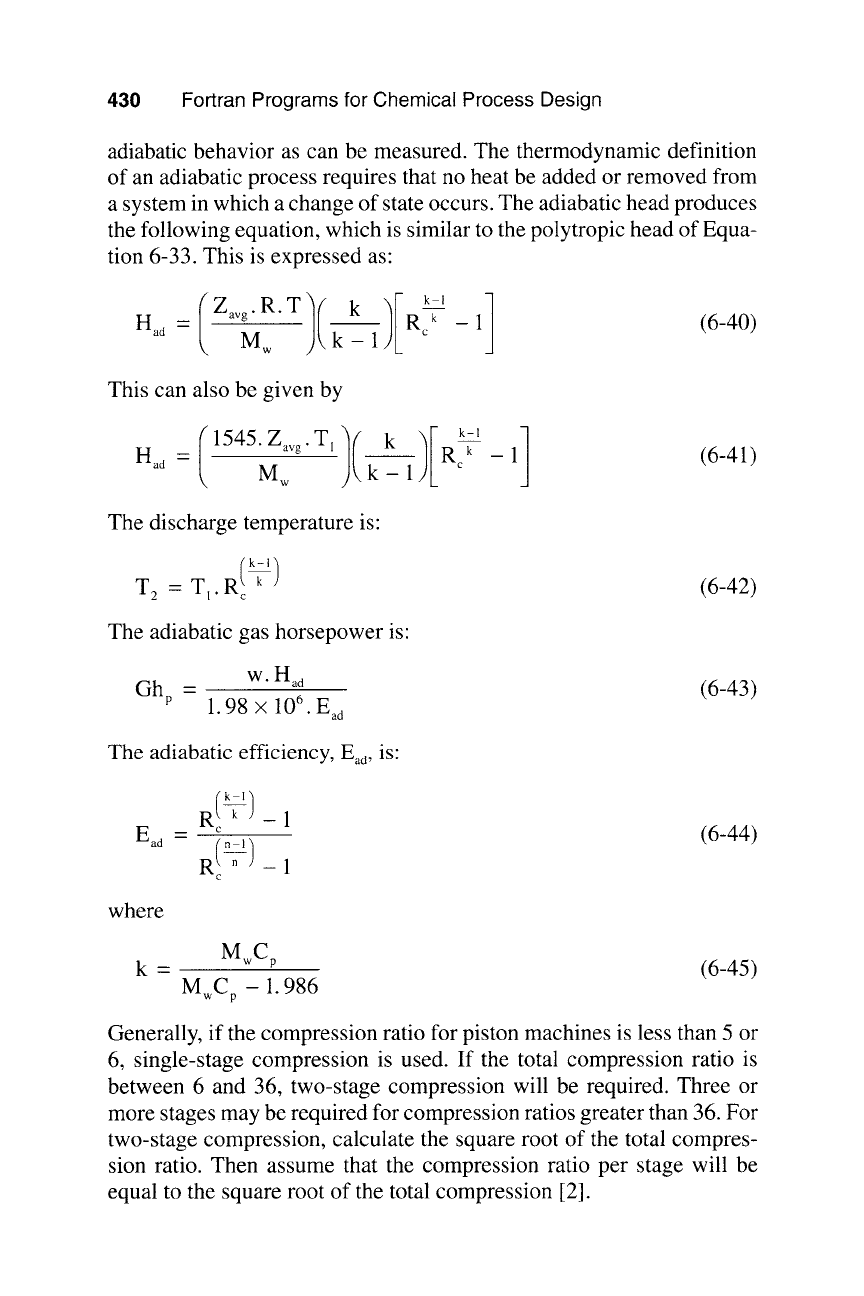
a system in which a change of state occurs. The adiabatic head produces
the following equation, which is similar to the polytropic head of Equa-
tion 6-33. This is expressed as:
(z R T//k/[k: 1
__ avg"
Rc k
- 1
Had
Mw k - 1
(6-40)
This can also be given by
1545.
Zavg~
T l k R k
--
1
Had --
~I Z k- 1
c
(6-41)
The discharge temperature is:
T2-
The adiabatic gas horsepower is"
Gh
=
p
W, Had
1.98 x 10⁶ .
gad
The adiabatic efficiency,
Ead ,
is:
(6-42)
(6-43)
k-l)
Ead=R -~- -1
R n --1
where
(6-44)
MwC
k
- P
(6-45)
MwC p -
1. 986
Generally, if the compression ratio for piston machines is less than 5 or
6, single-stage compression is used. If the total compression ratio is
between 6 and 36, two-stage compression will be required. Three or
more stages may be required for compression ratios greater than 36. For
two-stage compression, calculate the square root of the total compres-
sion ratio. Then assume that the compression ratio per stage will be
equal to the square root of the total compression [2].
Compressors
431
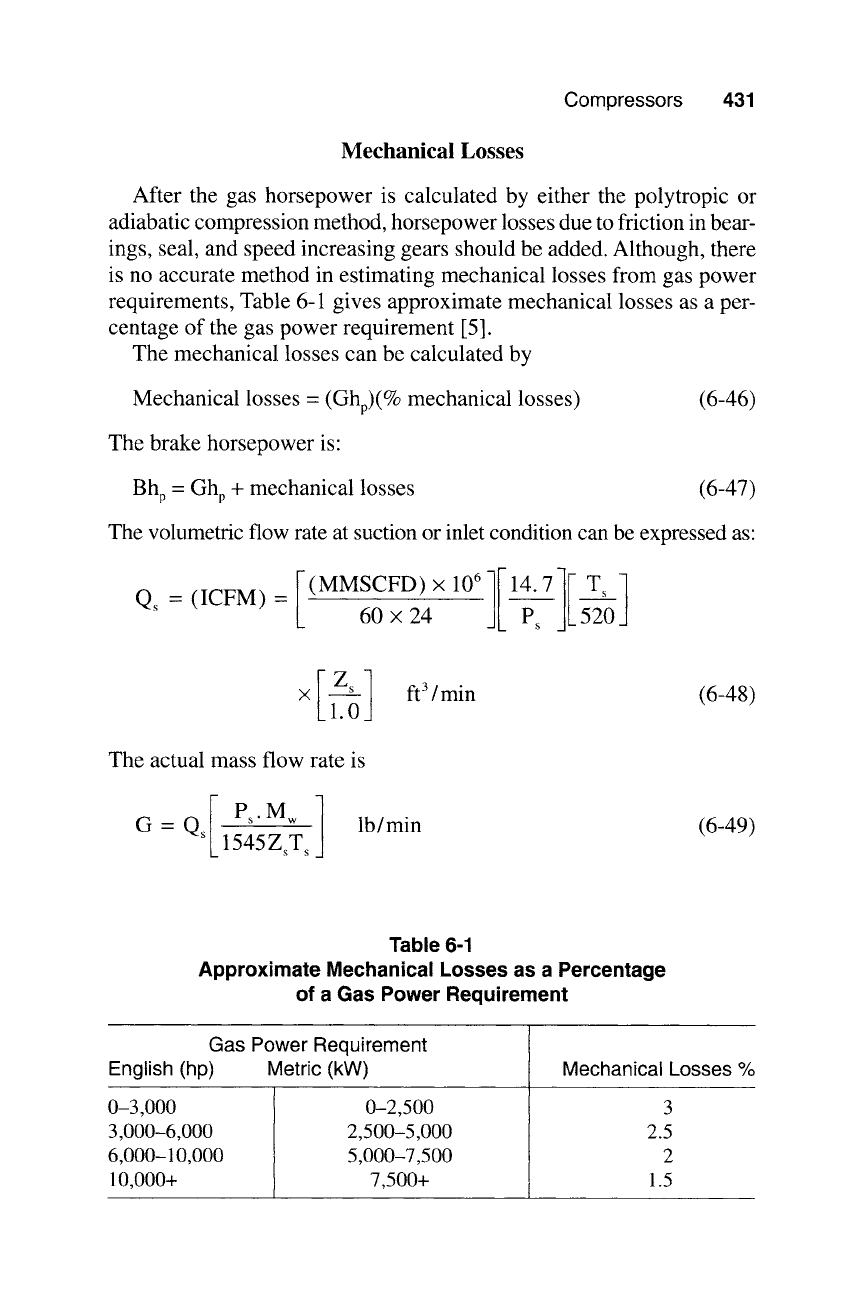
Mechanical Losses
After the gas horsepower is calculated by either the polytropic or
adiabatic compression method, horsepower losses due to friction in bear-
ings, seal, and speed increasing gears should be added. Although, there
is no accurate method in estimating mechanical losses from gas power
requirements, Table 6-1 gives approximate mechanical losses as a per-
centage of the gas power requirement [5].
The mechanical losses can be calculated by
Mechanical losses - (Ghp)(% mechanical losses)
(6-46)
The brake horsepower is:
B hp - Ghp + mechanical losses
(6-47)
The volumetric flow rate at suction or inlet condition can be expressed as"
Q~-(ICFM)-[ (MMSCFD) x10660 x 24 ][14"71[P~ 5-~T~ ]
IZsl
)< 1~ ft 3/min
(6-48)
The actual mass flow rate is
G-Q. I
P,'Mw
lb/min
(6-49)
Table 6-1
Approximate Mechanical Losses as a Percentage
of a Gas Power Requirement
Gas Power Requirement
English (hp)
0-3,000
3,000-6,000
6,000-10,000
10,000+
Metric (kW)
0-2,500
2,500-5,000
5,000-7,500
7,500+
Mechanical Losses %
3
2.5
2
1.5
432
Fortran Programs for Chemical Process Design
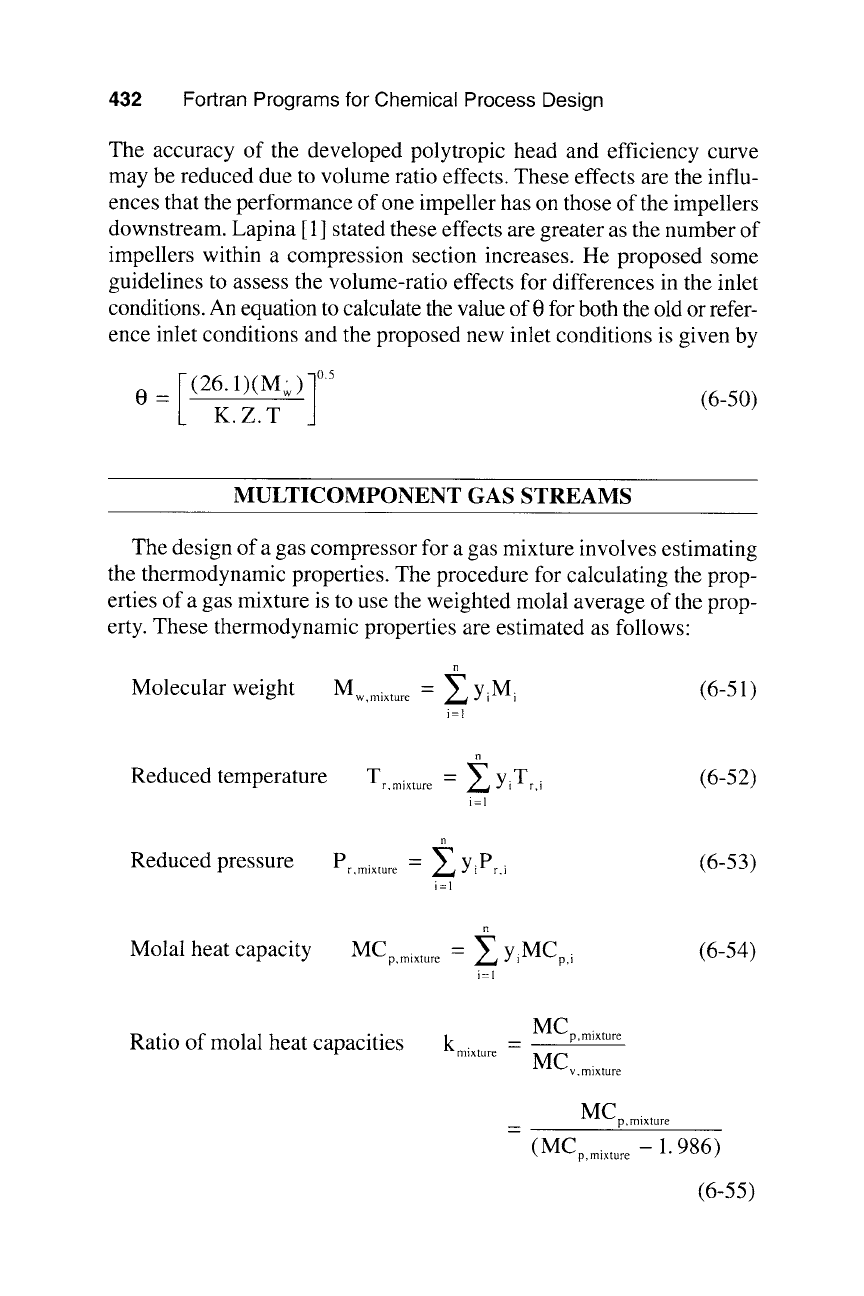
The accuracy of the developed polytropic head and efficiency curve
may be reduced due to volume ratio effects. These effects are the influ-
ences that the performance of one impeller has on those of the impellers
downstream. Lapina [ 1 ] stated these effects are greater as the number of
impellers within a compression section increases. He proposed some
guidelines to assess the volume-ratio effects for differences in the inlet
conditions. An equation to calculate the value of 0 for both the old or refer-
ence inlet conditions and the proposed new inlet conditions is given by
O-[(26I)(Mw)I~
(6-50)
MULTICOMPONENT GAS STREAMS
The design of a gas compressor for a gas mixture involves estimating
the thermodynamic properties. The procedure for calculating the prop-
erties of a gas mixture is to use the weighted molal average of the prop-
erty. These thermodynamic properties are estimated as follows:
Molecular weight
Mw,mixtur e =
~ y~M~ (6-51)
i=l
Reduced temperature
Tr,mixtur e = ~ YiTr,i
(6-52)
i=l
Reduced pressure
Pr,mixture --
s Yi Pr,i
(6-53)
i--I
Molal heat capacity
MCp,mixtur ~ - s yiMCp,i
(6-54)
i=l
Ratio of molal heat capacities
k mixtur e =
MC
p, mixture
MC v, mixture
MC
p, mixture
(MC p,mixture -- 1. 986)
(6-55)
Compressors 433
Compressibility factor
Zmixtur e :
f(T~,Pr) for the mixture
(6-56)
where Yi = mole fraction of component i.
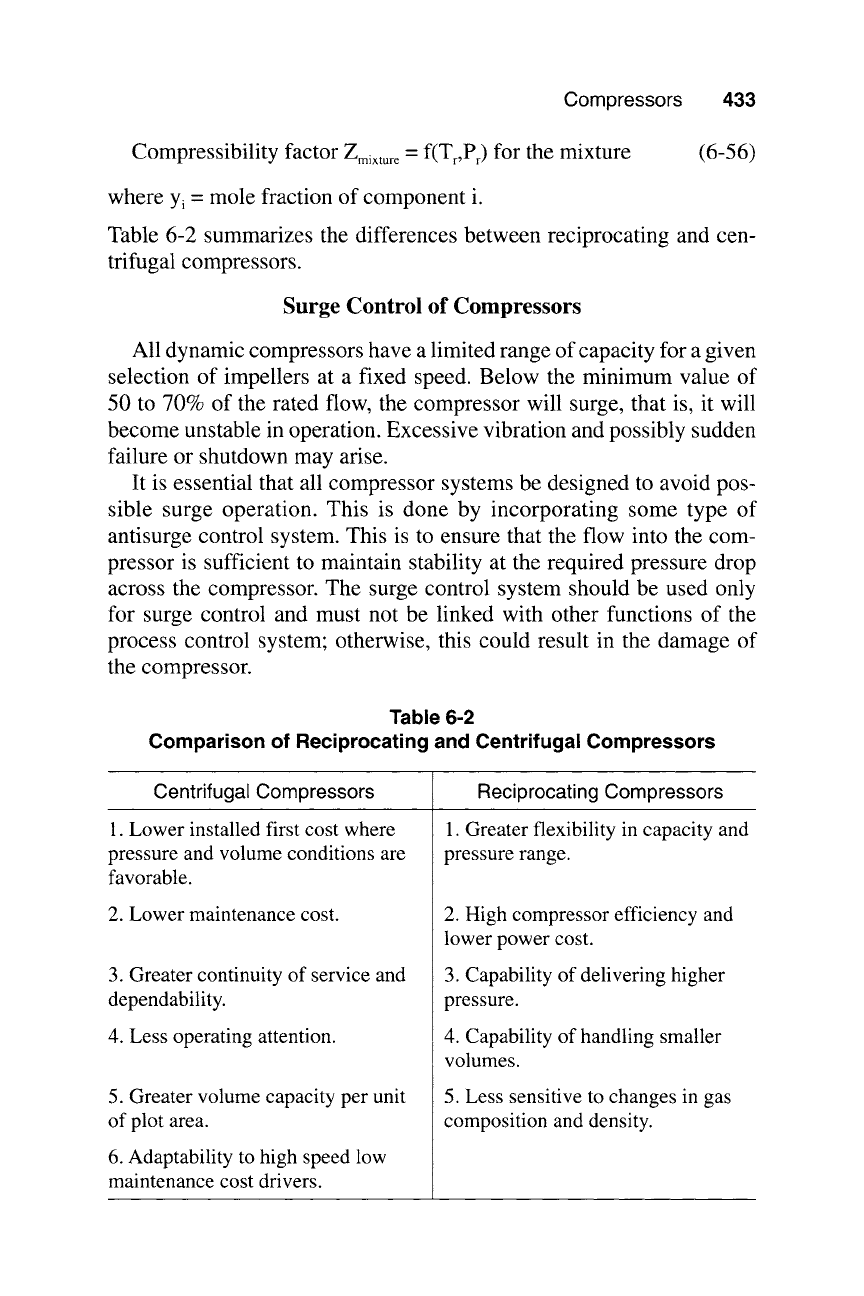
Table 6-2 summarizes the differences between reciprocating and cen-
trifugal compressors.
Surge Control of Compressors
All dynamic compressors have a limited range of capacity for a given
selection of impellers at a fixed speed. Below the minimum value of
50 to 70% of the rated flow, the compressor will surge, that is, it will
become unstable in operation. Excessive vibration and possibly sudden
failure or shutdown may arise.
It is essential that all compressor systems be designed to avoid pos-
sible surge operation. This is done by incorporating some type of
antisurge control system. This is to ensure that the flow into the com-
pressor is sufficient to maintain stability at the required pressure drop
across the compressor. The surge control system should be used only
for surge control and must not be linked with other functions of the
process control system; otherwise, this could result in the damage of
the compressor.
Table 6-2
Comparison of Reciprocating and Centrifugal Compressors
Centrifugal Compressors
1. Lower installed first cost where
pressure and volume conditions are
favorable.
2. Lower maintenance cost.
3. Greater continuity of service and
dependability.
4. Less operating attention.
5. Greater volume capacity per unit
of plot area.
6. Adaptability to high speed low
maintenance cost drivers.
Reciprocating Compressors
1. Greater flexibility in capacity and
pressure range.
2. High compressor efficiency and
lower power cost.
3. Capability of delivering higher
pressure.
4. Capability of handling smaller
volumes.
5. Less sensitive to changes in gas
composition and density.
434
Fortran Programs for Chemical Process Design
Another surge control may be a blow off valve. This is automatically
controlled to open or blow off excess capacity to the atmosphere if the
process flow requirement is too low. In some cases, suction control valves
are used. For gases that cannot be designed to atmosphere, a bypass
control is the common antisurge control. This action bypasses unwanted
flow back to the suction source. However, because the gas has already
been compressed, its temperature is increased, and must therefore be
cooled before entering the compressor a second time. In this case, a
bypass cooler may be installed. The cooler may be avoided where the
suction source is large or far away and the heat is dissipated by mixing
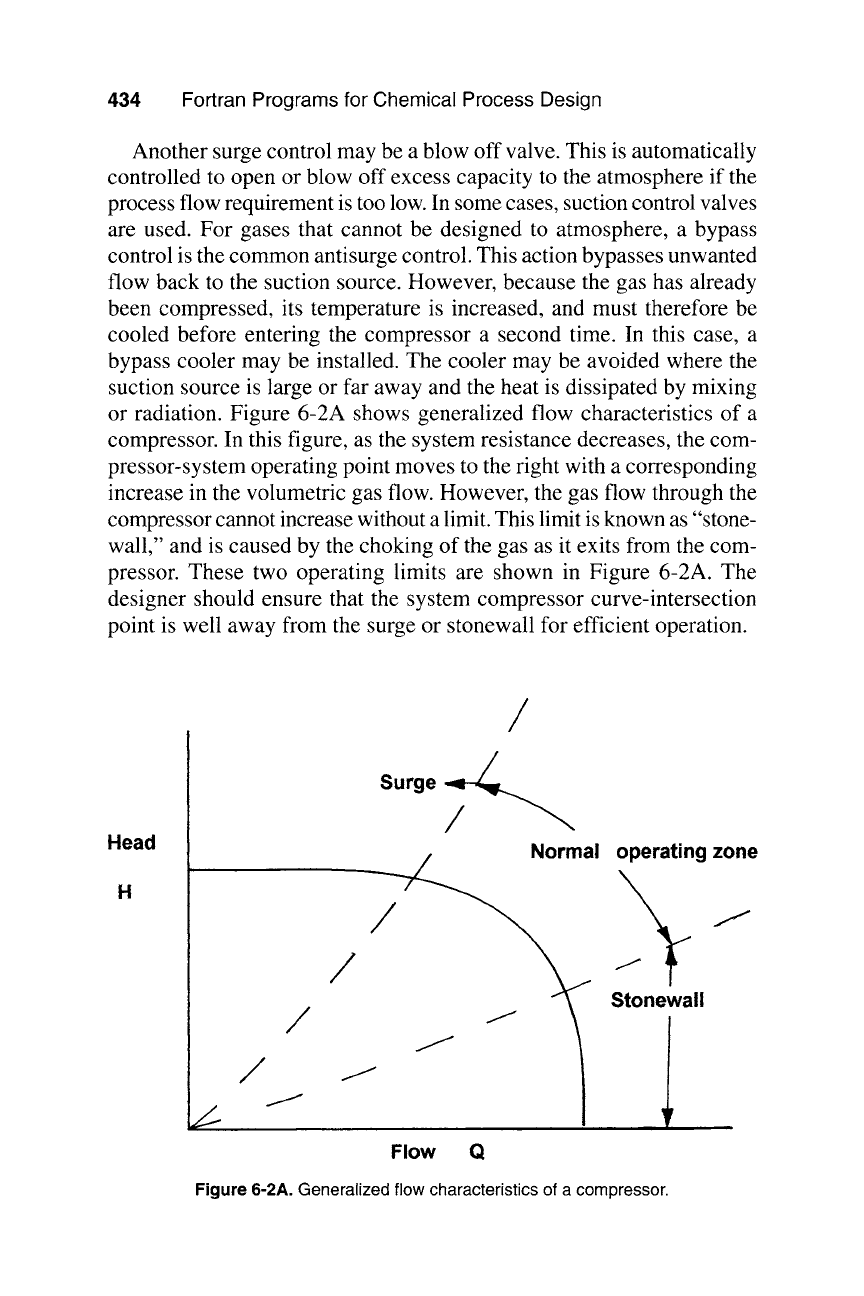
or radiation. Figure 6-2A shows generalized flow characteristics of a
compressor. In this figure, as the system resistance decreases, the com-
pressor-system operating point moves to the right with a corresponding
increase in the volumetric gas flow. However, the gas flow through the
compressor cannot increase without a limit. This limit is known as "stone-
wall," and is caused by the choking of the gas as it exits from the com-
pressor. These two operating limits are shown in Figure 6-2A. The
designer should ensure that the system compressor curve-intersection
point is well away from the surge or stonewall for efficient operation.
Head
H
/
/
/
J
/
Surge
-~
/
Normal operating zone
Stonewall
, ,
ii
J
Flow Q
Figure
6-2A. Generalized flow characteristics of a compressor.
Compressors 435
Treatment of Compressor Fluids
The discharge from any compressor is a dirty corrosive liquid. Remov-
ing the sludge from a compressor air system can effect the following:
9 reduce installation costs incurred or drain traps, pipe and fittings,
filters and regulators.
9 reduce the maintenance of drain trap and the failure rate of pneu-
matic equipment, which is caused by dirt and moisture in the
supply line.
9 increase the life of pneumatic equipment.
Cases of high performance equipment require high quality of clean
and dry compressed air. Compressed air contains water, oil, and dirty
particles, which affects the performance of pneumatic equipment. Com-
pressed air dryers are used to remove water vapor and to dry the air.
Two main types of dryers are used in the CPI: refrigerant and desiccant
dryers. Desiccant dryers use an adsorbent material, such as activated
alumina, or molecular sieves to remove moisture from the compressed
air. Also, desiccant dryers can be either heat regenerated or heatless.
The main advantage of desiccant dryers is their ability to cool the air to
a very low temperature. They are more expensive in terms of both capi-
tal and running costs. They are important when higher quality air is
required. These dryers are widely used in offshore oil industry, where
extreme ambient conditions are required. The design of desiccant
dryers for removing water vapor from a natural gas is explained in
Chapter Four.
Nomenclature
Bhp- brake or shaft horsepower, bhp
C = constant
Cp- specific heat at constant pressure, Btu/lb~
Cv = specific heat at constant volume, Btu/lb~
D = impeller diameter or rotor, ft
D s = specific diameter, ft
Ead-
adiabatic efficiency
Ep -
polytropic efficiency (try 0.75 for preliminary work)
G = gas flowrate, lb/min
Ghp - gas horsepower, actual compression horsepower, exclud-
ing mechanical losses, hp
H = head, (ft. lbf)/lb m
436 Fortran Programs for Chemical Process Design
Had-
adiabatic head, (ft lbf)/lb m
Hp- polytropic head, (ft lbf)/lb m
ICFM - volume flow referred to inlet condition, ft3/min
k- adiabatic (isentropic) exponent, Cp/C v
MCp - molar specific heat at constant pressure, Btu/(lb tool~
MC v - molar specific heat at constant volume, Btu/(lb tool~
M w - molecular weight
MMSCFD - million standard cubic feet per 24-hour day
N- speed, rpm
N~- specific speed, rpm
n- polytropic exponent
P- absolute pressure, psia
P~ - suction pressure, psia
P2 - discharge pressure, psia
P~- suction pressure, psia
Q - volume flow, ft3/s
Q~= volume flow, ft3/min
R- universal gas constant
= 10.73(psia ft3/lb mole ~
= 1545[(lb ft 2) ft3/lb mole ~ or ft lb/lb mole ~
= 1.986(Btu/lb mole ~
R c - compression ratio, P2/P~
T~ - suction temperature, ~
T 2 - discharge temperature, ~
T~- suction temperature, ~
t~ - inlet temperature, ~
t 2 -
discharge temperature, ~
W- workdone, Btu/lb-mole
w - gas flow, lb/h
Zavg -- average compressibility factor for gas from suction to dis-
charge conditions. A value of 1.0 will give conservative
results.
CENTRIFUGAL PUMP HYDRAULICS
Introduction
Selecting the correct pump requires a knowledge of the system in
which the pump must operate. In the chemical process industries (CPI),
the engineer should start from the process flow sheets and schematics
such as piping and instrument diagrams. The engineer must determine