
Coker A.K. Fortran Programs for Chemical Process Design, Analysis, and Simulation
Подождите немного. Документ загружается.

Compressors 437
the optimum height and co-ordinate pump requirements, where pumps
take suction from vessels or drums with the height above the pump.
Where friction loss through piping forms a significant part of the total
head, the designer should influence the selection of the allowable pres-
sure drop (AP). In addition, volatile liquids, hot liquids, viscous liquids,
and slurries will require a special approach and selection methods. If
the pump is installed in a sump or a pit, essential factors require the
correct sizing of the pit. These involve the flow requirements as the
liquid flows toward the pump, and the positioning of the pump in the pit
with sufficient baffles and spacing. Pump selection and troubleshooting
are illustrated by Garay [6], McGuire [7], McNaughton [8], and have
appeared in the literature [9,10,11 ].
This chapter considers the design of centrifugal pumps for given flow
rates and physical properties.
Hydraulics of the System
The required factors in pump hydraulics are:
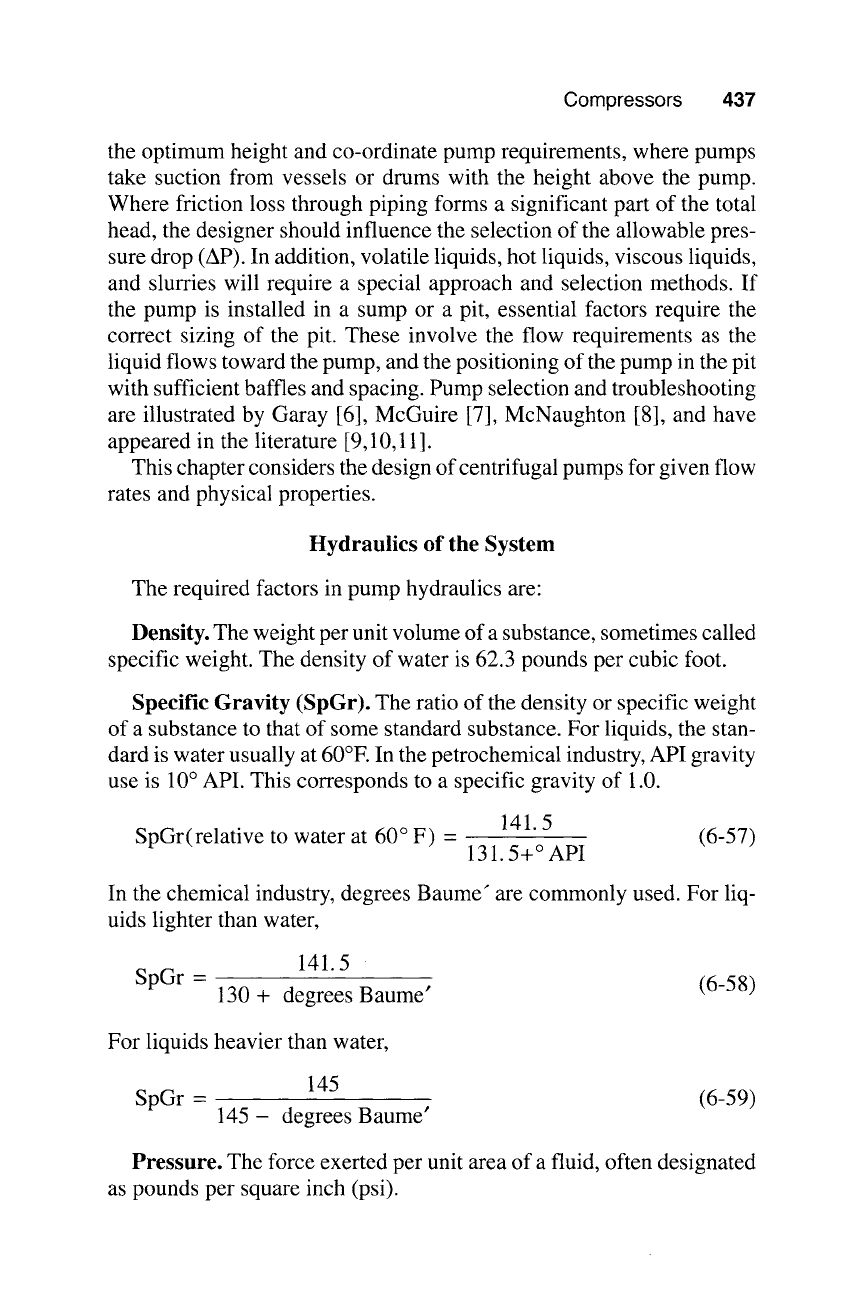
Density. The weight per unit volume of a substance, sometimes called
specific weight. The density of water is 62.3 pounds per cubic foot.
Specific Gravity
(SpGr). The ratio of the density or specific weight
of a substance to that of some standard substance. For liquids, the stan-
dard is water usually at 60~ In the petrochemical industry, API gravity
use is 10 ~ API. This corresponds to a specific gravity of 1.0.
SpGr(relative to water at 60 ~ F) =
141.5
131.5+ ~ API
(6-57)
In the chemical industry, degrees Baume" are commonly used. For liq-
uids lighter than water,
141.5
SpGr - (6-58)
130 + degrees Baume'
For liquids heavier than water,
145
SpGr = (6-59)
145 -
degrees Baume'
Pressure.
The force exerted per unit area of a fluid, often designated
as pounds per square inch (psi).
438
Fortran Programs for Chemical Process Design
Barometric Pressure.
The atmospheric pressure at the pump loca-
tion. It changes with the weather conditions.
Gauge Pressure
(psig). The gauge pressure is the pressure above
atmospheric (or below in a vacuum).
Atmospheric Pressure
(psi). The force exerted on a unit area by the
weight of the atmosphere. The pressure at sea level due to the atmos-
phere is 14.7 psi.
Absolute Pressure (psia).
The sum of atmospheric and gauge pres-
sures. Absolute pressure in a perfect vacuum is 0, and at the atmosphere
at sea level is 14.7 psi (0 psig).
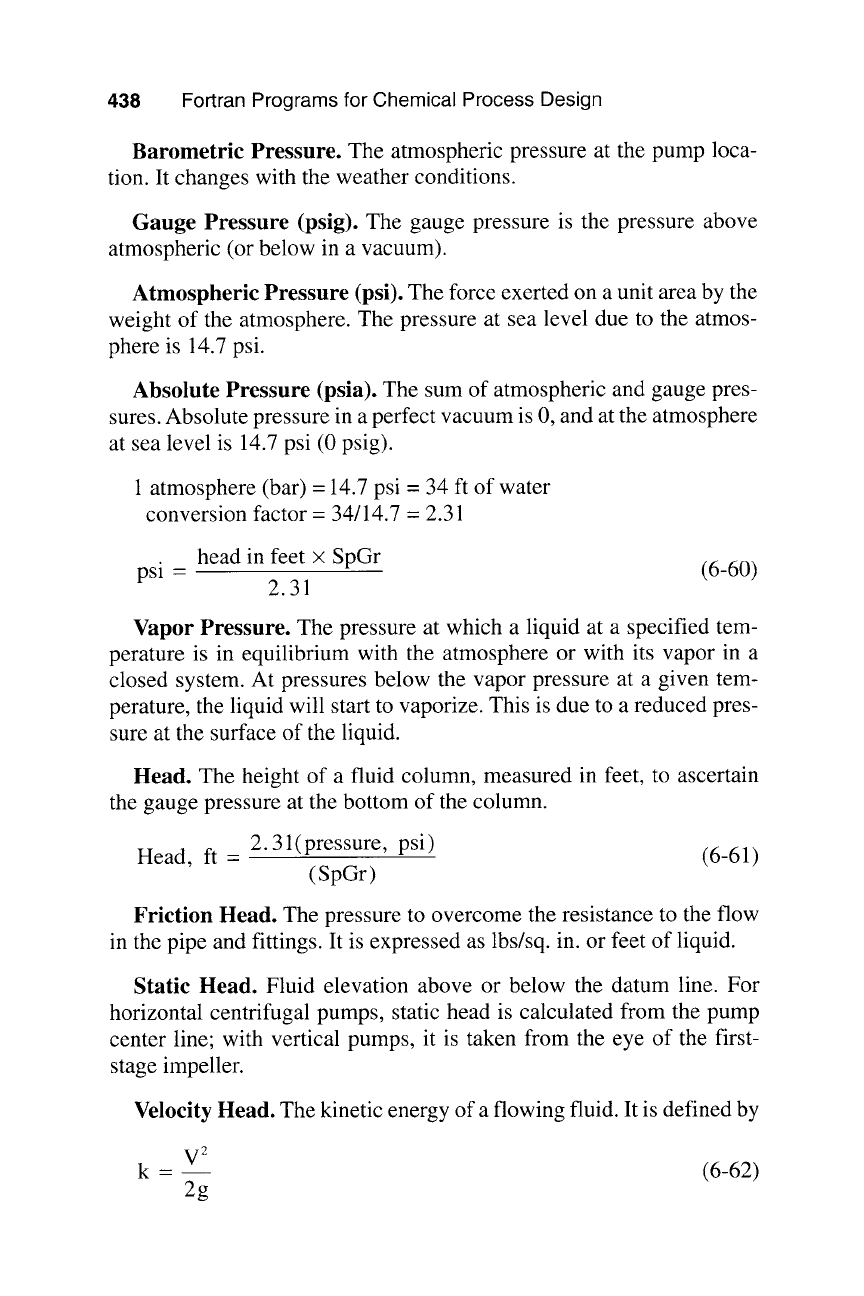
1 atmosphere (bar) = 14.7 psi = 34 ft of water
conversion factor = 34/14.7 = 2.31
psi - head in feet • SpGr (6-60)
2.31
Vapor Pressure.
The pressure at which a liquid at a specified tem-
perature is in equilibrium with the atmosphere or with its vapor in a
closed system. At pressures below the vapor pressure at a given tem-
perature, the liquid will start to vaporize. This is due to a reduced pres-
sure at the surface of the liquid.
Head.
The height of a fluid column, measured in feet, to ascertain
the gauge pressure at the bottom of the column.
Head, ft - 2.31 (pressure, psi) (6-61)
(SpGr)
Friction Head.
The pressure to overcome the resistance to the flow
in the pipe and fittings. It is expressed as lbs/sq, in. or feet of liquid.
Static Head.
Fluid elevation above or below the datum line. For
horizontal centrifugal pumps, static head is calculated from the pump
center line; with vertical pumps, it is taken from the eye of the first-
stage impeller.
Velocity Head.
The kinetic energy of a flowing fluid. It is defined by
V 2
k =
(6-62)
2g
Compressors 439
Suction
Lift. The manometer reading in feet of liquid at the pump
suction (corrected to a datum), minus the velocity head. This term
expresses the suction head when it is below atmospheric pressure.
Static Suction Lift.
The vertical distance from the center line of the
pump down to the free level of the liquid source.
Net or Dynamic Suction Lift.
Static suction lift, friction head, and
velocity head.
Suction Head.
Occurs when the source of supply is above the center
line of the liquid.
Static Discharge Head.
The vertical elevation from the center line
of the pump to the point of free discharge.
Dynamic Discharge Head.
The static discharge head plus dynamic
suction lift or minus dynamic suction head.
Total Discharge Head.
The pressure reading at the pump discharge
in feet of liquid, corrected to a datum, plus the velocity head.
Total Head.
The algebraic difference between the discharge and suc-
tion heads. A suction lift is added to the total discharge head; a positive
suction head is subtracted from the discharge head.
Head Losses.
The frictional head losses caused by fluid flow through
pipes, fittings, valves, and nozzles.
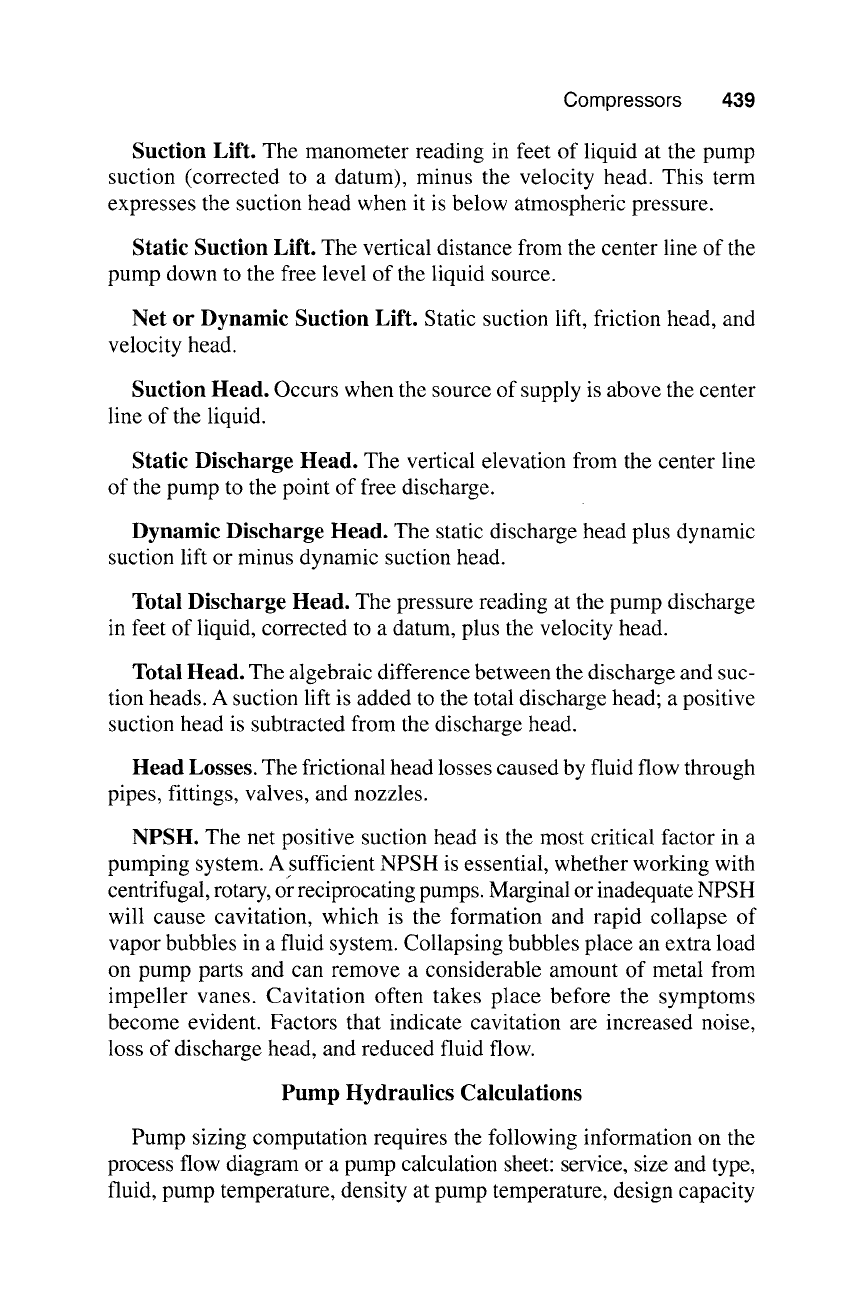
NPSH. The net positive suction head is the most critical factor in a
pumping system. A sufficient NPSH is essential, whether working with
centrifugal, rotary, or reciprocating pumps. Marginal or inadequate NPSH
will cause cavitation, which is the formation and rapid collapse of
vapor bubbles in a fluid system. Collapsing bubbles place an extra load
on pump parts and can remove a considerable amount of metal from
impeller vanes. Cavitation often takes place before the symptoms
become evident. Factors that indicate cavitation are increased noise,
loss of discharge head, and reduced fluid flow.
Pump Hydraulics Calculations
Pump sizing computation requires the following information on the
process flow diagram or a pump calculation sheet: service, size and type,
fluid, pump temperature, density at pump temperature, design capacity
440
Fortran Programs for Chemical Process Design
in gpm at pump temperature, suction head, discharge head, design dif-
ferential, NPSH (net positive suction head) and power requirements.
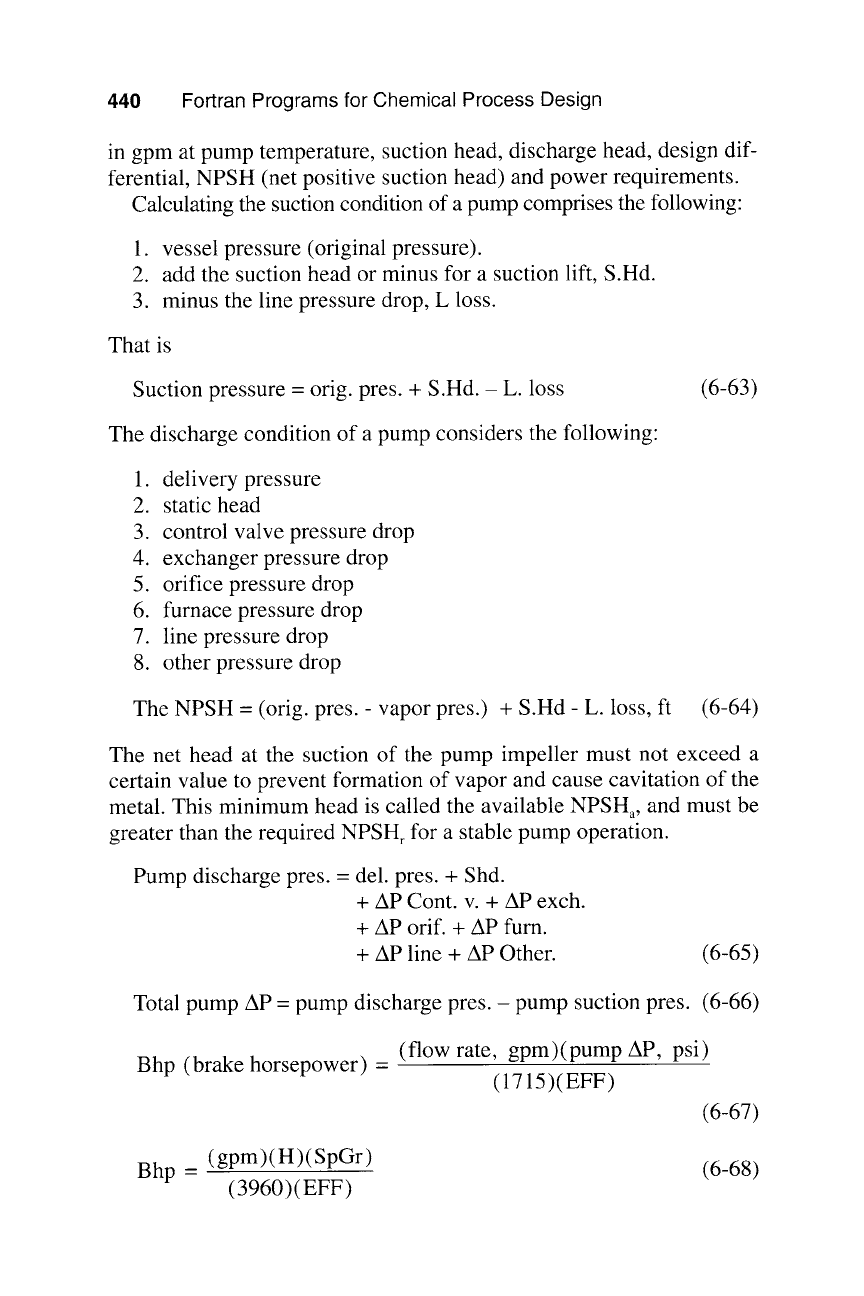
Calculating the suction condition of a pump comprises the following:
1. vessel pressure (original pressure).
2. add the suction head or minus for a suction lift, S.Hd.
3. minus the line pressure drop, L loss.
That is
Suction pressure = orig. pres. + S.Hd.- L. loss
The discharge condition of a pump considers the following:
(6-63)
1. delivery pressure
2. static head
3. control valve pressure drop
4. exchanger pressure drop
5. orifice pressure drop
6. furnace pressure drop
7. line pressure drop
8. other pressure drop
The NPSH = (orig. pres. - vapor pres.) + S.Hd - L. loss, ft (6-64)
The net head at the suction of the pump impeller must not exceed a
certain value to prevent formation of vapor and cause cavitation of the
metal. This minimum head is called the available NPSH a, and must be
greater than the required NPSH~ for a stable pump operation.
Pump discharge pres. = del. pres. + Shd.
+ AP Cont. v. + AP exch.
+ AP orif. + AP furn.
+ AP line + AP Other.
(6-65)
Total pump AP = pump discharge pres.- pump suction pres. (6-66)
Bhp (brake horsepower) =
(flow rate, gpm)(pump AP, psi)
(1715)(EFF)
(6-67)
Bhp =
(gpm)(H)(SpGr)
(3960)(EFF)
(6-68)
Compressors
441
where H = total discharge head
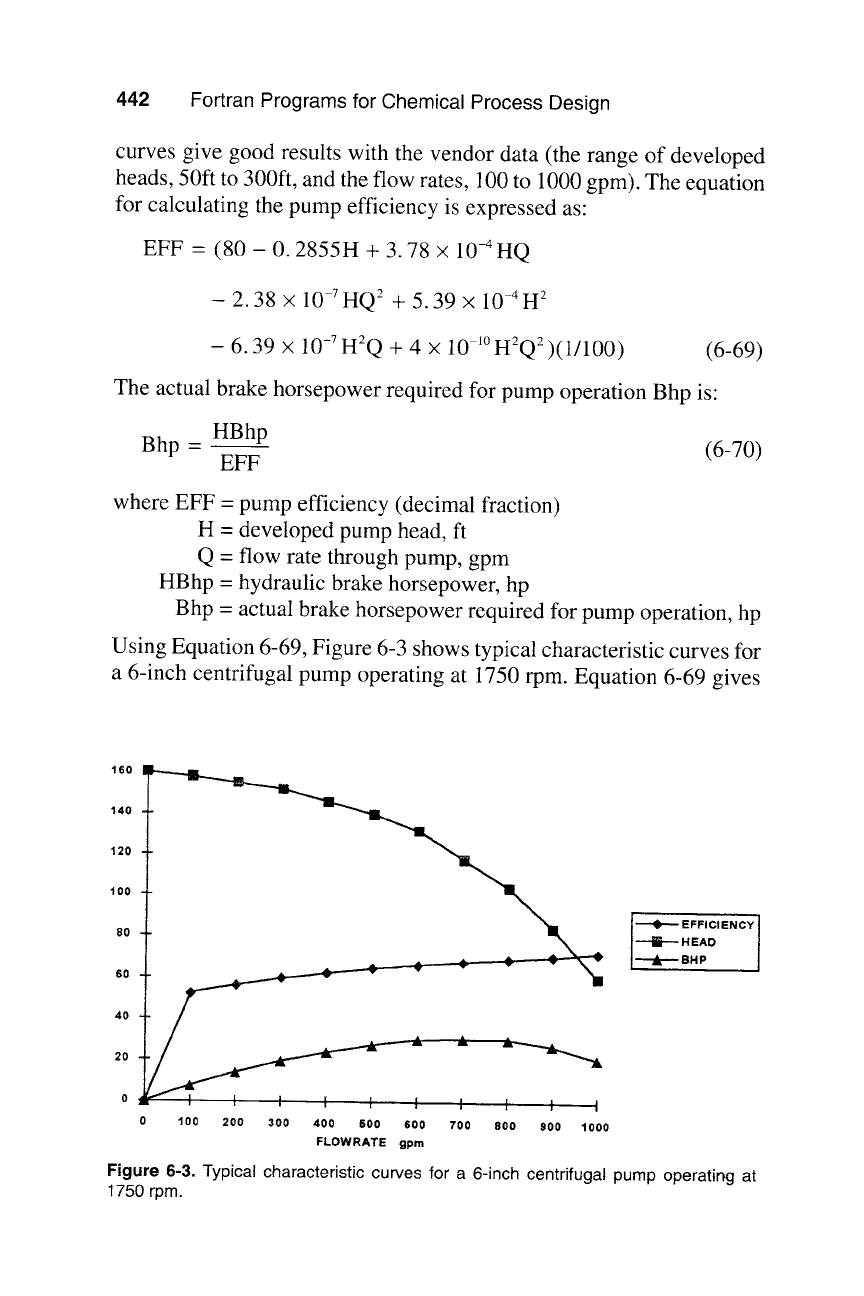
Table 6-3 shows a pump hydraulic design calculation data sheet.
Centrifugal Pump Efficiency
The design engineer must use the expected pump efficiency provided in
the pump performance curve to evaluate the required brake horsepower
for a centrifugal pump. In the early stages of the design, it is customary
to estimate a value for the efficiency. Final values depend on the speci-
fied pump and the operating conditions that are encountered. Branan
[4] has developed an equation to calculate the centrifugal pump effi-
ciency and pump horsepower. The equation was based on pump effi-
ciency curves of the NGPSA Engineering Data Book. These efficiency
Table 6-3
Pump Hydraulic Design Calculation Sheet
Fluid
Viscosity at Pumping temperature (RT), cP
Vapor Pressure at pumping temperature
(RT), psia
Specific gravity, (SpGr) at RT.
Density at RT., lb/ft 3
Operating flow at ET., gpm
Design Flow at ET., gpm
Suction
Vessel pressure, Orig. Pres., psia
Static head S.Hd., psi
- Line loss APf, psi.
Suction pres. = Orig. pres. + S.Hd.
27.7
5.4
0.23
Gas Oil
0.6
0.01
250.0
Discharge
Delivery pressure, psia. 28.2
Static head S.Hd., psi 14.86
AP Control valve, psi 10.0
AP Exchanger, psi 5.0
-
L. line
32.78
NPSH = (orig. pres.- vapor pres.) +
S.Hd.- L.loss, psia.
32.77
AP Orifice, psi 2.0
AP Furnace, psi
Line loss AP psi 4.38
Other AP, contigency, psi
250.0
64.87
1.04
442
Fortran Programs for Chemical Process Design
curves give good results with the vendor data (the range of developed
heads, 50ft to 300ft, and the flow rates, 100 to 1000 gpm). The equation
for calculating the pump efficiency is expressed as"
EFF - (80- 0. 2855H + 3.78 x 10 -4 HQ
- 2.38 x 10 -THQ 2 + 5.39 x 10 -4H 2
- 6.39 x 10 -7 HZQ + 4 x 10 -'~ HZQ 2 )(1/100) (6-69)
The actual brake horsepower required for pump operation Bhp is"
Bhp- HBhp
EFF (6-70)
where EFF = pump efficiency (decimal fraction)
H = developed pump head, ft
Q = flow rate through pump, gpm
HBhp = hydraulic brake horsepower, hp
B hp - actual brake horsepower required for pump operation, hp
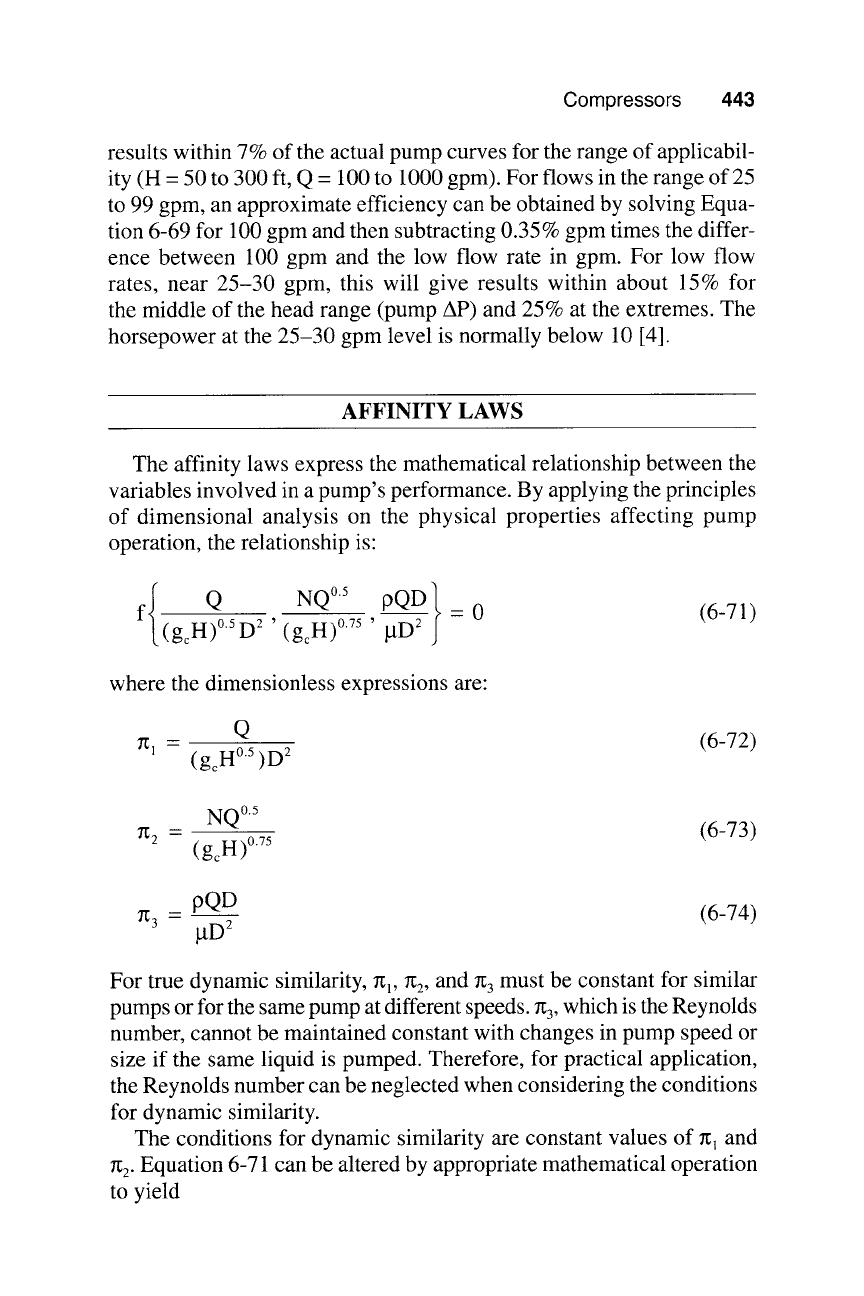
Using Equation 6-69, Figure 6-3 shows typical characteristic curves for
a 6-inch centrifugal pump operating at 1750 rpm. Equation 6-69 gives
160
140
120
100
80
40
20
EFFICIENCY
HEAD
BHP
0
0 100 200 300 400 600 600 700 800 900 1000
FLOWRATE
gpm
Figure
6-3. Typical characteristic curves for a 6-inch centrifugal pump operating at
1750 rpm.
Compressors 443
results within 7% of the actual pump curves for the range of applicabil-
ity (H = 50 to 300 ft, Q = 100 to 1000 gpm). For flows in the range of 25
to 99 gpm, an approximate efficiency can be obtained by solving Equa-
tion 6-69 for 100 gpm and then subtracting 0.35% gpm times the differ-
ence between 100 gpm and the low flow rate in gpm. For low flow
rates, near 25-30 gpm, this will give results within about 15% for
the middle of the head range (pump AP) and 25% at the extremes. The
horsepower at the 25-30 gpm level is normally below 10 [4].
AFFINITY LAWS
The affinity laws express the mathematical relationship between the
variables involved in a pump's performance. By applying the principles
of dimensional analysis on the physical properties affecting pump
operation, the relationship is:
f{ Q NQ ~ oQD}
(gcH)O.SD2,(gcH)O.7 5 , ~-~ - 0
(6-71)
where the dimensionless expressions are:
n, = Q (6-72)
(gcH~ 2
NQ 0.5
n2 = (6-73)
(gcH) ~
pQD (6-74)
71~ 3 =
~D 2
For true dynamic similarity, n~, n2, and
n 3
must be constant for similar
pumps or for the same pump at different speeds, n 3, which is the Reynolds
number, cannot be maintained constant with changes in pump speed or
size if the same liquid is pumped. Therefore, for practical application,
the Reynolds number can be neglected when considering the conditions
for dynamic similarity.
The conditions for dynamic similarity are constant values of n~ and
n 2. Equation 6-71 can be altered by appropriate mathematical operation
to yield
444
Fortran Programs for Chemical Process Design
ff Q No}
(gcH)O.5D2,(gcH)O.5 - 0
(6-75)
where
ND
/ m
rc 2 - (6-76)
(gcH) ~
Therefore, for conditions of similarity of flow rt,, T[~2, and rt~ are con-
stant. Stepanoff [12] has shown that the velocity diagrams at the impel-
ler are geometrically similar when the pumps are operating at the same
efficiency for similar pumps or for the same pump at different speeds.
Applications of Affinity Laws
For the same pumps or geometrically similar pumps, Q/(gcH)~ 2,
NQ~176 and ND/(g~H) ~ have unique values corresponding to each
efficiency. In addition, these values remain constant despite the impeller
diameter or pump speed. For the same pump operating at different speeds
the impeller diameter, D, is constant.
That is
D - constant
Therefore at any given efficiency
Capacity"
Q
and ND
(g~H)~ D 2 (gcH) ~
are constant
or
Q /ND
(g~H)~ D 2 (gcH) ~
Therefore
= Constant
(6-77)
Q
ND 3
= Constant - K
But D is constant
Therefore
Q- K'N
(6-78)
(6-79)
Compressors 445
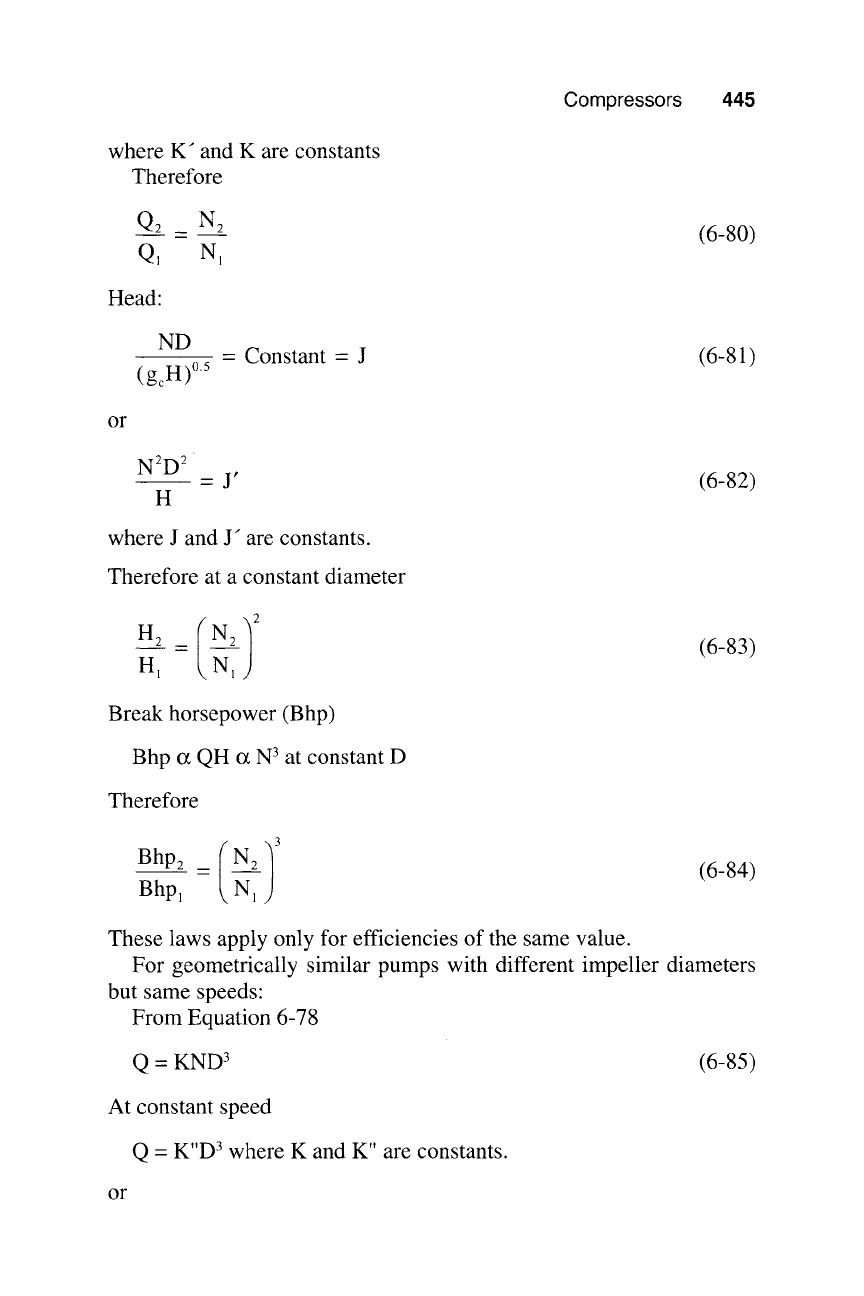
where K" and K are constants
Therefore
Q2 ~ N2
Ql NI
Head"
(6-80)
ND
(gcH) ~
= Constant
- J
(6-81)
or
N2D 2
H
= J' (6-82)
where J and
J"
are constants.
Therefore at a constant diameter
(/2
H2 _ N2
H1 - -~l
(6-83)
Break horsepower (Bhp)
Bhp ~ QH c~
N 3
at constant D
Therefore
( )3
BhP2 _ N2
(6-84)
These laws apply only for efficiencies of the same value.
For geometrically similar pumps with different impeller diameters
but same speeds:
From Equation 6-78
Q- KND 3 (6-85)
At constant speed
Q - K"D 3 where K and K" are constants.
or
446
Fortran Programs for Chemical Process Design
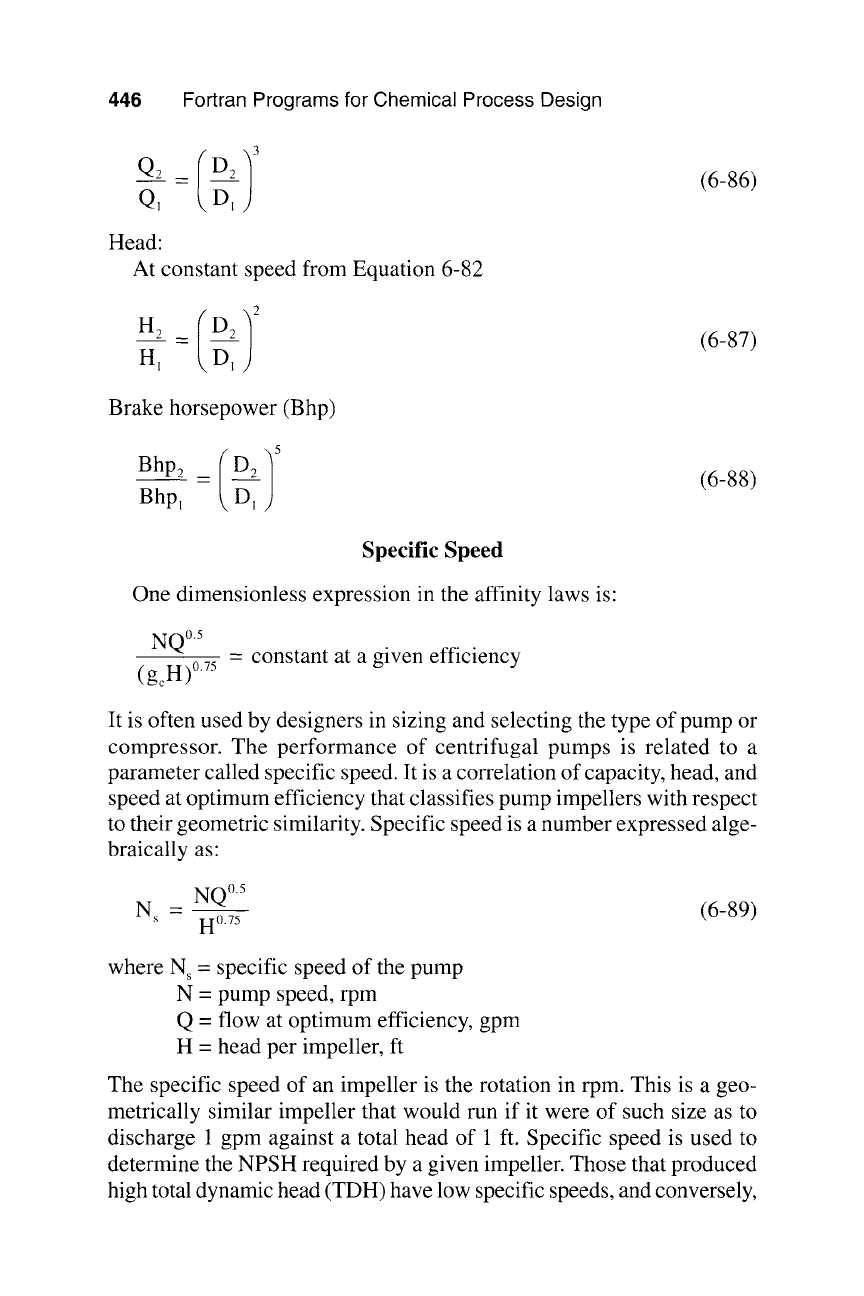
Q2 D2
Head:
At constant speed from Equation 6-82
H2 D2
Brake horsepower (Bhp)
/ / 5
BhP2 _ D2
(6-86)
(6-87)
(6-88)
Specific Speed
One dimensionless expression in the affinity laws is:
NQ ~
(gcH) ~
= constant at a given efficiency
It is often used by designers in sizing and selecting the type of pump or
compressor. The performance of centrifugal pumps is related to a
parameter called specific speed. It is a correlation of capacity, head, and
speed at optimum efficiency that classifies pump impellers with respect
to their geometric similarity. Specific speed is a number expressed alge-
braically as:
_ NQ ~
N~-
HO.75
(6-89)
where N s = specific speed of the pump
N = pump speed, rpm
Q = flow at optimum efficiency, gpm
H = head per impeller, ft
The specific speed of an impeller is the rotation in rpm. This is a geo-
metrically similar impeller that would run if it were of such size as to
discharge 1 gpm against a total head of 1 ft. Specific speed is used to
determine the NPSH required by a given impeller. Those that produced
high total dynamic head (TDH) have low specific speeds, and conversely,