
Coker A.K. Fortran Programs for Chemical Process Design, Analysis, and Simulation
Подождите немного. Документ загружается.

Heat Transfer 647
The length of a traced line varies from a few feet in a process area to
a few thousand feet between offsites and the process area, as well as to
hundreds of miles involving underground pipelines conveying crude
oil. The most common steam tracing lines are 3/8-inch and 1/2-inch o.d.
copper or stainless steel tubing. Larger tubing of 5/8-inch and 3/4-inch
o.d. can be used, but is more expensive. The 3/8-inch tube is more
easily plugged by debris or sediment, and is therefore used less than
1/2-inch tubing. Copper is preferred for its heat transfer characteristics,
but stainless steel generally provides better resistance in corrosive situ-
ations. The length of a single trace tube (for example, from steam sup-
ply valve to steam trap) is limited by the pressure drop in the trace. In
addition, the trap should have a condensate drainage capacity to match
the heating load. At steam pressure of 100 psig or higher, Kohli [23]
recommends that the length of a single trace should not exceed 200 ft.
Conversely, if the steam pressure is lower, a tracer length of 100 ft is
recommended. The trace tube is wired to the pipeline to provide greater
contact. The conductive heat transfer rate is often low, but this may be
increased by putting a layer of heat conducting cement (graphite mixed
with sodium silicate or other binders) between the trace and the pipeline.
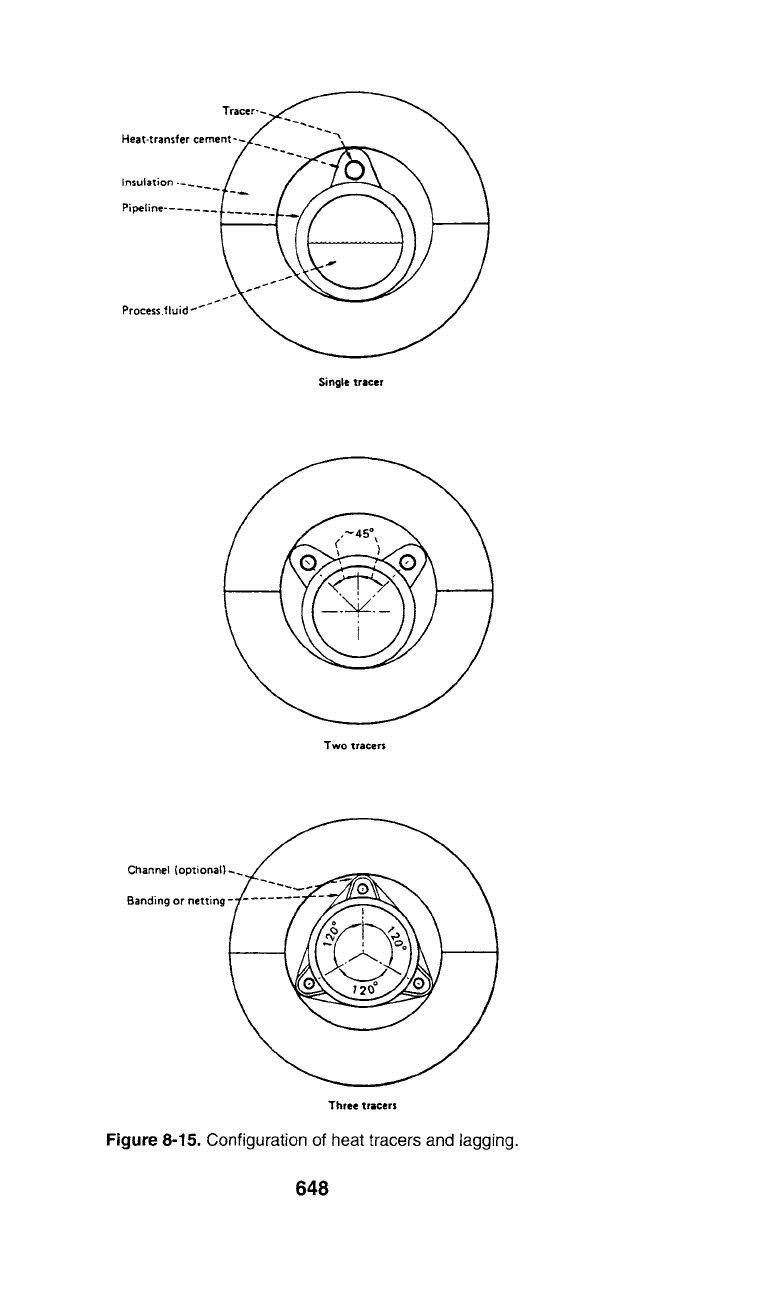
This results in better surface for conductive heat transfer. Figure 8-15
shows various configurations of tracer and lagging.
The following equations will allow the design engineer to calculate
the heat loss and tracing requirements for any given pipeline, using any
hot fluid medium as the heat source. The equations will calculate:
9 The surface temperature of insulated traced pipe.
9 Total heat transferred per 100ft of pipe.
9 Total heat transferred for the entire pipeline.
9 Flow rate of hot media.
9 Total number of heat tracers required with and without transfer
cement.
Kern [3] and others have shown that the heat transferred through an
insulated pipe involves four resistances:
1. The film resistance on the inside wall of the pipe.
2. Heat resistance through the pipewall.
3. Heat resistance through the insulation.
4. Air film resistance on the outside of the insulation.
The first two resistances are negligible, and therefore are neglected.
Heat-transfer cement-.-
s
Process .fluid """
Insulation .-
Single tracer
Two tracers
Channel (optional).....
Banding or " - netting
Three tracers
Figure 8-15. Configuration of heat tracers and lagging.
648
Heat Transfer 649
The Equations
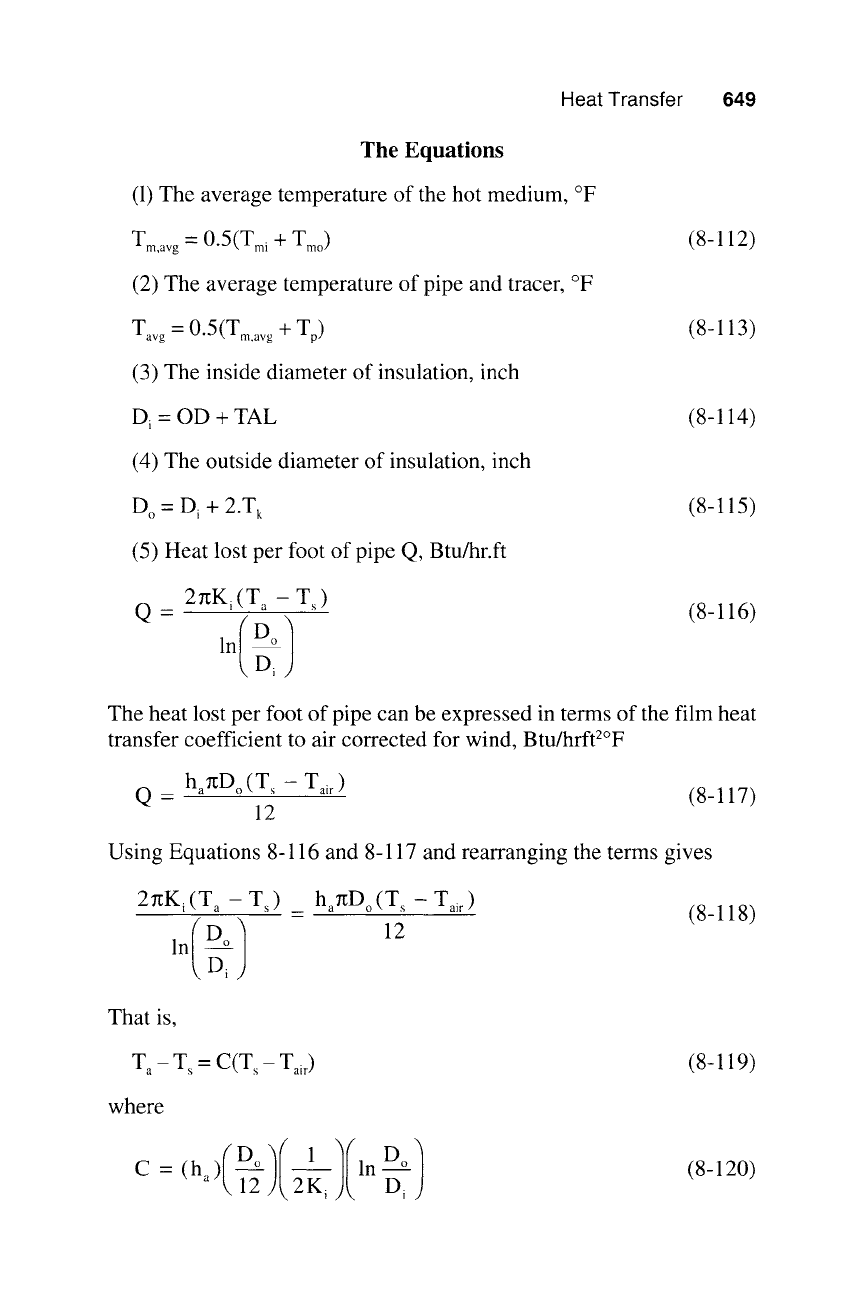
(1) The average temperature of the hot medium, ~
Tm,avg = 0.5(Tmi + Tmo)
(2) The average temperature of pipe and tracer, ~
(8-112)
Tavg = 0.5(Tm,avg + Tp)
(3) The inside diameter of insulation, inch
(8-113)
O i =
OD + TAL (8-114)
(4) The outside diameter of insulation, inch
D O
= D i +
2.T k (8-115)
(5) Heat lost per foot of pipe Q, Btu/hr.ft
Q _ 2rtK~(Ta - T) (8-116)
Do
ln( i /
The heat lost per foot of pipe can be expressed in terms of the film heat
transfer coefficient to air corrected for wind, Btu/hrft2~
Q - hartDo(T~
- Tair)
12
(8-117)
Using Equations 8-116 and 8-117 and rearranging the terms gives
2gKi(T a - T~) _ hagDo(T S
- Tair)
D O 12
ln( i)
(8-118)
That is,
T a -
T~ = C(T~-
Tair)
(8-119)
where
C-(h.)( D~
1 )(lnD~
(8-120)
650
Fortran Programs for Chemical Process Design
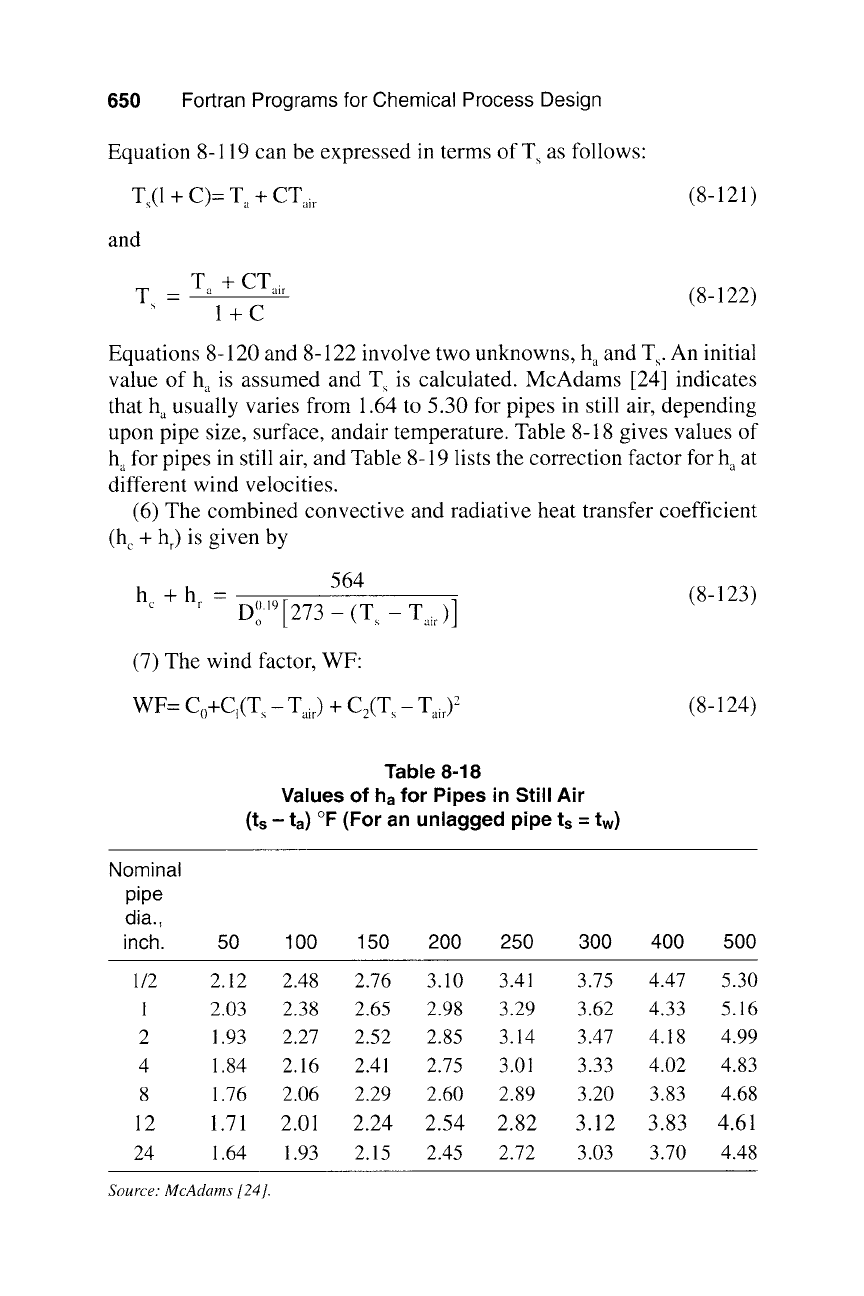
Equation 8-119 can be expressed in terms of T, as follows"
T,(1 + C)= T~ + CT~
and
(8-121)
T - - T.
+ CT~i ~
(8-122)
I+C
Equations 8-120 and 8-122 involve two unknowns, h, and T,. An initial
value of h, is assumed and T~ is calculated. McAdams [24] indicates
that h a usually varies from 1.64 to 5.30 for pipes in still air, depending
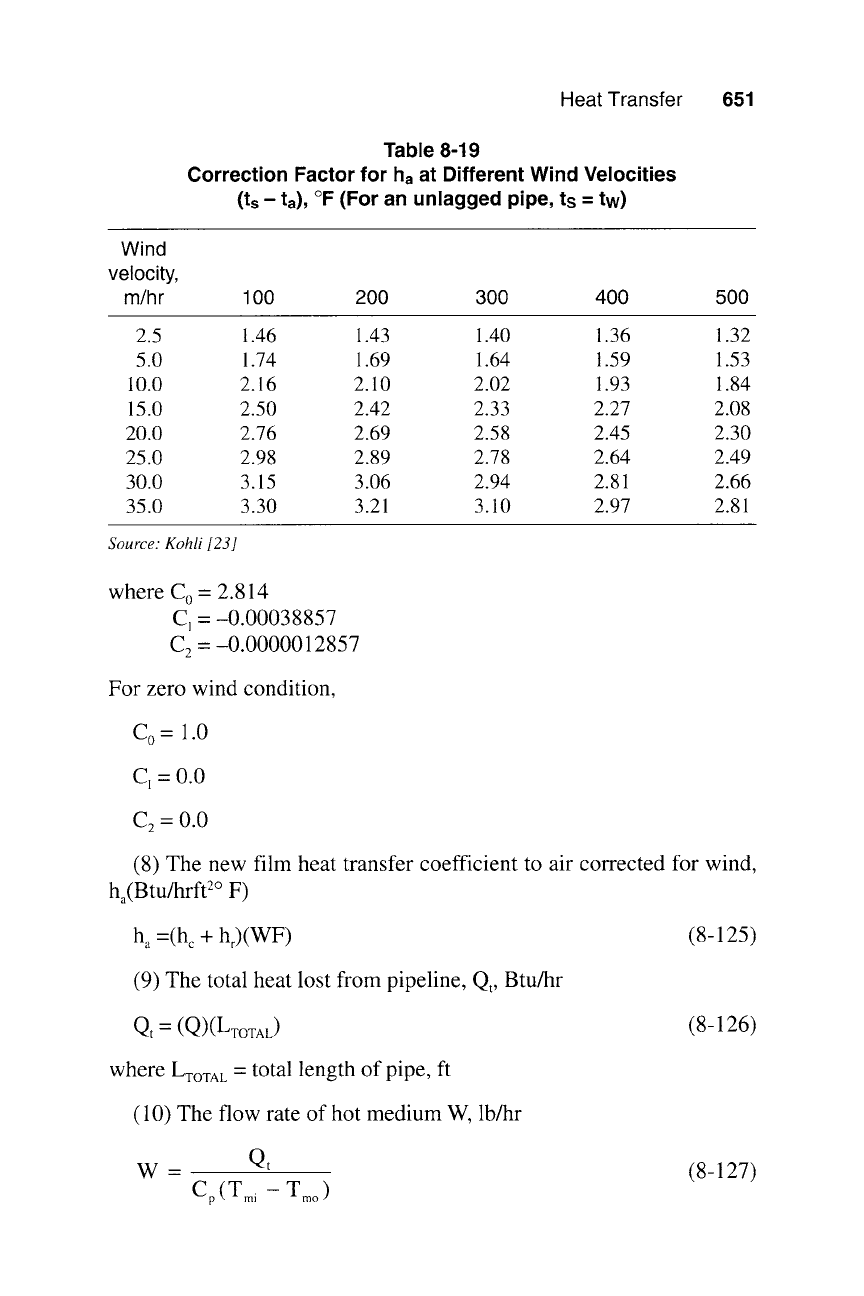
upon pipe size, surface, andair temperature. Table 8-18 gives values of
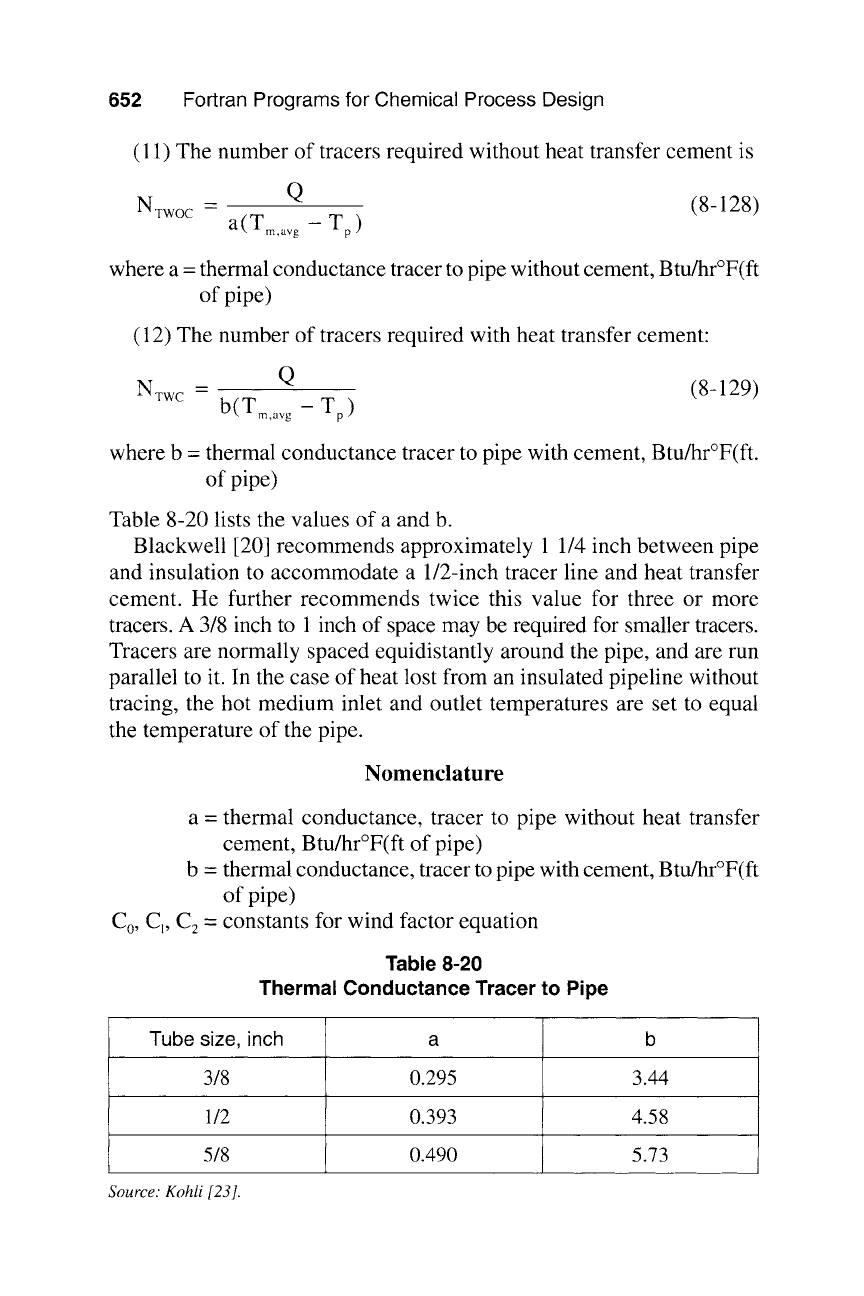
h, for pipes in still air, and Table 8-19 lists the correction factor for h~ at
different wind velocities.
(6) The combined convective and radiative heat transfer coefficient
(h~ + h~) is given by
564
h + h = 0~9
~ D o [273- (T - T i~)] (8-123)
(7) The wind factor, WF:
WF= C0+C,(T , - T.i~)
+
C2(T ~ -
T,~) 2
(8-124)
Table 8-18
Values of
ha
for Pipes in Still Air
(ts- ta) ~ (For an unlagged pipe ts = tw)
Nominal
pipe
dia.,
inch.
50 100 150 200 250 300 400 500
1/2 2.12
1 2.03
2 1.93
4 1.84
8 1.76
12 ....
24 1.64
2.48 2.76 3.10 3.41 3.75 4.47 5.30
2.38 2.65 2.98 3.29 3.62 4.33 5.16
2.27 2.52 2.85 3.14 3.47 4.18 4.99
2.16 2.41 2.75 3.01 3.33 4.02 4.83
2.06 2.29 2.60 2.89 3.20 3.83 4.68
2.01 2.24 2.54 2.82 3.12 3.83 4.61
1.93 2.15 2.45 2.72 3.03 3.70 4.48
Source: McAdams [24].
Heat Transfer
651
Table 8-19
Correction Factor for
ha
at Different Wind Velocities
(ts - ta), ~ (For an unlagged pipe, ts = tw)
Wind
velocity,
m/hr 100 200 300 400 500
2.5 1.46 1.43 1.40 1.36 1.32
5.0 1.74 1.69 1.64 1.59 1.53
10.0 2.16 2.10 2.02 1.93 1.84
15.0 2.50 2.42 2.33 2.27 2.08
20.0 2.76 2.69 2.58 2.45 2.30
25.0 2.98 2.89 2.78 2.64 2.49
30.0 3.15 3.06 2.94 2.81 2.66
35.0 3.30 3.21 3.10 2.97 2.81
Source." Kohli [23]
where C O - 2.814
C l - -0.00038857
C2 - -0.000001285 7
For zero wind condition,
C O - 1.0
Cl - 0.0
C 2 - 0.0
(8) The new film heat transfer coefficient to air corrected for wind,
h,(Btu/hrft 2~ F)
h a
=(h c + h~)(WF) (8-125)
(9) The total heat lost from pipeline, Qt, Btu/hr
Qt - (Q)(LToTAC) (8-126)
where
LTOTA L --
total length of pipe, ft
(10) The flow rate of hot medium W, lb/hr
W = Qt (8-127)
Cp (Ymi -
Tmo)
652
Fortran Programs for Chemical Process Design
(1 l) The number of tracers required without heat transfer cement is
Q
NTwoc = (8-128)
a(Tmavg, - Tp)
where a- thermal conductance tracer to pipe without cement, Btu/hr~
of pipe)
(12) The number of tracers required with heat transfer cement:
Q
NTw c = (8-129)
b(Tm,avg
--
Tp )
where b - thermal conductance tracer to pipe with cement, Btu/hr~
of pipe)
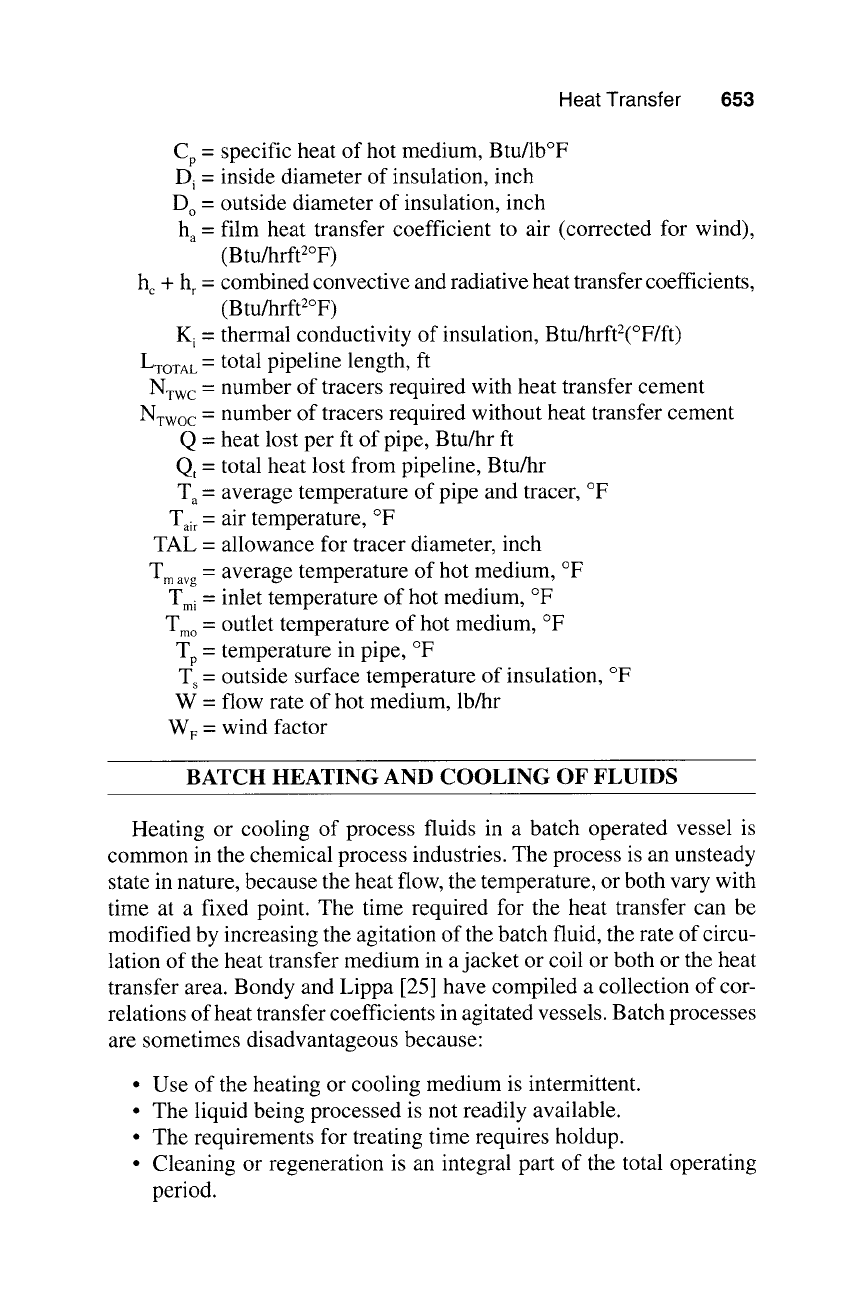
Table 8-20 lists the values of a and b.
Blackwell [20] recommends approximately 1 1/4 inch between pipe
and insulation to accommodate a 1/2-inch tracer line and heat transfer
cement. He further recommends twice this value for three or more
tracers. A 3/8 inch to 1 inch of space may be required for smaller tracers.
Tracers are normally spaced equidistantly around the pipe, and are run
parallel to it. In the case of heat lost from an insulated pipeline without
tracing, the hot medium inlet and outlet temperatures are set to equal
the temperature of the pipe.
Nomenclature
a = thermal conductance, tracer to pipe without heat transfer
cement, Btu/hr~ of pipe)
b = thermal conductance, tracer to pipe with cement, Btu/hr~
of pipe)
C 0, C~, C 2 = constants for wind factor equation
Table 8-20
Thermal Conductance Tracer to Pipe
Tube size, inch
3/8
1/2
5/8
0.295
0.393
0.490
3.44
4.58
5.73
Source." Kohli [23].
Heat Transfer 653
Cp- specific heat of hot medium, Btu/lb~
D i -
inside diameter of insulation, inch
D o = outside diameter of insulation, inch
h~ = film heat transfer coefficient to air (corrected for wind),
(Btu/hrftZ~
hc
+ h r =
combined convective and radiative heat transfer coefficients,
(Btu/hrftZ~
K~ = thermal conductivity of insulation, Btu/hrftZ(~
LTOTA L =
total pipeline length, ft
Nvw c = number of tracers required with heat transfer cement
Nvwoc = number of tracers required without heat transfer cement
Q = heat lost per ft of pipe, Btu/hr ft
Q, = total heat lost from pipeline, Btu/hr
T~ = average temperature of pipe and tracer, ~
T~ir = air temperature, ~
TAL = allowance for tracer diameter, inch
Tm avg-
average temperature of hot medium, ~
Ymi---
inlet temperature of hot medium, ~
Tmo --
outlet temperature of hot medium, ~
Tp- temperature in pipe, ~
T~ = outside surface temperature of insulation, ~
W = flow rate of hot medium, lb/hr
W F = wind factor
BATCH HEATING AND COOLING OF FLUIDS
Heating or cooling of process fluids in a batch operated vessel is
common in the chemical process industries. The process is an unsteady
state in nature, because the heat flow, the temperature, or both vary with
time at a fixed point. The time required for the heat transfer can be
modified by increasing the agitation of the batch fluid, the rate of circu-
lation of the heat transfer medium in a jacket or coil or both or the heat
transfer area. Bondy and Lippa [25] have compiled a collection of cor-
relations of heat transfer coefficients in agitated vessels. Batch processes
are sometimes disadvantageous because:
9 Use of the heating or cooling medium is intermittent.
9 The liquid being processed is not readily available.
9 The requirements for treating time requires holdup.
9 Cleaning or regeneration is an integral part of the total operating
period.
654
Fortran Programs for Chemical Process Design
The variables in batch heating or cooling processes are surface require-
ment, time, and temperature. Heating a batch may be by external means,
such as a jacket or coil, or by withdrawing and recirculating it through
an external heat exchanger. In either case, assumptions are made to
facilitate calculation:
1. The overall heat transfer coefficient, U, is constant for the process
and over the entire surface.
2. Liquid flow rates are at steady state.
3. Specific heats are constant for the process.
4. The heating or cooling medium has a constant inlet temperature.
5. Agitation gives a uniform batch fluid temperature.
6. There is no phase change.
7. Heat losses are negligible.
Batch Heating: Internal Coil, Isothermal Heating Medium
When an agitated batch containing M of fluid with specific heat, c,
and initial temperature, t, is heated with an isothermal condensing heat-
ing medium, T~, the batch temperature
t 2,
at any time, 0, can be derived
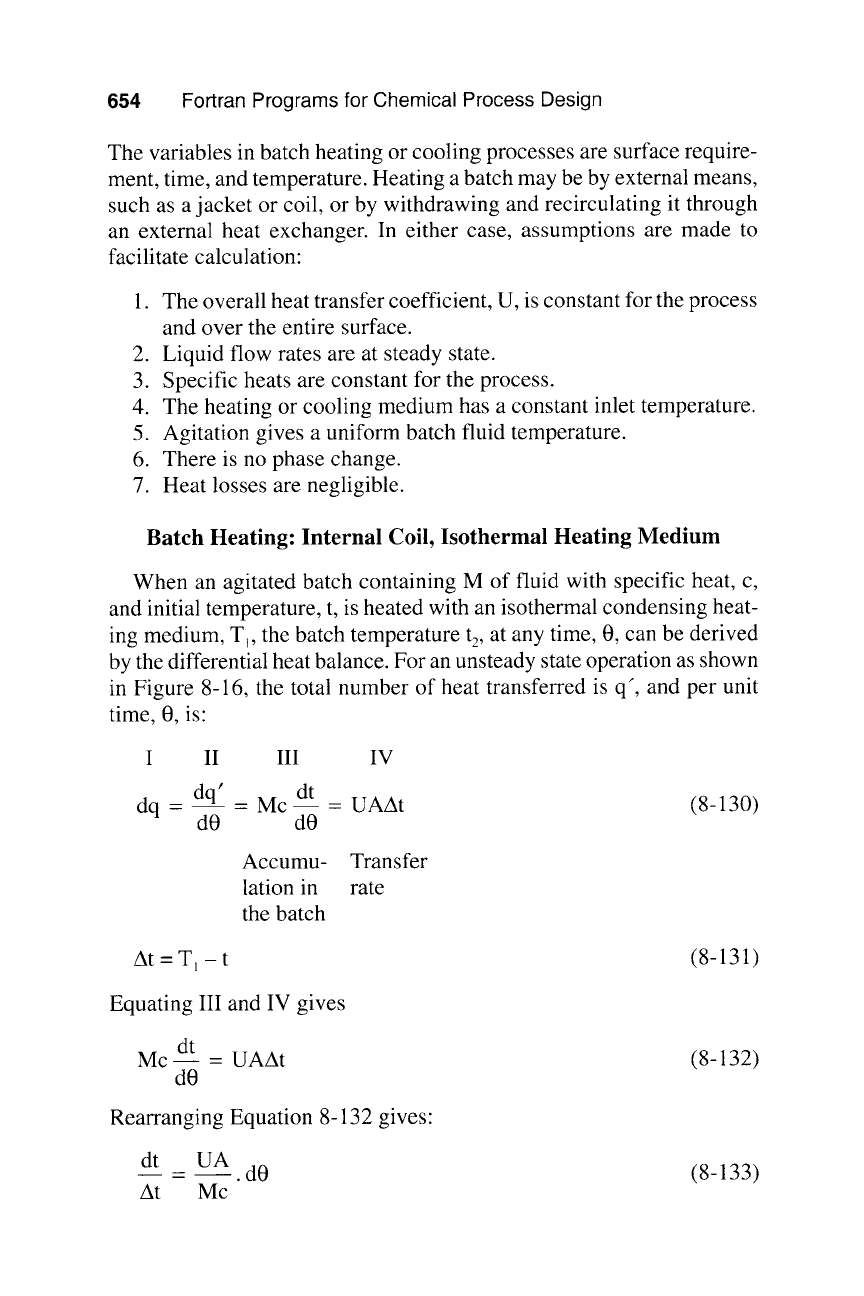
by the differential heat balance. For an unsteady state operation as shown
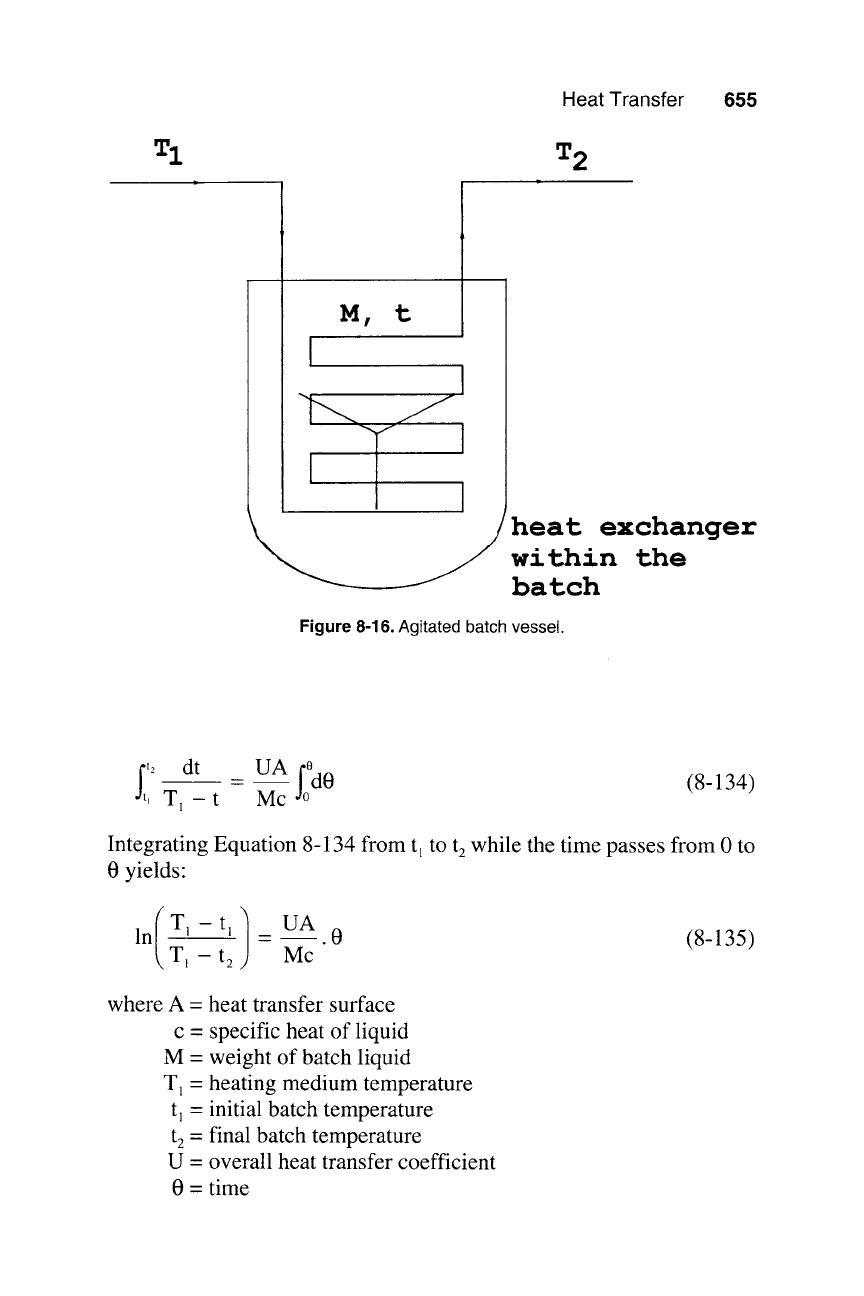
in Figure 8-16, the total number of heat transferred is q', and per unit
time, 0, is:
I II III IV
dq - dq' = Mc d__tt _ UAAt
dO dO
Accumu-
lation in
the batch
Transfer
rate
(8-130)
At-T l -t
Equating
III
and IV gives
Mc d__tt_ UAAt
dO
Rearranging Equation 8-132 gives"
dt UA
= ~.d0
At Mc
(8-~31)
(8-132)
(8-133)
Heat Transfer 655
T 2
M, t
I
J
I'71 1
I
/
heat exchanger
within the
batch
Figure 8-16. Agitated batch vessel.
~t
t2 dt _ UA j'~d0 (8-134)
,
Tl-t Mc
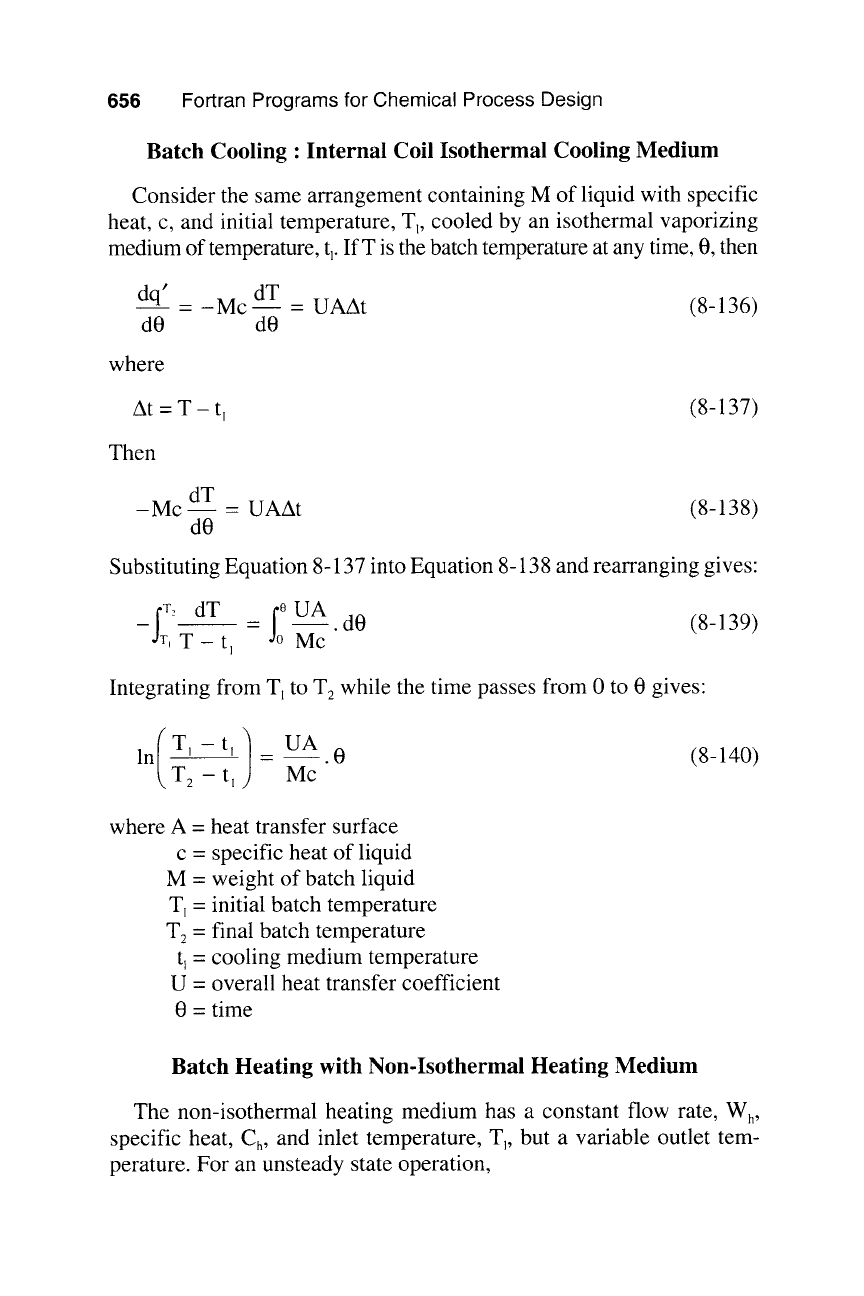
Integrating Equation 8-134 from t~ to t 2 while the time passes from 0 to
0 yields:
(T~ - t I ) _ UA
In TI-
t2
Mc
--.0 (8-135)
where A = heat transfer surface
c = specific heat of liquid
M = weight of batch liquid
T~ = heating medium temperature
t~ = initial batch temperature
t 2 =
final batch temperature
U = overall heat transfer coefficient
0 = time
656
Fortran Programs for Chemical Process Design
Batch Cooling : Internal Coil Isothermal Cooling Medium
Consider the same arrangement containing M of liquid with specific
heat, c, and initial temperature, TI, cooled by an isothermal vaporizing
medium of temperature, t~. If T is the batch temperature at any time, 0, then
dq' = -Mc dT - UAAt (8-136)
dO dO
where
At=T-t~ (8-137)
Then
dT
-Mc~ = UAAt (8-138)
dO
Substituting Equation 8-137 into Equation 8-138 and rearranging gives:
I~
_~ dT -I~UA'd0 (8-139)
- T- t~
Mc
Integrating from
T l to T 2
while the time passes from 0 to 0 gives:
(T~-t!)_ UA
In T~-t, Mc
m.0
(8-140)
where A = heat transfer surface
c = specific heat of liquid
M = weight of batch liquid
T~ = initial batch temperature
T 2 =
final batch temperature
t~ = cooling medium temperature
U = overall heat transfer coefficient
0 = time
Batch Heating with Non-Isothermal Heating Medium
The non-isothermal heating medium has a constant flow rate,
Wh,
specific heat, C h, and inlet temperature, T~, but a variable outlet tem-
perature. For an unsteady state operation,