
Darwin J. The Empire Project. The Rise and Fall of the British World-System, 1830-1970
Подождите немного. Документ загружается.

8
THE WAR FOR EMPIRE, 1914–1919
The longer war
1914 was the watershed between two ages of empire. In the long nine-
teenth century after 1815, the British world-system had developed as if
there were no danger of a general war in Europe or across the world.
Despite the Crimean War, the wars of Italian and German unification
and the Franco-Prussian War, this had proved a reasonable assump-
tion. The results can be seen from a glance at the map. Britain’s set-
tlements, possessions, spheres and commercial property were scattered
broadcast across the globe. Whatever the constitutional niceties, in the
‘formal’ empire colonial rule was highly devolved: to settler politicians
in the white dominions; to imperial officials in the rest. Devolution
assumed that their defence would fall to the Royal Navy, or be made
redundant by its global reach. The exception was India which paid
for its own standing army and much more beside (two-thirds, in fact,
of the Empire’s regular army). Imperial rivalry was real, and posed a
threat to Britain’s interests. But the threat was usually more regional
(and Near Eastern) than general. Much of its force was deflected by
the partition diplomacy of the 1880sand1890s. As a consequence,
across large parts of the world, British influence could be maintained
by the ‘soft power’ of commerce and culture. This had made possible
the coexistence of imperialism and liberalism in Britain, in the settler
colonies and even, more fitfully, in India. For all its hard coercive face,
colonial rule retained the power to engage local sympathy by its lib-
eral promise – however sparingly fulfilled – of individual freedom and
material progress. The imperialism of free trade, variously interpreted,
frequently modified, often abused, remained the Leitmotif of a system
306 / ‘The great liner is sinking’
whose protean ideology was a cocktail: global and cosmopolitan as
much as racial and territorial.
The geopolitical foundations of the Victorian and Edwardian
world-system rested in the last resort upon two sets of equations at the
opposite ends of the Old World. In East Asia where a local great power
might have challenged British influence, there had seemed little to fear
before the mid-1890s. Thereafter, disintegration not self-assertion was
the most likely prognosis for China. Japan was a different story. After
1895, when it seized Taiwan, it became a cadet imperialist. Ten years
later, it became the strongest military power in East Asia, defeating the
Russians. But Japan was still a ‘country power’: fearful of a European
combination against it. Up to 1914, its local strength seemed to work
to Britain’s advantage. The Anglo-Japanese alliance, twice renewed,
held the ring in East Asia while British efforts were concentrated on the
deterrence of Germany.
In Europe, the geopolitical equation was very different. Europe
was active, not passive. In Churchill’s expressive phrase, it was ‘where
the weather came from’. Commercially, territorially and demograph-
ically, nineteenth-century Europe was in a phase of hyper-expansion.
Towards the end of the century, the pace and scale of this European
‘enlargement’ rose sharply on a tide of trade and capital. International
tensions – stoked by private interests – grew more acute. But only to a
certain point. Dynamic though the continent had become in its social
and economic character, politically it remained in the grip of the long
conservative reaction that set in generally after 1815. The old regime
persisted. No great power government dared contemplate kicking over
the European chessboard – with the possible exception of Napoleon
III in 1859. All had too much to lose, or were too uncertain of ulti-
mate victory. Nor were they driven into general war by the threat to
their survival. Nationalism exerted a potent appeal as the instrument
of state-building (‘official nationalism’) and as an equal and opposite
claim for the liberation of ‘submerged nationalities’ from the chains of
dynastic Europe. Both versions could have volatile consequences. But,
until the end of the century, great power governments seemed more
than capable of restraining their disruptive potential.
For the British, this pattern of continental politics was highly
convenient. They could not hope to prevent the overflow of European
trade, influence and territorial ambition into the wider world. But there
were good grounds to think that the distribution of power in continental
307 / The war for Empire, 1914–1919
Europe between four and a half great powers (the half being Italy)
would persist indefinitely. No single power, nor any likely combination
of powers, could hope for a durable hegemony over all the rest. The
mutual antipathy of the continental states neutralised their resentment
at Britain’s vast share of imperial booty. Fearing that they would be
dragged into war by the antics of their frontiersmen in Afro-Asia (or
the furore of their admirers at home), continental statesmen accepted
the partition diplomacy through which Salisbury and his successors
hoped to stabilise (and maximise) the British share. Thus, for all the
intensity of Europe’s engagement with the wider world after 1870,there
were few signs before 1914 of a coming revolution in world politics.
In a ‘closed system’ in which the global ‘commons’ had been all but
shared out, international politics were bound to be stressful. Zones of
insecurity would wax and wane. But, while the East remained passive,
and the West was locked in the defensive diplomacy of the ‘balance of
power’, the British world-system – strung out between the two – could
guard its networks at bearable cost.
In retrospect, of course, we can see that the pre-war decade
contained the omens of catastrophic change. German economic power
was growing rapidly. Nationalism in East and Central Europe was
becoming more violent. Urbanisation and agrarian hardship screwed
up the social tensions. Most dangerous of all, as it turned out, were
the volcanic nationalisms of Southeastern Europe. The Balkan Wars of
1912–13 and 1913–14, and the struggle of Serbian nationalists against
Austrian over-rule in Bosnia, were symptomatic of a region where the
writ of the great powers hardly ran, but where their rivalries were
fuelled by the ethnic conflict of would-be clients. In July 1914,the
Habsburg government tried to use the Sarajevo murders to crush Ser-
bian nationalism, and humiliate Russia, Serbia’s great power sponsor.
It was a colossal blunder. Southeastern Europe was not a remote colo-
nial region where the stakes were low and compromise easy. Its fate
was thought crucial to the balance of Russian, Austrian and German
power. So the statesmen who had partitioned half the world fell out
over the most backward corner of their own continent.
The First World War was the violent rupture of the nineteenth-
century world in which the vast scale of British expansion had been
possible. It was the murderous first act of a conflict that was to last
until the 1950s, or (by some criteria) until 1990. It helped blow apart
the world economy and reversed the first ‘globalisation’ in a wave of
308 / ‘The great liner is sinking’
economic nationalism. The collapse of the old imperial order in East and
Central Europe wrecked the pre-war basis of great power diplomacy
and sanctified the nation-state as the ideal form of territorial polity.
In post-imperial Europe, ethnic conflict became even more bitter and
much more wide-ranging. It was soon entangled in the ideological war-
fare between communism and its enemies, with drastic consequences
for regional stability. Nor in the closed system the world had become
could the war’s effects be confined to Europe. By its end, almost every
state had become a belligerent or been drawn willy-nilly into the fight-
ing. In East Asia the consequences were especially dramatic. In this
unpartitioned corner of the semi-colonial world, the wartime abdica-
tion of the European powers had been a golden opportunity for local
ambition. ‘Passive’ East Asia entered its revolutionary phase in the tri-
angular struggle of nationalists, communists and Japanese imperialists.
Western interests could no longer be protected by a gunboat and a cor-
poral’s guard. By the mid-1930s, it seemed increasingly likely that the
turbulence in East Asia would spill over into the ‘colonial’ lands of the
South Pacific, Southeast Asia and even India.
The impact of these vast changes on the British system was pro-
found and ultimately devastating. It is tempting in hindsight to see the
First World War as the first and longest step towards its eventual dis-
integration. But that may be too simple a judgment. The war imposed
huge strains on the British system. It permanently altered the exter-
nal setting. It badly damaged the international economy with which
British power had grown symbiotically. But the British were also the
principal victors in this war of empires. They lost less and gained more
than all the other original combatants. In the post-war world, with
its corrosive frictions and shattered finances, this ‘victory’ won them a
crucial breathing-space. It bought strategic gains and political time: to
entrench their empire militarily and reform it constitutionally. It was a
vital respite before the long war of the twentieth century resumed its
course.
The Imperial Armageddon
Before the war, British leaders (and their strategic advisers) had assumed
that the Royal Navy would be Britain’s principal weapon in any Great
Power conflict in Europe. The pre-war scheme for a small expeditionary
309 / The war for Empire, 1914–1919
force (the ‘BEF’) to fight on the continent alongside France had not
altered this view: there were no plans to increase the size of the army
even after a war had begun.
1
The reasoning behind this ‘navalist’ strat-
egy was simple. The British expected that, in a war fought to maintain
the European balance of power against German aggression, the great
conscript armies of France and Russia would bear the brunt of the fight-
ing on land. The BEF would be a useful reinforcement in the critical
opening phase – and a gesture of solidarity. But Britain’s real contribu-
tion would be maritime and economic. The navy would sweep the seas
clear of enemy warships (and safeguard vital lanes of supply), gobble up
the German colonies and impose the blockade that would steadily stran-
gle the German economy. Meanwhile, British finance, industrial output
and inexhaustible coal would sustain the war effort of the Entente. A
war fought on these terms until the Germans gave in would have a
minor impact on British interests around the world. It would leave the
pre-war shape of the British world-system largely unchanged.
Within a few weeks of the outbreak of war in August 1914 it
was clear that this grand strategy was quite unreal. It was true that
Germany’s surface navy was soon driven from the high seas. In South-
west Africa and the South Pacific (though not in German East Africa
where Von Lettow Vorbeck held out to the bitter end), German colonies
were quickly seized. But British sea-power was not the great offensive
weapon on which navy traditionalists had counted. The attempt to
break through the Dardanelles in 1915 was an embarrassing failure.
The British Grand Fleet spent the war in the Orkneys waiting for the
Germans to venture into the North Sea. When they did so in 1916,there
was no Trafalgar but only the inconclusive battle of Jutland. The role
of the Royal Navy was vital but defensive, though it was ill-equipped
to counter the submarine menace especially after February 1917 when
the Germans turned to unrestricted submarine warfare. Tied down in
the North Sea, it watched the rise of American sea-power in the North
Atlantic, and its Japanese counterpart in the Western Pacific. Block-
ade was its primary means of attack: the slow remorseless pressure on
the morale and physique of the German army and people.
2
But, even
in 1918, it was uncertain whether it could work fast enough to stop
Germany winning the war.
Instead, for the British, like their continental allies, the ‘real’ war
was on land. Although the Germans were denied a Blitzkrieg victory in
1914, by the end of the year they controlled most of Belgium, including
310 / ‘The great liner is sinking’
part of its coastline, and a large area of Northern France to within fifty
miles of Paris. Far from intervening to restore the balance of power,
the British now found themselves in a dangerous position. If France
were defeated outright, or gave up an unwinnable struggle to evict the
Germans, Britain would have suffered a catastrophic setback. German
control of Belgium and its ports would destroy the benefits of British
insularity. French defeat would end the cooperation that allowed naval
concentration against Germany. It might mean German control over
France’s fleet. At best, the security of Britain – the imperial centre –
would have been compromised in ways that weakened British influence
around the world. At worst, the Germans would have taken a long step
towards uniting the European continent against Britain’s global preten-
sions. In either case, the implications for the stability and cohesion of
the British world-system were stark.
It followed that, from the end of 1914 until the armistice of
November 1918, the British war effort was dominated by the increas-
ingly desperate struggle to reverse the early verdict of the fighting
and escape the geopolitical nightmare threatened by failure to liberate
Belgium and Northern France. Lord Kitchener, who had been brought
into the Liberal government to take charge of the army, quickly realised
that a vast new volunteer force must be raised for the continental war.
He intended to hold it back for a decisive blow, perhaps in 1917,
when the continental powers had fought themselves to a standstill.
This would ensure a loud British voice in the subsequent peace, an echo
of the Vienna treaty in 1815. He was too optimistic. The scale of Ger-
man success against the Entente powers forced a premature offensive
in 1915.In1916, the disasters on the Eastern Front,
3
and the attrition
of France’s manpower at Verdun, forced the British into a reluctant
offensive on the Somme that was abandoned after 400,000 casualties.
After two years of war on the Western Front, and a quarter of a million
British dead, there had been no progress on the most vital of British
war aims.
Indeed, by the end of 1916, the military problem seemed all but
insoluble – except to the generals. To win on the Western Front, the
British and the French had to drive the Germans from positions they had
seized and fortified in the opening phase of the war. They had to achieve
this against an enemy enjoying all the advantages of interior lines. As
an attack developed, the Germans could shuttle their reinforcements
311 / The war for Empire, 1914–1919
across the battle zone by rail: the attackers had to walk through mud
and barbed wire. Moving into the open exposed the attacking force
not just to rifle and machine gun fire, but to the deadly barrage of
heavy artillery, which inflicted three-quarters of all casualties. With
little chance of a decisive breakthrough, the only means of breaking the
enemy’s will was through ‘attrition’: forcing German troops to fight, at
whatever cost, in the hope of eventually wearing down their reserves of
manpower and morale. With so desperate a strategy, and so few signs
of success, it was hardly surprising that by November 1916 a mood of
pessimism engulfed most of those responsible for the war effort of the
British Empire.
4
These were the circumstances in which the coalition govern-
ment that Asquith had formed in May 1915 was overthrown by a polit-
ical coup in December 1916. The new coalition led by Lloyd George,
with some Liberal but more Tory support, signalled the determination
to win and to mobilise every resource for victory. But Lloyd George,
who grasped better than anyone the political and technical difficulties
of a total war, and Lord Milner, who became his chief lieutenant, were
both keenly aware of how the drain of blood on the Western Front
would affect the deeper sources of British power. Even with conscrip-
tion to filter the call-up of skilled men, the huge losses of attrition war-
fare would weaken the British economy, limit its war production and
cut down the exports that helped pay the inflated bill of vital imports.
Economic exhaustion would accelerate war-weariness, starve Britain’s
allies of the material they needed and might break both the will and
the means of victory. Despite these misgivings, no alternative plan was
possible in 1917.
5
Instead, the pressure grew for even greater sacrifice
on the Western Front. The gradual collapse of the Russian army, the
threatened collapse of the French – whose losses had been far higher
than the British – made a new offensive against the German line a grand
strategic necessity. This was Passchendaele: a battle in the mud from
July to November 1917 that cost the BEF over 220,000 dead. Yet, by
the end of 1917, as the Bolshevik revolution dragged Russia out of war,
the prospects for victory in the West looked darker than ever. Triumph
in the East would give the German High Command just the reinforce-
ments it needed to break the Allied line, seize the Belgian coast and
capture Paris. If it moved fast enough it could pre-empt the arrival of
American troops and smother the impact of the United States’ decision
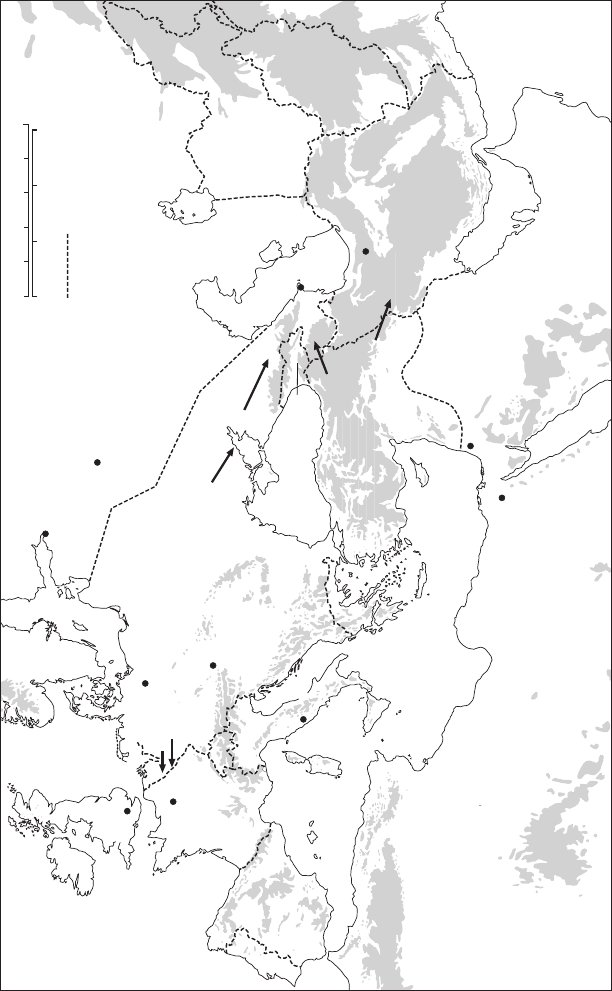
0
0
500 1000
250 500 750 miles
1250 km750250
Petrograd
Moscow
Berlin
Vienna
Paris
London
Rome
Cairo
Jerusalem
Tehran
Baku
GERMAN EMPIRE
HAPSBURG EMPIRE
OTTOMAN EMPIRE
IRAN
INDIA
A
F
G
H
A
N
I
S
T
A
N
Georgia
occupied by
Germany
German
advance 1918
Muslim rebellion
against Russian
rule 1918
Area controlled by Central
Powers 1918
Netherlands
Source: J. Darwin, After Tamerlane (Penguin Books, 2007)
Map 9 The First World War in 1918
313 / The war for Empire, 1914–1919
to enter the war (a result of Berlin’s unrestricted submarine warfare) in
April 1917. It could win the battle for Europe.
The spring and summer of 1918 thus turned out to be the climax
of the war, the moment at which for the British and their allies defeat
came closest. This was the ‘new war’ against which Milner warned
Lloyd George in March 1918. With the signature of the treaty of Brest-
Litovsk (6 March), the Germans had won the war against Russia ‘which
used to cover our whole Asian flank’. With the Germans poised to
swing round the Black Sea and enter the Caucasus, and the Turks now
freed from Russian pressure, ‘we have a new campaign which really
extends from the Mediterranean shore of Palestine to the frontier of
India . . . [W]hether or not Japan takes on North Asia – I doubt her
doing it – we alone have got to keep Southern Asia.’
6
The next day,
the expected German blow fell in the West, but with unexpected force.
Within days it had shattered the British Fifth Army in its path. ‘We are
very near a crash’, wrote the government’s chief military adviser, Sir
Henry Wilson, on 24 March.
7
A week’s fighting cost the BEF 114,000
men. ‘You must fight with your backs to the wall’, Haig, their comman-
der, told his troops (the irreverent reply was: ‘where’s the wall?’). As
the Germans pressed forward, the British faced the dilemma of aban-
doning the Channel ports or losing touch with the French armies to
the south. ‘No readjustment of our forces can save the situation’, said
Milner (now Secretary of State for War) until the British and French
divisions began to hold their ground against the Germans.
8
‘We are a
fast dwindling army’, wrote Wilson on 12 April. ‘This is desperately
serious.’
9
By early June, with the Germans at the Marne, and shells
falling in central Paris, British leaders began to ponder how they would
fight on if France and Italy (where a new German-Austrian offensive
was expected) gave up the struggle. ‘The United States too late, too late,
too late: what if it should turn out to be so?’, groaned the American
ambassador to his diary.
10
Milner was in no doubt that the supreme crisis of the war had
arrived. ‘We must be prepared for France and Italy being beaten to
their knees’, he told Lloyd George. ‘In that case, it is clear that the
German-Austro-Turko-Bulgar bloc will be master of all Europe and
Northern and Central Asia up to the point where Japan steps in to bar
the way.’
11
Milner predicted a global war in which Britain and her allies
would be forced to defend the maritime periphery against a ‘heartland’
dominated by German power. ‘It is clear’, he argued,
314 / ‘The great liner is sinking’
[t]hat unless the only remaining free peoples of the world,
America, this country and the Dominions, are knit together
in the closest conceivable alliance and prepared for the
maximum sacrifice, the Central bloc under the hegemony of
Germany will control not only Europe and most of Asia
but the whole world . . . If all these things happen, the
whole aspect of the war changes. These islands become an
exposed outpost of the Allied positions encircling the
world – a very disadvantageous position for the brain-
centre of such a combination.
The fight, he concluded, ‘will now be for Southern Asia and above
all for Africa (the Palestine bridgehead is of immense importance)’.
12
Here was a terrifying prospectus of Britain’s imperial future from the
most ardent of imperialists. The old balance of power had vanished
like a dream. Britain’s eastern empire now lay open to an attack far
more dangerous than anything threatened by Russia in the days of the
‘great game’. Japan’s domination of East Asia, foreshadowed in its ‘21
demands’ to China in 1915, would be the price of its support. Ameri-
can financial and military help would be more indispensable than ever,
strengthening when peace came the American demand for the ‘free-
dom of the seas’ and the international settlement of colonial claims:
key elements in Woodrow Wilson’s ‘Fourteen Points’ published in Jan-
uary 1918. The ‘new world’ taking shape by the middle of 1918 bore
a frightening resemblance to the warnings of Halford Mackinder, the
geographer and imperialist, some fourteen years before: a vast ‘heart-
land’ (ruled by Germany) controlling the ‘world island’ (continental
Europe, Asia and Africa) leaving only an outer fringe where sea-power
could contest its claims. With Britain and India under siege, and Lon-
don’s commercial empire in ruins, the rump of the British world-
system would have little choice but to look to the United States as
its saviour.
We know in hindsight that Milner was too pessimistic. Within
a month, the tide in the West had begun to turn. But his grim prognosis
left a fateful imperial legacy. Failure on the Western Front, perhaps a
‘Dunkirk’ in which the British army abandoned the continent, made the
Middle East the new fulcrum of imperial defence. It was there that the
road must be barred to the Central Powers whose victory in the region
would cut the British system in two and roll it up in detail. In the first