
Darwin J. The Empire Project. The Rise and Fall of the British World-System, 1830-1970
Подождите немного. Документ загружается.

0
0
400 800
200 400 600 miles
1000 km600200
MALTA
Mediterranean Sea
CYPRUS
LEBANON
PALESTINE
Cairo
EGYPT
Benghazi
CYRENAICA
TRIPOLITANIA
Tripoli
FEZZAN
LIBYA
TURKEY
Istanbul
G
R
E
E
C
E
SUDAN
ETHIOPIA
Khartoum
Addis Ababa
DJIBOUTI
ERITREA
YEMEN
Aden Colony
BRITISH
SOMALILAND
S
O
M
A
L
I
A
A
D
E
N
P
R
O
T
E
C
T
O
R
A
T
E
MUSCAT
and
OMAN
Socotra
TRUCIAL
STATES
B
o
un
d
a
r
y
u
n
d
e
f
i
n
e
d
R
e
d
S
e
a
SAUDI
ARABIA
Riyadh
Arabian Sea
SOVIET
UNION
Tehran
Baghdad
QATAR
BAHRAIN
KUWAIT
TRANS-
JORDAN
Abadan
IRAQ
SYRIA
IRAN
British
Zone
Soviet Zone
SOVIET UNION
AFGHANISTAN
INDIA
Crown colony
Protectorate
Oman and the
Persian Gulf States
Mandate
Anglo-Egyptian
Condominium
States bound to
Britain by Treaty
Territory under
wartime occupation
C
a
s
p
i
a
n
S
e
a
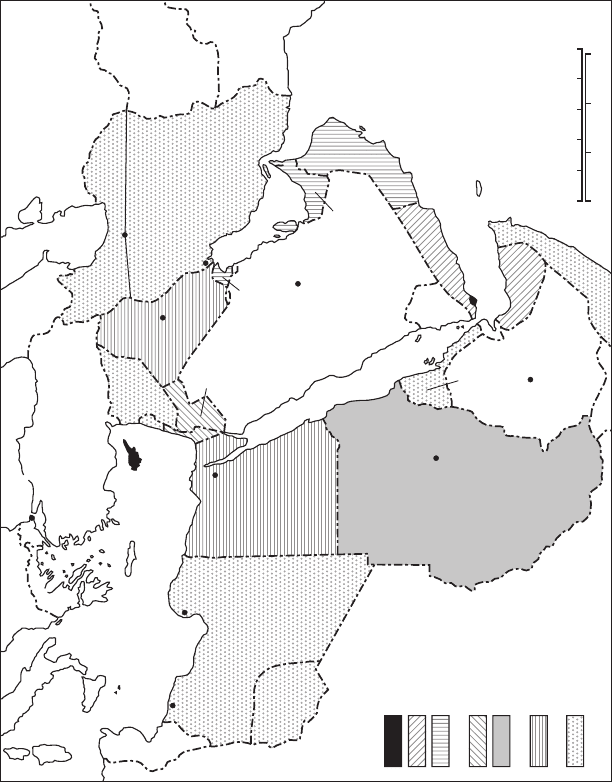
Map 11 TheMiddleEastin1945
536 / ‘The great liner is sinking’
that Stalin would not revive the designs on the Straits and North Persia,
that he had already revealed, once British power was withdrawn. The
Chiefs of Staff were incredulous at Attlee’s ‘naivety’; Bevin’s answer
was lapidary, almost Curzonian. He dismissed Attlee’s suggestion that
withdrawal from the Middle East would assuage Russian aggression:
‘It would be Munich over again, only on a world scale, with Greece,
Turkey and Persia as the victims in place of Czechoslovakia . . . Russia
would certainly fill the gap we leave empty, whatever her promises.’
It would wreck Britain’s relations with the United States, on whose
aid Britain depended, and whose leaders had just been persuaded that
American interests, like those of Britain, required the Middle East to
be held. ‘If we now withdraw at this moment, I should expect them to
write us off entirely.’ Nor was the Middle East economically valueless:
it was worth £100 million to Britain ‘and possibly a great difference in
our future dollar earnings’. Indeed, the Middle East might take India’s
place as an economic partner for Britain. If, instead, Britain left, hard
on the heels of its departure from India, it ‘would appear to the world
as the abdication of our position as a world power’. India would move
towards Russia; ‘the effect on the Dominions would be incalculable.’
56
Here was the case, cast in oracular terms, that Britain’s survival as
a power in the world now hinged – in the geopolitical conditions
that Soviet advance had created – on this dangerous salient in Middle
Eurasia.
Ironically, Attlee’s reluctant endorsement of the Middle East
policy occurred on the eve of the annus horribilis, the year in which
British world power seemed less real than the threat of financial and
political bankruptcy. A terrible winter brought on a fuel crisis and dam-
aged the export drive (to raise British earnings by 50 per cent above
the pre-war level) on which hopes of recovery were pinned. The Amer-
ican loan was being quickly used up. In March 1947, Stafford Cripps,
the avenging angel of socialism, forecast a long period of austerity.
In July 1947, under the terms of the Anglo-American loan, holders of
sterling could convert their pounds into dollars. The result was disas-
trous. Britain’s dollar reserves, already depleted by the cost of Ameri-
can imports, sank like a stone. Faced with sterling’s collapse, London
abruptly suspended convertibility on 20 August. Rations of petrol and
food were reduced, and potatoes joined the list of rationed supplies. The
Cabinet agonised over how many men could be spared from the civilian
economy, how large the army should be and how long those ‘called up’
537 / The price of survival, 1943–1951
should serve in the armed forces. At Dalton’s insistence, the provision of
aid to Turkey and Greece had already been scrapped: this was the bur-
den that the United States now assumed under the ‘Truman Doctrine’
promising help to those states fearful of Soviet aggression. Against this
background of deepening economic gloom, the government faced an
impasse in its effort to ease India into an agreed independence. With no
sign of a compromise between the Congress and the League, growing
communal friction and rising anxiety that the British in India would be
caught up in a storm of political violence, panic in London began to set
in. The Cabinet Mission had failed. Attlee and his colleagues rejected
the Viceroy, Lord Wavell’s, ‘breakdown plan’ (a staged withdrawal to
the Indian ports, handing power over province by province) as a recipe
for turmoil, but had no plan of their own. The sacking of Wavell and
the choice of Mountbatten were acts of inspired desperation. But Attlee
was forced to give Mountbatten a virtual free hand to decide on the
timing and settle the manner of Britain’s departure. Mountbatten was
lucky. His arrival in India in March 1947 coincided with the grudging
recognition in the Congress that, without an early transfer of power,
and agreement on partition, the spiral of communal violence would
destroy their authority over the Indian masses as much as that of the
British. This was the chink through which Mountbatten would drive
with ruthless diplomacy to impose partitioned independence in August
1947.
57
The late summer of 1947 erased any lingering hope that Britain
would quickly regain the substance of its world position before the
catastrophe of 1940. A further turn of the screw was the rapid deterio-
ration of the situation in Palestine. Here the British had struggled to find
a settlement acceptable to both Arabs and Jews whilst also reserving an
enclave of their own – in the event of withdrawal from their Canal Zone
bases. There was no question of stopping further Jewish immigration
or preserving Palestine as an Arab-majority state – the ‘solution’ envis-
aged in 1939. That was ruled out by American disapproval, and the
growing intensity of Zionist terrorism, against which the large British
garrison seemed poorly equipped. Even after the bombing of the King
David Hotel in July 1946 – aimed at the heart of the British mandate
administration – the Cabinet rejected the repression of Jewish organisa-
tions for fear of American anger.
58
Instead, the British found themselves
drifting into the worst of all worlds: as the unwilling executants of a
territorial partition fashioned in New York by the United Nations, but
538 / ‘The great liner is sinking’
whose real sponsor was the United States. The likely costs of this role
for Britain’s relations with the Arab states, at precisely the moment
when the terms of their post-war alliances were being redefined, were
regarded in London with horror. The only solution, it came to appear,
was an ignominious departure, without even the fig leaf of an ordered
transition, leaving the field to the local contestants and the war that
followed.
59
For an imperial system that laid so much stress on the pres-
tige of its rule, and which depended so much on its claim to embody
public order and justice, the events of 1947 were especially damag-
ing. London’s authority – among its ‘subordinate’ allies (like Egypt or
Jordan), its dominion ‘partners’, as well as its colonial subjects (who
enjoyed very varying degrees of local self-rule) – was a function in part
of local opinion. The appearance of strength, the assertion of will, and
the promise of rewards to bestow, were the often invisible strings with
which the British had tied their ramshackle system together. The ‘illu-
sion of permanence’ – that, in any future world order, British power
would loom large – was a vital constraint on the colonial temptation
to flout London’s wishes too rudely. It did not require a Cassandra
to wonder in late 1947 whether the spell had been broken. It seemed
after all that the disasters that the British had suffered between 1940
and 1942 could not be repaired. They might have hoped that victory
would restore the European balance, with the Soviet Union as the great
guarantor against a new Hitler. But, without a European peace, their
domestic security looked increasingly fraught. Their commercial empire
was crippled by weakness and what seemed like hopeless mismanage-
ment. India as an asset was finally gone. Their Middle East clients
were in open revolt. The dominions resisted commitment to ‘imperial
defence’, doubted London’s dire warnings about Soviet intentions, and
declined London’s anxious request to write down their sterling claims
by up to 50 per cent.
60
What remained of the Empire might yield wind-
fall gains, but it was a patchwork of colonies, some undeveloped, some
under-governed, and some (like Malaya) barely recovered from foreign
occupation.
This was a gloomy prospectus, but, as it turned out, unrealis-
tically gloomy. The British world-system did not implode. The politi-
cians in London may have resented its costs but they could not imagine
a post-imperial future. They were spared the need for a drastic rethink.
Grim as they looked, the pressures they faced were not unremitting.
539 / The price of survival, 1943–1951
The geopolitical position did not become critical. In Europe and the
Middle East, the Soviet Union was cautious. The British were not driven
back – in the way that Attlee had feared – to the strategic periphery.
Their uncertain defences were not seriously tested. Crucially, too, their
default on the loan agreement was accepted without too much ran-
cour in Washington.
61
The Truman administration acknowledged the
need to keep Britain solvent, and ideally strong, as the best ally it had
against Soviet expansion. The offer of help had already been mooted
in the famous speech of George Marshall, the Secretary of State, on
5 June 1947 which sketched out what became the European Recovery
Programme. So the British were allowed to seal off the sterling econ-
omy from American competition, to discriminate heavily against dollar
goods, to keep ‘imperial preference’ and put off the day when the pound
was exchanged freely for dollars – precisely those things that Ameri-
can leaders had been so determined to crush eighteen months earlier.
Their departure from India had been swift and involuntary but not
catastrophic. Both Nehru and Jinnah had been pragmatically willing
to accept independence as dominions and not to demand a republic.
The transfer of power was thus a constitutional pageant, performed in
London through an Act of Parliament, the Indian Independence Act,
as well as in India. It allowed Attlee to claim that the end of the Raj
was the triumphant completion of a long-matured plan to give the
Indians self-government, a pleasing if transparent fiction. It also held
out some hope that the two new dominions would be Britain’s part-
ners across Southern Asia, balancing the new international weight that
China (under Kuomintang rule) was expected to have. In the Middle
East, for all the difficulties faced by the British in securing fresh treaties
with their key Arab allies (a proposed treaty with Iraq collapsed in the
face of a popular outburst, the so-called Wathbah), there was as yet
little sign that nationalism was a strong enough glue to unify Britain’s
opponents and break down the suspicions that divided parties and fac-
tions. Among the dominions, Britain’s staunchest allies in the Second
World War, impatience with British imperial attitudes and the desire
to assert their own regional claims modulated gradually into a growing
unease at the scale of American power, and a stark realisation (among
the sterling dominions) that their economic survival was closely tied up
with Britain’s recovery and the fate of the pound.
Much of the flexibility that British leaders had hoped to enjoy
in the war’s aftermath had faded away. But the crucial fact was that the
540 / ‘The great liner is sinking’
scope for an empire had not disappeared. The seismic shift in American
policy meant that Britain’s importance as an imperial ally had been
grasped in Washington, as well as the need to support its imperial
claims, for the time being at least. In a war-shattered world, the sterling
economies also accounted for around half of world trade. For all the
irritation that London’s breach of faith had caused on the other side
of the Atlantic, this was too large an egg to think of killing the goose.
The sterling area had to be given a last-minute reprieve. Nor so far had
there been any great revulsion of sentiment in Britain itself against the
burden of empire, felt most directly in the prolonging of conscription,
abandoned precipitately after the First World War. ‘One should not
overlook the resurgence of nationalism which is characteristic of this
country in its post-war mood’, remarked one thoughtful observer.
62
It reflected not only the confidence that victory had brought but also
acceptance that, for both better (social reform) and worse (austerity),
there would be no return to a pre-war ‘normality’. No major voice had
called for a general withdrawal from overseas commitments – perhaps a
measure of how far the Churchillian idea of Britain’s place in the world
(if not Churchill himself) ruled the political realm (a strong case could
be made that it shaped public attitudes to Britain in the white dominions
as well). Finally, the British had also begun to equip themselves for the
next age of warfare. By early 1947, the decision had been taken to build
an atomic weapon that would deter the most powerful assailant. When
that was in place – a ten-year wait was envisaged – Britain’s scientific
prowess, hugely developed by the stress of war, could be mobilised fully
behind her claim to world power.
In this brave new world of unforeseen fears, the Labour gov-
ernment shuffled uneasily, with American and dominion help, towards
a new version of empire, with a new ideology, a new geostrategy, and
an all-but-new economic system. This we might call the fourth (and
last) British Empire.
The fourth British Empire
There was, of course, nothing that resembled an imperial programme,
still less an announcement that Britain had embarked upon a new phase
of empire-building. This was partly because, as in earlier times, no sin-
gle department or source of authority ruled over all Britain’s multiple
541 / The price of survival, 1943–1951
external connections, or could grasp their full meaning. Labour’s new
empire emerged instead from piecemeal decisions, made in pursuit of
a wide range of objectives. The result was an untidy, even ramshackle,
system like all previous versions of British world power. It was shaped
inevitably by the impress of forces largely outside the control of any
government in London. Indeed, it was mainly the product of an eco-
nomic and geopolitical crisis that was far more severe (from the British
point of view) than that which they had faced after 1918. Its prospects
were decided not only by the means that the British themselves could
commit, but by the help they enlisted inside and outside their impe-
rial system. Indeed, the scale of its dependence upon foreign assistance
became one of its hallmarks, and perhaps the principal cause of its
systemic instability. Indeed, as a ‘solution’ to the problem of restor-
ing Britain’s world position (as an independent great power co-equal
with the United States and the Soviet Union), its shortcomings were
obvious – or had become so by 1952 at the latest.
Labour’s embrace of an imperial destiny may have derived in
part from the innate conservatism of its leaders’ world-view or their
reluctance to challenge the passions and prejudices ascribed to pub-
lic opinion – the loathing for ‘scuttle’ which the Cabinet had feared
would discredit their Indian policy.
63
But, from mid-1947, their impe-
rial thinking was driven by two more urgent concerns. The first was
the danger that Stalin would repeat Hitler’s success in uniting Europe
against them, if by more indirect means, before American help could
be brought to bear. In geopolitical terms, Britain’s weakness in Europe
was bound to make them lean more heavily on their extra-European
resources. The second was the need, felt no less acutely, to secure their
achievements at home, and safeguard Labour’s position as the party of
government. The priority here was economic recovery, or, as it seemed
in the wake of the convertibility crisis, economic survival. But, for Attlee
and his colleagues, there was little real choice in the road to recovery.
The central plank in Labour’s electoral platform, the glue that held the
government, the party and its trade union supporters (the main source
of its funds) together, was the promise of full employment, originally
laid down in the wartime white paper in 1944. Full employment was
the key guarantee that the sacrifices of wartime had not been in vain,
and that victory had made possible a better, fairer, Britain. It could
not be repudiated. It was also the essential condition without which
Labour’s whole social programme would quickly unravel. Extending
542 / ‘The great liner is sinking’
social insurance, increasing state benefits for the jobless or sick, and
funding a national health service, assumed a very high level of produc-
tive employment: mass unemployment on the scale of the 1930s would
wreck their finances. The savage deflation through which governments
in the 1920s had sought to rebalance Britain’s trade deficit was no
longer an option. Nor was the mechanism through which that deflation
was imposed, the use of high interest rates to restrict the money supply.
Instead, Labour was committed to a ‘cheap money’ policy (interest rates
were kept at 2 per cent) partly to keep employment levels high, partly
because the cost of nationalising Britain’s mines and transport drove up
government borrowing. Cheap money was as vital to Labour’s public
finances as to its social policy and electoral hopes.
These considerations ruled out defending Britain’s solvency in
the open international economy that the Bretton Woods agreements
had envisaged. Cheap money at home required a closed sterling econ-
omy abroad, to guard sterling’s value and protect the overseas (sterling
area) markets to which much of her exports were sent. Nor was it
just a matter of weathering the immediate threat of a sterling collapse.
The convertibility disaster brought home to ministers and their advisers
that the fundamental imbalance of the British economy required both
immediate action and a longer-term remedy. They had to secure fresh
supplies of food and fuel to improve living standards, ease the huge bur-
den of food subsidies and improve distribution and output at home. But
they had to obtain them from dollar-free sources. They were anxious if
possible not just to save dollars by buying in sterling, but to earn dol-
lars as well by re-exporting sterling imports to the voracious American
economy. Foodstuffs (especially grain and fats), oil, gold (from South
Africa) and high-value minerals like copper and tin, were among their
key targets. The shortage of oil and the otherwise heavy dependence on
American imports made Middle Eastern supplies from British-owned
concessions there a glittering but vulnerable prize. ‘Should Russia over-
run this area’, worried Hugh Gaitskell, then Minister of Fuel and Power,
in January 1948,
[t]here would not merely be insufficient oil for Britain but
for a large part of the rest of the world . . . God knows
when we shall really get our expansion programme going
there, and how precarious it will be even when the output is
doubled.
64
543 / The price of survival, 1943–1951
‘It is hoped that by 1951 82 per cent of our oil supplies will be drawn
from the Middle East (as compared with 23 per cent in 1938)’, Bevin
told his Cabinet colleagues in October 1949. ‘This will present the
largest single factor in balancing our overseas payments. If we failed
to maintain our position in the Middle East, our plans for economic
recovery . . . would fail.’
65
This was a game that other ministers could
play. Malaya ‘is by far the most important source of dollars in the
Colonial Empire’, warned the Colonial Secretary in July 1948. ‘It would
gravely worsen the whole dollar balance of the Sterling Area if there
were serious interference with Malayan exports.’
66
Malayan security
was not just a matter of local importance, or even a primarily strategic
matter. It had become one of the crutches of a convalescent British
economy.
For the foreseeable future, then, the Labour government pinned
its hopes of economic revival to closer integration with the ster-
ling Commonwealth countries (mainly Australia, New Zealand and
South Africa), the rapid development of their most valuable dependen-
cies (including Malaya, the Gold Coast and Northern Rhodesia) and
the drastic expansion of output from Britain’s oil concessions in the
Middle East. Only in this way could they restore some equilibrium
between Britain’s dollar income and outgoings, build up the reserves
required for sterling’s eventual return to convertible status, and (above
all) protect the British economy from a drastic slump in employment
and living standards. Pressing arguments of geostrategy pushed them in
the same outward direction. By the end of 1947, the failure of the Coun-
cil of Foreign Ministers meeting in London in November–December,
had convinced British leaders that a negotiated settlement with Stalin
was more remote than ever. Deterring a Soviet advance into, or its sub-
version of, the Western European states meant a military build-up, and
a firmer commitment by London to the defence of the half-continent. In
the Western European Union in January 1948 and the Brussels Treaty
a few months later, the British pledged themselves more deeply to their
European partners than in any previous peacetime. But they were all
too aware that the military means to make good this commitment were
scanty at best. Without adequate means to defeat the Soviet Union
on land, a ‘Middle East’ strategy to bomb Southern Russia (despite
its manifold shortcomings
67
) remained the best option. The argument
went wider. On 5 January 1948, Attlee had broadcast an attack on
Soviet imperialism in Europe. A week later, he appealed for Australian
544 / ‘The great liner is sinking’
and New Zealand support. Britain, he told prime ministers Chifley and
Fraser, had proposed a ‘Western European Regional Economic and
Security Group’. Britain would provide the ‘political and moral lead-
ership’, but would depend upon the material support of the United
States and the Commonwealth.
68
Eager as they were to elicit American
help, both Attlee and Bevin were determined to avoid mere dependence
on Washington. ‘If it is our aim’, remarked the Cabinet Secretary, Sir
Norman Brook, ‘to achieve the leadership of a Western Union suffi-
ciently powerful to be independent of both the Soviet and the American
blocs, we must be at the heart of a Commonwealth of nations which
is as large as and powerful as we can make it.’
69
Bevin was blunter.
‘More stress should be laid’, he told his ministerial colleagues, ‘on the
need to build up a Commonwealth defence system which together with
Western Union, would result in a bloc equivalent in strength to the
United States or the Soviet Union.’
70
Defending Britain-in-Europe and
preserving British world power were imperial tasks.
At first sight, it seems strange that, at a time of such acute
economic hardship, domestic opposition to the burdens of empire
was not more vociferous. By late 1947, even potatoes were rationed
(bread had been rationed since mid-1946) and the ration of petrol sus-
pended altogether. Quite apart from Britain’s overseas debts, there was
also a mountain of borrowing at home increasing in size from some
£13 billion at the end of the war to more than £15 billion by 1951.
71
Partly in consequence, the level of income tax remained at a far higher
level than after the First World War. By 1951, six years into the peace, it
had fallen only marginally from 10 shillings (50 per cent) in the pound
to 9 shillings (45 per cent), twice the rate current in 1925. Nor was
it simply a question of feeling the pinch. There was also the matter
of public attitudes to empire. Britain’s impoverishment had coincided
with an ideological conversion to social democracy. After 1918,the
blueprint for social reconstruction had been largely torn up when the
government abandoned most of the levers of economic control at the
onset of depression. This pattern was not repeated after 1945. Instead,
the Labour government embarked upon a huge social programme to
extend educational opportunity, widen access to healthcare and (most
fundamental of all) secure full employment. It also took charge of two
basic industries whose renovation was vital to economic recovery: trans-
port (including railways, harbours and road haulage) and the mines.
The result was high levels of public expenditure for domestic recovery