
Devore J.L., Berk K.N. Modern Mathematical Statistics with Applications
Подождите немного. Документ загружается.


Example 2.35 The article “Reliability Evaluation of Solar Photovoltaic Arrays” (Solar Energy,
2002: 129–141) presents various configurations of solar photovoltaic arrays con-
sisting of crystalline silicon solar cells. Consider first the system illustrated in
Figure 2.14a. There are two subsystems connected in parallel, each one containing
three cells. In order for the system to function, at least one of the two parallel
subsystems must work. Within each subsystem, the three cells are connected in
series, so a subsystem will work only if all cells in the subsystem work. Consider a
particular lifetime value t
0
, and suppose we want to determine the probability that
the system lifetime exceeds t
0
. Let A
i
denote the event that the lifetime of cell i
exceeds t
0
(i ¼1, 2, ... , 6). We assume that the A
i
’s are independent events
(whether any particular cell lasts more than t
0
hours has no bearing on whether
any other cell does) and that P(A
i
) ¼.9 for every i since the cells are identical. Then
P system lifetime exceeds t
0
ðÞ¼P½ðA
1
\ A
2
\ A
3
Þ[ðA
4
\ A
5
\ A
6
Þ
¼ PðA
1
\ A
2
\ A
3
ÞþPðA
4
\ A
5
\ A
6
Þ
P½ðA
1
\ A
2
\ A
3
Þ\ðA
4
\ A
5
\ A
6
Þ
¼ :9ðÞ:9ðÞ:9ðÞþ:9ðÞ: 9ðÞ:9ðÞ
:9ðÞ:9ðÞ:9ðÞ:9ðÞ:9ðÞ:9ðÞ¼:927
Alternatively,
P system lifetime exceeds t
0
ðÞ¼1 Pðboth subsystem lives are t
0
Þ
¼ 1 ½Pðsubsystem life is t
0
Þ
2
¼ 1 ½1 Pðsubsystem life is>t
0
Þ
2
¼ 1 ½1 :9ðÞ
3
Þ
2
¼ :927
Next consider the total-cross-tied system shown in Figure 2.14b, obtained from the
series-parallel array by connecting ties across each column of junctions. Now the
system fails as soon as an entire column fails, and system lifetime exceeds t
0
only if
the life of every column does so. For this configuration,
P system lifetime exceeds t
0
ðÞ¼½P column lifetime exceeds t
0
ðÞ
3
¼½1 Pðcolumn lifetime is t
0
Þ
3
¼½1 Pðboth cells in a column have lifetime t
0
Þ
3
¼1 ½1 :9ðÞ
2
Þ
3
¼:970
■
1 2 3
4 5 6
1 2 3
4 5 6
ab
Figure 2.14 System configurations for Example 2.35: (a) series-parallel; (b) total-
cross-tied
88
CHAPTER 2 Probability

Exercises Section 2.5 (66–83)
66. Reconsider the credit card scenario of Exercise 47
(Section 2.4), and show that A and B are depen-
dent first by using the definition of independence
and then by verifying that the multiplication prop-
erty does not hold.
67. An oil exploration company currently has two
active projects, one in Asia and the other in Eur-
ope. Let A be the event that the Asian project is
successful and B be the event that the European
project is successful. Suppose that A and B are
independent events with P(A) ¼.4 and P(B) ¼.7.
a. If the Asian project is not successful, what
is the probability that the European project is
also not successful? Explain your reasoning.
b. What is the probability that at least one of the
two projects will be successful?
c. Given that at least one of the two projects is
successful, what is the probability that only the
Asian project is successful?
68. In Exercise 15, is any A
i
independent of any other
A
i
? Answer using the multiplication property for
independent events.
69. If A and B are independent events, show that A
0
and B are also independent. [Hint: First establish
a relationship among PðA
0
\ BÞ; PðBÞ; and
PðA \ BÞ.]
70. Suppose that the proportions of blood phenotypes
in a particular population are as follows:
ABABO
.42 .10 .04 .44
Assuming that the phenotypes of two randomly
selected individuals are independent of each
other, what is the probability that both phenotypes
are O? What is the probability that the phenotypes
of two randomly selected individuals match?
71. The probability that a grader will make a marking
error on any particular question of a multiple-
choice exam is .1. If there are ten questions and
questions are marked independently, what is the
probability that no errors are made? That at least
one error is made? If there are n questions and the
probability of a marking error is p rather than .1,
give expressions for these two probabilities.
72. An aircraft seam requires 25 rivets. The seam will
have to be reworked if any of these rivets is
defective. Suppose rivets are defective indepen-
dently of one another, each with the same proba-
bility.
a. If 20% of all seams need reworking, what is the
probability that a rivet is defective?
b. How small should the probability of a defec-
tive rivet be to ensure that only 10% of all
seams need reworking?
73. A boiler has five identical relief valves. The prob-
ability that any particular valve will open on
demand is .95. Assuming independent operation
of the valves, calculate P(at least one valve opens)
and P(at least one valve fails to open).
74. Two pumps connected in parallel fail indepen-
dently of each other on any given day. The proba-
bility that only the older pump will fail is .10, and
the probability that only the newer pump will fail
is .05. What is the probability that the pumping
system will fail on any given day (which happens
if both pumps fail)?
75. Consider the system of components connected as
in the accompanying picture. Components 1 and
2 are connected in parallel, so that subsystem
works iff either 1 or 2 works; since 3 and 4 are
connected in series, that subsystem works iff both
3 and 4 work. If components work independently
of one another and P(component works) ¼.9, cal-
culate P(system works).
2
1
3
4
76. Refer back to the series-parallel system configu-
ration introduced in Example 2.35, and suppose
that there are only two cells rather than three in
each parallel subsystem [in Figure 2.14a, elimi-
nate cells 3 and 6, and renumber cells 4 and 5 as 3
and 4]. Using P(A
i
) ¼.9, the probability that sys-
tem lifetime exceeds t
0
is easily seen to be .9639.
To what value would .9 have to be changed in
order to increase the system lifetime reliability
from .9639 to .99? [Hint: Let P(A
i
) ¼p, express
system reliability in terms of p, and then
let x ¼p
2
.]
77. Consider independently rolling two fair dice, one
red and the other green. Let A be the event that the
red die shows 3 dots, B be the event that the green
2.5 Independence 89

die shows 4 dots, and C be the event that the total
number of dots showing on the two dice is 7. Are
these events pairwise independent (i.e., are A and
B independent events, are A and C independent,
and are B and C independent)? Are the three
events mutually independent?
78. Components arriving at a distributor are checked
for defects by two different inspectors (each com-
ponent is checked by both inspectors). The first
inspector detects 90% of all defectives that are
present, and the second inspector does likewise.
At least one inspector fails to detect a defect on
20% of all defective components. What is the
probability that the following occur?
a. A defective component will be detected only
by the first inspector? By exactly one of the
two inspectors?
b. All three defective components in a batch
escape detection by both inspectors (assuming
inspections of different components are inde-
pendent of one another)?
79. A quality control inspector is inspecting newly
produced items for faults. The inspector searches
an item for faults in a series of independent fixa-
tions, each of a fixed duration. Given that a flaw is
actually present, let p denote the probability that
the flaw is detected during any one fixation (this
model is discussed in “Human Performance in
Sampling Inspection,” Hum. Factors, 1979:
99–105).
a. Assuming that an item has a flaw, what is the
probability that it is detected by the end of the
second fixation (once a flaw has been detected,
the sequence of fixations terminates)?
b. Give an expression for the probability that a
flaw will be detected by the end of the nth
fixation.
c. If when a flaw has not been detected in three
fixations, the item is passed, what is the proba-
bility that a flawed item will pass inspection?
d. Suppose 10% of all items contain a flaw
[P(randomly chosen item is flawed) ¼.1].
With the assumption of part (c), what is the
probability that a randomly chosen item will
pass inspection (it will automatically pass if it
is not flawed, but could also pass if it is
flawed)?
e. Given that an item has passed inspection
(no flaws in three fixations), what is the proba-
bility that it is actually flawed? Calculate for
p ¼.5.
80. a. A lumber company has just taken delivery on a
lot of 10,000 2 4 boards. Suppose that 20%
of these boards (2000) are actually too green to
be used in first-quality construction. Two
boards are selected at random, one after the
other. Let A ¼{the first board is green} and
B ¼{the second board is green}. Compute
P(A), P(B), and P(
A \ B) (a tree diagram
might help). Are A and B independent?
b. With A and B independent and P(A) ¼
P(B) ¼.2, what is P( A \ B)? How much
difference is there between this answer and
P(A \ B) in part (a)? For purposes of calculat-
ing P(A \ B), can we assume that A and B of
part (a) are independent to obtain essentially
the correct probability?
c. Suppose the lot consists of ten boards, of which
two are green. Does the assumption of indepen-
dence now yield approximately the correct
answer for P(A \ B)? What is the critical
difference between the situation here and
that of part (a)? When do you think that an
independence assumption would be valid in
obtaining an approximately correct answer to
P(A \ B)?
81. Refer to the assumptions stated in Exercise 75
and answer the question posed there for the system
in the accompanying picture. How would the
probability change if this were a subsystem
connected in parallel to the subsystem pictured
in Figure 2.14a?
2
1
5
3
6
7
4
82. Professor Stander Deviation can take one of two
routes on his way home from work. On the first
route, there are four railroad crossings. The prob-
ability that he will be stopped by a train at any
particular one of the crossings is .1, and trains
operate independently at the four crossings. The
other route is longer but there are only two cross-
ings, independent of each other, with the same
stoppage probability for each as on the first
route. On a particular day, Professor Deviation
has a meeting scheduled at home for a certain
time. Whichever route he takes, he calculates
that he will be late if he is stopped by trains at
least half the crossings encountered.
a. Which route should he take to minimize the
probability of being late to the meeting?
b. If he tosses a fair coin to decide on a route and
he is late, what is the probability that he took
the four-crossing route?
90
CHAPTER 2 Probability

83. Suppose identical tags are placed on both the left
ear and the right ear of a fox. The fox is then let
loose for a period of time. Consider the two events
C
1
¼{left ear tag is lost} and C
2
¼{right ear tag is
lost}. Let p ¼P(C
1
) ¼P(C
2
), and assume C
1
and
C
2
are independent events. Derive an expression
(involving p) for the probability that exactly one
tag is lost given that at most one is lost (“Ear Tag
Loss in Red Foxes,” J. Wildlife Manag., 1976:
164–167). [Hint: Draw a tree diagram in which
the two initial branches refer to whether the left
ear tag was lost.]
Supplementary Exercises (84–109)
84. A small manufacturing company will start
operating a night shift. There are 20 machinists
employed by the company.
a. If a night crew consists of 3 machinists, how
many different crews are possible?
b. If the machinists are ranked 1, 2, ... ,20in
order of competence, how many of these crews
would not have the best machinist?
c. How many of the crews would have at least 1
of the 10 best machinists?
d. If one of these crews is selected at random to
work on a particular night, what is the proba-
bility that the best machinist will not work that
night?
85. A factory uses three production lines to manufac-
ture cans of a certain type. The accompanying
table gives percentages of nonconforming cans,
categorized by type of nonconformance, for each
of the three lines during a particular time period.
Line 1 Line 2 Line 3
Blemish 15 12 20
Crack 50 44 40
Pull-Tab Problem 21 28 24
Surface Defect 10 8 15
Other 482
During this period, line 1 produced 500 noncon-
forming cans, line 2 produced 400 such cans, and
line 3 was responsible for 600 nonconforming
cans. Suppose that one of these 1500 cans is
randomly selected.
a. What is the probability that the can was pro-
duced by line 1? That the reason for noncon-
formance is a crack?
b. If the selected can came from line 1, what is the
probability that it had a blemish?
c. Given that the selected can had a surface defect,
what is the probability that it came from line 1?
86. An employee of the records office at a university
currently has ten forms on his desk awaiting pro-
cessing. Six of these are withdrawal petitions and
the other four are course substitution requests.
a. If he randomly selects six of these forms to
give to a subordinate, what is the probability
that only one of the two types of forms remains
on his desk?
b. Suppose he has time to process only four of
these forms before leaving for the day. If these
four are randomly selected one by one, what is
the probability that each succeeding form is of a
different type from its predecessor?
87. One satellite is scheduled to be launched from
Cape Canaveral in Florida, and another launching
is scheduled for Vandenberg Air Force Base in
California. Let A denote the event that the Van-
denberg launch goes off on schedule, and let B
represent the event that the Cape Canaveral
launch goes off on schedule. If A and B are
independent events with P(A) > P(B) and
P(A [ B) ¼.626, P(A \ B) ¼.144, determine the
values of
P(A) and P(B).
88. A transmitter is sending a message by using a
binary code, namely, a sequence of 0’s and 1’s.
Each transmitted bit (0 or 1) must pass through
three relays to reach the receiver. At each relay,
the probability is .20 that the bit sent will be differ-
ent from the bit received (a reversal). Assume that
the relays operate independently of one another.
Transmitter !Relay 1 !Relay 2 !Relay 3
! Receiver
a. If a 1 is sent from the transmitter, what is the
probability that a 1 is sent by all three relays?
b. If a 1 is sent from the transmitter, what is the
probability that a 1 is received by the receiver?
[Hint: The eight experimental outcomes can be
displayed on a tree diagram with three genera-
tions of branches, one generation for each
relay.]
Supplementary Exercises 91
c. Suppose 70% of all bits sent from the transmit-
ter are 1’s. If a 1 is received by the receiver,
what is the probability that a 1 was sent?
89. Individual A has a circle of five close friends
(B, C, D, E, and F). A has heard a certain rumor
from outside the circle and has invited the five
friends to a party to circulate the rumor. To begin,
A selects one of the five at random and tells the
rumor to the chosen individual. That individual
then selects at random one of the four remaining
individuals and repeats the rumor. Continuing, a
new individual is selected from those not already
having heard the rumor by the individual who has
just heard it, until everyone has been told.
a. What is the probability that the rumor is
repeated in the order B, C, D, E, and F?
b. What is the probability that F is the third per-
son at the party to be told the rumor?
c. What is the probability that F is the last person
to hear the rumor?
90. Refer to Exercise 89. If at each stage the person
who currently “has” the rumor does not know
who has already heard it and selects the next
recipient at random from all five possible indivi-
duals, what is the probability that F has still not
heard the rumor after it has been told ten times at
the party?
91. A chemist is interested in determining whether a
certain trace impurity is present in a product. An
experiment has a probability of .80 of detecting the
impurity if it is present. The probability of not
detecting the impurity if it is absent is .90. The
prior probabilities of the impurity being present
and being absent are .40 and .60, respectively.
Three separate experiments result in only two
detections. What is the posterior probability that
the impurity is present?
92. Fasteners used in aircraft manufacturing are
slightly crimped so that they lock enough to avoid
loosening during vibration. Suppose that 95% of all
fasteners pass an initial inspection. Of the 5% that
fail, 20% are so seriously defective that they must
be scrapped. The remaining fasteners are sent to a
recrimping operation, where 40% cannot be sal-
vaged and are discarded. The other 60% of these
fasteners are corrected by the recrimping process
and subsequently pass inspection.
a. What is the probability that a randomly
selected incoming fastener will pass inspection
either initially or after recrimping?
b. Given that a fastener passed inspection, what is
the probability that it passed the initial inspec-
tion and did not need recrimping?
93. One percent of all individuals in a certain popula-
tion are carriers of a particular disease. A diagnos-
tic test for this disease has a 90% detection rate for
carriers and a 5% detection rate for noncarriers.
Suppose the test is applied independently to two
different blood samples from the same randomly
selected individual.
a. What is the probability that both tests yield the
same result?
b. If both tests are positive, what is the probability
that the selected individual is a carrier?
94. A system consists of two components. The proba-
bility that the second component functions in a
satisfactory manner during its design life is .9, the
probability that at least one of the two components
does so is .96, and the probability that both compo-
nents do so is .75. Given that the first component
functions in a satisfactory manner throughout its
design life, what is the probability that the second
one does also?
95. A certain company sends 40% of its overnight mail
parcels via express mail service E
1
. Of these par-
cels, 2% arrive after the guaranteed delivery time
(denote the event “late delivery” by L). If a record
of an overnight mailing is randomly selected from
the company’s file, what is the probability that the
parcel went via E
1
and was late?
96. Refer to Exercise 95. Suppose that 50% of the
overnight parcels are sent via expres s mail ser-
vice E
2
and the remaining 10% are sent via E
3
.Of
those sent via E
2
, only 1% arrive late, whereas
5% of the parcels handled by E
3
arrive late.
a. What is the probability that a randomly
selected parcel arrived late?
b. If a randomly selected parcel has arrived on
time, what is the probability that it was not sent
via E
1
?
97. A company uses three different assembly lines—A
1
,
A
2
,andA
3
—to manufacture a particular component.
Of those manufactured by line A
1
, 5% need rework
to remedy a defect, whereas 8% of A
2
’s components
need rework and 10% of A
3
’s need rework. Suppose
that 50% of all components are produced by line A
1
,
30% are produced by line A
2
, and 20% come from
line A
3
. If a randomly selected component needs
rework, what is the probability that it came from
line A
1
? From line A
2
? From line A
3
?
92
CHAPTER 2 Probability
98. Disregarding the possibility of a February 29
birthday, suppose a randomly selected individual
is equally likely to have been born on any one of
the other 365 days.
a. If ten people are randomly selected, what is the
probability that all have different birthdays?
That at least two have the same birthday?
b. With k replacing ten in part (a), what is the
smallest k for which there is at least a 50–50
chance that two or more people will have the
same birthday?
c. If ten people are randomly selected, what is
the probability that either at least two have
the same birthday or at least two have the
same last three digits of their Social Security
numbers? [Note: The article “Methods for
Studying Coincidences” (F. Mosteller and
P. Diaconis, J. Amer. Statist. Assoc., 1989:
853–861) discusses problems of this type.]
99. One method used to distinguish between granitic (G)
and basaltic (B) rocks is to examine a portion of the
infrared spectrum of the sun’s energy reflected from
the rock surface. Let R
1
, R
2
,andR
3
denote measured
spectrum intensities at three different wavelengths;
typically, for granite R
1
< R
2
< R
3
, whereas for
basalt R
3
< R
1
< R
2
. When measurements are made
remotely (using aircraft), various orderings of the
R
i
’s may arise whether the rock is basalt or granite.
Flights over regions of known composition have
yielded the following information:
Granite Basalt
R
1
< R
2
< R
3
60% 10%
R
1
< R
3
< R
2
25% 20%
R
3
< R
1
< R
2
15% 70%
Suppose that for a randomly selected rock in a
certain region, P(granite) ¼.25 and P(basalt) ¼.75.
a. Show that P(granite | R
1
< R
2
< R
3
) > P(basalt
| R
1
< R
2
< R
3
). If measurements yielded R
1
<
R
2
< R
3
, would you classify the rock as granite
or basalt?
b. If measurements yielded R
1
< R
3
< R
2
, how
would you classify the rock? Answer the
same question for R
3
< R
1
< R
2
.
c. Using the classification rules indicated in parts
(a) and (b), when selecting a rock from this
region, what is the probability of an erroneous
classification? [Hint: Either G could be classified
as B or B as G,andP(B)andP(G)areknown.]
d. If P(granite) ¼p rather than .25, are there
values of p (other than 1) for which a rock
would always be classified as granite?
100. In a Little League baseball game, team A’s
pitcher throws a strike 50% of the time and a
ball 50% of the time, successive pitches are inde-
pendent of each other, and the pitcher never hits a
batter. Knowing this, team B’s manager has
instructed the first batter not to swing at any-
thing. Calculate the probability that
a. The batter walks on the fourth pitch.
b. The batter walks on the sixth pitch (so two of
the first five must be strikes), using a counting
argument or constructing a tree diagram.
c. The batter walks.
d. The first batter up scores while no one is out
(assuming that each batter pursues a no-swing
strategy).
101. Four graduating seniors, A, B, C, and D, have been
scheduled for job interviews at 10 a.m. on Friday,
January 13, at Random Sampling, Inc. The person-
nel manager has scheduled the four for interview
rooms 1, 2, 3, and 4, respectively. Unaware of this,
the manager’s secretary assigns them to the four
rooms in a completely random fashion (what
else!). What is the probability that
a. All four end up in the correct rooms?
b. None of the four ends up in the correct room?
102. A particular airline has 10 a.m. flights from Chi-
cago to New York, Atlanta, and Los Angeles. Let
A denote the event that the New York flight is full
and define events B and C analogously for the
other two flights. Suppose P(A) ¼.6, P(B) ¼.5,
P(C) ¼.4 and the three events are independent.
What is the probability that
a. All three flights are full? That at least one
flight is not full?
b. Only the New York flight is full? That exactly
one of the three flights is full?
103. A personnel manager is to interview four candi-
datesforajob.Theseareranked1,2,3,and4in
order of preference and will be interviewed in
random order. However, at the conclusion of
each interview, the manager will know only how
the current candidate compares to those previ-
ously interviewed. For example, the interview
order 3, 4, 1, 2 generates no information after
the first interview, shows that the second candi-
date is worse than the first, and that the third is
better than the first two. However, the order 3, 4,
2, 1 would generate the same information after
each of the first three interviews. The manager
wants to hire the best candidate but must make
an irrevocable hire/no hire decision after each
interview. Consider the following strategy: Auto-
matically reject the first s candidates and then hire
Supplementary Exercises 93
the first subsequent candidate who is best among
those already interviewed (if no such candidate
appears, the last one interviewed is hired).
For example, with s ¼2, the order 3, 4, 1,
2 would result in the best being hired, whereas
the order 3, 1, 2, 4 would not. Of the four possible
s values (0, 1, 2, and 3), which one maximizes
P(best is hired)? [Hint: Write out the 24 equally
likely interview orderings: s ¼0 means that the
first candidate is automatically hired.]
104. Consider four independent events A
1
, A
2
, A
3
,
and A
4
and let p
i
¼P(A
i
)fori ¼1, 2, 3, 4.
Express the probability that at least one of
these four events occurs in terms of the p
i
’s,
and do the sam e for the probability that at least
two of the events oc cur.
105. A box contains the following four slips of paper,
each having exactly the same dimensions: (1) win
prize 1; (2) win prize 2; (3) win prize 3; (4) win
prizes 1, 2, and 3. One slip will be randomly
selected. Let A
1
¼{win prize 1}, A
2
¼{win
prize 2}, and A
3
¼{win prize 3}. Show that A
1
and A
2
are independent, that A
1
and A
3
are inde-
pendent, and that A
2
and A
3
are also independent
(this is pairwise independence). However, show
that P(A
1
\A
2
\A
3
) 6¼P(A
1
) · P(A
2
) · P(A
3
), so the
three events are not mutually independent.
106. Consider a woman whose brother is afflicted
with hemophilia, which implies that the woman’s
mother has the hemophilia gene on one of her
two X chromosomes (almost surely not both,
since that is generally fatal). Thus there is a
50–50 chance that the woman’s mother has
passed on the bad gene to her. The woman has
two sons, each of whom will independently
inherit the gene from one of her two chromo-
somes. If the woman herself has a bad gene, there
is a 50–50 chance she will pass this on to a son.
Suppose that neither of her two sons is afflicted
with hemophilia. What then is the probability
that the woman is indeed the carrier of the hemo-
philia gene? What is this probability if she has a
third son who is also not afflicted?
107. Jurors may be a priori biased for or against the
prosecution in a criminal trial. Each juror is
questioned by both the prosecution and the
defense (the voir dire process), but this may not
reveal bias. Even if bias is revealed, the judge
may not excuse the juror for cause because of the
narrow legal definition of bias. For a randomly
selected candidate for the jury, define events B
0
,
B
1
, and B
2
as the juror being unbiased, biased
against the prosecution, and biased against the
defense, respectively. Also let C be the event that
bias is revealed during the questioning and D be
the event that the juror is eliminated for cause.
Let b
i
¼P(B
i
)(i ¼0, 1, 2), c ¼P(C|B
1
) ¼P(C|B
2
)
and d ¼P(D|B
1
\ C) ¼P(D|B
2
\ C)[“FairNum-
ber of Peremptory Challenges in Jury Trials,”
J. Amer. Statist. Assoc., 1979: 747–753].
a. If a juror survives the voir dire process, what
is the probability that he/she is unbiased (in
terms of the b
i
’s, c, and d)? What is the prob-
ability that he/she is biased against the prose-
cution? What is the probability that he/she is
biased against the defense? [Hint: Represent
this situation using a tree diagram with three
generations of branches.]
b. What are the probabilities requested in (a) if
b
0
¼.50, b
1
¼.10, b
2
¼.40 (all based on data
relating to the famous trial of the Florida
murderer Ted Bundy), c ¼.85 (corresponding
to the extensive questioning appropriate in a
capital case), and d ¼.7 (a “moderate” judge)?
108. Allan and Beth currently have $2 and $3, respec-
tively. A fair coin is tossed. If the result of the
toss is H, Allan wins $1 from Beth, whereas if the
coin toss results in T, then Beth wins $1 from
Allan. This process is then repeated, with a coin
toss followed by the exchange of $1, until one of
the two players goes broke (one of the two
gamblers is ruined). We wish to determine
a
2
¼P(Allan is the winner j he starts with $2)
To do so, let’s also consider a
i
¼P(Allan wins j
he starts with $i) for i ¼0, 1, 3, 4, and 5.
a. What are the values of a
0
and a
5
?
b. Use the law of total probability to obtain an
equation relating a
2
to a
1
and a
3
.[Hint: Con-
dition on the result of the first coin toss,
realizing that if it is a H, then from that
point Allan starts with $3.]
c. Using the logic described in (b), develop a
system of equations relating a
i
(i ¼1, 2, 3, 4)
to a
i–1
and a
i+1
. Then solve these equations.
[Hint: Write each equation so that a
i
a
i–1
is
on the left hand side. Then use the result of the
first equation to express each other a
i
a
i1
as a function of a
1
, and add together all four of
these expressions (i ¼2, 3, 4, 5).]
d. Generalize the result to the situation in which
Allan’s initial fortune is $a and Beth’s is $b.
Note: The solution is a bit more complicated
if p ¼P(Allan wins $1) 6¼.5.
94
CHAPTER 2 Probability

109. Prove that if P(B|A) > P(B) [in which case we
say that “A attracts B”], then P(A | B) > P(A)
[“B attracts A”].
110. Suppose a single gene determines whether the
coloring of a certain animal is dark or light. The
coloring will be dark if the genotype is either AA
or Aa and will be light only if the genotype is aa
(so A is dominant and a is recessive).
Consider two parents with genotypes Aa and
AA. The first contributes A to an offspring with
probability 1/2 and a with probability 1/2,
whereas the second contributes A for sure. The
resulting offspring will be either AA or Aa, and
therefore will be dark colored. Assume that this
child then mates with an Aa animal to produce a
grandchild with dark coloring. In light of this
information, what is the probability that the
first-generation offspring has the Aa genotype
(is heterozygous)? [Hint: Construct an appropri-
ate tree diagram.]
Bibliography
Durrett, Richard, Elementary Probability for Applica-
tions, Cambridge Univ. Press, London, England,
2009. A concise presentation at a slightly higher
level than this text.
Mosteller, Frederick, Robert Rourke, and George
Thomas, Probability with Statistical Applications
(2nd ed.), Addison-Wesley, Reading, MA, 1970.
A very good precalculus introduction to probabil-
ity, with many entertaining examples; especially
good on counting rules and their application.
Olkin, Ingram, Cyrus Derman, and Leon Gleser,
Probability Models and Application (2nd ed.),
Macmillan, New York, 1994. A comprehensive
introduction to probability, written at a slightly
higher mathematical level than this text but con-
taining many good examples.
Ross, Sheldon, A First Course in Probability (8th ed.),
Prentice Hall, Upper Saddle River, NJ, 2010.
Rather tightly written and more mathematically
sophisticated than this text but contains a wealth
of interesting examples and exercises.
Winkler, Robert, Introduction to Bayesian Inference
and Decision (2nd ed.), Probabilistic Publishing,
Sugar Land, Texas, 2003. A very good introduction
to subjective probability.
Bibliography 95

CHAPTER THREE
Discrete Random
Variables and
Probability
Distributions
Introduction
Whether an experiment yields qualitative or quantitative outcomes, methods of
statistical analysis require that we focus on certain numerical aspects of the data
(such as a sample proportion x/n, mean
x, or standard deviation s). The concept of
a random variable allows us to pass from the exp erimental outcome s themselves to
a numerical function of the outcomes. There are two fundamentally different types
of random variables—discrete random variables and continu ous random variables.
In this chapter, we examine the basic properties and discuss the most important
examples of discrete variables. Chapter 4 focuses on con tinuous random variables.
J.L. Devore and K.N. Berk, Modern Mathematical Statistics with Applications, Springer Texts in Statistics,
DOI 10.1007/978-1-4614-0391-3_3,
#
Springer Science+Business Media, LLC 2012
96
3.1
Random Variables
In any experiment, numerous characteristics can be observed or measured, but in
most cases an experimenter will focus on some specific aspect or aspects of a
sample. For example, in a study of commuting patterns in a metropolitan area, each
individual in a sample might be asked about commuting distance and the number of
people commuting in the same vehicle, but not about IQ, income, family size, and
other such characteristics. Alternatively, a researcher may test a sample of compo-
nents and record only the number that have failed within 1000 hours, rather than
record the individual failure times.
In general, each outcome of an experiment can be associated with a number
by specifying a rule of association (e.g., the number among the sample of ten
components that fail to last 1000 h or the total weight of baggage for a sample of
25 airline passengers). Such a rule of association is called a random variable—a
variable because different numerical values are possible and random because the
observed value depends on which of the possible experimental outcomes results
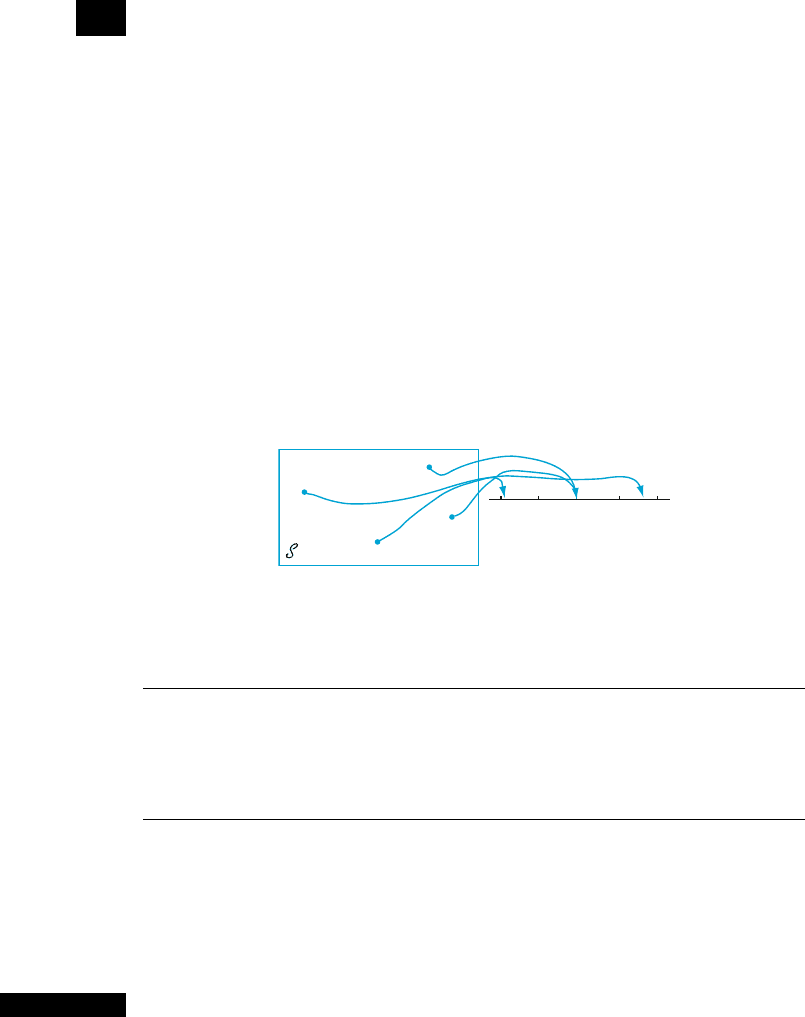
(Figure 3.1).
DEFINITION
For a given sample space S of some experiment, a random variable (rv) is
any rule that associates a number with each outcome in S . In mathematical
language, a random variable is a function whose domain is the sample space
and whose range is the set of real numbers.
Random variables are customarily denoted by uppercase letters, such as X
and Y, near the end of our alphabet. In contrast to our previous use of a lowercase
letter, such as x, to denote a variable, we will now use lowercase letters to represent
some particular value of the corresponding random variable. The notation X(s) ¼ x
means that x is the value associated with the outcome s by the rv X.
Example 3.1 When a student attempts to connect to a university computer syst em, either there is
a failure (F), or there is a success (S). With S ¼ {S , F}, define an rv X by X(S) ¼ 1,
X(F) ¼ 0. The rv X indicates whether (1) or not (0) the student can connect.
■
In Example 3.1, the rv X was specified by explicitly listing each element of S
and the associated number. If S contains more than a few outcomes, such a listing is
tedious, but it can frequently be avoided.
−2 −1120
Figure 3.1 A random variable
3.1 Random Variables 97