
Devore J.L., Berk K.N. Modern Mathematical Statistics with Applications
Подождите немного. Документ загружается.

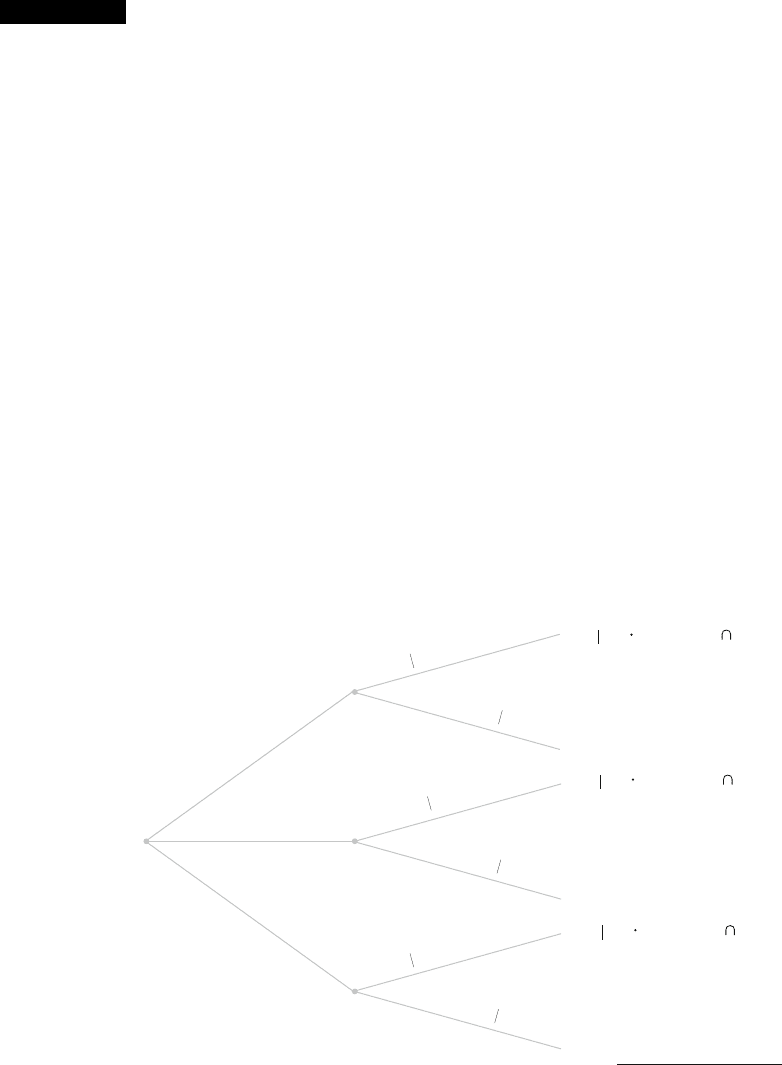
Example 2.29 A chain of video stores sells three different brands of DVD players. Of its DVD
player sales, 50% are brand 1 (the least expensive), 30% are brand 2, and 20% are
brand 3. Each manufacturer offers a 1-year warranty on parts and labor. It is known
that 25% of brand 1’s DVD players require warranty repair work, whereas the
corresponding percentages for brands 2 and 3 are 20% and 10%, respectively.
1. What is the probability that a randomly selected purchaser has bought a
brand 1 DVD player that will need repair while under warranty?
2. What is the probability that a randomly selected purchaser has a DVD
player that will need repair while under warranty?
3. If a customer returns to the store with a DVD player that needs warranty
repair work, what is the probability that it is a brand 1 DVD player? A brand
2 DVD player? A brand 3 DVD player?
The first stage of the problem involves a customer selecting one of the three
brands of DVD player. Let A
i
¼{brand i is purchased}, for i ¼1, 2, and 3. Then
P(A
1
) ¼.50, P(A
2
) ¼.30, and P(A
3
) ¼.20. Once a brand of DVD player is selected,
the second stage involves observing whether the selected DVD player needs warranty
repair. With B ¼{needs repair} and B
0
¼{doesn’t need repair}, the given information
implies that PBjA
1
ðÞ¼:25; PBjA
2
ðÞ¼:20; and PBjA
3
ðÞ¼:10
The tree diagram representing thi s experimental situatio n is shown in
Figure 2.10. The initial branches correspond to different brands of DVD players;
there are two second-generation branches emanating from the tip of each
initial branch, one for “needs repair” and the other for “doesn’t need repair.”
Brand 2
Brand 1
Brand 3
Repair
No repair
Repair
No repair
No repair
Repair
P(A
1
) = .50
P(A
2
) = .30
P(A
3
) = .20
P(B A
3
) = .10
P(B A
2
) = .20
P(B A
1
) = .25
P(B
' A
1
) = .75
P(B
' A
2
) = .80
P(B' A
3
) = .90
P(B A
1
) P(A
1
) = P(B A
1
) = .125
P(B A
2
) P(A
2
) = P(B A
2
) = .060
P(B A
3
) P(A
3
) = P(B A
3
) = .020
P(B) = .205
Figure 2.10 Tree diagram for Example 2.29
78
CHAPTER 2 Probability

The probability P(A
i
) appears on the ith initial branch, whereas the conditional
probabilities P(B | A
i
) and P(B
0
| A
i
) appear on the second-generation branches.
To the right of each second-generation branch corresponding to the occurrence
of B, we display the product of probabilities on the branches leading out to that
point. This is simply the multiplication rule in action. The answer to the
question posed in 1 is thus PðA
1
\ BÞ¼PBjA
1
ÞPA
1
ðÞ¼:125ð . The answer to
question 2 is
PðBÞ¼P brand 1 and repairðÞor brand 2 and repairðÞor brand 3 and repairðÞ½
¼ PðA
1
\B ÞþPðA
2
\B ÞþPðA
3
\B Þ
¼ :125 þ:060 þ:020 ¼:205
Finally,
PðA
1
jBÞ¼
PðA
1
\ BÞ
PðBÞ
¼
:125
:205
¼ :61
PðA
2
jBÞ¼
PðA
2
\ BÞ
PðBÞ
¼
:060
:205
¼ :29
and
PA
3
jBðÞ¼1 PA
1
jBðÞPA
2
jBðÞ¼:10
Notice that the initial or prior probability of brand 1 is .50, whereas once it is
known that the selected DVD player needed repair, the posterior probability of
brand 1 increases to .61. This is because brand 1 DVD players are more likel y to
need warranty repair than are the other brands. The posterior probability of brand 3
is P(A
3
|B) ¼.10 which is much less than the prior probability P(A
3
) ¼.20. ■
Bayes’ Theorem
The computation of a posterior probability P(A
j
|B) from given prior probabilities
P(A
i
) and conditional probabilities P(B | A
i
) occupies a central position in elemen-
tary probability. The general rule for such computations, which is really just
a simple application of the multiplication rule, goes back to the Reverend Thomas
Bayes, who lived in the eighteenth century. To state it we first need another
result. Recall that events A
1
, ... , A
k
are mutually exclusive if no two have any
common outcomes. The events are exhaustive if one A
i
must occur, so that
A
1
[[A
k
¼ S .
THE LAW
OF TOTAL
PROBABILITY
Let A
1
, ... , A
k
be mutually exclusive and exhaustive events. Then for any
other event B,
PðBÞ¼PBjA
1
ðÞPA
1
ð ÞþþPBjA
k
ðÞPA
k
ðÞ
¼
X
k
i¼1
PðB jA
i
ÞPðA
i
Þ
ð2:5Þ
2.4 Conditional Probability 79
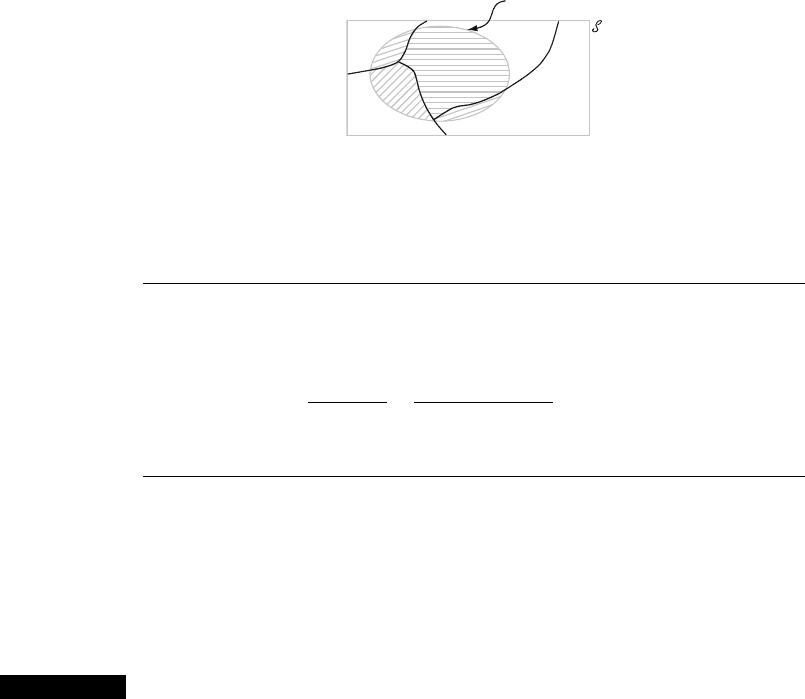
Proof Because the A
i
’s are mutually exclusive and exhaustive, if B occurs it
must be in conjunction with exactly one of the A
i
’s. That is, B ¼(A
1
and B)or...or
(A
k
and B) ¼(A
1
\ B) [ [ (A
k
\ B), where the events (A
i
\ B) are mutually
exclusive. This “partitioning of B” is illustrated in Figure 2.11. Thus
PðBÞ¼
X
k
i¼1
PðA
i
\ BÞ¼
X
k
i¼1
PðB jA
i
ÞPðA
i
Þ
as desired.
An example of the use of Equation (2.5) appeared in answering question 2 of Exam-
ple 2.29, where A
1
¼{brand 1}, A
2
¼{brand 2}, A
3
¼{brand 3}, and B ¼ {repair}.
BAYES’
THEOREM
Let A
1
, ... , A
k
be a collection of mutually exclusive and exhaustive events
with P(A
i
) > 0 for i ¼1, ..., k. Then for any other event B, for which P(B) > 0
PðA
j
jBÞ¼
PðA
j
\ BÞ
PðBÞ
¼
PðB jA
j
ÞPðA
j
Þ
P
k
i¼1
PðB jA
i
ÞPðA
i
Þ
j ¼ 1; ...; k ð2:6Þ
The transition from the second to the third expression in (2.6) rests on using the
multiplication rule in the numerator and the law of total probability in the denominator.
The proliferation of events and subscripts in (2.6) can be a bit intimidating to
probability n ewcomers. As long as there are relatively few events in the partition, a
tree diagram (as in Example 2.29) can be used as a basis for calculating posterior
probabilities without ever referring explicitly to Bayes’ theorem.
Example 2.30 INCIDENCE OF A RARE DISEASE Only 1 in 1000 adults is afflicted with a
rare disease for which a diagnostic test has been developed. The test is such that
when an individual actually has the disease, a positive result will occur 99% of the
time, whereas an individual without the disease will show a positive test result only
2% of the time. If a randomly selected individual is tested and the result is positive,
what is the probability that the individual has the dise ase?
[Note: The sensitivity of this test is 99%, whereas the specificity (how specific
positive results are to the disease) is 98%. As an indication of the accuracy of
medical tests, an article in the October 29, 2010 New York Times reported that the
sensitivity and specificity for a new DNA test for colon cancer were 86% and 93%,
respectively. The PSA test for prostate cancer has sensitivity 85% and specificity
about 30%, while the mammogram for breast cancer has sensitivity 75% and
specificity 92%. All tests are less than perfect.]
A
1
A
2
A
4
A
3
B
Figure 2.11 Partition of
B
by mutually exclusive and exhaustive
A
i
’s ■
80
CHAPTER 2 Probability
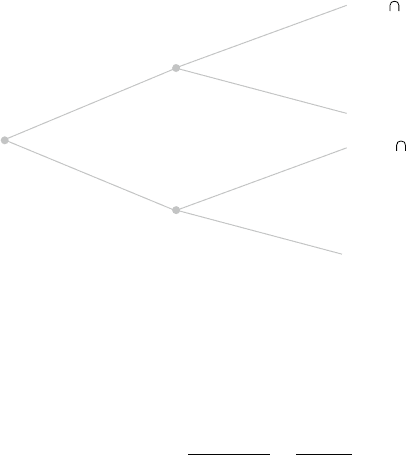
TouseBayes’theorem,letA
1
¼{individual has the disease}, A
2
¼{individual
does not have the disease}, and B ¼{positive test result}. Then PA
1
ðÞ¼:001;
PA
2
ðÞ¼:999; PBjA
1
ðÞ¼:99; and PBjA
2
ðÞ¼:02. The tree diagram for this problem
is in Figure 2.12.
Next to each branch corr esponding to a positive test result, the multiplication
rule yields the recorded probabilities. Therefore, PðBÞ¼: 00099 þ :01998 ¼
:02097, from which we have
PðA
1
jBÞ¼
PðA
1
\ BÞ
PðBÞ
¼
:00099
:02097
¼ :047
This result seems counterintuitive; because the diagnostic test appears so
accurate, we expect som eone with a positive test result to be highly likely to have
the disease, whereas the computed conditional probability is only .047. However,
because the disease is rare and the test only moderately reliable, most positive test
results arise from errors rather than from diseased individuals. The probability of
having the disease has increased by a multiplicative factor of 47 (from prior .001 to
posterior .047); but to get a further increase in the posterior probability, a diagnostic
test with much smaller error rates is needed. If the disease were not so rare (e.g.,
25% incidence in the population), then the error rates for the present test would
provide good diagnoses.
This example shows why it makes sense to be tested for a rar e disease only if
you are in a high-risk group. For example, most of us are at low risk for HIV
infection, so testing would not be indicated, but those who are in a high-risk group
should be tes ted for HIV. For some diseases the degree of risk is strongly influ-
enced by age. Young women are at low risk for breast cancer and should not be
tested, but older women do have increased risk and need to be tested. There is some
argument about where to draw the line. If we can find the incidence rate for our
group and the sensitivity and specificity for the test, then we can do our own
calculation to see if a positive test result would be informative.
■
An important contemporary application of Bayes’ theorem is in the identifi-
cation of spam e-mail messages. A nice expository article on this appears in
Statistics: A Guide to the Unknown (see the Chapter 1 bibliography).
A
1
= Has disease
A
2
= Doesn't have disease
.001
.999
.02
.98
.01
.99
B = +Test
B = +Test
B
'
= −
Test
B
'
= −
Test
P(A
1
B) = .00099
P(A
2
B) = .01998
Figure 2.12 Tree diagram for the rare-disease problem
2.4 Conditional Probability 81

Exercises Section 2.4 (45–65)
45. The population of a particular country consists of
three ethnic groups. Each individual belongs to
one of the four major blood groups. The accom-
panying joint probability table gives the pro-
portions of individuals in the various ethnic
group–blood group combinations.
Blood Group
Ethnic Group O A B AB
1 .082 .106 .008 .004
2 .135 .141 .018 .006
3 .215 .200 .065 .020
Suppose that an individual is randomly selected
from the population, and define events by A ¼
{type A selected}, B ¼{type B selected}, and
C ¼{ethnic group 3 selected}.
a. Calculate P(A), P(C), and P(A \ C).
b. Calculate both P(A | C) and P(C | A) and
explain in context what each of these probabil-
ities represents.
c. If the selected individual does not have type B
blood, what is the probability that he or she is
from ethnic group 1?
46. Suppose an individual is randomly selected from
the population of all adult males living in the
United States. Let A be the event that the selected
individual is over 6 ft in height, and let B be the
event that the selected individual is a professional
basketball player. Which do you think is larger,
P(A | B)orP(B | A)? Why?
47. Return to the credit card scenario of Exercise 14
(Section 2.2), where A ¼{Visa}, B ¼{Master-
Card}, P(A)
¼.5, P(B) ¼.4, and P(A \ B) ¼ .25.
Calculate and interpret each of the following prob-
abilities (a Venn diagram might help).
a. PBjAðÞ
b. PB
0
jAðÞ
c. PAjBðÞ
d. PA
0
jBðÞ
e. Given that the selected individual has at least
one card, what is the probability that he or she
has a Visa card?
48. Reconsider the system defect situation described
in Exercise 28 (Section 2.2).
a. Given that the system has a type 1 defect, what
is the probability that it has a type 2 defect?
b. Given that the system has a type 1 defect, what
is the probability that it has all three types of
defects?
c. Given that the system has at least one type of
defect, what is the probability that it has
exactly one type of defect?
d. Given that the system has both of the first two
types of defects, what is the probability that it
does not have the third type of defect?
49. If two bulbs are randomly selected from the box of
lightbulbs described in Exercise 40 (Section 2.3)
and at least one of them is found to be rated 75 W,
what is the probability that both of them are 75-W
bulbs? Given that at least one of the two selected is
not rated 75 W, what is the probability that both
selected bulbs have the same rating?
50. A department store sells sport shirts in three sizes
(small, medium, and large), three patterns (plaid,
print, and stripe), and two sleeve lengths (long and
short). The accompanying tables give the propor-
tions of shirts sold in the various category combi-
nations.
Short-sleeved
Pattern
Size Pl Pr St
S .04 .02 .05
M .08 .07 .12
L .03 .07 .08
Long-sleeved
Pattern
Size Pl Pr St
S .03 .02 .03
M .10 .05 .07
L .04 .02 .08
a. What is the probability that the next shirt sold
is a medium, long-sleeved, print shirt?
b. What is the probability that the next shirt sold
is a medium print shirt?
c. What is the probability that the next shirt
sold is a short-sleeved shirt? A long-sleeved
shirt?
82
CHAPTER 2 Probability
d. What is the probability that the size of the next
shirt sold is medium? That the pattern of the
next shirt sold is a print?
e. Given that the shirt just sold was a short-
sleeved plaid, what is the probability that its
size was medium?
f. Given that the shirt just sold was a medium
plaid, what is the probability that it was short-
sleeved? Long-sleeved?
51. One box contains six red balls and four green
balls, and a second box contains seven red balls
and three green balls. A ball is randomly chosen
from the first box and placed in the second box.
Then a ball is randomly selected from the second
box and placed in the first box.
a. What is the probability that a red ball is
selected from the first box and a red ball is
selected from the second box?
b. At the conclusion of the selection process,
what is the probability that the numbers of
red and green balls in the first box are identical
to the numbers at the beginning?
52. A system consists of two identical pumps, #1
and #2. If one pump fails, the system will still
operate. However, because of the added strain,
the extra remaining pump is now more likely
to fail than was originally the case. That is,
r ¼P(#2 fails j#1 fails) > P(#2 fails) ¼q.Ifat
least one pump fails by the end of the pump
design life in 7% of all systems and both pumps
fail during that period in only 1%, what is the
probability that pump #1 will fail during the
pump design life?
53. A certain shop repairs both audio and video com-
ponents. Let A denote the event that the next
component brought in for repair is an audio com-
ponent, and let B be the event that the next com-
ponent is a compact disc player (so the event B is
contained in A). Suppose that P(A) ¼.6 and
P(B) ¼.05. What is P(B | A)?
54. In Exercise 15, A
i
¼{awarded project i}, for i ¼1,
2, 3. Use the probabilities given there to compute
the following probabilities:
a. PA
2
jA
1
ðÞ
b. PðA
2
\ A
3
jA
1
Þ
c. PðA
2
[ A
3
jA
1
Þ
d. PðA
1
\ A
2
\ A
3
jA
1
[ A
2
[ A
3
Þ
Express in words the probability you have
calculated.
55. For any events A and B with P(B) > 0, show that
P(A | B)+P(A
0
| B) ¼1.
56. If P(B | A) > P(B) show that P(B
0
| A) < P(B
0
).
[Hint: Add P(B
0
| A) to both sides of the given
inequality and then use the result of Exercise 55.]
57. Show that for any three events A, B, and C with
P(C) > 0, P(A [ B | C) ¼P(A | C)+P(B | C)
P(A \ B | C ).
58. At a gas station, 40% of the customers use regular
gas (A
1
), 35% use mid-grade gas (A
2
), and 25%
use premium gas (A
3
). Of those customers using
regular gas, only 30% fill their tanks (event B).
Of those customers using mid-grade gas, 60% fill
their tanks, whereas of those using premium, 50%
fill their tanks.
a. What is the probability that the next customer
will request mid-grade gas and fill the tank
(A
2
\ B)?
b. What is the probability that the next customer
fills the tank?
c. If the next customer fills the tank, what is the
probability that regular gas is requested? mid-
grade gas? Premium gas?
59. Seventy percent of the light aircraft that disappear
while in flight in a certain country are subsequently
discovered. Of the aircraft that are discovered, 60%
have an emergency locator, whereas 90% of the
aircraft not discovered do not have such a locator.
Suppose a light aircraft has disappeared.
a. If it has an emergency locator, what is the
probability that it will not be discovered?
b. If it does not have an emergency locator, what
is the probability that it will be discovered?
60. Components of a certain type are shipped to a
supplier in batches of ten. Suppose that 50% of
all such batches contain no defective components,
30% contain one defective component, and 20%
contain two defective components. Two compo-
nents from a batch are randomly selected and
tested. What are the probabilities associated with
0, 1, and 2 defective components being in the
batch under each of the following conditions?
a. Neither tested component is defective.
b. One of the two tested components is defective.
[Hint: Draw a tree diagram with three first-
generation branches for the three different
types of batches.]
61. Show that P(A \ B | C) ¼P(A | B \ C) P(B | C).
2.4 Conditional Probability 83

62. For customers purchasing a full set of tires at a
particular tire store, consider the events
A ¼{tires purchased were made in the United
States}
B ¼{purchaser has tires balanced immediately}
C ¼{purchaser requests front-end alignment}
along with A
0
, B
0
, and C
0
. Assume the following
unconditional and conditional probabilities:
PðAÞ¼:75 PBjAðÞ¼:9 PBjA
0
ðÞ¼:8
PðCjA \ BÞ¼:8 PðCjA \ B
0
Þ¼:6
PðCjA
0
\ BÞ¼:7 PðCjA
0
\ B
0
Þ¼:3
a. Construct a tree diagram consisting of first-,
second-, and third-generation branches and
place an event label and appropriate probabil-
ity next to each branch.
b. Compute P ð A \ B \ CÞ.
c. Compute PðB \ CÞ
d. Compute P ð CÞ.
e. Compute PðA jB \ CÞ the probability of a pur-
chase of U.S. tires given that both balancing
and an alignment were requested.
63. A professional organization (for statisticians, of
course) sells term life insurance and major medical
insurance. Of those who have just life insurance,
70% will renew next year, and 80% of those with
only a major medical policy will renew next year.
However, 90% of policyholders who have both types
of policy will renew at least one of them next year.
Of the policy holders 75% have term life insurance,
45% have major medical, and 20% have both.
a. Calculate the percentage of policyholders that
will renew at least one policy next year.
b. If a randomly selected policy holder does in
fact renew next year, what is the probability
that he or she has both life and major medical
insurance?
64. At a large university, in the never-ending quest for
a satisfactory textbook, the Statistics Department
has tried a different text during each of the last
three quarters. During the fall quarter, 500 stu-
dents used the text by Professor Mean; during
the winter quarter, 300 students used the text by
Professor Median; and during the spring quarter,
200 students used the text by Professor Mode.
A survey at the end of each quarter showed that
200 students were satisfied with Mean’s book, 150
were satisfied with Median’s book, and 160 were
satisfied with Mode’s book. If a student who took
statistics during one of these quarters is selected at
random and admits to having been satisfied with
the text, is the student most likely to have used the
book by Mean, Median, or Mode? Who is the least
likely author? [Hint: Draw a tree-diagram or use
Bayes’ theorem.]
65. A friend who lives in Los Angeles makes frequent
consulting trips to Washington, D.C.; 50% of the
time she travels on airline #1, 30% of the time on
airline #2, and the remaining 20% of the time on
airline #3. For airline #1, flights are late into D.C.
30% of the time and late into L.A. 10% of the
time. For airline #2, these percentages are 25%
and 20%, whereas for airline #3 the percentages
are 40% and 25%. If we learn that on a particular
trip she arrived late at exactly one of the two
destinations, what are the posterior probabilities
of having flown on airlines #1, #2, and #3?
Assume that the chance of a late arrival in L.A.
is unaffected by what happens on the flight to D.C.
[Hint: From the tip of each first-generation branch
on a tree diagram, draw three second-generation
branches labeled, respectively, 0 late, 1 late, and
2 late.]
2.5
Independence
The definition of conditional probability enables us to revise the probability P(A)
originally assigned to A when we are subsequently informed that another event B
has occurred; the new probability of A is P(A | B). In our examples, it was frequently
the case that P(A | B) was unequal to the unconditional probability P(A), indicating
that the information “ B has occurred” resulted in a change in the chance of A
occurring. There are other situations, though, in which the chance that A will
occur or has occur red is not affected by knowledge that B has occurred, so that
P(A | B) ¼P(A). It is then natural to think of A and B as independent events,
meaning that the occurrence or nonoccurrence of one event has no bearing on the
chance that the other will occur.
84 CHAPTER 2 Probability
DEFINITION
Two events A and B are independent if PAjBðÞ¼PðAÞ and are dependent
otherwise.
The definition of independence might seem “unsymmetrical” because we do
not demand that PBjAðÞ¼PðBÞ also. However, using the definition of condi tional
probability and the multiplication rule,
PðB jAÞ¼
PðA \ BÞ
PðAÞ
¼
PðA jBÞ P ðBÞ
PðAÞ
ð2:7Þ
The right-hand side of Equation (2.7) is P(B) if and only if PAjBðÞ¼PðAÞ
(independence), so the equal ity in the definition implies the other equality (and vice
versa). It is also straightforward to show that if A and B are independent, then so are
the following pairs of events: (1) A
0
and B, (2) A and B
0
, and (3) A
0
and B
0
.
Example 2.31 Consider an ordinary deck of 52 cards comprised of the four “suits” spades, hearts,
diamonds, and clubs, with each suit consisting of the 13 denominations ace, king,
queen, jack, ten, ..., and two. Suppose someone rando mly sel ects a card from the
deck and reveals to you that it is a face card (that is, a king, queen, or jack). What
now is the probability that the card is a spade? If we let A ¼{spade} and B ¼{face
card}, then P(A) ¼13/52, P(B) ¼12/52 (there are three face cards in each of the
four suits), and P(A \ B) ¼P(spade and face card) ¼3/52. Thus
PðA jBÞ¼
PðA \ BÞ
PðBÞ
¼
3=52
12=52
¼
3
12
¼
1
4
¼
13
52
¼ PðAÞ
Therefore, the likelihood of getting a spade is not affected by knowledge that
a face card had been selected. Intuitively this is because the fraction of spades
among face cards (3 out of 12) is the same as the fraction of spades in the entire
deck (13 out of 52). It is also easily verified that P(B | A) ¼P(B), so knowledge that
a spade has been selected does not affect the likelihood of the card being a jack,
queen, or king.
■
Example 2.32 Let A and B be any two mutually exclusi ve events with P(A) > 0. For example, for a
randomly chosen automobile, let A ¼{car is blue} and B ¼{car is red}. Since the
events are mutually exclusive, if B occurs, then A cannot possibly have occurred, so
P(A | B) ¼0 6¼P(A). The message here is that if two events are mutually exclusive,
they cannot be independent. When A and B are mutually exclusive, the information
that A occurred says something about B (it cannot have occurred), so independence
is precluded.
■
P(A \ B) When Events Are Independent
Frequently the nature of an experiment suggests that two events A and B should be
assumed independent. This is the case, for example, if a manufacturer receives
a circuit board from each of two different suppliers, each board is tested on
arrival, and A ¼{first is defective} and B ¼{second is defective}. If P(A) ¼.1,
2.5 Independence 85

it should also be the case that P(A | B) ¼.1; knowing the condition of the second
board shouldn’t provide information about the condition of the first. Our next result
shows how to compute P(A \ B) when the events are independent.
PROPOSITION
A and B are independent if and only if
PðA \ BÞ¼PðAÞPð BÞð2:8Þ
To paraphrase the proposition, A and B are independent events iff
1
the
probability that they both occur (A \ B) is the product of the two individual
probabilities. The verification is as follows:
PðA \ BÞ¼PAjBðÞPðBÞ¼PðAÞPðBÞð2:9Þ
where the second equality in Equation (2.9) is valid iff A and B are independent.
Because of the equivalence of independence with Equation (2.8), the latter can be
used as a definition of independence.
2
Example 2.33 It is known that 30% of a certain company’s washing machines require service
while under warranty, whereas only 10% of its dryers need such service. If
someone purchases both a washer and a dryer made by this company, what is the
probability that both machines need warranty service?
Let A denote the event that the washer needs service while under warranty,
and let B be defined analogously for the dryer. Then P(A) ¼.30 and P(B) ¼.10.
Assuming that the two machines function independently of each other, the desired
probability is
PðA \ BÞ¼PðAÞPðBÞ¼ :30ðÞ:10ðÞ¼:03
The probability that neither machine needs service is
PðA
0
\ B
0
Þ¼PA
0
ðÞPB
0
ðÞ¼:70ðÞ:90ðÞ¼:63
Note that, although the independence assumption is reasonable here, it can be
questioned. In particular, if heavy usage causes a breakdown in one machine,
it could also cause trouble for the other one.
■
Example 2.34 Each day, Monday through Friday, a batch of components sent by a first supplier
arrives at a certain inspection facility. Two days a week, a batch also arrives from a
second supplier. Eighty percent of all supplier 1’s batches pass inspection, and 90%
of supplier 2’s do likewise. What is the probability that, on a randomly selected day,
two batches pass inspection? We will answer this assuming that on days when two
1
Iff is an abbreviation for “if and only if.”
2
However, the multiplication property is satisfied if P(B) ¼0, yet P(A|B) is not defined in this case. To
make the multiplication property completely equivalent to the definition of independence, we should
append to that definition that A and B are also independent if either P(A) ¼0orP(B) ¼0.
86 CHAPTER 2 Probability
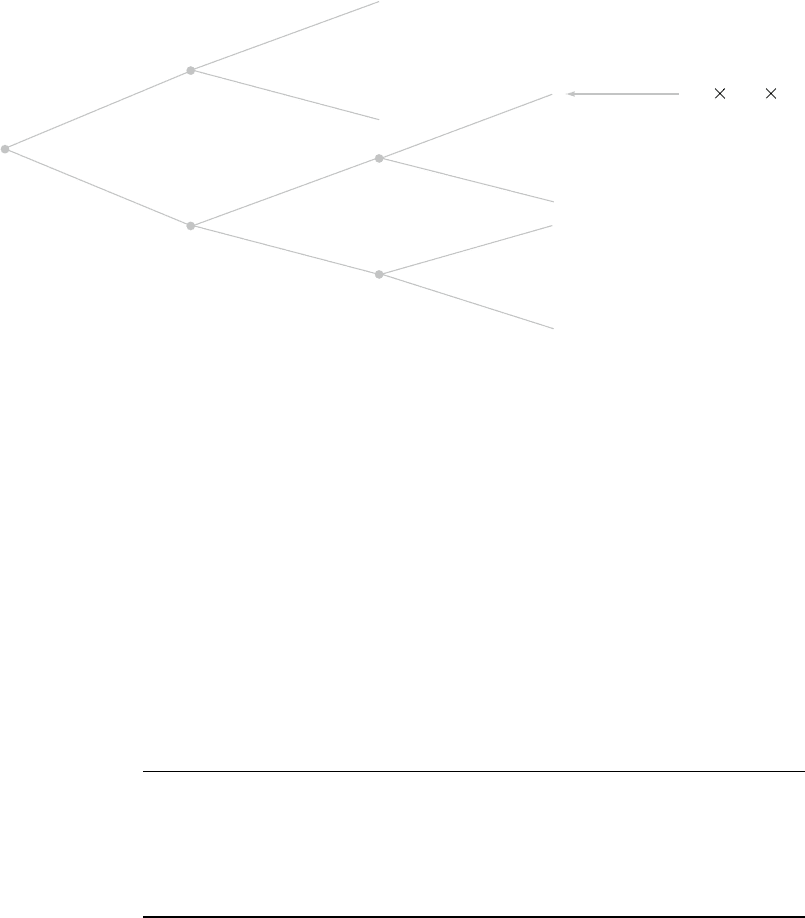
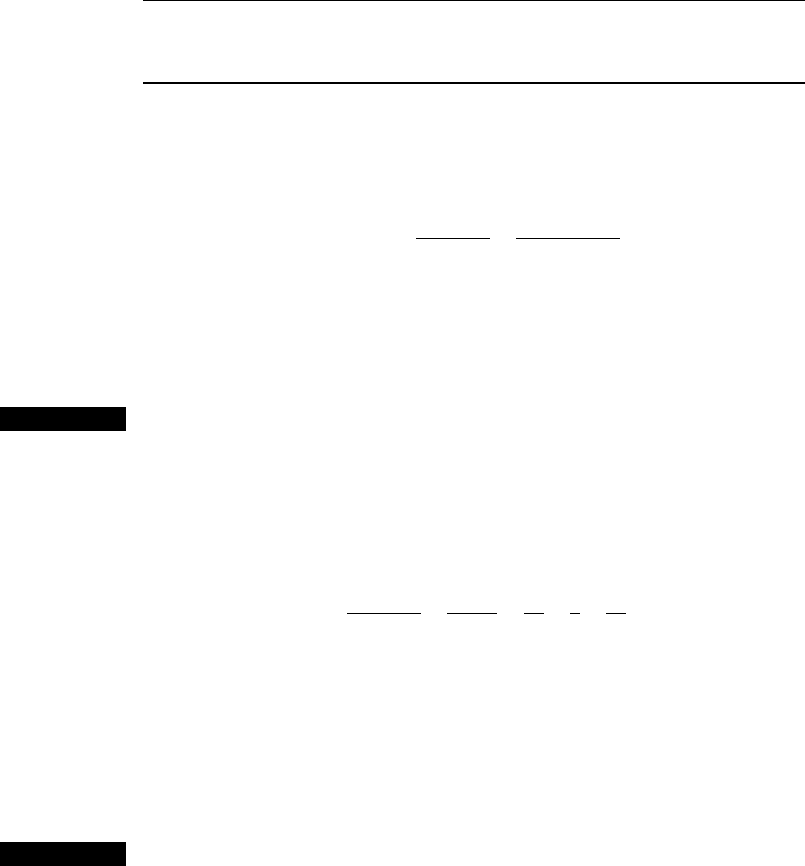
batches are tested, whether the first batch passes is independent of whether the
second batch does so. Figure 2.13 displays the relevant information.
P two passðÞ¼Pðtwo received \ both passÞ
¼ P both pass jtwo receivedðÞP two receivedðÞ
¼ :8ðÞ:9ðÞ½:4ðÞ¼:288
■
Independence of More Than Two Events
The notion of independence of two events can be extended to collections of
more than two events. Although it is possible to extend the definition for two
independent events by working in terms of conditional and unconditional prob-
abilities, it is more direct and less cumbersome to proceed along the lines of the
last proposition.
DEFINITION
Events A
1
, ..., A
n
are mutually independent if for every k (k ¼2, 3, ..., n)
and every subset of indices i
1
, i
2
, ... , i
k
,
PðA
i
1
\ A
i
2
\\A
i
k
Þ¼PðA
i
1
ÞPðA
i
2
ÞPðA
i
k
Þ
To paraphrase the definition, the events are mutually independent if the
probability of the intersection of any subset of the n events is equal to the product
of the individual probabilities. As was the case with two events, we frequently
specify at the outset of a problem the independence of certain events. The definition
can then be used to calculate the probability of an intersection.
2 batches
1 batch
.6
.4
.8
1st passes
.2
1st fails
.2
Fails
.8
Passes
.9
2nd passes
.1
2nd fails
.9
2nd passes
.1
2nd fails
.4 (.8 .9)
Figure 2.13 Tree diagram for Example 2.34
2.5 Independence 87