
Devore J.L., Berk K.N. Modern Mathematical Statistics with Applications
Подождите немного. Документ загружается.


More generally, the probability that X falls in a specified interval is easily obtained
from the cdf. For example,
Pð2 X 4Þ¼p 2ðÞþp 3ðÞþp 4ðÞ
¼ pð0Þþþp 4ðÞ½pð0Þþp 1ðÞ½
¼ PðX 4ÞPðX 1Þ
¼ Fð4ÞFð1Þ
Notice that P(2 X 4) 6¼ F (4) F(2). This is because the X value 2 is
includedin2 X 4, so we do not want to subtract out its probability. How-
ever, P(2 < X 4) ¼ F(4) F(2) because X ¼ 2 i s not included in the interval
2 < X
4.
PROPOSITION
For any two numbers a and b with a b,
Pða X bÞ¼FðbÞFaðÞ
where F(a) represents the maximum of F(x) values to the left of a.
Equivalently, if a is the limit of values of x approaching from the left, then
F(a) is the limiting value of F(x). In particular, if the only possible values
are integers and if a and b are integers, then
Pða X bÞ¼PX¼ a or a þ 1or...or bðÞ
¼ FðbÞFa 1ðÞ
Taking a ¼ b yields P(X ¼ a) ¼ F(a)
F(a 1) in this case.
The reason for subtracting F(a) rather than F(a) is that we want to include
P(X ¼ a); F(b) F(a) gives P(a < X b). This proposition will be used
extensively when computing binomial and Poisson probabilities in Sects. 3.5
and 3.7.
Example 3.13 Let X ¼ the number of days of sick leave taken by a randomly selected employee
of a large company during a particular year. If the maximum number of allowable
sick days per year is 14, possible values of X are 0, 1, ... , 14. With F(0) ¼ .58,
F(1) ¼ .72, F(2) ¼ .76, F(3) ¼ .81, F(4) ¼ .88, and F (5) ¼ .94,
Pð2 X 5Þ¼PðX ¼ 2; 3; 4; or 5Þ¼Fð5ÞFð1Þ¼:22
and
PðX ¼ 3Þ¼Fð3ÞFð2Þ¼:05
■
108 CHAPTER 3 Discrete Random Variables and Probability Distributions
Another View of Probability Mass Functions
It is often helpful to think of a pmf as specifying a mathematical model for a
discrete population.
Example 3.14 Consider selecting at random a stud ent who is among the 15,000 registered for the
current term at Mega University. Let X ¼ the number of courses for which the
selected student is registered, and suppose that X has the following pmf:
x 1 234567
p(x) .01 .03 .13 .25 .39 .17 .02
One way to view this situation is to think of the population as consisting of 15,000
individuals, each having his or her own X value; the proportion with each X value
is given by p(x). An alternative viewpoint is to forget about the students and think
of the population itself as consisting of the X values: There are some 1’s in the
population, some 2’s, ... , and finally some 7’s. The population then consists of
the numbers 1, 2, ..., 7 (so is discrete), and p(x) gives a model for the distribution
of population values.
■
Once we have such a population model, we will use it to compute valu es of
population characteristics (e.g., the mean m) and make inferences about such
characteristics.
Exercises Section 3.2 (11–27)
11. Let X be the number of students who show up at
a professor’s office hours on a particular day.
Suppose that the only possible values of X are
0, 1, 2, 3, and 4, and that p(0) ¼ .30, p(1) ¼ .25,
p(2) ¼ .20, and p(3) ¼ .15.
a. What is p(4)?
b. Draw both a line graph and a probability
histogram for the pmf of X.
c. What is the probability that at least two stu-
dents come to the office hour? What is the
probability that more than two students come
to the office hour?
d. What is the probability that the professor
shows up for his office hour?
12. Airlines sometimes overbook flights. Suppose
that for a plane with 50 seats, 55 passengers
have tickets. Define the random variable Y as
the number of ticketed passengers who actually
show up for the flight. The probability mass
function of Y appears in the accompanying table.
y 45 46 47 48 49 50 51 52 53 54 55
p(y) .05 .10 .12 .14 .25 .17 .06 .05 .03 .02 .01
a. What is the probability that the flight will
accommodate all ticketed passengers who
show up?
b. What is the probability that not all ticketed pas-
sengers who show up can be accommodated?
c. If you are the first person on the standby list
(which means you will be the first one to get on
the plane if there are any seats available after all
ticketed passengers have been accommodated),
what is the probability that you will be able to
take the flight? What is this probability if you
are the third person on the standby list?
13. A mail-order computer business has six tele-
phone lines. Let X denote the number of lines in
use at a specified time. Suppose the pmf of X is as
given in the accompanying table.
x 0 123456
p(x) .10 .15 .20 .25 .20 .06 .04
Calculate the probability of each of the following
events.
a. {at most three lines are in use}
3.2 Probability Distributions for Discrete Random Variables 109

b. {fewer than three lines are in use}
c. {at least three lines are in use}
d. {between two and five lines, inclusive, are in
use}
e. {between two and four lines, inclusive, are
not in use}
f. {at least four lines are not in use}
14. A contractor is required by a county planning
department to submit one, two, three, four, or
five forms (depending on the nature of the proj-
ect) in applying for a building permit. Let Y ¼
the number of forms required of the next appli-
cant. The probability that y forms are required is
known to be proportional to y—that is, p(y) ¼ ky
for y ¼ 1, ... ,5.
a. What is the value of k?[Hint:
P
5
y¼1
pðyÞ¼1.]
b. What is the probability that at most three
forms are required?
c. What is the probability that between two and
four forms (inclusive) are required?
d. Could p(y) ¼ y
2
/50 for y ¼ 1, ... , 5 be the
pmf of Y?
15. Many manufacturers have quality control
programs that include inspection of incoming
materials for defects. Suppose a computer manu-
facturer receives computer boards in lots of five.
Two boards are selected from each lot for inspec-
tion. We can represent possible outcomes of the
selection process by pairs. For example, the pair
(1, 2) represents the selection of boards 1 and
2 for inspection.
a. List the ten different possible outcomes.
b. Suppose that boards 1 and 2 are the only
defective boards in a lot of five. Two boards
are to be chosen at random. Define X to be the
number of defective boards observed among
those inspected. Find the probability distribu-
tion of X.
c. Let F(x) denote the cdf of X. First determine
F(0) ¼ P(X 0), F(1), and F(2), and then
obtain F(x) for all other x.
16. Some parts of California are particularly earth-
quake-prone. Suppose that in one such area, 30%
of all homeowners are insured against earth-
quake damage. Four homeowners are to be
selected at random; let X denote the number
among the four who have earthquake insurance.
a. Find the probability distribution of X.[Hint:
Let S denote a homeowner who has insurance
and F one who does not. One possible out-
come is SFSS, with probability (.3)(.7)(.3)(.3)
and associated X value 3. There are 15 other
outcomes.]
b. Draw the corresponding probability histogram.
c. What is the most likely value for X?
d. What is the probability that at least two of
the four selected have earthquake insurance?
17. A new battery’s voltage may be acceptable (A)or
unacceptable (U). A certain flashlight requires
two batteries, so batteries will be independently
selected and tested until two acceptable ones
have been found. Suppose that 90% of all bat-
teries have acceptable voltages. Let Y denote the
number of batteries that must be tested.
a. What is p(2), that is, P (Y ¼ 2)?
b. What is p(3)? [Hint: There are two different
outcomes that result in Y ¼ 3.]
c. To have Y ¼ 5, what must be true of the fifth
battery selected? List the four outcomes for
which Y ¼ 5 and then determine p(5).
d. Use the pattern in your answers for parts
(a)–(c) to obtain a general formula for p(y).
18. Two fair six-sided dice are tossed independently.
Let M ¼ the maximum of the two tosses [thus
M(1, 5) ¼ 5, M(3, 3) ¼ 3, etc.].
a. What is the pmf of M?[Hint: First determine
p(1), then p(2), and so on.]
b. Determine the cdf of M and graph it.
19. Suppose that you read through this year’s issues
of the New York Times and record each number
that appears in a news article—the income of a
CEO, the number of cases of wine produced by a
winery, the total charitable contribution of a pol-
itician during the previous tax year, the age of a
celebrity, and so on. Now focus on the leading
digit of each number, which could be 1, 2, ...,8,
or 9. Your first thought might be that the leading
digit X of a randomly selected number would be
equally likely to be one of the nine possibilities
(a discrete uniform distribution). However, much
empirical evidence as well as some theoretical
arguments suggest an alternative probability dis-
tribution called Benford’s law:
pðxÞ¼P 1st digit is xðÞ¼log
10
x þ 1
x
;
x ¼ 1; 2; ::: ; 9
a. Without computing individual probabilities
from this formula, show that it specifies a
legitimate pmf.
b. Now compute the individual probabilities and
compare to the corresponding discrete
uniform distribution.
110
CHAPTER 3 Discrete Random Variables and Probability Distributions

c. Obtain the cdf of X.
d. Using the cdf, what is the probability that the
leading digit is at most 3? At least 5?
[Note: Benford’s law is the basis for some auditing
procedures used to detect fraud in financial report-
ing—for example, by the Internal Revenue Ser-
vice.]
20. A library subscribes to two different weekly news
magazines, each of which is supposed to arrive
in Wednesday’s mail. In actuality, each one
may arrive on Wednesday, Thursday, Friday, or
Saturday. Suppose the two arrive independently
of one another, and for each one P(Wed.) ¼ .3,
P(Thurs.) ¼ .4, P(Fri.) ¼ .2, and P(Sat.) ¼ .1.
Let Y ¼ the number of days beyond Wednesday
that it takes for both magazines to arrive (so
possible Y values are 0, 1, 2, or 3). Compute the
pmf of Y.[Hint: There are 16 possible outcomes;
Y(W, W) ¼ 0, Y(F, Th) ¼ 2, and so on.]
21. Refer to Exercise 13, and calculate and graph the
cdf F(x). Then use it to calculate the probabilities of
the events given in parts (a)–(d) of that problem.
22. A consumer organization that evaluates new auto-
mobiles customarily reports the number of major
defects in each car examined. Let X denote the
number of major defects in a randomly selected
car of a certain type. The cdf of X is as follows:
FðxÞ¼
0 x < 0
:06 0 x < 1
:19 1 x <
2
:39 2 x < 3
:67 3 x < 4
:92 4 x < 5
:97 5 x < 6
16 x
8
>
>
>
>
>
>
>
>
>
>
>
>
>
>
<
>
>
>
>
>
>
>
>
>
>
>
>
>
>
:
Calculate the following probabilities directly from
the cdf:
a. p(2), that is, P(X ¼ 2)
b. P(X > 3)
c. P(2 X 5)
d. P(2 < X < 5)
23. An insurance company offers its policyholders a
number of different premium payment options.
For a randomly selected policyholder, let X ¼ the
number of months between successive payments.
The cdf of X is as follows:
FðxÞ¼
0 x < 1
:30 1 x < 3
:40 3 x < 4
:45 4 x <
6
:60 6 x < 12
112 x
8
>
>
>
>
>
>
>
>
>
<
>
>
>
>
>
>
>
>
>
:
a. What is the pmf of X?
b. Using just the cdf, compute P(3 X 6) and
P(4 X).
24. In Example 3.10, let Y ¼ the number of girls born
before the experiment terminates. With p ¼ P(B)and
1 p ¼ P(G), what is the pmf of Y?[Hint: First
list the possible values of Y, starting with the smallest,
and proceed until you see a general formula.]
25. Alvie Singer lives at 0 in the accompanying dia-
gram and has four friends who live at A, B, C, and
D. One day Alvie decides to go visiting, so he
tosses a fair coin twice to decide which of the four
to visit. Once at a friend’s house, he will either
return home or else proceed to one of the two
adjacent houses (such as 0, A,orC when at B),
with each of the three possibilities having proba-
bility 1=3. In this way, Alvie continues to visit
friends until he returns home.
B
C
A
D
0
a. Let X ¼ the number of times that Alvie visits a
friend. Derive the pmf of X.
b. Let Y ¼ the number of straight-line segments
that Alvie traverses (including those leading to
and from 0). What is the pmf of Y?
c. Suppose that f emale friends live at A and C and
male friends at B and D.IfZ ¼ the number of
visits to female friends, what is the pmf of Z?
26. After all students have left the classroom, a statis-
tics professor notices that four copies of the text
were left under desks. At the beginning of the next
lecture, the professor distributes the four books in
a completely random fashion to each of the four
students (1, 2, 3, and 4) who claim to have left
books. One possible outcome is that 1 receives 2’s
book, 2 receives 4’s book, 3 receives his or her
own book, and 4 receives 1’s book. This outcome
can be abbreviated as (2, 4, 3, 1).
3.2 Probability Distributions for Discrete Random Variables 111

a. List the other 23 possible outcomes.
b. Let X denote the number of students who receive
their own book. Determine the pmf of X.
27. Show that the cdf F(x) is a nondecreasing func-
tion; that is, x
1
< x
2
implies that F(x
1
) F(x
2
).
Under what condition will F(x
1
) ¼ F(x
2
)?
3.3
Expected Values of Discrete
Random Variables
In Example 3.14, we considered a university having 15,000 students and let X ¼
the number of courses for which a randomly selected student is registered . The pmf
of X follows. Since p(1) ¼ .01, we know that (.01) · (15,000) ¼ 150 of the students
are registered for one course, and similarly for the other x valu es.
x 1234567
p(x) .01 .03 .13 .25 .39 .17 .02 (3.6)
Number re
g
istered 150 450 1950 3750 5850 2550 300
To compute the average number of courses per student, or the average value
of X in the population, we should calculate the total number of courses and divide
by the total number of students. Since each of 150 students is taking one course,
these 150 contribute 150 courses to the total. Similarly, 450 students contribute
2(450) courses, and so on. The population average value of X is then
1ð150Þþ2ð450Þþ3ð1950 Þþþ7ð300Þ
15; 000
¼ 4:57 ð3:7Þ
Since 150/15,000 ¼ .01 ¼ p(1), 450/15,000 ¼ .03 ¼ p(2), and so on, an alterna-
tive expression for (3.7)is
1 p 1ðÞþ2 p 2ðÞþþ7 p 7ðÞ ð3:8Þ
Expression (3.8) shows that to compute the population average value of X,
we need only the possible values of X along with their probabilities (proportions).
In particular, the population size is irrelevant as long as the pmf is given by (3.6).
The average or mean value of X is then a weighted average of the possible values
1, ... , 7, where the weights are the probabilities of those values.
The Expected Value of X
DEFINITION
Let X be a discrete rv with set of possible values D and pmf p(x).
The expected value or mean value of X, denoted by E(X)orm
X
,is
EðXÞ¼m
X
¼
X
x 2 D
x pðxÞ
This expected value will exist provided that
P
x2D
jxjpðxÞ < 1
112 CHAPTER 3 Discrete Random Variables and Probability Distributions
When it is clear to which X the expected value refers, m rather than m
X
is
often used.
Example 3.15 For the pmf in (3.6),
m ¼ 1 p 1ðÞþ2 p 2ðÞþþ7 p 7ðÞ
¼ 1ðÞ:01ðÞþ2ðÞ:03ðÞþþ7ðÞ:02ðÞ
¼ :01 þ :06 þ :39 þ 1:00 þ 1:95 þ 1:02 þ :14 ¼ 4:57
If we think of the population as consisting of the X values 1, 2, ..., 7, then m ¼ 4.57
is the population mean. In the sequel, we will often refer to m as the population
mean rather than the mean of X in the population.
■
In Example 3.15, the expected value m was 4.57, which is not a possible value
of X. The word expected should be interpreted with caution because one would not
expect to see an X value of 4.57 whe n a single student is selected.
Example 3.16 Just after birth, each newborn child is rated on a scale called the Apgar scale. The
possible ratings are 0, 1, ... , 10, with the child’s rating determined by color,
muscle tone, respiratory effort, heartbeat, and reflex irritability (the best possible
score is 10). Let X be the Apgar score of a randomly selected child born at a certain
hospital during the next year, and suppose that the pmf of X is
x 0 1 2 3 45678910
p(x) .002 .001 .002 .005 .02 .04 .18 .37 .25 .12 .01
Then the mean value of X is
EðX Þ¼ m ¼ð0Þ :002ðÞþ1ðÞ:001ðÞþþ8ðÞ:25ðÞþ9ðÞ:12ðÞþ10ðÞ:01ðÞ
¼ 7:15
Again, m is not a possible value of the variable X. Also, because the variable refers
to a future child, there is no concrete existing population to which m refers. Instead,
we think of the pmf as a model for a conceptual population consisting of the values
0, 1, 2, ..., 10. The mean value of this conceptual population is then m ¼ 7.15.
■
Example 3.17 Let X ¼ 1 if a randomly selected component needs warranty service and ¼ 0
otherwise. Then X is a Bernoulli rv with pmf
pðxÞ¼
1 px¼ 0
px¼ 1
0 x 6¼ 0; 1
8
>
<
>
:
from which E(X) ¼ 0 ·p(0) + 1 ·p(1) ¼ 0(1 p) + 1(p) ¼ p. That is, the
expected value of X is just the probability that X takes on the value 1. If we
conceptualize a population consisting of 0’s in proportion 1 p and 1’s in
proportion p, then the population aver age is m ¼ p.
■
3.3 Expected Values of Discrete Random Variables 113

Example 3.18 From Example 3.10 the general form for the pmf of X ¼ the number of children
born up to and including the first boy is
pðxÞ¼
ð1 pÞ
x1
px¼ 1; 2 ; 3; ...
0 otherwise
(
From the definition,
EðXÞ¼
X
D
x pðxÞ¼
X
1
x¼1
xpð1 pÞ
x1
¼ p
X
1
x¼1
xð1 pÞ
x1
¼ p
X
1
x¼1
d
dp
ð1 pÞ
x
ð3:9Þ
If we interchange the order of taking the derivative and the summation, the sum is
that of a geometric series. After the sum is computed, the derivative is taken, and
the final result is E(X) ¼ 1/p.Ifp is near 1, we expect to see a boy very soon,
whereas if p is near 0, we expect many births before the first boy. For p ¼ .5,
E(X) ¼ 2.
■
There is another frequently used interpretation of m. Consider the pmf
pðxÞ¼
ð:5Þ
ð:5Þ
x1
x ¼ 1; 2 ; 3; ...
0 otherwise
(
This is the pmf of X ¼ the number of tosses of a fair coin necessary to obtain the
first H (a special case of Example 3.18). Suppose we observe a value x from this
pmf (toss a coin until an H appears), then observe independently another value
(keep tossing), then another, and so on. If after observing a very large number of x
values, we average them, the resulting sample average will be very near to m ¼ 2.
That is, m can be interpreted as the long-run average observed value of X when the
experiment is performed repeatedly.
Example 3.19 Let X, the number of interviews a student has prior to getting a job, have pmf
pðxÞ¼
k=x
2
x ¼ 1; 2; 3; ...
0 otherwise
(
where k is chosen so that
P
1
x¼1
ðk=x
2
Þ¼ 1. (Because
P
1
x¼1
ð1=x
2
Þ¼p
2
=6, the
value of k is 6/p
2
.) The expected value of X is
m ¼ EðXÞ¼
X
1
x¼1
x
k
x
2
¼ k
X
1
x¼1
1
x
ð3:10Þ
The sum on the right of Equation (3.10) is the famous harmonic series
of mathematics and can be shown to equal 1. E(X) is not finite here because
p(x) does not decrease sufficiently fast as x increases; statisticians say that the
probability distribution of X has “a heavy tail.” If a sequence of X values is chosen
using this distribution, the sample average will not settle down to some finite
number but will tend to grow without bound.
114 CHAPTER 3 Discrete Random Variables and Probability Distributions
Statisticians use the phrase “heavy tails” in connection with any distribution
having a large amount of probability far from m (so heavy tails do not require
m ¼1). Such heavy tails make it difficult to make inferences about m.
■
The Expected Value of a Function
Often we will be interested in the expected value of some function h(X) rather than
X itself.
Example 3.20 Suppose a bookstore purchases ten copies of a book at $6.00 each to sell at $12.00
with the understanding that at the end of a 3-month period any unsold copies can be
redeemed for $2.00. If X represents the number of copies sold, then net revenue ¼
h(X) ¼ 12X+2(10 X) 60 ¼ 10X 40.
■
An easy way of computing the expected value of h(X) is suggested by the
following example.
Example 3.21 The cost of a certain diagnostic test on a car depends on the number of cylinders
(4, 6, or 8) in the car’s engine. Let X denote the number of cylinders on a randomly
chosen vehicle about to undergo this test, and suppose the cost function is
h(X) ¼ 20 + 3X+.5X
2
. Since X is a random variable, so is h(X); denote this latter
rv by Y. The pmf’s of X and Y are as follows:
x 468 y 40 56 76
p(x).5 .3 .2 p(y).5 .3 .2
With D* denoting possible values of Y,
EðYÞ¼E½hðXÞ ¼
X
D
y pðyÞ
¼ð40Þð:5Þþð56Þð:3Þþð76Þð:2Þ
¼ hð4Þð:5Þþhð6Þð:3Þþhð8Þð:2Þ
¼
X
D
hðxÞpðxÞð3:11Þ
According to Equation (3.11), it was not necessary to determine the pmf of Y to
obtain E(Y); instead, the desired expected value is a weighted average of the
possible h(x) (rather than x) values.
■
PROPOSITION
If the rv X has a set of possible values D and pmf p(x), then the expected value
of any function h(X), denoted by E[h(X)] or m
h(X)
, is computed by
E½hðXÞ ¼
X
D
hðxÞpðxÞ
assuming that
P
D
jhðxÞj pðxÞ is finite.
3.3 Expected Values of Discrete Random Variables 115

According to this proposition, E[h(X)] is computed in the same way that E(X)
itself is, except that h(x) is substituted in place of x.
Example 3.22 A computer store has purchased three computers at $500 apiece. It will sell them
for $1000 apiece. The manufacturer has agreed to repurchase any computers
still unsold after a specified period at $200 apiece. Let X denote the number of
computers sold, and suppose that p(0) ¼ .1, p(1) ¼ .2, p(2) ¼ .3, and p(3) ¼ .4.
With h(X) denoting the profit associated with selling X units, the given information
implies that h(X) ¼ revenue cost ¼ 1000X+200(3 X) 1500 ¼ 800X
900. The expected profit is then
EhðXÞ½¼hð0Þpð0Þþh 1ðÞp 1ðÞþh 2ðÞp 2ðÞþh 3ðÞp 3ðÞ
¼900ðÞ:1ðÞþ100ðÞ:2ðÞþ700ðÞ:3ðÞþ1500ðÞ:
4ðÞ
¼ $700
■
The h(X) function of interest is quite frequently a linear function aX + b. In this
case, E[h(X)] is easily computed from E(X).
PROPOSITION
EaXþ bðÞ¼a EðXÞþb ð3:12Þ
(Or, using alternative notation, m
aXþb
¼ a m
X
þ b:Þ
To paraphrase, the expected value of a linear function equals the linear
function evaluated at the expected value E(X). Since h(X) in Example 3.22 is linear
and E(X) ¼ 2, E[h( X)] ¼ 800(2) 900 ¼ $700, as before.
Proof
■
EðaX þ bÞ¼
X
D
ðax þ bÞpðxÞ¼a
X
D
x pðxÞþb
X
D
pðxÞ
¼ aEðXÞþb
Two special cases of the proposition yield two important rules of expected value.
1. For any constant a, E(aX) ¼ a·E(X) [take b ¼ 0in(3.12)].
2. For any constant b, E(X+b) ¼ E(X) +b[take a ¼ 1in(3.12)].
Multiplication of X by a constant a changes the unit of measurement (from
dollars to cents, where a ¼ 100, inches to cm, where a ¼ 2.54, etc.). Rule 1 says
that the expected value in the new units equals the expected value in the old units
multiplied by the conversion factor a. Similarly, if the constant b is added to
each possible value of X, then the expected value will be shifted by that same
constant amount.
116 CHAPTER 3 Discrete Random Variables and Probability Distributions
The Variance of X
The expected value of X describes where the probability distribution is centered.
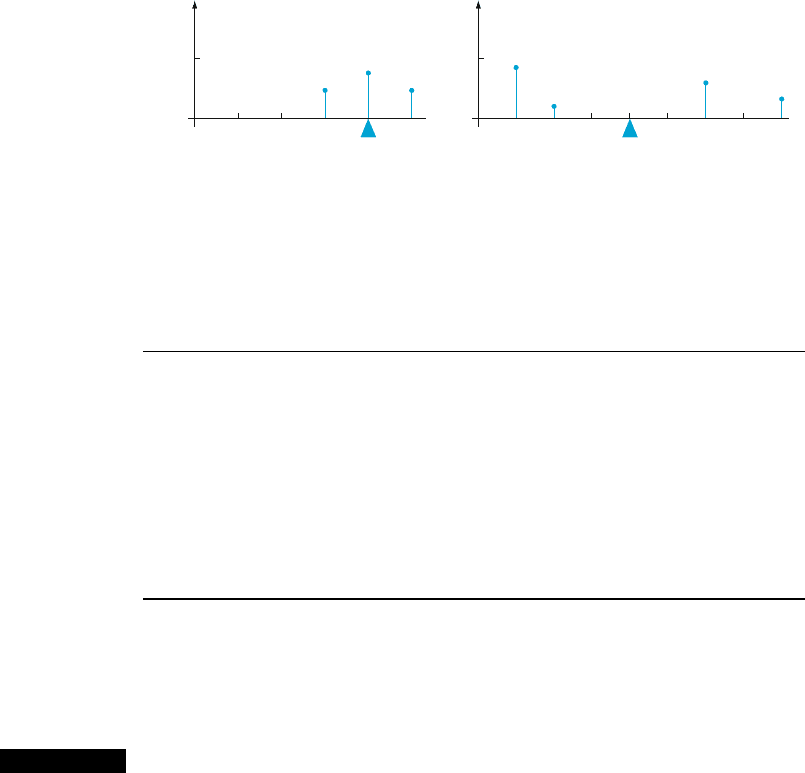
Using the physical analogy of placing point mass p(x) at the value x on a one-
dimensional axis, if the axis were then supported by a fulcrum placed at m, there
would be no tendency for the axis to tilt. This is illustrated for two different
distributions in Figure 3.7.
Although both distributions pictured in Figure 3.7 have the same center m,the
distribution of Figure 3.7b has greater spread or variability or dispersion than does that
of Figure 3.7a. We will use the variance of X to assess the amount of variability in (the
distribution of) X,justass
2
was used in Chapter 1 to measure variability in a sample.
DEFINITION
Let X have pmf p( x) and expected value m. Then the variance of X, denoted
by V(X)ors
2
X
, or just s
2
,is
VðXÞ¼
X
D
ðx mÞ
2
pðxÞ¼EðX mÞ
2
The standard deviation (SD) of X is
s
X
¼
ffiffiffiffiffiffi
s
2
X
p
The quantity h(X) ¼ (X m)
2
is the squared deviation of X from its mean,
and s
2
is the expected squared deviation. If most of the probability distribution is
close to m, then s
2
will typically be relatively small. However, if there are x values
far from m that have large p(x), then s
2
will be quite large.
Example 3.23 Consider again the distribution of the Apgar score X of a randomly selected newborn
described in Example 3.16. The mean value of X was calculated as m ¼ 7.15, so
VðXÞ¼s
2
¼
X
10
x¼0
ðx 7:15Þ
2
pðxÞ
¼ð0 7 :15Þ
2
ð:002Þþ::: þð10 7:15Þ
2
ð:01Þ¼1:5815
The standard deviation of X is s ¼
ffiffiffiffiffiffiffiffiffiffiffiffiffiffi
1:5815
p
¼ 1:26:
■
.5
123 5
.5
123 5678
ab
p(x) p(x)
Figure 3.7 Two different probability distributions with m ¼ 4
3.3 Expected Values of Discrete Random Variables 117