
Devore J.L., Berk K.N. Modern Mathematical Statistics with Applications
Подождите немного. Документ загружается.


Example 3.2 Consider the experiment in which a telephone number in a certain area code is
dialed using a random number dialer (such devices are used extensively by polling
organizations), and define an rv Y by
Y ¼
1
0
if the selected number is unlisted
if the selected number is listed in the directory
For example, if 5282966 appears in the telephone directory, then Y(5282966) ¼ 0,
whereas Y(7727350) ¼ 1 tell s us that the number 7727350 is unlisted. A word
description of this sort is more economical than a complete li sting, so we will use
such a description whenever possible.
■
In Examples 3.1 and 3.2, the only possible values of the rando m variable
were 0 and 1. Such a random variable arises frequently enough to be given a special
name, after the individual who first studied it.
DEFINITION
Any random variable whose only possible values are 0 and 1 is called a
Bernoulli random variable.
We will often want to define and study several different random variables
from the same sample space.
Example 3.3 Example 2.3 described an experiment in which the number of pumps in use at each
of two gas stations was determined. Define rv’s X, Y, and U by
X ¼ the total number of pumps in use at the two stations
Y ¼ the difference between the number of pumps in use at station 1 and the
number in use at station 2
U ¼ the maximum of the numbers of pump s in use at the two stations
If this experiment is performed and s ¼ (2, 3) results, then X((2, 3)) ¼ 2 + 3 ¼ 5, so
we say that the observed value of X is x ¼ 5. Similarly, the observed value of Y would
be y ¼ 2 3 ¼1, and the observed value of U would be u ¼ max(2, 3) ¼ 3.
■
Each of the random variables of Examples 3.1–3.3 can assume only a finite
number of possible values. This need not be the case.
Example 3.4 In Example 2.4, we considered the experiment in which batteries were examined
until a good one (S) was obtained. The sample space was S ¼ {S, FS, FFS, ... }.
Define an rv X by
X ¼ the number of batteries examined before the experiment terminates
Then XðS Þ¼1; XðFSÞ¼2; XðFFSÞ¼3; ...; XðFFFFFFSÞ¼7, and so on. Any
positive integer is a possible value of X, so the set of possible values is infinite.
■
98 CHAPTER 3 Discrete Random Variables and Probability Distributions

Example 3.5 Suppose that in some random fashion, a location (latitude and longitude) in the
continental United States is selected. Define an rv Y by
Y ¼ the height above sea level at the selected location
For example, if the selected location were (39
50
0
N, 98
35
0
W), then we might have
Y((39
50
0
N, 98
35
0
W)) ¼ 1748.26 ft. The largest possible value of Y is 14,494
(Mt. Whitney), and the smallest possibl e value is 282 (Death Valley). The set of
all possible values of Y is the set of all numbers in the interval between 282 and
14,494—that is,
y : y is a number; 282 y 14; 494
fg
and there are an infinite number of numbers in this interval.
■
Two Types of Random Variables
In Section 1.2 we distinguished between data resulting from observations on a
counting variable and data obtained by observing values of a measurement variable.
A slightly more formal distinction characterizes two different types of random
variables.
DEFINITION
A discrete random variable is an rv whose possible values either constitute a
finite set or else can be listed in an infinite sequence in which there is a first
element, a second element, and so on.
A random variable is continuous if both of the following apply:
1. Its set of possible values consists either of all numbers in a single interval
on the number line (possibly infinite in extent, e.g., from 1 to 1)or
all numbers in a disjoint union of such intervals ðe:g:; 0; 10½[20; 30½Þ.
2. No possible value of the variable has positive probability, that is,
P(X ¼ c) ¼ 0 for any possible value c.
Although any interval on the number line contains an infinite number of numbers, it
can be shown that there is no way to create an infinite listing of all these values—
there are just too many of them. The second condition describing a continuous
random variable is perhaps counterintuitive, since it would seem to imply a total
probability of zero for all possible values. But we shall see in Chapter 4 that
intervals of values have positive proba bility; the probability of an interval will
decrease to zero as the width of the interval shrinks to zero.
Example 3.6 All random variables in Examples 3.1–3.4 are discrete. As another example, suppose
we select married couples at random and do a blood test on each person until we
find a husband and wife who both have the same Rh factor. With X ¼ the number of
blood tests to be performed, possible values of X are D ¼ {2,4,6,8,...}. Since the
possible values have been listed in sequence, X is a discrete rv.
■
To study basic properties of discrete rv’s, only the tools of discrete mathemat-
ics—summation and differences—are required. The study of continuous variables
requires the continuous mathematics of the calculus—integrals and derivatives.
3.1 Random Variables 99
Exercises Section 3.1 (1–10)
1. A concrete beam may fail either by shear (S)or
flexure (F). Suppose that three failed beams are
randomly selected and the type of failure is deter-
mined for each one. Let X ¼ the number of beams
among the three selected that failed by shear. List
each outcome in the sample space along with the
associated value of X.
2. Give three examples of Bernoulli rv’s (other than
those in the text).
3. Using the experiment in Example 3.3, define two
more random variables and list the possible values
of each.
4. Let X ¼ the number of nonzero digits in a ran-
domly selected zip code. What are the possible
values of X? Give three possible outcomes and
their associated X values.
5. If the sample space S is an infinite set, does this
necessarily imply that any rv X defined from S will
have an infinite set of possible values? If yes, say
why. If no, give an example.
6. Starting at a fixed time, each car entering an
intersection is observed to see whether it turns
left (L), right ( R), or goes straight ahead (A). The
experiment terminates as soon as a car is observed
to turn left. Let X ¼ the number of cars observed.
What are possible X values? List five outcomes
and their associated X values.
7. For each random variable defined here, describe
the set of possible values for the variable, and state
whether the variable is discrete.
a. X ¼ the number of unbroken eggs in a ran-
domly chosen standard egg carton
b. Y ¼ the number of students on a class list for a
particular course who are absent on the
first day of classes
c. U ¼ the number of times a duffer has to swing
at a golf ball before hitting it
d. X ¼ the length of a randomly selected rattle-
snake
e. Z ¼ the amount of royalties earned from the
sale of a first edition of 10,000 textbooks
f. Y ¼ the pH of a randomly chosen soil sample
g. X ¼ the tension (psi) at which a randomly
selected tennis racket has been strung
h. X ¼ the total number of coin tosses required
for three individuals to obtain a match
(HHH or TTT)
8. Each time a component is tested, the trial is a
success (S) or failure (F). Suppose the component
is tested repeatedly until a success occurs on three
consecutive trials. Let Y denote the number of
trials necessary to achieve this. List all outcomes
corresponding to the five smallest possible values
of Y, and state which Y value is associated with
each one.
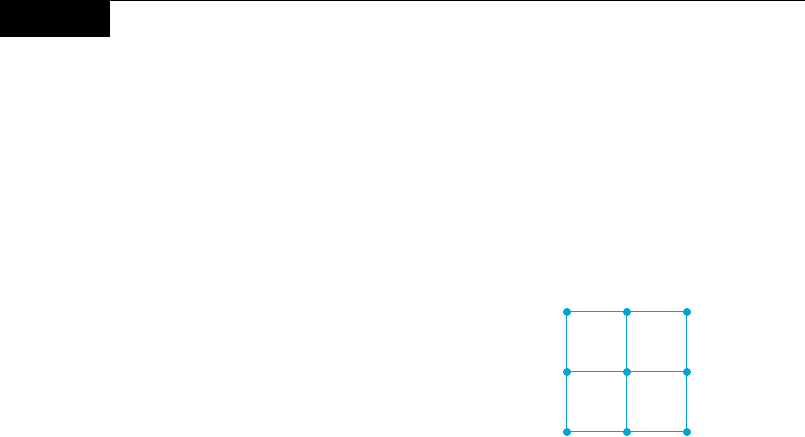
9. An individual named Claudius is located at the
point 0 in the accompanying diagram.
A
2
A
1
A
4
B
4
A
3
B
3
B
1
B
2
0
Using an appropriate randomization device
(such as a tetrahedral die, one having four sides),
Claudius first moves to one of the four locations
B
1
, B
2
, B
3
, B
4
. Once at one of these locations, he
uses another randomization device to decide
whether he next returns to 0 or next visits one of
the other two adjacent points. This process then
continues; after each move, another move to one
of the (new) adjacent points is determined by
tossing an appropriate die or coin.
a. Let X ¼ the number of moves that Claudius
makes before first returning to 0. What are
possible values of X?IsX discrete or continu-
ous?
b. If moves are allowed also along the
diagonal paths connecting 0 to A
1
, A
2
, A
3
,
and A
4
, respectively, answer the questions in
part (a).
10. The number of pumps in use at both a six-pump
station and a four-pump station will be deter-
mined. Give the possible values for each of the
following random variables:
a. T ¼ the total number of pumps in use
b. X ¼ the difference between the numbers in use
at stations 1 and 2
c. U ¼ the maximum number of pumps in use at
either station
d. Z ¼ the number of stations having exactly two
pumps in use
100
CHAPTER 3 Discrete Random Variables and Probability Distributions

3.2
Probability Distributions for Discrete
Random Variables
When probabilities are assigned to various outcomes in S , these in turn determine
probabilities associated with the values of any particular rv X. The probability
distribution of X says how the total probability of 1 is distributed among (allocated
to) the various possible X values.
Example 3.7 Six lots of components are ready to be shipped by a supplier. The number
of defective components in each lot is as follows:
Lot 123456
Number of defectives 020120
One of these lots is to be randomly selected for shipment to a customer. Let X be the
number of defectives in the selected lot. The three possible X values are 0, 1, and 2.
Of the six equally likely simple events, three result in X ¼ 0, one in X ¼ 1, and the
other two in X ¼ 2. Let p(0) denote the probability that X ¼ 0 and p(1) and p(2)
represent the probabilities of the other two possible values of X. Then
pð0Þ¼PðX ¼ 0 Þ¼Pðlot 1 or 3 or 6 is sentÞ¼
3
6
¼ :500
pð1Þ¼PðX ¼ 1 Þ¼Pðlot 4 is sentÞ¼
1
6
¼ :167
pð2Þ¼PðX ¼ 2 Þ¼Pðlot 2 or 5 is sentÞ¼
2
6
¼ :333
That is, a probability of .500 is distributed to the X value 0, a probability of .167 is
placed on the X value 1, and the remaining probability, .333, is associated with
the X value 2. The values of X along with their probabilities collectively specify
the probability distribution or probabi lity mass function of X. If this experiment
were repeated over and over again, in the long run X ¼ 0 would occur one-half of
the time, X ¼ 1 one-sixth of the time, and X ¼ 2 one-third of the time.
■
DEFINITION
The probability distribution or probability mass function (pmf) of a
discrete rv is defined for every number x by pðxÞ¼PðX ¼ xÞ¼
Pðall s 2 S : XðsÞ¼xÞ.
1
In words, for every possible value x of the random variable, the pmf specifies
the probability of observing that value when the experiment is perform ed. The
conditions pðxÞ0 and SpðxÞ¼1, where the summation is over all possible x,
are required of any pmf.
1
P(X ¼ x) is read “the probability that the rv X assumes the value x .” For example, P(X ¼ 2) denotes the
probability that the resulting X value is 2.
3.2 Probability Distributions for Discrete Random Variables
101
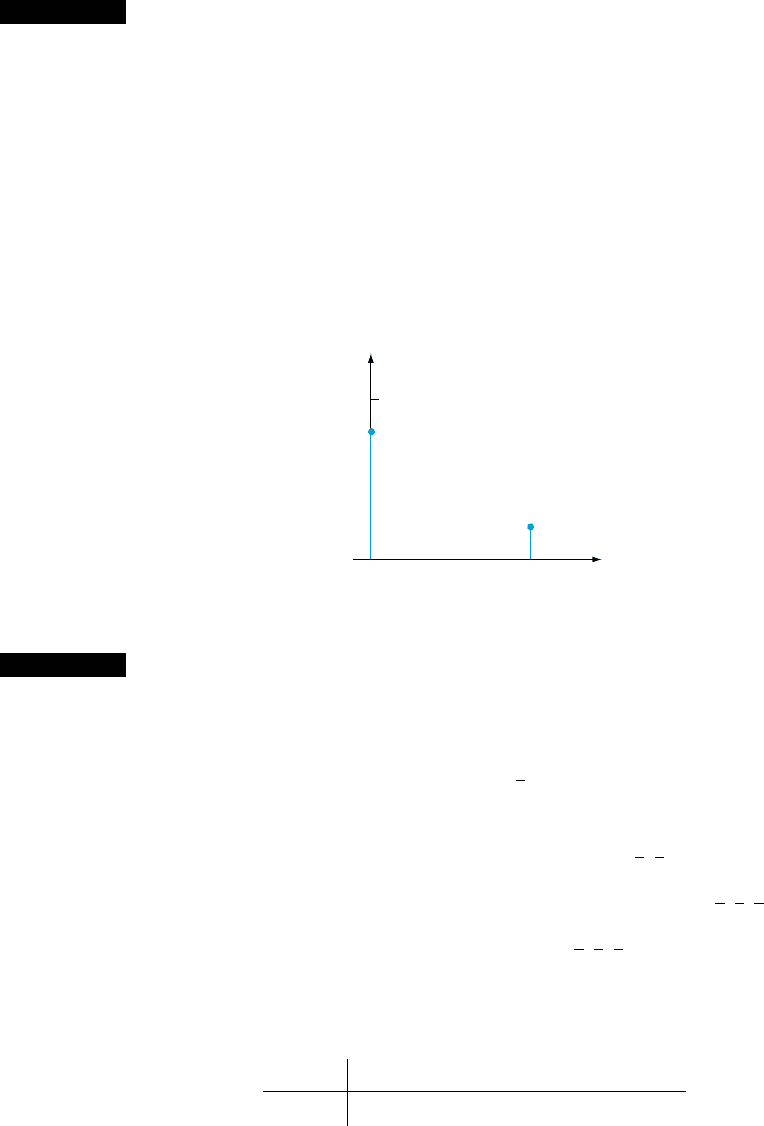
Example 3.8 Consider randomly selecting a student at a large public university, and define a
Bernoulli rv by X ¼ 1 if the selected student does not qualify for in-state tuition
(a success from the unive rsity administration’s point of view) and X ¼ 0 if the
student does qualify. If 20% of all students do not qualify, the pmf for X is
pð0Þ¼PX¼ 0ðÞ¼P the selected student does qualifyðÞ¼:8
p 1ðÞ¼PX¼ 1ðÞ¼P the selected student does not qualifyðÞ¼:2
pðxÞ¼PðX ¼ xÞ¼0 for x 6¼ 0or1:
pðxÞ¼
:8ifx ¼ 0
:2ifx ¼ 1
0ifx 6¼ 0or1
8
>
<
>
:
Figure 3.2 is a picture of this pmf, called a line graph.
Example 3.9 Consider a group of five potential blood donors—A, B, C, D, and E—of whom only
A and B have type O+ blood. Five blood samples, one from each individual, will be
typed in random order until an O+ individual is identified. Let the rv Y ¼ the
number of typings necessary to identify an O+ individual. Then the pmf of Y is
pð1Þ¼PðY ¼1Þ¼PðA or B typed firstÞ¼
2
5
¼:4
pð2Þ¼PðY ¼2Þ¼PðC;D;or E first;and then A or B Þ
¼PðC;D;or E firstÞPðA or B nextjC;D;or E firstÞ¼
3
5
2
4
¼:3
pð3Þ¼PðY ¼3Þ¼PðC; D; or E first and second; and then A or BÞ¼
3
5
2
4
2
3
¼:2
pð4Þ¼PðY ¼4Þ¼PðC; D; and E all done firstÞ¼
3
5
2
4
1
3
¼:1
pðyÞ¼0 for y 6¼1;2;3;4:
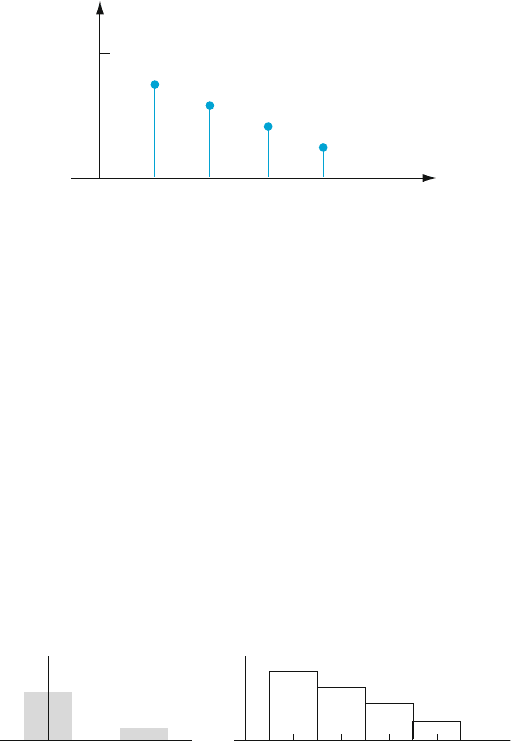
The pmf can be presented compactly in tabu lar form:
y 1 234
p(y).4 .3 .2 .1
where any y value not listed receives zero probability. This pmf can also be
displayed in a line graph (Figure 3.3).
1
1
x
0
p(x)
Figure 3.2 The line graph for the pmf in Example 3.8 ■
102 CHAPTER 3 Discrete Random Variables and Probability Distributions
The name “probability mass function” is suggested by a model used in physics for a
system of “point masses.” In this model, masses are distributed at various locations
x along a one-dimensional axis. Our pmf describes how the total probability mass
of 1 is distributed at various points along the axis of possible values of the random
variable (where and how much mass at each x).
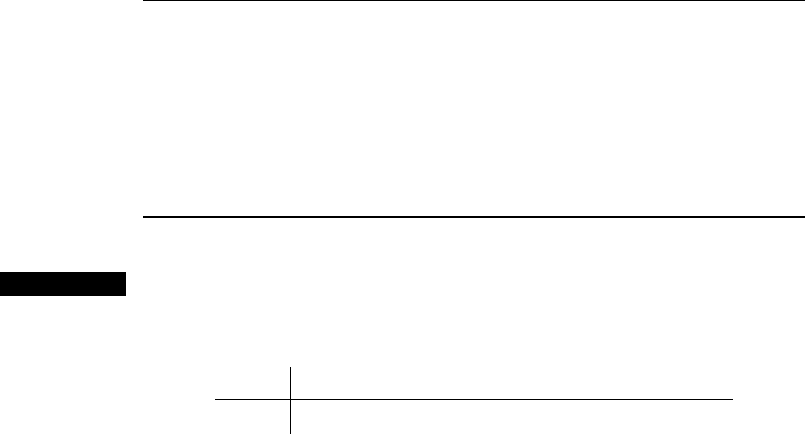
Another usef ul pictorial representation of a pmf, called a probability histo-
gram, is similar to histograms discusse d in Chapter 1. Abov e each y with p (y) > 0,
construct a rectangle centered at y. The height of each rectangle is proportional to
p(y), and the base is the same for all rectangles. When possible values are equally
spaced, the base is frequently chosen as the distance between successive y values
(though it could be smaller). Figure 3.4 shows two probability histograms.
A Parameter of a Probability Distribution
In Example 3.8, we had p(0) ¼ .8 and p(1) ¼ .2 because 20% of all students
did not qualify for in-state tuition. At another university, it may be the case that
p(0) ¼ .9 and p(1) ¼ .1. More generally, the pmf of any Bernoulli rv can be
expressed in the form p(1) ¼ a and p(0) ¼ 1 a, where 0 < a < 1. Because the
pmf depends on the particular value of a, we often write p(x; a) rather than just p(x):
pðx; aÞ¼
1 a if x ¼ 0
a if x ¼ 1
0 otherwise
8
>
<
>
:
ð3:1Þ
Then each choice of a in Expression (3.1) yields a different pmf.
01 1234
ba
Figure 3.4 Probability histograms: (a) Example 3.8; (b) Example 3.9
.5
1
y
0
2 3 4
p(y)
Figure 3.3 The line graph for the pmf in Example 3.9 ■
3.2 Probability Distributions for Discrete Random Variables 103

DEFINITION
Suppose p(x) depends on a quantity that can be assigned any one of a number
of possible values, with each different value determining a different proba-
bility distribution. Such a quantity is called a parameter of the distribution.
The collection of all probability distributions for different values of the
parameter is called a family of probability distributions.
The quantity a in Expression (3.1) is a parameter. Each different number a
between 0 and 1 determines a different member of a family of distributions; two
such members are
pðx; :6Þ¼
:4ifx ¼ 0
:6ifx ¼ 1
0 otherwise
8
>
<
>
:
and pðx; :5Þ¼
:5ifx ¼ 0
:5ifx ¼ 1
0 otherwise
8
>
<
>
:
Every probability distribution for a Bernoulli rv has the form of Expression (3.1), so
it is called the family of Bernoulli distributions.
Example 3.10 Starting at a fixed time, we observe the gender of each newborn child at a certain
hospital until a boy (B) is born. Let p ¼ P(B), assume that successive births are
independent, and define the rv X by X ¼ number of births observed. Then
pð1Þ¼PðX ¼ 1Þ¼PðBÞ¼p
pð2Þ¼PðX ¼ 2Þ¼PðGBÞ¼PðGÞPð B Þ¼ð1 pÞp
and
pð3Þ¼ PðX ¼ 3Þ¼PðGGBÞ¼PðGÞPðGÞPðB Þ¼ð1 pÞ
2
p
Continuing in this way, a general formula eme rges:
pðxÞ¼
ð1 pÞ
x1
px¼ 1; 2; 3; ...
0 otherwise
(
ð3:2Þ
The quantity p in Expression (3.2) represents a number between 0 and 1 and is a
parameter of the probability distribution. In the gender example, p ¼ .51 might be
appropriate, but if we were looking for the first child with Rh-positive blood, then
we might have p ¼ .85.
■
The Cumulative Distribution Function
For some fixed value x , we often wish to compute the probability that the observed
value of X will be at mos t x. For example, the pmf in Example 3.7 was
pðxÞ¼
:500 x ¼ 0
:167 x ¼ 1
:333 x ¼ 2
0 otherwise
8
>
>
>
<
>
>
>
:
104 CHAPTER 3 Discrete Random Variables and Probability Distributions
The probability that X is at most 1 is then
PðX 1Þ¼pð0Þþp 1ðÞ¼:500 þ :167 ¼ :667
In this example, X 1.5 iff X 1, so P(X 1.5) ¼ P(X 1) ¼ .667. Similarly,
P(X 0) ¼ P (X ¼ 0) ¼ .5, and P(X .75) ¼ .5 also. Since 0 is the smallest
possible value of X, P(X 1.7) ¼ 0, P(X .0001) ¼ 0, and so on. The
largest possible X value is 2, so P(X 2) ¼ 1, and if x is any number larger
than 2, P(X x) ¼
1; that is, P(X 5) ¼ 1, P(X 10.23) ¼ 1, and so on.
Notice that P(X < 1) ¼ .5 6¼ P(X 1), since the probability of the X value 1 is
included in the latter probability but not in the former. When X is a discrete random
variable and x is a possible value of X , P(X < x) < P(X x).
DEFINITION
The cumulative distribution function (cdf) F(x) of a discrete rv X with pmf
p(x) is defined for every number x by
FðxÞ¼PðX xÞ¼
X
y:y x
pðyÞð3:3Þ
For any number x, F(x) is the proba bility that the observed value of X will be
at most x.
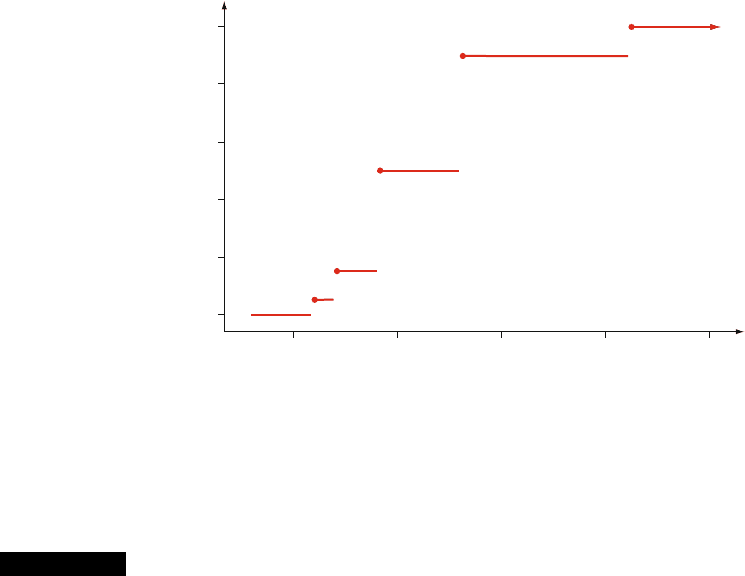
Example 3.11 A store carries flash drives with either 1, 2, 4, 8, or 16 GB of memory. The
accompanying table gives the distribution of Y ¼ the amount of memor y in a
purchased drive:
y 124816
p(y) .05 .10 .35 .40 .10
Let’s first determine F(y) for each of the five possible values of Y:
F 1ðÞ¼PY 1ðÞ¼PY¼ 1ðÞ¼p 1ðÞ¼:05
F 2ðÞ¼PY 2ðÞ¼PY¼ 1or2ðÞ¼p 1ðÞþp 2ðÞ¼:15
F 4ðÞ¼PY 4ðÞ¼PY¼ 1 or 2 or 4ðÞ¼p 1ðÞþp 2ðÞþp 4ðÞ¼:50
F 8ðÞ¼PY 8ðÞ¼p 1ðÞþp 2ðÞþp 4ðÞþp 8ðÞ¼:90
F 16ðÞ¼PY 16ðÞ¼1
Now for any other number y, F(y) will equal the value of F
at the closest possible
value of Y to the left of y. For example,
F 2:7ðÞ¼PY 2:7ðÞ¼PY 2ðÞ¼F 2ðÞ¼:15
F 7:999ðÞ¼PY 7:999ðÞ¼PY 4ðÞ¼F 4ðÞ¼:50
If y is <1, F(y) ¼ 0 [e.g. F(.58) ¼ 0], and if y is at least 16, F( y) ¼ 1 [e.g.
F(25) ¼ 1]. The cdf is thus
3.2 Probability Distributions for Discrete Random Variables 105
FðyÞ¼
0 y < 1
:05 1 y < 2
:15 2 y < 4
:50 4 y < 8
:90 8 y < 16
116 y
8
>
>
>
>
>
>
>
>
>
<
>
>
>
>
>
>
>
>
>
:
A graph of this cdf is shown in Figure 3.5.
For X a discrete rv, the graph of F(x) will have a jump at every possible
value of X and will be flat between possible values. Such a graph is called a
step function.
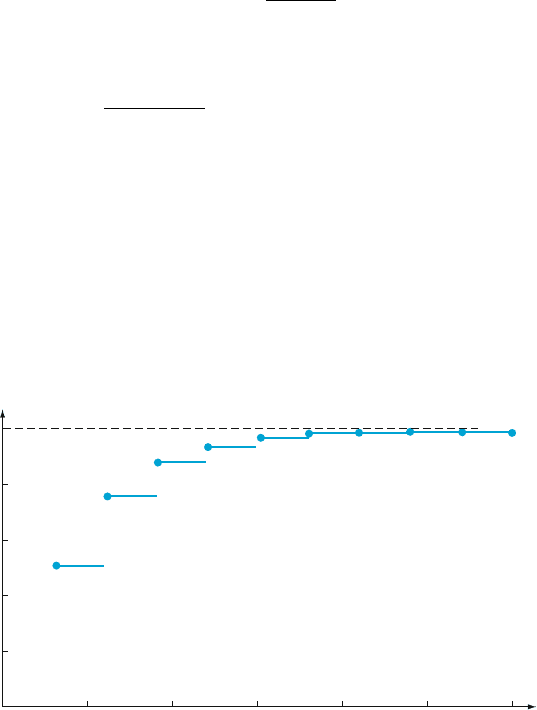
Example 3.12 In Example 3.10, any positive integer was a possible X value, and the pmf was
pðxÞ¼
1pÞ
x1
px¼ 1; 2; 3; ...
0 otherwise
(
For any positive integer x,
FðxÞ¼
X
y x
pðyÞ¼
X
x
y ¼ 1
ð1 pÞ
y1
p ¼ p
X
x1
y ¼0
ð1 pÞ
y
ð3:4Þ
2015105
0
1.0
0.8
0.6
0.4
0.2
0.0
y
F(y)
Figure 3.5 A graph of the cdf of Example 3.11 ■
106
CHAPTER 3 Discrete Random Variables and Probability Distributions
To evaluate this sum, we use the fact that the partial sum of a geometric series is
X
k
y¼0
a
y
¼
1 a
kþ1
1 a
Using this in Equation (3.4), with a ¼ 1 p and k ¼ x 1, gives
FðxÞ¼p
1 ð1 pÞ
x
1 ð1 pÞ
¼ 1 ð1 p Þ
x
x a positive integer
Since F is constant in between positive integers,
FðxÞ¼
0 x < 1
1 ð1 pÞ
½x
x 1
(
ð3:5Þ
where [x] is the largest integer x (e.g., [2.7] ¼ 2). Thus if p ¼ .51 as in the birth
example, then the probability of having to examine at most five births to see the
first boy is F(5) ¼ 1 (.49)
5
¼ 1 .0282 ¼ .9718, whereas F(10) 1.0000.
This cdf is graphed in Figure 3.6.
In our examples thus far, the cdf has been derived from the pmf. This process
can be reversed to obtain the pmf from the cdf whenever the latter function is
available. Suppose, for example, that X represents the number of defective compo-
nents in a shipment consisting of six components, so that possible X values are
0, 1, ... , 6. Then
pð3Þ¼PðX ¼ 3 Þ
¼ pð0Þþp 1ðÞþp 2ðÞþp 3ðÞ½pð0Þþp 1ðÞþp 2ðÞ½
¼ PðX 3ÞPðX 2Þ
¼ Fð3ÞFð2Þ
02146810
.2
.4
.6
.8
1.0
0
1
x
F(x)
Figure 3.6 A graph of
F
(
x
) for Example 3.12 ■
3.2 Probability Distributions for Discrete Random Variables 107