
Devore J.L., Berk K.N. Modern Mathematical Statistics with Applications
Подождите немного. Документ загружается.

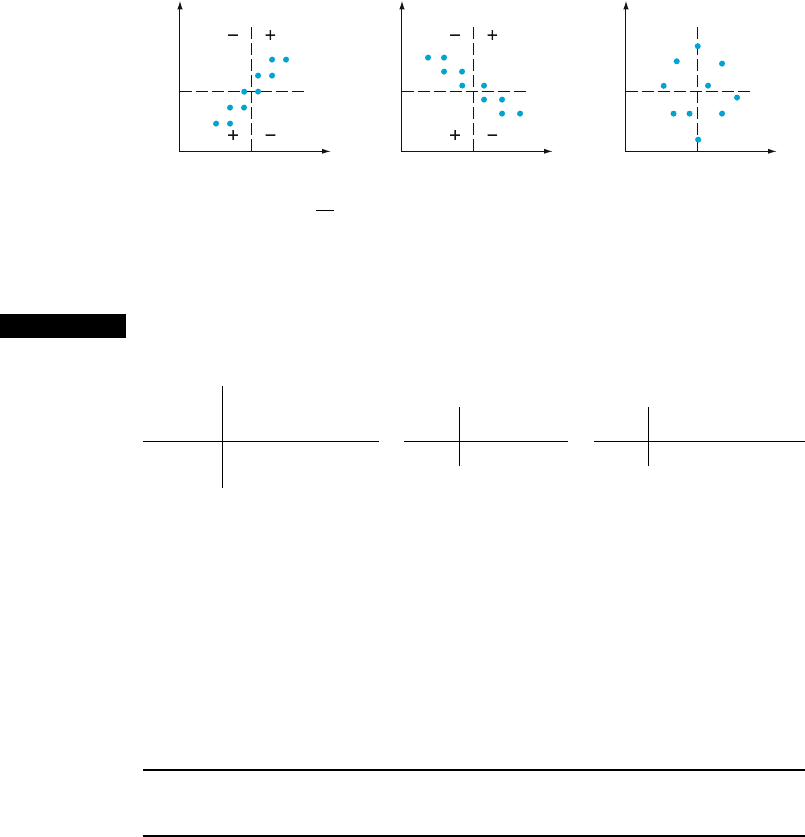
negative product. Thus for a strong negative relationship, Cov(X , Y) should be quite
negative. If X and Y are not strongly related, positive and negative products
will tend to cancel each other, yielding a covariance near 0. Figure 5.4 illustrates
the different possibilities. The covariance depends on both the set of possible pairs
and the probabilities. In Figure 5.4, the probabilities could be change d without
altering the set of possible pairs, and this could drastically change the value of
Cov(X, Y).
Example 5.14 The joint and marginal pmf’s for X ¼ automobile policy deductible amount and
Y ¼ homeowner policy deductible amount in Example 5.1 were
p(x, y)
y
0 100 200 x 100 250 y 0 100 200
x
100 .20 .10 .20 p
X
(x).5 .5p
Y
(y) .25 .25 .50
250 .05 .15 .30
from which m
X
¼ Sxp
X
ðxÞ¼175 and m
Y
¼ 125. Therefore,
CovðX;YÞ¼
X
ðx;
X
yÞ
ðx 175Þðy 125Þpðx;yÞ
¼ð100 175Þð0 125 Þð: 20Þþþð250 175Þð200 125Þð:30Þ
¼1875
■
The following shortcut formula for Cov(X, Y) simplifies the computations.
PROPOSITION
CovðX; YÞ¼EXYðÞm
X
m
Y
According to this formula, no intermediate subtractions are necessary; only at the
end of the computation is m
X
· m
Y
subtracted from E(XY). The proof involves
expanding ðX m
X
ÞðY m
Y
Þ and then taking the expected value of each term
separately. Note that Cov ðX; XÞ¼EðX
2
Þm
2
X
¼ VðXÞ.
y
abc
x
yy
x
x
m
Y
m
Y
m
Y
m
X
m
X
m
X
Figure 5.4 p(x,y) ¼
1
10
for each of ten pairs corresponding to indicated points;
(a) positive covariance; (b) negative covariance; (c) covariance near zero
248
CHAPTER 5 Joint Probability Distributions

Example 5.15
(Example 5.5
continued)
The joint and marginal pdf’s of X ¼ amount of almonds and Y ¼amount of cashews
were
f ð x; yÞ¼
24xy 0 x 1; 0 y 1; x þ y 1
0 otherwise
(
f
X
ðxÞ¼
12xð1 xÞ
2
0 x 1
0 otherwise
with f
Y
(y) obta ined by replacing x by y in f
X
(x). It is easily verified that
m
X
¼ m
Y
¼
2
5
, and
EðXYÞ¼
ð
1
1
ð
1
1
xyf ðx; yÞdx dy ¼
ð
1
0
ð
1x
0
xy 24xy dy dx
¼ 8
ð
1
0
x
2
ð1 xÞ
3
dx ¼
2
15
Thus CovðX; YÞ¼
2
15
2
5
2
5
¼
2
15
4
25
¼
2
75
. A negative covariance is reason-
able here because more almonds in the can implies fewer cashews.
■
The covariance satisfies a useful linearity prope rty (Exercise 33).
PROPOSITION
If X, Y, and Z are rv’s and a and b are constants then
Cov aX þ bY; ZðÞ¼a Cov X; ZðÞþb Cov Y; ZðÞ
It would appear that the relationship in the insurance example is quite strong
since Cov(X, Y) ¼ 1875, whereas in the nut example CovðX; YÞ¼
2
75
would seem
to imply quite a weak relationship. Unfortunately, the covariance has a serious
defect that makes it imposs ible to interpret a computed value of the covariance. In
the insurance example, suppose we had expressed the deductible amount in cents
rather than in dollars. Then 100X would replace X, 100Y would replace Y, and
the resulting covariance would be Cov(100X, 100Y) ¼ (100)(100)Cov(X, Y) ¼
18,750,000. If, on the other hand, the deductible amount had been expressed in
hundreds of dollars, the computed covariance would have been (.01)(.01)(1875) ¼
.1875. The defect of covariance is that its computed value depends critically on the
units of measurement. Ideally, the choice of units should have no effect on a
measure of strength of relationship. This is achieved by scaling the covariance.
Correlation
DEFINITION
The correlation coefficient of X and Y, denoted by Corr(X, Y), or r
X,Y
,
or just r, is defined by
r
X;Y
¼
CovðX; YÞ
s
X
s
Y
5.2 Expected Values, Covariance, and Correlation 249

Example 5.16 It is easily verified that in the insurance problem of Example 5.14, EðX
2
Þ¼
36; 250; s
2
X
¼ 36; 250 175ðÞ
2
¼ 5625; s
X
¼ 75; EðY
2
Þ¼22; 500; s
2
Y
¼ 6875;
and s
Y
¼ 82:92: This gives
r ¼
1875
ð75Þð82:92Þ
¼ :301
■
The following proposition show s that r remedies the defect of Cov(X, Y) and also
suggests how to recognize the existence of a strong (linear) relations hip.
PROPOSITION
1. If a and c are either both positive or both negative,
Corr aX þ b; cY þ dðÞ¼Corr X; YðÞ
2. For any two rv’s X and Y; 1 Corr X ; YðÞ1
Statement 1 says precisely that the correlation coefficient is not affected by a linear
change in the units of measurement (if, say, X ¼ temperature in
C, then 9X/5 +
32 ¼ temperature in
F). According to Statement 2, the strongest possible positive
relationship is evidenced by r ¼ +1, whereas the strongest possible negative
relationship corresponds to r ¼1. The proof of the first statement is sketched
in Exercise 31, and that of the second appears in Exercise 35 and also Supplemen-
tary Exercise 76 at the end of the next chapter. For descriptive purposes, the
relationship will be described as strong if |r| .8, moderate if .5 < |r| <.8, and
weak if |r| .5.
If we think of p(x, y)orf(x, y) as prescribing a mathematical model for how
the two numerical variables X and Y are distributed in some population (height and
weight, verbal SAT score and quantitative SAT score, etc.), then r is a population
characteristic or parameter that measures how strongly X and Y are related in
the population. In Chapter 12, we will consider taking a sample of pairs
x
1
; y
1
ðÞ; :::; x
n
; y
n
ðÞfrom the population. The sample correlation coefficient r
will then be defined and used to make inferences about r.
The correlation coefficient r is actually not a completely general measure of
the strength of a relationship.
PROPOSITION
1. If X and Y are independent, then r ¼ 0, but r ¼ 0 does not imply
independence.
2. r ¼ 1or1 iff Y ¼ aX + b for some numbers a and b with a 6¼ 0.
Exercise 29 and Example 5.17 relate to Property 1, and Property 2 is investigated
in Exercises 32 and 35.
This propositi on says that r isameasureofthedegreeoflinear
relationship between X and Y, and only when the two variables are perfectly
250 CHAPTER 5 Joint Probability Distributions
related in a linear manner will r be as positive or negative as it can be. A r
less than 1 in absolute value indicates only that the relationship is not
completely linear, but there m ay still be a very strong nonlinear relation. Also,
r ¼ 0 doe s not im pl y t hat X and Y are independent, but only that there is complete
absence of a linear r elationship. When r ¼ 0, X and Y ar e said to be uncorrelated.
Two variables could be uncorrelated yet highly dependent because of a strong
nonlinear relationship, so be careful not to conclude too much from knowing
that r ¼ 0.
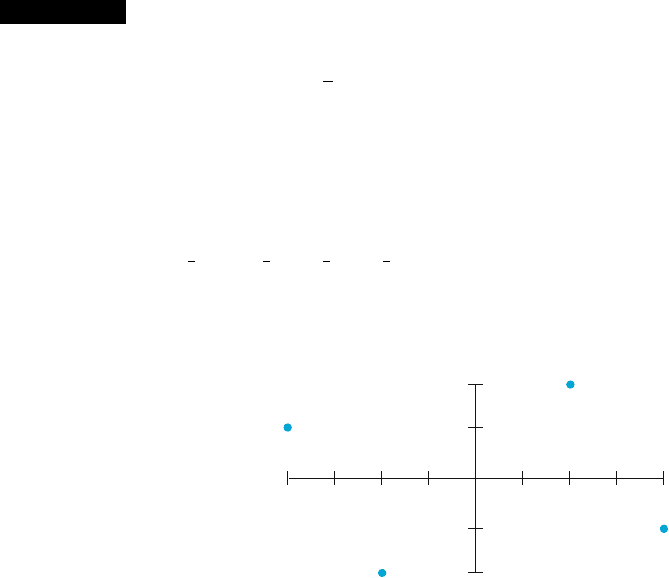
Example 5.17 Let X and Y be discrete rv’s with joint pmf
pðx; yÞ¼
1
4
ðx; yÞ¼ð4; 1Þ; ð4; 1Þ; ð2 ; 2Þ ; ð2; 2Þ
0 otherwise
8
<
:
The points that receive positive probability mass are identified on the (x, y)
coordinate system in Figure 5.5. It is evident from the figure that the value of X
is completely determined by the value of Y and vice versa, so the two variables
are completely dependent. However, by symmetry m
X
¼ m
Y
¼ 0 and EðXYÞ¼
ð4Þ
1
4
þð4Þ
1
4
þð4Þ
1
4
þð4Þ
1
4
¼ 0 so Cov X; YðÞ¼EXYðÞm
X
m
Y
¼ 0 and thus
r
X,Y
¼ 0. Although there is perfect dependence, there is also complete absence of
any linear relationship!
A value of r near 1 does not necessarily imply that increasing the value of
X causes Y to increase. It implies only that large X values are associated with
large Y values. For example, in the population of children, vocabulary size and
number of cavities are quite positively correlated, but it is certainly not true
that cavities cause vocabulary to grow. Instead, the values of both these variables
tend to increase as the value of age, a third variable, increases. For children of a
fixed age, there is probably a very low correlation between number of cavities
and vocabulary size. In summary, association (a high correlation) is not the same
as causation.
2
1
1234−1
−1
−2
−2
−3−4
Figure 5.5 The population of pairs for Example 5.17 ■
5.2 Expected Values, Covariance, and Correlation 251

Exercises Section 5.2 (18–35)
18. An instructor has given a short quiz consisting of
two parts. For a randomly selected student, let X ¼
the number of points earned on the first part and
Y ¼ the number of points earned on the second
part. Suppose that the joint pmf of X and Y is given
in the accompanying table.
y
p(x, y)051015
x
0 .02 .06 .02 .10
5 .04 .15 .20 .10
10 .01 .15 .14 .01
a. If the score recorded in the grade book is the
total number of points earned on the two parts,
what is the expected recorded score EðX þ YÞ?
b. If the maximum of the two scores is recorded,
what is the expected recorded score?
19. The difference between the number of customers
in line at the express checkout and the number in
line at the superexpress checkout in Exercise 3 is
X
1
X
2
. Calculate the expected difference.
20. Six individuals, including A and B, take seats
around a circular table in a completely random
fashion. Suppose the seats are numbered 1, ...,6.
Let X ¼ A’s seat number and Y ¼ B’s seat num-
ber. If A sends a written message around the table
to B in the direction in which they are closest, how
many individuals (including A and B) would you
expect to handle the message?
21. A surveyor wishes to lay out a square region
with each side having length L. However, because
of measurement error, he instead lays out a rect-
angle in which the north–south sides both have
length X and the east–west sides both have length
Y. Suppose that X and Y are independent and that
each is uniformly distributed on the interval
½L A; L þ A (where 0 < A < L). What is the
expected area of the resulting rectangle?
22. Consider a small ferry that can accommodate cars
and buses. The toll for cars is $3, and the toll for
buses is $10. Let X and Y denote the number of
cars and buses, respectively, carried on a single
trip. Suppose the joint distribution of X and Y is as
given in the table of Exercise 7. Compute the
expected revenue from a single trip.
23. Annie and Alvie have agreed to meet for lunch
between noon (0:00 p.m.) and 1:00 p.m. Denote
Annie’s arrival time by X, Alvie’s by Y, and sup-
pose X and Y are independent with pdf’s
f
X
ðxÞ¼
3x
2
0 x 1
0 otherwise
f
Y
ðyÞ¼
2y
0
0 y 1
otherwise
What is the expected amount of time that the one
who arrives first must wait for the other person?
[Hint: hðX; YÞ¼jX Yj:]
24. Suppose that X and Y are independent rv’s with
moment generating functions M
X
(t) and M
Y
(t),
respectively. If Z ¼ X þ Y, show that
M
Z
ðtÞ¼M
X
ðtÞM
Y
ðtÞ.[Hint: Use the proposition
on the expected value of a product.]
25. Compute the correlation coefficient r for X and Y
of Example 5.15 (the covariance has already been
computed).
26. a. Compute the covariance for X and Y in
Exercise 18.
b. Compute r for X and Y in the same exercise.
27. a. Compute the covariance between X and Y in
Exercise 9.
b. Compute the correlation coefficient r for this X
and Y.
28. Reconsider the computer component lifetimes
X and Y as described in Exercise 12. Determine
EXYðÞ. What can be said about CovðX; YÞ and r?
29. Use the proposition on the expected product to
show that when X and Y are independent,
CovðX; YÞ¼ CorrðX; YÞ¼0
30. a. Recalling the definition of s
2
for a single rv
X, write a formula that would be appropriate
for computing the variance of a function h(X, Y)
of two random variables. [Hint: Remember that
variance is just a special expected value.]
b. Use this formula to compute the variance of the
recorded score h(X, Y)[¼ max(X, Y)] in part
(b) of Exercise 18.
31. a. Use the rules of expected value to show that
CovðaX þ b; cY þ dÞ¼acCovðX; YÞ:
b. Use part (a) along with the rules of variance
and standard deviation to show that
CorrðaX þ b; cY þ dÞ¼ CorrðX; YÞ when a
and c have the same sign.
c. What happens if a and c have opposite signs?
252
CHAPTER 5 Joint Probability Distributions
32. Show that if Y ¼aX þb ða 6¼0Þ,thenCorrðX;YÞ¼
þ1or1. Under what conditions will r ¼þ1?
33. Show that if X, Y, and Z are rv’s and a and b are
constants, then Cov aX þ bY; ZðÞ¼a Cov X; ZðÞþ
b Cov Y; ZðÞ
34. Let Z
X
be the standardized X; Z
X
¼ðX m
X
Þ=s
X
,
and let Z
Y
be the standardized Y; Z
Y
¼
ðY m
Y
Þ=s
Y
. Use Exercise 31 to show that
Corr X; YðÞ¼Cov Z
X
; Z
Y
ðÞ¼EZ
X
Z
Y
ðÞ
35. Let Z
X
be the standardized X, Z
X
¼ (X m
X
)/s
X
,
and let Z
Y
be the standardized Y, Z
Y
¼ (Y m
Y
)/s
Y
.
a. Show with the help of Exercise 34 that
Ef½ðZ
Y
rZ
X
Þ
2
g¼1 r
2
b. Use part (a) to show that 1 r 1.
c. Use part (a) to show that r ¼ 1 implies that
Y ¼ aX þ b where a > 0, and r ¼1 implies
that Y ¼ aX þ b where a < 0.
5.3
Conditional Distributions
The distribution of Y can depend strongly on the value of another variable X. For
example, if X is height and Y is weight, the distribution of weight for men who are
6 ft tall is very different from the distribution of weight for short men. The
conditional distribution of Y given X ¼ x describes for each possible x how
probability is distributed over the set of possible y values. We define the condi tional
distribution of Y given X, but the conditional distribution of X given Y can be
obtained by just reversing the roles of X and Y. Both definitions are analogous to
that of the conditional probability P(A |B) as the ratio PðA \ BÞ=PðBÞ.
DEFINITION
Let X and Y be two discrete random variables with joint pmf p(x,y) and
marginal X pmf p
X
(x). Then for any x valu e such that p
X
(x) > 0, the
conditional probability mass function of Y given X ¼ x is
p
YjX
ðyjxÞ¼
pðx; yÞ
p
X
ðxÞ
An analogous formula holds in the continuous case. Let X and Y be two
continuous random variables with joint pdf f(x,y) and marginal X pdf f
X
(x).
Then for any x valu e such that f
X
(x) > 0, the conditional probability density
function of Y given X ¼ x is
f
YjX
ðyjxÞ¼
f ðx; yÞ
f
X
ðxÞ
Example 5.18 For a discrete example, reconsider Example 5.1, where X represents the deductible
amount on an automobile policy and Y represents the deductible amount on a
homeowner’s policy. Here is the joint distribution again.
y
p(x, y) 0 100 200
x
100 .20 .10 .20
250 .05 .15 .30
5.3 Conditional Distributions 253
The distribution of Y depends on X. In particular, let’s find the conditional
probability that Y is 200, given that X is 250, using the definition of conditional
probability from Section2.4.
PðY ¼ 200jX ¼ 250Þ¼
PðY ¼ 200 and X ¼ 250Þ
PðX ¼ 250Þ
¼
:3
:05 þ :15 þ :3
¼ :6
With our new definition we obtain the same result
p
YjX
ð200j250Þ¼
pð250; 200Þ
p
X
ð250Þ
¼
:3
:05 þ :15 þ :3
¼ :6
The conditional probabilities for the two other possible values of Y are
p
YjX
ð0j250Þ¼
pð250; 0Þ
p
X
ð250Þ
¼
:05
:05 þ :15 þ :3
¼ :1
p
YjX
ð100j250Þ¼
pð250; 100Þ
p
X
ð250Þ
¼
:15
:05 þ :15 þ :3
¼ :3
Thus, p
YjX
0j250ðÞþp
YjX
100j250ðÞþp
YjX
200j250ðÞ¼:1 þ :3 þ :6 ¼ 1. This is no
coincidence; conditional probabilities satisfy the properties of ordinary probabil-
ities. They are nonnegative and they sum to 1. Essentially, the denominator in the
definition of conditional probability is designed to make the total be 1.
Reversing the roles of X and Y, we find the conditional probabilities for X,
given that Y ¼ 0:
p
XjY
ð100j0Þ¼
pð100; 0Þ
p
Y
ð0Þ
¼
:20
:20 þ :05
¼ :8
p
XjY
ð250j0Þ¼
pð250; 0Þ
p
Y
ð0Þ
¼
:05
:20 þ :05
¼ :2
Again, the conditional probabilities add to 1.
■
Example 5.19 For a continuous example, recall Example 5.5, where X is the weight of almonds
and Y is the weight of cashe ws in a can of mixed nuts. The sum of X + Y is at most
one pound, the total weight of the can of nuts. The joint pdf of X and Y is
f ð x; yÞ¼
24xy
0
0 x 1; 0 y 1; x þ y 1
otherwise
In Example 5.5 it was shown that
f
X
ðxÞ¼
12xð1 xÞ
2
0 x 1
0 otherwise
The conditional pdf of Y given that X ¼ x is
f
YjX
ðyjxÞ¼
f ð x; yÞ
f
X
ðxÞ
¼
24xy
12xð1 xÞ
2
¼
2y
ð1 xÞ
2
0 y 1 x
254 CHAPTER 5 Joint Probability Distributions

This can be used to get conditional probabiliti es for Y. For example,
PðY :25jX ¼ :5Þ¼
ð
:25
1
f
YjX
ðyj:5Þdy ¼
ð
:25
0
2y
ð1 :5Þ
2
dy ¼ 4y
2
:25
0
¼ :25
Recall that X is the weight of almonds and Y is the weight of cashews, so this says
that, given that the weight of almonds is .5 pound, the probability is .25 for the
weight of cashews to be less than .25 pound.
Just as in the discrete case, the conditional distribution assigns a total
probability of 1 to the set of all possible Y values. That is, integrating the condi-
tional density over its set of possible values should yield 1:
ð
1
1
f
YjX
ðyjxÞdy ¼
ð
1x
0
2y
ð1 xÞ
2
dy ¼
y
2
ð1 xÞ
2
1x
0
¼ 1
Whenever you calculate a conditional density, we recommend doing this integra-
tion as a validity check.
■
Because the conditional distribution is a valid probability distribution, it
makes sense to define the conditional mean and variance.
DEFINITION
Let X and Y be two discrete random variables with conditional probability
mass function p
Y|X
(y|x). Then the conditional mean or expected value of Y
given that X ¼ x is
m
YjX¼x
¼ EðYjX ¼ xÞ¼
X
y 2D
Y
yp
YjX
ðyjxÞ
An analogous formula holds in the continuous case. Let X and Y be
two continuous random variables with conditional probability density func-
tion f
Y|X
(y|x). Then
m
YjX¼x
¼ EðYjX ¼ xÞ¼
ð
1
1
yf
YjX
ðyjxÞdy
The conditional mean of any function g(Y) can be obtained similarly. In
the discrete case,
EðgðYÞjX ¼ xÞ¼
X
y 2D
Y
gðyÞp
YjX
ðyjxÞ
In the continuous case
EðgðYÞjX ¼ xÞ¼
ð
1
1
gðyÞf
YjX
ðyjxÞdy
The conditional variance of Y given X ¼ x is
s
2
YjX¼x
¼ VYjX ¼ xðÞ¼EY EYjX ¼ xðÞ½
2
jX ¼ x
no
5.3 Conditional Distributions 255

There is a shortcut formula for the conditional variance analogous to that
for V(Y) itself:
s
2
YjX¼x
¼ VðYjX ¼ xÞ¼EðY
2
jX ¼ xÞm
2
YjX¼x
Example 5.20 Having found the conditional distribution of Y given X ¼ 250 in Example 5.18, we
compute the conditional mean and variance.
m
YjX¼250
¼ EYjX ¼ 250ðÞ¼0p
YjX
0j250ðÞþ100p
YjX
100j250ðÞ
þ 200p
YjX
200j250ðÞ¼0 :1ðÞþ100 :3ðÞþ200 :6ðÞ¼150:
Given that the possibilities for Y are 0, 100, and 200 and most of the probability is
on 100 and 200, it is reasonable that the conditional mean should be between 100
and 200.
Let’s use the alternative formula for the conditional variance.
EY
2
jX ¼ 250
¼ 0
2
p
YjX
0j250ðÞþ100
2
p
YjX
100j250ðÞþ200
2
p
YjX
200j250ðÞ
¼ 0
2
:1ðÞþ100
2
:3ðÞþ200
2
:6ðÞ¼27; 000:
Thus,
s
2
YjX¼250
¼VYjX ¼ 250ðÞ¼EY
2
jX ¼ 250
m
2
YjX¼250
¼27; 000 150
2
¼ 4500:
Taking the square root, we get s
YjX¼250
¼ 67:08, which is in the right ballpark when
we recall that the possible valu es of Y are 0, 100, and 200.
It is important to realize that E(Y|X ¼ x) is one particular possible value
of a random variable E(Y|X), which is a function of X. Similarly, the conditional
variance V(Y|X ¼ x) is a value of the rv V(Y|X). The value of X might be 100
or 250. So far, we have just E(Y|X ¼ 250) ¼ 150 and V(Y|X ¼ 250) ¼ 4500.
If the calculat ions are repeated for X ¼ 100, the results are E( Y|X ¼ 100) ¼ 100 and
V(Y|X ¼ 100) ¼ 8000. Here is a summary in the form of a table:
xP(X ¼ x) E(Y|X ¼ x) V(Y|X ¼ x)
100 .5 100 8000
250 .5 150 4500
Similarly, the conditional mean and variance of X can be computed for
specific Y. Taking the conditional probabilities from Example 5.18,
m
XjY¼0
¼ EXjY ¼ 0ðÞ¼100p
XjY
100j0ðÞþ250p
XjY
250j0ðÞ
¼ 100 :8ðÞþ250 :2ðÞ¼130
s
2
XjY¼0
¼ VXjY ¼ 0ðÞ¼EX EXjY ¼ 0ðÞ½
2
jY ¼ 0
¼ 100 130ðÞ
2
p
XjY
100j0ðÞþ250 130ðÞ
2
p
XjY
250j0ðÞ
¼ 30
2
:8ðÞþ120
2
:2ðÞ¼3600:
256 CHAPTER 5 Joint Probability Distributions

Similar calcul ations give the other entries in this table:
yP(Y ¼ y) E(X|Y ¼ y) V(X|Y ¼ y )
0 .25 130 3600
100 .25 190 5400
200 .50 190 5400
Again, the conditional mean and variance are random because they depend on the
random value of Y.
■
Example 5.21
(Example 5.19
continued)
For any given weight of almonds, let’s find the expected weight of cashews. Using
the definition of conditional mean,
m
YjX¼x
¼ EðYjX ¼ xÞ¼
ð
1
1
yf
YjX
ðyjxÞdy ¼
ð
1x
0
y
2y
ð1 xÞ
2
dy
¼
2
3
ð1 xÞ 0 x 1
The conditional mean is a linear decreasing function of x. When there are
more almonds, we expect less cashews. This is in accord with Figure 5.2, which
shows that for large X the domain of Y is restricted to small values. To get the
corresponding variance, compute first
EðY
2
jX ¼xÞ¼
ð
1
1
y
2
f
YjX
ðyjxÞdy ¼
ð
1x
0
y
2
2y
ð1 xÞ
2
dy ¼
ð1 xÞ
2
2
0 x 1
Then the conditional variance is
s
2
YjX¼x
¼VYjX ¼xðÞ¼EY
2
jX ¼x
m
2
YjX¼x
¼
ð1xÞ
2
2
4ð1xÞ
2
9
¼
ð1xÞ
2
18
and the conditional standard deviation is
s
YjX¼x
¼
1 x
ffiffiffiffiffi
18
p
This says that the variance gets smaller as the weight of almonds approaches 1.
Does this make sense? When the weight of almonds is 1, the weight of cashews is
guaranteed to be 0, implying that the variance is 0. This is clarified by Figure 5.2,
which shows that the set of y-values narrow s to 0 as x approaches 1.
■
Independence
Recall that in Section 5.1 two random variables were defined to be independent if
their joint pmf or pdf factors into the product of the marginal pmf’s or pdf’s. We
can understand this definition better with the help of conditional distributions. For
example, suppos e there is independence in the discrete case. Then
p
YjX
ðyjxÞ¼
pðx; yÞ
p
X
ðxÞ
¼
p
X
ðxÞp
Y
ðyÞ
p
X
ðxÞ
¼ p
Y
ðyÞ
5.3 Conditional Distributions 257