
Devore J.L., Berk K.N. Modern Mathematical Statistics with Applications
Подождите немного. Документ загружается.


That is, independence implies that the conditional distribution of Y is the same as
the unconditional distribution. The implication works in the other direct ion, too. If
p
YjX
ðyjxÞ¼p
Y
ðyÞ
then
pðx; yÞ
p
X
ðxÞ
¼ p
Y
ðyÞ
so
px; yðÞ¼p
X
ðxÞp
Y
ðyÞ
and therefore X and Y are independent. Is this intuitively reasonable? Yes,
because independence means that knowing X does not change our probabilities
for Y.
In Example 5.7 we said that indep endence necessitates the region of positive
density being a rectangle (possibly infinite in extent). In terms of conditional
distribution this region tells us the domain of Y for each X. For independence we
need to have the domain of Y not be dependent on X. That is, the conditional
distributions must all be the same, so the interval of positive density must be the
same for each x, implying a rectangular region.
The Bivariate Normal Distribution
Perhaps the most useful example of a joint distribution is the bivariate normal.
Although the formula may seem rather messy, it is based on a simple quadratic
expression in the standardized variables (subtract the mean and then divide by the
standard deviation). The bivariate normal density is
f ð x; yÞ¼
1
2ps
1
s
2
ffiffiffiffiffiffiffiffiffiffiffiffiffi
1 r
2
p
e
f½ðxm
1
Þ=s
1
2
2rðxm
1
Þðym
2
Þ=s
1
s
2
þ½ðym
2
Þ=s
2
2
g=½2ð1r
2
Þ
There are five parameters, including the mean m
1
and the standard deviation s
1
of X
and the mean m
2
and the standard deviation s
2
of Y. The fifth parameter r is the
correlation between X and Y. The integration required to do bivariate normal
probability calculations is quite difficult. Computer code is available for calculat-
ing P(X < x, Y < y) approximately using numerical integration, and some statistical
software packages (e.g., R, SAS, Stata) include this feature.
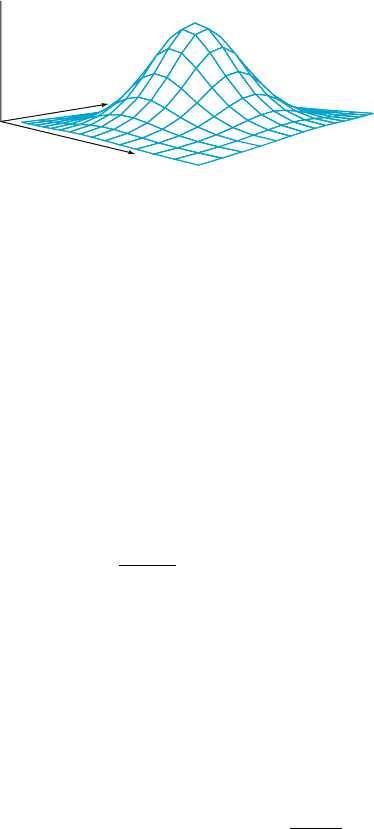
What does the density look like when plotted as a function of x and y?Ifwe
set f(x, y) to a constant to investigate the contours, this is setting the exponent to a
constant, and it will give ellipses centered at (x, y) ¼ (m
1
, m
2
). That is, all of the
contours are concentric ellipses. The plot in three dimensions looks like a mountain
with elliptical cross-sections. The vertical cross-sections are all proportional to
normal densities. See Figure 5.6.
258 CHAPTER 5 Joint Probability Distributions
If r ¼ 0, then fx; yðÞ¼f
X
ðxÞ f
Y
ðyÞ, where X is normal with mean m
1
and
standard deviation s
1
, and Y is normal with mean m
2
and standard deviation s
2
.That
is, X and Y have independent normal distributions. In this case the plot in three
dimensions has elliptical contours that reduce to circles. Recall that in Section 5.2
we emphasized that independence of X and Y implies r ¼ 0 but, in general, r ¼
0 does not imply independence. However, we have just seen that when X and Y are
bivariate normal r ¼0 does imply independence. Therefore, in the bivariate norm al
case r ¼ 0 if and only if the two rv’s are independent.
What do we get for the marginal distributions? As you might guess, the
marginal distribution f
X
(x) is just a normal distribution with mean m
1
and standard
deviation s
1
:
f
X
ðxÞ¼
1
s
1
ffiffiffiffiffiffi
2p
p
e
f½ðxm
1
Þ=s
1
2
g=2
The integration to show this [integ rating f(x,y)ony from 1 to 1 ] is rather messy.
More generally, any linear combination of the form aX + bY, where a and b are
constants, is normally distributed.
We get the conditional density by dividing the marginal density of X into
f(x,y). Unfortunately, the algebra is again a mess, but the result is fairly simple.
The conditional density f
Y|X
(y|x) is a normal density with mean and variance
given by
m
Y
jX¼x
¼ EYjX ¼ xðÞ¼m
2
þ rs
2
x m
1
s
1
s
2
YjX¼x
¼ VYjX ¼ xðÞ¼s
2
2
ð1 r
2
Þ
Notice that the conditional mean is a linear function of x and the conditional
variance doesn’ t depend on x at all. When r ¼ 0, the conditional mean is the
mean of Y and the conditional variance is just the variance of Y. In other words,
if r ¼ 0, then the conditional distribution of Y is the same as the unconditional
distribution of Y. This says that if r ¼ 0 then X and Y are independent, but we
already saw that previously in terms of the factorization of f(x,y) into the product of
the marginal densities.
When r is close to 1 or 1 the conditional variance will be much smaller
than V(Y), which says that knowledge of X will be very helpful in predicting Y.
x
y
f
(x, y)
Figure 5.6 A graph of the bivariate normal pdf
5.3 Conditional Distributions 259

If r is near 0 then X and Y are nearly independen t and knowledge of X is not very
useful in predicting Y.
Example 5.22 Let X be mother’s height and Y be daughter’s height. A similar situation was one
of the first applications of the bivariate normal distribution, by Francis Galton
in 1886, and the data was found to fit the distribution very well. Suppose a bivariate
normal distribution with mean m
1
¼ 64 in. and standard deviation s
1
¼ 3 in. for X
and mean m
2
¼ 65 in. and standard deviation s
2
¼ 3 in. for Y . Here m
2
> m
1
, which
is in accord with the increase in height from one generation to the next. Assume
r ¼ .4. Then
m
YjX¼x
¼ m
2
þ rs
2
x m
1
s
1
¼ 65 þ :4ð3Þ
x 64
3
¼ 65 þ :4ðx 64Þ¼:4x þ 39:4
s
2
YjX¼x
¼ VYjX ¼ xðÞ¼s
2
2
ð1 r
2
Þ¼9 ð1 :4
2
Þ¼7:56 and s
YjX¼x
¼ 2:75
Notice that the conditional variance is 16% less than the variance of Y.
Squaring the correlation gives the percentage by which the conditional variance
is reduced relative to the variance of Y.
■
Regression to the Mean
The formula for the conditional mean can be re-expressed as
m
YjX¼x
m
2
s
2
¼ r
x m
1
s
1
In words, when the formula is expressed in terms of standardized variables, the
standardized conditional mean is just r times the standardized x. In particular,
for the example of heights,
m
YjX¼x
65
3
¼ :4
x 64
3
If the mother is 5 in. above the mean of 64 in. for mothers, then the daughter’s
conditional expected height is just 2 in. above the mean for daughters. In this
example, with equal standard deviations for Y and X, the daughter’s conditional
expected height is always closer to its mean than the mother’s height is to its mean.
In general, the conditional expected Y is closer when it is measured in terms of
standard deviations. One can think of the conditional expectation as being pulled
back toward the mean, and that is why Galton called this regression to the mean.
Regression to the mean occurs in many contexts. For example, let X be a
baseball player’s average for the first half of the season and let Y be the average for
the second half. Most of the players with a high X (above .300) will not have such a
high Y. The same kind of reasoning applies to the “sophomore jinx,” which says
that if a player has a very good first season, then the player is unlikely to do as well
in the second season.
260 CHAPTER 5 Joint Probability Distributions

The Mean and Variance Via the Conditional
Mean and Variance
From the conditional mean we can obtain the mean of Y. From the conditional mean
and the conditional variance, the variance of Y can be obtained. The following
theorem uses the idea that the conditional mean and variance are themselves
random variables, as illustrated in the tables of Example 5.20.
THEOREM
a. EðYÞ¼EE YjXðÞ½
b. VðYÞ¼VEYjXðÞ½þEV YjXðÞ½
The result in (a) says that E(Y) is a weighted average of the conditional means
E(Y|X ¼ x), where the weights are given by the pmf or pdf of X. We give the
proof of just part (a) in the discrete case:
E½EðYjXÞ¼
X
x2D
X
EðYjX ¼xÞp
X
ðxÞ¼
X
x2D
X
X
y2D
Y
yp
YjX
ðyjxÞp
X
ðxÞ
¼
X
x2D
X
X
y2D
Y
y
pðx;yÞ
p
X
ðxÞ
p
X
ðxÞ¼
X
y2D
Y
y
X
x2D
X
pðx;yÞ¼
X
y2D
Y
yp
Y
ðyÞ¼EðYÞ
Example 5.23 To try to get a feel for the theorem, let’s apply it to Example 5.20. Here again is the
table for the conditional mean and variance of Y given X.
xP(X ¼ x) E(Y|X ¼ x) V(Y|X ¼ x)
100 .5 100 8000
250 .5 150 4500
Compute
EE YjXðÞ½¼EYjX ¼ 100ðÞPX¼ 100ðÞþEYj X ¼ 250ðÞPX¼ 250ðÞ
¼ 100 :5ðÞþ150 :5ðÞ¼125
Compare this with E(Y) computed directly:
EðYÞ¼0PY¼ 0ðÞþ100PY¼ 100ðÞþ200PY¼ 200ðÞ
¼ 0 :25ðÞþ100 :25ðÞþ200 :5ðÞ¼125
For the variance first compute the mean of the conditi onal variance:
EV YjXðÞ½¼VYjX ¼ 100ðÞPX¼ 100ðÞþVYjX ¼ 250ðÞPX¼ 250ðÞ
¼
4500 :5ðÞþ8000 :5ðÞ¼6250
Then comes the variance of the conditional mean. We have already computed
the mean of this random variable to be 125. The variance is
VEYjXðÞ½¼:5 100 125ðÞ
2
þ :5 150 125ðÞ
2
¼ 625
5.3 Conditional Distributions 261

Finally, do the sum in part (b) of the theorem:
VðYÞ¼VEYjXðÞ½þEV YjXðÞ½¼625 þ 6250 ¼ 6875
To compare this with V(Y) calculated from the pmf of Y, compute first
EY
2
¼ 0
2
PY¼ 0ðÞþ100
2
PY¼ 100ðÞþ200
2
PY¼ 200ðÞ
¼ 0 :25ðÞþ10; 000 :25ðÞþ40; 000 :5ðÞ¼22; 500
Thus, VðYÞ¼EY
2
ðÞEðYÞ½
2
¼ 22; 500 125
2
¼ 6875, in agreement with the
calculation based on the theorem.
■
Here is an example where the theorem is helpful in finding the mean and
variance of a random variable that is neither discrete nor continuous.
Example 5.24 The probability of a claim being filed on an insurance policy is .1, and
only one claim can be filed. If a claim is filed, the amount is exponentially
distributed with mean $1000. Recall from Section 4.4 that the mean and standard
deviation of the exponential distribution are the same, so the variance is the
square of this value. We want to find the mean and variance of the amount
paid. Let X be the number of claims (0 or 1) and let Y be the payment. We know
that E(Y| X ¼ 0) ¼ 0 and E(Y| X ¼ 1) ¼ 1000. Also, V(Y| X ¼ 0) ¼ 0 and V(Y|X ¼ 1)
¼ 1000
2
¼ 1,000,000. Here is a table for the distribution of E(Y|X ¼ x) and
V(Y|X ¼ x):
xP(X ¼ x) E(Y|X ¼ x) V(Y|X ¼ x)
0.9 0 0
1 .1 1000 1,000,000
Therefore,
EðYÞ¼EE YjXðÞ½¼EYjX ¼ 0ðÞPX¼ 0ðÞþEYjX ¼ 1ðÞPX¼ 1ðÞ
¼ 0 :9ðÞþ1000 :1ðÞ¼100
The variance of the conditional mean is
VEYjXðÞ½¼:90100ðÞ
2
þ :11000 100ðÞ
2
¼ 90; 000
The expected value of the conditional variance is
EV YjXðÞ½¼:9ð 0Þþ:11; 000; 000ðÞ¼100; 000
Finally, use part (b) of the theorem to get V(Y):
VðYÞ¼VEYjXðÞ½þEV YjXðÞ½¼90; 000 þ 100; 000 ¼ 190; 000
Taking the square root gives the standard deviation, s
Y
¼ $435.89.
Suppose that we want to compute the mean and variance of Y directly.
Notice that X is discrete, but the conditional distribution of Y given X ¼ 1
is continuous. The random variable Y itself is neither discrete nor continuous, because
it has probability .9 of being 0, but the other .1 of its probability is spread out from
0to1. Such “mixed” distributions may require a little extra effort to evaluate means
and variances, although it is not especially hard in this case. Compute
262 CHAPTER 5 Joint Probability Distributions
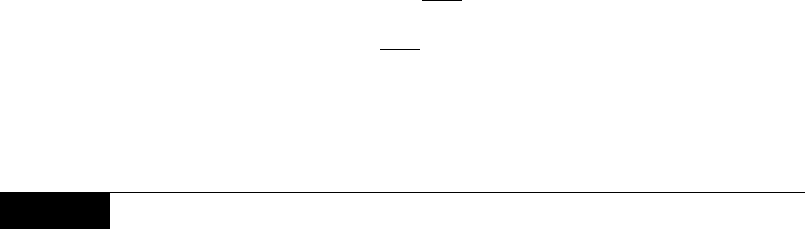
m
Y
¼ EðYÞ¼ð:1Þ
ð
1
0
y
1
1000
e
y=1000
dy ¼ð:1Þð1000Þ¼100
EðY
2
Þ¼ð:1Þ
ð
1
0
y
2
1
1000
e
y=1000
dy ¼ð:1Þ2ð1000
2
Þ¼200;000
VðYÞ¼EðY
2
Þ½EðYÞ
2
¼ 200;000 10;000 ¼ 190;000
These agree with what we found using the theorem.
■
Exercises Section 5.3 (36–57)
36. According to an article in the August 30, 2002
issue of the Chronicle of Higher Education,
30% of first-year college students are liberals,
20% are conservatives, and 50% characterize
themselves as middle-of-the-road. Choose two
students at random, let X be the number of liber-
als, and let Y be the number of conservatives.
a. Using the multinomial distribution from
Section 5.1, give the joint probability mass func-
tion p(x, y)ofX and Y. Give the joint probability
table showing all nine values, of which three
should be 0.
b. Determine the marginal probability mass func-
tions by summing p(x, y)numerically.How
could these be obtained directly? [Hint:What
are the univariate distributions of X and Y?]
c. Determine the conditional probability mass
function of Y given X ¼ x for x ¼ 0, 1, 2.
Compare with the Bin[2x, .2/(.2 + .5)] distri-
bution. Why should this work?
d. Are X and Y independent? Explain.
e. Find E(Y|X ¼ x) for x ¼ 0, 1, 2. Do this numer-
ically and then compare with the use of the
formula for the binomial mean, using the bino-
mial distribution given in part (c). Is E(Y|X ¼x)
a linear function of x?
f. Determine V(Y
|X ¼ x) for x ¼ 0, 1, 2. Do this
numerically and then compare with the use of
the formula for the binomial variance, using the
binomial distribution given in part (c).
37. Teresa and Allison each have arrival times uni-
formly distributed between 12:00 and 1:00. Their
times do not influence each other. If Y is the first
of the two times and X is the second, on a scale of
0–1, then the joint pdf of X and Y is f(x, y) ¼ 2 for
0 < y < x < 1.
a. Determine the marginal density of X.
b. Determine the conditional density of Y given
X ¼ x.
c. Determine the conditional probability that Y is
between 0 and .3, given that X is .5.
d. Are X and Y independent? Explain.
e. Determine the conditional mean of Y given
X ¼ x.IsE(Y|X ¼ x) a linear function of x?
f. Determine the conditional variance of Y given
X ¼ x.
38. Refer back to Exercise 37.
a. Determine the marginal density of Y.
b. Determine the conditional density of X given
Y ¼ y.
c. Determine the conditional mean of X given
Y ¼ y.IsE(X|Y ¼ y) a linear function of y?
d. Determine the conditional variance of X given
Y ¼ y.
39. A pizza place has two phones. On each phone the
waiting time until the first call is exponentially
distributed with mean one minute. Each phone is
not influenced by the other. Let X be the shorter of
the two waiting times and let Y be the longer.
It can be shown that the joint pdf of X and Y is
fx; yðÞ¼2e
ðxþyÞ
; 0 < x < y < 1
a. Determine the marginal density of X.
b. Determine the conditional density of Y given
X ¼ x.
c. Determine the probability that Y is greater
than 2, given that X ¼ 1.
d. Are X and Y independent? Explain.
e. Determine the conditional mean of Y given
X ¼ x.IsE(Y|X ¼ x) a linear function of x?
f. Determine the conditional variance of Y given
X ¼ x.
40. A class has 10 mathematics majors, 6 computer
science majors, and 4 statistics majors. A committee
of two is selected at random to work on a problem.
Let X be the number of mathematics majors and let Y
be the number of computer science majors chosen.
a. Determine the joint probability mass function
p(x,y). This generalizes the hypergeometric
distribution studied in Section 3.6. Give the
joint probability table showing all nine values,
of which three should be 0.
5.3 Conditional Distributions 263
b. Determine the marginal probability mass
functions by summing numerically. How could
these be obtained directly? [Hint: What are the
univariate distributions of X and Y?]
c. Determine the conditional probability mass
function of Y given X ¼ x for x ¼ 0, 1, 2.
Compare with the h(y;2x, 6, 10) distribution.
Intuitively, why should this work?
d. Are X and Y independent? Explain.
e. Determine E(Y|X ¼ x), x ¼ 0, 1, 2. Do this
numerically and then compare with the use of
the formula for the hypergeometric mean,
using the hypergeometric distribution given in
part (c). Is E(Y|X ¼ x) a linear function of x?
f. Determine V(Y|X ¼ x), x ¼ 0, 1, 2. Do this
numerically and then compare with the use of
the formula for the hypergeometric variance,
using the hypergeometric distribution given in
part (c).
41. A stick is one foot long. You break it at a point X
(measured from the left end) chosen randomly
uniformly along its length. Then you break the
left part at a point Y chosen randomly uniformly
along its length. In other words, X is uniformly
distributed between 0 and 1 and, given X ¼ x, Y is
uniformly distributed between 0 and x.
a.
Determine E(Y|X ¼ x) and then V(Y|X ¼ x). Is
E(Y|X ¼ x) a linear function of x?
b. Determine f(x,y) using f
X
(x) and f
Y|X
(y|x).
c. Determine f
Y
(y).
d. Use f
Y
(y) from (c) to get E(Y) and V(Y).
e. Use (a) and the theorem of this section to get
E(Y) and V(Y).
42. A system consisting of two components will con-
tinue to operate only as long as both components
function. Suppose the joint pdf of the lifetimes
(months) of the two components in a system
is given by fx; yðÞ¼c 10 x þ yðÞ½for x > 0;
y > 0; x þ y < 10
a. If the first component functions for exactly
3 months, what is the probability that the sec-
ond functions for more than 2 months?
b. Suppose the system will continue to work only
as long as both components function. Among 20
of these systems that operate independently of
each other, what is the probability that at least
half work for more than 3 months?
43. Refer to Exercise 1 and answer the following
questions:
a. Given that X ¼ 1, determine the conditional
pmf of Ythat is, p
Y|X
(0|1), p
Y|X
(1|1), and
p
Y|X
(2|1).
b. Given that two hoses are in use at the
self-service island, what is the conditional
pmf of the number of hoses in use on the full-
service island?
c. Use the result of part (b) to calculate the con-
ditional probability P(Y 1|X ¼ 2).
d. Given that two hoses are in use at the full-
service island, what is the conditional pmf of
the number in use at the self-service island?
44. The joint pdf of pressures for right and left front
tires is given in Exercise 9.
a. Determine the conditional pdf of Y given that
X ¼ x and the conditional pdf of X given that
Y ¼ y.
b. If the pressure in the right tire is found to be 22
psi, what is the probability that the left tire has
a pressure of at least 25 psi? Compare this to
P(Y 25).
c. If the pressure in the right tire is found to be
22 psi, what is the expected pressure in the left
tire, and what is the standard deviation of pres-
sure in this tire?
45. Suppose that X is uniformly distributed between
0 and 1. Given X ¼ x, Y is uniformly distributed
between 0 and x
2
a. Determine E(Y|X ¼ x) and then V(Y|X ¼ x).
Is E(Y|X ¼ x) a linear function of x?
b. Determine f(x,y) using f
X
(x) and f
Y|X
(y|x).
c. Determine f
Y
(y).
46. This is a continuation of the previous exercise.
a. Use f
Y
(y) from Exercise 45(c) to get E(Y) and
V(Y).
b. Use Exercise 45(a) and the theorem of this
section to get E(Y) and V(Y).
47. David and Peter independently choose at random a
number from 1, 2, 3, with each possibility equally
likely. Let X be the larger of the two numbers, and
let Y be the smaller.
a. Determine p( x, y).
b. Determine p
X
(x), x ¼ 1, 2, 3.
c. Determine p
Y|X
(y|x).
d. Determine E(Y|X ¼ x). Is this a linear function
of x?
e. Determine V(Y|X ¼ x).
48. In Exercise 47 find
a. E(X).
b. p
Y
(y).
c. E(Y) using p
Y
(y).
d. E(Y) using E(Y|X).
e. E(X)+E(Y). Intuitively, why should this be 4?
264
CHAPTER 5 Joint Probability Distributions

49. In Exercise 47 find
a. p
X|Y
(x|y).
b. E(X|Y ¼ y). Is this a linear function of y ?
c. V(X|Y ¼ y).
50. For a Calculus I class, the final exam score Y and
the average of the four earlier tests X are bivariate
normal with mean m
1
¼ 73, standard deviation
s
1
¼ 12, mean m
2
¼70, standard deviation s
2
¼
15. The correlation is r ¼.71. Determine
a. m
Y|X¼x
b. s
2
YjX¼x
c. s
Y|X¼x
d. P(Y > 90|X ¼ 80), i.e., the probability that the
final exam score exceeds 90 given that the
average of the four earlier tests is 80
51. Let X and Y, reaction times (sec) to two different
stimuli, have a bivariate normal distribution with
mean m
1
¼ 20 and standard deviation s
1
¼ 2 for X
and mean m
2
¼30 and standard deviation s
2
¼ 5
for Y. Assume r ¼.8. Determine
a. m
Y|X¼x
b. s
2
YjX¼x
c. s
Y|X¼x
d. P(Y > 46|X ¼ 25)
52. Consider three ping pong balls numbered 1, 2, and 3.
Two balls are randomly selected with replacement.
If the sum of the two resulting numbers exceeds 4,
two balls are again selected. This process continues
until the sum is at most 4. Let X and Y denote the
last two numbers selected. Possible (X, Y) pairs are
{(1, 1), (1, 2), (1, 3), (2, 1), (2, 2), (3, 1)}.
a. Determine p
X,Y
(x,y).
b. Determine p
Y|X
(y|x).
c. Determine E(Y|X ¼ x). Is this a linear function
of x?
d. Determine E(X|Y ¼ y). What special property
of p(x, y) allows us to get this from (c)?
e. Determine V(Y|X ¼ x).
53. Let X be a random digit (0, 1, 2, ..., 9 are equally
likely) and let Y be a random digit not equal to X.
That is, the nine digits other than X are equally
likely for Y.
a. Determine p
X
(x), p
Y|X
(y|x), p
X,Y
(x,y).
b. Determine a formula for E(Y|X ¼ x). Is this a
linear function of x?
54. In our discussion of the bivariate normal, there is
an expression for E(Y|X ¼ x).
a. By reversing the roles of X and Y give a similar
formula for E(X|Y ¼ y).
b. Both E(Y|X ¼ x) and E(X|Y ¼ y) are linear
functions. Show that the product of the two
slopes is r
2
.
55. This week the number X of claims coming into an
insurance office is Poisson with mean 100. The
probability that any particular claim relates to
automobile insurance is .6, independent of any
other claim. If Y is the number of automobile
claims, then Y is binomial with X trials, each
with “success” probability .6.
a. Determine E( Y|X ¼ x) and V(Y|X ¼ x).
b. Use part (a) to find E(Y).
c. Use part (a) to find V(Y).
56. In Exercise 55 show that the distribution of Y is
Poisson with mean 60. You will need to recognize
the Maclaurin series expansion for the exponential
function. Use the knowledge that Y is Poisson with
mean 60 to find E(Y) and V(Y).
57. Let X and Y be the times for a randomly selected
individual to complete two different tasks, and
assume that (X, Y) has a bivariate normal distribution
with m
X
¼ 100, s
X
¼ 50, m
Y
¼ 25, s
Y
¼ 5, r ¼ .5.
From statistical software we obtain P(X < 100,
Y < 25) ¼ .3333, P(X < 50, Y < 20) ¼ .0625,
P(X < 50, Y < 25) ¼ .1274, and P(X < 100, Y <
20) ¼ .1274.
(a) Determine P(50 < X < 100, 20 < Y < 25).
(b) Leave the other parameters the same but
change the correlation to r ¼ 0 (indepen-
dence). Now recompute the answer to part
(a). Intuitively, why should the answer to
part (a) be larger?
5.4
Transformations of Random Variables
In the previous chapter we discussed the problem of starting with a single random
variable X, forming some function of X, such as X
2
or e
X
, to obtain a new random
variable Y ¼ h(X), and investigating the distribution of this new random variable.
We now generalize this scenario by starting with more than a single random
variable. Consider as an example a system having a component that can be replaced
just once before the system itself expires. Let X
1
denote the lifetime of the original
5.4 Transformations of Random Variables 265

component and X
2
the lifetime of the replacement component. Then any of the
following functions of X
1
and X
2
may be of interest to an investigator:
1. Th e total lifeti me X
1
+ X
2
2. Th e ratio of lifetimes X
1
/X
2
; for example, if the value of this ratio is 2, the
original component lasted twice as long as its replacement
3. Th e ratio X
1
/(X
1
+ X
2
), which represents the proportion of system lifetime during
which the original component operated
The Joint Distribution of Two New Random Variables
Given two random variables X
1
and X
2
, consider forming two new random vari-
ables Y
1
¼ u
1
(X
1
, X
2
) and Y
2
¼ u
2
(X
1
, X
2
). We now focus on finding the joint
distribution of these two new variables. Since most applications assume that the
X
i
’s are continuous we restrict ourselves to that case. Some notation is needed
before a general result can be given. Let
f(x
1
, x
2
) ¼ the joint pdf of the two original variables
g(y
1
, y
2
) ¼ the joint pdf of the two new variables
The u
1
(·) and u
2
(·) functions express the new variables in terms of the original ones.
The general result presumes that these functions can be inverted to solve for the
original variables in terms of the new ones:
X
1
¼ v
1
Y
1
; Y
2
ðÞ; X
2
¼ v
2
Y
1
; Y
2
ðÞ
For example, if
y
1
¼ x
1
þ x
2
and y
2
¼
x
1
x
1
þ x
2
then multiplying y
2
by y
1
gives an expression for x
1
, and then we can substitute this
into the expression for y
1
and solve for x
2
:
x
1
¼ y
1
y
2
¼ v
1
y
1
; y
2
ðÞx
2
¼ y
1
1 y
2
ðÞ¼v
2
y
1
; y
2
ðÞ
In a final burst of notation, let
S ¼ x
1
; x
2
ðÞ: fx
1
; x
2
ðÞ> 0
fg
T ¼ y
1
; y
2
ðÞ: gy
1
; y
2
ðÞ> 0
fg
That is, S is the region of positive density for the original variables and T is the
region of positive density for the new variables; T is the “image” of S under the
transformation.
THEOREM
Suppose that the partial derivative of each v
i
(y
1
, y
2
) with respect to both y
1
and y
2
exists for every (y
1
, y
2
) pair in T and is continuous. Form the 2 2
matrix
M ¼
@v
1
ðy
1
; y
2
Þ
@y
1
@v
1
ðy
1
; y
2
Þ
@y
2
@v
2
ðy
1
; y
2
Þ
@y
1
@v
2
ðy
1
; y
2
Þ
@y
2
0
B
B
B
@
1
C
C
C
A
266 CHAPTER 5 Joint Probability Distributions
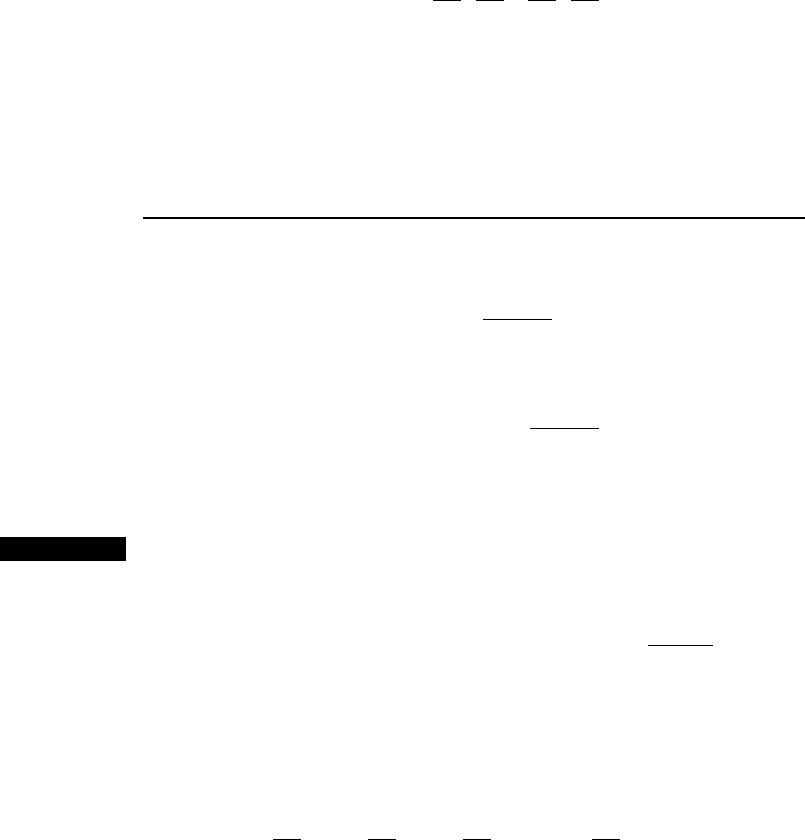
The determinant of this matrix, called the Jacobian,is
detðMÞ¼
@v
1
@y
1
@v
2
@y
2
@v
1
@y
2
@v
2
@y
1
The joint pdf for the new variables then results from taking the joint pdf
f(x
1
, x
2
) for the original variables, replacing x
1
and x
2
by their expressions in
terms of y
1
and y
2
, and finally multiplying this by the absolute value of the
Jacobian:
gy
1
; y
2
ðÞ¼fv
1
y
1
; y
2
ðÞ; v
2
y
1
; y
2
ðÞ½jdetðMÞj y
1
; y
2
ðÞ2T
The theorem can be rewritten slightly by using the notation
detðMÞ¼
@ðx
1
; x
2
Þ
@ðy
1
; y
2
Þ
Then we have
gðy
1
; y
2
Þ¼f ðx
1
; x
2
Þ
@ðx
1
; x
2
Þ
@ðy
1
; y
2
Þ
which is the natural extension of the univariate result (transforming a single rv X to
obtain a single new rv Y) g(y) ¼ f(x)
|dx/dy| discussed in Chapter 4.
Example 5.25 Continuing with the component lifetime situation, suppose that X
1
and X
2
are
independent, each having an exponential distribution with parameter l. Let’s
determine the joint pdf of
Y
1
¼ u
1
X
1
; X
2
ðÞ¼X
1
þ X
2
and Y
2
¼ u
2
X
1
; X
2
ðÞ¼
X
1
X
1
þ X
2
We have already inve rted this transformation:
x
1
¼ v
1
y
1
; y
2
ðÞ¼y
1
y
2
x
2
¼ v
2
y
1
; y
2
ðÞ¼y
1
1 y
2
ðÞ
The image of the transformation, i.e. the set of (y
1
, y
2
) pairs with positive density,
is 0 < y
1
and 0 < y
2
< 1. The four relevant partial derivatives are
@v
1
@y
1
¼ y
2
@v
1
@y
2
¼ y
1
@v
2
@y
1
¼ 1 y
2
@v
2
@y
2
¼y
1
from which the Jacobian is y
1
y
2
y
1
1 y
2
ðÞ¼y
1
Since the joint pdf of X
1
and X
2
is
f ð x
1
; x
2
Þ¼le
lx
1
le
lx
2
¼ l
2
e
lðx
1
þx
2
Þ
x
1
> 0; x
2
> 0
we have
gðy
1
; y
2
Þ¼l
2
e
ly
1
y
1
¼ l
2
y
1
e
ly
1
10< y
1
; 0 < y
2
< 1
The joint pdf thus factors into two parts. The first part is a gamma pdf with
parameters a ¼ 2 and b ¼ 1/l, and the second part is a uniform pdf on (0, 1).
5.4 Transformations of Random Variables 267