
Devore J.L., Berk K.N. Modern Mathematical Statistics with Applications
Подождите немного. Документ загружается.


mðm þ 2n þ 1Þ=2. As with the special case m ¼ 3, n ¼ 4, the distribution of W is
symmetric about the value that is halfway between the smallest and largest values;
this middle value is m(m + n + 1)/2. Because of this symmetry, probabilities
involving lower-tail critical values can be obtained from corresponding upper-tail
values.
Null hypothesis: H
0
: m
1
m
2
¼ D
0
Test statistic value : w ¼
X
m
i¼1
r
i
where r
i
¼ rank of ðx
i
D
0
Þ in the
combined sample of m þ n ðx D
0
Þ’s
and y’s
Alternative Hypothesis Rejection Region
H
a
: m
1
m
2
> D
0
w c
1
H
a
: m
1
m
2
< D
0
w mðm þ n þ 1Þc
1
H
a
: m
1
m
2
6¼ D
0
either w c or w mðm þ n þ 1Þc
where P(W c
1
when H
0
is true) a, P(W c when H
0
is true) a/2.
Because W has a discrete probability distribution, there will not always exist
a critical value corresponding exactly to one of the usual levels of significance.
Appendix Table A.13 gives upper-tail critical values for probabilities closest to .05,
.025, .01, and .005, from which level .05 or .01 one- and two-tailed tests can be
obtained. The table gives information only for m ¼ 3, 4, ..., 8 and n ¼ m, m +1,
... , 8 (i.e., 3 m n 8). For values of m and n that exceed 8, a normal
approximation can be used (Exercise 14). To use the table for small m and n,
though, the X and Y samples should be labeled so that m n.
Example 14.3 The urinary fluoride conce ntration (parts per million) was measured both for a
sample of livestock grazing in an area previously exposed to fluoride pollution and
for a similar sample grazing in an unpolluted region:
Polluted 21.3 18.7 23.0 17.1 16.8 20.9 19.7
Unpolluted 14.2 18.3 17.2 18.4 20.0
Does the data indicate strongly that the true average fluoride concentration for
livestock grazing in the polluted region is larger than for the unpolluted region? Use
the Wilcoxon rank-sum test at level a ¼ .01.
The sample sizes here are 7 and 5. To obtain m n, label the unpolluted
observations as the x’s (x
1
¼ 14.2, ... , x
5
¼ 20.0) and the polluted observations
as the y ’s. Thus m
1
is the true average fluoride concentration without pollution, and
m
2
is the true average concentration with pollution. The alternative hypothesis is
H
a
: m
1
m
2
< 0 (pollution causes an increase in concentration), so a lower-tailed
768 CHAPTER 14 Alternative Approaches to Inference

test is appropriate. From Appendix Table A.13 with m ¼ 5 and n ¼ 7, P(W 47
when H
0
is true) .01. The critical value for the lower-tailed test is therefore
m(m + n +1) 47 ¼ 5(13) 47 ¼ 18; H
0
will now be rejected if w 18.
The pooled ordered sample follows; the computed W is w ¼ r
1
þ r
2
þþr
5
(where r
i
is the rank of x
i
) ¼ 1+5+4+6+9¼ 25. Since 25 is not 18, H
0
is
not rejected at (approximately) level .01.
xyyxxxyyxyyy
14.2 16.8 17.1 17.2 18.3 18.4 18.7 19.7 20.0 20.9 21.3 23.0
123456789101112
■
Ties are handled as suggested for the signed-rank test in the previous section.
Efficiency of the Wilcoxon Rank-Sum Test
When the distributions being sampled are both normal with s
1
¼ s
2
, and therefore
have the same shapes and spreads, either the pooled t test or the Wilcoxon test can
be used (th e two-sample t test assumes normality but not equal variances, so
assumptions underlying its use are more restrictive in one sense and less in another
than those for Wilcoxon’s test). In this situation, the pooled t test is best among all
possible tests in the sense of minimizing b for any fixed a. However, an investigator
can never be absolutely certain that underlying assumptions are satisfied. It is
therefore relevant to ask (1) how much is lost by using Wilcoxon’s test rather
than the pooled t test when the distributions are normal with equal variances and
(2) how W compares to T in nonnormal situations.
The notion of test efficiency was discussed in the previous section in connec-
tion with the one-sample t test and Wilcoxon signed-rank test. The results for the
two-sample tests are the same as those for the one-sample tests. When normality
and equal variances both hold, the rank-sum test is approximately 95% as efficient
as the pooled t test in large samples. That is, the t test will give the same error
probabilities as the Wilcoxon test using slightly smaller sample sizes. On the other
hand, the Wilcoxon test will always be at least 86% as efficient as the pooled t test
and may be much more efficient if the underlying distributions are very nonnormal,
especially with heavy tails. The com parison of the Wilcoxon test with the two-
sample (unpooled) t test is less clear-cut. The t test is not known to be the best test in
any sense, so it seems safe to conclude that as long as the population distributions
have similar shapes and spreads, the behavior of the Wilcoxon test should compare
quite favorably to the two-sample t test.
Lastly, we note that b calculat ions for the Wilcoxon test are quite difficult.
This is because the distribution of W when H
0
is false depends not only on m
1
m
2
but also on the shapes of the two distributions. For most underlying distributions,
the nonnull distribution of W is virtually intractable. This is why statisticians have
developed large-sample (asymptotic relative) efficiency as a means of comparing
tests. With the capabilities of modern-day computer software, another approach to
calculation of b is to carry out a simulation experiment.
14.2 The Wilcoxon Rank-Sum Test 769

Exercises Section 14.2 (9–16)
9. In an experiment to compare the bond strength of
two different adhesives, each adhesive was used in
five bondings of two surfaces, and the force nec-
essary to separate the surfaces was determined for
each bonding. For adhesive 1, the resulting values
were 229, 286, 245, 299, and 250, whereas the
adhesive 2 observations were 213, 179, 163, 247,
and 225. Let m
i
denote the true average bond
strength of adhesive type i. Use the Wilcoxon
rank-sum test at level .05 to test H
0
: m
1
¼ m
2
versus H
a
: m
1
> m
2
.
10. The article “A Study of Wood Stove Particulate
Emissions” (J. Air Pollut. Contr. Assoc., 1979:
724–728) reports the following data on burn time
(hours) for samples of oak and pine. Test at level
.05 to see whether there is any difference in true
average burn time for the two types of wood.
Oak 1.72 .67 1.55 1.56 1.42 1.23 1.77 .48
Pine .98 1.40 1.33 1.52 .73 1.20
11. A modification has been made to the process for
producing a certain type of “time-zero” film (film
that begins to develop as soon as a picture is taken).
Because the modification involves extra cost, it will
be incorporated only if sample data strongly indi-
cates that the modification has decreased true aver-
age developing time by more than 1 s. Assuming
that the developing-time distributions differ only
with respect to location if at all, use the Wilcoxon
rank-sum test at level .05 on the accompanying data
to test the appropriate hypotheses.
Original
Process 8.6 5.1 4.5 5.4 6.3 6.6 5.7 8.5
Modified
Process 5.5 4.0 3.8 6.0 5.8 4.9 7.0 5.7
12. The article “Measuring the Exposure of Infants to
Tobacco Smoke” (New Engl. J. Med., 1984:
1075–1078) reports on a study in which various
measurements were taken both from a random
sample of infants who had been exposed to house-
hold smoke and from a sample of unexposed
infants. The accompanying data consists of obser-
vations on urinary concentration of cotinine, a
major metabolite of nicotine (the values constitute
a subset of the original data and were read from a
plot that appeared in the article). Does the data
suggest that true average cotinine level is higher in
exposed infants than in unexposed infants by more
than 25? Carry out a test at significance level .05.
Unexposed 81112142043111
Exposed 35 56 83 92 128 150 176 208
13. Reconsider the situation described in Exercise 100
of Chapter 10 and the accompanying MINITAB
output (the Greek letter eta is used to denote a
median).
Mann-Whitney Confidence Interval and
Test
good N
¼ 8 Median ¼ 0.540
poor N
¼ 8 Median ¼ 2.400
Point estimate for ETA1
ETA2 is
1.155
95.9 % CI for ETA1 ETA2 is( 3.160,
0.409) W ¼ 41.0
Test of ETA1
¼ ETA2 vs ETA1 < ETA2 is
significant at 0.0027
a. Verify that the value of MINITAB’s test statis-
tic is correct.
b. Carry out an appropriate test of hypotheses
using a significance level of .01.
14. The Wilcoxon rank-sum statistic can be repre-
sented as W ¼ R
1
þ R
2
þþR
m
, where R
i
is
the rank of X
i
D
0
among all m + n such differ-
ences. When H
0
is true, each R
i
is equally likely to
be one of the first m + n positive integers; that is,
R
i
has a discrete uniform distribution on the values
1, 2, 3, ..., m + n.
a. Determine the mean value of each R
i
when H
0
is true and then show that the mean value of W
is m(m+n+1)/2. [Hint: Use the hint given in
Exercise 6(a).]
b. The variance of each R
i
is easily determined.
However, the R
i
’s are not independent random
variables because, for example, if m ¼ n ¼ 10
and we are told that R
1
¼ 5, then R
2
must
be one of the other 19 integers between 1
and 20. However, if a and b are any two
distinct positive integers between 1 and
m+n inclusive, it follows that
PðR
i
¼ a and R
j
¼ bÞ¼1=½ðm þ nÞðm þ n 1Þ
since two integers are being sampled without
replacement from among 1, 2,
... , m+n.
Use this fact to show that
CovðR
i
; R
j
Þ¼
ðm þ n þ 1Þ=12
and then show that the vari-
ance of W is
mnðm þ n þ 1Þ=12.
c. A central limit theorem for a sum of non-inde-
pendent variables can be used to show that
when m > 8 and n > 8, W has approximately
a normal distribution with mean and variance
given by the results of (a) and (b). Use this to
770
CHAPTER 14 Alternative Approaches to Inference

propose a large-sample standardized rank-sum
test statistic and then describe the rejection
region that has approximate significance level
a for testing H
0
against each of the three
commonly encountered alternative hypotheses.
[Note: When there are ties in the observed
values, a correction for the variance derived
in (b) should be used in standardizing W; please
consult a book on nonparametric statistics for
the result.]
15. The accompanying data resulted from an experi-
ment to compare the effects of vitamin C in orange
juice and in synthetic ascorbic acid on the length
of odontoblasts in guinea pigs over a 6-week
period (“The Growth of the Odontoblasts of the
Incisor Tooth as a Criterion of the Vitamin C
Intake of the Guinea Pig,” J. Nutrit., 1947:
491–504). Use the Wilcoxon rank-sum test at
level .01 to decide whether true average length
differs for the two types of vitamin C intake.
Compute also an approximate P-value. [Hint:
See Exercise 14.]
Orange Juice 8.2 9.4 9.6 9.7 10.0 14.5
15.2 16.1 17.6 21.5
Ascorbic Acid 4.2 5.2 5.8 6.4 7.0 7.3
10.1 11.2 11.3 11.5
16. Test the hypotheses suggested in Exercise 15
using the following data:
Orange Juice 8.2 9.5 9.5 9.7 10.0 14.5
15.2 16.1 17.6 21.5
Ascorbic Acid 4.2 5.2 5.8 6.4 7.0 7.3
9.5 10.0 11.5 11.5
[Hint: See Exercise 14.]
14.3
Distribution-Free Confidence Intervals
The method we have used so far to construct a confidence interval (CI) can be
described as follows: Start with a random variable (Z, T, w
2
, F, or the like) that
depends on the parameter of interest and a probability statement involving the
variable, manipulate the inequalities of the statement to isolate the parameter
between random endpoints, and finally substitute computed values for random
variables. Another general method for obtaining CIs takes advantage of a relation-
ship between test procedures and CIs. A 100(1 a)% CI for a parameter y can be
obtained from a level a test for H
0
: y ¼ y
0
versus H
a
: y 6¼ y
0
. This method will
be used to derive intervals associated with the Wilcoxon signed-rank test and the
Wilcoxon rank-sum test.
Before using the method to derive new intervals, reconsider the t test and the
t interval. Suppose a random sample of n ¼ 25 observations from a normal
population yields summary statistics
x¼ 100, s ¼ 20. Then a 90% CI for m is
x t
:05;24
s
ffiffiffiffiffi
25
p
;
x þ t
:05;24
s
ffiffiffiffiffi
25
p
¼ð93 :16; 106:84Þð14: 2 Þ
Suppose that instead of a CI, we had wished to test a hypoth esis about m. For
H
0
: m ¼ m
0
versus H
a
: m 6¼ m
0
, the t test at level .10 specifies that H
0
should be
rejected if t is either 1.711 or 1.711, where
t ¼
x m
0
s=
ffiffiffiffiffi
25
p
¼
100 m
0
20=
ffiffiffiffiffi
25
p
¼
100 m
0
4
ð14:3Þ
Consider now the null value m
0
¼ 95. Then t ¼ 1.25, so H
0
is not rejected.
Similarly, if m
0
¼ 104, then t ¼1, so again H
0
is not rejected. However,
if m
0
¼ 90, then t ¼ 2.5, so H
0
is rejected, and if m
0
¼ 108, then t ¼2, so H
0
is again rejected. By considering other values of m
0
and the decision resulting
from each one, the following general fact emerges: Every number inside the
14.3 Distribution-Free Confidence Intervals 771

interval (14.2) specifies a value of m
0
for which t of (14.3) leads to nonrejection of
H
0
, whereas every number outside interval (14.2) corresponds to a t for which H
0
is
rejected. That is, for the fixed values of n,
x, and s, the interval (14.2) is precisely
the set of all m
0
values for which testing H
0
: m ¼ m
0
versus H
a
: m 6¼ m
0
results in
not rejecting H
0
.
PROPOSITION
Suppose we have a level a test procedure for testing H
0
: y ¼ y
0
versus
H
a
: y 6¼ y
0
. For fixed sample values, let A denote the set of all values
y
0
for which H
0
is not rejected. Then A is a 100(1 a)% CI for y.
There are actually pathological examples in which the set A defined in the
proposition is not an interval of y values, but instead the complement of an interval
or something even stranger. To be more precise, we should reall y replace the notion
of a CI with that of a confidence set. In the cases of interest here, the set A does
turn out to be an interval.
The Wilcoxon Signed-Rank Interval
To test H
0
: m ¼ m
0
versus H
a
: m 6¼ m
0
using the Wilcoxon signed-rank test, where
m is the mean of a continuous symmetric distribution, the absolute values
jx
1
m
0
; ...;
jj
x
n
m
0
j are ordered from smallest to largest, with the smallest
receiving rank 1 and the largest, rank n. Each rank is then given the sign of its
associated x
i
m
0
, and the test statistic is the sum of the positively signed ranks.
The two-tailed test rejects H
0
if s
+
is either c or n(n + 1)/2 c, where c is
obtained from Appendix Table A.12 once the desired level of significance a is
specified. For fixed x
1
, ..., x
n
, the 100(1 a)% signed-rank interval will consist of
all m
0
for which H
0
: m ¼ m
0
is not rejected at level a. To identify this interval, it is
convenient to express the test statistic S
+
in another form.
S
þ
¼ the number of pairwise averages X
i
þ X
j
=2 with i j
that are m
0
ð14:4Þ
That is, if we average each x
j
in the list with each x
i
to its left, including (x
j
+ x
j
)/2
(which is just x
j
), and count the number of these averages that are m
0
, s
+
results.
In moving from left to right in the list of sample values, we are simply averaging
every pair of observations in the sample [again including (x
j
+ x
j
)/2] exactly once,
so the order in which the observations are listed before averaging is not important.
The equivalence of the two methods for computing s
+
is not difficult to verify. The
number of pairwise averages is
n
2
þ n (the first term due to averaging of different
observations and the second due to averaging each x
i
with itself), which equals
n(n + 1)/2. If either too many or too few of these pairwise averages are m
0
,
H
0
is rejected.
772 CHAPTER 14 Alternative Approaches to Inference
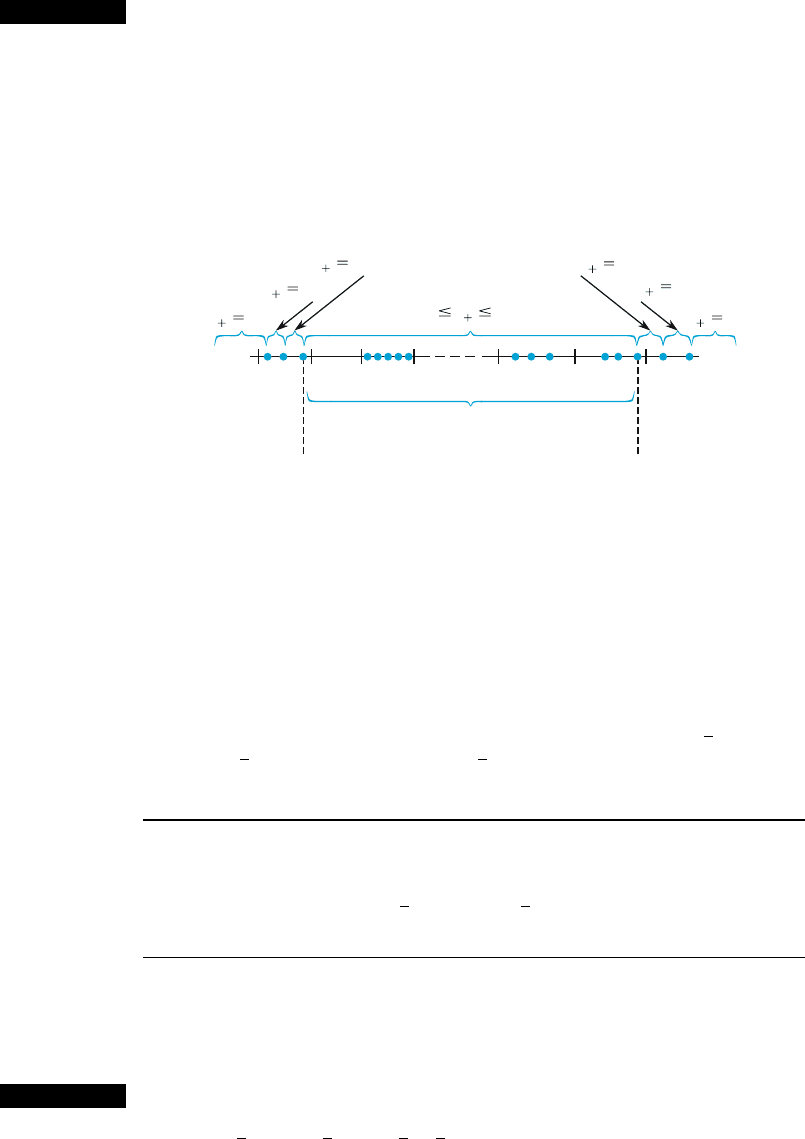
Example 14.4 The following observations are values of cerebral metabolic rate for rhesus monkeys:
x
1
¼ 4.51, x
2
¼ 4.59, x
3
¼ 4.90, x
4
¼ 4.93, x
5
¼ 6.80, x
6
¼ 5.08, x
7
¼ 5.67. The
28 pairwise averages are, in increasing order,
4.51 4.55 4.59 4.705 4.72 4.745 4.76 4.795 4.835 4.90
4.915 4.93 4.99 5.005 5.08 5.09 5.13 5.285 5.30 5.375
5.655 5.67 5.695 5.85 5.865 5.94 6.235 6.80
The first few and the last few of these are pictured on a measurement axis in Figure 14.2.
Because of the discreteness of the distribution of S
+
, a ¼ .05 cannot be
obtained exactly. The rejection region {0, 1, 2, 26, 27, 28} has a ¼ .046, which
is as close as possible to .05, so the level is approximately .05. Thus if the number of
pairwise averages m
0
is between 3 and 25, inclusive, H
0
is not rejected. From
Figure 14.2 the (approximate) 95% CI for m is (4.59, 5.94).
■
In general, once the pairwise averages are ordered from smallest to largest,
the endpoints of the Wilcoxon interval are two of the “extreme” averages. To
express this precisely, let the smallest pairwise average be denoted by
x
ð1Þ
, the next
smallest by
x
ð2Þ
; ... ; and the largest by x
ðnðnþ1Þ=2Þ
.
PROPOSITION
If the level a Wilcoxon signed-rank test for H
0
: m ¼ m
0
versus H
a
: m 6¼ m
0
is to
reject H
0
if either s
+
c or s
+
n(n +1)/2 c, then a 100(1 a)% CI for m is
ð
x
ðnðnþ1Þ=2cþ1Þ
; x
ðcÞ
Þð14:5Þ
In words, the interval extends from the dth smallest pairwise average to the dth
largest average, where d ¼ nðn þ 1Þ=2 c þ 1. Appendix Table A.14 gives the
values of c that correspond to the usual confidence levels for n ¼ 5, 6, ... , 25.
Example 14.5
(Example 14.4
continued)
For n ¼ 7, an 89.1% interval (approximately 90%) is obtained by using c ¼ 24
(since the rejection region {0, 1, 2, 3, 4, 24, 25, 26, 27, 28} has a ¼ .109). The
interval is ð
x
ð2824þ1Þ
; x
ð24Þ
Þ¼ðx
ð5Þ
; x
ð24Þ
Þ¼ 4:72; 5:85ðÞ, which extends from the
fifth smallest to the fifth largest pairwise average.
■
At level .0469, H
0
is
not rejected for m
0
in here
s
27
s
26
s
0
s
1
s
28
4.8 5.5 5.75 64.5 4.6 4.7
s 2
3 s 25
Figure 14.2 Plot of the data for Example 14.4
14.3 Distribution-Free Confidence Intervals 773

The derivation of the interval depended on having a single sample from a continuous
symmetric distribution with mean (median) m. When the data is paired, the interval
constructed from the differences d
1
, d
2
, ... , d
n
is a CI for the mean (median)
difference m
D
. In this case, the symmetry of X and Y distributions need not be
assumed; as long as the X and Y distributions have the same shape, the X Y
distribution will be symmetric, so only continuity is required.
For n > 20, the large-sample approximat ion (Exercise 6) to the Wilcoxon
test based on standardizing S
+
gives an approximation to c in (14.5). The result
[for a 100(1 a)% interval] is
c
nðn þ 1Þ
4
þ z
a=2
ffiffiffiffiffiffiffiffiffiffiffiffiffiffiffiffiffiffiffiffiffiffiffiffiffiffiffiffiffiffiffiffiffiffi
nðn þ 1Þð2n þ 1Þ
24
r
The efficiency of the Wilcoxon interval relative to the t interval is roughly the
same as that for the Wilcoxon test relative to the t test. In particular, for large
samples when the underlying population is normal, the Wilcoxon interval will tend
to be slightly longer than the t interval, but if the population is quite nonnormal
(symmetric but with heavy tails), then the Wilcoxon interval will tend to be
much shorter than the t interval. And as we emphasized earlier in our discussion
of bootstrapping, in the pres ence of nonnormality the actual confidence level of
the t interval may differ considerably from the nominal (e.g., 95%) level.
The Wilcoxon Rank-Sum Interval
The Wilcoxon rank-sum test for testing H
0
: m
1
m
2
¼ D
0
is carried out by first
combining the (X
i
D
0
)’s and Y
j
’s into one sample of size m + n and ranking them
from smallest (rank 1) to largest (rank m + n). The test statistic W is then the sum of
the ranks of the (X
i
D
0
)’s. For the two-sided alternative, H
0
is rejected if w is
either too small or too large.
To obtain the associated CI for fixed x
i
’s and y
j
’s, we must d eter mine the set
of all D
0
values for which H
0
is not rej ected. This is easiest to do if we first express
the test statistic in a slightly different form. The smallest possible value of W is
m(m + 1)/2, corresponding to every (X
i
D
0
)lessthaneveryY
j
,andtherearemn
differences of the form (X
i
D
0
) Y
j
. A bit of manipulation gives
W ¼½number of (X
i
Y
j
D
0
Þ’s 0þ
mðm þ 1Þ
2
¼½number o f (X
i
Y
j
Þ’s D
0
þ
mðm þ 1Þ
2
ð14:6Þ
Thus rejecting H
0
if the number of (x
i
y
j
)’s D
0
is either too small or too large
is equivalent to rejecting H
0
for small or large w.
Expression (14.6) suggests that we compute x
i
y
j
for each i and j and order
these mn differences from smallest to largest. Then if the null value D
0
is neither
smaller than most of the differences nor larger than most, H
0
: m
1
m
2
¼ D
0
is not
rejected. Varying D
0
now shows that a CI for m
1
m
2
will have as its lower
endpoint one of the ordered (x
i
y
i
)’s, and similarly for the upper endpoint.
774 CHAPTER 14 Alternative Approaches to Inference

PROPOSITION
Let x
1
, ..., x
m
and y
1
, ..., y
n
be the observed values in two independent samples
from continuous distributions that differ only in location (and not in shape).
With d
ij
¼ x
i
y
j
and the ordered differences denoted by d
ij(1)
, d
ij(2)
, ..., d
ij(mn)
,
the general form of a 100(1 a)% CI for m
1
m
2
is
ðd
ijðmncþ1Þ
; d
ijðcÞ
Þð14:7Þ
where c is the critical constant for the two-tailed level a Wilcoxon rank-sum test.
Notice that the form of the Wilcoxon rank-sum interval (14.7) is very similar to the
Wilcoxon signed-rank interval (14.5); (14.5) uses pairwise averages from a single
sample, whereas (14.7) uses pairwise differences from two samples. Appendix
Table A.15 gives values of c for selected values of m and n.
Example 14.6 The article “Some Mechanical Properties of Impregnated Bark Board” (Forest
Products J., 1977: 31–38) reports the following data on maximum crushing strength
(psi) for a sample of epoxy-impregnated bark board and for a sample of bark board
impregnated with another polymer:
Epoxy (x’s) 10,860 11,120 11,340 12,130 14,380 13,070
Other (y’s) 4,590 4,850 6,510 5,640 6,390
Obtain a 95% CI for the true average difference in crushing strength between the
epoxy-impregnated board and the other type of board.
From Appendix Table A.15, since the smaller sample size is 5 and the larger
sample size is 6, c ¼ 26 for a confidence level of approximately 95%. The d
ij
’s
appear in Table 14.4. The five smallest d
ij
’s [d
ij(1)
, ..., d
ij(5)
] are 4350, 4470, 4610,
4730, and 4830; and the five largest d
ij
’s are (in descending order) 9790, 9530,
8740, 8480, and 8220. Thus the CI is (d
ij(5)
, d
ij(26)
) ¼ (4830, 8220).
■
When m and n are both large, the Wilcoxon test statistic has approximately a
normal distribution (Exer cise 14). This can be used to derive a large-sample
approximation for the value c in interval (14.7). The result is
Table 14.4 Differences (d
ij
) for the rank-sum interval in Example 14.6
y
j
4590 4850 5640 6390 6510
x
i
10,860 6270 6010 5220 4470 4350
11,120 6530 6270 5480 4730 4610
11,340 6750 6490 5700 4950 4830
12,130 7540 7280 6490 5740 5620
13,070 8480 8220 7430 6680 6560
14,380 9790 9530 8740 7990 7870
14.3 Distribution-Free Confidence Intervals 775

c
mn
2
þ z
a=2
ffiffiffiffiffiffiffiffiffiffiffiffiffiffiffiffiffiffiffiffiffiffiffiffiffiffiffiffiffiffi
mnðm þ n þ 1Þ
12
r
ð14:8Þ
As with the signed-rank interval, the rank-sum interval (14.7) is quite effi-
cient with respect to the t interval; in large samples, (14.7) will tend to be only a bit
longer than the t interval when the underlying populations are normal and may be
considerably shorter than the t interval if the underlying populations have heavier
tails than do norm al populations. And once again, the actual confidence level for
the t interval may be quite different from the nominal level in the presence of
substantial nonnormality.
Exercises Section 14.3 (17–22)
17. The article “The Lead Content and Acidity of
Christchurch Precipitation” (New Zeal. J. Sci.,
1980: 311–312) reports the accompanying data
on lead concentration (mg/L) in samples gathered
during eight different summer rainfalls: 17.0,
21.4, 30.6, 5.0, 12.2, 11.8, 17.3, and 18.8. Assum-
ing that the lead-content distribution is symmetric,
use the Wilcoxon signed-rank interval to obtain a
95% CI for m.
18. Compute the 99% signed-rank interval for true
average pH m (assuming symmetry) using the
data in Exercise 3. [Hint: Try to compute only
those pairwise averages having relatively small
or large values (rather than all 105 averages).]
19. Compute a CI for m
D
of Example 14.2 using the
data given there; your confidence level should be
roughly 95%.
20. The following observations are amounts of hydro-
carbon emissions resulting from road wear of bias-
belted tires under a 522-kg load inflated at
228 kPa and driven at 64 km/h for 6 h (“Charac-
terization of Tire Emissions Using an Indoor Test
Facility,” Rubber Chem. Tech., 1978: 7–25): .045,
.117, .062, and .072. What confidence levels are
achievable for this sample size using the signed-
rank interval? Select an appropriate confidence
level and compute the interval.
21. Compute the 90% rank-sum CI for m
1
m
2
using
the data in Exercise 9.
22. Compute a 99% CI for m
1
m
2
using the data in
Exercise 10.
14.4
Bayesian Methods
Consider making an inference about some parameter y. The “frequentist” or
“classical” approach, which we have followed until now in this book, is to regard
the value of y as fixed but unknown, observe data from a joint pmf or pdf
f ð x
1
; ...; x
n
; yÞ, and use the observations to draw appropriate conclusions. The
Bayesian or “subjective” paradigm is different. Again the value of y is unknown,
but Bayesians say that all available information about it—intuition, data from past
experiments, expert opinions , etc. —can be incorporated into a prior distribution,
usually a prior pdf g(y) since there will typically be a continuum of possible values
of the parameter rather than just a discrete set. If there is substantial knowledge
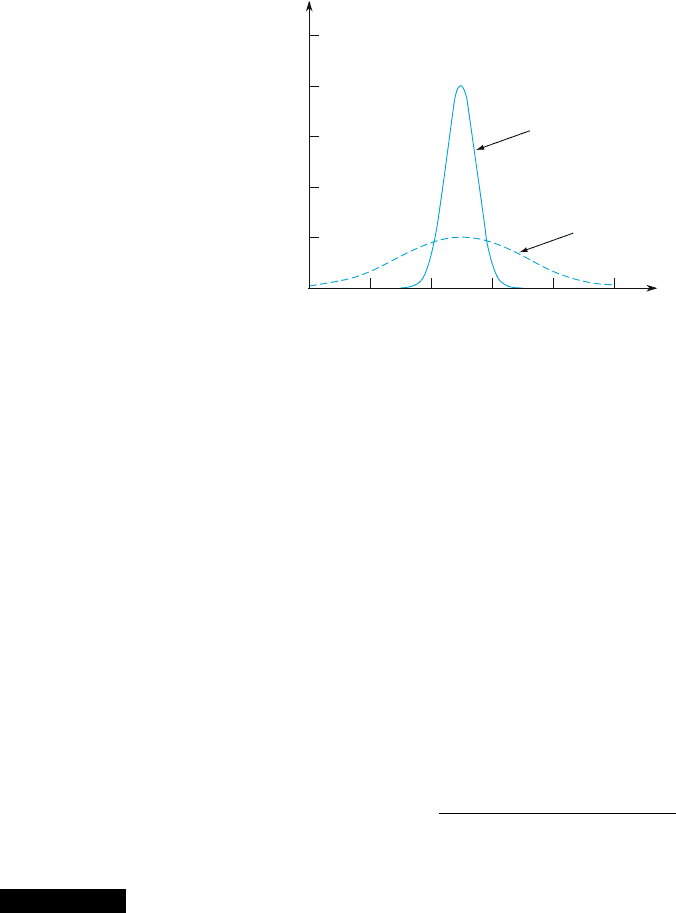
about y, the prior will be quite peaked and highly concentrated about some central
value, whereas a lack of information is shown by a relatively flat “uninformative”
prior. These possibilities are illustrated in Figure 14.3.
In esse nce we are now thinking of the actual value of y as the observed value
of a random variable Y, although unfortun ately we ourselves don’t get to observe
the value. The (prior) distribution of this random variable is g(y). Now, just as in
776 CHAPTER 14 Alternative Approaches to Inference
the frequentist scenario, an experiment is performed to obtain data. The joint pmf or
pdf of the data given the value of y is pðx
1
; ...; x
n
jyÞ or f ðx
1
; ...; x
n
jyÞ. We use a
vertical line segment here rather than the earlier semicolon to emphasize that we are
conditioning on the value of a random variable.
At this point, an appropriate version of Bayes’ theorem is used to obtain
h(yjx
1
,...,x
n
), the posterior distribution of the parameter. In the Bayesian world,
this posterior distribution contains all current information about y. In particular, the
mean of this posterior distribution gives a point estimate of the parameter.
An interval [a, b] having posterior probability .95 gives a 95% credibility interval,
the Bayesian analogue of a 95% confidence interval (but the interpretation is
different). After presenting the necessary version of Bayes’ Theorem, we illustrate
the Bayesian approach with two examples.
Bayes’ theorem here needs to be a bit more general than in Section 2.4 to
allow for the possibility of continuous distributions. This version gives the posterior
distribution h(y | x
1
,x
2
, ...,x
n
) as a product of the prior pdf times the conditional
pdf, with a denominator to assure that the total posterior probability is 1:
hðyjx
1
; x
2
; ...; x
n
Þ¼
f ð x
1
; x
2
; ...; x
n
jyÞgðyÞ
R
1
1
f ð x
1
; x
2
; ...; x
n
jyÞgðyÞdy
Example 14.7 Suppose we want to make an inference about a population proportion p. Since the
value of this parameter must be between 0 and 1, and the family of standard beta
distributions is concentrated on the interval [0, 1], a particular beta distribution is a
natural choice for a prior on p. In particular, consider data from a survey of 1574
American adults reported by the National Science Foundation in May 2002.
Of those responding, 803 (51%) incorrectly said that antibiotics kill viruses.
In accord with the discussi on in Section 3.5, the data can be considered either a
random sample of 1574 from the Bernoulli distribution (binomial with number of
trials ¼ 1) or a single observation from the binomial distribution with n ¼ 1574.
We use the latter approach here, but Exercise 23 involves showing that the
Bernoulli approach is equivalent.
0.2
0.0
0.8
0.6
0.4
1.0
0246810
Prior pdf
q
Wide
Narrow
Figure 14.3 A narrow concentrated prior and a wider less informative prior
14.4 Bayesian Methods 777