
Dignas B., Winter E. Rome and Persia in late Antiquity. Neighbours and Rivals
Подождите немного. Документ загружается.

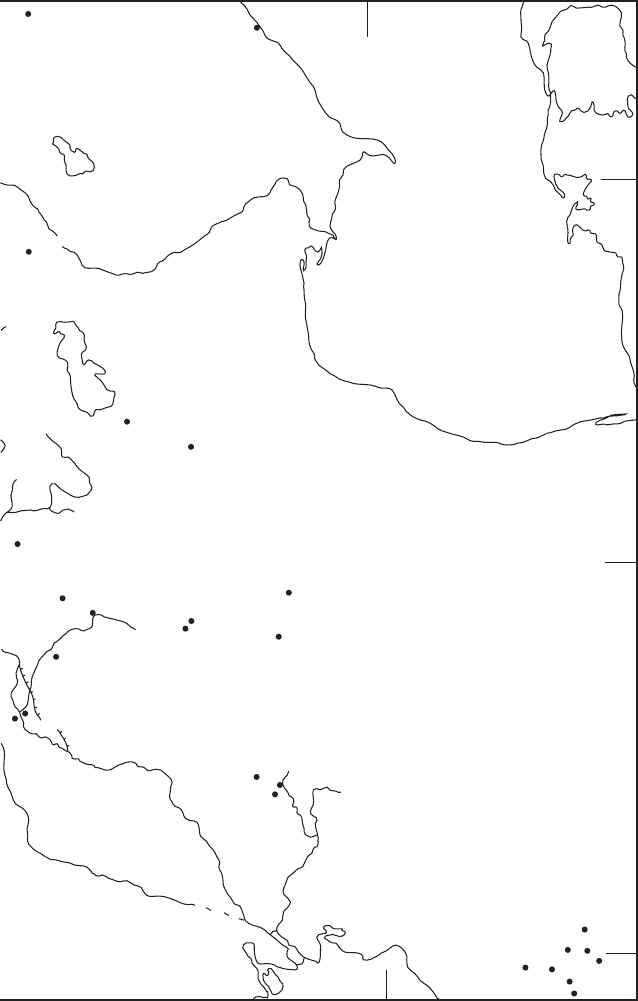
4 Earliest Roman–Sasanian confrontations 73
50 °E
40°N
35°N
30°N
50 °E
Mtskheta
Darband
A L B A N I A
A Z A R B A I J A N
L. Gukcha
Avara
ır
Ganzak
K
ırkuk
Hamadan
N
ıhavand
R. Diyala
Karkha d Ledan
Gundeshapur
Susa
Naqsh-
ı Rustam
Pasargadae
Stakhr
B
ıshapur
Guyum
Persepolis
Sh
ıraz
Barm-
ı Dılak
R T
ı
gr
ı
s
Kırmanshah
Dastagird
Rumagan
Nahravan
Canal
Ctes
ıphon
Pa
ıkulı
Qasr-ı Shırın
Ta q-
ı Bustan
E L Y M A I S
K H U Z I S T A N
M E S E N E
Shiz
L Urm
ıya
R. Ar
axes
C
a
s
p
i
a
n
S
e
a
¯¯
¯
¯
¯
¯
¯
¯
¯
¯¯
¯¯¯
¯¯¯
¯¯
¯
¯
¯¯
¯
¯
¯
.
.
.
Map 6:(cont.)
74 3 Military confrontations
many had died and even more had been wounded. For the Romans had not been
cowards but had in a way also inflicted great harm on their enemy; moreover,
they had been inferior only because they were fewer in number. (6) In fact, almost
the same number of soldiers had fallen on both sides and the surviving barbarian
soldiers seemed to have won because of their number and not their force. A clear
indicator of the barbarian losses is the fact that they remained quiet for three or
four years and did not take up arms. When Alexander found out about this, he
decided to stay in Antioch; he became more optimistic and lost his fear, and as he
was relieved from his concerns about the war he relaxed and enjoyed the pleasures
of the city.
Herodian describes the situation after hostilities had ceased in the summer
of the year 233. While the Roman emperor Severus Alexander spent his time
in Antioch preparing an army for a new attack, he received the news that
the Sasanian king had dismissed his soldiers because the Persians had also
suffered great losses. Herodian’s comments – in particular his remark on
the equal numbers of soldiers who had died on both sides – are surprising
because this passage is preceded by a detailed account of the hostilities which
clearly describes a crushing Roman defeat.
11
The author’s psychological
characterisation of the Roman emperor tends to be rather schematic. We
therefore have to apply caution with regard to Herodian’s claim that Severus
Alexander’s dithering and timid behaviour provoked resentment within the
Roman army.
12
However, in spite of inconsistencies in the author’s report it
looks as if Herodian observed an ‘undecided’ outcome, which means that
matters in the East were not yet settled.
13
It is difficult to assess the historical accuracy of Herodian’s narrative. In
particular authors of the fourth and fifth centuries evaluate the outcome
of the fighting differently and talk about a great Roman victory.
14
They do
not mention Severus Alexander’s difficult situation. The biography of the
emperor in the Historia Augusta, especially, presents him as the triumphant
victor. This so-called collection of the Scriptores Historiae Augustae includes
thirty biographies of Roman emperors and usurpers that cover the time
period from Hadrian to Numerianus. The biographies were all composed
by the same pagan author towards the end of the fourth century (?) and
were not, as they purport to be, a collection of biographies written by
six authors during the reigns of Diocletian and Constantine the Great.
15
11
Herodian vi.5.5–10.
12
Ibid. vi.5.8 and vi.6.1; on Herodian’s tendency to accept stereotypical characterisations and to distort
his material along these lines see Zimmermann 1999a: esp. 321–9.
13
Winter 1988: 63–8.
14
Fest. 22; Aur. Vict. Caes. 24.2.7.; Eutr. viii.23; Oros. vii.17.7.
15
On this collection of Latin imperial biographies see especially the commentaries written by an
international team of scholars and published as Alf
¨
oldi, Straub and Rosen 1964–91 and Bonamente,
Duval and Paschoud 1991; for further bibliographical references see Johne 1998: 639–40; Birley 1976
with an English translation.
4 Earliest Roman–Sasanian confrontations 75
The description of the Persian War of Severus Alexander and the obvious
idealisation of the emperor illustrate how problematic these biographies are
as a historical source.
Scriptores Historiae Augustae, Severus Alexander 56.2 and 5–8
(2) From the senatorial records of the seventh day before the Calends of
October:
16
Senators, we have defeated the Persians. There is no need for long
explanations, you should learn only this much, how they were armed and what
their contingents were. . .
(5) We scattered 120,000 of their cavalry, we killed 10,000 mailed horsemen,
17
whom they call Clibanarians,
18
in battle and equipped our men with their armour.
We captured many Persians and then sold them into slavery. (6) We re-conquered
the area between the streams, namely Mesopotamia, which had been given up
by that vile beast.
19
(7) We put Arda
ˇ
s
¯
ır (I), the most powerful king (not only by
name but also in fact) to flight once and for all so that he was seen in flight even
on Persian territory, and the king escaped to where our standards had once been
taken,
20
leaving his own standards behind. (8) These, Senators, are the facts. There
is no need for further explanations. Our soldiers are returning as wealthy men, in
light of the victory nobody feels the fatigue.
Scriptores Historiae Augustae, Severus Alexander 57.2–3
(2) This we found in both the annals and many authors. Some, however, claim that
he was betrayed by his slave and that he did not defeat the king but fled himself so
that he would not be defeated. (3) For those who know the testimonies well there
is no doubt that this is against the prevailing view. This minority even claims that
he lost his army through hunger, cold and disease, as Herodian states against the
prevailing view.
In a fictive speech, the emperor boasts of his military achievements, which
present him as the glorious victor over the Persians. The emperor’s skills in
warfare and his successes are central to the passage. Although the author
knows Herodian’s account and explicitly names the author, he does not rely
on his work and doubts his credibility because Herodian’s remarks would
spoil the image of the princeps bonus.
16
This is a fictive document dating from 25 September 233, which the author of the vita claims to cite.
17
There is no doubt that this number is exaggerated; the origins of these catafractarii go back to the
sixth century bc. These were heavily armed cavalry from the areas around the Aral Sea who had been
integrated into the Seleucid army. Since the time of Hadrian the mailed horsemen also appear in
the Roman army; for a description of their elaborate suit of armour see Amm. xvi.10.8 and xxv.1.12;
on Persian armour and fighting in general see Wilcox and McBride 1986 and 3 above; on the two
powers’ military and strategies see Coulston 1986: 77–91;Frye1977: 7–15.
18
For equating catafractarii and clibanarii see Amm. xvi.10.8 and Veg. Mil. iii.24; whereas the clibanarii
were soldiers whose horses also wore mailed armour, the horses of the Roman catafractarii were not
mailed; see 3 above, on Sasanian armament and tactics.
19
This is a reference to the Roman emperor Elagabalus (218–22).
20
In 54/53 BC the Roman standards were lost when Crassus was defeated at Carrhae; cf. p. 12 n. 13.
76 3 Military confrontations
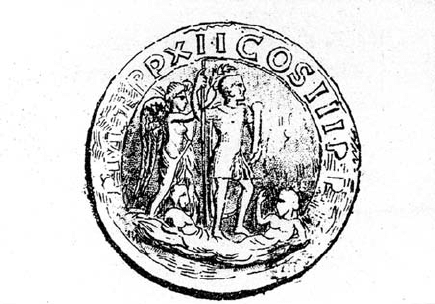
Fig. 5 Coin of Severus Alexander, reverse, 233
(Cohen, H. (1955
2
) Description historique des monnaies frap
´
ees sous l’empire romain
commun
´
ement appel
´
ees m
´
edailles imp
´
eriales IV/2: Alexandre S
´
ev
`
ere nr. 446)
(Cabinet de France. M
´
edaillon de bronze)
The biography follows other much more concise testimonies,
21
which
the author of the Historia Augusta embellishes rhetorically. Topoi such as the
elaborate preparations for the war, the flight of the Persian king, the victory
of Severus Alexander and his triumph in Rome appear in the majority
of the extant sources; the anonymous author of the biography elaborates
on these with much literary freedom and offers the more questionable
and remote testimonies in the place of a well-informed and contemporary
source. The account is clearly panegyrical.
22
Numismatic evidence attests
to a Roman victory and celebrates the emperor’s successful return from the
East.
The reverse of a coin dated to the year 233 depicts Severus Alexander
crowned by the goddess of victory Victoria, at whose feet we see the person-
ified river gods Euphrates and Tigris (fig. 5). The propagandistic character
of the image is obvious. Strictly speaking, a representation of the emperor
as the master over the two rivers was not correct because this claim did
not correspond to the actual frontier between the Roman and the Sasanian
Empire. It is noteworthy that the legend (pm trp xii cos iii pp), which
shows parts of the typical imperial titulature, does not include the titles
Parthicus maximus or Persicus maximus.
23
No other testimonies confirm
Rome’s territorial gains as they are suggested by the coin.
21
Cf. n. 14.
22
R
¨
osger 1978: 167–74.
23
Kienast 1990: 177–8; on the question whether these titles are attested at all for Severus Alexander
see Winter 1988: 60–2; on the liberal use of the terms Parthi/Persae see Kettenhofen 1984: 189 and
Winter 1988: 227.
5
ˇ
S
¯
ap
¯
ur I at war with Rome 77
In general, the coins of Severus Alexander are based on older types, which
the emperor Trajan issued in order to celebrate his successes in the East and
which were later also used by Marcus Aurelius as well as Lucius Verus.
24
The
choice of these motifs illustrates the aim to depict Severus Alexander as the
same triumphant victor over the Persians. After the war in the East further
coins were issued whose legends Victoria Augusti, Iovi Propugnatori, Marti
Propugnatori or Pax Aeterna Augusti make it clear that the outcome of the
Persian War was to be seen as a victory.
25
This type of propaganda emerged
immediately after the events of 233 and was taken up and rhetorically
embellished by later authors. An analysis of the source material has thus
shown that the outcome of the first Roman–Sasanian confrontation is far
from clear.
26
It is neither possible to talk about a splendid Sasanian victory
nor to view the Roman emperor as a triumphant victor over the Persians.
It rather looks as if each side withdrew their armies and thereby ended the
first Roman–Sasanian War because both sides had suffered considerable
losses. The Romans retained their positions along the middle Euphrates.
5:
ˇ
S¯ap ¯ur I (240–72) at war with Rome
The second Sasanian ruler
ˇ
S
¯
ap
¯
ur I (240–72) scored a number of presti-
gious military as well as diplomatic successes against Rome. In numerous
triumphal reliefs he boasts of his victories over his Western opponent. The
depicted relief cut into the rock at B
¯
ı
ˇ
s
¯
ap
¯
ur synchronises the successive con-
frontations with the Roman emperors Gordian III, Philip the Arab and
Valerian within one scene (fig. 6).
27
ˇ
S
¯
ap
¯
ur’s report of his achievements that
was inscribed on the Kaba-i Zardu
ˇ
st in Naq
ˇ
s-i Rustam (2) also informs
us about these wars and describes the events from a Sasanian perspective
soon after they took place. First, let us turn to the reign of Gordian III
(238–44).
The
ˇ
S
¯
ap
¯
ur Inscription on the Kaba-i Zardu
ˇ
st at Naq
ˇ
s-i Rustam (
ˇ
SKZ ),
§§ 6–7 The Parthian text
(§ 6) And as soon as we had become the ruler of the territories, the emperor Gordian
conscribed a force taken from the entire Roman Empire, the Gothic and German
peoples and marched into
¯
As
¯
urest
¯
an against the Empire of the Aryans and against
us; and a great frontal attack took place along the borders of
¯
As
¯
urest
¯
an–inMi
ˇ
s
¯
ık.
(§ 7) And the emperor Gordian was killed, and we destroyed the Roman army;
and the Romans proclaimed Philip emperor.
24
Gricourt 1965: 319–26.
25
RIC iv
2
nos. 164; 201; 324; 652.
26
Wieseh
¨
ofer 1982: 445 and 1986a: 373–4.
27
MacDermot 1954: 76–80;Gaj
´
e 1965: 343–88; Mackintosh 1973: 183–203;G
¨
obl 1974; Herrmann 1980;
Meyer 1990: 237–302; for an overview over the Sasanian rock reliefs see Vanden Berghe 1984; also
Herrmann 2000: 35–45.
78 3 Military confrontations
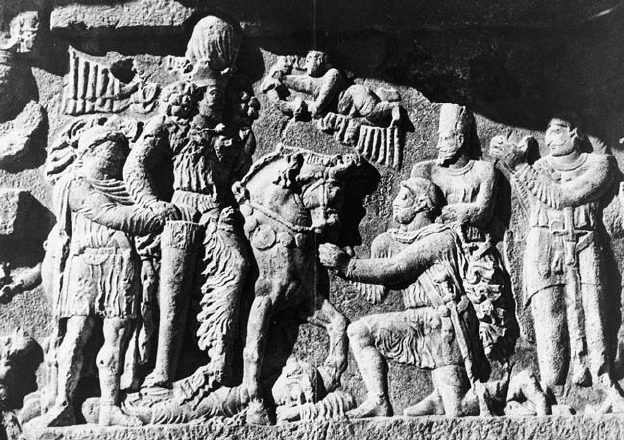
Fig. 6 Triumphal relief of
ˇ
S
¯
ap
¯
urIatB
¯
ı
ˇ
s
¯
ap
¯
ur
(Ghirshman, R. (1962) Iran. Parthians and Sassanians: fig. 197)
(Photo: John Russel)
According to the Res gestae divi Saporis the Roman emperor Gordian III
opened war on the Persians immediately after
ˇ
S
¯
ap
¯
ur I succeeded to the
throne.
28
This statement contradicts the Western sources; these mention
several Sasanian invasions into Roman territory, which provoked a Roman
counter-attack.
29
In the spring of 243 the Roman army inflicted a crushing
defeat on the Persians at Rhesaina, between Nisibis and Carrhae, about
which we hear only in Ammianus Marcellinus.
30
In 244 another and this
time decisive battle was fought at Mi
ˇ
s
¯
ık. According to the
ˇ
S
¯
ap
¯
ur Inscrip-
tion (
ˇ
SKZ ) the Roman army was destroyed in this battle and the Roman
emperor killed. The Persian account clearly links Gordian’s death with the
confrontation at Mi
ˇ
s
¯
ık and thereby differs completely from the Western
28
On the defensive character of
ˇ
S
¯
ap
¯
ur’s first campaign against Rome see Sprengling 1940b: 360–71, esp.
363–4; on the Eastern campaign of this Roman emperor see Kettenhofen 1983: 151–71 and Bleckmann
1992: 57–76.
29
SHA Gord. 26.6; Synk. 681; Zon. xii.18.
30
Amm. xxiii.5.17; it is unlikely that
ˇ
S
¯
ap
¯
ur I was prepared to hand over Mesopotamia to the Romans
without fighting.
5
ˇ
S
¯
ap
¯
ur I at war with Rome 79
sources.
31
These talk about Gordian III’s victorious activities against the
Persians and emphasise that the emperor’s successor, the praetorian pre-
fect Philip the Arab, was responsible for Gordian’s death.
32
They do not
mention the battle of Mi
ˇ
s
¯
ık. The
ˇ
S
¯
ap
¯
ur Inscription alone does not suf-
fice in order to question the entire Western tradition but as the account
was composed very soon after the events it cannot be dismissed eas-
ily. This is even more so if we consider that the Western authors did
not have access to immediate eyewitness accounts but were based on
older sources of the third century.
33
There is no doubt that the battle
of Mi
ˇ
s
¯
ık did in fact take place.
34
As it was typical in Eastern historiog-
raphy to record only victorious events, the battle at Rhesaina does not
appear. Western historiography shows the same tendency by on the one
hand ignoring the battle of Mi
ˇ
s
¯
ık, but on the other mentioning the con-
frontation at Rhesaina and referring to the successful Persian campaign of
Gordian III.
The
ˇ
S
¯
ap
¯
ur Inscription was composed within thirty years of the events of
244 and we may assume that it would have harmed
ˇ
S
¯
ap
¯
ur’s credibility to
deliberately create a false account; this could not have been in the Sasanian
ruler’s interest. The rock relief at B
¯
ı
ˇ
s
¯
ap
¯
ur also confirms that Gordian III
met his death in the context of the Persian–Roman confrontations (fig. 6).
35
The figure lying under the hoofs of
ˇ
S
¯
ap
¯
ur’s horse has been identified as
Gordian III, and on the Sasanian triumphal reliefs a prostrate figure always
symbolises a dead opponent.
36
Admittedly, neither the Res gestae divi Saporis nor the representation on
the relief at B
¯
ı
ˇ
s
¯
ap
¯
ur reveal whether the emperor actually died on the battle-
field or as the result of a wound he had incurred during the battle. Perhaps
the inscription and the visual representation were consciously designed in
an ambiguous way in order to insinuate that
ˇ
S
¯
ap
¯
ur I was prepared to take
responsibility for the emperor’s death. Gordian’s death was a triumph for
the king, which he used in his imperial propaganda. Why would
ˇ
S
¯
ap
¯
ur
31
SHA Gord. 29–30; Eutr. ix.2–3; Fest. 22; Zos. i.18–19; Oros. vii.19; on the element of propaganda
in the Res gestae divi Saporis see Rubin 1998: 177–85.
32
On the circumstances of Gordian’s death see Oost 1958: 106–7; Winter 1988: 83–97; Bleckmann
1992: 66–78; Schottky 1994: 232–5;K
¨
orner 2002: 77–92.
33
York 1972: 320–32 and MacDonald 1981: 502–8.
34
Maricq and Honigmann 1953: 111–22; at first, it was difficult to locate the place referred to in the
ˇ
S
¯
ap
¯
ur
Inscription; today it is fairly certain that Mi
ˇ
s
¯
ık, which was later called P
¯
er
¯
oz-
ˇ
S
¯
ap
¯
ur (= ‘victorious is
ˇ
S
¯
ap
¯
ur’) is al-Anb
¯
ar of the Muslim period and situated on the left bank of the Euphrates as far north
as Baghdad; for the date and outcome of the battle cf. also Gignoux 1991a: 9–22.
35
Apart from the bibliographical references in n. 27 see also the monographs (i–vi)onB
¯
ı
ˇ
s
¯
ap
¯
ur that
have appeared in the series ‘Iranische Denkm
¨
aler’.
36
Cf. G
¨
obl 1974: 12.
80 3 Military confrontations
claim credit for this death if Gordian III had in fact been assassinated by
Philip the Arab far away from Mi
ˇ
s
¯
ık, as the majority of the Western sources
state?
The idea that Philip the Arab was responsible for Gordian III’s death
thus has to be dismissed. The Western sources share widespread prejudices
against Philip the Arab and do not conceal these. It would appear that all
versions intend to cover up the military defeat and to blame Philip the
Arab for the events of the year 244.
37
Reporting on the fact that the new
emperor concluded a humiliating peace treaty with
ˇ
S
¯
ap
¯
ur I also served these
intentions well (16).
In the year 252 a new Roman–Persian War broke out. By 253 the Persians
had made a deep advance into Roman territory and inflicted heavy losses
on the Romans. Possibly reacting to a Roman counter-attack, they then
withdrew without having taken possession of Roman territory. However,
in the year 260 the Persians embarked on a new, major campaign about
which we learn also from the
ˇ
S
¯
ap
¯
ur Inscription.
38
The
ˇ
S
¯
ap
¯
ur Inscription on the Kaba-i Zardu
ˇ
st at Naq
ˇ
s-i Rustam (
ˇ
SKZ),
§§ 18–22 The Parthian text
(§ 18) During the third campaign, when we advanced against Carrhae and Edessa
and besieged Carrhae and Edessa, the emperor Valerian marched against us, (§ 19)
and there was with him . . . (§ 21) a force of 70,000 men. (§ 22) And on the other
side of Carrhae and Edessa we fought a great battle with Valerian, and we captured
the emperor Valerian with our own hands and the others, the praetorian prefect
and senators and officials, all those who were the leaders of that force, and we made
all of them prisoners and deported them to Persis.
If we believe
ˇ
S
¯
ap
¯
ur’s words, the Roman emperor Valerian moved an army
of 70,000 men against the king while the Sasanians were laying siege to
the Mesopotamian cities of Carrhae and Edessa. In order to commemorate
his victory in the most effective way,
ˇ
S
¯
ap
¯
ur refers in detail to the make
up and size of the Roman army. We learn that during the decisive battle
near Edessa not only high Roman officials but also the emperor Valerian
himself were captured by
ˇ
S
¯
ap
¯
ur ‘with his own hands’. We do not know what
happened to Valerian afterwards. He must have died in captivity.
39
The
Sasanians celebrated this victory, which was one of their greatest successes
37
Cf. York 1972: 320–1 and Pohlsander 1980: 464–5.
38
On the course of events during this decade see also Tyler 1975.
39
On the capture of Valerian see Kettenhofen 1982: 97–9; on the inconsistencies in our sources
see Alf
¨
oldi 1937: 62–3 (= 1967: 149–50); Stolte 1971a: 385–6; 1971b: 157–62; Carson 1982: 461–5;
Bleckmann 1992: 97–114; Huyse 1999: 10–14 (vol. i) and 82–4 (vol. ii).
5
ˇ
S
¯
ap
¯
ur I at war with Rome 81
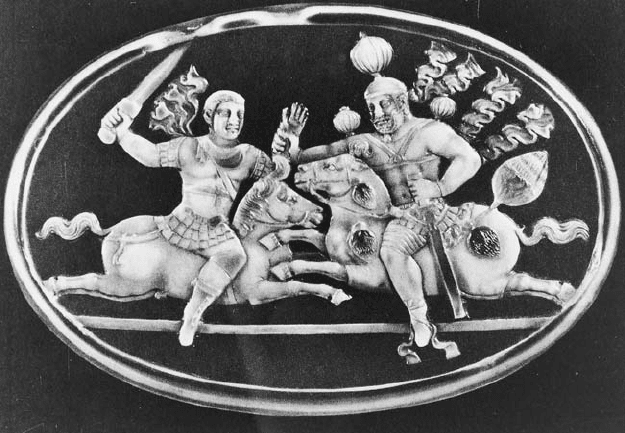
Fig. 7 Paris Cameo
(Ghirshman, R. (1962) Iran. Parthians and Sassanians: fig. 195)
(Photo: Paris, Biblioth
`
eque Nationale, Cabinet des M
´
edailles)
over the Western opponent, as an unparalleled triumph, as they had
ˇ
S
¯
ap
¯
ur’s
preceding victories. On the triumphal relief at B
¯
ı
ˇ
s
¯
ap
¯
ur (fig. 6) Valerian is
standing behind
ˇ
S
¯
ap
¯
ur’s horse. The Sasanian king grasps the emperor’s
wrist, which nicely illustrates
ˇ
S
¯
ap
¯
ur’s personal involvement in the capture
and also highlights Valerian’s submission.
However, in contrast to Philip the Arab, who is represented on his knees
before
ˇ
S
¯
ap
¯
ur’s horse and pleading for peace (16), Valerian appears in a
standing position. Considering that Valerian most likely died in Sasanian
captivity this contrast is rather surprising. Even at the height of his successes
against Rome
ˇ
S
¯
ap
¯
ur did not place the emperor Valerian on a level with those
on whom he imposed tributary payments, such as Philip the Arab. The fact
that
ˇ
S
¯
ap
¯
ur refrained from depicting Valerian in a kneeling position suggests
that the rulers of both empires could see each other as of equal rank during
this early phase of their relations.
The so-called Paris Cameo, on which a duel on horseback between the
two rulers symbolises the Sasanian triumph, shows a striking representation
of Valerian’s capture (fig. 7). Valerian raises his sword against his enemy,
whereas his opponent
ˇ
S
¯
ap
¯
ur has not drawn his sword. Instead, he seizes the
82 3 Military confrontations
emperor’s left hand.
40
Traditionally, ‘grasping someone’s wrist’ symbolises
that the person is taken prisoner. The gesture is the same as the one found on
the Sasanian triumphal reliefs (fig. 6). It has been argued that the cameo rep-
resents the events from a Roman perspective and that the image encourages
the viewer to reinterpret the humiliating events by suggesting that
ˇ
S
¯
ap
¯
ur
achieved his victory not in battle but through a trick.
41
This interpretation is
not convincing. In any case, the cameo and all other references to Valerian’s
capture reveal the deep impression this event left on contemporaries as well
as later observers.
42
The following two examples further illustrate the powerful motif of the
victorious Sasanian ruler. Towards the end of the tenth century the Persian
poet Firdausi began to collect popular legends and stories of pre-Islamic
Iran and to incorporate these in a long epic poem.
43
He dedicated more
than thirty years of his life to this work, the so-called
ˇ
Sahn
¯
ama (‘Book of
kings’). As a consequence of his efforts the memory of old traditions and
a distinctive pride in the pre-Islamic ancestors and heroes were preserved.
No other work of Persian poetry has been illustrated as often as this book,
which the German scholar Theodor N
¨
oldeke once appropriately called the
‘Iranian national epos’.
44
The miniatures of the Berlin manuscript of 1605,
which were commissioned by Sh
¯
ah ‘Abb
¯
as I, are particularly impressive.
45
The artistic miniatures and their representations of rulers, royal scenes,
duels of Iranian heroes as well as of demons, imaginative creatures or wild
beasts express the lifestyle of the Persian nobility of this period. One of
the miniatures alludes to the numerous confrontations between Persia and
Rome, the great opponent in the West.
In the year 363 the Roman emperor Julian lost his life during his advance
against the Sasanian capital Kt
¯
esiph
¯
on (8), which forced the Roman army
to retreat and to the conclusion of ‘an extremely shameful peace’
46
(18).
According to the illustration of the
ˇ
Sahn
¯
ama the Persian king managed
to capture the Roman emperor (fig. 8).
47
Admittedly, there is a confusion
of the events that took place during the reign of
ˇ
S
¯
ap
¯
ur II (309–79) with
those that took place during the reign of
ˇ
S
¯
ap
¯
ur I (240–72) because Valerian
40
Gall 1990: 56–9 assumes that
ˇ
S
¯
ap
¯
ur II and Jovian are represented.
41
See G
¨
obl 1974: 15.
42
Sykes 1921: 401, ‘Few if any events in history have produced a greater moral effect than the capture
of a Roman Emperor by the monarch of a young dynasty. The impression of the time must have
been overwhelming, and the news must have resounded like a thunderclap throughout Europe and
Asia.’
43
For the text see Mohl 1838–55; on the author and his work see also Shahbazi 1991.
44
Cf. N
¨
oldeke 1892 and 1920.
45
Enderlein and Sundermann 1988.
46
Agath. iv.26.7.
47
Cf. Enderlein and Sundermann 1988: 199 (plate) and 191 (description and commentary); also
Wieseh
¨
ofer 1996: 226.