
Dignas B., Winter E. Rome and Persia in late Antiquity. Neighbours and Rivals
Подождите немного. Документ загружается.

chapter 1
Political goals
In order to understand the intense and multi-faceted relations between
Romans and Persians during the course of late antiquity – and in particular
the many military confrontations that continued into the seventh century –
one has to address the overall political goals of the two great powers. These
goals are therefore the starting point of the second part of our survey, in
which we present and analyse the source material.
Whereas Roman generals of the Late Republic already boasted that as
Alexander’s successors they had extended the borders of the Roman Empire
to the ends of the earth
1
and scholars agree on Rome’s claim to world
domination,
2
namely to rule an imperium sine fine (‘an empire without
borders’)
3
or ‘an empire that extended from sun rise to sun set’,
4
there is no
corresponding consensus among scholars with regard to the goals that drove
Sasanian foreign policy. The following examination therefore focuses on
the Sasanian claims and the ideological background of the Sasanian foreign
policy vis
`
a vis Rome. This should not, however, evoke the impression that
the Sasanians acted as aggressors and the Romans as defenders of threatened
possessions or territories, which, obviously, the latter had conquered in long,
violent wars from an unwilling population. On the contrary, the reader
should be aware that such a ‘eurocentric’ view, which has been prevalent
for many decades in the scholarly literature, is not justified in any way.
5
1: Territorial claims of the Sasanians against Rome
The contemporary sources presented in this chapter indicate that immedi-
ately after ad 224 the Sasanians refused to acknowledge Rome’s supremacy
in the Near and Middle East. The enormous Persian capacity for expansion
1
Diod. xl.4.
2
Cf. Badian 1971; Raaflaub 1996: 273–314.
3
Verg. Aen. i.279; cf. also p. 13 n. 22 above.
4
Horace Carm. iv.15.14–15.
5
On the scholarly discussion see van de Mierop 1997: 285–306 and (with references) Hauser 2001a:
1233–43.
53
54 1 Political goals
during the course of the third century was based on and reinforced by the
euphoric successful foundation of the Sasanian Empire and moreover facil-
itated by the deep ‘crisis’ Rome faced during this period, a crisis that forced
the Western power into a defensive position and led to the primary goal of
preserving its own possessions. However, as soon as the political, economic
and social problems of the Roman Empire receded, the Romans similarly
exploited phases of instability within the Sasanian Empire and embarked
on numerous military offensives against the territories held by their Eastern
opponent in order to underline their claim to world domination, which
continued to exist up to the fall of the Roman Empire. Evidently, the impe-
rial prestige on both sides significantly fostered the emergence of conflicts
between the two powers.
Herodian
vi
.2.1–2
(1) For thirteen years he [sc. Severus Alexander] reigned in this way, and so far
as it was up to him, irreproachably. In the fourteenth year,
6
however, he was
suddenly sent reports by the governors in Syria and Mesopotamia informing him
of the following: the Persian king Arda
ˇ
s
¯
ır [I]
7
had defeated the Parthians and had
dissolved their rule in the East. He had put to death Artabanos,
8
who used to be
called Great King and had worn two diadems.
9
Moreover, Arda
ˇ
s
¯
ır had conquered
all of the barbaric areas around and was forcing them to pay tribute. He was still
not satisfied and was not staying within the borderline of the river Tigris but
crossing its banks and thus the borders of the Roman Empire. He was overrunning
Mesopotamia and threatening Syria. (2) He was determined to re-conquer for
Persia the whole territory across from Europe and cut off by the Aegean Sea and
the Sea of Marmara, which as a whole is called Asia, because he viewed this as
his inheritance, arguing that the whole area, as far as Ionia and Caria, had been
administered by Persian satraps from the time of Cyrus, who was the first to transfer
power from the Medes to the Persians, to the time of Darius, the last of the Persian
kings, whose power the Macedonian Alexander destroyed. He claimed that it was
now his task to renew this empire for the Persians just as they had possessed it in
the past.
Herodian composed his history of the Roman Empire, which covers the
time period between 180 and 238, in the third century. Although the author,
who wrote in the Greek language, favoured the rhetorical and literary
6
The number of years is historically not correct. It should be the tenth year of the reign of Severus
Alexander (= 232), whose dies imperii was 13 March 222.
7
Herodian calls the first Sasanian king Arda
ˇ
s
¯
ırI(224–40) by his Greek name ‘Artaxerxes’; for reasons
of consistency the translations of the sources use the conventional names of the respective rulers.
8
This is the last Arsacid ruler Artabanos IV (213–24).
9
On the iconography of this Parthian ruler with ‘two diadems’ see Gall 1980: 241–50.
1 Territorial claims – Sasanians vs Rome 55
aspects of his work over historical accuracy,
10
the above passage attests
to important political changes within Iran. The successful revolt of the
Sasanian Arda
ˇ
s
¯
ırI(224–40) against the ruling dynasty of the Arsacids led
to the fall of the Parthian kingdom and became the foundation of the
Neo-Persian Sasanian Empire. The consequences of this development for
the Romans are evident. The Roman emperor received reports from the
East that speak not only of an immediate threat for the Eastern frontier as
well as Mesopotamia and Syria but also of Sasanian territorial claims that
affected all of Asia Minor. Herodian explains these aspirations by referring
to Arda
ˇ
s
¯
ır’s argument that all territories east of Europe and the Aegean
Sea had once been part of the Achaemenid Empire founded by Cyrus the
Great, the ancestor of the Sasanians. Arda
ˇ
s
¯
ır thus presents his claims as an
inherited right and his political goals as legitimate.
Cassius Dio, who wrote a history of Rome that ended with the events
of the year 229, also points to the dangers arising for Rome when power in
Iran changed hands. This contemporary author is in general judged to be a
more reliable source, but in accordance with Herodian he states that Arda
ˇ
s
¯
ır
was planning to re-conquer everything the Persians had once ruled, all the
way to the Aegean Sea.
11
This also corresponds to the Sasanian tradition,
which is now lost but has been passed on through Muslim scholars. The
Arab historian Tabar
¯
ı, who lived in the ninth/tenth century, is the main
representative of this learned tradition.
12
He reports that Arda
ˇ
s
¯
ır started an
uprising in order to avenge the blood of the last Achaemenid ruler Darius
III, who had been defeated by Alexander the Great. Tabar
¯
ı moreover reveals
that Arda
ˇ
s
¯
ır intended to return power to the legitimate family and to restore
it as it had existed during the reigns of his ancestors,
13
who had lived before
the ‘vassal’ kings.
14
Succession to the former Persian kings included, so Arda
ˇ
s
¯
ır believed,
ruling the territories they had ruled. Although knowledge regarding the
10
See M
¨
uller 1996; on Herodian as a historical source for the third century see Alf
¨
oldy 1974: 89-111;
Zimmermann 1999a and 1999b: 119–43.
11
Cass. Dio lxxx.4.1.; cf. Bering-Staschewski 1981: 112–13; on the relation between Herodian and
Cassius Dio see also Alf
¨
oldy 1971: 360–6.
12
Tabar
¯
ı, tr. N
¨
oldeke 2–3; Bosworth 3–4 (813–14); on Tabar
¯
ı and his work see Sezgin 1967: 323–8;
Springberg-Hinsen 1989: 32–4; see also the relevant chapters on the Arab authors al-Mas
¯
ud
¯
ı(29)
and Ibn Miskawayh (29 and 37).
13
The Neo-Persian ‘letter of Tansar’, which probably goes back to the late Sasanian period but refers
to the reign of Arda
ˇ
s
¯
ır states that the king did not want to give peace before he had avenged Darius
against the successors of Alexander (letter of Tansar, p. 42; tr. Boyce 65; cf. Fowden 1993: 29–30;in
n. 72 Fowden points to Mas
¯
ud
¯
ı naming ‘Ardashir as restorer of the Achaemenid achievement and
principal forerunner of Muhammad’s Islamic Empire’.
14
This is a reference to Parthian rule; on the ‘vassal kings’ see the glossary.
56 1 Political goals
Achaemenid dynasty must have been sparse during the Sasanian period,
the fact that the Western and Eastern traditions agree speaks for itself.
Apparently, immediately after the foundation of the empire in 224 the
Sasanians demanded possession of all of Mesopotamia, Syria, Asia Minor,
Armenia and Egypt as well as control over Arabia and the Red Sea.
These goals conflicted with the claims made by the Roman emperor, who
saw himself as successor to Alexander the Great and wanted ‘to rule the
world’; they deepened the antagonism between the Western and the East-
ern power and led to numerous military confrontations that lasted into
the seventh century.
15
A recurring question throughout this book will be
whether and how far these wide-reaching Sasanian goals were strictly lim-
ited to the context of the foundation of the empire and attempts to legit-
imise the rule of their own dynasty, or if Sasanian claims to areas out-
side Iran were an ideological premise of a programmatic foreign policy
that lasted significantly beyond early military conflicts between the two
powers.
2: Succession to Achaemenid rule as programmatic foreign policy
The
ˇ
S
¯
ap
¯
ur Inscription on the Ka ba-i Zardu
ˇ
st at Naq
ˇ
s-i Rustam (
ˇ
SKZ ),
§ 1 The Parthian text
I, the Mazd
¯
a-worshipping ‘god’
ˇ
S
¯
ap
¯
ur, King of Kings of the Aryans and non-
Aryans, scion of the gods, son of the Mazd
¯
a-worshipping ‘god’ Arda
ˇ
s
¯
ır, King of
Kings of the Aryans, scion of the gods, grandson of the ‘god’ P
¯
abag, the King, am
ruler of the Empire of the Aryans.
With regard to our knowledge of Roman–Sasanian relations in the third
century we cannot overestimate the significance of an epigraphic testi-
mony that dates to the reign of the second Sasanian ruler,
ˇ
S
¯
ap
¯
urI(240–72),
namely
ˇ
S
¯
ap
¯
ur’s great trilingual inscription on the Kaba-i Zardu
ˇ
st (‘Cube
of Zarathustra’) in Naq
ˇ
s-i Rustam, near Persepolis (map 5). The inscription
informs us about
ˇ
S
¯
ap
¯
ur’s conception of himself and his political goals,
about the make up of the Sasanian state and about religious matters in the
Sasanian kingdom. By analogy with the Res gestae divi Augusti, the famous
and also epigraphic report of the first Roman emperor, Augustus, the text is
called Res gestae divi Saporis.
ˇ
S
¯
ap
¯
ur I probably composed it himself during
the final years of his life, before his son Hormizd had it inscribed after his
father’s death. Between 1936 and 1939 scholars of the Oriental Institute of
15
Cf. in contrast Strobel 1993: 287–8 and the references in n. 31 below.
2 Succession to Achaemenid rule 57
Chicago discovered the inscription. In 1940 it was published for the first
time. Numerous studies of the text have appeared since then that illustrate
the extent to which the inscription complements the Western tradition
with its more vague and impressionistic account of the Roman–Persian
confrontations. In particular, the inscription draws attention to aspects that
authors writing in Greek and Latin neglect altogether. Taken in conjunction
with its place of origin and the object inscribed, the content of the text
throws significant light on the political goals and rule of the second Sasanian
ruler.
16
ˇ
S
¯
ap
¯
ur I uses the title ‘King of kings’, which had previously been used
by the Achaemenid Great Kings.
17
The additional title ‘King of Iran and
non-Iran’
18
attests to the universal character of
ˇ
S
¯
ap
¯
ur’s claims, which were
among other things also directed against Rome.
19
E. Kettenhofen cautions
us that the king does not explicitly claim an old Achaemenid legacy in
order to legitimise his political goals vis-
`
a-vis Rome.
20
ˇ
S
¯
ap
¯
ur neither labels
his conquests ‘former Achaemenid territory’ nor does he reclaim the whole
area to the Sea of Marmara as Persian legacy.
21
However, the genre of the
text may be responsible for the lack of such explicit claims. In his report,
the Sasanian ruler displays facts that serve to praise his military and political
achievements. M. Rostovtzeff suspected that the inscription followed the
official annals of the Sasanian ruling house, which – as was traditional in
the ancient Near and Middle East – recorded the king’s deeds day by day
and year by year. According to this interpretation the inscription is a kind
of epitome of an official history.
22
Undoubtedly, the text’s main objective
is to display
ˇ
S
¯
ap
¯
ur as he wanted to be viewed; that is, defeats are omitted,
just as they are in the Western tradition of historiography.
Apart from
ˇ
S
¯
ap
¯
ur’s official title ‘King of the kings of Iran and Non-Iran’
the inscription contains further Achaemenid reminiscences. We may start
with the fact that the text was cut into the Kaba-i Zardu
ˇ
st. The building, a
kind of tower, was a fire sanctuary built during the reign of Darius I and was
located in the valley of Naq
ˇ
s-
¯
ı Rustam, an important Achaemenid place of
worship (fig. 1). Here the Achaemenids worshipped their former kings in
16
For a bibliography see Kettenhofen 1982: 12–18; 1983: 151–71 and Huyse 1999: 9–11 (vol. 2).
17
On the significance of this title for the Arsacids see Wieseh
¨
ofer 1996: 55–66.
18
Gignoux 1987: 30–1; Gnoli 1989; Wieseh
¨
ofer 2001: 287,‘In
ˇ
SKZ Shapur uses it to denote all the
regions he (temporarily) conquered (Syria, Cappadocia, Cilicia), while he accounts Armenia and
the Caucasus region as part of Eran, although they were primarily inhabited by non-Iranian people.
Kirdir lists Armenia, Georgia, Albania, Balasagan, as well as Syria and Asia Minor, as regions of
Aneran.’
19
Gnoli 1987: 509–32.
20
Kettenhofen 1984: 184–5.
21
Ibid.
22
Rostovtzeff 1943/4: 20–1; cf. also MacDonald 1979: 77–83.
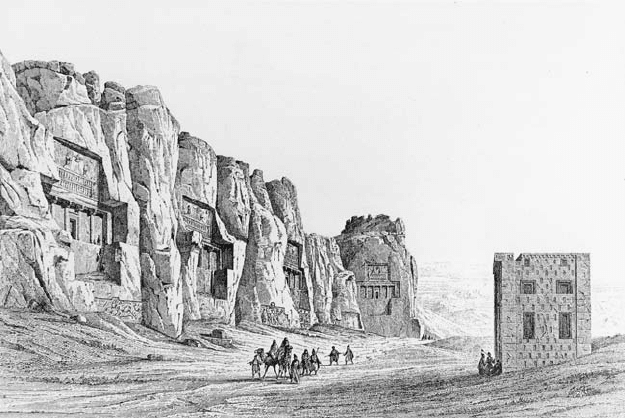
58 1 Political goals
Fig. 1 The Achaemenid rock tombs at Naq
ˇ
s-
¯
ı Rustam and the Kaba-i Zardu
ˇ
st
(Gallas, K. (1978) Iran. Kulturst
¨
atten Persiens zwischen W
¨
usten, Steppen und Bergen: fig. 34:
drawing in Flandin, E. and Coste, P. (1843–54) Voyage en Perse pendant les ann
´
ees
1840 et 1842)
monumental rock tombs.
23
The three languages of the inscription (fig. 2)
also illustrate an attempt to take up Achaemenid traditions. Middle Persian,
Parthian and Greek were the three official scripts in the Sasanian Empire. In
contrast to the Middle Persian text, which was discovered first, the Parthian
and Greek translations of the Middle Persian have been preserved fairly well.
The Middle Persian text was inscribed on the eastern side of the Achaemenid
shrine, the Parthian and Greek texts on the southern and western faces. The
monumental royal inscriptions of the former Achaemenid rulers had also
been trilingual (Babylonian, Elamite, Old Persian).
24
This parallel cannot
be a coincidence.
23
Cf. Fowden 1993: 29, ‘It is unreasonable to maintain that the Sasanians had no knowledge at all of
the Achaemenids. There were, for instance, the visible monuments of the past such as the tombs of
the Achaemenids at Naqsh-
¯
ı Rustam, a place that the Sasanian dynasty too regarded as of central
significance and obviously not by coincidence’; cf. also Potter 1990: 372f.
24
On these Achaemenid trilingual inscriptions see Kent 1953: 116–35; on the origins of the trilingual
documentation see Ghirshman 1965: 248–9; on the Achaemenid royal inscriptions in general see
Koch 1992: 13–28; for a comparison of the three versions and on the ‘original’ text see Huyse 1999:
182–209 (vol. 2); on the official and spoken languages in the Achaemenid and Sasanian Empires see
Schmitt 2000: 21–42 and 45–7.
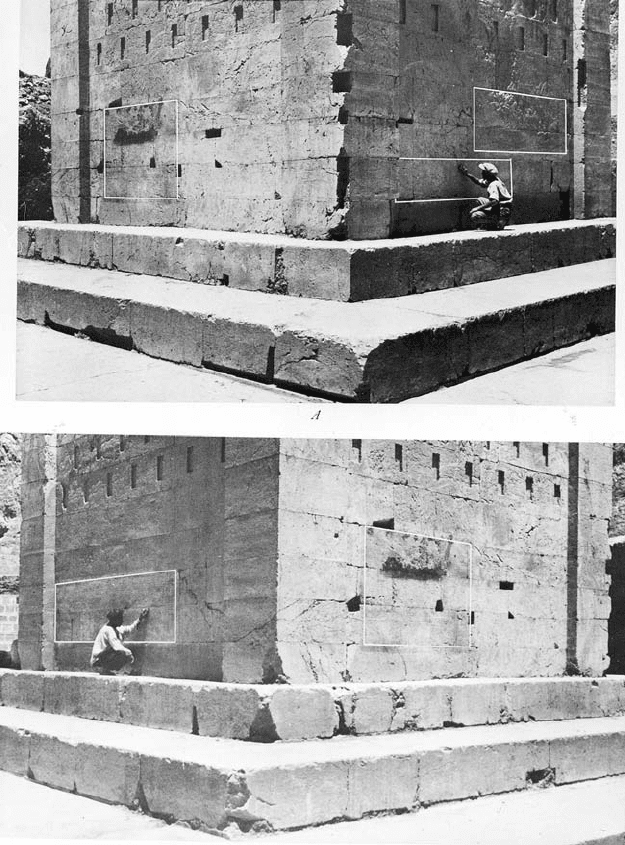
2 Succession to Achaemenid rule 59
Fig. 2 The three languages of the
ˇ
S
¯
ap
¯
ur Inscription (
ˇ
SKZ )
(Schmidt, E.F. (1970) Persepolis III. The Royal Tombs and other Monuments: pl. 9 A–B:
Southeast and Southwest Corner)
60 1 Political goals
In the fourth century the Sasanians still referred to the Achaemenid
dynasty in order to legitimise their own territorial claims. The contempo-
rary historian Ammianus Marcellinus, whose knowledge of the situation
in the East was extensive, includes a letter of the Sasanian king
ˇ
S
¯
ap
¯
ur II
(309–79) in his work. In this letter, the king demands that the Roman
emperor Constantius II return Armenia and Mesopotamia and in addition
to these all territories to the Strymon river and the borders of Macedonia
which had belonged to his ancestors.
25
Elsewhere the author reiterates that
ˇ
S
¯
ap
¯
ur II claimed territories reaching as far as Bithynia and the coasts of
the Sea of Marmara.
26
E. Kettenhofen raises the objection that the Roman
historian does not quote
ˇ
S
¯
ap
¯
ur literally and that the letter should not be
viewed as an authentic testimony. However, there is no reason to believe
that the king’s letter did not include the phrase ad usque Strymona flumen
et Macedonicos fines. We would not do the author, who must be accorded
high credibility,
27
justice if we see
ˇ
S
¯
ap
¯
ur’s claims as they are presented in
Ammianus as mere ‘literary reminiscences’.
28
Most scholars agree that in
Roman eyes
ˇ
S
¯
ap
¯
ur’s references to the borders of the former Achaemenid
Empire were a delicate and dangerous political threat.
29
As Roman–Persian relations progressed in time, there are but few hints
that show the East adopting Achaemenid ideology.
30
Be that as it may, in
spite of numerous setbacks, the dynamics of the Sasanian Western poli-
cies from the third to the seventh century illustrate a desire to restore the
Achaemenid borders (15).
This interpretation should not lead us to assume that the Sasanians
were necessarily the aggressors and responsible for every war they fought
with the Romans. In many instances, the activities of the latter were far
from ‘reactive’ or ‘defensive’. On the contrary, there is no doubt that Rome
repeatedly pursued an offensive policy in the East. However, it seems jus-
tified to talk about a programmatic Sasanian foreign policy, which formed
the counterpart to the Roman claim to world domination.
31
Scholars
correctly point to these rivalling ideological claims to explain how Rome and
25
Amm. xvii.5.3–8.
26
Ibid. xxv.4.24.
27
Cf. the important works by Matthews 1989a and Barnes 1998; with regard to the situation in the
East see Matthews 1986: 549–64; on the Sasanians as Rome’s main opponent in the East see Straub
1986: 218–22.
28
Kettenhofen 1984: 183–4 and 190; Seager 1997: 253–68; Teitler 1999: 216–23; Trombley 1999: 17–28.
29
See Rubin 1960: 252 (‘ein Politicum von gef
¨
ahrlicher Brisanz’); for a different interpretation see
Strobel 1993: 288.
30
Yarshater 1971: 517–31.
31
This interpretation is controversial among scholars; see Kettenhofen 1984: 177–90; Wieseh
¨
ofer 1986b:
177–85; Winter 1988: 26–44; Panitscheck 1990: 457–72; Potter 1990: 370–80; Gnoli 1991: 57–63;
Wolski 1992: 169–87; Lee 1993a: 21–32; Fowden 1993: 24–36; Wieseh
¨
ofer 1994: 389–97, esp. 392;
Kettenhofen 1994a: 99–108; Roaf 1998: 1–7; Daryaree 2002: 1–14; Shahbazi 2002c: 61–73; Huyse
2002: 298–311.
A
a
b
c
d
B
C
D
d
c
b
a
DC
B
35°E
B l a c k S e a
LAZICA
SUANIA
ALBANIA
HAKKARI
MOUNTAINS
ARZANENE
BETH ARABAYE
SRHOENE
PALESTINE
CAPPADOCIA
Dwin
Lake
Van
Nineveh
Arbela
Nisibis
Singara
Constantina
Amida
Martyropolis
Circesium
Theodosiopolis
(Resaina)
Dara
Chlomaron
Kitharizon
Sergiopolis
Callinicum
Carrhae
Antioch
Edessa
Chalcis
Melitene
Comana
Arabissus
Caesarea
Amasea
Sebaste
Trabzon
Satala
Theodosiopolis
(Erzurum)
Apamea
Epiphania
Palmyra
Damascus
Jerusalem
Anathon
Seleucia
Ctesiphon
al-Hira
Frontier
Land over 1000 metres
SCALE
0 100
0 100 200 miles
200 300 400 km
Tigris
Habur
Lake
Urmiah
Araxes
CAUCASUS MOUNTAINS
40°E45°E
40°N
35°N
30°N
45°E40°E
35°E
30°N
35°N
40°N
I
B
E
R
I
A
P
E
R
S
A
R
M
E
N
I
A
A
Z
E
R
B
A
I
J
A
N
Z
A
G
R
O
S
M
O
U
N
T
A
I
NS
C
A
R
D
U
C
H
I
A
E
u
p
h
r
a
t
e
s
D
i
y
a
l
a
L
e
s
s
e
r
Z
a
b
G
r
e
a
t
Z
a
b
A
R
M
E
N
I
A
T
A
U
R
U
S
M
O
U
N
T
A
I
N
S
B
E
T
H
A
R
A
M
A
Y
E
M
e
d
i
t
e
r
r
a
n
e
a
n
S
e
a
K
h
a
b
o
u
r
S
Y
R
I
A
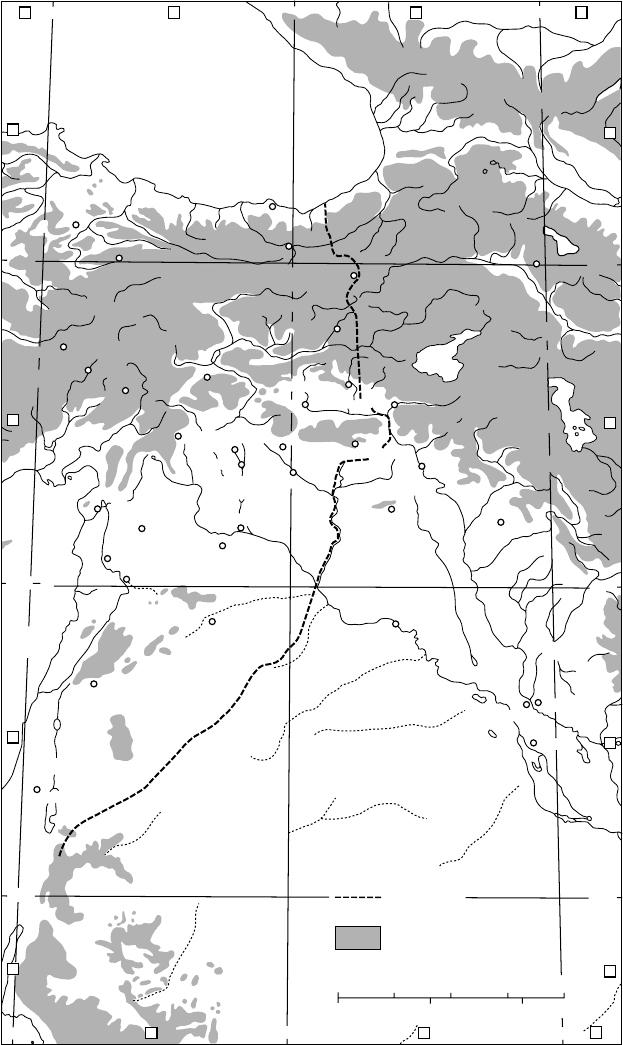
Map 4: The Roman–Sasanian Frontier in late antiquity
62 1 Political goals
Persia consistently failed to become long-term partners on the basis of a
mutually accepted international law.
32
In other words, the universal claims
on both sides hardly allowed for a peaceful coexistence. They had a tremen-
dous impact on how both sides handled latent conflicts; almost always the
enemy’s real or apparent weaknesses were met by an aggressive behaviour.
Over centuries the borders between Rome and Persia were contested and
military confrontations took place almost without interruption.
33
32
Grey 1973: 24–40 and Funke 1996: 225–6.
33
For an overview see Ensslin 1939: 126-37; for the period before ad 337 see Millar 1996: 127–89.