
Dignas B., Winter E. Rome and Persia in late Antiquity. Neighbours and Rivals
Подождите немного. Документ загружается.

chapter 2
Warfare
3: Sasanian armament and tactics
Heliodorus, Aethiopica
ix
.15.1–6
(1) The character of their armament is the following. A selected man chosen for
his bodily strength wears a helmet
1
that is compact and made of one piece, and it
is skillfully crafted to look exactly like a man’s face. He is covered by this from the
top of his head to the neck except for the eyes in order to see through it; he equips
his right hand with a pike longer than a spear, the left is free for the reins. He has
a sabre hung by his side under his arm, and he is armed with a corselet not only
across his breast but also across the rest of his body. (2) The construction of the
corselet is as follows: they forge plates of bronze and iron into a square shape that
is a span long on all sides, and they fit one to the other at the edges on each side so
that the one above always overlaps with the one below and the one alongside with
the one next to run on continuously, and they furnish the conjunction with hooks
under the flaps; thereby they create a kind of chiton clad in horny scales, which
clings to the body without causing pain and covers it on all sides, tracing each limb
and not hindering movement as it contracts and extends. (3) For there are sleeves,
and it reaches from the neck to the knee, separated only at the thighs, as much as is
necessary to mount a horse’s back. Such a corselet it is, a protection against missiles
and a defence against all wounds. The greave reaches from the top of the foot to
the knee, fastened to the corselet. (4) They fence their horses all around with a
similar equipment, tying greaves around the feet, and they bind the whole head
tightly with frontlets, and from the back to the belly they suspend on either side a
covering plaited in iron, so that it serves as armour but at the same time because of
its slackness does not impede the fast pace. (5) Having equipped or rather encased
the horse in this way the rider gets on, not leaping up but with others lifting him up
because of the weight. When the moment of battle comes, he drives his horse with
the rein, applies his spurs and goes with all his force against the enemies, looking
like an iron man or like a moving image wrought with the hammer. (6) With its
point the pike protrudes a lot, being held up against the horse’s neck by a rope. The
butt-end is fastened alongside the horse’s thighs with a knot, so that it does not
1
Grancsay 1963: 253–62; Overlaet 1982: 189–206.
63
64 2 Warfare
give way in clashes but supports the hand of the rider, which only gives direction
to the blow; the rider, however, exerts himself and presses for the wound to be even
harsher; through his force he destroys everyone whom he encounters, and with
one blow he may often transfix two.
Maurice, Strategikon
xi
.1
The Persian nation is wretched, dissembling and servile, but also patriotic and
obedient. It obeys its rulers out of fear. Because of this the Persians are capable
of enduring their work and engage in wars on behalf of their fatherland. Eager
to deal with most serious matters rather by way of counsel and strategy, they pay
attention to order and not to courage and rashness. Raised in a hot climate, they
easily bear the annoyance of heat, thirst and the lack of food. They are awesome
when they lay siege, and even more awesome when they are besieged; they are
extremely apt in hiding their pain, in holding out nobly in adverse circumstances
and turning these to their advantage. And in negotiations they are irreconcilable so
that they do not offer themselves what they want to choose for their own benefit
but as recipients are offered this by their enemies. They are armed with cuirass or
thorax, bows and swords,
2
and experienced in quick – but not forceful – archery,
more than all other warlike nations. Going to war, they encamp within fortified
boundaries. When battle arises, they create a ditch and a sharp palisade around
themselves; they do not leave the baggage train in this but create the ditch to have
a refuge from a critical situation in battle. It is not their practice to let their horses
graze but to let them gather their feed from the hand. They are set up for battle
in three equal parts, the centre, the right and the left, with the centre having up
to 400 or 500 selected men in addition. They do not create an even depth within
the formation but try to line up the cavalry in each unit in the first and second
line or phalanx and to keep the front of the formation even and dense. They place
the supernumerary horses and the train a short way behind the main line. When
they are in battle against pike men it is their practice to place their main line in the
roughest landscape and to use their bows in order that the attacks of the pike men
against them are dispersed and easily dissolved by the difficult terrain. Not only
before the day of the battle do they like to delay the fighting, in particular when
they know that the enemies are well prepared and ready for fighting, encamping
on the most inaccessible ground, but also during the battle itself, in particular
in the summer, they like to make their attacks around the hottest hour, in order
that through the boiling heat of the sun and the delay in time the courage and
spirit of those lined up against them slackens, and they make their charges step
by step in an even and dense formation, because they walk gently and attentively.
They are, however, distressed by the following: the cold and the rain and the south
wind, which ruin the force of their bows; a formation of infantry that is carefully
composed; a place with an even surface or a bare one because of the charges of
pike men; dense fighting because showers of arrows become useless from close
by and because they themselves do not use pikes and shields; pressing forward in
2
Rostovtzeff 1943: 174–87; Paterson 1969: 29–32; Overlaet 1989: 741–55 and Masia 2000: 185–9.
3 Sasanian armaments and tactics 65
battles because they rush to immediate flight and do not know how to suddenly
turn against their attackers, as do the Scythian nations; attacks and encirclements
as the result of an outflanking on the sides and rear of their formation because
they do not place good flank guards in their line to sustain a major attack; often
also unexpected nightly attacks against their camp because they place their tents
without distinction and at random within the encirclement of the camp. It is thus
necessary to line up in battles as the treatise about formations says, namely to
choose ground that is even, open and level, so far as possible, which does not have
swamps or ditches or shrubs so as not to dissolve the formation. When the army or
formation is well prepared do not delay the attack, if it has been firmly decided to
fight on that day. In battle, launch the charges and attacks when close to the reach
of the bows, even and in dense order, and swiftly, lest through a delay in getting
to hand-to-hand combat the enemies, sending a continuous shower of arrows, get
to afflict our soldiers and horses with even more missiles.
The two passages are excerpts from two very different sources, each of
which provides us with an impressive as well as vivid account of Sasanian
armament and tactics.
3
Heliodorus, who tells us that he was a ‘Phoenician
from the city of Emesa, from the family of the descendants of Helios’, is
the author of a Greek novel entitled Aethiopica (‘Aethiopian stories’). The
date of this work is uncertain but it was probably composed in the third
century, or possibly the second half of the fourth century.
4
As a genre, the
Greek novel was extremely popular. The Aethiopica tells the love story of
a certain Theagenes and an Aethiopian princess Chariclea, whose adven-
tures take them all the way to Delphi.
5
Because of its wide geographical
scope this novel is particularly interesting. In our passage the contemporary
observer Heliodorus describes the mailed Sasanian cavalry,
6
which under-
lines the significance of this source with regard to questions of cultural
history.
The second source relates to the late phase of Byzantine–Sasanian rela-
tions. A work entitled Strategikon
7
is attributed to the Byzantine emperor
Maurice (582–602), who secured the throne for the Persian king Xusr
¯
oII
P
¯
arv
¯
ez (34). This is a manual on military affairs composed in Greek, which
contains much information concerning military tactics, the organisation
and line-up of the army, military training and the use of armament as well as
siege craft and instructions for generals. It is not clear whether the emperor
3
For a general background see Tafazzoli 2000.
4
Cf. van der Walk 1941: 97–100 and Szepessy 1975: 279–87; Bowie 1999: 40–1.
5
See Winkler 1982: 93–158 (also in Swain 1999: 286–350); Szepessy 1984: 432–50; Hunter 1998.
6
On the Sasanian mailed cavalry see Bivar 1972: 271–91; Michalak 1987: 73–86; Mielczarek 1993: 51–67;
Campbell 1999: 339.
7
For the Greek text see Dennis 1981; for an English translation see Dennis 1985; also Kollautz 1985:
87–136.
66 2 Warfare
Maurice was indeed the author of the work but it is fairly certain that the
text originates from some time between the end of the sixth and the begin-
ning of the seventh century. The confrontations with the Islamic Arabs that
began in the 630s are not mentioned.
8
Although the so called Strategikon of
Maurice is one of many comparable military treatises that were composed
in the early Byzantine period,
9
it stands out as one of the most important
works and adheres to the reality of its time in an exceptional way. Moreover,
it is of special value because of its detailed descriptions of foreign peoples
and possible opponents, such as the Avars, Slavs and Persians, which provide
us with important historical and ethnographical information.
Both texts give insight into the character of Persian armament and battle
techniques as well as tactical counter-measures adopted by the Byzantine
army.
10
The extremely detailed descriptions of Sasanian armament, tech-
niques and strategies are vivid and accurate, which surprises and impresses
the reader. Many of the observations correspond not only with the late
antique accounts of particular battles between Byzantium and the Persian
Empire
11
but also with the numerous visual testimonies. Many Sasanian
silver bowls, finest examples of Persian art and culture, represent the king
in full armour and engaged in hunting.
12
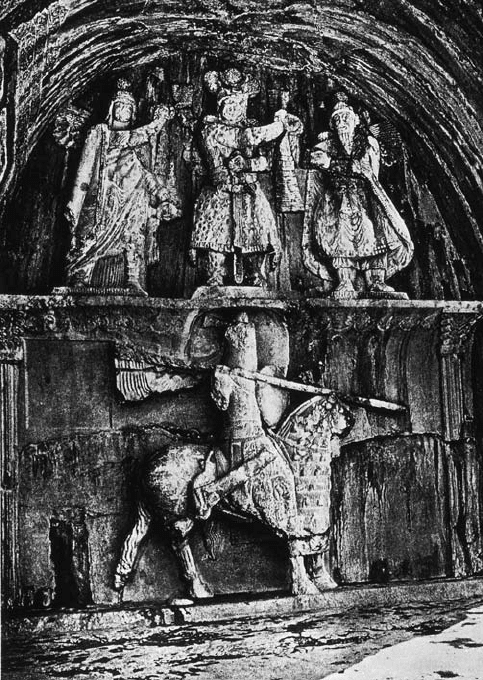
The depicted equestrian statue is
most likely that of the Sasanian ruler Xusr
¯
oII(590–628)
13
because it was
found in the grotto of Taq-i Bustan (map 5),
14
immediately below the rock
relief representing the investiture of this king. It is not only one of the most
important monuments of Sasanian art
15
but also the latest one among the
known Sasanian rock reliefs (fig. 3).
The equestrian statue shows the king in full armour.
16
He is armed like a
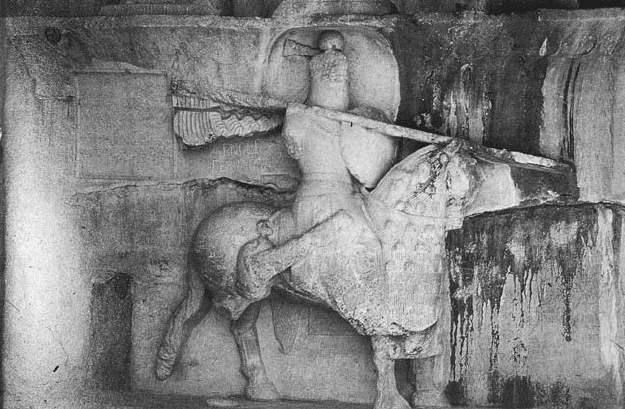
clibanarius of the heavy Sasanian cavalry. The equipment of both rider and
horse are visible in all details. In 1821 Sir Robert Ker-Porter made a drawing
of the relief to illustrate his book Travels in Georgia, Persia, Armenia and
Ancient Babylonia; in its own way it conveys a good impression of both
8
For a discussion of the date and authorship see Whitby 1988: 242.
9
Hunger 1978: 329–30.
10
Cf. e.g. Speidel 1984: 151–6 and Negin 1995: 65–75.
11
Greatrex and Lieu 2002: 179 and 297 n. 92; Greatrex 1998: 169–85 and 195–207; Wiita 1977:
53–111.
12
For the most important examples see Ghirshman 1962: figs. 207–11; 247–54; see also Peck 1969:
101–46; Tanabe 1981: 105–18; Wilcox and McBride 1986: 36–48; Harper 1983: 1113–29.
13
Several scholars have attributed this rock relief to king P
¯
er
¯
oz (459–84); cf. Ghirshman 1962: 193;on
the interpretation of this relief see also Shepherd 1983: 1086–89.
14
Ghirshman 1962: fig. 235; on the significance of Taq-i Bustan as a place for royal self-representation
see the references pp. 92–3 nn. 87–90.
15
Fukai and Horiuchi 1962–72; Fukai 1972.
16
See also Wilcox and McBride 1986: 41.
3 Sasanian armaments and tactics 67
Fig. 3 Equestrian statue of Xusr
¯
o II at Taq-i Bustan
(Ghirshman, R. (1962) Iran. Parthians and Sassanians: fig. 235)
(Photo: Ph. Claude Deffarge-Rapho)
the monumentality of the work and the many details eagerly added by the
artist (fig. 4).
Testimonies such as the two passages that opened this chapter attest not
only to the Western insight into Persian customs and tactics but also to
an awareness in the West that the powerful Persian military was well wor-
thy of and in need of investigation.
17
The respect accorded to the Persians
17
Cf. also Lee 1993a: 103–4.
68 2 Warfare
Rock reliefs
C a s p i a n
S e a
Other remains
(Yazd) Modern towns
Salmas
(Tabrız)
Chalus
Shahristanak
Tepe Hisar
Nıshapur
(Mashhad)
KHURASAN
A F G H A N I S T A N
Qal
a-yi Dukhtar Bazı Hur
GURGAN
0
0 300 km
20 miles
Varamın
Kai Ka'us
Takht-i Rustam
Karku
SISTAN
(Kırman)
(Yazd)
(Isfahan)
Natanz
I R A Q - I
A J A M
Niyasar
Atashkuh
(Dizful)
Susa
Stakhr
Naqsh-i Rustam
Naqsh-i Bahram
Bıshapur
Kazarum
Sar Mashhad
Jirra
Fıruzabad
Tang-i Karam
Atashkada
Barm-i Dilak
(Shıraz)
Naqsh-i Rajab
Guyum
Farrashband
Abu Nasr
Qasr-i
Shushtar
KHUZISTAN
Khung-i
Nauruzı
Aivan-i Karkha
Yazdikhwast
Khairabad
Stakhr
(Shıraz)
Fıruzabad
Bıshapur
0
0 50 miles
100 km
Darabgird
Tang-i Chakchak
Fıshvar
G u l f
P e r s i a n
FARS
Gardana Bizan
BALUCHISTAN
LARISTAN
(Qazvın)
Ray
Kalar Dasht
(Tehran)
MAZANDARAN
Takht-i Sulaiman
(Hamadan)
Harsın
Taq-i Bustan
(Kirmanshah)
L U R I S T A N
AZARBAIJAN
Qasr-i Shırın
Halush
Quri
Taq-i Girra
R. Tigris
KURDISTAN
L.Urmıya
R
.
E
u
p
h
r
a
t
e
s
S
a
r
v
i
s
t
a
n
T
A
L
I
S
H
G
I
L
A
N
¯¯
¯
¯
¯¯
¯¯¯
¯
¯¯
¯
¯
¯
¯
¯¯
¯¯
¯
¯
¯
¯
¯¯¯¯
¯¯
¯
¯
¯
¯
¯
¯¯
¯¯
¯¯
¯
¯¯
¯¯¯
¯
¯¯
¯
¯
¯¯
¯
¯
¯
¯¯
¯¯
¯
¯
¯
¯¯¯
¯
¯
¯
¯
¯
¯
¯
¯¯
¯
¯
¯
¯
¯
¯
¯
¯¯
¯
¯¯¯¯
¯
¯
¯
¯
¯
¯
¯
.
.
.
.
.
.
.
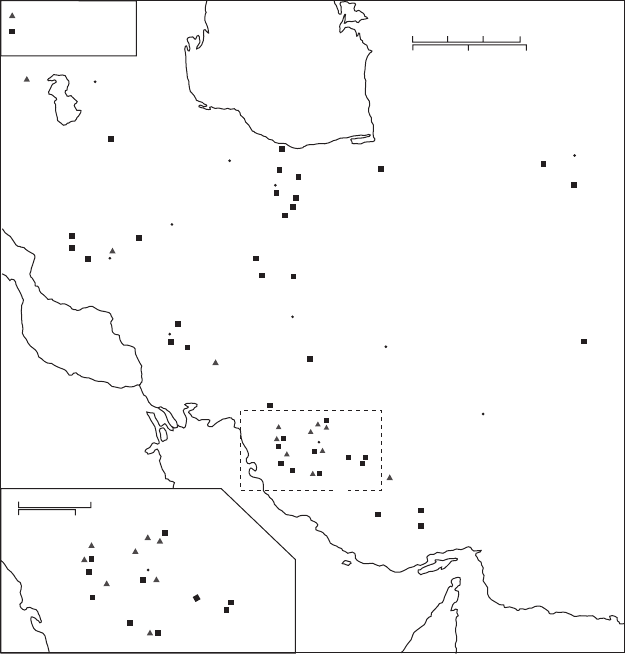
Map 5: Sasanian Sites
and their army was certainly crucial. Although in general the Strategikon
displays a hostile attitude towards the Eastern opponent, its author is full
of admiration when addressing specific aspects of the Sasanian military.
The texts therefore reveal how tough and tenacious the military strug-
gle between the great powers was and how much the relationship cen-
tred on strategic advantages and the numerous campaigns fought between
the third and the seventh century – campaigns that lasted over decades
and moreover demanded long logistic and strategic preparations.
18
On
18
Lee 1989: 257–65 and Whitby 1995: 61–124.
3 Sasanian armaments and tactics 69
Fig. 4 Sketch of the relief from Taq-i Bustan
(Sir Robert Ker-Porter, Travels in Georgia, Persia, Armenia, Ancient Babylonia During the
Years 1817, 1818, 1819 and 1820. Vol. ii, London 1822, pl. 62)
the Roman
19
as well as the Persian side
20
matters concerning the organisa-
tion of the army and its resources were paramount throughout late antiquity.
19
See Eadie 1967b: 161–73; MacMullen 1980: 451–60; Kaegi 1981a: 209–13; 1982; Turtledove 1983: 216–
22; Kennedy 1989: 235–46; Coulston 1990: 139–60; Dixon and Southern 1992; Isaac 1995: 125–55;
Kennedy 1996c.
20
See Inostrancev 1926: 7–52;Frye1977: 7–15; Coulston 1986: 59–95; Shahbazi 1986: 496–9; Hamblin
1986: 99–106; Nicolle 1996; Tafazzoli 2000.
chapter 3
Military confrontations
Diplomatic contacts and an intensive exchange of information regarding
a variety of issues – economy and trade, the security of the borders, reli-
gious and cultural matters etc. – formed an important part of Roman–
Persian relations. However, it was above all the military confrontations that
characterised Rome’s relations with her Eastern neighbours. These were as
numerous as they were of long duration. Both powers’ claim to univer-
sal rule pointed out in the previous chapter did not leave any room for a
stable coexistence on the basis of international law. Almost inevitably, or
rather instinctively, any perceived or real weakness provoked the military
initiative of the opponent so that from the third into the seventh century
a state of war between the two has to be seen as ‘endemic’.
1
The analy-
sis of these military confrontations is therefore predominant in this study,
not because of an imbalanced modern view of Roman–Sasanian relations
that adopts a ‘confrontational perspective’ but because of the actual his-
torical events, which were experienced and analysed by the contemporary
observers in a similar way. These also emphasise the opposition between
West and East and focus on sometimes very elaborate descriptions of a
permanent struggle for a powerful position and strategic advantages in the
Near and Middle East. This is – and rightly so – reflected in modern schol-
arship, which has always paid particular attention to questions of peace and
war as well as triumph and defeat. Our diachronic survey thus includes a
detailed account of the rivalry between the two powers as it is expressed in
the numerous military confrontations. The theatres of war included both
the Eastern Roman provinces and the Western regions of the Sasanian
Empire.
1
See Hauser’s review on Winter and Dignas 2001 (BMCR 2002.05.06).
70
4 Earliest Roman–Sasanian confrontations 71
3.1 the third century: origins of sasanian
interests in the west
2
4: Earliest Roman–Sasanian confrontations (230–3)
In the year 230 Arda
ˇ
s
¯
ır made his first advance into Roman territory.
3
The
Persians besieged Nisibis and undertook raids that led them as far as Syria
and Cappadocia.
4
Arda
ˇ
s
¯
ır seemed determined to put his political ideas
into practice. The Roman emperor reacted with dismay to the Sasanian
invasions.
5
On several occasions he sent ambassadors to the king in order to
negotiate for a peaceful solution but Arda
ˇ
s
¯
ır repeated his aim to re-conquer
former Achaemenid territories.
6
A military confrontation was therefore
inevitable.
There are but few Western sources that help us with a reconstruction of
the events, and the ones that do exist contradict one another. The Eastern
tradition does not yield any precise references. Tabar
¯
ı’s remark that Arda
ˇ
s
¯
ır
was always victorious and that his army had never been defeated is typical.
7
Herodian’s elaborate but problematic account
8
is closest to the events in
time and allows for a closer analysis.
Herodian
vi
.6.4–6
(4) When Alexander arrived in Antioch he recovered quickly because after the dry
heat in Mesopotamia the much cooler air in the city and its good water supply
felt pleasant. He wanted to win back the soldiers’ loyalty and tried to appease their
anger by promising them a lot of money. He thought that this was the only remedy
when it came to regaining the good will of soldiers.
9
He also gathered and prepared
a force for a new attack against the Persians, should they cause problems and not
give peace. (5) He was informed, however, that the Persian king had demobilised
his force and had sent all units back to their homelands. Although the barbarians
seemed to have been victorious through the help of some superior force,
10
they
were still worn out by the many clashes in Media and the battle in Parthia, where
2
For sourcebooks on Roman–Persian relations in the third century see Felix 1985 and Dodgeon
and Lieu 1991.
3
On the history, origin, course and outcome of this war see Winter 1988: 45–68.
4
Herodian vi.2.1; Cass. Dio lxxx.3.4; Zon. xii.15.
5
On the relationship between the two rulers see Potter 1987: 147–57.
6
Herodian vi.2.4 and vi.4.5 (for an Engl. tr. of these passages see Dodgeon and Lieu 1991: 17 and
19–20.
7
Tabar
¯
ı, tr. N
¨
oldeke 21; Bosworth 1999: 17 (820).
8
Zon. xii.15 is based on Herodian’s account. On Herodian see p. 55 n. 10.
9
These words once more reveal Herodian’s critical view of Severus Alexander, whose skills in warfare
he tends to judge very negatively.
10
The expression ek tou kreittonos has been interpreted in various ways; cf. M
¨
uller 1996: 332; another
possible translation would be ‘by superiority of military force’.
72 3 Military confrontations
B l a c k S e a
40 °E
LAZICA
Petra
Caesarea
Mazaca
Trapezus
Cılıcıan Gates
Zeugma
Tarsus
C A P P A D O C I A
Antıoch
Barbalıssus
Palmyra
Massıce
(Anbar)
Hira
Dhu Qar
300 km0
0 200 miles
Dura Europos
Cırcesıum
Callınıcum
Carrhae
Hatra
Sıngara
Nıneveh
Arbela
Lesser Zab
Nısıbıs
Resaina
Zab
Dara
Constantına
Amıda
Maıferqat
Edessa
3
Nımrud
Dagh
Dvin
L.Van
Mt Ararat
Theodosıopolıs
(Erzurum)
G E O R G I A
A R M E N I A
40°N
35°N
30°N
40 °E
A
D
I
A
B
E
N
E
R
.
T
i
g
r
i
s
G
r
e
a
t
e
r
R
.
E
u
p
h
r
a
t
e
s
¯
¯
¯
¯¯
¯
¯¯
.
.
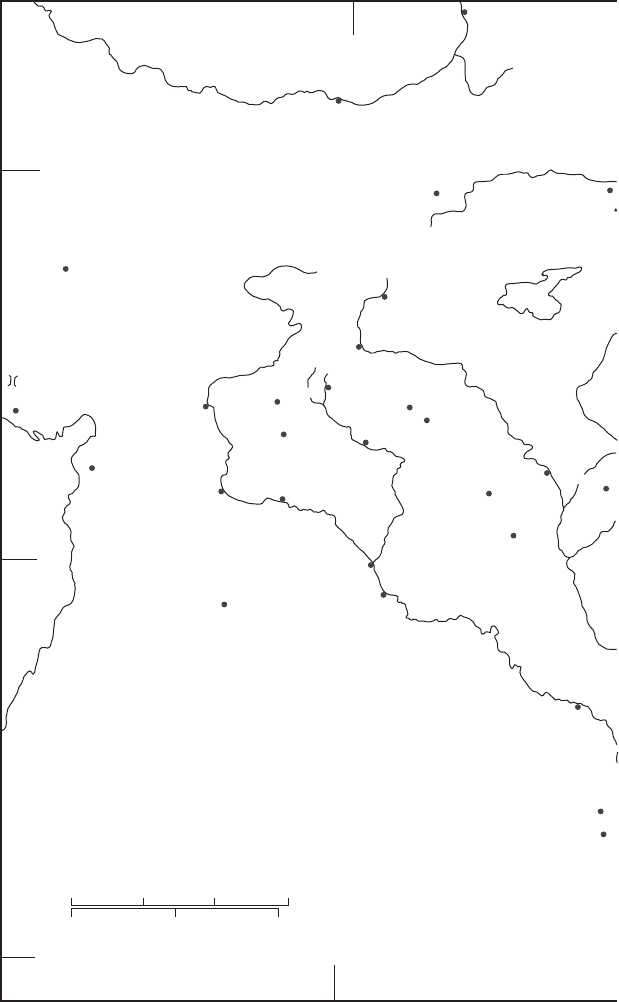
Map 6: The Roman Near East and the Western Regions of the Sasanian Empire