
Dignas B., Winter E. Rome and Persia in late Antiquity. Neighbours and Rivals
Подождите немного. Документ загружается.

5
ˇ
S
¯
ap
¯
ur I at war with Rome 83
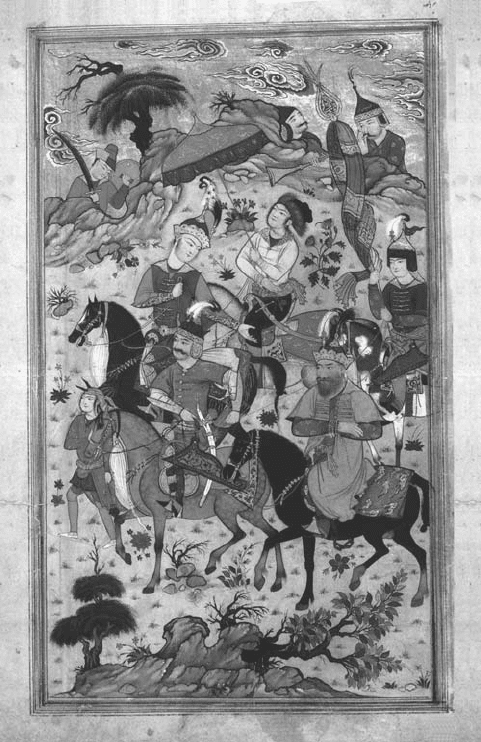
Fig. 8 Illustration of the
ˇ
Sahn
¯
ama representing the victory of
ˇ
S
¯
ap
¯
ur I against Valerian –
Miniatures of the Berlin manuscript, 1605
(Enderlein, V. and Sundermann, W. (eds.) (1988) Schahname. Das Persische K
¨
onigsbuch.
Miniaturen und Texte der Berliner Handschrift von 1605:p.190)
was the only Roman emperor who ever fell into Sasanian captivity. In the
foreground we see the Roman emperor on horseback, represented as an
elderly bearded man. His hands are tied up and his feet chained together.
ˇ
S
¯
ap
¯
ur, who can be recognised by the honorific parasol, turns his head
towards the Roman emperor as he leads him away in triumph. The Sasanian
ruler is accompanied by his usual train, namely a page holding the parasol,
84 3 Military confrontations
a standard-bearer, a mounted soldier who leads the emperor’s horse and
another page walking in front of the king’s horse. There is a striking detail
at the lower edge of the image where two little trees grow out of the rock.
Whereas the left one below
ˇ
S
¯
ap
¯
ur grows tall and straight the one next to
it on the right below the Roman emperor is bent and wilted. The growth
of the two trees corresponds to the different positions of power of the two
rulers at the time when the Persians defeated Rome in the year 260. This
again corresponds to the victorious Sasanian soldiers depicted at the upper
edge of the image; one of these is proclaiming the victory by blowing his
trumpet. As a whole it reveals how the Sasanians saw themselves – and
claimed to be perceived from the outside – in other words, how the events
were interpreted from an ‘Eastern perspective’.
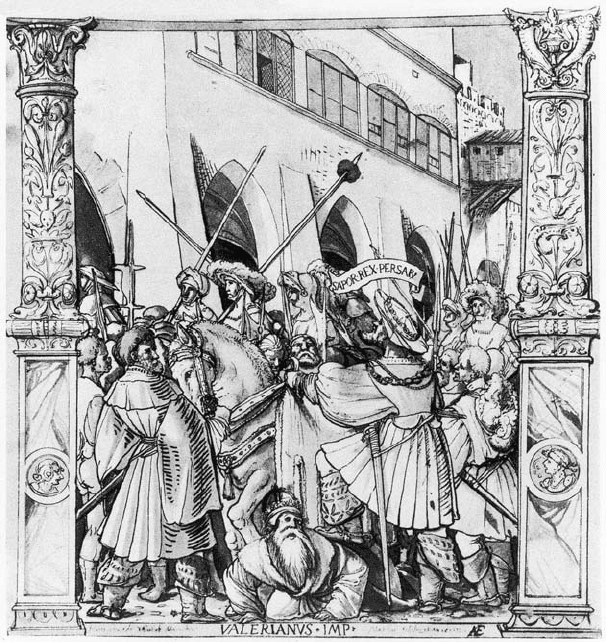
In the West the motif of the victorious Sasanian king, who had defeated
the Roman emperor, was also transmitted and passed into European cultural
memory. Although much later in time, in 1521 the German painter Hans
Holbein captured Valerian’s humiliation in a pen-and-ink drawing (fig. 9).
Among other scenes from antiquity and representations of the virtues,
the drawing complemented the programme of murals for the Great Council
Chamber of Basle Town Hall. The setting is contemporary and the names
of the main characters are given as inscriptions (Valerianus Imp./Sapor Rex
Persarum).
ˇ
S
¯
ap
¯
ur uses the emperor as a stool to mount his horse. The scene
probably served to remind councillors of the quick reversal of fate and to
warn them not to abuse their power.
6: Galerius defeats Nars ¯e in the year 298
Lactantius, De mortibus persecutorum 9.5–8
(5) Spurred on by the example of his grandfather
ˇ
S
¯
ap
¯
ur (I), the Persian king Nars
¯
e
attempted to conquer the East with a great force. (6) At the time, Diocletian, who
tended to respond to any unrest with fear and pessimism and who was also afraid
that he could share Valerian’s fate, did not dare to oppose the king but instead sent
him [Galerius] via Armenia while he himself halted in the East and waited to see
how matters developed. (7) The former trapped the barbarians, who customarily
went to war together with their whole family and were therefore impeded by
their numbers and occupied with their luggage,
48
and overcame them without
difficulties. After Galerius had put King Nars
¯
e to flight he returned with plunder
and immense booty and with this brought for himself ‘pride’, for Diocletian ‘fear’.
(8) For after this victory he became so arrogant that he even despised the title
48
Several ancient authors agree that the Romans took a large number of members of the royal family
as prisoners; cf. e.g. Eutrop. ix.25; Festus 14.5 and 25.2–3; Oros. vii.25.11; only Malal. 12.6–24 (p. 308)
mentions that the Persian queen Arsane was taken to Daphne near Antioch on the Orontes.
6 Galerius defeats Nars
¯
ein298 85
Fig. 9 The Capture of Valerian. Hans Holbein, Basle, 1521
(Waetzhold, W. (1939) Hans Holbein der J
¨
ungere, Werk und Welt: fig. 68)
(Basle,
¨
Offentliche Kunstsammlung; program of murals for the Great Council Chamber
of Basle Town Hall; pen-and-ink drawing, 1521)
‘Caesar’. Whenever he read this title in letters addressed to him, a grim expression
showed up on his face and he shouted in a terrible voice, ‘For how long Caesar?’
49
Lactantius
50
has no doubts about the political goals of the Sasanian
king. Through military successes Nars
¯
e(293–302) wanted to acquire new
49
The fourth-century Christian author tries to portray Galerius and Diocletian, who persecuted
the Christians, in a negative way. The reproach against Diocletian of being a coward contradicts
Diocletian’s in fact very assertive course of action at the Eastern frontier. Lactantius also hints at
rivalries and tensions between Diocletian and his Caesar, which indeed existed during the later part
of Diocletian’s reign; cf. Kolb 1987a: 159–76.
50
Christensen 1980; Creed 1984.
86 3 Military confrontations
splendour for the Persians, who had been in a defensive position since the
death of
ˇ
S
¯
ap
¯
ur I. Nars
¯
e aspired to take possession of the entire Near and
Middle East and threatened many parts of the eastern half of the Roman
Empire. Diocletian entrusted the Caesar of the East, Galerius, with the
response to the Persian offensive of 296, which presented an immediate
threat especially for Syria. There were initial setbacks but in the spring of
298 a Roman offensive opened a new and decisive phase in this Persian
War.
51
Near the Armenian city of Satala Galerius forced his way into the
Persian camp and inflicted a crushing defeat on Nars
¯
e. Lactantius attributes
significance to the fact that the kings in the Near East customarily travelled
together with their entire household and that this diminished the mobility
of the Sasanian army considerably. It was wiped out completely. Galerius
captured the royal family including his harem and many treasures. Nars
¯
e
himself managed to escape with difficulty.
The Roman triumph over the Eastern opponent was celebrated and com-
memorated on a wide scale. Apart from victory-titles such as Persicus max-
imus II, Armeniacus maximus, Medicus maximus and Adiabenicus maximus,
which were assumed by all Tetrarchs after 298,
52
coins conveyed the tri-
umphal message.
53
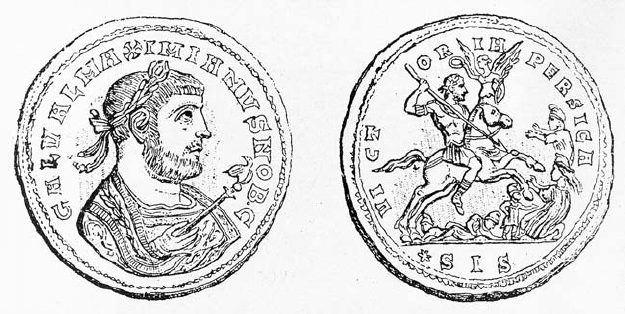
This also applies to a bronze medallion of 298, which was
issued for Galerius after his victory against the Sasanians in Siscia (fig. 10).
The legend Victoria Persica leaves no doubt that the theme of the medal-
lion is Galerius’ triumph over Nars
¯
e.
54
On the obverse the bust of Galerius is
depicted, on the reverse the mounted Caesar is galloping over two unarmed
figures. This detail alludes to the fact that Galerius attacked the Persian
camp at Satala by surprise. In the foreground, a woman, a child and a
man are visible, who are extending their arms, pleading with Galerius. All
figures can be easily identified as Persians by their Phrygian caps. Appar-
ently, Galerius intended to emphasise not only his military victory but also
the capture of the king’s family and harem. Nars
¯
e’s extreme humiliation
reminds one of Valerian’s defeat and capture by
ˇ
S
¯
ap
¯
ur I.
55
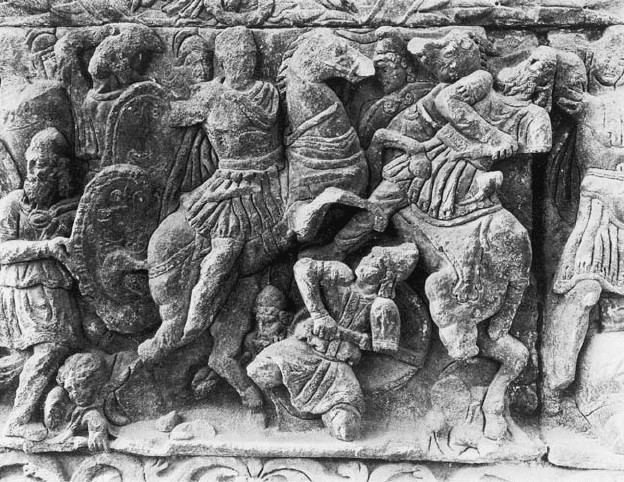
In 304 Galerius erected a triumphal arch in Thessaloniki (fig. 11). The
dimensions of the monument and its ornamentation make this arch one of
51
On Galerius’ campaigns see Enßlin 1936: 102–10; 1942: 40–5; Bleckmann 1992: 135–55; on the
chronology of events see also Barnes 1982: 54 and 63.
52
CIL iii 824 (= ILS 642), iii 6979 (= ILS 660); on the victory-titles in the imperial titulature of the
Tetrarchs see also Barnes 1976: 182–6 and id. 1982: 27.
53
Cf. e.g. RIC vi no. 23 a.b. 26; also Pink 1931: 3, 47, 50. fig. iii 59–61.
54
Garucci 1870: 112–18; Dressel 1973: 306–7.
55
Sch
¨
onebeck 1937: 370 places the medallion within the traditional triumphal iconography; in this
context see also Pond 1970. Laubscher 1975: 135 observes that the motif follows the typical repre-
sentation of an emperor’s triumph over barbarians; Garucci 1870: 113 suggests that the medallion
explains the victory-title Persicus II because the military victory and the capture of the royal family
can be seen as a ‘two-fold’ victory over Persia.
6 Galerius defeats Nars
¯
ein298 87
Fig. 10 Medallion of Galerius, 298
(Cohen, H. (1955
2
) Description historique des monnaies frap
´
ees sous l’empire romain
commun
´
ement appel
´
ees m
´
edailles imp
´
eriales VII/2: Galerius Valerius Maximianus nr. 204)
(M
´
edaillon de bronze)
the greatest Roman triumphal arches.
56
The relief cycles on the monument
depict and glorify the Persian campaign of the year 298. In succession, the
following themes appear: Roman victorious battles, submission and sub-
missiveness, prisoners being brought forward, the end of the war, peace
negotiations, tribute, and again decisive battles and victory. In a large rep-
resentation of a battle on the north-eastern side of the monument we see
the Romans as victors over the Persians. Foot soldiers frame two mounted
figures, the Roman emperor and the Sasanian ‘King of kings’. The repre-
sentation of the two rulers fighting each other on horseback
57
is part of the
Eastern royal ideology, and as an iconographic motif the royal duel carries
high symbolic meaning. In spite of his defeat, the enemy is not viewed as
submissive but as equal in rank.
58
Although the arch of Galerius attests to
Rome’s military superiority over the Eastern opponent,
59
the fact that an
Eastern iconographic motif was chosen and interpreted
60
implies that the
Sasanian king was attributed equal status as a ruler. This is confirmed by
the peace negotiations following the Roman triumph and by the specific
56
Laubscher 1975 and Meyer 1980: 374–444.
57
Gall 1990.
58
Chrysos 1976: 16.
59
The central scene, which depicts the duel between Galerius and Nars
¯
e, does not lack details which
express this superiority; Nars
¯
e e.g. sits on the skin of a panther, which points to his ‘barbarian’
character; the right front hoof of Galerius’ horse strides across Nars
¯
e’s left leg. But this does not
diminish the idea of the equal status of both rulers.
60
Rodenwaldt 1940: 55–6 points to Galerius’ deliberate decision to use the iconographic language of
his enemy. He (56) suggests that the representation on the arch was a monumental response to
ˇ
S
¯
ap
¯
ur’s triumphal relief; in contrast see Laubscher 1975: 135.
88 3 Military confrontations
Fig. 11 The Arch of Galerius in Thessaloniki. Detail from the North-East
(Laubscher, H.P. (1975) Der Reliefschmuck des Galeriusbogens in Thessaloniki: pl. 52)
(DAI-Neg.-Nr. 1 D-DAI-ATH-Thessaloniki 257; by Hermann Wagner)
agreements of the foedus of 298, which from a Persian perspective can be
seen as acceptable (17).
3.2 the fourth century: the conflict escalates
under
ˇ
s
¯
ap
¯
ur ii (309–79)
61
7: Fighting during the reign of Constantius II (337–61)
Sasanian invasions of Roman territory appear to have resumed before the
reign of Constantine the Great ended.
62
The emperor’s death on 22 May
337 in the middle of his military preparations delayed the outbreak of the
61
For a comprehensive survey of the sources related to Rome’s relations with
ˇ
S
¯
ap
¯
ur II see
Dodgeon and Lieu 1991: 143–274.
62
Scholars are not unanimous regarding the date of the first siege of Nisibis; see Matthews 1989a: 499
n. 15 and Blockley 1989: 470; on the beginning of the war and its causes see Mosig-Walburg 2002:
329–47.
7 Fighting during Constantine’s reign 89
war
63
but in the following year his son Constantius II, who was entrusted
with the rule over the East, led an enormous force against
ˇ
S
¯
ap
¯
ur II in order
to put a halt to the king’s activities in Mesopotamia and Armenia.
64
When
in 338 hostilities opened, this was just the beginning of a series of military
conflicts that took place during Constantius’ reign. Festus, who seems to
have been commissioned by the emperor Valens to write a survey of Roman
history to the beginning of his reign, summarises the fighting in the East
as follows:
65
Festus 27
(1) Constantius fought against the Persians with varying and indecisive outcome.
66
Apart from the light skirmishes of those positioned along the ‘limes’ nine pitched
battles took place; among these seven were fought by his generals, and he was
himself present twice. In the battles at Sisara, at Singara and a second one at
Singara, in which Constantius was present, at Sicgara (sic), also at Constantia,
and when Amida was captured, our state was severely harmed under this emperor.
(2) Nisibis was besieged three times but the enemy suffered even greater losses
while maintaining the siege. In the battle of Narasara,
67
however, where Nars
¯
e was
killed,
68
we were victorious. (3) In the night battle at Eleia, near Satara, where
Constantius himself was present, the outcome of all activities would have been
balanced, if the emperor – although the terrain and night time were adverse – had
personally addressed his soldiers, who were in a state of aggressive excitement, and
had been able to stop them from opening battle at a most unfavourable moment.
69
The excerpt is typical for the histories of the fourth century, which, because
of the concise character of the narrative, are also labelled ‘epitomes’.
70
While
numerous other sources describe the course of individual battles in detail,
71
Festus’ sparse comments reveal important general characteristics of the
fighting between 338 and 361. First, the large number of battles, second,
the indecisive outcome of battles and third, the focus on strategically and
economically important urban centres in Mesopotamia, such as Nisibis,
Singara, Constantia or Amida.
63
On Constantine the Great’s plans for a Persian campaign see Fowden 1994: 146–70.
64
Peeters 1931: 10–47.
65
On the author and his work see Eadie 1967a.
66
For a similar assessment see Eutr. x.10.1
67
Narasara (Hileia) is located at the foot of the Djebel Sindjar, near the modern river Nahr Gh
¯
ır
¯
an.
68
Festus is the only author who mentions the death of the Sasanian prince in this battle; according
to the Byzantine chronicler Theophanes (Chron. A.M. 5815 [p. 20, 21–6 ed. de Boor]) a brother of
ˇ
S
¯
ap
¯
ur II named Nars
¯
e died in the confrontations with Constantius.
69
On this night battle at Singara see Mosig-Walburg 1999: 330–84, who dates this confrontation to
the year 344; cf. also Portmann 1989: 1–18.
70
See Den Boer 1972; Schlumberger 1974.
71
For references with regard to the siege of Nisibis in the year 350, e.g., see Brandt 1998: 161–4.
90 3 Military confrontations
Although
ˇ
S
¯
ap
¯
ur was victorious in the majority of the nine battles men-
tioned by Festus, he apparently did not gain significant advantages as a
result. The oriental limes,
72
which had been fortified during the reign
of Diocletian, obviously represented a strong bulwark against the Sasanian
attacks. The Persians besieged Nisibis three times in the years 337(8), 346(8)
and 350 but were not able to capture the city.
73
ˇ
S
¯
ap
¯
ur’s luck in war did not
turn until 359, when he took Amida
74
and soon after Singara.
75
According
to the contemporary observer Ammianus Marcellinus, who himself barely
escaped from Amida, the Chionites fought on the side of the Persians.
76
At the beginning of the 350s this tribe of the Huns had caused unrest along
the northern border of the Sasanian Empire, forcing
ˇ
S
¯
ap
¯
ur II to withdraw
from Mesopotamia. In fact, the Chionites’ activities put the confrontation
between Romans and Persians on hold for ten years, during which, however,
peace was not officially restored. In 356, while the Sasanians were still
engaged in fighting in the East, Constantius II sent ambassadors and a
peace offer to
ˇ
S
¯
ap
¯
ur II. Ammianus Marcellinus tells us about an exchange
of letters in which both parties express their views.
ˇ
S
¯
ap
¯
ur II demanded that
the Romans return Armenia and Mesopotamia,
77
conditions that were
unacceptable for Constantius II. Until the death of this Roman emperor
the Sasanians remained a dangerous opponent along the Eastern frontier
of the Roman Empire.
8: Julian’s Persian War (363)
Julian’s Persian War and his death in enemy territory have received
much attention among both ancient and modern authors.
78
The excel-
lent accounts by the eyewitness Ammianus Marcellinus
79
and by the fifth-
century pagan author Zosimus,
80
who wrote in Greek, give us a detailed
knowledge of the events.
72
On the Roman Eastern frontier in late antiquity see Wagner 1985: 67–70.
73
On the rivalry over this ‘strongest fortress of the East’ (orientis firmissimum claustrum, Amm. xxv.8.14)
during the reign of
ˇ
S
¯
ap
¯
ur II see Mar
´
oth 1979: 239–43; Lightfoot 1988: 105–25; on the date of the first
siege see Burgess 1999: 7–17.
74
Amm. xix.1–9; for a comprehensive treatment see Lightfoot 1989: 285–94.
75
Amm. xx.6.1–9; see also Lenssen 1999: 40–50.
76
Amm. xix.1.7 and xix.2.3; on the history of this tribe of the Huns see Schippmann 1990: 38–9.
77
Amm. xvii.5.3–5 and xxv.4.24; cf. also below pp. 182–4.
78
On Julian’s Persian campaign see Ridley 1973: 317–30; Blockley 1973: 54–5;Arce1974: 340–3; Wirth
1978: 455–507; Kaegi 1981a: 209–13.
79
Matthews 1986: 549–64; Fornara 1991: 1–15; Seager 1997: 253–68.
80
On Zosimus and his work see Veh 1990; Paschoud 1971–1989; Ridley 1984.
8 Julian’s Persian War 91
Ammianus Marcellinus
xxiv
.7.1 and 3–6
(1) The emperor therefore discussed a siege of Kt
¯
esiph
¯
on with his chief advisors
and then followed the opinion of some well-informed men that this would be bold
and inappropriate because not only was the city impregnable by its location but
also because the king was expected to arrive any minute together with an enormous
force . . .
(3) But as usual he was greedy for more and did not respect the words of those
who warned him; he accused the generals of advising him to let go of the Persian
kingdom, which was already almost won, because of laziness and a desire for leisure.
With the river on his left and untrustworthy guides leading the way he decided
to march quickly into the interior. (4) And as if the fire had been lit with the fatal
torch of Bellona
81
herself, he gave the instruction to burn all ships except for twelve
smaller ones, which he decided would be useful for building bridges and therefore
decided to transport on wagons. He thought that this decision had the advantage of
not leaving a fleet behind for the enemy’s use and in any case the advantage that (as
it had been the case from the beginning of the campaign) almost 20,000 men would
no longer be busy transporting and guiding those ships.
82
(5) When then everybody
muttered, fearing for his life, and open truth revealed that the army, should it be
forced to retreat because the climate was so dry and the mountains so high, would
not be able to return to the waters, and when the defectors openly confessed under
torture that they had told lies, the order was given to exert all energies to extinguish
the flames. As the uncontrollable fire had already spread and had destroyed the
majority of the ships, only the twelve ships, which had been set aside to be kept,
could be saved unharmed. (6) In this way the fleet had been lost although there had
been no need for this, but Julian, who trusted in his ‘unified’ army, because none
of the soldiers were distracted by other duties, advanced with greater numbers into
the interior, where the rich countryside furnished supplies in abundance.
Zosimus
iii
.28.3–29.1
(3) They [the Romans] passed a few villages and then arrived at Toummara, where
they were all overcome by regret regarding the burnt ships. For the pack-animals,
who had suffered hardship on the long journey through enemy territory, did not
suffice for the provision of necessary supplies and the Persians had collected as
much grain as they could and had hidden this away in the most fortified places
so that they could prevent the Roman army from using it. Although they were
in this situation, the Romans, when Persian units appeared and they fought a
battle, defeated them easily and many Persians died. (4) In the late morning of
the following day, however, the Persians unexpectedly attacked the rear guard of
81
Bellona is the wild and cruel goddess of war, who in later times was often identified with the
Cappadocian goddess M
ˆ
a; cf. Amm. xxxi.13.1 where the goddess intervenes when the Romans are
defeated by the Goths at Adrianople (ad 378).
82
The Byzantine historian Zonaras (xxxi.13) claims that two defectors persuaded Julian to burn the
Roman fleet; Lib. Or. 18.263 and Zos. iii.26.4 also mention the small number of the remaining ships.
92 3 Military confrontations
the Roman army with their combined forces. Although the soldiers were at first
confused and in disorder because the attack had come so suddenly, they took heart
and counter-attacked when the emperor, as he used to do, went through their
ranks and encouraged them.
(29.1) When it came to a general hand-to-hand combat, he joined the comman-
ders and captains and mixed with the crowd but was then struck by a sword in the
decisive moment of the battle and taken to his tent on a shield. He lived until almost
midnight and then died, close to having brought on the downfall of Persian rule.
On 5 March 363 Julian left Syrian Antioch with a large force in order to
invade Persia. Whereas parts of his army were instructed to attack the
Sasanians from the North via Nisibis, Julian crossed the Euphrates at
Nikephorion and marched downstream along the left bank of the river.
He was headed for the Sasanian capital Kt
¯
esiph
¯
on. Although the Romans
made good progress on their march south, which lasted over three months,
they obviously were afraid to attack Kt
¯
esiph
¯
on.
83
Against the advice of his
generals, Julian decided to cross the river Tigris in order to gain control
over important roads in the interior and thereby to improve his strategic
position. Ammianus, who in general depicts Julian in a very positive light,
criticises the emperor sharply.
84
In particular Julian’s decision to destroy his
own fleet that was in operation on the Tigris was completely inappropriate
from a strategic point of view because, as the author describes, this cut
the Romans off from their own fresh supplies. Zosimus also points to the
disastrous consequences of Julian’s decision and emphasises the problems
of provisions, which were exacerbated by the Persian practice of collecting
and hiding produce. In this situation the two armies clashed at Samarra;
85
the Romans defeated the Persians but Julian was wounded and died on
26 June 363. With regard to the emperor’s death, other sources diverge
from these accounts.
86
Whereas the pagan author and admirer of Julian,
Zosimus, describes a courageous emperor who was struck down in battle
by the enemy, other sources claim that he was the victim of an intrigue.
A Sasanian relief at Taq-i Bustan shows the dead emperor and may
indicate that he was killed in battle by his enemy (fig. 12).
87
In contrast to
the early Sasanian rulers, who had their rock reliefs carved in the vicinity
of Persepolis, from Arda
ˇ
s
¯
ır II (379–83) onwards the kings chose the massive
rock at Taq-i Bustan (map 5), which rises into a steep summit and is located
close to Kermanshah along the road to the Sasanian capital Kt
¯
esiph
¯
on, as
the place where they could praise their own deeds.
83
Austin 1972: 301–9.
84
See Smith 1999: 85–104.
85
Herzfeld 1948.
86
On Julian’s death see B
¨
uttner-Wobst 1978: 24–47; Conduch
´
e 1978: 355–80.
87
See Tr
¨
umpelmann 1975: 107–11; Sellheim 1994: 354–66.