
Dignas B., Winter E. Rome and Persia in late Antiquity. Neighbours and Rivals
Подождите немного. Документ загружается.

Introduction 3
much better known to the reader. It is the goal of this book to illuminate the
much less-known Persian position and thereby to enable the reader to con-
trast and compare in a more balanced way. The tradition of a ‘pro-Roman’
historical scholarship with all its ideological nuances and consequences has
to be challenged and dismissed.
5
Aware that we are examining a period
and topic that are not only under-studied but also loaded with sensitive
actuality, we address both the ‘unaware’ as well as the ‘too-aware’ reader.
The scope of this study does not allow for a general analysis of or compar-
ison between the two powers. Excellent works for background and further
reading have been written, of which we suggest but a few. A. H. M. Jones’
and A. Cameron’s surveys of the later Roman Empire,
6
P. Brown’s The World
of Late Antiquity
7
and now S. Mitchell’s A History of the Later Roman Empire
AD 284–641. The Transformation of the Ancient World
8
provide the best out-
line of the whole period. The essays in the guide to Late Antiquity edited
by G. Bowersock, P. Brown and O. Grabar
9
inform the interested reader
on topics that are of much relevance for our context. The alphabetically
listed entries in the second part of the same volume can be used as a refer-
ence work for specific terms and themes, people, places and institutions –
much more exhaustive and detailed than the brief glossary at the end of
this volume. For the period between 180 and 395, D. Potter’s The Roman
Empire at Bay
10
assesses the Roman situation well, focusing both on the
structures of government and the Persian challenge in particular. For back-
ground reading on the history of Byzantium, the works of W. Treadgold
11
are highly recommended. On the Sasanian side the works by Wieseh
¨
ofer
and Frye are outstanding introductions.
12
The Sasanian source material is
well presented in Wieseh
¨
ofer, Yarshater 1983b and Howard-Johnston 1995b.
In his excellent contribution to Cameron’s Byzantine and Early Islamic Near
East
13
J. Howard-Johnston compares the structures of both empires (with
a closer focus on the Sasanian background).
14
The proceedings of an inter-
national colloquium on the relations between the Sasanian Empire and
the Mediterranean World have now been published and include many
important contributions.
15
For good discussions of the Roman East the
5
J. Wieseh
¨
ofer’s work represents this new approach in an exemplary way; see now his pointed analysis
of the ‘traditional Romanocentrism’ in Gruen 2005: 105–20.
6
Jones 1964; Cameron 1993a.
7
1971.
8
2006.
9
1999.
10
2004.
11
1997 and 2001.
12
Above all Wieseh
¨
ofer 2001;Frye1984.
13
1995.
14
1995b: 157–226; the chapter also provides an excellent overview of the Sasanian source material. See
now also Howard-Johnston 2006.
15
Wieseh
¨
ofer and Huyse 2006.
4 Introduction
reader may also be referred to the works by Millar, Ball and Humphrey, as
well as the relevant volumes of the CAH and the CHI.
16
With regard to its theme, scope and focus on the source material, our book
is closest to H. Dodgeon and S. Lieu’s The Roman Eastern Frontier and
the Persian Wars AD 226–363. A Documentary History
17
and its successor
by G. Greatrex and S. Lieu (Part II. AD 363–630).
18
As it distinguishes
itself from these superb sourcebooks in many ways, it complements and is
complemented by them. The present volume intends to be neither a com-
prehensive sourcebook nor an analytical study of Sasanian Iran. We believe
that the exemplary character of carefully selected passages and historical
commentary make the material accessible to a wider readership and allow
the readers to survey the relations between the two empires over a long
period of time. Our detailed introductory and explicatory comments to
each passage aim to assist an undergraduate and non-specialist audience,
who, as we believe, are often not familiar with the majority of the quoted
authors and texts, nor with the historical context. However, we are hoping
that specialists on the subject also find the volume usable and readable from
‘cover to cover’.
‘The Fascinating Enemy’ is the title of A. N
¨
unnerich-Asmus’ editorial pref-
ace in a recent issue of the Antike Welt
19
that focuses on ‘Persia and Rome’.
The expression captures the rich texture of Roman–Sasanian relations. An
examination of not only the textual but also the visual evidence explains how
the fascination with and competitive nature of the ‘other’ created a ‘likeness’
that influenced the relationship as much as one-sided concepts of cultural
superiority. The many illustrations in our volume serve to illuminate the
multi-layered character of self-representation and cultural exchange. The
triumphal reliefs on both sides, to give but one example, are very simi-
lar in nature; although they are meant to convey a stark contrast between
the respective victorious rulers and their enemies, they utilise the same
techniques and share crucial symbols. As both pieces of art and means
of political propaganda, these material sources form an essential part of
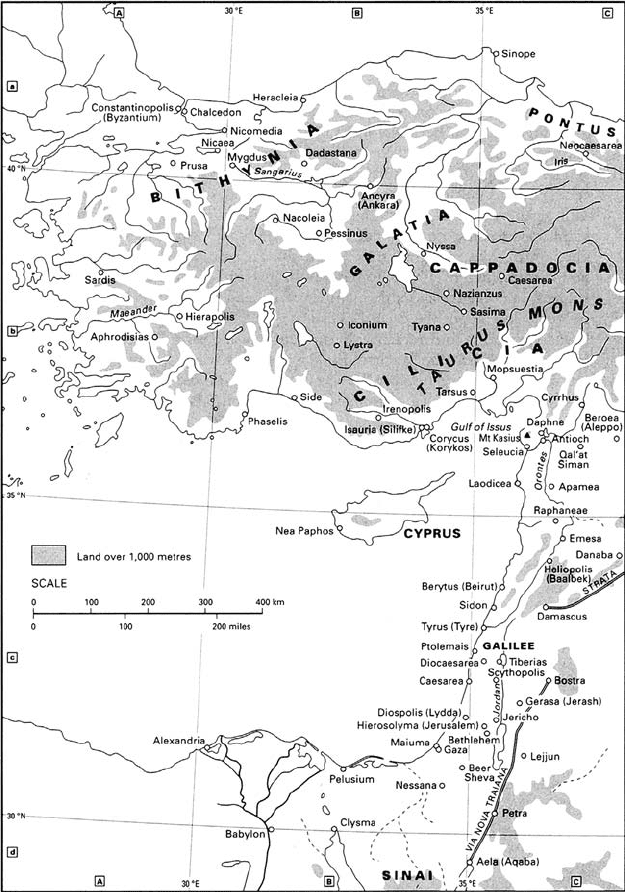
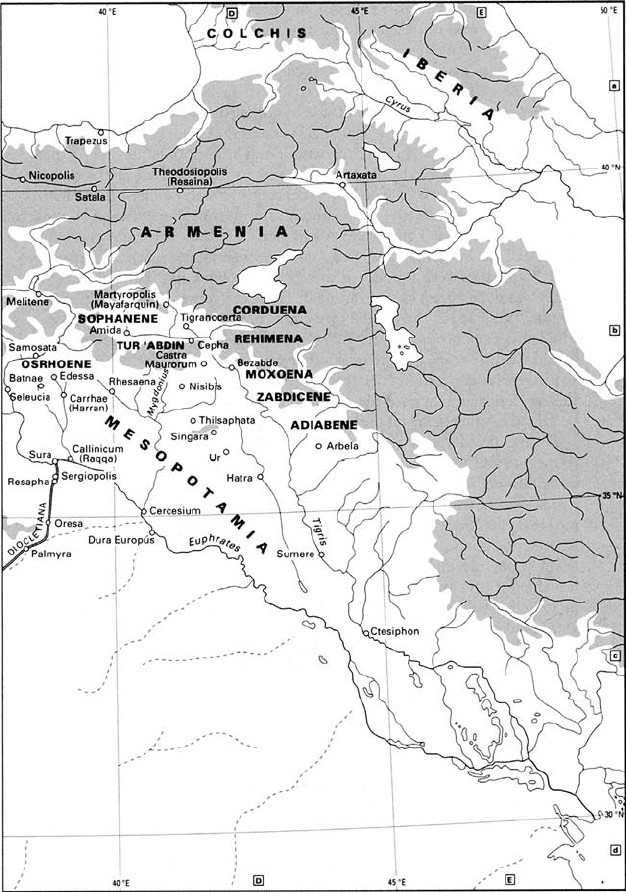
our subject. The large number of maps are included to assist the reader
with an immediate understanding of the events. They also remind us that
16
Millar 1993 and 2006, with an emphasis on the Graeco-Roman presence in the East; Ball 2000, with
its focus on the importance of Eastern influence reacting in part to Millar; Humphrey 1995–9;on
the Roman East see also Alcock 1997.
17
1991.
18
2002.
19
Heft 1/2006: 1.
Introduction 5
Romans and Sasanians were neighbours and rivals whose competition for
supremacy affected not only two peoples but all those within and between
the two empires. In addition, maps and their shifting geographical centres
are a means to manifest that modern scholarship is moving away from
eurocentric views.
The following study consists of two main parts. The first part begins with
a brief survey of Roman–Parthian relations in order to set the stage for
questions of continuity and change. After that, the chronological narra-
tive sets out the development of the relationship between Rome and the
Sasanians from the third to the seventh century. As episodes of peace and
war characterised the relations, above all the military conflicts between the
two empires are analysed and form the core of the narrative. The longer,
second part presents a wide range of source material, which is placed in its
context and illustrates patterns and structural premises. Throughout the
book, cross-references link both parts. ‘Sources and Contexts’ starts with
assessing the political goals of the two sides, which, if they amounted to
a programmatic foreign policy, would have determined relations from the
beginning (II 1). In order to set the stage for the discussion of the military
confrontations (II 3), a short discussion of Sasanian warfare precedes this
chapter (II 2). ‘Diplomatic solutions’ (II 4) are expressed in the numerous
peace treaties that concluded the many wars fought between Rome and
Persia from the third to the seventh century. However, Part II also points
to the close diplomatic relations between West and East that existed at
all times, and to the numerous contacts that emerged through common
interests between the two powers. Chapter II 5 focuses on the special role of
Arabia. After that, Armenia, an area that was of particular interest to both
sides, trade and economy, and the protection of the frontiers are examined
(II 6). The religious life in both empires and the role played by Christianity
and Zoroastrianism in their political and ideological confrontation form
another important theme (II 7). Surprisingly, the rulers of both empires did
not perceive each other as ‘alien counterparts’ but formed personal relation-
ships characterised by mutual respect and even affection. In this context
the ‘legitimacy of kingship’ was closely linked with the notion of a ‘family
of kings’, two concepts that are discussed in chapter II 8. Apart from wars,
all these factors shaped and intensified relations tremendously throughout
the course of late antiquity. The final chapter discusses the disposition and
actual channels that facilitated an exchange of information between East
and West (II 9), a process that was far from one-sided and included multiple
agents and every aspect of life.
6 Introduction
More than once the Byzantine author and diplomat Peter the Patrician
will be quoted in this study. In his view, ‘It is obvious for all mankind
that the Roman and the Persian Empires are just like two lamps; and it
is necessary that, like eyes, the one is brightened by the light of the other
and that they do not angrily strive for each other’s destruction.’ Wishful
thinking, one may say, if one looks at the almost continuous sequence of
wars fought between Rome and Persia, and at the actual downfall of both
empires. For us, however, it may be an inspiration.
In order to express the phonetic value of the languages involved, we are
using a few diacritical or phonetic signs when transliterating Persian, Arabic,
Syriac or Armenian names, titles and places.
With regard to the Persian material, the most frequent transliterations
are
ˇ
c for a pronunciation ‘ch’ (as in chill ),
˘
g for ‘j’ (as in jeans) and
ˇ
s for ‘sh’
(as in shell). ‘X’ (which is rendered as ‘ch’ in many other modern works)
should be pronounced in the same way as the ‘ch’ in Scottish loch. S is sharp
as in loss, whereas z has a pronunciation as in size. ‘renders an explosive
glottal sound, whereas’ implies a glottal sound that stops the flow of air.
It is extremely difficult to spell names, titles and places in a consistent way
as Latin, Greek or modern familiar forms of some names and places exist
which do not correspond to the general phonetic transliterations of the
original languages. In these cases we have used the more familiar version
at the expense of consistency. This also applies to Greek names, places
and terms, which, unless their Latinised (such as Ephesus or Heraclius)
or Anglicised (Constantinople or Maurice) forms or versions are more
familiar, are transliterated on the basis of the Greek sounds and endings.
The translations of the sources follow the original text as close as possible
but also try to be readable and understandable.
part i
Narrative
chapter 1
Rome and Iran to the beginning of the
third century
ad
Around the middle of the third century bc the kingdom of the Parthi-
ans emerged in the Eastern parts of the Seleucid kingdom. Originally
the nomadic tribe resided in the area between the Caspian and the Aral
Seas.
1
Around 250 bc Arsaces I, who was to become the first Parthian king
(247–217 bc) and who became the first representative of the ‘dynasty of
the Arsacids’, led the Parnians, as they were called, into the province of
Parthava, which was situated east of the Caspian Sea and was part of Seleu-
cid Iran.
2
Although at first this campaign amounted to no more than one
of the frequent insurrections against an unstable Seleucid rule in one of the
Eastern provinces, after a few setbacks the Arsacid kings managed to take
firm hold of these areas. When the Parthians embarked on their Western
expansion during the second century bc, the Seleucid kingdom, which was
among other things confronted with the new world power of Rome in the
West, was not able to stop them.
3
During the reign of the most significant
Parthian king, Mithradates II (124/3–88/7bc), the Arsacids succeeded in
extending their rule into Armenia and Mesopotamia.
4
This was the begin-
ning of an ‘international role’ for the Parthian kingdom, a phase that also
entailed contacts with Rome.
5
Favoured by the decline of the Hellenistic
kingdoms and driven by an immense desire for expansion during the first
two centuries bc, the Romans extended their rule not only into Asia Minor
but throughout the entire Eastern Mediterranean world.
6
1
For the history, culture and sources of the Parthian Empire see Schippmann 1980; Bivar 1983b: 21–99;
Wolski 1993; Wieseh
¨
ofer 1996: 115–49, 1998a and 2001: 163–204;Frye2000: 17–22; Wolski 2003.
2
For the beginning of Parthian rule, the foundation of the Arsacid Empire and the chronology of events
see Brodersen 1986: 378–81; Boyce 1994: 241–51; Olbrycht 1998: 51–76 and 2003: 69–103; Drijvers
1998: 279–93 and 1999: 193–206; Lerner 1999.
3
Wolski 1969: 188–254 and Dobbins 1974: 63–79.
4
Arnaud 1987: 129–46.
5
For Parthian–Roman relations in general see Ziegler 1964; Keaveney 1982: 412–28; Dabrowa 1983;
Campbell 1993: 213–40; Millar 1996: 127–47; Kennedy 1996a: 67–90; Isaac 1992: 19–53; Butcher 2003:
32–78.
6
On the expansion of Roman rule in the eastern Mediterranean see Gruen 1984 and Sherwin-White
1984; also Millar 1996: 19–53.
9
10 1 To the beginning of the third century
Map 1: Asia Minor and the Roman Eastern provinces
1 To the beginning of the third century 11
Map 1:(cont.)
12 1 To the beginning of the third century
Since 64 bc, when Pompey had established the province of Syria,
7
Rome
had been the immediate neighbour of the Parthian kingdom. But already
before that official contacts existed; in 96 bc Sulla received the Parthian
ambassador Orobazos on the western banks of the river Euphrates. As
Roman power was increasing dramatically in the East, the Parthians sought
peaceful relations and wanted to come to a settlement that guaranteed
mutual respect. During the meeting, the two empires established amicitia
between them.
8
Plutarch’s account of the protocol is revealing.
9
Sulla sat
in the centre and presided over the proceedings. He obviously claimed
an exceptional role. Also present was the Cappadocian king Ariobarzanes,
a man who favoured and was dependent on Rome and who – just like
Orobazos – sat next to Sulla. It becomes clear that the Parthian ambassador
was placed on the same level with him and the Parthian kingdom thus
viewed as a second-rank power. It was probably for good reasons that
Orobazos was executed after his return.
10
Roman foreign policy in the following years confirmed Western feelings
of superiority. Although in 69 and 66 bc a foedus was concluded with the
Parthians, which saw the Euphrates as the Western frontier of the Parthian
kingdom, Roman diplomatic activities reflect strategic interests rather than
the effort to come to a settlement with an equal partner. After the foedus of
66 bc had been concluded, Pompey’s behaviour made it clear that Rome was
not going to tolerate any rival.
11
When Roman soldiers broke the agreement
and crossed the Euphrates, the Parthian king Phraates III warned Pompey
to respect the river as the boundary but the latter declared that he would
give way to military force only.
12
Rome did not feel obliged to comply
with legal norms but was convinced of its political, military and cultural
superiority over the East.
When Crassus launched another attack on Mesopotamia in 54 bc, the
Parthian kingdom was well prepared. In 53 bc Rome suffered a major defeat
at Carrhae. The Roman standards fell into Parthian hands and Crassus was
killed.
13
The outcome of this battle is significant for subsequent Roman–
Parthian relations because it influenced Rome’s policy in the East consider-
ably. Whereas the Romans had treated the Parthians with arrogance before,
after the defeat they reversed their attitude and rather overestimated the
opponent’s military force; Rome sought revenge.
14
7
On Pompey’s settlement see Freeman 1994: 143–70; on Syria in general see Kennedy 1996b: 703–36.
8
Sherwin-White 1977: 173–83; Keaveney 1981: 196–212.
9
Plut. Sull. 5.4–5.
10
Karras-Klapproth 1988: 101–2.
11
Keaveney 1982: 412–28; Hillman 1996: 380–99.
12
Cass. Dio xxxvii.6.1–2.
13
Plut. Crass. 18–33; Cass. Dio xl.16–27; Marshall 1976; Shahbazi 1992: 9–13; Tucci 1992.
14
Timpe 1962: 104–29.