
Dignas B., Winter E. Rome and Persia in late Antiquity. Neighbours and Rivals
Подождите немного. Документ загружается.

2.1 The third century 23
also made an advance into Cappadocia.
22
Exceptionally important was the
destruction of the caravan city Dura-Europos in the central Mesopotamian
steppe.
23
After the fall of Hatra, the Romans had now lost a further impor-
tant trading base in the region. In the second half of 253, however, the
Persians suffered a first setback when one of their columns was stopped at
Emesa and defeated, possibly by the Palmyrene Odaenathus (died in 267).
In the following years this man figured prominently in Persian–Roman
confrontations. When
ˇ
S
¯
ap
¯
ur I rejected his offer of an alliance, Odaenathus
asked Rome instead and soon after his support became crucial for the
Roman position in the East (23).
At first
ˇ
S
¯
ap
¯
ur I used the internal difficulties Rome faced during this
period for further offensives.
24
In 260 the Persians defeated the emperor
and his personal army. At Edessa they captured high Roman officials and
Valerian himself.
25
Within all of Sasanian history this was one of the greatest
triumphs over their Western opponent. Over and over again
ˇ
S
¯
ap
¯
ur I boasted
of this triumph (5). According to his own words, the king exploited Vale-
rian’s defeat at Edessa by taking thirty-seven cities in the Roman provinces
of Syria, Cilicia and Cappadocia.
26
Apparently he also occupied the Syrian
metropolis Antioch on the Orontes. Among the numerous Roman pris-
oners were many engineers, scholars and artists, who were deported and
resettled in the modern provinces of F
¯
ars and H
¯
uzist
¯
an. Many of them
found a new home in cities founded by
ˇ
S
¯
ap
¯
ur I. These men contributed to
a spread of Western ‘know-how’ to areas beyond the rivers Euphrates and
Tigris and thus enhanced the infrastructure of the Sasanian Empire (36).
Numerous Christians, and among these priests and Church officials, also
entered Persia and established organised congregations.
27
These were not
bothered by
ˇ
S
¯
ap
¯
ur I because the king hoped that by tolerating Christians,
whose fellow believers in the Roman Empire were persecuted at the time
of the deportations, he would gain an advantage in his conflict with Rome.
However, the quick spread of Christianity in the Sasanian Empire endan-
gered the position of the Zoroastrian priesthood, whose claims to power
22
The individual dates are uncertain. An advance between 253 and 255 is as likely as one in 255/6.
23
MacDonald 1986: 45–68; Millar 1996: 445–71 and 1998b; Pollard 2004: 119–44.
24
Strobel 1993: 243–4.
25
On the Roman–Sasanian confrontations of the year 260 and on the capture of Valerian see
Kettenhofen 1982: 97–126.
26
ˇ
SKZ §§ 10–17 (pp. 295–306 ed. Back); regarding the number of cities conquered by
ˇ
S
¯
ap
¯
ur I see
Maricq and Honigmann 1953: 144.
27
For the religious life in the Sasanian Empire see the respective entries in CHI iii.2 1983: 819–
1024; for the position of Christianity see Atiya 1991; Wieseh
¨
ofer 2001: 199–216; see also chapter 7
below.
24 2 A chronological survey
became more and more visible towards the end of
ˇ
S
¯
ap
¯
ur I’s reign, and
in particular after his death. Although the Christian population displayed
loyalty towards the king in many instances, as a guardian and protector
of Zoroastrianism he was ultimately not allowed to tolerate Christian-
ity (30). Here we see clear parallels to the developments in the Roman
Empire where reasons of state were also responsible for persecutions of the
Christians.
ˇ
S
¯
ap
¯
ur I’s long-standing policy of religious tolerance favoured especially
the rise of Mani, the founder of Manichaeanism,
28
a religion that was for
a short time a religious alternative to Zoroastrianism, but at the end of his
life the king turned to Zoroastrianism.
29
In his Great Inscription
ˇ
S
¯
ap
¯
ur
proclaimed that he owed his political successes entirely to the goodwill of
Ahura Mazda (30). At the beginning of the fourth century Constantine the
Great displayed a similar attitude with regard to the Christian God after
his victories over Maxentius and Licinius.
30
Both rulers propagated their
close relationship with a supreme god in a way that illustrates structural
similarities between their ideas of kingship. On the Eastern side, one is
reminded of the Sasanian reliefs that capture the ‘King of kings’ receiving
the ring, symbol of his divine rule, that is Ahura Mazda handing over
his power to the secular ruler; on the Western side, what comes to mind
are the many images that underline the close link between emperor and
God and show the emperor as the executor of divine plans in the world.
31
Further parallels to the religious situation in Persia can be observed with
regard to the motives, goals and consequences of Constantine’s religious
policy. As the Sasanian kings supported Zoroastrianism a long time before
the conversion of Constantine, religious developments in Persia must have
been significant for the events in the West.
32
It is striking how much
ˇ
S
¯
ap
¯
ur I’s aggressive policy against Rome rein-
forced the claims made by the founder of the Sasanian dynasty, Arda
ˇ
s
¯
ır
I, namely to rule the territories that had once made up the Achaemenid
Empire (2). During his reign, Sasanian interests in the West reached a high
point for the first time and Rome had to apply all its energies in order to
28
On M
¯
an
¯
ı and the religion named after him see MacKenzie 1979: 500–31; Hutter 1988; Lieu 1992 and
1994.
29
On Zoroastrianism in the Sasanian Period see Zaehner 1975 and 1961; Duchesne-Guillemin 1983:
866–908 and Boyce 1984a: 101–43 and 1984b.
30
See Brandt 1998: 32–7 and 128–46 for references.
31
One famous example is the silver medallion from Ticinum, which probably dates to the year 315;
see Brandt 1998: 135–7.
32
Paul 1983: 108–12.
2.1 The third century 25
deal with the threat. Although
ˇ
S
¯
ap
¯
ur I suffered setbacks towards the end
of his rule, West and East always remembered that he had defeated the
Romans several times, that Gordian III had met his death in the battle of
Mi
ˇ
s
¯
ık and that Valerian had been captured.
The activities of Odaenathus of Palmyra rather than Roman offensives
deserve credit for the fact that the territories and cities conquered by
ˇ
S
¯
ap
¯
ur I
remained in Persian hands only for a short period of time. On behalf of the
Romans Odaenathus promoted Western interests against Sasanian claims.
ˇ
S
¯
ap
¯
ur I’s earlier rejection of Odaenathus’ offer to ally himself with Persia
backfired. The Roman emperor Gallienus (260–8) invested the Palmyrene
king with almost unlimited power, and from the second half of the year
260 onwards the Sasanians suffered several defeats at his hands. From 264
onwards the Eastern frontier of the Roman Empire was quiet.
33
When Odaenathus was assassinated in the spring of 267
ˇ
S
¯
ap
¯
ur I was
finally liberated from a dangerous opponent. With Odaenathus’ help
Palmyra – which was favoured by its geographical location in the first
place – had developed into a powerful buffer state between Rome and
Persia. Odaenathus’ successor Zenobia (267–72) took advantage of the so-
called crisis of the Roman Empire
34
and fostered an unparalleled rise of
Palmyrene power. Eventually, the creation of a Palmyrene kingdom that
was independent from Rome was not tolerable. In the year 272 the Roman
emperor Aurelian (270–5) attacked Palmyra and captured Zenobia, who
was paraded through Rome in the emperor’s triumph (23).
The Sasanians did not intervene in the confrontations between Rome
and Palmyra, possibly because the short reigns of Hormizd I (272–3) and
Bahr
¯
am I did not allow for any bold initiatives in foreign affairs. Removing
Palmyrene power from the political map certainly strengthened the Roman
position. Aurelian adopted the titles Parthicus and Persicus maximus
35
and
thereby emphasised his military achievements in the East. The Roman
emperor Probus (276–82) travelled to the East twice; these visits included
diplomatic contacts with the Persian opponent but no armed conflict. A
Roman offensive was planned for the year 283 but was abandoned when
the emperor was assassinated.
36
33
De Blois 1975: 7–23.
34
On this ‘crisis’ see Potter 1990; Bleckmann 1992; Strobel 1993; with further references Witschel 1999;
Strobel 2001: 239–78.
35
CIL iii 7586 (= ILS 8925); vi 1112; viii 9040; xii 5549 and 5561; xiii 8973 (= ILS 581); see also
Kettenhofen 1986: 138–46.
36
SHA Prob. 17.4; 20.1; for the year 279 the title Persikos megistos is attested; cf. P. O x y . xiv 1713; for
Probus’ activities in the East see Crees 1965: 110–11 and 124–5; Kreucher 2003: 82–3 and 179–86.
26 2 A chronological survey
His successor Carus (282–3) was proclaimed emperor with the explicit
goal of destroying the Persian Empire.
37
This may be literary fiction but
Carus translated into action a long-planned military offensive against the
Sasanians. The Roman army invaded Mesopotamia and did not meet any
Persian resistance.
38
Internal unrest during the reign of Bahr
¯
am II (276–93)
may have favoured the successful advance and capture of Kt
¯
esiph
¯
on.
39
This
was the only time ever that the Romans captured the Persian capital, which
to some extent made up for the humiliation Rome had suffered in 260.Not
surprisingly, Carus also adopted the titles Persicus maximus and Parthicus
in order to display his success over the Eastern rival.
40
Carus’ sudden death prevented Rome from further advances. In the
Historia Augusta we read that he was struck by lightning while in his
camp at the Tigris. No Roman emperor was destined to advance beyond
Kt
¯
esiph
¯
on.
41
According to the words of this so-called ‘Kt
¯
esiph
¯
on oracle’
Carus died because he did not abide by an oracular prophecy that anybody
who tried to conquer the Persian capital would be punished. Rome’s cau-
tious dealings with Persia were thus expressed not only in political terms
but also as a motif in the realm of myth and fiction. Carus’ successor,
Numerianus (283–4), withdrew his army immediately and without even
negotiating for a peace.
42
The campaign thus had no consequences for the
Sasanians. Rome was not able to use the prestigious victory over Bahr
¯
am II
and did not gain any territory in the long term. The latent state of war and
the unsettled situation along the frontiers that had existed already before
Carus’ Persian campaign continued.
43
Too many unresolved issues prevented a formal peace or agreement
regarding the frontiers, and this did not change until the Roman emperor
Diocletian (284–305) consolidated his rule and returned to the East in 286.
Immediately, he started to reorganise Roman rule and the defence system
along the frontier, a development which caused Sasanian concern. In the
year 287 Bahr
¯
am II sent ambassadors to Diocletian in order to negotiate for
a peace treaty.
44
Apparently the negotiations were successful and a peace
was concluded without any territory changing hands. Diocletian was sat-
isfied that the Sasanian king respected the existing Eastern frontier and in
37
Anonymus post Dionem, frg. 12 (FHG iv 198).
38
SHA Car. 8.1; Aur. Vict. Caes. 38.2–3; Eutr. ix.18.1; Fest. 24.
39
SHA Car. 8.1; Pan. Lat. xi (iii) 17.2 (p. 268, rec. Mynors).
40
CIL viii 12522 (= ILS 600); IGRR i 1144.
41
SHA Car. 9.1; in this context see Kerler 1970: 263–4.
42
Aur. Vict. Caes. 38.6.
43
For the Persian campaign of the emperor Carus see Winter 1988: 130–7.
44
Pan. Lat. x (ii) 7.5; 9.2.
2.1 The third century 27
288 returned to the Western parts of his empire in order to intervene in the
conflict with the Alamanni.
45
Bahr
¯
am II’s readiness to come to a friendly understanding with Rome
indicates that the Sasanian king was preoccupied with domestic affairs.
46
His brother Hormizd was rebelling against the legitimate ruler with the help
of Eastern peoples such as the Saka and the K
¯
u
ˇ
s
¯
an,
47
and the Zoroastrian
priest Kart
¯
er was exerting more and more influence in the empire. The
latter, who had been a political factor already during the reign of
ˇ
S
¯
ap
¯
ur I,
was now at the zenith of his power and had great influence over Bahr
¯
am II.
48
The king backed Kart
¯
er in pursuing a repressive policy that aimed at the
elimination of all non-Zoroastrian religions in Persia (29).
49
Measures by
which Bahr
¯
am increased the powers of the Zoroastrian priesthood reflect
the king’s efforts to unify his kingdom as well as to strengthen his own
position.
50
This period saw the origins of the union between the Sasanian
monarchy and the Zoroastrian religion that would become so significant
for the history of the Sasanian Empire (28). The priest Kart
¯
er expanded
his power enormously and became the leading exponent of a movement
51
that gained more and more independence from the monarchy. Reflecting
the king’s weak position, this development is probably the reason why
Bahr
¯
am yielded to Diocletian and was eager to come to an agreement with
the emperor. From now onwards religious affairs became a significant and
growing factor in the relations between the two great powers.
Both sides respected the agreement of 288 while their energies were
applied elsewhere. Already in 290 Diocletian once more headed East. In
the following period he took numerous measures in order to strengthen
the Roman position along the Eastern frontier.
52
Above all, he inter-
vened in Armenian matters by restoring Tiridates III to the throne in
290, thereby increasing Roman influence in this strategically important
region.
53
Although Tiridates’ realm of influence was limited to Western
(Lesser) Armenia, Diocletian used the opportunity to win an important
ally for the imminent conflict with Persia (26). The difficult situation
45
On the Roman–Sasanian peace treaty of 288 see Winter 1988: 137–51.
46
On the king’s struggle to legitimise his rule see Winter 1988: 138–41.
47
Pan. Lat. x (ii) 7.5; 9.2; on the Saka see Bosi 1994: 109–22; Narain 1987: 27–31 and 1990: 151–76;on
the K
¯
u
ˇ
s
¯
an see the glossary, and below p. 93 with n. 107.
48
For Kart
¯
er and his rise to power see Sprengling 1940a: 197–228; Chaumont 1960: 339–80; Hinz 1971:
485–99.
49
Brock 1978: 167–81.
50
Decret 1979: 130–1.
51
Metzler 1982: 144.
52
The title Persicus maximus of the year 290 (CIL iii 5810) emphasises Diocletian’s successes in the
East; cf. Enßlin 1942.
53
Chaumont 1969: 93–111; Kettenhofen 1995c: esp. 48–55 and 144–68; see also p. 128 with n. 47 below.
28 2 A chronological survey
mentioned above forced Bahr
¯
am II to watch the activities of the Roman
emperor without taking any action.
Since the capture of Valerian in the year 260 the balance of power
between West and East had changed. The Sasanian Empire, which from
its foundation in 224 had pursued an aggressive policy against its West-
ern neighbour and had inflicted major defeats on Rome, suffered setbacks
that were the result not only of its own internal situation but also of a
recovering Roman Empire from the beginning of the 270s. In particular
Diocletian’s sensible and far sighted reforms
54
helped to get over the so-
called crisis of the Roman Empire, and this had to affect the relations with
the Eastern neighbour. Only when Persia’s internal struggle for power
55
ended in favour of king Nars
¯
e(293–302) was the Eastern power in the
position to revert to the policy of expansion pursued by the early Sasanian
kings.
56
In 296 Nars
¯
e used the first opportunity for a military offensive against
Rome and invaded the Roman part of Armenia. He benefited from the fact
that the Romans had to deal with a revolt against their rule in Egypt. In
297 Diocletian was determined to end the political unrest and issued an
edict against the Manichaeans, whose religion was one of those persecuted
by the Zoroastrian priest Kart
¯
er in the Sasanian Empire but who from a
Western perspective were perceived as followers of a Persian religion.
57
It is
not clear, however, if the so-called ‘Edict against the Manichaeans’ of 297
(31), which formed part of a general policy of religious restoration pursued
by Diocletian and his fellow emperors,
58
should be seen in the context of
the new Persian war. However, it is remarkable that persecutions of the
Manichaeans ceased in Persia after 297 in order that their support could be
used in the battle against Rome.
59
In the year 297 the armies of Nars
¯
e and Galerius ([293] 305–11), who
had been made Caesar by Diocletian because of his military successes,
clashed between Kallinikos and Carrhae; the Romans were utterly defeated.
Ammianus Marcellinus tells us that Diocletian hurried to the scene and that
Galerius, clad in purple, marched for nearly a mile before the carriage of
the enraged emperor. Possibly, Diocletian humiliated Galerius in this way
54
Brandt 1998: 19–26.
55
On the quarrels over the succession to the throne after the death of Bahr
¯
am II in 293 see Tanabe
1991: 7–39.
56
For a different interpretation see Wieseh
¨
ofer 1993: 373 n. 54, who argues that Nars
¯
e’s attack was a
preventive measure and not part of an expansionist Western policy.
57
On the revolt in Egypt and the role of the Manichaeans as ‘agents of the Persians’ see Seston 1939:
227–34.
58
Strobel 1993: 337–8 and Brandt 1998: 25–6.
59
Frye 1983a: 131.
2.1 The third century 29
in order to provoke his thirst for revenge.
60
And indeed, in 298 Galerius
defeated Nars
¯
e at Satala in Armenia.
61
There are many attestations of this
particular Roman triumph against its Eastern rival (6).
The new success against Persia made Rome forget the setbacks of the
third century, in particular the capture of Valerian by
ˇ
S
¯
ap
¯
urIin260. The
reign of Diocletian instilled in the West a level of confidence regarding
victory and peace that had been lost throughout the third century. Rome’s
successes reminded it of its former glory and accordingly were much empha-
sised in Western historiography. In the Historia Augusta Diocletian is called
the ‘father of a golden age’ (aurei parens saeculi).
62
Aurelius Victor refers
to him as a father who had acted on behalf of his people.
63
Even Eusebius
of Caesarea mentions the fortune and wealth of the reign of Diocletian in
his ecclesiastical history.
64
According to the emperor Julian (361–3) Dio-
cletian, the ‘ruler of the entire world’, instilled such fear into his enemy
that the Sasanian king had to accept his conditions for peace.
65
The pan-
egyric literature praises the victory over Persia by emphasising that this
empire was the only power in a position to diminish Rome’s glory.
66
In
its preamble, the Prices Edict of the year 301, which is preserved on stone,
mentions that the most fortunate stability and peace had been restored in
the Roman Empire, if only with great difficulty.
67
Coins that show the
legend pax aeterna and securitas orbis were part of an imperial propaganda
but also expressed how much the Romans hoped that they had returned to
their former glory.
68
Diocletian was the man whom the state needed (vir
rei publicae necessarius).
69
In the light of his crushing defeat at Satala Nars
¯
e wanted to end the
conflict as quickly as possible, in particular as he could otherwise expect
Galerius to advance further into Sasanian territory. It was to his advan-
tage that Galerius and Diocletian could not agree on a strategy.
70
Whereas
Galerius intended to pursue Nars
¯
e, who had taken flight, and take posses-
sion of the Persian heartland, Diocletian saw the aims of the war fulfilled
with the victory at Satala. He did not want to embark on new and uncertain
60
So Klein 1997: 278.
61
Enßlin 1936: 102–10; 1942: 40–5; for the chronology of the events see Barnes 1982: 54–5 and 63.
62
SHA Heliogab. 35.4.
63
Aur. Vict. Caes. 39.8.
64
Eus. HE viii.13.9.
65
Iul. Or. 1. 18a–b.
66
Pan. Lat. viii (v) 10.4.
67
Edictum Diocletiani et collegarum de pretiis rerum venalium, praef.; for an English translation of the
preamble and an early list of the prices see Grazer in Frank 1940: 157–74 (= Lewis and Reinhold
1955 ii: 464–72); for new fragments of the text see Crawford and Reynolds 1977: 125–51 and 1979:
163–210; S. Corcoran is preparing a translation of all fragments; see also Brandt 1998: 78–86.
68
Cf. e.g. references in RIC vi 1967: 145.
69
SHA Car. 10.1.
70
Aur. Vict. Caes. 39.36; see also Kolb 1987a: 85.
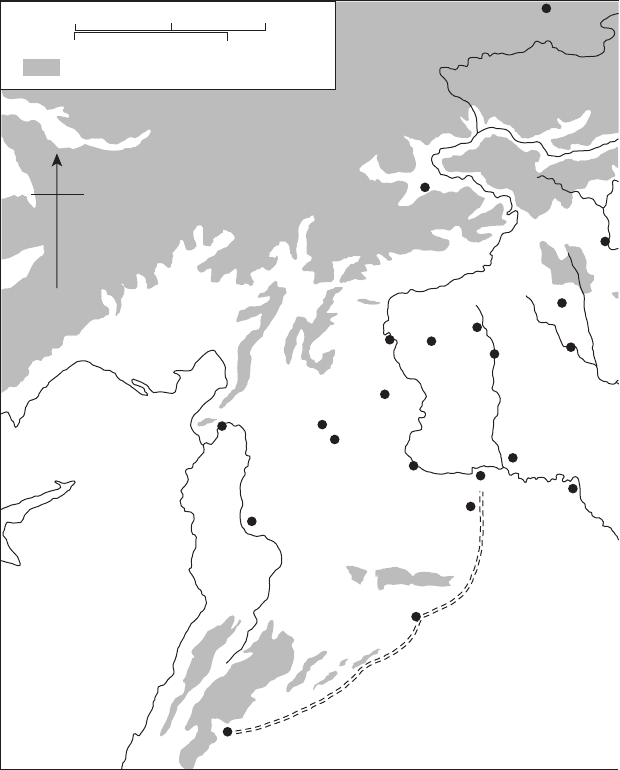
30 2 A chronological survey
Syrian
Desert
Damascus
Palmyra
Apamea
Mediterranean
Sea
SYRIA
Gabbulon
Beroea
Antioch
Zeugma
Hierapolis
Batnae
Edessa
Carrhae
Constantia
River Euphrates
Amida
Satala
Melitene
Land over 1000 metres
100 miles0
0 200 km
Taurus M
ountains
CAPPADOCIA
N
Resaina/Theodosiopolis
OSRHOENE
EUPHRATESIA
Callinicum
Zenobia
Sura
Sergiopolis
Barbalissos
S
O
P
H
A
N
E
N
E
S
t
r
a
t
a
D
i
o
c
l
e
t
i
a
n
a
R
i
v
e
r
O
r
o
n
t
e
a
s
Map 3: Northern Mesopotamia and adjacent regions
military campaigns that could put at risk what had been accomplished so
far. In the end, Diocletian prevailed in the negotiations at Nisibis. A peace
treaty was concluded and put an end to the last of the Roman–Sasanian
Wars of the third century. Although the foedus of 298 put the Sasanians at
a major disadvantage (17), Rome intended to respect the sovereignty of the
defeated Sasanian ruler.
71
71
Chrysos 1976: 11–17.
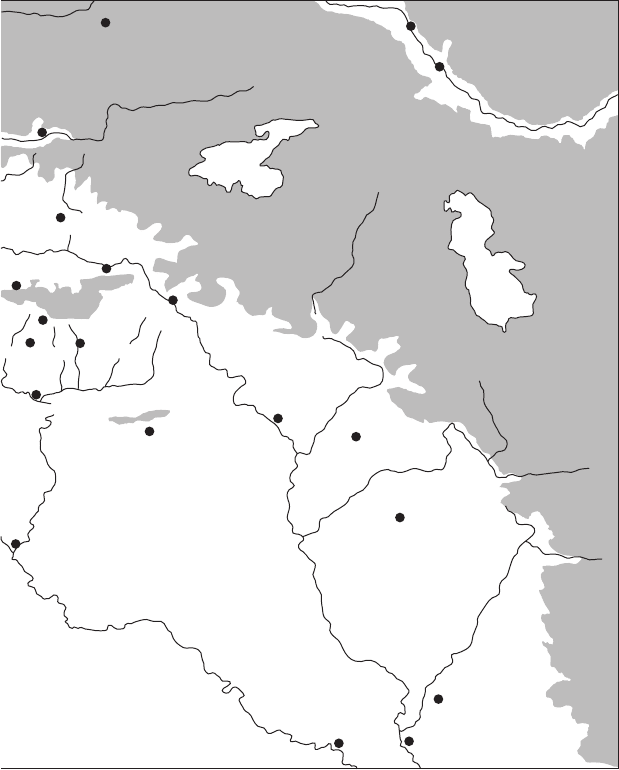
2.1 The third century 31
ARMENIA
PERSARMENIA
Artaxata
Dvin
River Araxes
Theodosiopolis
Citharizon
Martyropolis
Cepha
Bezabde
Nineveh
River Tigris
Irbil
Lesser Zab
Greater Za
b
Kirkuk
(Karka de
Beth Selok)
Perozshapur
Ctesiphon
Dastagerd
River Diyala
Monocarton
Nisibis
Solachon
Thannuris
Singara
Circesium
River Euphrates
Khabour
Jebel
Sinjar
Dara
Tur Abdin
CORDUENE
ZABDICENE
Lake Urmiah
Lake
Van
ARZANENE
R
i
v
e
r
T
i
g
r
i
s
Z
a
g
r
o
s
M
o
u
n
t
a
i
n
s
B
a
t
m
a
n
(
N
y
m
p
h
i
u
s
)
Map 3:(cont.)
There is no doubt that the peace treaty of 298 made the Roman Eastern
frontier more secure. During the first Tetrarchy the so-called Strata Dio-
cletiana from Damascus via Palmyra to Sura
72
was built and fortified with
numerous forts (map 3), and a security zone with military roads, fortresses
and watch towers created between Hauran in Southern Syria and the Sinai.
72
See Eadie 1996: 72–82; Konrad 1999: 392–410.
32 2 A chronological survey
The latter was later called ‘Palestinian’ or ‘Arabian Limes’.
73
Given how
important Persia was for Roman foreign trade (28), Diocletian had worked
towards a settlement in which economic and strategic components comple-
mented each other. It was his goal to reconcile questions of security with the
control over the trade with the East, which was so important for Rome.
74
The treaty established the Mesopotamian city of Nisibis as central to the
trade between the two empires (17), and this role would continue in the
future. From now on economic and strategic factors were also important
in the diplomatic relations between both empires (27–28). Although there
were still unsolved problems to do with the spread of information through
diplomats, defectors and spies (35), for the time being the peace treaty of
Nisibis formed the beginning of a peaceful period between Rome and Persia
that would last for forty years – an exceptionally long period of peace in
the history of Roman–Sasanian relations.
2.2 the fourth century: the conflict escalates
under
ˇ
s
¯
ap
¯
ur ii (309–79)
Very little is known about the successors of the Sasanian king Nars
¯
e,
Hormizd II (302–9) and Adanars
¯
e(309). They did not play a decisive
role in Roman–Sasanian relations. It looks as if Hormizd II embarked on
an unsuccessful Western campaign, possibly in order to take revenge for his
father Nars
¯
e’s humiliating defeat, which he had witnessed.
75
A small note
found in the so-called Chronicle of Arbela, a Syriac–Nestorian source of the
sixth or seventh century whose authenticity and reliability are controver-
sial among scholars, should be mentioned in this context.
76
The chronicle
claims that Hormizd initiated his Western campaign in order to avenge
the Roman persecutions of Christians that took place during the reigns
of Diocletian and Galerius.
77
Hormizd II indeed showed tolerance to the
Christians, who were a persecuted minority in both the Roman Empire
and the Sasanian kingdom. His Western advance, however, did not bear an
impact on the peace of 298.
This peace between Romans and Persians ended during the reign of
ˇ
S
¯
ap
¯
ur II (309–79), who renewed the aggressive Western policy of the early
Sasanian kings.
ˇ
S
¯
ap
¯
ur II intended to recover not only those territories
73
On the development of this part of the Roman frontier see Graf 1978: 1–26; Kennedy 1982; Bowersock
1983: 76–157; Isaac 1992: 118–34.
74
Seston 1946: 176–7.
75
Wieseh
¨
ofer 1989: 68–71.
76
See ibid. 68–9 n. 7.
77
Chr. Arb. ii p. 67, 9–11 (tr. Kawerau); cf. Assfalg 1966: 19–36; on the significance of this source see
Kettenhofen 1995b: 287–319.