
Dignas B., Winter E. Rome and Persia in late Antiquity. Neighbours and Rivals
Подождите немного. Документ загружается.

1 To the beginning of the third century 13
Caesar’s plans for a Parthian War
15
and the intense preparations prior
to Antony’s Parthian campaign
16
confirm Rome’s respect for the military
force of the Parthian kingdom. However, the Romans were still not willing
to acknowledge their opponent in the East as an equal power. In the late
republican period Roman foreign policy strove to create a Rome that was,
as Cicero puts it, ‘lord over kings, victor and ruler over all nations’ (domi-
nus regum, victor atque imperator omnium gentium).
17
The claim for world
domination prevented the imperium Romanum and other states from coex-
isting as equal partners bound by principles of international law. However,
Augustus’ policy in the East paved the way for a new attitude. In order to
come to an official agreement concerning the political relations between the
two powers, the Parthians had to return the Roman standards they had cap-
tured at Carrhae; they agreed to do so in 20 bc when Rome demonstrated
its military strength in the East.
18
It is not surprising that in Roman eyes
the foedus concluded between Augustus and Phraates IV (38–3/2bc) was a
great success.
19
Given that public opinion in Rome was all in favour of war,
it was even more important that the princeps decided to restore the Roman–
Parthian amicitia and to conclude a foedus in 20 bc according to which the
Romans respected the Euphrates as the frontier between the two powers.
20
The treaty acknowledged the fact that Rome was, in the long term, not
in a position to control vast territories beyond the Euphrates. Augustus
pursued a policy ‘within the existing borders of the empire’ (intra terminos
imperii)
21
although official propaganda continued to emphasise an ‘empire
without borders’ (imperium sine fine).
22
However, by refraining from fur-
ther expansion in the East Rome acknowledged the military strength of
the Parthian kingdom. Authors of the early imperial period talk about
the Parthian kingdom and the Roman empire as maxima imperia
23
and as
‘the two greatest rules under the sun’,
24
and the Augustan historian Pom-
peius Trogus saw the world as divided between Romans and Parthians;
25
there is no doubt that such statements reflect emerging rules of an inter-
national community of which the Parthian kingdom was a part. On an
15
Malitz 1984: 21–59.
16
Craven 1920; Bengtson 1974; Schieber 1979: 105–24; Hersh 1980: 41–5.
17
Cic. Dom. 90.
18
Timpe 1975: 155–69.
19
On the significance of returning the standards see Zanker 1987: 188–96; in this context see also
Schneider 1998: 95–147.
20
Strabo xvi.1.28; on Strabo’s representation of the Parthians see Bosi 1994: 109–222; Drijvers 1998:
279–93.
21
Tac. Ann. i.11.
22
Verg. Aen. i.279.
23
Tac. Ann. ii.56.
24
Ios. AJ xviii.46; on the representation of the Parthians in Josephus see Rajak 1998: 309–24.
25
Iust. xli.1.1; on this passage see also Van Wickevoort Crommelin 1998: 261; on the Parthians in
Pompeius Trogus see Alonso-Nunez 1988–9: 125–55.
14 1 To the beginning of the third century
ideological level, however, Rome’s claim for world domination remained
intact.
26
Many comments made by poets of the Augustan period, who rep-
resented the opinion of the nobility in the city of Rome, reflect the view
that no state or people could be equal to the imperium Romanum.
27
Augustus initiated a policy that refrained from conquests beyond the
Euphrates and acknowledged the Parthians as a second world power equal
to Rome. Although Nero (54–68) fought a Parthian War over Armenia,
the Arsacid ruler Tiridates was eventually crowned by Nero as king of
Armenia in a great Roman spectacle,
28
and we may say that Augustus’
policy of cooperation laid the foundation for a more or less uninterrupted
peace between the two powers throughout the first century ad. The fact
that in ad 66 the so-called ‘Armenian question’ found a solution must
have strengthened relations even further (26).
29
Local conflicts, Rome’s
fortification of the frontier along the Euphrates and in the Caucasus and a
tightened Roman rule in the Eastern provinces did their part to see relations
deteriorate but did not immediately lead to new armed confrontations on
the Eastern frontier of the Roman Empire.
30
Rome, however, improved its
military position significantly during this period.
31
At the beginning of the second century the emperor Trajan (98–117)
intended to conquer the Parthian kingdom and thereby turned the dream
of Roman world domination into political reality.
32
Our ancient sources do
not reveal the precise reasons for the emperor’s Parthian campaign. It looks
as if ideas of world domination and military glory
33
were equally important
as strategic considerations regarding a stronger Roman frontier beyond the
Euphrates. Trajan rejected Parthian efforts to come to a peaceful settlement.
Contemporary observers criticised the emperor’s actions prior to the
military confrontations
34
and accused him of turning his back on a Roman
policy in the East that had prevailed since Augustus, namely a policy that
acknowledged the sovereignty of the Parthian kingdom as a political factor
within a community of states that abided by the same international laws.
35
26
On the image of the Parthians in the West see Sonnabend 1986.
27
For references see Wissemann 1982.
28
Anderson 1934: 743–80; Ziegler 1964: 67–78; Wagner 1985: 31–42.
29
Wolski 1983a: 269–77; for the period after 34/5 see also Schottky 1991: 81–7; for the position of
Armenia between the two great powers in general see Garso
¨
ıan 1997a: 63–94 and 1985: 95–116.
30
For developments within the Parthian kingdom during the first century see Dabrowa 1981: 187–204;
Schottky 1991: 61–135; Ash 1999: 114–35.
31
For the fortification of the Roman–Parthian frontier along the Euphrates from Augustus to the
Flavian emperors see Dabrowa 1980: 382–8; Wagner 1985: 19–57; Bosworth 1976: 63–78; Mitchell
1993: 118–42.
32
On Trajan’s political goals see Eadie 1985: 407–23.
33
Cf. esp. Cass. Dio lxviii.17.1.
34
E.g. Front. 15.
35
Cf. Ziegler 1964: 102.
1 To the beginning of the third century 15
In spite of Trajan’s great military successes, his Parthian War (114–17)
ended with a fiasco.
36
Late in Trajan’s reign revolts took place in the con-
quered territories, and the new provinces of Armenia, Mesopotamia and
Assyria were eventually lost. Trajan’s successor Hadrian (117–38) returned to
the Augustan policy of ‘sustaining the empire within its borders’ (coercendi
intra terminos)
37
and restored the amicitia with the Parthian kingdom on
the basis of the status quo that had existed before the war.
38
In its outline,
this policy was not even changed by the successful Parthian Wars of L. Verus
(161–9) and Septimius Severus (193–211), who – after Trajan’s offensive –
advanced a second and third time as far as the Parthian capital Seleucia-
Kt
¯
esiph
¯
on.
39
Rome withdrew after these successes. Its declared goals were
different from those of the beginning of the second century and no longer
extended to the subjugation of the Parthian kingdom. But whereas the East-
ern power had retained its political sovereignty, Rome’s military successes
improved its strategic position along the Eastern frontier considerably, in
particular by moving the frontiers forward to the Chaboras-Singara line,
which created a boundary within Mesopotamia, and finally establishing the
province of Mesopotamia during the reign of Septimius Severus.
40
Roman
control over upper Mesopotamia represented a permanent and immedi-
ate threat to the Mesopotamian heartland of the Parthian kingdom. This
was the end of a policy that firmly recognised the Euphrates as the border
between Romans and Parthians.
At the beginning of the third century ad Caracalla (211–17) launched yet
another attack against the Parthians.
41
In contrast to his predecessors, he
seems to have pursued the conquest of the Parthian kingdom. Apparently,
his plans amounted to world domination and were guided by the idea that
he would become a successor of Alexander the Great – he was certainly
not prepared to acknowledge Parthian sovereignty. Caracalla’s attempts to
create a casus belli for a ‘justified war’ illustrate this position no less than
his actions during the Parthian campaign when he desecrated the graves
of local rulers in the Adiab
¯
en
¯
e.
42
In contrast, ancient authors mention
Caracalla’s plans to marry the daughter of the Parthian king Artabanos IV.
36
Lepper 1948; Eadie 1985: 407–23; Lightfoot 1990: 115–26; Wylie 1990: 37–43.
37
See note 21 above.
38
Birley 1956: 25–33 and Birley 1998: 66–76.
39
Birley 1987: 140–7; 1988: 201–4; Rubin 1975: 419–41; Speidel 1985: 321–6; Potter 1991: 277–90; Millar
1996: 80–99 and 111–26.
40
On the fortification of the Roman Eastern frontier along the Tigris and Chaboras under the Severan
emperors see Kennedy 1987: 57–66; Wagner 1985: 63–7; 1983: 103–30; Millar 1996: 127–41.
41
Heichelheim 1944: 113–15.
42
Cass. Dio lxxix.1.1–2.
16 1 To the beginning of the third century
The king’s refusal led to war.
43
Caracalla’s request was certainly unrealistic
and the Roman emperor may have anticipated the refusal in his political cal-
culations. Nevertheless, Herodian’s account of the situation is revealing.
44
It mentions a Roman embassy dispatched to propose the marriage to the
Parthian king. The ambassadors claimed that if the empires of the Romans
and the Parthians, which in their words were the greatest of the world, were
no longer separated by a river and frontier but formed a single empire, no
opposition would arise because the other barbarian nations would be an
easy prey to these. Although we have to be cautious when using Herodian
as a historical source, his ideas reflect contemporary views and throw light
on the relations between the two single great powers at the beginning of
the third century.
45
Caracalla’s war of aggression is therefore surprising. In order to explain
his political goals, in particular the dream of succeeding Alexander the
Great,
46
we have to take into account the character and personality of this
Roman emperor. After Caracalla’s assassination, his successor Macrinus
(217–18) immediately announced that his predecessor had done wrong by
the Parthians and restored peace. In 218, after a battle fought at Nisibis
during which both sides suffered heavy losses, a treaty was signed. According
to Herodian, the Roman emperor Macrinus was delighted about having
won the Iranian opponent as a reliable friend.
47
Be that as it may, until its downfall the Parthian kingdom was and
remained an openly acknowledged serious opponent, who required con-
stant Roman vigilance.
48
Internal developments in Iran made it impossible
to intensify Roman–Parthian relations and to strengthen emerging signs of
an international law. In 224 the rise of the Sasanians, fostered, to be sure,
by the confrontations and tensions between Parthians and Romans during
the first two decades of the third century, led to the fall of Arsacid rule.
Modern scholars long underestimated the Arsacid dynasty and regarded
Parthian–Roman relations solely from the Roman perspective. Inevitably,
scholars did not acknowledge an ‘active’ Western policy on the part of
the Arsacids. Above all the many works of G. Wolski
49
have opened the
discussion to new views, and the era of the Parthian kings within the
43
The historicity of Caracalla’s plans is controversial; see Ziegler 1964: 132–4.
44
Herodian iv.10.2–4.
45
Ziegler 1964: 133–40.
46
On Caracalla’s imitatio Alexandri see Cass. Dio lxxviii.7.1–4; Herodian iv.8.1–3.
47
Herodian v.1.4.
48
There has been a lively scholarly discussion regarding the goals and character of Rome’s military and
strategic policy along the Eastern frontier of the empire. Cf. Luttwak 1976; MacMullen 1976; Isaac
1989: 231–4; 1992 and Zyromski 1998.
49
Wolski 1966: 65–89; 1976: 195–214; 1985: 163–73; 1983b: 137–49.
1 To the beginning of the third century 17
history of Iran as a whole has gained significance – in particular with
regard to the study of the Achaemenids and the Sasanians. Relations with
Rome were in fact a major structural element in the history of the Parthian
kingdom. Wolski is right in emphasising that the ‘Iranicism’ of the Arsacids
played an important role in their conflict with Rome. The recollection of
the significant Achaemenid past
50
encouraged the Arsacids to stand up to
the Roman Empire, an aspect that widens the scope of Arsacid policies
tremendously.
51
A prime example is the following: according to the Roman
historian Tacitus, the Parthian king Artabanos II (10/11–38) threatened
the Roman emperor Tiberius (14–37) by referring to the old Persian and
Macedonian conquests and by boasting that he would gain possession of
what Cyrus and later Alexander had ruled.
52
By comparing the first Arsacid
ruler with the first Achaemenid ruler Cyrus (559–530 bc) the third-century
author Justin also underlines this claim.
53
The Parthians thus continued
Achaemenid traditions and can be counted among the ‘first pioneers of
Iranicism’.
54
K. H. Ziegler hesitates to label Arsacid foreign policy ‘programmatic’
55
because there was no Arsacid ideology equivalent to the Roman idea of
world domination. He argues that Parthian goals never amounted to the
destruction of the Roman Empire and that even the claims made by Arta-
banos II in Tacitus’ account aimed at territorial gains that were modest in
comparison with later Sasanian claims.
56
It is crucial for an assessment of
Roman–Sasanian relations to examine whether the Sasanians took up goals
of the Arsacid rulers and continued their Western policy or developed plans
that went beyond any foreign policy pursued by the Parthians. Given that
the late phase of Parthian–Roman relations was characterised by mutual
respect and appreciation – certainly beyond a modus vivendi
57
and with
options for a formalised relationship on the basis of an international law,
58
one also has to ask if and to what extent the rising Sasanian Empire was
prepared to use the opportunity and to further develop existing relations.
50
Metzler 1982: 130–7.
51
On the goals of Arsacid foreign policy and on Arsacid military strength see Kennedy 1996a: 67–90.
52
Tac. Ann. vi.37. Cf. Wieseh
¨
ofer 1986b: 177–85; Ehrhardt 1998: 299 with further references.
53
Iust. xli.5.5.
54
Wolski 1983b: 147.
55
Dabrowa 1984: 153.
56
Ziegler 1964: 86; cf. also Zyromski 1998: 11.
57
Wirth 1980/1: 324.
58
Ziegler 1964: 140.
chapter 2
Rome and the Sasanian Empire:
A chronological survey
2.1 the third century: the origins of
sasanian interests in the west
The rise of the Sasanian dynasty, the revolt of Arda
ˇ
s
¯
ırI(224–40) against the
Arsacids, the fall of Parthian rule and the foundation of the Neo-Persian
Sasanian Empire (map 2)
1
– together, these were not only a turning point
within the history of Iran
2
but also a benchmark regarding Iran’s relations
with Rome. Although Arda
ˇ
s
¯
ır’s hostile attitude against Rome was at first a
mere continuation of Parthian sentiments, within a few years of his reign
the king established, consolidated and centralised his rule
3
to the extent
that his ambitions threatened wide areas of the eastern half of the Roman
Empire. The West knew that Arda
ˇ
s
¯
ır’s claims would go beyond the borders
of the Parthian kingdom and that he would ask for more than declarations
of loyalty from the many client kings within his empire; it was clear that he
would claim all the territories that had once belonged to his Achaemenid
ancestors. Rome therefore considered the Sasanian dynasty as a serious
opponent right from the beginning of their relations (1).
4
As soon as Arda
ˇ
s
¯
ır had established his rule he turned towards the West.
According to the contemporary historian Herodian, Arda
ˇ
s
¯
ır I responded
to a letter from the Roman emperor Severus Alexander (222–35), in which
the emperor warned him to respect peace and reminded him of the great
victories of Augustus, Trajan and Septimius Severus,
5
by asking Rome to
1
For a chronology of the early Sasanian rulers and the beginnings of Sasanian history see Altheim-Stiehl
1982: 152–9; Sundermann 1990: 295–9; Richter-Bernburg 1993: 71–80.
2
For the history of the Sasanian Empire see Morony 1997: 70–83; Christensen 1944; Widengren
1971: 711–82;Frye1983a: 116–80; 1984: 287–339; Schippmann 1990: 10–79; Wieseh
¨
ofer 2001: 151–
221; see Shahbazi 1990: 588–99 for a survey of the multi-faceted relations between Iran and the
West.
3
With regard to the activities of the first Sasanian king see Wieseh
¨
ofer 1986a: 371–6.
4
On ‘Achaemenid echoes’ see Frye 1983c: 247–52 and Roaf 1998: 1–7.
5
Herodian vi.2.4–5.
18
2.1 The third century 19
withdraw altogether from Syria and Asia Minor.
6
Between 230 and 232
Arda
ˇ
s
¯
ır invaded Roman territory but was stopped in 233 by a counter-attack
of Severus Alexander, who had successfully reorganised Rome’s desolate
Eastern frontier units. The Sasanians withdrew from the areas they had
conquered and the status quo ante bellum was restored. Although this first
military confrontation was not a victory for either Persians or Romans,
the fact that a Persian advance had been prevented was viewed as a major
triumph in the West (4).
Soon the Sasanians invaded again. When in 235 the assassination of
Severus Alexander caused political unrest in the Roman Empire, Arda
ˇ
s
¯
ır I
once more turned to the West. In 235 and 236 he apparently gained control
of a number of fortresses in Roman Mesopotamia, among these the impor-
tant cities of Nisibis and Carrhae.
7
Arda
ˇ
s
¯
ır not only attempted to conquer
Roman frontier areas, but he also advanced into southern Mesopotamia, the
western coastal regions of the Persian Gulf and eastern Arabia.
8
Above all he
must have been interested in trade with India and therefore tried to control
seafaring in the Persian Gulf. It looks as if Arda
ˇ
s
¯
ır actually gained control
over the northern part of the eastern coast of the Arabian Peninsula. His
activities along the Persian Gulf, which primarily illustrate economic and
strategic motives, affected Roman economic interests. Immediately after
the fall of the Arsacid dynasty Arda
ˇ
s
¯
ır had occupied Spasinu Charax on
the
ˇ
Satt al-Arab and thereby threatened the trading metropolis and Roman
colony of Palmyra, which was located in the Syrian Desert, and engaged
in trade with Indian luxury goods along the Persian Gulf; in consequence
also Roman interests in trade in the region were threatened. This situation
could not but affect relations between the two powers (23).
Moreover, both powers contended for the well-fortified caravan city of
Hatra, which had turned into one of the most important Arabian centres
during the course of the second century; because of its location in northern
Mesopotamia, the city functioned as a junction for caravan routes and a
stop on the route from Nisibis to Kt
¯
esiph
¯
on (22). Herodian describes Hatra
as an impregnable fortress.
9
The ‘city of the sun-god’ with its many shrines
was also an important destination for pilgrims and derived further wealth
from this.
6
Ibid. vi.2.5–6; vi.4.4–5; Potter 1990: 372–5 suggests that Arda
ˇ
s
¯
ır’s goals were more modest, namely to
establish or secure control over the former client kingdoms such as Hatra and Armenia, which had
fallen under Roman rule.
7
Wieseh
¨
ofer 1982: 437–47; Kettenhofen 1982: 21–2 and 1995a: 159–77.
8
Widengren 1971: 754–5; Whitehouse and Williamson 1973: 29–49;Frye1983b: 167–70; Winter 1988:
72–9; Potts 1990: 228–41 and 1997: 89–107.
9
Herodian iii.9.4.
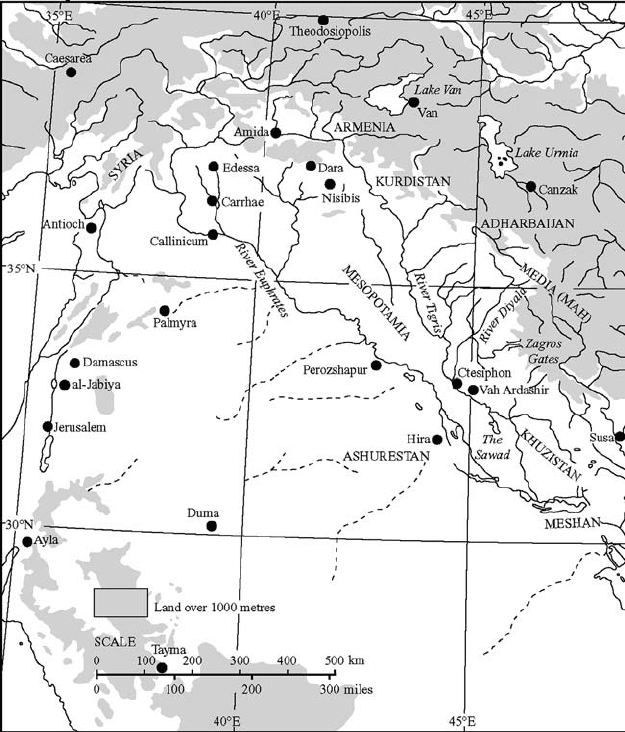
20 2 A chronological survey
Map 2: Sasanian Iran
When Arda
ˇ
s
¯
ır I had taken over Parthian territories he had also made
an unsuccessful attempt at capturing Hatra. Losing a fortress of immense
strategic importance for securing middle Mesopotamia to Rome threatened
the Persian Western frontier considerably. Only towards the end of Arda
ˇ
s
¯
ır’s
reign the Sasanians managed to capture Hatra after a two-year siege and
probably by treason.
10
Scholars date the fall of Hatra to some time between
10
Tabar
¯
ı, tr. N
¨
oldeke 33–40; Bosworth 31–7 (827–30).
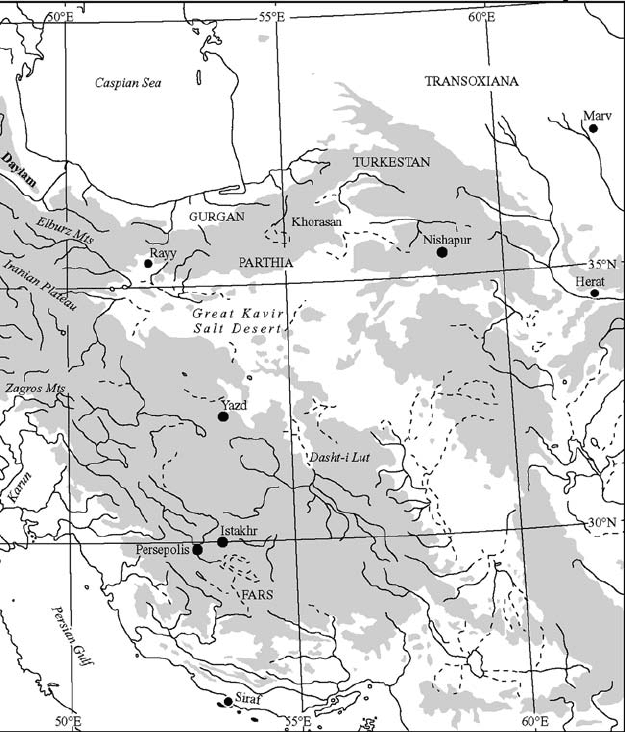
2.1 The third century 21
Map 2:(cont.)
April 12 and September 30 of the year 240.
11
It was a blow to Rome because
controlling Hatra put the Persians in a much better strategic position in
northern Mesopotamia. The already strained diplomatic relations between
Rome and Persia took a turn for the worse when Arda
ˇ
s
¯
ır I died. From a
Western perspective the conquest of Hatra was the cause of the new war
11
The conquest of Hatra is closely linked to the beginning of the reign of
ˇ
S
¯
ap
¯
ur I; see 22 with further
references.
22 2 A chronological survey
that broke out during the reign of Arda
ˇ
s
¯
ır’s son and successor
ˇ
S
¯
ap
¯
ur I
(240–72).
12
In the spring of 243 the Roman emperor Gordian III (238–44) set off
with his army from the Syrian metropolis Antioch on the Orontes, crossed
the Euphrates and won back the cities of Carrhae and Nisibis, which had
been occupied by the Sasanians.
13
Under the command of the Prefect of
the Guard Timesitheus the Romans defeated the Persians at Rhesaina and
then advanced into the Sasanian province of
¯
As
¯
urest
¯
an.
14
They probably
intended to get as far as the Sasanian capital Kt
¯
esiph
¯
on
15
but at the begin-
ning of the year 244
ˇ
S
¯
ap
¯
ur I scored a decisive victory against the Roman
army at Mi
ˇ
s
¯
ık. Gordian III died in battle (5). His successor Philip the Arab
(244–9)
16
concluded a peace with
ˇ
S
¯
ap
¯
ur and withdrew. Although Rome
had to pay large sums of money and lost influence in Armenia the Roman
emperor boasted about the peace (16).
The peace of 244 lasted for only a few years.
ˇ
S
¯
ap
¯
ur claimed that Rome
was to be blamed for new confrontations because it had done wrong by
Armenia.
17
When the Arsacid king of Armenia had become the victim of
Persian intrigues his son Tiridates, who was not yet of age, went over to
Rome (26).
ˇ
S
¯
ap
¯
ur saw the regulations of the foedus of 244 violated and
used the opportunity to take over Armenia.
18
In 252 he eliminated the
Arsacid royal house and turned Armenia into a Sasanian province under
the command of his son Hormizd.
19
This development brought significant
strategic advantages for the Sasanians, and this not only with regard to the
looming conflicts with Rome but also with regard to their military and
economic interests in the Caucasus region.
From 252 on
ˇ
S
¯
ap
¯
ur was once more at war with Rome.
20
He boasted
of a spectacular victory at Barbalissos over a Roman army of 60,000
men.
21
Afterwards the Persians invaded the Roman province of Syria. They
captured Hierapolis, Antioch on the Orontes and further Syrian cities and
12
Schippmann 1990: 19.
13
On Gordian’s Persian expedition see Kettenhofen 1983: 151–71.
14
Amm. xxiii.5.17.
15
SHA Gord. 27.6.
16
On this emperor and his rule see de Blois 1978–9: 11–43 and K
¨
orner 2002.
17
ˇ
SKZ § 9 (p. 294 ed. Back).
18
For the possible causes of the Sasanian expedition against Armenia and the course of events see
Chaumont 1976: 169–76 and below (26) with further references.
19
For an examination of
ˇ
S
¯
ap
¯
ur’s intervention in Armenia see Schottky 1994: 223–35, esp. 231–2; see
again 26 below.
20
It is difficult to establish a chronology of the various Sasanian expeditions between 253 and 256; see
Kettenhofen 1982: 50–96; Schippmann 1990: 21–3; Potter 1990: 189–96 and 290–7; Strobel 1993:
220–56.
21
ˇ
SKZ § 9 (p. 295 ed. Back).