
Engelbrecht Andries P. Computational Intelligence: An Introduction
Подождите немного. Документ загружается.


138 8. Introduction to Evolutionary Computation
Linear ranking assumes that the best individual creates
ˆ
λ offspring, and the worst
individual
˜
λ,where1≤
ˆ
λ ≤ 2and
˜
λ =2−
ˆ
λ. The selection probability of each
individual is calculated as
ϕ
s
(x
i
(t)) =
˜
λ +(f
r
(x
i
(t))/(n
s
− 1))(
ˆ
λ −
˜
λ)
n
s
(8.11)
where f
r
(x
i
(t)) is the rank of x
i
(t).
Nonlinear ranking techniques calculate the selection probabilities, for example, as
follows:
ϕ
s
(x
i
(t)) =
1 − e
−f
r
(x
i
(t))
β
(8.12)
or
ϕ
s
(x
i
)=ν(1 −ν)
n
p
−1−f
r
(x
i
)
(8.13)
where f
r
(x
i
) is the rank of x
i
(i.e. the individual’s position in the ordered sequence of
individuals), β is a normalization constant, and ν indicates the probability of selecting
the next individual.
Rank-based selection operators may use any sampling method to select individuals,
e.g. roulette wheel selection (Algorithm 8.2) or stochastic universal sampling (Algo-
rithm 8.3).
8.5.6 Boltzmann Selection
Boltzmann selection is based on the thermodynamical principles of simulated anneal-
ing (refer to Section A.5.2). It has been used in different ways, one of which computes
selection probabilities as follows:
ϕ(x
i
(t)) =
1
1+e
f(x
i
(t))/T (t)
(8.14)
where T (t) is the temperature parameter. A temperature schedule is used to reduce
T (t) from its initial large value to a small value.
The initial large value ensures that all individuals have an equal probability of being
selected. As T (t) becomes smaller, selection focuses more on the good individuals.
The sampling methods discussed in Section 8.5.3 can be used to select individuals.
Alternatively, Boltzmann selection can be used to select between two individuals, for
example, to decide if a parent, x
i
(t), should be replaced by its offspring, x
i
(t). If
U(0, 1) >
1
1+e
(f(x
i
(t))−f(x
i
(t)))/T (t)
(8.15)
then x
i
(t) is selected; otherwise, x
i
(t) is selected.

8.6 Reproduction Operators 139
8.5.7 (µ
+
,λ)-Selection
The (µ, λ)- and (µ+λ)-selection methods are deterministic rank-based selection meth-
ods used in evolutionary strategies (refer to Chapter 12). For both methods µ indicates
the number of parents (which is the size of the population), and λ is the number of off-
spring produced from each parent. After production of the λ offspring, (µ, λ)-selection
selects the best µ offspring for the next population. This process of selection is very
similar to beam search (refer to Section A.5.2). (µ + λ)-selection, on the other hand,
selects the best µ individuals from both the parents and the offspring.
8.5.8 Elitism
Elitism refers to the process of ensuring that the best individuals of the current
population survive to the next generation. The best individuals are copied to the new
population without being mutated. The more individuals that survive to the next
generation, the less the diversity of the new population.
8.5.9 Hall of Fame
The hall of fame is a selection scheme similar to the list of best players of an arcade
game. For each generation, the best individual is selected to be inserted into the hall
of fame. The hall of fame will therefore contain an archive of the best individuals
found from the first generation. The hall of fame can be used as a parent pool for
the crossover operator, or, at the last generation, the best individual is selected as the
best one in the hall of fame.
8.6 Reproduction Operators
Reproduction is the process of producing offspring from selected parents by apply-
ing crossover and/or mutation operators. Crossover is the process of creating one or
more new individuals through the combination of genetic material randomly selected
from two or more parents. If selection focuses on the most-fit individuals, the selec-
tion pressure may cause premature convergence due to reduced diversity of the new
populations.
Mutation is the process of randomly changing the values of genes in a chromosome.
The main objective of mutation is to introduce new genetic material into the popula-
tion, thereby increasing genetic diversity. Mutation should be applied with care not to
distort the good genetic material in highly fit individuals. For this reason, mutation
is usually applied at a low probability. Alternatively, the mutation probability can be
made proportional to the fitness of individuals: the less fit the individual, the more
it is mutated. To promote exploration in the first generations, the mutation proba-
bility can be initialized to a large value, which is then reduced over time to allow for

140 8. Introduction to Evolutionary Computation
exploitation during the final generations.
Reproduction can be applied with replacement, in which case newly generated indi-
viduals replace parent individuals only if the fitness of the new offspring is better than
that of the corresponding parents.
Since crossover and mutation operators are representation and EC paradigm depen-
dent, the different implementations of these operators are covered in chapters that
follow.
8.7 Stopping Conditions
The evolutionary operators are iteratively applied in an EA until a stopping condition
is satisfied. The simplest stopping condition is to limit the number of generations that
the EA is allowed to execute, or alternatively, a limit is placed on the number of fitness
function evaluations. This limit should not be too small, otherwise the EA will not
have sufficient time to explore the search space.
In addition to a limit on execution time, a convergence criterion is usually used to
detect if the population has converged. Convergence is loosely defined as the event
when the population becomes stagnant. In other words, when there is no genotypic or
phenotypic change in the population. The following convergence criteria can be used:
• Terminate when no improvement is observed over a number of consec-
utive generations. This can be detected by monitoring the fitness of the best
individual. If there is no significant improvement over a given time window, the
EA can be stopped. Alternatively, if the solution is not satisfactory, mechanisms
can be applied to increase diversity in order to force further exploration. For
example, the mutation probability and mutational step sizes can be increased.
• Terminate when there is no change in the population.If,overanumber
of consecutive generations, the average change in genotypic information is too
small, the EA can be stopped.
• Terminate when an acceptable solution has been found.Ifx
∗
(t)rep-
resents the optimum of the objective function, then if the best individual, x
i
,
is such that f(x
i
) ≤|f(x) − |, an acceptable solution is found; is the error
threshold. If is too large, solutions may be bad. Too small values of may
cause the EA never to terminate if a time limit is not imposed.
• Terminate when the objective function slope is approximately zero,as
defined in equation (16.16) of Chapter 16.

8.8 Evolutionary Computation versus Classical Optimization 141
8.8 Evolutionary Computation versus Classical Op-
timization
While classical optimization algorithms have been shown to be very successful (and
more efficient than EAs) in linear, quadratic, strongly convex, unimodal and other
specialized problems, EAs have been shown to be more efficient for discontinuous,
non-differentiable, multimodal and noisy problems.
EC and classical optimization (CO) differ mainly in the search process and information
about the search space used to guide the search process:
• The search process: CO uses deterministic rules to move from one point in
the search space to the next point. EC, on the other hand, uses probabilistic
transition rules. Also, EC applies a parallel search of the search space, while CO
uses a sequential search. An EA search starts from a diverse set of initial points,
which allows parallel search of a large area of the search space. CO starts from
one point, successively adjusting this point to move toward the optimum.
• Search surface information: CO uses derivative information, usually first-
order or second-order, of the search space to guide the path to the optimum.
EC, on the other hand, uses no derivative information. The fitness values of
individuals are used to guide the search.
8.9 Assignments
1. Discuss the importance of the fitness function in EC.
2. Discuss the difference between genetic and phenotypic evolution.
3. In the case of a small population size, how can we ensure that a large part of
the search space is covered?
4. How can premature convergence be prevented?
5. In what situations will a high mutation rate be of advantage?
6. Is the following statement valid? ‘‘A genetic algorithm is assumed to have con-
verged to a local or global solution when the ratio
f/f
max
is close to 1, where
f
max
and f are the maximum and average fitness of the evolving population
respectively.’’
7. How can an EA be used to train a NN? In answering this question, focus on
(a) the representation scheme, and
(b) fitness function.
8. Show how an EA can be used to solve systems of equations, by illustrating how
(a) solutions are represented, and
(b) the fitness is calculated.
What problem can be identified in using an EA to solve systems of equations?
9. How can the effect of a high selective pressure be countered?

142 8. Introduction to Evolutionary Computation
10. Under which condition will stochastic universal sampling behave like tournament
selection?
11. Identify disadvantages of fitness-based selection operators.
12. For the nonlinear ranking methods given in equations (8.12) and (8.13), indicate
if these assume a minimization or maximization problem.
13. Critisize the following stopping condition: Stop execution of the EA when there
is no significant change in the average fitness of the population over a number
of consecutive generations.

Chapter 9
Genetic Algorithms
Genetic algorithms (GA) are possibly the first algorithmic models developed to sim-
ulate genetic systems. First proposed by Fraser [288, 289], and later by Bremermann
[86] and Reed et al. [711], it was the extensive work done by Holland [376] that pop-
ularized GAs. It is then also due to his work that Holland is generally considered the
father of GAs.
GAs model genetic evolution, where the characteristics of individuals are expressed
using genotypes. The main driving operators of a GA is selection (to model survival of
the fittest) and recombination through application of a crossover operator (to model
reproduction). This section discusses in detail GAs and their evolution operators,
organized as follows: Section 9.1 reviews the canonical GA as proposed by Holland.
Crossover operators for binary and floating-point representations are discussed in Sec-
tion 9.2. Mutation operators are covered in Section 9.3. GA control parameters are
discussed in Section 9.4. Different GA implementations are reviewed in Section 9.5,
while advanced topics are considered in Section 9.6. A summary of GA applications
isgiveninSection9.7.
9.1 Canonical Genetic Algorithm
The canonical GA (CGA) as proposed by Holland [376] follows the general algorithm
as given in Algorithm 8.1, with the following implementation specifics:
• A bitstring representation was used.
• Proportional selection was used to select parents for recombination.
• One-point crossover (refer to Section 9.2) was used as the primary method to
produce offspring.
• Uniform mutation (refer to Section 9.3) was proposed as a background operator
of little importance.
It is valuable to note that mutation was not considered as an important operator
in the original GA implementations. It was only in later implementations that the
explorative power of mutation was used to improve the search capabilities of GAs.
Computational Intelligence: An Introduction, Second Edition A.P. Engelbrecht
c
2007 John Wiley & Sons, Ltd
143

144 9. Genetic Algorithms
Since the CGA, several variations of the GA have been developed that differ in repre-
sentation scheme, selection operator, crossover operator, and mutation operator. Some
implementations introduce other concepts from nature such as mass extinction, culling,
population islands, amongst others. While it is impossible to provide a complete re-
view of these alternatives, this chapter provides a good flavor of these approaches to
illustrate the richness of GAs.
9.2 Crossover
Crossover operators can be divided into three main categories based on the arity (i.e.
the number of parents used) of the operator. This results in three main classes of
crossover operators:
• asexual, where an offspring is generated from one parent.
• sexual, where two parents are used to produce one or two offspring.
• multi-recombination, where more than two parents are used to produce one
or more offspring.
Crossover operators are further categorized based on the representation scheme used.
For example, binary-specific operators have been developed for binary string represen-
tations (refer to Section 9.2.1), and operators specific to floating-point representations
(refer to Section 9.2.2).
Parents are selected using any of the selection schemes discussed in Section 8.5. It
is, however, not a given that selected parents will mate. Recombination is applied
probabilistically. Each pair (or group) of parents have a probability, p
c
, of producing
offspring. Usually, a high crossover probability (also referred to as the crossover rate)
is used.
In selection of parents, the following issues need to be considered:
• Due to probabilistic selection of parents, it may happen that the same individual
is selected as both parents, in which case the generated offspring will be a copy
of the parent. The parent selection process should therefore incorporate a test
to prevent such unnecessary operations.
• It is also possible that the same individual takes part in more than one applica-
tion of the crossover operator. This becomes a problem when fitness-proportional
selection schemes are used.
In addition to parent selection and the recombination process, the crossover operator
considers a replacement policy. If one offspring is generated, the offspring may replace
the worst parent. Such replacement can be based on the restriction that the offspring
must be more fit than the worst parent, or it may be forced. Alternatively, Boltzmann
selection (refer to Section 8.5.6) can be used to decide if the offspring should replace
the worst parent. Crossover operators have also been implemented where the offspring
replaces the worst individual of the population. In the case of two offspring, similar
replacement strategies can be used.
9.2 Crossover 145
9.2.1 Binary Representations
Most of the crossover operators for binary representations are sexual, being applied
to two selected parents. If x
1
(t)andx
2
(t) denote the two selected parents, then
the recombination process is summarized in Algorithm 9.1. In this algorithm, m(t)
is a mask that specifies which bits of the parents should be swapped to generate the
offspring,
˜
x
1
(t)and
˜
x
2
(t). Several crossover operators have been developed to compute
the mask:
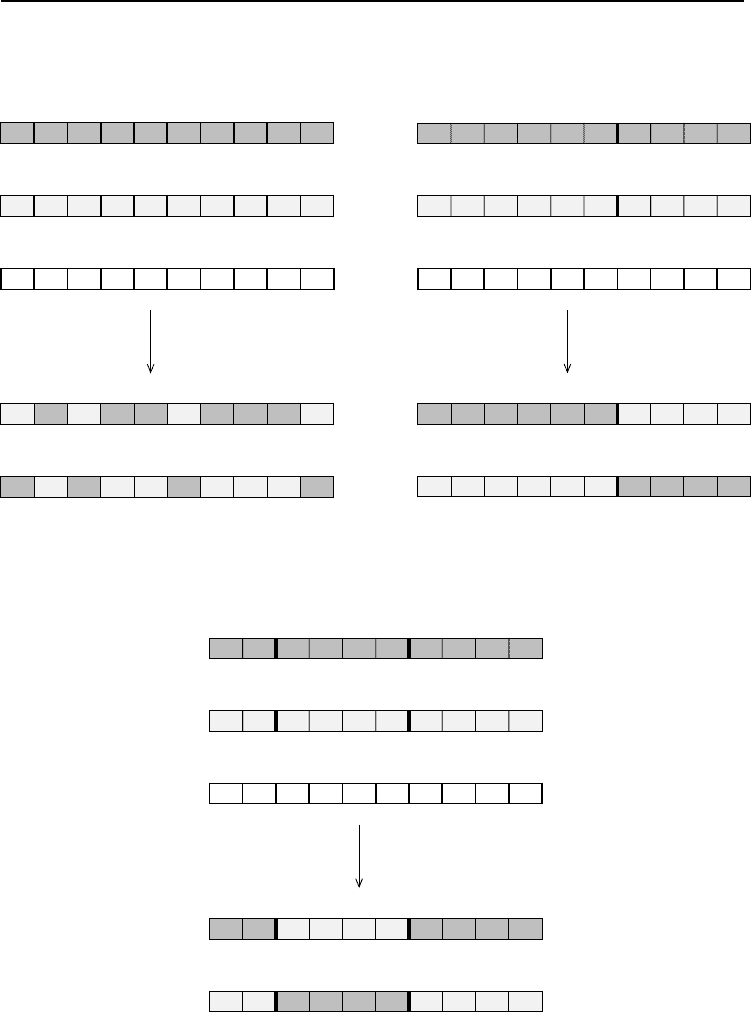
• One-point crossover: Holland [376] suggested that segments of genes be
swapped between the parents to create their offspring, and not single genes.
A one-point crossover operator was developed that randomly selects a crossover
point, and the bitstrings after that point are swapped between the two parents.
One-point crossover is illustrated in Figure 9.1(a). The mask is computed using
Algorithm 9.2.
• Two-point crossover: In this case two bit positions are randomly selected, and
the bitstrings between these points are swapped as illustrated in Figure 9.1(b).
The mask is calculated using Algorithm 9.3. This operator can be generalized
to an n-point crossover [85, 191, 250, 711].
• Uniform crossover: The n
x
-dimensional mask is created randomly [10, 828]
as summarized in Algorithm 9.4. Here, p
x
is the bit-swapping probability. If
p
x
=0.5, then each bit has an equal chance to be swapped. Uniform crossover
is illustrated in Figure 9.1(c).
Algorithm 9.1 Generic Algorithm for Bitstring Crossover
Let
˜
x
1
(t)=x
1
(t)and
˜
x
2
(t)=x
2
(t);
if U(0, 1) ≤ p
c
then
Compute the binary mask, m(t);
for j =1,...,n
x
do
if m
j
=1then
//swap the bits
˜
x
1j
(t)=x
2j
(t);
˜
x
2j
(t)=x
1j
(t);
end
end
end
Algorithm 9.2 One-Point Crossover Mask Calculation
Select the crossover point, ξ ∼ U(1,n
x
−1);
Initialize the mask: m
j
(t)=0,forallj =1,...,n
x
;
for j = ξ +1 to n
x
do
m
j
(t)=1;
end
146 9. Genetic Algorithms
Algorithm 9.3 Two-Point Crossover Mask Calculation
Select the two crossover points, ξ
1
,ξ
2
∼ U(1,n
x
);
Initialize the mask: m
j
(t)=0,forallj =1,...,n
x
;
for j = ξ
1
+1to ξ
2
do
m
j
(t)=1;
end
Algorithm 9.4 Uniform Crossover Mask Calculation
Initialize the mask: m
j
(t)=0,forallj =1,...,n
x
;
for j =1to n
x
do
if U(0, 1) ≤ p
x
then
m
j
(t)=1;
end
end
Bremermann et al. [85] proposed the first multi-parent crossover operators for binary
representations. Given n
µ
parent vectors, x
1
(t),...,x
n
µ
(t), majority mating generates
one offspring using
˜
x
ij
(t)=
0ifn
µ
≥ n
µ
/2,l=1,...,n
µ
1otherwise
(9.1)
where n
µ
is the number of parents with x
lj
(t)=0.
A multiparent version of n-point crossover was also proposed by Bremermann et al.
[85], where n
µ
− 1 identical crossover points are selected in the n
µ
parents. One
offspring is generated by selecting one segment from each parent.
Jones [427] developed a crossover hillclimbing operator that can be applied to any
representation. Crossover hillclimbing starts with two parents, and continues to pro-
duce offspring from this pair of parents until either a maximum number of crossover
attempts has been exceeded, or a pair of offspring is found where one of the offspring
has a better fitness than the best parent. Crossover hillclimbing then continues repro-
duction using these two offspring as the new parent pair. If a better parent pair cannot
be found within the specified time limit, the worst parent is replaced by a randomly
selected parent.
9.2.2 Floating-Point Representation
The crossover operators discussed above (excluding majority mating) can also be ap-
plied to floating-point representations as discrete recombination strategies. In contrast
9.2 Crossover 147
Parent 1
Parent 2
Mask
0 00100 111 0
Offspring 1
Offspring 2
(a) Uniform Crossover
Parent 1
Parent 2
Mask
0 00011 100 1
Offspring 1
Offspring 2
(b) One-point Crossover
Parent 1
Parent 2
Mask
0 11100 001 0
Offspring 1
Offspring 2
(c) Two-point Crossover
Figure 9.1 Crossover Operators for Binary Representations