
Engelbrecht Andries P. Computational Intelligence: An Introduction
Подождите немного. Документ загружается.


158 9. Genetic Algorithms
9.5.1 Generation Gap Methods
The GAs as discussed thus far differ from biological models of evolution in that pop-
ulation sizes are fixed. This allows the selection process to be described by two steps:
• Parent selection, and
• a replacement strategy that decides if offspring will replace parents, and which
parents to replace.
Two main classes of GAs are identified based on the replacement strategy used, namely
generational genetic algorithms (GGA) and steady state genetic algorithms (SSGA),
also referred to as incremental GAs. For GGAs the replacement strategy replaces
all parents with their offspring after all offpsring have been created and mutated.
This results in no overlap between the current population and the new population
(assuming that elitism is not used). For SSGAs, a decision is made immediately after
an offspring is created and mutated as to whether the parent or the offspring survives
to the next generation. Thus, there exists an overlap between the current and new
populations.
The amount of overlap between the current and new populations is referred to as the
generation gap [191]. GGAs have a zero generation gap, while SSGAs generally have
large generation gaps.
A number of replacement strategies have been developed for SSGAs:
• Replace worst [192], where the offspring replaces the worst individual of the
current population.
• Replace random [192, 829], where the offspring replaces a randomly selected
individual of the current population.
• Kill tournament [798], where a group of individuals is randomly selected, and
the worst individual of this group is replaced with the offspring. Alternatively,
a tournament size of two is used, and the worst individual is replaced with a
probability, 0.5 ≤ p
r
≤ 1.
• Replace oldest, where a first-in-first-out strategy is followed by replacing the
oldest individual of the current population. This strategy has a high probability
of replacing one of the best individuals.
• Conservative selection [798] combines a first-in-first-out replacement strategy
with a modified deterministic binary tournament selection. A tournament size of
two individuals is used of which one is always the oldest individual of the current
population. The worst of the two is replaced by the offspring. This approach
ensures that the oldest individual will not be lost if it is the fittest.
• Elitist strategies of the above replacement strategies have also been developed,
where the best individual is excluded from selection.
• Parent-offspring competition, where a selection strategy is used to decide if
an offspring replaces one of its own parents.

9.5 Genetic Algorithm Variants 159
Theoretical and empirical studies of steady state GAs can be found in [734, 797, 798,
872].
9.5.2 Messy Genetic Algorithms
Standard GAs use populations where all individuals are of the same fixed size. For an
n
x
-dimensional search space, a standard GA finds a solution through application of
the evolutionary operators to the complete n
x
-dimensional individuals. It may happen
that good individuals are found, but some of the genes of a good individual are non-
optimal. It may be difficult to find optimal allele for such genes through application
of crossover and mutation on the entire individual. It may even happen that crossover
looses optimized genes, or groups of optimized genes.
Goldberg et al. [321, 323, 324] developed the messy GA (mGA), which finds solutions
by evolving optimal building blocks and combining building blocks. Here a building
block refers to a group of genes. In a messy GA individuals are of variable length, and
specified by a list of position-value pairs. The position specifies the gene index, and
the value specifies the allele for that gene. These pairs are referred to as messy genes.
As an example, if n
x
= 4, then the individual, ((1, 0)(3, 1), (4, 0)(1, 1)), represents the
individual 0 ∗ 10.
The messy representation may result in individuals that are over-specified or under-
specified. The example above illustrates both cases. The individual is over-specified
because gene 1 occurs twice. It is under-specified because gene 2 does not occur,
and has no value assigned. Fitness evaluation of messy individuals requires strategies
to cope with such individuals. For over-specified individuals, a first-come-first-served
approach is followed where the first specified value is assigned to the repeating gene.
For under-specified individuals, a missing gene’s allele is obtained from a competitive
template. The competitive template is a locally optimal solution. As an example, if
1101 is the template, the fitness of 0 ∗10 is evaluated as the fitness of 0101.
The objective of mGAs is to evolve optimal building blocks, and to incrementally com-
bine optimized building blocks to form an optimal solution. An mGA is implemented
using two loops as shown in Algorithm 9.8. The inner loop consists of three steps:
• Initialization to create a population of building blocks of a specified length,
n
m
.
• Primordial, which aims to generate small, promising building blocks.
• Juxtapositional, to combine building blocks.
The outer loop specifies the size of the building blocks to be considered, starting with
the smallest size of one, and incrementally increasing the size until a maximum size is
reached, or an acceptable solution is found. The outer loop also sets the best solution
obtained from the juxtaposition step as the competitive template for the next iteration.
160 9. Genetic Algorithms
Algorithm 9.8 Messy Genetic Algorithm
Initialize the competitive template;
for n
m
=1to n
m,max
do
Initialize the population to contain building blocks of size n
m
;
Apply the primordial step;
Apply the juxtaposition step;
Set the competitive template to the best solution from the juxtaposition step;
end
The initialization step creates all possible combinations of building blocks of length
n
m
.Forn
x
-dimensional solutions, this results in a population size of
n
s
=2
n
m
n
x
n
m
(9.27)
where
n
x
n
m
=
n
x
!
n
m
!(n
x
− n
m
)!
(9.28)
This leads to one of the major disadvantages of mGAs, in that computational complex-
ity explodes with increase in n
m
(i.e. building block size). The fast mGA addresses
this problem by starting with larger building block sizes and adding a gene deletion
operator to the primordial step to prune building blocks [322].
The primordial step is executed for a specified number of generations, applying only
selection to find the best building blocks. At regular intervals the population is halved,
with the worst individuals (building blocks) discarded. No crossover or mutation is
used. While any selection operator can be used, fitness proportional selection is usually
used. Because individuals in an mGA may contain different sets of genes (as specified
by the building blocks), thresholding selection has been proposed to apply selection
to “similar” individuals. Thresholding selection applies tournament selection between
two individuals that have in common a number of genes greater than a specified
threshold. The effect achieved via the primordial step is that poor building blocks are
eliminated, while good building blocks survive to the juxtaposition step.
The juxtaposition step applies cut and splice operators. The cut operator is applied
to selected individuals at a probability proportional to the length of the individual
(i.e. the size of the building block). The objective of the cut operator is to reduce
the size of building blocks by splitting the individual at a randomly selected gene.
The splicing operator combines two individuals to form a larger building block. Since
the probability of cutting is proportional to the length of the individual, and the
mGA starts with small building blocks, splicing occurs more in the beginning. As n
m
increases, cutting occurs more. Cutting and splicing then resembles crossover.

9.5 Genetic Algorithm Variants 161
9.5.3 Interactive Evolution
In standard GAs (and all EAs for that matter), the human user plays a passive role.
Selection is based on an explicitly defined analytical function, used to quantify the
quality of a candidate solution. It is, however, the case that such a function cannot be
defined for certain application areas, for example, evolving art, music, animations, etc.
For such application areas subjective judgment is needed, based on human intuition,
aesthetical values or taste. This requires interaction of a human evaluator as the
“fitness function”.
Interactive evolution (IE) [48, 179, 792] involves a human user online into the selection
and variation processes. The search process is now directed through interactive selec-
tion of solutions by the human user instead of an absolute fitness function. Dawkins
[179] was the first to consider IE to evolve biomorphs, which are tree-like representa-
tions of two-dimensional graphical forms. Todd and Latham [849] used IE to evolve
computer sculptures. Sims [792] provides further advances in the application of IE to
evolve complex simulated structures, textures, and motions.
Algorithm 9.9 provides a summary of the standard IE algorithm. The main com-
ponent of the IE algorithm is the interactive selection step. This step requires that
the phenotype of individuals be generated from the genotype, and visualized. Based
on the visual representations of candidate solutions, the user selects those individuals
that will take part in reproduction, and that will survive to the next generation. Some
kind of fitness function can be defined (if possible) to order candidate solutions and
to perform a pre-selection to reduce the number of solutions to be evaluated by the
human user.
In addition to act as the selection mechanism, the user can also interactively specify
the reproduction operators and population parameters.
Instead of the human user performing selection, interaction may be of the form where
the user assigns a fitness score to individuals. Automatic selection is then applied,
using these user assigned quality measures.
Algorithm 9.9 Interactive Evolution Algorithm
Set the generation counter, t =0;
Initialize the control parameters;
Create and initialize the population, C(0), of n
s
individuals;
while stopping condition(s) not true do
Determine reproduction operators, either automatically or via interaction;
Select parents via interaction;
Perform crossover to produce offspring;
Mutate offspring;
Select new population via interaction;
end

162 9. Genetic Algorithms
Although the section on IE is provided as part of the chapter on GAs, IE can be
applied to any of the EAs.
9.5.4 Island Genetic Algorithms
GAs lend themselves to parallel implementation. Three main categories of parallel
GA have been identified [100]:
• Single-population master-slave GAs, where the evaluation of fitness is distributed
over several processors.
• Single-population fine-grained GAs, where each individual is assigned to one pro-
cessor, and each processor is assigned only one individual. A small neighborhood
is defined for each individual, and selection and reproduction are restricted to
neighborhoods. Whitley [903] refers to these as cellular GAs.
• Multi-population, or island GAs, where multiple populations are used, each on
a separate processor. Information is exchanged among populations via a migra-
tion policy. Although developed for parallel implementation, island GAs can be
implemented on a single processor system.
The remainder of this section focuses on island GAs. In an island GA, a number of sub-
populations are evolved in parallel, in a cooperative framework [335, 903, 100]. In this
GA model, a number of islands occurs, where each island represents one population.
Selection, crossover and mutation occur in each subpopulation independently from the
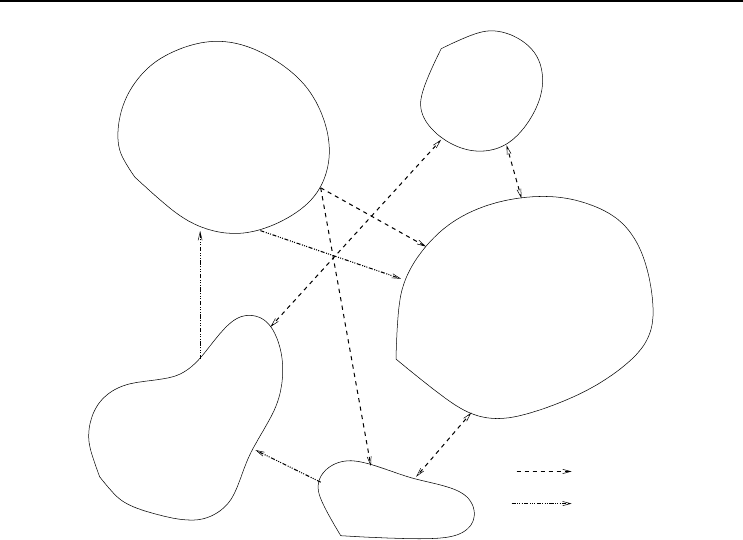
other subpopulations. In addition, individuals are allowed to migrate between islands
(or subpopulations), as illustrated in Figure 9.5.
An integral part of an island GA is the migration policy which governs the exchange
of information between islands. A migration policy specifies [100, 102, 103, 104]:
• A communications topology, which determines the migration paths between
islands. For example, a ring topology (such as illustrated in Figure 16.4(b))
allows exchange of information between neighboring islands. The communica-
tion topology determines how fast (or slow) good solutions disseminate to other
subpopulations. For a sparsely connected structure (such as the ring topology),
islands are more isolated from one another, and the spread of information about
good solutions is slower. Sparse topologies also facilitate the appearance of mul-
tiple solutions. Densely connected structures have a faster spread of information,
which may lead to premature convergence.
• A migration rate, which determines the frequency of migration. Tied with
the migration rate is the question of when migration should occur. If migration
occurs too early, the number of good building blocks in the migrants may be too
small to have any influence at their destinations. Usually, migration occurs when
each population has converged. After exchange of individuals, all populations
are restarted.
• A selection mechanism to decide which individuals will migrate.
9.5 Genetic Algorithm Variants 163
Island 5
Island 1
Island 2
Island 3
Island 4
Migration
Visitation
Figure 9.5 An Island GA Model
• A replacement strategy to decide which individual of the destination island
will be replaced by the migrant.
Based on the selection and replacement strategies, island GAs can be grouped into
two classes of algorithms, namely static island GAs and dynamic island GAs. For
static island GAs, deterministic selection and replacement strategies are followed, for
example [101],
• a good migrant replaces a bad individual,
• a good migrant replaces a randomly selected individual,
• a randomly selected migrant replaces a bad individual, or
• a randomly selected migrant replaces a randomly selected individual.
To select the good migrant, any of the fitness-proportional selection operators given in
Section 8.5 can be used. For example, an elitist strategy will have the best individual
of a population move to another population. Gordon [329] uses tournament selection,
considering only two randomly selected individuals. The best of the two will migrate,
while the worst one will be replaced by the winning individual from the neighboring
population.
Dynamic models do not use a topology to determine migration paths. Instead, migra-
tion decisions are made probabilistically. Migration occurs at a specified probability.

164 9. Genetic Algorithms
If migration from an island does occur, the destination island is also decided prob-
abilistically. Tournament selection may be used, based on the average fitness of the
subpopulations. Additionally, an acceptance strategy can be used to decide if an im-
migrant should be accepted. For example, an immigrant is probabilistically accepted
if its fitness is better than the average fitness of the island (using, e.g. Boltzmann
selection).
Another interesting aspect to consider for island GAs is how subpopulations should be
initialized. Of course a pure random approach can be used, which will cause different
populations to share the same parts of the search space. A better approach would
be to initialize subpopulations to cover different parts of the search space, thereby
covering a larger search space and facilitating a kind of niching by individuals islands.
Also, in multicriteria optimization, each subpopulation can be allocated the task to
optimize one criterion. A meta-level step is then required to combine the solutions
from each island (refer to Section 9.6.3).
A different kind of “island” GA is the cooperative coevolutionary GA (CCGA) of
Potter [686, 687]. In this case, instead of distributing entire individuals over several
subpopulations, each subpopulation is given one or a few genes (one decision variable)
to optimize. The subpopulations are mutually exclusive, each having the task of
evolving a single (or limited set of) gene(s). A subpopulation therefore optimizes one
parameter (or a limited number of parameters) of the optimization problem. Thus, no
single subpopulation has the necessary information to solve the problem itself. Rather,
information of all the subpopulations must be combined to construct a solution.
Within the CCGA, a solution is constructed by adding together the best individual
from each subpopulation. The main problem is how to determine the best individual
of a subpopulation, since individuals do not represent complete solutions. A simple
solution to this problem is to keep all other components (genes) within a complete
chromosome fixed and to change just the gene that corresponds to the current sub-
population for which the best individual is sought. For each individual in the subpop-
ulation, the value of the corresponding gene in the complete chromosome is replaced
with that of the individual. Values of the other genes of the complete chromosome are
usually kept fixed at the previously determined best values.
The constructed complete chromosome is then a candidate solution to the optimization
problem.
It has been shown that such a cooperative approach substantially improves the ac-
curacy of solutions, and the convergence speed compared to non-cooperative, non-
coevolutionary GAs.
9.6 Advanced Topics
This section shows how GAs can be used to find multiple solutions (Section 9.6.1), to
solve multi-objective optimization problems (Section 9.6.3), to cope with constraints
(Section 9.6.2), and to track dynamically changing optima (Section 9.6.4). For each

9.6 Advanced Topics 165
of these problem types, only a few of the GA approaches are discussed.
9.6.1 Niching Genetic Algorithms
Section A.7 defines niching and different classes of niching methods. This section
provides a short summary of GA implementations with the ability to locate multiple
solutions to optimization problems.
Fitness Sharing
Fitness sharing is one of the earliest GA niching techniques, originally introduced as
a population diversity maintenance technique [325]. It is a parallel, explicit niching
approach. The algorithm regards each niche as a finite resource, and shares this
resource among all individuals in the niche. Individuals are encouraged to populate a
particular area of the search space by adapting their fitness based on the number of
other individuals that populate the same area. The fitness f(x
i
(t)) of individual x
i
is
adapted to its shared fitness:
f
s
(x
i
(t)) =
f(x
i
(t))
j
sh(d
ab
)
(9.29)
where
j
sh(d
ab
) is an estimate of how crowded a niche is. A common sharing function
is the triangular sharing function,
sh(d)=
1 − (d/σ
share
)
α
if d<σ
share
0 otherwise.
(9.30)
The symbol d
ab
represents the distance between individuals x
a
and x
b
. The distance
measure may be genotypic or phenotypic, depending on the optimization problem. If
the sharing function finds that d
ab
is less than σ
share
, it returns a value in the range
[0, 1], which increases as d
ab
decreases. The more similar x
a
and x
b
are, the lower their
individual fitnesses will become. Individuals within σ
share
of one another will reduce
each other’s fitness. Sharing assumes that the number of niches can be estimated, i.e.
it must be known prior to the application of the algorithm how many niches there are.
It is also assumed that niches occur at least a minimum distance, 2σ
share
, from each
other.
Dynamic Niche Sharing
Miller and Shaw [593] introduced dynamic niche sharing as an optimized version of
fitness sharing. The same assumptions are made as with fitness sharing. Dynamic
niche sharing attempts to classify individuals in a population as belonging to one of
the emerging niches, or to a non-niche category. Fitness calculation for individuals
belonging to the non-niche category is the same as in the standard fitness sharing
technique above. The fitness of individuals found to belong to one of the developing

166 9. Genetic Algorithms
niches is diluted by dividing it by the size of the developing niche. Dynamically
finding niches is a simple process of iterating through the population of individuals
and constructing a set of non-overlapping areas in the search space. Dynamic sharing is
computationally less expensive than ‘normal’ sharing. Miller and Shaw [593] presented
results showing that dynamic sharing has improved performance when compared to
fitness sharing.
Sequential Niching
Sequential niching (SN), introduced by Beasley et al. [55], identifies multiple solutions
by adapting an optimization problem’s objective function’s fitness landscape through
the application of a derating function at a position where a potential solution was
found. A derating function is designed to lower the fitness appeal of previously located
solutions. By repeatedly running the algorithm, all optima are removed from the
fitness landscape. Sample derating functions, for a previous maximum x
∗
, include:
G
1
(x, x
∗
)=
#
x−x
∗
R
α
if x − x
∗
<R
1otherwise
(9.31)
and
G
2
(x, x
∗
)=
#
e
log m
R−x−x
∗
R
if x − x
∗
<R
1otherwise
(9.32)
where R is the radius of the derating function’s effect. In G
1
, α determines whether
the derating function is concave (α>1) or convex (α<1). For α =1,G
1
is a linear
function. For G
2
, m determines ‘concavity’. Noting that lim
x→0
log(x)=−∞, m
must always be larger than 0. Smaller values for m result in a more concave derating
function. The fitness function f(x) is then redefined to be
M
n+1
(x) ≡ M
n
(x) × G(x,
ˆ
x
n
) (9.33)
where M
0
(x) ≡ f(x)and
ˆ
x
n
is the best individual found during run n of the algorithm.
G can be any derating function, such as G
1
and G
2
.
Crowding
Crowding (or the crowding factor model), as introduced by De Jong [191], was origi-
nally devised as a diversity preservation technique. Crowding is inspired by a naturally
occurring phenomenon in ecologies, namely competition amongst similar individuals
for limited resources. Similar individuals compete to occupy the same ecological niche,
while dissimilar individuals do not compete, as they do not occupy the same ecolog-
ical niche. When a niche has reached its carrying capacity (i.e. being occupied by
the maximum number of individuals that can exist within it) older individuals are
replaced by newer (younger) individuals. The carrying capacity of the niche does not
change, so the population size will remain constant.

9.6 Advanced Topics 167
For a genetic algorithm, crowding is performed as follows: It is assumed that a pop-
ulation of GA individuals evolve over several generational steps. At each step, the
crowding algorithm selects only a portion of the current generation to reproduce. The
selection strategy is fitness proportionate, i.e. more fit individuals are more likely to
be chosen. After the selected individuals have reproduced, individuals in the current
population are replaced by their offspring. For each offspring, a random sample is
taken from the current generation, and the most similar individual is replaced by the
offspring individual.
Deterministic crowding (DC) is based on De Jong’s crowding technique, but with the
following improvements as suggested by Mahfoud [553]:
• Phenotypic similarity measures are used instead of genotypic measures. Pheno-
typic metrics embody domain specific knowledge that is most useful in multi-
modal optimization, as several different spatial positions can contain equally
optimal solutions.
• It was shown that there exists a high probability that the most similar individuals
to an offspring are its parents. Therefore, DC compares an offspring only to its
parents and not to a random sample of the population.
• Random selection is used to select individuals for reproduction. Offspring replace
parents only if the offspring perform better than the parents.
Probabilistic crowding, , introduced by Mengshoel et al. [578], is based on Mahfoud’s
deterministic crowding, but employs a probabilistic replacement strategy. Where the
original crowding and DC techniques replaced an individual x
a
with x
b
if x
b
was more
fit than x
a
, probabilistic crowding uses the following rule: If individuals x
a
and x
b
are
competing against each other, the probability of x
a
winning is given by
P (x
a
(t)wins) =
f(x
a
(t))
f(x
a
(t)) + f(x
b
(t))
(9.34)
where f(x
a
(t)) is the fitness of individual x
a
(t). The core of the algorithm is therefore
to use a probabilistic tournament replacement strategy. Experimental results have
shown it to be both fast and effective.
Coevolutionary Shared Niching
Goldberg and Wang [326] introduced coevolutionary shared niching (CSN). CSN lo-
cates niches by co-evolving two different populations of individuals in the same search
space, in parallel. Let the two parallel populations be designated by C
1
and C
2
, respec-
tively. Population C
1
can be thought of as a normal population of candidate solutions,
and it evolves as a normal population of individuals. Individuals in population C
2
are
scattered throughout the search space. Each individual in population C
1
associates
with itself a member of C
2
that lies the closest to it using a genotypic metric. The
fitness calculation of the i
th
individual in population C
1
, C
1
.x
i
, is then adapted to
f
(C
1
.x
i
)=
f(C
1
.x
i
)
C
2
.n
2
,wheref(·) is the fitness function; C
2
.n
2
designates the cardinality
of the set of individuals associated with individual C
2
.x
i
and C
2
.n
2
is the index of the