
Engelbrecht Andries P. Computational Intelligence: An Introduction
Подождите немного. Документ загружается.


148 9. Genetic Algorithms
to these discrete operators where information is swapped between parents, intermedi-
ate recombination operators, developed specifically for floating-point representations,
blend components across the selected parents.
One of the first floating-point crossover operators is the linear operator proposed by
Wright [918]. From the parents, x
1
(t)andx
2
(t), three candidate offspring are gen-
erated as (x
1
(t)+x
2
(t)), (1.5x
1
(t) − 0.5x
2
(t)) and (−0.5x
1
(t)+1.5x
2
(t)). The two
best solutions are selected as the offspring. Wright [918] also proposed a directional
heuristic crossover operator where one offspring is created from two parents using
˜x
ij
(t)=U(0, 1)(x
2j
(t) − x
1j
(t)) + x
2j
(t) (9.2)
subject to the constraint that parent x
2
(t) cannot be worse than parent x
1
(t).
Michalewicz [586] coined the arithmetic crossover, which is a multiparent recombina-
tion strategy that takes a weighted average over two or more parents. One offspring
is generated using
˜x
ij
(t)=
n
µ
l=1
γ
l
x
lj
(t) (9.3)
with
n
µ
l=1
γ
l
= 1. A specialization of the arithmetic crossover operator is obtained
for n
µ
=2,inwhichcase
˜x
ij
(t)=(1− γ)x
1j
(t)+γx
2j
(t) (9.4)
with γ ∈ [0, 1]. If γ =0.5, the effect is that each component of the offspring is simply
the average of the corresponding components of the parents.
Eshelman and Schaffer [251] developed a variation of the weighted average given in
equation (9.4), referred to as the blend crossover (BLX-α), where
˜x
ij
(t)=(1− γ
j
)x
1j
(t)+γ
j
x
2j
(t) (9.5)
with γ
j
=(1+2α)U(0, 1) −α.TheBLX-α operator randomly picks, for each compo-
nent, a random value in the range
[x
1j
(t) − α(x
2j
(t) − x
1j
(t)),x
2j
(t)+α(x
2j
(t) − x
1j
(t))] (9.6)
BLX-α assumes that x
1j
(t) <x
2j
(t). Eshelman and Schaffer found that α =0.5works
well.
The BLX-α has the property that the location of the offspring depends on the dis-
tance that the parents are from one another. If this distance is large, then the distance
between the offpsring and its parents will be large. The BLX-α allows a bit more ex-
ploration than the weighted average of equation (9.3), due to the stochastic component
in producing the offspring.
Michalewicz et al. [590] developed the two-parent geometrical crossover to produce a
single offspring as follows:
˜x
ij
(t)=(x
1j
x
2j
)
0.5
(9.7)

9.2 Crossover 149
The geometrical crossover can be generalized to multi-parent recombination as follows:
˜x
ij
(t)=(x
α
1
1j
x
α
2
2j
...x
α
n
µ
n
µ
j
) (9.8)
where n
µ
is the number of parents, and
n
µ
l=1
α
l
=1.
Deb and Agrawal [196] developed the simulated binary crossover (SBX) to simulate the
behavior of the one-point crossover operator for binary representations. Two parents,
x
1
(t)andx
2
(t) are used to produce two offspring, where for j =1,...,n
x
˜x
1j
(t)=0.5[(1 + γ
j
)x
1j
(t)+(1−γ
j
)x
2j
(t)] (9.9)
˜x
2j
(t)=0.5[(1 − γ
j
)x
1j
(t)+(1+γ
j
)x
2j
(t)] (9.10)
where
γ
j
=
(2r
j
)
1
η+1
if r
j
≤ 0.5
1
2(1−r
j
)
1
η+1
otherwise
(9.11)
where r
j
∼ U(0, 1), and η>0 is the distribution index. Deb and Agrawal suggested
that η =1.
The SBX operator generates offspring symmetrically about the parents, which prevents
bias towards any of the parents. For large values of η there is a higher probability that
offspring will be created near the parents. For small η values, offspring will be more
distant from the parents.
While the above focused on sexual crossover operators (some of which can also be
extended to multiparent operators), the remainder of this section considers a number
of multiparent crossover operators. The main objective of these multiparent opera-
tors is to intensify the explorative capabilities compared to two-parent operators. By
aggregating information from multiple parents, more disruption is achieved with the
resemblance between offspring and parents on average smaller compared to two-parent
operators.
Ono and Kobayashi [642] developed the unimodal distributed (UNDX) operator where
two or more offspring are generated using three parents. The offspring are created from
an ellipsoidal probability distribution, with one of the axes formed along the line that
connects two of the parents. The extent of the orthogonal direction is determined from
the perpendicular distance of the third parent from the axis. The UNDX operator can
be generalized to work with any number of parents, with 3 ≤ n
µ
≤ n
s
.Forthe
generalization, n
µ
−1 parents are randomly selected and their center of mass (mean),
x(t), is calculated, where
x
j
(t)=
n
µ
−1
l=1
x
lj
(t) (9.12)
From the mean, n
µ
− 1 direction vectors, d
l
(t)=x
l
(t) − x(t) are computed, for
l =1,...,n
µ
− 1. Using the direction vectors, the direction cosines are computed as
e
l
(t)=d
l
(t)/|d
l
(t)|,where|d
l
(t)| is the length of vector d
l
(t). A random parent,
with index n
µ
is selected. Let x
n
µ
(t) − x(t) be the vector orthogonal to all e
l
(t), and
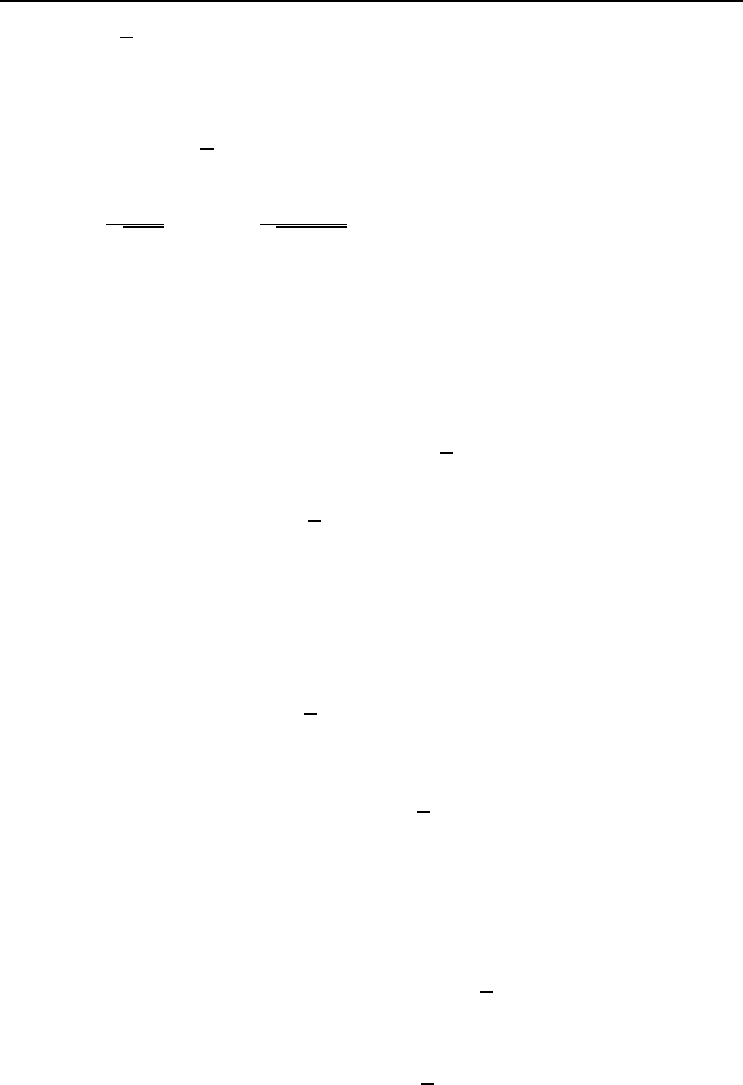
150 9. Genetic Algorithms
δ = |x
n
µ
(t) − x(t)|.Lete
l
(t),l= n
µ
,...,n
s
be the orthonormal basis of the subspace
orthogonal to the subspace spanned by the direction cosines, e
l
(t),l=1,...,n
µ
− 1.
Offspring are then generated using
˜
x
i
(t)=x(t)+
n
µ
−1
l=1
N(0,σ
2
1
)|d
l
|e
l
+
n
s
l=n
µ
N(0,σ
2
2
)δe
l
(t) (9.13)
where σ
1
=
1
√
n
µ
−2
and σ
2
=
0.35
√
n
s
−n
µ
−2
.
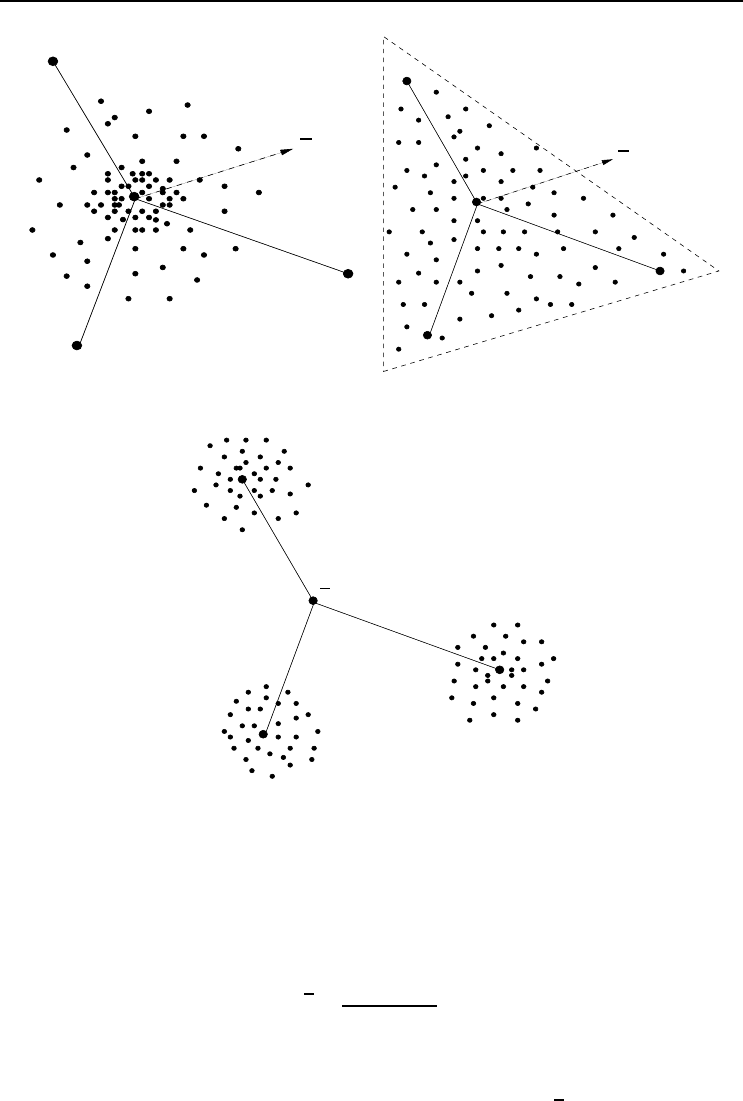
Using equation (9.13) any number of offspring can be created, sampled around the
center of mass of the selected parents. A higher probability is assigned to create
offspring near the center rather than near the parents. The effect of the UNDX
operator is illustrated in Figure 9.2(a) for n
µ
=4.
Tsutsui and Goldberg [857] and Renders and Bersini [714] proposed the simplex
crossover (SPX) operator as another center of mass approach to recombination. Ren-
ders and Bersini selects n
µ
> 2 parents, and determines the best and worst parent, say
x
1
(t)andx
2
(t) respectively. The center of mass, x (t) is computed over the selected
parents, but with x
2
(t) excluded. One offspring is generated using
˜
x(t)=
x(t)+(x
1
(t) − x
2
(t)) (9.14)
Tsutsui and Goldberg followed a similar approach, selecting n
µ
= n
x
+1 parents
independent from one another for an n
x
-dimensional search space. These n
µ
parents
form a simplex. The simplex is expanded in each of the n
µ
directions, and offspring
sampled from the expanded simplex as illustrated in Figure 9.2(b). For n
x
=2,n
µ
=3,
and
x(t)=
n
µ
l=1
x
l
(t) (9.15)
the expanded simplex is defined by the points
(1 + γ)(x
l
(t) − x(t)) (9.16)
for l =1,...,n
µ
=3andγ ≥ 0. Offspring are obtained by uniform sampling of the
expanded simplex.
Deb et al. [198] proposed a variation of the UNDX operator, which they refer to as
parent-centric crossover (PCX). Instead of generating offspring around the center of
mass of the selected parents, offspring are generated around selected parents. PCX
selects n
µ
parents and computes their center of mass, x(t). Foreachoffspringtobe
generated one parent is selected uniformly from the n
µ
parents. A direction vector is
calculated for each offspring as
d
i
(t)=x
i
(t) − x(t)
where x
i
(t) is the randomly selected parent. From the other n
µ
−1 parents perpendic-
ular distances, δ
l
,fori = l =1,...,n
µ
, are calculated to the line d
i
(t). The average
9.2 Crossover 151
x
1
(t)
x
3
(t)
x
2
(t)
x(t)
(a) UNDX Operator
x
3
(t)
x(t)
x
1
(t)
x
2
(t)
(b) SPX Operator
x
2
(t)
x
3
(t)
x(t)
x
1
(t)
(c) PCX Operator
Figure 9.2 Illustration of Multi-parent Center of Mass Crossover Operators (dots rep-
resent potential offpsring)
over these distances is calculated, i.e.
δ =
n
µ
l=1,l=i
δ
l
n
µ
− 1
(9.17)
Offspring is generated using
˜
x
i
(t)=x
i
(t)+N(0,σ
2
1
)|d
i
(t)| +
n
µ
l=1,i=l
N(0,σ
2
2
)δe
l
(t) (9.18)
where x
i
(t) is the randomly selected parent of offspring
˜
x
i
(t), and e
l
(t)arethen
µ
−1

152 9. Genetic Algorithms
orthonormal bases that span the subspace perpendicular to d
i
(t).
The effect of the PCX operator is illustrated in Figure 9.2(c).
Eiben et al. [231, 232, 233] developed a number of gene scanning techniques as multi-
parent generalizations of n-point crossover. For each offspring to be created, the gene
scanning operator is applied as summarized in Algorithm 9.5. The algorithm contains
two main procedures:
• A scanning strategy, which assigns to each selected parent a probability that
the offspring will inherit the next component from that parent. The component
under consideration is indicated by a marker.
• A marker update strategy, which updates the markers of parents to point to the
next component of each parent.
Marker initialization and updates depend on the representation method. For binary
representations the marker of each parent is set to its first gene. The marker update
strategy simply advances the marker to the next gene.
Eiben et al. proposed three scanning strategies:
• Uniform scanning creates only one offspring. The probability, p
s
(x
l
(t)), of
inheriting the gene from parent x
l
(t),l =1,...,n
µ
, as indicated by the marker
of that parent is computed as
p
s
(x
l
(t +1))=
1
n
µ
(9.19)
Each parent has an equal probability of contributing to the creation of the off-
spring.
• Occurrence-based scanning bases inheritance on the premise that the allele
that occur most in the parents for a particular gene is the best possible allele to
inherit by the offspring (similar to the majority mating operator). Occurrence-
based scanning assumes that fitness-proportional selection is used to select the
n
µ
parents that take part in recombination.
• Fitness-based scanning, where the allele to be inherited is selected propor-
tional to the fitness of the parents. Considering maximization, the probability
to inherit from parent x
l
(t)is
p
s
(x
l
(t)) =
f(x
l
(t))
n
µ
i=1
f(x
i
(t))
(9.20)
Roulette-wheel selection is used to select the parent to inherit from.
For each of these scanning strategies, the offspring inherits p
s
(x
l
(t +1))n
x
genes from
parent x
l
(t).
9.3 Mutation 153
Multiple offspringSingle offspring
x
1
(t)
x
2
(t)
x
3
(t)
˜
x
1
(t)
˜
x
2
(t)
˜
x
3
(t)
Figure 9.3 Diagonal Crossover
Algorithm 9.5 Gene Scanning Crossover Operator
Initialize parent markers;
for j =1,...,n
x
do
Select the parent, x
l
(t), to inherit from;
˜x
j
(t)=x
lj
(t);
Update parent markers;
end
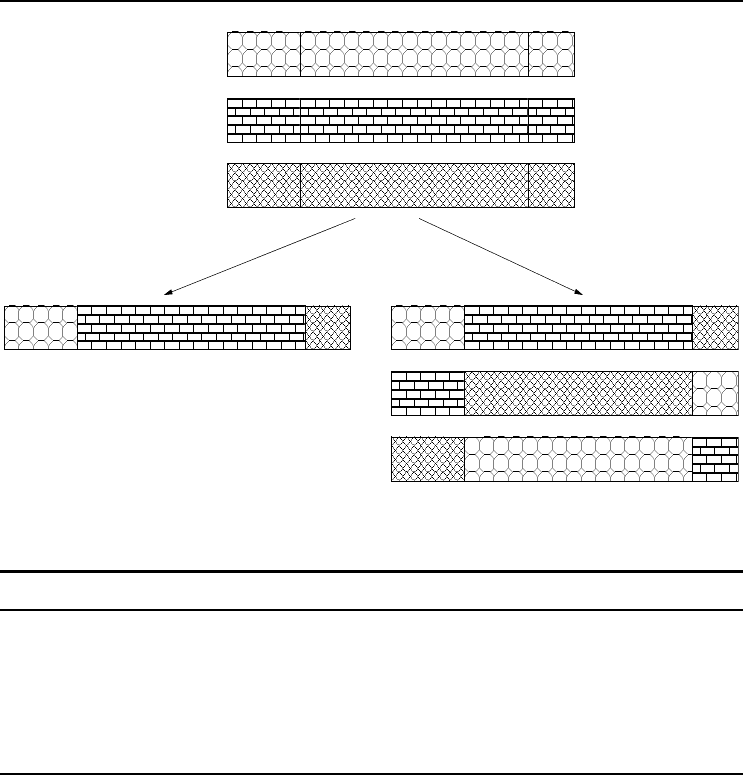
The diagonal crossover operator developed by Eiben et al. [232] is a generalization of
n-point crossover for more than two parents: n ≥ 1 crossover points are selected and
applied to all of the n
µ
= n +1 parents. One orn + 1 offspring can be generated by
selecting segments from the parents along the diagonals as illustrated in Figure 9.3,
for n =2,n
µ
=3.
9.3 Mutation
The aim of mutation is to introduce new genetic material into an existing individual;
that is, to add diversity to the genetic characteristics of the population. Mutation is
used in support of crossover to ensure that the full range of allele is accessible for each
gene. Mutation is applied at a certain probability, p
m
, to each gene of the offspring,
˜
x
i
(t), to produce the mutated offspring, x
i
(t). The mutation probability, also referred

154 9. Genetic Algorithms
to as the mutation rate, is usually a small value, p
m
∈ [0, 1], to ensure that good
solutions are not distorted too much.
Given that each gene is mutated at probability p
m
, the probability that an individual
will be mutated is given by
Prob(
˜
x
i
(t)ismutated)=1− (1 − p
m
)
n
x
(9.21)
where the individual contains n
x
genes.
Assuming binary representations, if H(
˜
x
i
(t), x
i
(t)) is the Hamming distance between
offspring,
˜
x
i
(t), and its mutated version, x
i
(t), then the probability that the mutated
version resembles the original offspring is given by
Prob(x
i
(t)) ≈
˜
x
i
(t)) = p
H(
˜
x
i
(t),x
i
(t))
m
(1 − p
m
)
n
x
−H(
˜
x
i
(t),x
i
(t))
(9.22)
This section describes mutation operators for binary and floating-point representations
in Sections 9.3.1 and 9.3.2 respectively. A macromutation operator is described in
Section 9.3.3.
9.3.1 Binary Representations
For binary representations, the following mutation operators have been developed:
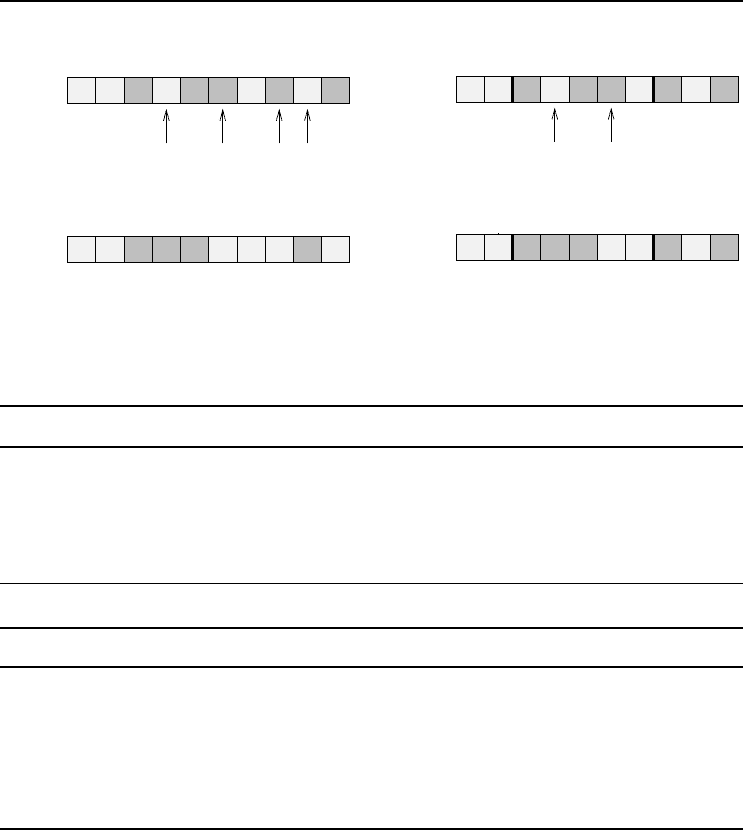
• Uniform (random) mutation [376], where bit positions are chosen randomly
and the corresponding bit values negated as illustrated in Figure 9.4(a). Uniform
mutation is summarized in Algorithm 9.6.
• Inorder mutation, where two mutation points are randomly selected and only
the bits between these mutation points undergo random mutation. Inorder mu-
tation is illustrated in Figure 9.4(b) and summarized in Algorithm 9.7.
• Gaussian mutation: For binary representations of floating-point decision vari-
ables, Hinterding [366] proposed that the bitstring that represents a decision
variable be converted back to a floating-point value and mutated with Gaus-
sian noise. For each chromosome random numbers are drawn from a Poisson
distribution to determine the genes to be mutated. The bitstrings representing
these genes are then converted. To each of the floating-point values is added
the stepsize N(0,σ
j
), where σ
j
is 0.1 of the range of that decision variable. The
mutated floating-point value is then converted back to a bitstring. Hinterding
showed that Gaussian mutation on the floating-point representation of decision
variables provided superior results to bit flipping.
For large dimensional bitstrings, mutation may significantly add to the computational
cost of the GA. In a bid to reduce computational complexity, Birru [69] divided the
bitstring of each individual into a number of bins. The mutation probability is applied
to the bins, and if a bin is to be mutated, one of its bits are randomly selected and
flipped.
9.3 Mutation 155
Before Mutation
mutation points
After Mutation
(a) Random Mutate
Before Mutation
mutation points
After Mutation
(b) Inorder Mutate
Figure 9.4 Mutation Operators for Binary Representations
Algorithm 9.6 Uniform/Random Mutation
for j =1,...,n
x
do
if U(0, 1) ≤ p
m
then
x
ij
(t)=¬˜x
ij
(t), where ¬ denotes the boolean NOT operator;
end
end
Algorithm 9.7 Inorder Mutation
Select mutation points, ξ
1
,ξ
2
∼ U(1,...,n
x
);
for j = ξ
1
,...,ξ
2
do
if U(0, 1) ≤ p
m
then
x
ij
(t)=¬˜x
ij
(t);
end
end
9.3.2 Floating-Point Representations
As indicated by Hinterding [366] and Michalewicz [586], better performance is obtained
by using a floating-point representation when decision variables are floating-point val-
ues and by applying appropriate operators to these representations, than to convert
to a binary representation. This resulted in the development of mutation operators
for floating-point representations. One of the first proposals was a uniform mutation,
where [586]
x
ij
(t)=
˜x
ij
(t)+∆(t, x
max,j
− ˜x
ij
(t)) if a random digit is 0
˜x
ij
(t)+∆(t, ˜x
ij
(t) − x
min,j
(t)) if a random digit is 1
(9.23)
where ∆(t, x) returns random values from the range [0,x].

156 9. Genetic Algorithms
Any of the mutation operators discussed in Sections 11.2.1 (for EP) and 12.4.3 (for
ES) can be applied to GAs.
9.3.3 Macromutation Operator – Headless Chicken
Jones [427] proposed a macromutation operator, referred to as the headless chicken
operator. This operator creates an offspring by recombining a parent individual with
a randomly generated individual using any of the previously discussed crossover oper-
ators. Although crossover is used to combine an individual with a randomly generated
individual, the process cannot be referred to as a crossover operator, as the concept of
inheritence does not exist. The operator is rather considered as mutation due to the
introduction of new randomly generated genetic material.
9.4 Control Parameters
In addition to the population size, the performance of a GA is influenced by the
mutation rate, p
m
, and the crossover rate, p
c
. In early GA studies very low values
for p
m
and relatively high values for p
c
are propagated. Usually, the values for p
m
and p
c
are kept static. It is, however, widely accepted that these parameters have
a significant influence on performance, and that optimal settings for p
m
and p
c
can
significantly improve performance. To obtain such optimal settings through empirical
parameter tuning is a time consuming process. A solution to the problem of finding
best values for these control parameters is to use dynanically changing parameters.
Although dynamic, and self-adjusting parameters have been used for EP and ES (refer
to Sections 11.3 and 12.3) as early as the 1960s, Fogarty [264] provided one of the
first studies of dynamically changing mutation rates for GAs. In this study, Fogarty
concluded that performance can be significantly improved using dynamic mutation
rates. Fogarty used the following schedules where the mutation rate exponentially
decreases with generation number:
p
m
(t)=
1
240
+
0.11375
2
t
(9.24)
As an alternative, Fogarty also proposed for binary representations a mutation rate
per bit, j =1,...,n
b
,wheren
b
indicates the least significant bit:
p
m
(j)=
0.3528
2
j−1
(9.25)
The two schedules above were combined to give
p
m
(j, t)=
28
1905 × 2
j−1
=
0.4026
2
t+j−1
(9.26)
A large initial mutation rate favors exploration in the initial steps of the search, and
with a decrease in mutation rate as the generation number increases, exploitation

9.5 Genetic Algorithm Variants 157
is facilitated. Different schedules can be used to reduce the mutation rate. The
schedule above results in an exponential decrease. An alternative may be to use a
linear schedule, which will result in a slower decrease in p
m
, allowing more exploration.
However, a slower decrease may be too disruptive for already found good solutions.
A good strategy is to base the probability of being mutated on the fitness of the
individual: the more fit the individual is, the lower the probability that its genes will
be mutated; the more unfit the individual, the higher the probability of mutation.
Annealing schedules similar to those used for the learning rate of NNs (refer to equation
(4.40)), and to adjust control parameters for PSO and ACO can be applied to p
m
(also
refer to Section A.5.2).
For floating-point representations, performance is also influenced by the mutational
step sizes. An ideal strategy is to start with large mutational step sizes to allow larger,
stochastic jumps within the search space. The step sizes are then reduced over time,
so that very small changes result near the end of the search process. Step sizes can also
be proportional to the fitness of an individual, with unfit individuals having larger step
sizes than fit individuals. As an alternative to deterministic schedules to adapt step
sizes, self-adaptation strategies as for EP and ES can be used (refer to Sections 11.3.3
and 12.3.3).
The crossover rate, p
c
, also bears significant influence on performance. With its op-
timal value being problem dependent, the same adaptive strategies as for p
m
can be
used to dynamically adjust p
c
.
In addition to p
m
(and mutational step sizes in the case of floating-point represen-
tations) and p
c
, the choice of the best evolutionary operators to use is also problem
dependent. While a best combination of crossover, mutation, and selection operators
together with best values for the control parameters can be obtained via empirical stud-
ies, a number of adaptive methods can be found as reviewed in [41]. These methods
adaptively switch between different operators based on search progress. Ultimately,
finding the best set of operators and control parameter values is a multi-objective
optimization problem by itself.
9.5 Genetic Algorithm Variants
Based on the general GA, different implementations of a GA can be obtained by
using different combinations of selection, crossover, and mutation operators. Although
different operator combinations result in different behaviors, the same algorithmic flow
as given in Algorithm 8.1 is followed. This section discusses a few GA implementations
that deviate from the flow given in Algorithm 8.1. Section 9.5.1 discusses generation
gap methods. The messy GA is described in Section 9.5.2. A short discussion on
interactive evolution is given in Section 9.5.3. Island (or parallel) GAs are discussed
in Section 9.5.4.