
Engelbrecht Andries P. Computational Intelligence: An Introduction
Подождите немного. Документ загружается.

108 7. Performance Issues (Supervised Learning)
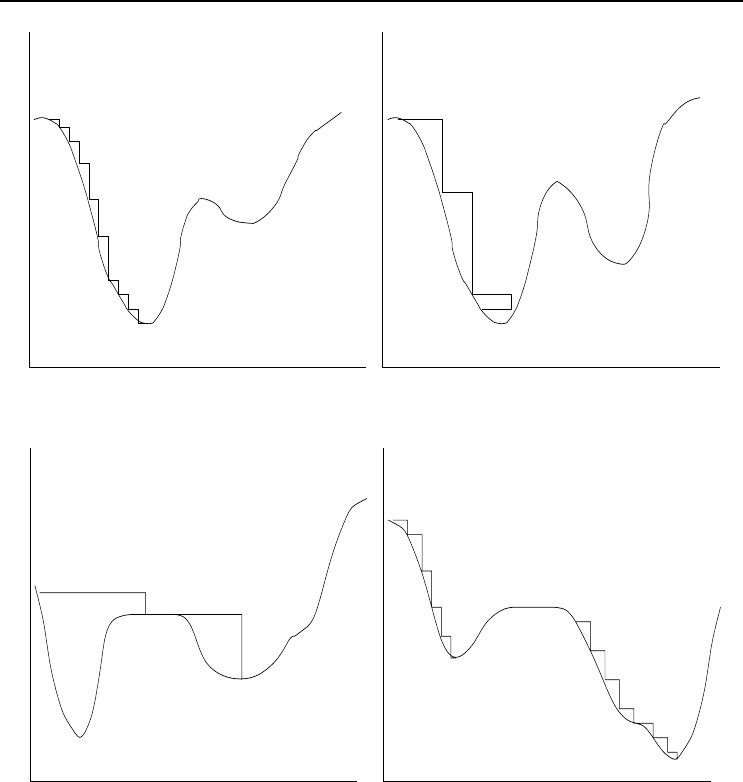
(a) Small η (b) Large η gets stuck
(c) Large η overshoots
Starting position 1
Starting position 2
(d) Small η gets stuck
Figure 7.5 Effect of Learning Rate
Of course more complex adaptive learning rate techniques have been developed, with
elaborate theoretical analysis. The interested reader is referred to [170, 552, 755, 880].
Momentum
Stochastic learning, where weights are adjusted after each pattern presentation, has
the disadvantage of fluctuating changes in the sign of the error derivatives. The net-
work spends a lot of time going back and forth, unlearning what the previous steps
have learned. Batch learning is a solution to this problem, since weight changes are
accumulated and applied only after all patterns in the training set have been presented.
Another solution is to keep with stochastic learning, and to add a momentum term.
7.3 Performance Factors 109
The idea of the momentum term is to average the weight changes, thereby ensuring
that the search path is in the average downhill direction. The momentum term is then
simply the previous weight change weighted by a scalar value α.Ifα = 0, then the
weight changes are not influenced by past weight changes. The larger the value of α,
the longer the change in the steepest descent direction has to be persevered in order
to affect the direction in which weights are adjusted. A static value of 0.9 is usually
used.
The optimal value of α can also be determined through cross-validation. Strategies
have also been developed that use adaptive momentum rates, where each weight has
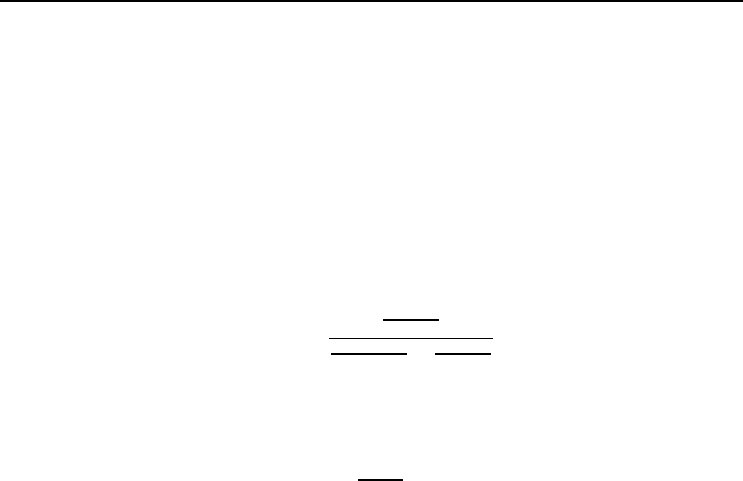
a different momentum rate. Fahlman developed the schedule
α
kj
(t)=
∂E
∂w
kj
(t)
∂E
∂w
kj
(t−1)
−
∂E
∂w
kj
(t)
(7.24)
This variation to the standard back-propagation algorithm is referred to as quickprop
[253]. Becker and Le Cun [57] calculated the momentum rate as a function of the
second-order error derivatives:
α =(
∂
2
E
∂w
2
kj
)
−1
(7.25)
For more information on other approaches to adapt the momentum rate refer to [644,
942].
7.3.4 Optimization Method
The optimization method used to determine weight adjustments has a large influence
on the performance of NNs. While GD is a very popular optimization method,
GD is plagued by slow convergence and susceptibility to local minima (as introduced
and discussed in Section 3.2.2). Improvements of GD have been made to address
these problems, for example, the addition of the momentum term. Also, second-
order derivatives of the objective function have been used to compute weight updates.
In doing so, more information about the structure of the error surface is used to
direct weight changes. The reader is referred to [51, 57, 533]. Other approaches
to improve NN training are to use global optimization algorithms instead of local
optimization algorithms, for example simulated annealing [736], genetic algorithms
[247, 412, 494], particle swarm optimization algorithms [157, 229, 247, 862, 864], and
LeapFrog optimization [247, 799, 800].
7.3.5 Architecture Selection
Referring to one of Ockham’s statements, if several networks fit the training set equally
well, then the simplest network (i.e. the network that has the smallest number of
weights) will on average give the best generalization performance [844]. This hypoth-
esis has been investigated and confirmed by Sietsma and Dow [789]. A network with

110 7. Performance Issues (Supervised Learning)
too many free parameters may actually memorize training patterns and may also ac-
curately fit the noise embedded in the training data, leading to bad generalization.
Overfitting can thus be prevented by reducing the size of the network through elimina-
tion of individual weights or units. The objective is therefore to balance the complexity
of the network with goodness-of-fit of the true function. This process is referred to as
architecture selection. Several approaches have been developed to select the optimal
architecture, i.e. regularization, network construction (growing) and pruning. These
approaches will be overviewed in more detail below.
Learning is not just perceived as finding the optimal weight values, but also finding the
optimal architecture. However, it is not always obvious what is the best architecture.
Finding the ultimate best architecture requires a search of all possible architectures.
For large networks an exhaustive search is prohibitive, since the search space consists
of 2
w
architectures, where w is the total number of weights [602]. Instead, heuristics
are used to reduce the search space. A simple method is to train a few networks of
different architecture and to choose the one that results in the lowest generalization
error as estimated from the generalized prediction error [603, 604] or the network
information criterion [616, 617, 618]. This approach is still expensive and requires
many architectures to be investigated to reduce the possibility that the optimal model
is not found. The NN architecture can alternatively be optimized by trial and error.
An architecture is selected, and its performance is evaluated. If the performance
is unacceptable, a different architecture is selected. This process continues until an
architecture is found that produces an acceptable generalization error.
Other approaches to architecture selection are divided into three categories:
• Regularization: Neural network regularization involves the addition of a
penalty term to the objective function to be minimized. In this case the ob-
jective function changes to
E = E
T
+ λE
C
(7.26)
where E
T
is the usual measure of data misfit, and E
C
is a penalty term, penalizing
network complexity (network size). The constant λ controls the influence of the
penalty term. With the changed objective function, the NN now tries to find
a locally optimal trade-off between data-misfit and network complexity. Neural
network regularization has been studied rigorously by Girosi et al. [318], and
Williams [910].
Several penalty terms have been developed to reduce network size automatically
during training. Weight decay, where E
C
=
1
2
w
2
i
, is intended to drive small
weights to zero [79, 346, 435, 491]. It is a simple method to implement, but
suffers from penalizing large weights at the same rate as small weights. To solve
this problem, Hanson and Pratt [346] propose the hyperbolic and exponential
penalty functions which penalize small weights more than large weights. Nowlan
and Hinton [633] developed a more complicated soft weight sharing, where the
distribution of weight values is modeled as a mixture of multiple Gaussian dis-
tributions. A narrow Gaussian is responsible for small weights, while a broad
Gaussian is responsible for large weights. Using this scheme, there is less pressure
on large weights to be reduced.
Weigend et al. [895] propose weight elimination where the penalty function

7.3 Performance Factors 111
E
C
=
w
2
i
/w
2
0
1+w
2
i
/w
2
0
, effectively counts the number of weights. Minimization of this
objective function will then minimize the number of weights. The constant w
0
is very important to the success of this approach. If w
0
is too small, the network
ends up with a few large weights, while a large value results in many small
weights. The optimal value for w
0
can be determined through cross-validation,
which is not cost-effective.
Chauvin [116, 117] introduces a penalty term that measures the “energy spent”
by the hidden units, where the energy is expressed as a function of the squared
activation of the hidden units. The aim is then to minimize the energy spent by
hidden units, and in so doing, to eliminate unnecessary units.
Kamimura and Nakanishi [435] show that, in an information theoretical context,
weight decay actually minimizes entropy. Entropy can also be minimized directly
by including an entropy penalty term in the objective function [434]. Minimiza-
tion of entropy means that the information about input patterns is minimized,
thus improving generalization. For this approach entropy is defined with respect
to hidden unit activity. Schittenkopf et al. [763] also propose an entropy penalty
term and show how it reduces complexity and avoids overfitting.
Yasui [938] develops penalty terms to make minimal and joint use of hidden units
by multiple outputs. Two penalty terms are added to the objective function to
control the evolution of hidden-to-output weights. One penalty causes weights
leading into an output unit to prevent another from growing, while the other
causes weights leaving a hidden unit to support another to grow.
While regularization models are generally easy to implement, the value of the
constant λ in equation (7.26) may present problems. If λ is too small, the
penalty term will have no effect. If λ is too large, all weights might be driven
to zero. Regularization therefore requires a delicate balance between the normal
error term and the penalty term. Another disadvantage of penalty terms is that
they tend to create additional local minima [346], increasing the possibility of
converging to a bad local minimum. Penalty terms also increase training time
due to the added calculations at each weight update. In a bid to reduce this
complexity, Finnoff et al. [260] show that the performance of penalty terms is
greatly enhanced if they are introduced only after overfitting is observed.
• Network construction (growing): Network construction algorithms start
training with a small network and incrementally add hidden units during training
when the network is trapped in a local minimum [291, 368, 397, 495]. A small
network forms an approximate model of a subset of the training set. Each new
hidden unit is trained to reduce the current network error – yielding a better
approximation. Crucial to the success of construction algorithms is effective
criteria to trigger when to add a new unit, when to stop the growing process,
where and how to connect the new unit to the existing architecture, and how to
avoid restarting training. If these issues are treated on an ad hoc basis, overfitting
may occur and training time may be increased.
• Network pruning: Neural network pruning algorithms start with an oversized
network and remove unnecessary network parameters, either during training or
after convergence to a local minimum. Network parameters that are considered
for removal are individual weights, hidden units and input units. The decision

112 7. Performance Issues (Supervised Learning)
to prune a network parameter is based on some measure of parameter relevance
or significance. A relevance is computed for each parameter and a pruning
heuristic is used to decide when a parameter is considered as being irrelevant
or not. A large initial architecture allows the network to converge reasonably
quickly, with less sensitivity to local minima and the initial network size. Larger
networks have more functional flexibility, and are guaranteed to learn the input-
output mapping with the desired degree of accuracy. Due to the larger functional
flexibility, pruning weights and units from a larger network may give rise to a
better fit of the underlying function, hence better generalization [604].
A more elaborate discussion of pruning techniques is given next, with the main ob-
jective of presenting a flavor of the techniques available to prune NN architectures.
For more detailed discussions, the reader is referred to the given references. The first
results in the quest to find a solution to the architecture optimization problem were
the derivation of theoretical limits on the number of hidden units to solve a particular
problem [53, 158, 436, 751, 759]. However, these results are based on unrealistic as-
sumptions about the network and the problem to be solved. Also, they usually apply
to classification problems only. While these limits do improve our understanding of the
relationship between architecture and training set characteristics, they do not predict
the correct number of hidden units for a general class of problems.
Recent research concentrated on the development of more efficient pruning techniques
to solve the architecture selection problem. Several different approaches to pruning
have been developed. This chapter groups these approaches in the following gen-
eral classes: intuitive methods, evolutionary methods, information matrix methods,
hypothesis testing methods and sensitivity analysis methods.
• Intuitive pruning techniques: Simple intuitive methods based on weight
values and unit activation values have been proposed by Hagiwara [342]. The
goodness factor G
l
i
of unit i in layer l, G
l
i
=
p
j
(w
l
ji
o
l
i
)
2
, where the first
sum is over all patterns, and o
l
i
is the output of the unit, assumes that an
important unit is one that excites frequently and has large weights to other
units. The consuming energy, E
l
i
=
p
j
w
l
ji
o
l+1
j
o
l
j
, additionally assumes that
unit i excites the units in the next layer. Both methods suffer from the flaw that
when a unit’s output is more frequently 0 than 1, that unit might be considered
as being unimportant, while this is not necessarily the case. Magnitude-based
pruning assumes that small weights are irrelevant [342, 526]. However, small
weights may be of importance, especially compared to very large weights that
cause saturation in hidden and output units. Also, large weights (in terms of
their absolute value) may cancel each other out.
• Evolutionary pruning techniques: The use of genetic algorithms (GA) to
prune NNs provides a biologically plausible approach to pruning [494, 712, 901,
904]. Using GA terminology, the population consists of several pruned versions
of the original network, each needed to be trained. Differently pruned networks
are created by the application of mutation, reproduction and crossover operators.
These pruned networks “compete” for survival, being awarded for using fewer
parameters and for improving generalization. GA NN pruning is thus a time-
consuming process.

7.3 Performance Factors 113
• Information matrix pruning techniques: Several researchers have used ap-
proximations to the Fisher information matrix to determine the optimal number
of hidden units and weights. Based on the assumption that outputs are lin-
early activated, and that least squares estimators satisfy asymptotic normality,
Cottrell et al. [160] compute the relevance of a weight as a function of the
information matrix, approximated by
I =
1
P
P
p=1
∂f
NN
∂w
(
∂f
NN
∂w
)
T
(7.27)
Weights with a low relevance are removed.
Hayashi [355], Tamura et al. [837], Xue et al. [929] and Fletcher et al. [261]
use singular value decomposition (SVD) to analyze the hidden unit activation
covariance matrix to determine the optimal number of hidden units. Based on
the assumption that outputs are linearly activated, the rank of the covariance
matrix is the optimal number of hidden units (also see [292]). SVD of this
information matrix results in an eigenvalue and eigenvector decomposition where
low eigenvalues correspond to irrelevant hidden units. The rank is the number
of non-zero eigenvalues. Fletcher et al. [261] use the SVD of the conditional
Fisher information matrix, as given in equation (7.27), together with likelihood-
ratio tests to determine irrelevant hidden units. In this case the conditional
Fisher information matrix is restricted to weights between the hidden and output
layer only, whereas previous techniques are based on all network weights. Each
iteration of the pruning algorithm identifies exactly which hidden units to prune.
Principal Component Analysis (PCA) pruning techniques have been developed
that use the SVD of the Fisher information matrix to find the principal com-
ponents (relevant parameters) [434, 515, 763, 834]. These principal components
are linear transformations of the original parameters, computed from the eigen-
vectors obtained from a SVD of the information matrix. The result of PCA
is the orthogonal vectors on which variance in the data is maximally projected.
Non-principal components/parameters (parameters that do not account for data
variance) are pruned. Pruning using PCA is thus achieved through projection of
the original w-dimensional space onto a w
-dimensional linear subspace (w
<w)
spanned by the eigenvectors of the data’s correlation or covariance matrix cor-
responding to the largest eigenvalues.
• Hypothesis testing techniques: Formal statistical hypothesis tests can be
used to test the statistical significance of a subset of weights, or a subset of
hidden units. Steppe et al. [809] and Fletcher et al. [261] use the likelihood-
ratio test statistic to test the null hypothesis that a subset of weights is zero.
Weights associated with a hidden unit are tested to see if they are statistically
different from zero. If these weights are not statistically different from zero, the
corresponding hidden unit is pruned.
Belue and Bauer [58] propose a method that injects a noisy input parameter into
the NN model, and then use statistical tests to decide if the significances of the
original NN parameters are higher than that of the injected noisy parameter.
Parameters with lower significances than the noisy parameter are pruned.

114 7. Performance Issues (Supervised Learning)
Similarly, Prechelt [694] and Finnoff et al. [260] test the assumption that a
weight becomes zero during the training process. This approach is based on the
observation that the distribution of weight values is roughly normal. Weights
located in the left tail of this distribution are removed.
• Sensitivity analysis pruning techniques: Two main approaches to sensitiv-
ity analysis exist, namely with regard to the objective function and with regard
to the NN output function. Both sensitivity analysis with regard to the objective
function and sensitivity analysis with regard to the NN output function resulted
in the development of a number of pruning techniques. Possibly the most popu-
lar of these are optimal brain damage (OBD) [166] and its variants, optimal brain
surgeon (OBS) [351, 352] and optimal cell damage (OCD) [129]. A parameter
saliency measure is computed for each parameter, indicating the influence small
perturbations to the parameter have on the approximation error. Parameters
with a low saliency are removed. These methods are time-consuming due to the
calculation of the Hessian matrix. Buntine and Weigend [95] and Bishop [71]
derived methods to simplify the calculation of the Hessian matrix in a bid to
reduce the complexity of these pruning techniques. In OBD, OBS and OCD,
sensitivity analysis is performed with regard to the training error. Pedersen et
al. [669] and Burrascano [98] develop pruning techniques based on sensitivity
analysis with regard to the generalization error. Other objective function sensi-
tivity analysis pruning techniques have been developed by Mozer and Smolensky
[611] and Moody and Utans [602].
NN output sensitivity analysis pruning techniques have been developed that are
less complex than objective function sensitivity analysis, and that do not rely
on simplifying assumptions. Zurada et al. [962] introduced output sensitivity
analysis pruning of input units, further investigated by Engelbrecht et al. [245].
Engelbrecht and Cloete [238, 240, 246] extended this approach to also prune
irrelevant hidden units.
A similar approach to NN output sensitivity analysis was followed by Dorizzi et
al. [218] and Czernichow [168] to prune parameters of a RBFNN.
The aim of all architecture selection algorithms is to find the smallest architecture
that accurately fits the underlying function. In addition to improving generalization
performance and avoiding overfitting (as discussed earlier), smaller networks have the
following advantages. Once an optimized architecture has been found, the cost of
forward calculations is significantly reduced, since the cost of computation grows al-
most linearly with the number of weights. From the generalization limits overviewed
in section 7.3.7, the number of training patterns required to achieve a certain gen-
eralization performance is a function of the network architecture. Smaller networks
therefore require less training patterns. Also, the knowledge embedded in smaller
networks is more easily described by a set of simpler rules. Viktor et al. [879] show
that the number of rules extracted from smaller networks is less for pruned networks
than that extracted from larger networks. They also show that rules extracted from
smaller networks contain only relevant clauses, and that the combinatorics of the rule
extraction algorithm is significantly reduced. Furthermore, for smaller networks the
function of each hidden unit is more easily visualized. The complexity of decision
boundary detection algorithms is also reduced.
7.3 Performance Factors 115
With reference to the bias/variance decomposition of the MSE function [313], smaller
network architectures reduce the variance component of the MSE. NNs are gener-
ally plagued by high variance due to the limited training set sizes. This variance
is reduced by introducing bias through minimization of the network architecture.
Smaller networks are biased because the hypothesis space is reduced; thus limiting
the available functions that can fit the data. The effects of architecture selection on
the bias/variance trade-off have been studied by Gedeon et al. [311].
7.3.6 Adaptive Activation Functions
The performance of NNs can be improved by allowing activation functions to change
dynamically according to the characteristics of the training data. One of the first
techniques to use adaptive activations functions was developed by Zurada [961], where
the slope of the sigmoid activation function is learned together with the weights. A
slope parameter λ is kept for each hidden and output unit. The lambda-learning
algorithm of Zurada was extended by Engelbrecht et al. [244] where the sigmoid
function is given as
f(net, λ, γ)=
γ
1+e
−λnet
(7.28)
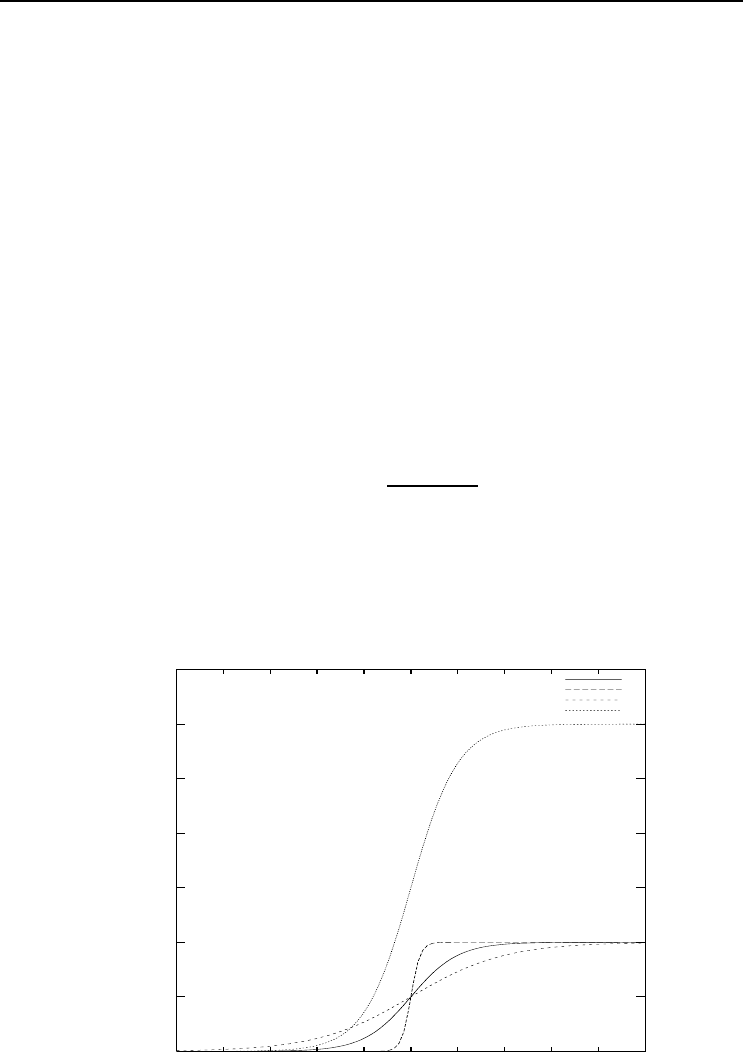
where λ is the slope of the function and γ the maximum range. Engelbrecht et al. de-
veloped learning equations to also learn the maximum ranges of the sigmoid functions,
thereby performing automatic scaling. By using gamma-learning, it is not necessary
to scale target values to the range (0, 1). The effect of changing the slope and range
of the sigmoid function is illustrated in Figure 7.6.
0
0.5
1
1.5
2
2.5
3
3.5
-10 -8 -6 -4 -2 0 2 4 6 8 10
Output
Input Value
standard sigmoid
slope = 5
slope = 0.5
slope = 1, range = 3
Figure 7.6 Adaptive Sigmoid
Algorithm 7.1 illustrates the differences between standard GD learning (referred to as

116 7. Performance Issues (Supervised Learning)
delta learning) and the lambda and gamma learning variations. (Note that although
the momentum terms are omitted below, a momentum term is usually used for the
weight, lambda and gamma updates.)
7.3.7 Active Learning
Ockham’s razor states that unnecessarily complex models should not be preferred to
simpler ones – a very intuitive principle [544, 844]. A neural network (NN) model
is described by the network weights. Model selection in NNs consists of finding a
set of weights that best performs the learning task. In this sense, the data, and not
just the architecture should be viewed as part of the NN model, since the data is
instrumental in finding the “best” weights. Model selection is then viewed as the
process of designing an optimal NN architecture as well as the implementation of
techniques to make optimal use of the available training data. Following from the
principle of Ockham’s razor is a preference then for both simple NN architectures and
optimized training data. Usually, model selection techniques address only the question
of which architecture best fits the task.
Standard error back-propagating NNs are passive learners. These networks passively
receive information about the problem domain, randomly sampled to form a fixed
size training set. Random sampling is believed to reproduce the density of the true
distribution. However, more gain can be achieved if the learner is allowed to use
current attained knowledge about the problem to guide the acquisition of training
examples. As passive learner, a NN has no such control over what examples are
presented for learning. The NN has to rely on the teacher (considering supervised
learning) to present informative examples.
The generalization abilities and convergence time of NNs are greatly influenced by
the training set size and distribution: Literature has shown that to generalize well,
the training set must contain enough information to learn the task. Here lies one of
the problems in model selection: the selection of concise training sets. Without prior
knowledge about the learning task, it is very difficult to obtain a representative training
set. Theoretical analysis provides a way to compute worst-case bounds on the number
of training examples needed to ensure a specified level of generalization. A widely used
theorem concerns the Vapnik-Chervonenkis (VC) dimension [8, 9, 54, 152, 375, 643].
This theorem states that the generalization error, E
G
, of a learner with VC-dimension,
d
VC
, trained on P
T
random examples will, with high confidence, be no worse than
a limit of order d
VC
/P
T
. For NN learners, the total number of weights in a one
hidden layer network is used as an estimate of the VC-dimension. This means that
the appropriate number of examples to ensure an E
G
generalization is approximately
the number of weights divided by E
G
.
The VC-dimension provides overly pessimistic bounds on the number of train-
ing examples, often leading to an overestimation of the required training set size
[152, 337, 643, 732, 948]. Experimental results have shown that acceptable gener-
alization performances can be obtained with training set sizes much less than that

7.3 Performance Factors 117
Algorithm 7.1 Lambda-Gamma Training Rule
Choose the values of the learning rates η
1
,η
2
and η
3
according to the learning rule:
Delta learning rule η
1
> 0,η
2
=0,η
3
=0
Lambda learning rule η
1
> 0,η
2
> 0,η
3
=0
Gamma learning rule η
1
> 0,η
2
=0,η
3
> 0
Lambda-gamma learning rule η
1
> 0,η
2
> 0,η
3
> 0
Initialize weights to small random values;
Initialize the number of epochs t =0;
Initialize the steepness and range coefficients
λ
y
j
= γ
y
j
=1 ∀ j =1,...,J and λ
o
k
= γ
o
k
=1 ∀ k =1,...,K;
while stopping condition(s) not true do
Let E
T
=0;
for each pattern p =1,...,P
T
do
z = z
p
and t = t
p
;
for each j =1,...,J do
y
j
= f(γ
y
j
,λ
y
j
, v
T
j
z);
end
for each k =1,...,K do
o
k
= f(γ
o
k
,λ
o
k
, w
T
k
y);
E
T
+=
1
2
(t
k
− o
k
)
2
;
Compute the error signal, δ
o
k
:
δ
o
k
= −
λ
o
k
γ
o
k
(t
k
− o
k
)o
k
(γ
o
k
− o
k
) (7.29)
Adjust output unit weights and gains, ∀ j =1,...,J +1:
w
kj
= w
kj
+ η
1
δ
o
k
y
j
,λ
o
k
= λ
o
k
+ η
2
δ
o
k
net
o
k
λ
o
k
(7.30)
γ
o
k
= γ
o
k
+ η
3
(t
k
−o
k
)
1
γ
o
k
o
k
(7.31)
end
for each j =1,...,J do
Compute the error signal, δ
y
j
:
δ
y
j
=
λ
y
j
γ
y
j
y
j
(γ
y
j
− y
j
)
K
k=1
δ
o
k
w
kj
(7.32)
Adjust hidden unit weights and gains, ∀ i =1,...,I +1:
v
ji
= v
ji
+ η
1
δ
y
j
z
i
,λ
y
j
= λ
y
j
+ η
2
1
λ
y
j
δ
y
j
net
y
j
(7.33)
γ
y
j
= γ
y
j
+ η
3
1
γ
y
j
f(γ
y
j
,λ
y
j
,net
y
j
)
K
k=1
δ
o
k
w
kj
(7.34)
end
t = t +1;
end
end