
Engelbrecht Andries P. Computational Intelligence: An Introduction
Подождите немного. Документ загружается.

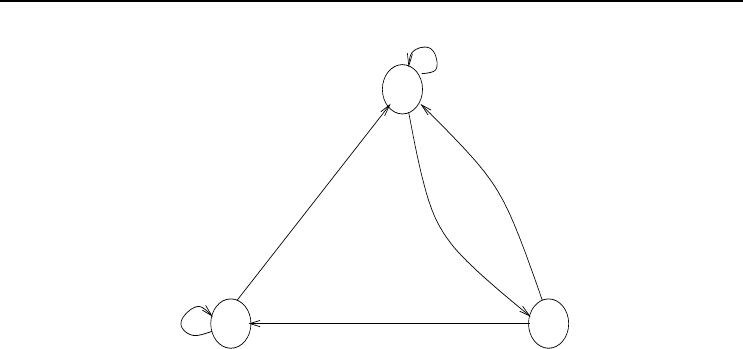
208 11. Evolutionary Programming
C
B
A
1/
1/
0/
0/
0/
1/
E
E
J
D
E
J
Figure 11.1 Finite-State Machine [278]
Fitness Evaluation
The fitness of each individual is measured as the individual’s ability to correctly predict
the next output symbol. A sequence of symbols is used for this purpose. The first
symbol from the sequence is presented to each individual, and the predicted symbol
compared to the next symbol in the sequence. The second symbol is then presented
as input, and the process iterates over the entire sequence. The individual with the
most correct predictions is considered the most fit individual.
Mutation
The following mutation operations can be applied: The initial state can be changed,
a state can be deleted, a state can be added, a state transition can be changed, or an
output symbol for a given state and input symbol can be changed.
These operators are applied probabilistically, in one of the following ways:
• Select a uniform random number between 1 and 5. The corresponding mutation
operator is then applied with probability p
m
.
• Generate a Poisson number, ξ with mean λ. Select ξ mutation operators uni-
formly from the set of operators, and apply them in sequence.
11.6.2 Function Optimization
The next example application of EP is in function optimization. Consider, for example,
finding the minimum of the function sin(2πx)e
−x
in the range [0, 2].

11.6 Applications 209
Representation
The function has one parameter. Each individual is therefore represented by a vector
consisting of one floating-point element (not binary encoded). The initial population
is generated randomly, with each individual’s parameter x
ij
selected such that x
ij
∼
U(0, 2).
Fitness Evaluation
In the case of minimization, the fittest individual is the one with the smallest value
for the function being optimized; that is, the individual with the smallest value for
the function sin(2πx)e
−x
. For maximization, it is the largest value.
Mutation
Any of the mutation operators discussed in Section 11.2.1 can be used to produce
offspring.
11.6.3 Training Neural Networks
One of the first applications as an approach to optimize unconstrained functions was
to train supervised feedforward neural networks [272]. Since then, EP has been applied
to many neural network problems [28, 571, 933].
Representation
Each individual represents one neural network (NN), where a component represents a
single weight or bias.
Fitness Evaluation
The mean squared error (MSE), or sum squared error (SSE), can be used to quan-
tify the performance of a NN. In the case of a classification task, the percentage of
incorrectly classified patterns can be used. Fitness evaluation involves conversion of
the vector representation used for individuals to a layered NN structure in order to
perform feedforward passes for patterns in the given data set.

210 11. Evolutionary Programming
Table 11.2 Real-World Applications of Evolutionary Programming
Application Class References
Bayesian networks [519]
Controller design [889]
Robotics [350, 445, 465]
Games [267, 273]
Image processing [546]
Power systems [110, 111, 417, 543, 779, 916, 943]
Scheduling and routing [235, 270, 795]
Model selection [542, 620]
Design [169, 381, 819]
Mutation
Any of the mutation operators discussed in Section 11.2.1 can be used to adjust weight
and bias values. Special mutation operators are available if the NN architecture is
optimized simultaneously with weight values [28, 933]. Optimizing NN architecture
is a discrete-valued optimization problem. Architecture mutation operators include
node deletion and addition, as well as removing or adding a connection between two
nodes.
11.6.4 Real-World Applications
Table 11.2 summarizes some applications of EP. This table should not be considered
as an exhaustive list.
11.7 Assignments
1. Show if EP can be used to evolve the regular expression of a sequence of char-
acters.
2. Use unconstrained functions from Section A.5.3 to show which probability dis-
tribution results in step sizes that maximize exploration.
3. Develop an EP to train an LVQ-I network.
4. The representation scheme used in Section 11.6.1 to evolve FSMs can be reduced
to use less bits. Suggest a way in which this can be accomplished.
5. How can premature convergence be prevented in EP?
6. With reference to Chapter 12 discuss the similarities and differences between EP
and ES.

11.7 Assignments 211
7. With reference to Chapter 15 discuss the influence of different fitness sampling
methods on EP performance.
8. With reference to Chapter 15 discuss the influence of different fitness sharing
methods on EP performance.
9. Evaluate the performance of different mutation operators on the following de-
ceptive function [169]:
f(x
1
,x
2
)=
1 −
)
)
)
)
sin(π(x
1
− 2)) sin(π(x
2
− 2))
π
2
(x
1
− 2)(x
2
−2)
)
)
)
)
5
×[2 + (x
1
− 7)
2
+2(x
2
− 7)
2
] (11.87)
for x
1
,x
2
, ∼ U(0, 12). The global minimum is f
∗
(x
1
,x
2
)=0at(x
1
,x
2
)=(2, 2),
and the local minimum of f
∗
(x
1
,x
2
)=2at(x
1
,x
2
)=(7, 7).
10. Explain why mutational noise should have a mean of 0.
11. Propose a method to ensure that the uniform mutation operator in equation
(11.6) does not prematurely stagnate.
12. Compare the characteristics of the L´evy distribution with that of the Gaussian
and Cauchy distributions in relation to the exploration–exploitation trade-off.
13. Propose ways in which strategy parameters can be initialized.
14. Propose an approach to self-adapt the α parameter of the L´evy distribution.
15. Discuss the merits of the following approach to calculate dynamic strategy pa-
rameters:
σ
ij
(t)=σ
i
(t)=|f(
ˆ
y(t)) − f(x
i
(t))| (11.88)
where
ˆ
y(t) is the best individual of the current generation.

Chapter 12
Evolution Strategies
Rechenberg reasoned that, since biological processes have been optimized by evolution,
and evolution is a biological process itself, then it must be the case that evolution
optimizes itself [710]. Evolution strategies (ES), piloted by Rechenberg in the 1960s
[708, 709] and further explored by Schwefel [768], are then based on the concept of the
evolution of evolution. While ESs consider both genotypic and phenotypic evolution,
the emphasis is toward the phenotypic behavior of individuals. Each individual is
represented by its genetic building blocks and a set of strategy parameters that models
the behavior of that individual in its environment. Evolution then consists of evolving
both the genetic characteristics and the strategy parameters, where the evolution of
the genetic characteristics is controlled by the strategy parameters. An additional
difference between ESs and other EC paradigms is that changes due to mutation are
only accepted in the case of success. In other words, mutated individuals are only
accepted if the mutation resulted in improving the fitness of the individual. Also
interesting in ESs is that offspring can also be produced from more than two parents.
The rest of this chapter is organized as follows: An overview of the first ES is given
in Section 12.1. A generic framework for ES algorithms is given in Section 12.2, and
the main components of ES are discussed. Section 12.3 discusses strategy parameters
– one of the most distinguishing aspects of ES. Evolutionary operators for ES are
described in Section 12.4. A few ES variants are described in Section 12.5. Advanced
topics are addressed in Section 12.6, including constraint handling, multi-objective
optimization, niching, and dynamic environments.
12.1 (1 + 1)-ES
The first ES was developed for experimental optimization, applied to hydrodynamical
problems [708]. This ES, referred to as the (1 + 1)-ES, does not make use of a
population. A single individual is used from which one offspring is produced through
application of a mutation operator. The (1 + 1)-ES is one of the first evolutionary
algorithms that represents an individual as a tuple to consist of the decision vector, x,
to be optimized and a vector of strategy parameters, σ. The strategy parameter vector
represents the mutational step size for each dimension, which is adapted dynamically
according to performance.
Computational Intelligence: An Introduction, Second Edition A.P. Engelbrecht
c
2007 John Wiley & Sons, Ltd
213

214 12. Evolution Strategies
The individual is represented as the tuple,
χ(t)=(x(t),σ(t)) (12.1)
According to the biological observation that offspring are similar to their parents,
and that smaller deviations from the parent occur more often than larger ones, the
offspring,
χ
(t)=(x
(t),σ
(t)) (12.2)
is created (very similar to the CEP in Chapter 11) by adding Gaussian noise as follows:
x
j
(t)=x
j
(t)+N
j
(0,σ
j
(t))
= x
j
(t)+σ
j
(t)N
j
(0, 1) (12.3)
Strategy parameters are adapted based on the 1/5 success rule proposed by Rechen-
berg: Increase deviations, σ
j
, if the relative frequency of successful mutations over
a certain period is larger than 1/5; otherwise, deviations are decreased. Schwefel
[769, 770] proposed that, after t>10n
x
,ift mod n
x
= 0, the number of successful
mutations, n
m
, that have occurred during steps t − 10n
x
to t − 1 is calculated. The
deviations are then updated using,
σ
j
(t)=
ασ
j
(t)ifn
m
< 2n
x
σ
j
(t)/α if n
m
> 2n
x
σ
j
(t)ifn
m
=2n
x
(12.4)
where α =0.85. A successful mutation produces an offspring with a fitness that is
better than the fitness of the parent.
Note that the original (1 + 1)-ES as proposed by Rechenburg did not adapt deviations.
Variations have also been proposed where σ
j
(t)=σ, j =1,...,n
x
.
The selection operator selects the best between the parent and the offspring. That is,
assuming minimization,
x(t +1)=
x
(t)iff(x
(t)) <f(x(t))
x(t)otherwise
(12.5)
and
σ(t +1)=
σ
(t)iff(x
(t)) <f(x(t))
σ(t)otherwise
(12.6)
Rechenberg [709] suggested that the (1 + 1)-ES can be extended to a multimembered
ES, denoted as the (µ + 1)-ES. This strategy uses a population of µ>1parents.
Two parents are randomly selected and recombined by discrete, multipoint crossover
to produce one offspring. If x
1
(t)andx
2
(t) denote the two parents, then
x
j
(t)=
x
1j
(t)ifr
j
≤ 0.5
x
2j
(t)otherwise
(12.7)

12.2 Generic Evolution Strategy Algorithm 215
and
σ
j
(t)=
σ
1j
(t)ifr
j
≤ 0.5
σ
2j
(t)otherwise
(12.8)
where r
j
∼ U(0, 1),j =1,...,n
x
.
The offspring is mutated as for (1 + 1)-ES. An elitist approach is followed to select
the new population: the best µ individuals out of the µ + 1 (parents and offspring)
survive to the next generation.
Due to problems with self-adaptation of step sizes, (µ + 1)-ES (also referred to as the
steady-state ES) have not been regularly used.
12.2 Generic Evolution Strategy Algorithm
A generic framework for the implementation of an ES is given in Algorithm 12.1.
Parameters µ and λ respectively indicate the number of parents and the number of
offspring.
Algorithm 12.1 Evolution Strategy Algorithm
Set the generation counter, t =0;
Initialize the strategy parameters;
Create and initialize the population, C(0), of µ individuals;
for each individual, χ
i
(t) ∈C(t) do
Evaluate the fitness, f(x
i
(t));
end
while stopping condition(s) not true do
for i =1,...,λ do
Choose ρ ≥ 2 parents at random;
Create offspring through application of crossover operator on parent
genotypes and strategy parameters;
Mutate offspring strategy parameters and genotype;
Evaluate the fitness of the offspring;
end
Select the new population, C(t +1);
t = t +1;
end
As summarized in Algorithm 12.1, an ES uses the following main components:
• Initialization: For each individual, its genotype is initialized to fall within the
problem boundary constraints. The strategy parameters are also initialized.
• Recombination: Offspring are produced through application of a crossover
operator on two or more parents. ES crossover operators are discussed in Sec-
tion 12.4.2.

216 12. Evolution Strategies
• Mutation: Offspring are mutated, where mutational step sizes are determined
from self-adaptive strategy parameters. Mutation operators for ES are discussed
in Section 12.4.3.
• Evaluation: An absolute fitness function is used to determine the quality of
the solution represented by the genotype of the individual.
• Selection: Selection operators are used for two purposes in an ES. Firstly, to
select parents for recombination, and secondly, to determine which individu-
als survive to the next generation. Selection methods for ES are discussed in
Section 12.4.1.
Any of the stopping conditions discussed in Section 8.7 can be used to terminate
execution of an ES.
12.3 Strategy Parameters and Self-Adaptation
As with EP, strategy parameters are associated with each individual. These strategy
parameters are self-adapted in order to determine the best search direction and maxi-
mum step size per dimension. In essence, the strategy parameters define the mutation
distribution from which mutational step sizes are sampled. The main goal of a self-
adaptation strategy is to refine the mutation distribution such that maximal search
progress is maintained. This section discusses strategy parameters and self-adaptation
in relation to ES. Since much of what has been discussed about self-adaptation in EP
(refer to Chapter 11) is also applicable to ES, this section emphasizes aspects related
to ES.
Section 12.3.1 discusses different types of strategy parameters, while variations in
which these parameters can be used are described in Section 12.3.2. Different self-
adaptation strategies proposed in ES literature is overviewed in Section 12.3.3.
12.3.1 Strategy Parameter Types
First implementations of ES used one type of strategy parameter, i.e. the deviation of
the Gaussian distributed noise used by the mutation operator [708, 709, 769]. In this
case, individuals are represented as
χ
i
(t)=(x
i
(t),σ
i
(t)) (12.9)
where x
i
∈ R
n
x
represents the genotype (i.e. the vector of decision variables), and
σ
i
represents the deviation strategy parameter vector. Usually, σ
i
∈ R
n
x
+
. However,
ES have been tested using one deviation for all components of the genotype, i.e.
σ
ij
= σ
i
,j =1,...,n
x
,inwhichcaseσ
i
∈ R
+
[42, 39].
Using more strategy parameters provide more degrees of freedom to individuals to fine
tune their mutation distribution in all dimensions (refer to Section 12.3.2 for visual
illustrations of this point).

12.3 Strategy Parameters and Self-Adaptation 217
If deviations are used as the only strategy parameters, best search directions are
determined along the axes of the coordinate system in which the search space resides.
It is not always the case that the best search direction (i.e. the gradient) is aligned with
the axes. In such cases, the search trajectory have been shown to fluctuate along the
gradient, decreasing the rate of progress toward the optimum [43]. More information
about the search is needed to speed up convergence for such cases. More information
about the fitness function, which defines the search space, can be obtained by the
Hessian matrix of the fitness function. If the Hessian is used as strategy parameter,
mutations are done as follows:
x
i
(t)=x
i
(t)+N(0, H
−1
) (12.10)
where H is the Hessian matrix.
It is, however, not feasible to use the Hessian matrix. Fitness (objective) functions
are not always guaranteed to have a second-order derivative. Even if a second-order
derivative does exist, it is computationally expensive to calculate the Hessian.
Schwefel [769] proposed that the covariance matrix, C
−1
, described by the deviation
strategy parameters of the individual, be used as additional information to determine
optimal step sizes and directions. In this case,
x
i
(t)=x
i
(t)+N(0, C) (12.11)
where N (0, C) refers to a normally distributed random vector r with expectation zero
and probability density [43],
f
G
(r)=
det C
(2π)
n
x
e
−
1
2
r
T
Cr
(12.12)
The diagonal elements of C
−1
are the variances, σ
2
j
, while the off-diagonal elements
are the covariances of the mutational step sizes.
Covariances are given by rotation angles which describe the rotations that need to
be done to transform an uncorrelated mutation vector to a correlated vector. If ω
i
(t)
denotes the vector of rotational angles for individual i, then individuals are represented
as the triplet,
χ
i
(t)=(x
i
(t),σ
i
(t),ω
i
(t)) (12.13)
where x
i
(t) ∈ R
n
x
,σ
i
(t) ∈ R
n
x
+
,ω
i
(t) ∈ R
n
x
(n
x
−1)/2
,andω
ik
(t) ∈ (0, 2π],k =
1,...,n
x
(n
x
− 1)/2.
The rotational angles are used to represent the covariances among the n
x
genetic
variables in the genetic vector x
i
. Because the covariance matrix is symmetric, a vector
can be used to represent the rotational angles instead of a matrix. The rotational
angles are used to calculate an orthogonal rotation matrix, T(ω
i
), as
T (ω
i
)=
n
x
−1
l=1
n
x
j=i+1
R
lj
(ω
i
) (12.14)