
Engelbrecht Andries P. Computational Intelligence: An Introduction
Подождите немного. Документ загружается.


238 13. Differential Evolution
parameters are discussed in Section 13.1.6. A geometric illustration of the DE variation
approach is given in Section 13.1.7.
13.1.1 Difference Vectors
The positions of individuals provide valuable information about the fitness landscape.
Provided that a good uniform random initialization method is used to construct the
initial population, the initial individuals will provide a good representation of the
entire search space, with relatively large distances between individuals. Over time,
as the search progresses, the distances between individuals become smaller, with all
individuals converging to the same solution. Keep in mind that the magnitude of the
initial distances between individuals is influenced by the size of the population. The
more individuals in a population, the smaller the magnitude of the distances.
Distances between individuals are a very good indication of the diversity of the current
population, and of the order of magnitude of the step sizes that should be taken
in order for the population to contract to one point. If there are large distances
between individuals, it stands to reason that individuals should make large step sizes
in order to explore as much of the search space as possible. On the other hand,
if the distances between individuals are small, step sizes should be small to exploit
local areas. It is this behaviour that is achieved by DE in calculating mutation step
sizes as weighted differences between randomly selected individuals. The first step of
mutation is therefore to first calculate one or more difference vectors, and then to use
these difference vectors to determine the magnitude and direction of step sizes.
Using vector differentials to achieve variation has a number of advantages. Firstly,
information about the fitness landscape, as represented by the current population, is
used to direct the search. Secondly, due to the central limit theorem [177], mutation
step sizes approaches a Gaussian (Normal) distribution, provided that the population
is sufficiently large to allow for a good number of difference vectors [811].
1
The mean
of the distribution formed by the difference vectors are always zero, provided that
individuals used to calculate difference vectors are selected uniformly from the pop-
ulation [695, 164]. Under the condition that individuals are uniformly selected, this
characteristic follows from the fact that difference vectors (x
i
1
− x
i
2
)and(x
i
2
− x
i
1
)
occur with equal frequency, where x
i
1
and x
i
2
are two randomly selected individuals.
The zero mean of the resulting step sizes ensures that the population will not suffer
from genetic drift. It should also be noted that the deviation of this distribution is
determined by the magnitude of the difference vectors. Eventually, differentials will
become infinitesimal, resulting in very small mutations.
Section 13.2 shows that more than one differential can be used to determine the muta-
tion step size. If n
v
is the number of differentials used, and n
s
is the population size,
then the total number of differential perturbations is given by [429]
n
s
2n
v
2n
v
! ≈O(n
2n
v
s
) (13.1)
1
The central limit theorem states that the probability distribution governing a random variable
approaches the Normal distribution as the number of samples of that random variable tends to infinity.

13.1 Basic Differential Evolution 239
Equation (13.1) expresses the total number of directions that can be explored per
generation. To increase the exploration power of DE, the number of directions can be
increased by increasing the population size and/or the number of differentials used.
At this point it is important to emphasize that the original DE was developed for
searching through continuous-valued landscapes. The sections that follow will show
that exploration of the search space is achieved using vector algebra, applied to the
individuals of the current population.
13.1.2 Mutation
The DE mutation operator produces a trial vector for each individual of the current
population by mutating a target vector with a weighted differential. This trial vector
will then be used by the crossover operator to produce offspring. For each parent,
x
i
(t), generate the trial vector, u
i
(t), as follows: Select a target vector, x
i
1
(t), from
the population, such that i = i
1
. Then, randomly select two individuals, x
i
2
and x
i
3
,
from the population such that i = i
1
= i
2
= i
3
and i
2
,i
3
∼ U(1,n
s
). Using these
individuals, the trial vector is calculated by perturbing the target vector as follows:
u
i
(t)=x
i
1
(t)+β(x
i
2
(t) − x
i
3
(t)) (13.2)
where β ∈ (0, ∞) is the scale factor, controlling the amplication of the differential
variation.
Different approaches can be used to select the target vector and to calculate differen-
tials as discussed in Section 13.2.
13.1.3 Crossover
The DE crossover operator implements a discrete recombination of the trial vector,
u
i
(t), and the parent vector, x
i
(t), to produce offspring, x
i
(t). Crossover is imple-
mented as follows:
x
ij
(t)=
u
ij
(t)ifj ∈J
x
ij
(t)otherwise
(13.3)
where x
ij
(t) refers to the j-th element of the vector x
i
(t), and J is the set of element
indices that will undergo perturbation (or in other words, the set of crossover points).
Different methods can be used to determine the set, J, of which the following two
approaches are the most frequently used [811, 813]:
• Binomial crossover: The crossover points are randomly selected from the set
of possible crossover points, {1, 2,...,n
x
},wheren
x
is the problem dimension.
Algorithm 13.1 summarizes this process. In this algorithm, p
r
is the probability
that the considered crossover point will be included. The larger the value of
p
r
, the more crossover points will be selected compared to a smaller value. This
means that more elements of the trial vector will be used to produce the offspring,
and less of the parent vector. Because a probabilistic decision is made as to the

240 13. Differential Evolution
inclusion of a crossover point, it may happen that no points may be selected, in
which case the offspring will simply be the original parent, x
i
(t). This problem
becomes more evident for low dimensional search spaces. To enforce that at least
one element of the offspring differs from the parent, the set of crossover points,
J, is initialized to include a randomly selected point, j
∗
.
• Exponential crossover: From a randomly selected index, the exponential
crossover operator selects a sequence of adjacent crossover points, treating the
list of potential crossover points as a circular array. The pseudocode in Algo-
rithm 13.2 shows that at least one crossover point is selected, and from this
index, selects the next until U(0, 1) ≥ p
r
or |J| = n
x
.
Algorithm 13.1 Differential Evolution Binomial Crossover for Selecting Crossover
Points
j
∗
∼ U(1,n
x
);
J←J∪{j
∗
};
for each j ∈{1,...,n
x
} do
if U(0, 1) <p
r
and j = j
∗
then
J←J∪{j};
end
end
Algorithm 13.2 Differential Evolution Exponential Crossover for Selecting Crossover
Points
J←{};
j ∼ U(0,n
x
− 1);
repeat
J←J∪{j +1};
j =(j +1)modn
x
;
until U(0, 1) ≥ p
r
or |J| = n
x
;
13.1.4 Selection
Selection is applied to determine which individuals will take part in the mutation
operation to produce a trial vector, and to determine which of the parent or the
offspring will survive to the next generation. With reference to the mutation operator,
a number of selection methods have been used. Random selection is usually used
to select the individuals from which difference vectors are calculated. For most DE
implementations the target vector is either randomly selected or the best individual is
selected (refer to Section 13.2).
To construct the population for the next generation, deterministic selection is used:
the offspring replaces the parent if the fitness of the offspring is better than its parent;
otherwise the parent survives to the next generation. This ensures that the average
fitness of the population does not deteriorate.

13.1 Basic Differential Evolution 241
13.1.5 General Differential Evolution Algorithm
Algorithm 13.3 provides a generic implementation of the basic DE strategies. Initial-
ization of the population is done by selecting random values for the elements of each
individual from the bounds defined for the problem being solved. That is, for each
individual, x
i
(t), x
ij
(t) ∼ U(x
min,j
,x
max,j
), where x
min
and x
max
define the search
boundaries.
Any of the stopping conditions given in Section 8.7 can be used to terminate the
algorithm.
Algorithm 13.3 General Differential Evolution Algorithm
Set the generation counter, t =0;
Initialize the control parameters, β and p
r
;
Create and initialize the population, C(0), of n
s
individuals;
while stopping condition(s) not true do
for each individual, x
i
(t) ∈C(t) do
Evaluate the fitness, f(x
i
(t));
Create the trial vector, u
i
(t) by applying the mutation operator;
Create an offspring, x
i
(t), by applying the crossover operator;
if f(x
i
(t)) is better than f(x
i
(t)) then
Add x
i
(t)toC(t +1);
end
else
Add x
i
(t)toC(t +1);
end
end
end
Return the individual with the best fitness as the solution;
13.1.6 Control Parameters
In addition to the population size, n
s
, the performance of DE is influenced by two
control parameters, the scale factor, β, and the probability of recombination, p
r
.The
effects of these parameters are discussed below:
• Population size: As indicated in equation (13.1), the size of the population
has a direct influence on the exploration ability of DE algorithms. The more
individuals there are in the population, the more differential vectors are available,
and the more directions can be explored. However, it should be kept in mind
that the computational complexity per generation increases with the size of the
population. Empirical studies provide the guideline that n
s
≈ 10n
x
. The nature
of the mutation process does, however, provide a lower bound on the number of
individuals as n
s
> 2n
v
+1, where n
v
is the number of differentials used. For n
v
differentials, 2n
v
different individuals are required, 2 for each differential. The

242 13. Differential Evolution
additional individual represents the target vector.
• Scaling factor: The scaling factor, β ∈ (0, ∞), controls the amplification of the
differential variations, (x
i
2
−x
i
3
). The smaller the value of β, the smaller the mu-
tation step sizes, and the longer it will be for the algorithm to converge. Larger
values for β facilitate exploration, but may cause the algorithm to overshoot
good optima. The value of β should be small enough to allow differentials to
explore tight valleys, and large enough to maintain diversity. As the population
size increases, the scaling factor should decrease. As explained in Section 13.1.1,
the more individuals in the population, the smaller the magnitude of the dif-
ference vectors, and the closer individuals will be to one another. Therefore,
smaller step sizes can be used to explore local areas. More individuals reduce
the need for large mutation step sizes. Empirical results suggest that large val-
ues for both n
s
and β often result in premature convergence [429, 124], and that
β =0.5 generally provides good performance [813, 164, 19].
• Recombination probability: The probability of recombination, p
r
,hasadi-
rect influence on the diversity of DE. This parameter controls the number of
elements of the parent, x
i
(t), that will change. The higher the probability of
recombination, the more variation is introduced in the new population, thereby
increasing diversity and increasing exploration. Increasing p
r
often results in
faster convergence, while decreasing p
r
increases search robustness [429, 164].
Most implementations of DE strategies keep the control parameters constant. Al-
though empirical results have shown that DE convergence is relatively insensitive to
different values of these parameters, performance (in terms of accuracy, robustnes, and
speed) can be improved by finding the best values for control parameters for each new
problem. Finding optimal parameter values can be a time consuming exercise, and
for this reason, self-adaptive DE strategies have been developed. These methods are
discussed in Section 13.3.3.
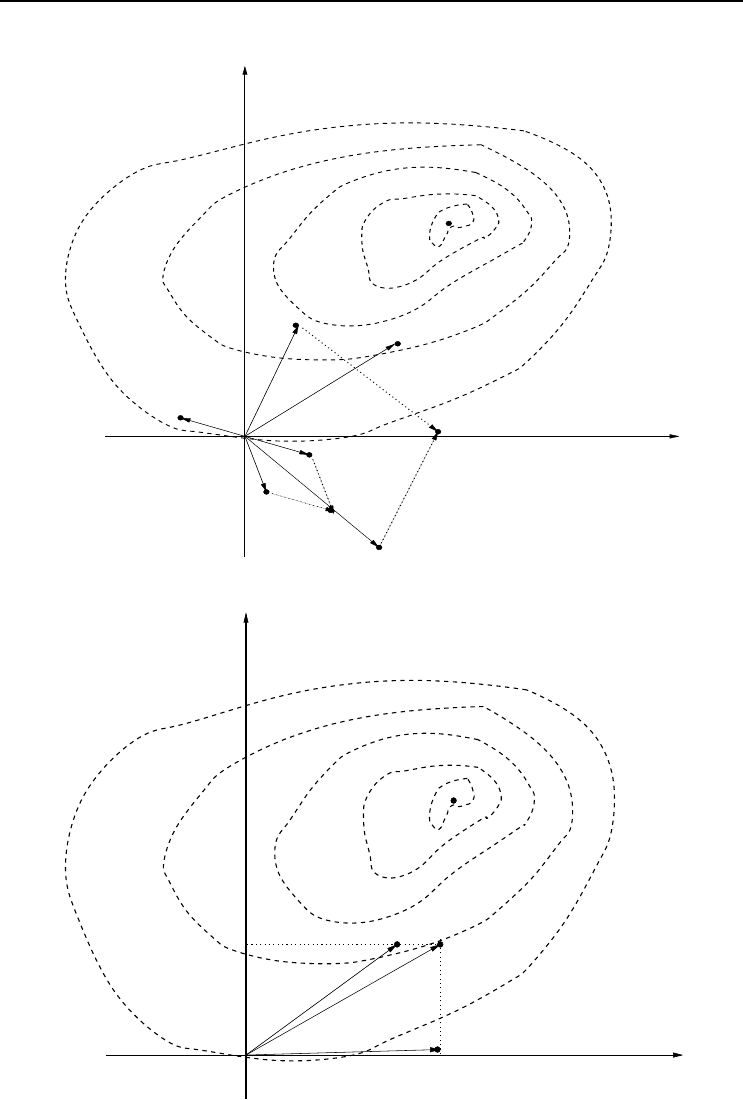
13.1.7 Geometrical Illustration
Figure 13.1(a) illustrates the mutation operator of the DE as described in Sec-
tion 13.1.2. The optimum is indicated by x
∗
, and it is assumed that β =1.5. The
crossover operator is illustrated in Figure 13.1(b). For this illustration the offspring
consists of the first element of the trial vector, u
i
(t), and the second element of the
parent, x
i
(t).
13.2 DE/x/y/z
A number of variations to the basic DE as discussed in Section 13.1 have been devel-
oped. The different DE strategies differ in the way that the target vector is selected,
the number of difference vectors used, and the way that crossover points are deter-
mined. In order to characterize these variations, a general notation was adopted in
the DE literature, namely DE/x/y/z [811, 813]. Using this notation, x refers to the
13.2 DE/x/y/z 243
x
∗
x
i
2
(t)
u
i
(t)
x
i
(t)
x
i
1
(t)
−x
i
3
(t)
β(x
i
2
(t) −x
i
3
(t))
x
i
3
(t)
x
i
2
(t) −x
i
3
(t)
x
i1
x
i2
(a) Mutation Operator
x
∗
u
i
(t)
x
i
(t)
x
i
(t)
x
i2
x
i1
(b) Crossover Operator
Figure 13.1 Differential Evolution Mutation and Crossover Illustrated

244 13. Differential Evolution
method of selecting the target vector, y indicates the number of difference vectors
used, and z indicates the crossover method used. The DE strategy discussed in Sec-
tion 13.1 is referred to as DE/rand/1/bin for binomial crossover, and DE/rand/1/exp
for exponential crossover. Other basic DE strategies include [429, 811, 813]:
• DE/best/1/z: For this strategy, the target vector is selected as the best in-
dividual,
ˆ
x(t), from the current population. In this case, the trial vector is
calculated as
u
i
(t)=
ˆ
x(t)+β(x
i
2
(t) − x
i
3
(t)) (13.4)
Any of the crossover methods can be used.
• DE/x/n
v
/z: For this strategy, more than one difference vector is used. The
trial vector is calculated as
u
i
(t)=x
i
1
(t)+β
n
v
k=1
(x
i
2
,k
(t) − x
i
3
,k
(t)) (13.5)
where x
i
2
,k
(t)−x
i
3
,k
(t) indicates the k-th difference vector, x
i
1
(t) can be selected
using any suitable method for selecting the target vector, and any of the crossover
methods can be used. With reference to equation (13.1), the larger the value of
n
v
, the more directions can be explored per generation.
• DE/rand-to-best/n
v
/z: This strategy combines the rand and best strategies
to calculate the trial vector as follows:
u
i
(t)=γ
ˆ
x(t)+(1− γ)x
i
1
(t)+β
n
v
k=1
(x
i
2
,k
(t) − x
i
3
,k
(t)) (13.6)
where x
i
1
(t) is randomly selected, and γ ∈ [0, 1] controls the greediness of the
mutation operator. The closer γ is to 1, the more greedy the search process
becomes. In other words, γ close to 1 favors exploitation while a value close to 0
favors exploration. A good strategy will be to use an adaptive γ,withγ(0) = 0.
The value of γ(t) increases with each new generation towards the value 1.
Note that if γ = 0, the DE/rand/y/z strategies are obtained, while γ =1gives
the DE/best/y/z strategies.
• DE/current-to-best/1+n
v
/z: With this strategy, the parent is mutated using
at least two difference vectors. One difference vector is calculated from the best
vector and the parent vector, while the rest of the difference vectors are calculated
using randomly selected vectors:
u
i
(t)=x
i
(t)+β(
ˆ
x(t) − x
i
(t)) + β
n
v
k=1
(x
i
1
,k
(t) − x
i
2
,k
(t)) (13.7)
Empirical studies have shown that DE/rand/1/bin maintains good diversity, while
DE/current-to-best/2/bin shows good convergence characteristics [698]. Due to this
observation, Qin and Suganthan [698] developed a DE algorithm that dynamically
switch between these two strategies. Each of these strategies is assigned a probability

13.3 Variations to Basic Differential Evolution 245
of being applied. If p
s,1
is the probability that DE/rand/1/bin will be applied, then
p
s,2
=1−p
s,1
is the probability that DE/current-to-best/2/bin will be applied. Then,
p
s,1
=
n
s,1
(n
s,2
+ n
f,2
)
n
s,2
(n
s,1
+ n
f,1
)+n
s,1
(n
s,2
+ n
f,2
)
(13.8)
where n
s,1
and n
s,2
are respectively the number of offspring that survive to the next
generation for DE/rand/1/bin, and n
f,1
and n
f,2
represent the number of discarded
offspring for each strategy. The more offspring that survive for a specific strategy, the
higher the probability for selecting that strategy for the next generation.
13.3 Variations to Basic Differential Evolution
The basic DE strategies have been shown to be very efficient and robust [811, 813,
811, 813]. A number of adaptations of the original DE strategies have been developed
in order to further improve performance. This section reviews some of these DE varia-
tions. Section 13.3.1 describe hybrid DE methods, a population-based DE is described
in Section 13.3.2, and self-adaptive DE strategies are discussed in Section 13.3.3.
13.3.1 Hybrid Differential Evolution Strategies
DE has been combined with other EAs, particle swarm optimization (PSO), and
gradient-based techniques. This section summarizes some of these hybrid methods.
Gradient-Based Hybrid Differential Evolution
One of the first DE hybrids was developed by Chiou and Wang [124], referred to
as the hybrid DE. As indicated in Algorithm 13.4, the hybrid DE introduces two
new operations: an acceleration operator to improve convergence speed – without
decreasing diversity – and a migration operator to provide the DE with the improved
ability to escape local optima.
The acceleration operator uses gradient descent to adjust the best individual toward
obtaining a better position if the mutation and crossover operators failed to improve
the fitness of the best individual. Let
ˆ
x(t) denote the best individual of the current
population, C(t), before application of the mutation and crossover operators, and let
ˆ
x(t + 1) be the best individual for the next population after mutation and crossover
have been applied to all individuals. Then, assuming a minimization problem, the
acceleration operator computes the vector
x(t)=
ˆ
x(t +1) if f (
ˆ
x(t +1))<f(
ˆ
x(t))
ˆ
x(t +1)− η(t)∇f otherwise
(13.9)
where η(t) ∈ (0, 1] is the learning rate, or step size; ∇f is the gradient of the objective
function, f . The new vector, x(t), replaces the worst individual in the new population,
C(t).

246 13. Differential Evolution
Algorithm 13.4 Hybrid Differential Evolution with Acceleration and Migration
Set the generation counter, t =0;
Initialize the control parameters, β and p
r
;
Create and initialize the population, C(0), of n
s
individuals;
while stopping condition(s) not true do
Apply the migration operator if necessary;
for each individual, x
i
(t) ∈C(t) do
Evaluate the fitness, f(x
i
(t));
Create the trial vector, u
i
(t) by applying the mutation operator;
Create an offspring, x
i
(t) by applying the crossover operator;
if f(x
i
(t)) is better than f(x
i
(t)) then
Add x
i
(t)toC(t +1);
end
else
Add x
i
(t)toC(t +1);
end
end
Apply the acceleration operator if necessary;
end
Return the individual with the best fitness as the solution;
The learning rate is initialized to one, i.e. η(0) = 1. If the gradient descent step failed
to create a new vector, x(t), with better fitness, the learning rate is reduced by a
factor. The gradient descent step is then repeated until η(t)∇f is sufficiently close to
zero, or a maximum number of gradient descent steps have been executed.
While use of gradient descent can significantly speed up the search, it has the disad-
vantage that the DE may get stuck in a local minimum, or prematurely converge. The
migration operator addresses this problem by increasing population diversity. This is
done by spawning new individuals from the best individual, and replacing the current
population with these new individuals. Individuals are spawned as follows:
x
ij
(t)=
#
ˆx
j
(t)+r
ij
(x
min,j
− ˆx
j
)ifU (0, 1) <
ˆx
j
−x
min,j
x
max,j
−x
min,j
ˆx
j
(t)+r
ij
(x
max,j
− ˆx
j
)otherwise
(13.10)
where r
ij
∼ U(0, 1). Spawned individual x
i
(t) becomes x
i
(t +1).
The migration operator is applied only when the diversity of the current population
becomes too small; that is, when
n
s
i=1
x
i
(t)=
ˆ
x(t)
I
ij
(t)
/(n
x
(n
s
− 1)) <
1
(13.11)

13.3 Variations to Basic Differential Evolution 247
with
I
ij
(t)=
1if|(x
ij
(t) − ˆx
j
(t))/ˆx
j
(t)| >
2
0otherwise
(13.12)
where
1
and
2
are respectively the tolerance for the population diversity and gene
diversity with respect to the best individual,
ˆ
x(t). If I
ij
(t) = 0, then the value of
the j-th element of individual i is close to the value of the j-th element of the best
individual.
Magoulas et al. [550] combined a stochastic gradient descent (SGD) [549] and DE in
a sequential manner to train artificial neural networks (NN). Here, SGD is first used
to find a good approximate solution using the process outlined in Algorithm 13.5. A
population of DE individuals is then created, with individuals in the neighborhood of
the solution returned by the SGD step. As outlined in Algorithm 13.6, the task of
DE is to refine the solution obtained from SGD by using then DE to perform a local
search.
Algorithm 13.5 Stochastic Gradient Descent for Neural Network Training
Initialize the NN weight vector, w(0);
Initialize the learning rate, η(0), and the meta-step size, η
m
;
Set the pattern presentation number, t =0;
repeat
for each training pattern, p do
Calculate E(w(t));
Calculate ∇E(w(t));
Update the weights using
w(t +1)=w(t)+η(t)∇E(w(t)) (13.13)
Calculate the new step size using
η(t +1)=η(t)+η
m
< ∇E(w(t − 1)), ∇E(w(t)) > (13.14)
t = t +1;
end
Return w(t + 1) as the solution;
until until a termination condition is satisfied;
In Algorithms 13.5 and 13.6, < •, • > denotes the inner product between the two
given vectors, E is the NN training objective function (usually the sum-squared error),
σ is the standard deviation of mutations to w used to create DE individuals in the
neighborhood of w,andD
T
is the training set. The DE algorithm uses the objective
function, E, to assess the fitness of individuals.