
Engelbrecht Andries P. Computational Intelligence: An Introduction
Подождите немного. Документ загружается.


228 12. Evolution Strategies
subintervals of equal length, where the s-th interval is computed as
I
js
=
'
x
min,j
+(s − 1)
x
max,j
− x
min,j
n
I
,x
min,j
+ s
x
max,j
− x
min,j
n
I
(
(12.42)
The fitness of interval I
js
is defined by
f(I
js
)=
µ
i=1
f
I
(x
ij
(t) ∈ I
js
)
˜
f(x
i
(t)) (12.43)
where
f
I
(x
ij
(t) ∈ I
js
)=
1ifx
ij
(t) ∈ I
js
0ifx
ij
(t) ∈ I
js
(12.44)
and
˜
f(x
i
(t)) is the normalized fitness of x
i
(t),
˜
f(x
i
(t)) =
f(x
i
(t)) − f
min
(t)
f
max
(t) − f
min
(t)
(12.45)
The minimum and maximum fitness of the current population is indicated by f
min
(t)
and f
max
(t) respectively.
Directed variation is applied to each component of each individual as follows. For
component x
ij
(t), the direction of mutation is determined by f(I
js
),f(I
j,s−1
)and
f(I
j,s+1
), where x
ij
(t) ∈ I
js
.Iff(I
js
) >f(I
j,s−1
)andf(I
js
) >f(I
j,s+1
), no directed
variation will be applied. If f(I
j,s−1
) >f(I
js
) >f(I
j,s+1
), then x
ij
(t)movestoward
subinterval I
j,s−1
with probability 1−
f(I
js
)
f(I
j,s−1
)
. The move is implemented by replacing
x
ij
(t) with a random number uniformly distributed between x
ij
(t) and the middle-
point of the interval I
j,s−1
. A similar approach is followed when f(I
j,s−1
) <f(I
js
) <
f(I
j,s+1
). If f (I
js
) <f(I
j,s−1
)andf(I
js
) <f(I
j,s+1
), then x
ij
(t)movestowardany
of its neighboring intervals with equal probability.
For the above, f(I
j0
)=f(I
j,n
I
+1
)=0.
Two approaches have been proposed to apply directed variation. For the first, directed
variation is applied, after selection, to the µ members of the new population. For the
second strategy, each parent produces one offspring using directed variation. Crossover
is then applied as usual to create the remaining λ−µ offspring. The selection operator
is applied to the µ parents, the µ offspring produced by directed variation, and the
λ − µ offspring produced by crossover.
12.5.3 Incremental Evolution Strategies
Incremental ES search for an optimal solution by dividing the search process into n
x
phases – one phase for each decision variable [597]. Each phase consists of two steps.
The first step applies a single variable evolution on the one decision variable, while the
second step applies a multi-variable evolution after the first phase. For phase numbers
less than n
x
, a context vector is needed to evaluate the fitness of the partially evolved
individual (similar to the CCGA and CPSO discussed in Sections 15.3 and 16.5.4).

12.6 Advanced Topics 229
12.5.4 Surrogate Evolution Strategy
Surrogate methods have been developed specifically for problems where the fitness
function is computationally expensive to evaluate. The fitness function is approx-
imated by a set of basis functions, called surrogates. Evaluation of the surrogate
model is computationally less expensive than the original function. The reader is
referred to [860] for more detail on surrogate models for ES.
12.6 Advanced Topics
This section shows how ES can be used to solve constrained problems (Section 12.6.1),
multi-objective optimization problems (Section 12.6.2), problems with dynamically
changing optima (Section 12.6.3), and to locate multiple optima (Section 12.6.4).
12.6.1 Constraint Handling Approaches
While a number of ES variations have been developed to cope with constraints, this
section discusses only some of these approaches.
Tahk and Sun [830] converted the constrained problem to an unconstrained problem
using the augmented Lagrangian approach given in Section A.6.2. A coevolutionary
approach is used to find the saddle point, (x
∗
,λ
∗
g
,λ
∗
h
), of the Lagrangian given in equa-
tion (A.27). Two populations are used, each with different objectives, both evolved in
parallel. Assuming a minimization problem, the one population minimizes the fitness
function,
f(x)=max
λ
g
,λ
h
L(x,λ
g
,λ
h
) (12.46)
where L(x ,λ
g
,λ
h
) is defined in equation (A.27). The second population maximizes
the fitness function,
f(λ
g
,λ
h
)=min
x
L(x,λ
g
,λ
h
) (12.47)
Both populations use an ES as search algorithm.
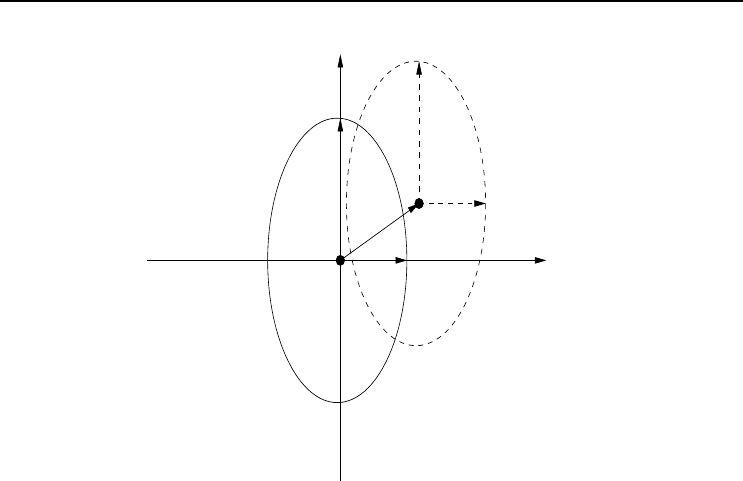
Kramer et al. [488] developed a biased mutation operator to lead the search to more
promising, feasible areas. The mean of the Gaussian distribution, from which muta-
tional step sizes are sampled, is biased to shift the center of the mutation distribution
as illustrated in Figure 12.3.
Let ξ
i
(t)=(ξ
i1
(t),...,ξ
in
x
(t)) be the bias coefficient vector, with ξ
ij
(0) ∼ U(−1, 1),
for all j =1,...,n
x
. The bias vector, β
i
(t), is then defined as β
ij
(t)=σ
ij
(t)ξ
ij
(t).
Mutational step sizes are calculated as
∆x
ij
(t)=σ
ij
(t)N
j
(0, 1) + β
ij
(t)=N
j
(ξ
ij
(t),σ
ij
(t)) (12.48)
Bias coefficients are self-adapted using
ξ
ij
(t)=ξ
ij
(t)+αN(0, 1) (12.49)
230 12. Evolution Strategies
x
2
x
1
x
i
β
x
i
σ
1
σ
2
σ
2
σ
1
Figure 12.3 Biased Mutation for Evolution Strategies
with α =0.1 (suggested in [488]).
A very simple approach to handle constraints is to change the selection operator to
select the next population as follows: Until µ individuals have been selected,
• First select the best feasible individuals.
• If all feasible solutions have been selected, select those that violate the fewest
constraints.
• As last resort, when individuals are infeasible, and they violate the same number
of constraints, select the most fit individuals.
When a selection operator is applied to select one of two individuals, the following
rules can be applied:
• If both are feasible, select the one with the best fitness.
• If one is feasible, and the other infeasible, select the feasible solution.
• If both are infeasible, select the one that violates the fewest constraints. If
constraint violation is the same, select the most fit individual.
12.6.2 Multi-Objective Optimization
One of the first, simple ES for solving multi-objective (MOO) problems was devel-
oped by Knowles and Corne [469]. The Pareto archived evolution strategy (PAES)

12.6 Advanced Topics 231
consists of three parts: (1) a candidate solution generator, (2) the candidate solution
acceptance function, and (3) the nondominated-solutions archive.
The candidate solution generator is an (1 + 1)-ES, where the individual that survives
to the next generation is based on dominance. If the parent dominates the offspring,
the latter is rejected, and the parent survives. If the offspring dominates the parent,
the offspring survives to the next generation. If neither the parent nor the offspring is
dominating, the offspring is compared with the nondominated solutions in the archive,
as summarized in Algorithm 12.4.
The archive maintains a set of nondominated solutions to the MOO. The size of the
archive is restricted. When an offspring dominates the current solutions in the archive,
it is included in the archive. When the offspring is dominated by any of the solutions
in the archive, the offspring is not included in the archive. When the offspring and
the solutions in the archive are nondominating, the offspring is accepted and included
in the archive based on the degree of crowding in the corresponding area of objective
space.
To keep track of crowding, a grid is defined over objective space, and for each cell of the
grid a counter is maintained to keep track of the number of nondominated solutions
for that part of the Pareto front. When an offspring is accepted into the archive, and
the archive has reached its capacity, the offspring replaces one of the solutions in the
highest populated grid cell (provided that the grid cell corresponding to the offspring
has a lower frequency count). When the parent and its offspring are nondominating,
the one with the lower frequency count is accepted in the archive.
The PAES is summarized in Algorithm 12.3.
Costa and Oliveira [159] developed a different approach to ensure that nondominated
solutions survive to next generations, and to produce diverse solutions with respect to
objective space. Fitnesses of individuals are based on a Pareto ranking, where individ-
uals are grouped into a number of Pareto fronts. An individual’s fitness is determined
based on the Pareto front in which the individual resides. At each generation, the
Pareto ranking process proceeds as follows. All of the nondominated solutions from
the λ offspring, or µ + λ parents and offspring, form the first Pareto front. These
individuals are then removed, and the nondominating solutions from the remainder of
the individuals form the second Pareto front. This process of forming Pareto fronts
continues until all λ (or µ + λ) individuals are assigned to a Pareto front. Individuals
of the first Pareto front is assigned a fitness of 1/n
c
,wheren
c
is the niche count. The
niche count is the number of individuals in this front that lies within a distance of
σ
share
from the individual (distance is measured with respect to objective space). The
threshold, σ
share
, is referred to as the niche radius. Individuals of the next Pareto
front is assigned a fitness of (1 + f
worst
)/n
c
,wheref
worst
is the worst fitness from the
previous front. This process of fitness assignment continues until all individuals have
been assigned a fitness.
The fitness sharing approach described above promotes diversity of nondominated
solutions. The process of creating Pareto fronts ensures that dominated individuals are
excluded from future generations as follows: Depending on the ES used, µ individuals

232 12. Evolution Strategies
Algorithm 12.3 Pareto Archived Evolution Strategy
Set generation counter;
Generate a random parent solution;
Evaluate the parent;
Add the parent to the archive;
while stopping condition(s) not true do
Create offspring through mutation;
Evaluate offspring;
if offspring is not dominated by parent then
Compare offspring with solutions in the archive;
Update the archive using Algorithm 12.4;
if offspring dominated parent then
Offspring survives to new generation to become the parent;
end
else
//nondominating case
Select the individual that maps to the grid cell with lowest frequency
count;
end
end
end
Algorithm 12.4 Archive Update Algorithm used by PAES
Input: A candidate solution and an archive of nondominated solutions;
Output: An updated archive;
if candidate is dominated by any member of the archive then
Reject the candidate;
end
else
if candidate dominates any s olutions in the archive then
Remove all dominated members from the archive;
Add candidate to the archive;
end
else
if archive is full then
if candidate will increase diversity in the archive then
Remove the solution with the highest frequency from the archive;
end
Add candidate to the archive;
end
end
end

12.6 Advanced Topics 233
are selected from λ or µ + λ individuals to form the new population. Individuals are
sorted according to their fitness values in ascending order. If the number of individuals
in the first front is greater than µ, the next population is selected from the first front
individuals using tournament selection. Otherwise the best µ individuals are selected.
An archive of fixed size is maintained to contain a set of nondominated solutions, or
elite. A specified number of these solutions are randomly selected and included in the
next population.
At each generation, each Pareto optimal solution of the current population is tested
for inclusion in the archive. The candidate solution is included if
• all solutions in the archive are different from the candidate solution, thereby
further promoting diversity,
• none of the solutions in the archive dominates the candidate solution, and
• the distance between the candidate and any of the solutions in the archive is
larger than a defined threshold.
Other ES approaches to solve MOPs can be found in [395, 464, 613, 637].
12.6.3 Dynamic and Noisy Environments
Beyer [61, 62, 63, 64] provided the first theoretical analyses of ES. In [61] Beyer made
one of the first statements claiming that ES are robust against disturbances of the
search landscape. B¨ack and Hammel [42] provided some of the first empirical results
to show that low levels of noise in the objective function do not have an influence on
performance. Under higher noise levels, they recommended that the (µ, λ)-ES, with
µ>1 be used, due to its ability to maintain diversity. In a more elaborate study,
B¨ack [40] reconfirmed these statements and showed that the (µ, λ)-ES was perfectly
capable to track dynamic optima for a number of different dynamic environments.
Markon et al. [562] showed that (µ + λ)-ES with threshold-selection is capable of
optimizing noisy functions. With threshold-selection an offspring is selected only if its
performance is better than its parents by a given margin.
Arnold and Beyer [32] provided a study of the performance of ES on noisy functions,
where noise is generated from a Gaussian, Cauchy, or χ
2
1
distribution. Beyer [65] and
Arnold [31] showed that rescaled mutations improve the performance of ES on noisy
functions. Under rescaled mutations, mutational step sizes are multiplied by a scaling
factor (which is greater than one) to allow larger step sizes, while preventing that these
large step sizes are inherited by offspring. Instead, the smaller step sizes are inherited.
12.6.4 Niching
In order to locate multiple solutions, Aichholzer et al. [12] developed a multipopulation
ES, referred to as the τ (µ/ρ, κ, λ)-ES, where τ is the number of subpopulations and κ
specifies the number of generations that each individual is allowed to survive. Given τ

234 12. Evolution Strategies
clusters, recombination proceeds as follows: One of the clusters is randomly selected,
and roulette wheel selection is used to select one of the individuals from this cluster
as one of the parents. The second parent is selected from any cluster, but such that
individuals from remote clusters are selected with a low probability. Over time, clusters
tend to form over local minima.
Shir and B¨ack [785] proposed a dynamic niching algorithm for ES that identifies fitness-
peaks using a peak identification algorithm. Each fitness-peak will correspond to one
of the niches. For each generation, the dynamic niche ES applies the following steps:
The mutation operator is applied to each individual. After determination of the fitness
of each individual, the dynamic peak identification algorithm is applied to identify n
K
niches. Individuals are assigned to their closest niche, after which recombination is
applied within niche boundaries. If required, niches are populated with randomly
generated individuals.
If n
K
niches have to be formed, they are created such that their peaks are a distance
of at least
r
n
x
√
n
K
from one another, where
r =
1
2
n
x
j=1
(x
max,j
− x
min,j
)
2
(12.50)
Peaks are formed from the current individuals of the population, by sequentially con-
sidering each as a fitness peak. If an individual is
r
n
x
√
n
K
from already defined fitness
peaks, then that individual is considered as the next peak. This process continues
until n
K
peaks have been found or until all individuals have been considered.
Recombination considers a uniform distribution of resources. Each peak is allowed
˜µ =
µ
n
K
parents, and produces
˜
λ =
λ
n
K
offspring in every generation. For each
peak,
˜
λ offspring are created as follows: One of the parents is selected from the
individuals of that niche using tournament selection. The other parent, which should
differ from the first parent, is selected as the best individual of that niche. If a niche
contains only one individual, the second parent will be the best individual from another
niche. Intermediate recombination is used for the strategy parameters, and discrete
recombination for the genotypes.
The selection operator selects ˜µ individuals for the next generation by selecting n
˜
λ
of
the best
˜
λ offspring, along with the best ˜µ − n
˜
λ
parents from that niche. If there are
not enough parents to make up a total of ˜µ individuals, the remainder is filled up by
generating random individuals.
New niches are generated at each generation. Repeated application of the above
process results in niches, where each niche represents a different solution.
Shir and B¨ack [785] expanded the approach above to a (1,λ)-ES with corrrelated
mutations.

12.7 Applications of Evolution Strategies 235
Table 12.1 Applications of Evolution Strategies
Application Class References
Parameter optimization [256, 443, 548, 679]
Controller design [59, 456, 646]
Induction motor design [464]
Neural network training [59, 550]
Transformer design [952]
Computer security [52]
Power systems [204]
12.7 Applications of Evolution Strategies
The first application of ES was in experimental optimization as applied to hydrody-
namical problems [708]. Since then most new ES implementations were tested on
functional optimization problems. ES have, however, been applied to a number of
real-world problems, as summarized in Table 12.1 (note that this is not an exhaustive
list of applications).
12.8 Assignments
1. Discuss the differences and similarities between ES and EP.
2. Can an ES that utilizes strategy parameters be considered a cultural algorithm?
Motivate your answer.
3. Determine if the reward scheme as given in equation (12.20) is applicable to
minimization or maximization tasks. If it is for minimization (maximization)
show how it can be changed for maximization (minimization).
4. Identify problems with the reinforcement learning approach where the reward
is proportional to changes in phenotypic space. Do the same for the approach
where reward is proportional to step sizes in decision (genetic) space.
5. Implement an (1 + λ)-ES to train a FFNN on any problem of your choice, and
compare its performance with an (µ +1)-ES,(µ + λ)-ES, and (µ, λ)-ES.
6. Evaluate the following approaches to initialize deviation strategy parameters:
(a) For all individuals, the same initial value is used for all components of the
genotype, i.e.
σ
ij
(0) = σ(0), ∀i =1,...,n
s
, ∀j =1,...,n
x
where σ(0) = α min
j=1,...,n
x
{|x
max,j
− x
min,j
|} with α =0.9.
(b) The same as above, but α =0.1.

236 12. Evolution Strategies
(c) For each individual, a different initial value is used, but the same for each
component of the genotype, i.e.
σ
ij
(0) = σ
i
(0), ∀j =1,...,n
x
where σ
i
(0) ∼ U (0,αmin
j=1,...,n
x
{|x
max,j
− x
min,j
|})forα =0.9andα =
0.1.
(d) The same as above, but with σ
i
(0) ∼|N(0,αmin
j=1,...,n
x
{|x
max,j
−
x
min,j
|})| for α =0.9andα =0.1.
(e) Each component of each genotype uses a different initial value, i.e.
σ
ij
(0) ∼|N(0,α min
j=1,...,n
x
{|x
max,j
−x
min,j
|})|, ∀i =1,...,n
s
, ∀j =1,...,n
x
for α ∼ U(0, 1).
7. Discuss the advantages of using a lifespan within (µ, κ, λ)-ES compared to (µ, λ)-
ES.
8. True or false: (µ + λ)-ES implements a hill-climbing search. Motivate your
answer.

Chapter 13
Differential Evolution
Differential evolution (DE) is a stochastic, population-based search strategy developed
by Storn and Price [696, 813] in 1995. While DE shares similarities with other evolu-
tionary algorithms (EA), it differs significantly in the sense that distance and direction
information from the current population is used to guide the search process. Further-
more, the original DE strategies were developed to be applied to continuous-valued
landscapes.
This chapter provides an overview of DE, organized as follows: Section 13.1 discusses
the most basic DE strategy and illustrates the method of adaptation. Alternative DE
strategies are described in Sections 13.2 and 13.3. Section 13.4 shows how the original
DE can be applied to discrete-valued and binary-valued landscapes. A number of
advanced topics are covered in Section 13.5, including multi-objective optimization
(MOO), constraint handling, and dynamic environments. Some applications of DE
are summarized in Section 13.6.
13.1 Basic Differential Evolution
For the EAs covered in the previous chapters, variation from one generation to the next
is achieved by applying crossover and/or mutation operators. If both these operators
are used, crossover is usually applied first, after which the generated offspring are
mutated. For these algorithms, mutation step sizes are sampled from some probability
distribution function. DE differs from these evolutionary algorithms in that
• mutation is applied first to generate a trial vector, which is then used within the
crossover operator to produce one offspring, and
• mutation step sizes are not sampled from a prior known probability distribution
function.
In DE, mutation step sizes are influenced by differences between individuals of the
current population.
Section 13.1.1 discusses the concept of difference vectors, used to determine muta-
tion step sizes. The mutation, crossover, and selection operators are described in
Sections 13.1.2 to 13.1.4. Section 13.1.5 summarizes the DE algorithm, and control
Computational Intelligence: An Introduction, Second Edition A.P. Engelbrecht
c
2007 John Wiley & Sons, Ltd
237