
Engelbrecht Andries P. Computational Intelligence: An Introduction
Подождите немного. Документ загружается.


218 12. Evolution Strategies
which is the product of n
x
(n
x
−1)/2 rotation matrices. Each rotation matrix R
lj
(ω
i
)
is a unit matrix with r
ll
=cos(ω
ik
)andr
lj
= −r
jl
= −sin(ω
ik
), with k =1⇔ (l =
1,j =2),k =2⇔ (l =1,j =3), ···. The rotational matrix is used by the mutation
operator as described in Section 12.4.3.
12.3.2 Strategy Parameter Variants
As discussed in Section 12.3.1, the two types of strategy parameters that have been
used are the standard deviation of mutational step sizes, and rotational angles that
represent covariances of mutational step sizes. These strategy parameters have resulted
in a number of self-adaptation variants [39, 364]. For the discussion below, let n
σ
denote the number of deivation parameters used, and n
ω
the number of rotational
angles. The following cases have been used:
• n
σ
=1,n
ω
= 0, i.e. only one deviation parameter is used (σ
j
= σ ∈ R
+
,j =
1,...,n
x
) for all components of the genotype, and no rotational angles. The
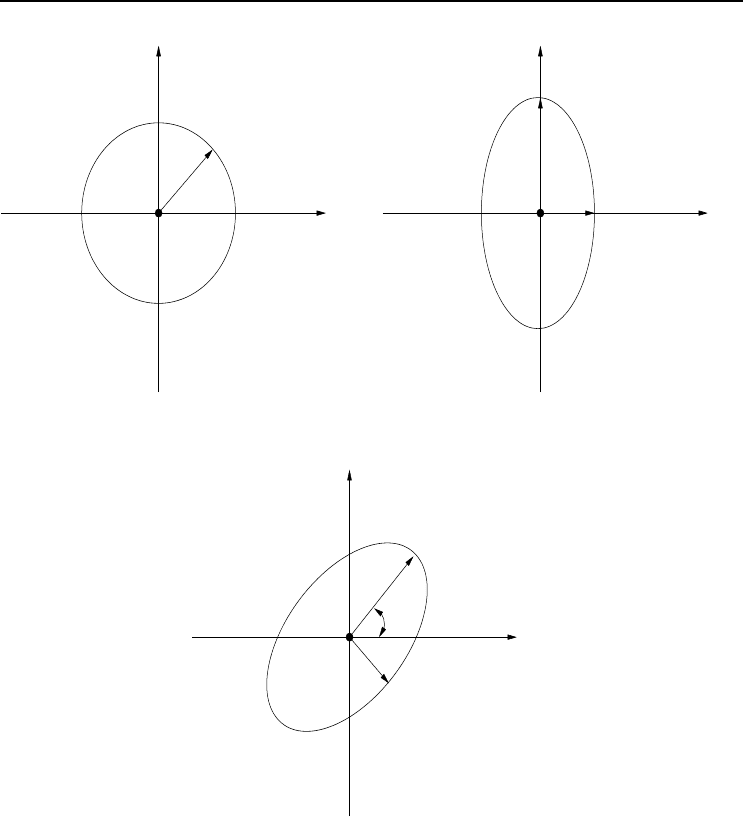
mutation distribution has a circular shape as illustrated in Figure 12.1(a). The
middle of the circle indicates the position of the parent, x
i
, while the boundary
indicates the deviation in step sizes. Keep in mind that this distribution indicates
the probability of the position of the offspring, x
i
, with the highest probability
at the center.
The strategy parameter is adjusted as follows:
σ
i
(t)=σ
i
(t)e
τN(0,1)
(12.15)
where τ =
1
√
n
x
.
While adjustment of the single parameter is computationally fast, the approach
is not flexible when the coordinates have different gradients.
• n
σ
= n
x
,n
ω
= 0, in which each component has its own deviation parameter.
The mutation distribution has an elliptic shape as illustrated in Figure 12.1(b),
where σ
1
<σ
2
. In this case the increased number of parameters causes a linear
increase in computational complexity, but the added degrees of freedom provide
for better flexibility. Different gradients along the coordinate axes can now be
taken into consideration.
Strategy parameters are updated as follows:
σ
ij
(t)=σ
ij
(t)e
τ
N(0,1)+τN
j
(0,1)
(12.16)
where τ
=
1
√
2n
x
and τ =
1
√
2
√
n
x
.
• n
σ
= n
x
,n
ω
= n
x
(n
x
− 1)/2, where in addition to the deviations, rotational
angles are used. The elliptical mutation distribution is rotated with respect to
the coordinate axes as illustrated in Figure 12.1(c). Such rotations allow better
approximation of the contours of the search space.
Deviation parameters are updated using equation (12.16), while rotational angles
are updated using,
ω
ik
(t)=ω
ik
(t)+γN
j
(0, 1) mod 2π (12.17)
12.3 Strategy Parameters and Self-Adaptation 219
x
2
x
1
x
i
σ
(a) n
σ
=1,n
ω
=0
x
2
x
1
x
i
σ
1
σ
2
(b) n
σ
= n
x
,n
ω
=0
x
2
x
1
σ
1
ω
σ
2
x
i
(c) n
σ
= n
x
,n
ω
= n
x
(n
x
− 1)/2
Figure 12.1 Illustration of Mutation Distributions for ES
where γ ≈ 0.0873 [39].
Adding the rotational angles improves flexibility, but at the cost of a quadratic
increase in computational complexity.
• 1 <n
σ
<n
x
: This approach allows for different degrees of freedom. For all
j>n
σ
,deviationσ
n
σ
is used.
12.3.3 Self-Adaptation Strategies
The most frequently used approach to self-adapt strategy parameters is the lognor-
mal self-adaptation mechanism used above in Section 12.3.2. Additive methods as

220 12. Evolution Strategies
discussed in Section 11.3.3 for EP can also be used.
Lee et al. [507] and M¨uller et al. [614] proposed that reinforcement learning be used
to adapt strategy parameters, as follows:
σ
ij
(t)=σ
ij
(t)e
Θ
i
(t)|τ
N(0,1)+τN
j
(0,1)|
(12.18)
where Θ
i
(t) is the sum of temporal rewards over the last n
Θ
generations for individual
i, i.e.
Θ
i
(t)=
1
n
Θ
n
Θ
t
=0
θ
i
(t − t
) (12.19)
Different methods can be used to calculate the reward for each individual at each time
step. Lee et al. [507] proposed that
θ
ij
(t)=
0.5if∆f(x
i
(t)) > 0
0if∆f(x
i
(t)) = 0
−1if∆f(x
i
(t)) < 0
(12.20)
where deterioration in fitness is heavily penalized. In equation (12.20),
∆f(x
i
(t)) = f(x
i
(t)) − f(x
i
(t − 1)) (12.21)
M¨uller et al. [614] suggested a reward of +1, 0or−1 depending on performance.
Alternatively, they suggested that
• θ
ij
(t)=f(x
i
(t)) −f(x
i
(t −∆t)), with 0 < ∆t<t. This approach bases rewards
on changes in phenotypic behavior, as quantified by the fitness function. The
more an individual improves its current fitness, the greater the reward. On
the other hand the worse the fitness of the individual becomes, the greater the
penalty for that individual.
• θ
ij
(t) = sign(f(x
i
(t)) −f(x
i
(t −∆t))). This scheme results in +1, 0, −1rewards.
• θ
ij
(t)=||x
i
(t) −x
i
(t − ∆t)||sign(f(x
i
(t)) −f(x
i
(t −∆t))). Here the reward (or
punishment) is proportional to the step size in decision (genotypic) space.
Ostermeier and Hansen [645] considered a self-adaptation scheme where n
σ
=1and
where a covariance matrix is used. In this scheme, the deviation of an offspring is
calculated as a function of the deviations of those parents from which the offspring
has been derived. For each offspring, x
l
(t),l =1,...,λ,
σ
l
(t)=
ρ
!
i∈Ω
l
(t)
σ
i
(t)
e
ξ
(12.22)
where Ω
l
(t) is the index set of the ρ parents of offspring x
l
(t), and the distribution of
ξ is such that prob(ξ =0.4) = prob(ξ = −0.4) = 0.5. Section 12.4.3 shows how this
self-adaptation scheme is used in a coordinate system independent mutation operator.

12.4 Evolution Strategy Operators 221
Kursawe [492] used a self-adaptation scheme where 1 ≤ n
σ
≤ n
x
, and each individual
uses a different number of deviation parameters, n
σ
i
(t). At each generation, t,the
number of deviation parameters can be increased or decreased at a probability of 0.05.
If the number of deviation parameters increases, i.e. n
σ
i
(t)=n
σ
i
(t −1), then the new
deviation parameter is initialized as
σ
in
σ,i
(t)
(t)=
1
n
σ,i
(t − 1)
n
σ,i
(t−1)
k=1
σ
ik
(t) (12.23)
12.4 Evolution Strategy Operators
Evolution strategies use the three main operators of EC, namely selection, crossover,
and mutation. These operators are discussed in Sections 12.4.1, 12.4.2, and 12.4.3
respectively.
12.4.1 Selection Operators
Selection is used for two tasks in an ES: (1) to select parents that will take part in
the recombination process and (2) to select the new population. For selecting the ρ
parents for the crossover operator, any of the selection methods reviewed in Section 8.5
can be used. Usually, parents are randomly selected.
For each generation, λ offspring are generated from µ parents and mutated. After
crossover and mutation, the individuals for the next generation are selected. Two
main strategies have been developed:
• (µ + λ) − ES: In this case (also referred to as the plus strategies) the ES
generates λ offspring from µ parents, with 1 ≤ µ ≤ λ<∞. The next generation
consists of the µ best individuals selected from µ parents and λ offspring. The
(µ+λ)−ES strategy implements elitism to ensure that the fittest parents survive
to the next generation.
• (µ, λ) − ES: In this case (also referred to as the comma strategies), the next
generation consists of the µ best individuals selected from the λ offspring. Elitism
is not used, and therefore this approach exhibits a lower selective pressure than
the plus strategies. Diversity is therefore larger than for the plus strategies, which
results in better exploration. The (µ, λ) − ES requires that 1 ≤ µ<λ<∞.
Using the above notation, ES are collectively referred to as (µ
+
,λ)-ES. The (µ + λ)
notation has been extended to (µ, κ, λ), where κ denotes the maximum lifespan of
an individual. If an individual exceeds its lifespan, it is not selected for the next
population. Note that (µ, λ)-ES is equivalent to (µ, 1,λ)-ES.
The best selection strategy to use depends on the problem being solved. Highly convo-
luted search spaces need more exploration, for which the (µ, λ)-ES are more applicable.

222 12. Evolution Strategies
Because information about the characteristics of the search space is usually not avail-
able, it is not possible to say which selection scheme will be more appropriate for an
arbitrary function. For this reason, Huang and Chen [392] developed a fuzzy con-
troller to decide on the number of parents that may survive to the next generation.
The fuzzy controller receives population diversity measures as input, and attempts to
balance exploration against exploitation.
Runarsson and Yao [746] developed a continuous selection method for ES, which is
essentially a continuous version of (µ, λ)-ES. The basis of this selection method is that
the population changes continuously, and not discretely after each generation. There
is no selection of a new population at discrete generational intervals. Selection is only
used to select parents for recombination, based on a fitness ranking of individuals. As
soon as a new offspring is created, it is inserted in the population and the ranking is
immediately updated. The consequence is that, at each creation of an offspring, the
worst individual among the µ parents and offspring is eliminated.
12.4.2 Crossover Operators
In order to introduce recombination in ES, Rechenberg [709] proposed that the (1+1)-
ES be extended to a (µ + 1)-ES (refer to Section 12.1). The (µ + 1)-ES is therefore
the first ES that utilized a crossover operator. In ES, crossover is applied to both
the genotype (vector of decision variables) and the strategy parameters. Crossover is
implemented somewhat differently from other EAs.
Crossover operators differ in the number of parents used to produce a single offspring
and in the way that the genetic material and strategy parameters of the parents are
combined to form the offspring. In general, the notation (µ/ρ,
+
,λ) is used to indicate
that ρ parents are used per application of the crossover operator. Based on the value
of ρ, the following two approaches can be found:
• Local crossover (ρ = 2), where one offspring is generated from two randomly
selected parents.
• Global crossover (2 <ρ≤ µ), where more than two randomly selected parents
are used to produce one offspring. The larger the value of ρ, the more diverse
the generated offspring is compared to smaller ρ values. Global crossover with
large ρ improves the exploration ability of the ES.
In both local and global crossover, recombination is done in one of two ways:
• Discrete recombination, where the actual allele of parents are used to con-
struct the offspring. For each component of the genotype or strategy parameter
vectors, the corresponding component of a randomly selected parent is used.
The notation (µ/ρ
D
+
,λ) is used to denote discrete recombination.
• Intermediate recombination, where allele for the offspring is a weighted
average of the allele of the parents (remember that floating-point representations
are assumed for the genotype). The notation (µ/ρ
I
+
,λ) is used to denote
intermediate recombination.

12.4 Evolution Strategy Operators 223
Based on the above, five main types of recombination have been identified for ES:
• No recombination: If χ
i
(t) is the parent, the offspring is simply ˜χ
l
(t)=χ
i
(t).
• Local, discrete recombination,where
˜χ
lj
(t)=
χ
i
1
j
(t)ifU
j
(0, 1) ≤ 0.5
χ
i
2
j
(t)otherwise
(12.24)
The offspring, ˜χ
l
(t)=(
˜
x
l
(t), ˜σ
l
(t), ˜ω
l
(t)) inherits from both parents, χ
i
1
(t)=
(x
i
1
(t),σ
i
1
(t),ω
1
(t)) and χ
i
2
(t)=(x
i
2
(t),σ
i
2
(t),ω
i
2
(t)).
• Local, intermediate recombination,where
˜x
lj
(t)=rx
i
1
j
(t)+(1−r)x
i
2
j
(t), ∀j =1,...,n
x
(12.25)
and
˜σ
lj
(t)=rσ
i
1
j
(t)+(1−r)σ
i
2
j
(t), ∀j =1,...,n
x
(12.26)
with r ∼ U(0, 1). If rotational angles are used, then
ω
lk
(t)=[rω
i
1
k
(t)+(1− r)σ
i
2
k
(t)] mod 2π, ∀k =1,...,n
x
(n
x
− 1) (12.27)
• Global, discrete recombination,where
˜χ
lj
(t)=
χ
i
1
j
(t)ifU
j
(0, 1) ≤ 0.5
χ
r
j
j
(t)otherwise
(12.28)
with r
j
∼ Ω
l
;Ω
l
is the set of indices of the ρ parents selected for crossover.
• Global, intermediate recombination, which is similar to the local recombi-
nation above, except that the index i
2
is replaced with r
j
∼ Ω
l
. Alternatively,
the average of the parents can be calculated to form the offspring [62],
˜χ
l
(t)=
1
ρ
ρ
i=1
x
i
(t),
1
ρ
ρ
i=1
σ
i
(t),
1
ρ
ρ
i=1
ω
i
(t)
(12.29)
Izumi et. al. [409] proposed an arithmetic recombination between the best individual
and the average over all the parents:
˜x
l
(t)=r
ˆ
y(t)+(1− r)
1
ρ
ρ
i∈Ω
l
x
i
(t) (12.30)
where
ˆ
y(t) is the best individual of the current generation. The same can be applied to
the strategy parameters. This strategy ensures that offspring are located around the
best individual. However, care must be taken as this operator may cause premature
stagnation, especially for large r.

224 12. Evolution Strategies
12.4.3 Mutation Operators
Offspring produced by the crossover operator are all mutated with probability one.
The mutation operator executes two steps for each offspring:
• The first step self-adapts strategy parameters as discussed in Sections 12.3.2 and
12.3.3.
• The second step mutates the offspring, ˜χ
l
, to produce a mutated offspring, χ
l
,
as follows
x
l
(t)=˜x
l
(t)+∆x
l
(t) (12.31)
The λ mutated offspring, χ
l
(t)=(x
l
(t), ˜σ
l
(t), ˜ω
l
(t)) take part in the selection
process, together with the parents depending on whether a (µ + λ)-ES or a
(µ, λ)-ES is used.
This section considers only mutation of the genotype, as mutation (self-adaptation) of
the strategy parameters has been discussed in previous sections.
If only deviations are used as strategy parameters, the genotype,
˜
x
l
(t), of each off-
spring, ˜χ
l
(t),l=1,...,λ, is mutated as follows:
• If n
σ
=1,∆x
lj
(t)=σ
l
(t)N
j
(0, 1), ∀j =1,...,n
x
.
• If n
σ
= n
x
,∆x
lj
(t)=σ
lj
(t)N
j
(0, 1), ∀j =1,...,n
x
• If 1 <n
σ
<n
x
,∆x
lj
(t)=σ
lj
(t)N
j
(0, 1), ∀j =1,...,n
σ
and ∆x
lj
(t)=
σ
ln
σ
(t)N
j
(0, 1), ∀j = n
σ
+1,...,n
x
If deviations and rotational angles are used, assuming that n
σ
= n
x
,then
∆x
l
(t)=T(˜ω
l
(t))S(˜σ
l
(t))N(0, 1) (12.32)
where T(˜ω
l
(t)) is the orthogonal rotation matrix,
T(˜ω
l
(t)) =
n
x
−1
a=1
n
x
b=a+1
R
ab
(˜ω
l
(t)) (12.33)
which is a product of n
x
(n
x
−1)/2 rotation matrices. Each rotation matrix, R
ab
(˜ω
l
(t)),
is a unit matrix with each element defined as follows: r =cos(˜ω
lk
)andr
ab
= −r
ba
=
−sin(˜ω
lk
), for k =1,...,n
x
(n
x
−1)/2andk =1⇔ (a =1,b=2),k=2⇔ (a =1,b=
3),.... S(˜σ
l
(t)) = diag(˜σ
l1
(t), ˜σ
l2
(t),...,˜σ
ln
x
(t)) is the diagonal matrix representation
of deviations.
Based on similar reasoning as for EP (refer to Section 11.2.1), Yao and Liu [935]
replaced the Gaussian distribution with a Cauchy distribution to produce the fast ES.
Huband et al. [395] developed a probabilistic mutation as used in GAs and GP, where
each component of the genotype is mutated at a given probability. It is proposed that
the probability of mutation be 1/n
x
. This approach imposes a smoothing effect on
search trajectories.
Hildebrand et al. [364] proposed a directed mutation, where preference can be given
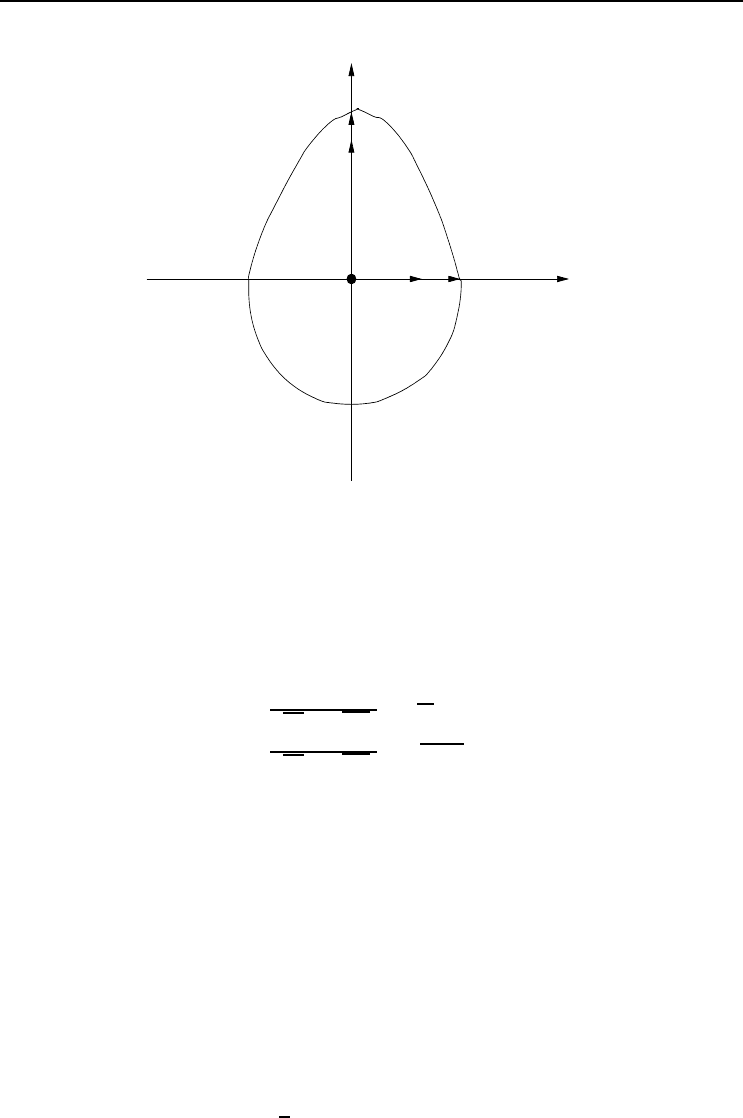
to specific coordinate directions. As illustrated in Figure 12.2, the directed mutation
12.4 Evolution Strategy Operators 225
x
1
x
i
c
1
σ
2
c
2
x
i
σ
1
x
2
Figure 12.2 Directed Mutation Operator for ES
results in an asymmetrical mutation probability distribution. Here the step size is
larger for the x
2
axis than for the x
1
axis, and positive directions are preferred. As
each component of the genotype is mutated independently, it is sufficient to define a
1-dimensional asymmetrical probability density function. Hildebrand et al. proposed
the function,
f
D
(x)=
2
√
πσ(1+
√
1+c)
e
−
x
2
σ
if x<0
2
√
πσ(1+
√
1+c)
e
−
x
2
σ(1+c)
if x ≥ 0
(12.34)
where c>0 is the positive directional value.
The directional mutation method uses only deviations as strategy parameters, but as-
sociates a directional value, c
j
, with each deviation, σ
j
.Bothσ and c are self-adapted,
giving a total of 2n
x
strategy parameters. This is computationally more efficient than
using a n
x
(n
x
− 1)/2-sized rotational vector, and provides more information about
preferred search directions and step sizes than deviations alone.
If D(c, σ) denotes the asymmetric distribution, then ∆x
ij
(t)=D
j
(c
ij
(t),σ
ij
(t)).
Ostermeier and Hansen [645] developed a coordinate system invariant mutation oper-
ator, with self-adaptation as discussed in Section 12.3.3. Genotypes are mutated using
both deviations and correlations, as follows:
x
l
(t)=
1
ρ
i∈Ω
l
(t)
x
i
(t)+˜σ
l
N(0, C
l
(t)) (12.35)

226 12. Evolution Strategies
where
C
l
(t)=
n
m
k=1
ξ
lk
(t)ξ
T
lk
(t) (12.36)
with ξ
lk
(t) ∼ N(0,
1
ρ
i∈Ω
l
(t)
C
i
(t)) and n
m
is the mutation strength. For large values
of n
m
, the mutation strength is small, because a large sample, ξ
1
,ξ
2
,...,ξ
n
m
, provides
a closer approximation to the original distribution than a smaller sample. Ostermeier
and Hansen suggested that n
m
= n
x
.
12.5 Evolution Strategy Variants
Previous sections have already discussed a number of different self-adaptation and
mutation strategies for ES. This section describes a few ES implementations that
differ somewhat from the generic ES algorithm summarized in Algorithm 12.1.
12.5.1 Polar Evolution Strategies
Bian et al. [66], and Sierra and Echeverr
´
ia [788] independently proposed that the
components of genotype be transformed to polar coordinates. Instead of the original
genotype, the “polar genotypes”are evolved.
For an n
x
-dimensional Cartesian coordinate, the corresponding polar coordinate is
given as
(r, θ
n
x
−2
,...,θ
1
,φ) (12.37)
where 0 ≤ φ<2π,0≤ θ
q
≤ π for q =1,...,n
x
− 2, and r>0. Each individual is
therefore represented as
χ
i
(t)=(x
p
i
(t),σ
i
(t)) (12.38)
where , x
p
i
=(r, θn
x
− 2,...,θ
1
,φ). Polar coordinates are transformed back to Carte-
sian coordinates as follows:
x
1
= r cos φ sin θ
1
sin θ
2
...sin θ
n
x
−2
x
2
= r sin φ sin θ
1
sin θ
2
...sin θ
n
x
−2
x
3
= r cos θ
1
sin θ
2
...sin θ
n
x
−2
.
.
. = (12.39)
x
i
= r cos θ
i−2
sin θ
i−1
...sin θ
n
x
−2
.
.
.=
x
n
= r cos θ
n
x
−2
The mutation operator uses deviations to adjust the φ and θ
q
angles:
φ
l
=(
˜
φ
l
(t)+˜σ
φ,l
(t)N(0, 1)) mod 2π (12.40)
θ
lq
(t)=π − (
˜
θ
lq
(t)+˜σ
θ
lq
(t)N
q
(0, 1)) mod π (12.41)

12.5 Evolution Strategy Variants 227
Algorithm 12.2 Polar Evolution Strategy
Set the generation counter, t =0;
Initialize the strategy parameters, σ
φ
,σ
θ,q
,q =1,...,n
x
− 2;
Create and initialize the population, C(0), as follows:;
for i =1,...,µ do
r =1;
φ
i
(0) ∼ U(0, 2π);
θ
iq
(0) ∼ U(0,π), ∀q =1,...,n
x
− 2;
x
p
i
(0) = (r, θ
i
(0),φ
i
(0));
χ
i
(0) = (x
p
i
(0),σ
i
(0));
end
for each individual, χ
l
(0) ∈C(0) do
Transform polar coordinate x
p
i
(0) to Cartesian coordinate nx
i
(0);
Evaluate the fitness, f(x
i
(0));
end
while stopping condition(s) not true do
for l =1,...,λ, generate offspring do
Randomly choose two parents;
Create offspring, ˜χ
l
(t), using local, discrete recombination;
Mutate ˜χ
l
(t) to produce χ
l
(t);
Transform x
p
l
(t) back to Cartesian x
l
(t);
Evaluate the fitness, f(x
i
(t));
end
Select µ individuals from the λ offspring to form C(t +1);
t = t +1;
end
where
˜
φ
l
(t)and
˜
θ
lq
(t),q =1,...,n
x
− 2 refer to the components of the off-
spring, ˜χ
l
(t),l =1,...,λ produced by the crossover operator, and ˜σ
l
(t)=
(˜σ
φ,l
(t), ˜σ
θ,l1
(t), ˜σ
θ,l2
(t),...,˜σ
θ,l(n
x
−2)
(t)), is its strategy parameter vector. Note that
r = 1 is not mutated.
The polar ES as used in [788] is summarized in Algorithm 12.2.
12.5.2 Evolution Strategies with Directed Variation
A direction-based mutation operator has been discussed in Section 12.4.3. Zhou and
Li [960] proposed a different approach to bias certain directions within the mutation
operator, and presented two alternative implementations to utilize directional varia-
tion.
The approach is based on intervals defined over the range of each decision variable,
and interval fitnesses. For each component of each genotype, the direction of mutation
is towards a neighboring interval with highest interval fitness. Assume that the j-th
component is bounded by the range [x
min,j
,x
max,j
]. This interval is divided into n
I