
Engelbrecht Andries P. Computational Intelligence: An Introduction
Подождите немного. Документ загружается.


248 13. Differential Evolution
Algorithm 13.6 Differential Evolution with Stochastic Gradient Descent
w = SGD(D
T
);
Set the individual counter, i =0;
Set C(0) = {};
repeat
i = i +1;
x
i
(0) = w + N(0,σ);
C(0) ←C(0) + {x
i
(0)};
until i = n
s
;
Apply any DE strategy;
Return the best solution from the final population;
Evolutionary Algorithm-Based Hybrids
Due to the efficiency of DE, Hrstka and Kucerov´a [384] used the DE reproduction
process as a crossover operator in a simple GA.
Chang and Chang [113] used standard mutation operators to increase DE population
diversity by adding noise to the created trial vectors. In [113], uniform noise is added
to each component of trial vectors, i.e.
u
ij
(t)=u
ij
(t)+U(u
min,j
,u
max,j
) (13.15)
where u
min,j
and u
max,j
define the boundaries of the added noise. However, the
approach above should be considered carefully, as the expected mean of the noise
added is
u
min,j
+ u
max,j
2
(13.16)
If this mean is not zero, the population may suffer genetic drift. An alternative is to
sample the noise from a Gaussian or Cauchy distribution with zero mean and a small
deviation (refer to Section 11.2.1).
Sarimveis and Nikolakopoulos [758] use rank-based selection to decide which individ-
uals will take part to calculate difference vectors. At each generation, after the fitness
of all individuals have been calculated, individuals are arranged in descending or-
der, x
1
(t), x
2
(t),...,x
n
s
(t)wherex
i
1
(t) precedes x
i
2
(t)iff(x
i
1
(t)) >f(x
i
2
(t)). The
crossover operator is then applied as summarized in Algorithm 13.7 assuming mini-
mization. After application of crossover on all the individuals, the resulting population
is again ranked in descending order. The mutation operator in Algorithm 13.8 is then
applied.
With reference to Algorithm 13.8, p
m,i
refers to the probability of mutation, with each
individual assigned a different probability based on its rank. The lower the rank of
an individual, the more unfit the individual is, and the higher the probability that
the individual will be mutated. Mutation step sizes are initially large, decreasing over
time due to the exponential term used in equations (13.17) and (13.18). The direction
of the mutation is randomly decided, using the random variable, r
2
.

13.3 Variations to Basic Differential Evolution 249
Algorithm 13.7 Rank-Based Crossover Operator for Differential Evolution
Rank all individuals in decreasing order of fitness;
for i =1,...,n
s
do
r ∼ U(0, 1);
x
i
(t)=x
i
(t)+r(x
i+1
(t) − x
i
(t));
if f(x
i
(t)) <f(x
i+1
(t)) then
x
i
(t)=x
i
(t);
end
end
Algorithm 13.8 Rank-Based Mutation Operator for Differential Evolution
Rank all individuals in decreasing order of fitness;
for i =1,...,n
s
do
p
m,i
=
n
s
−i+1
n
s
;
for j =1,...,n
x
do
r
1
∼ U(0, 1);
if (r
1
>p
m,i
) then
r
2
∼{0, 1};
r
3
∼ U(0, 1);
if (r
2
=0)then
x
ij
(t)=x
ij
(t)+(x
max,j
− x
ij
(t))r
3
e
−2t/n
t
(13.17)
end
if (r
2
=1)then
x
ij
(t)=x
ij
(t) − (x
ij
(t) − x
min,j
)r
3
e
−2t/n
t
(13.18)
end
end
end
if f(x
i
(t)) <f(x
i
(t)) then
x
i
(t)=x
i
(t);
end
end

250 13. Differential Evolution
Particle Swarm Optimization Hybrids
A few studies have combined DE with particle swarm optimization(PSO) (refer to
Chapter 16).
Hendtlass [360] proposed that the DE reproduction process be applied to the particles
in a PSO swarm at specified intervals. At the specified intervals, the PSO swarm
serves as the population for a DE algorithm, and the DE is executed for a number
of generations. After execution of the DE, the evolved population is then further
optimized using PSO. Kannan et al. [437] apply DE to each particle for a number of
iterations, and replaces the particle with the best individual obtained from the DE
process.
Zhang and Xie [954], and Talbi and Batouche [836] follow a somewhat different ap-
proach. Only the personal best positions are changed using
y
ij
(t +1)=
ˆy
ij
(t)+δ
j
if j ∈J
i
(t)
y
ij
(t)otherwise
(13.19)
where δ is the general difference vector defined as
δ
j
=
y
1j
(t) − y
2j
(t)
2
(13.20)
with y
1
(t)andy
2
(t) randomly selected personal best positions; the notations y
i
(t)and
ˆ
y
i
(t) are used to indicate a personal best and neighborhood best respectively (refer to
Chapter 16). The offspring, y
i
(t + 1), replaces the current personal best, y
i
(t), only
if the offspring has a better fitness.
13.3.2 Population-Based Differential Evolution
In order to improve the exploration ability of DE, Ali and T¨orn [19] proposed to use
two population sets. The second population, referred to as the auxiliary population,
C
a
(t), serves as an archive of those offspring rejected by the DE selection operator.
During the initialization process, n
s
pairs of vectors are randomly created. The best
of the two vectors is inserted as an individual in the population, C(0), while the other
vector, x
a
i
(0), is inserted in the auxiliary population, C
a
(0). At each generation, for
each offspring created, if the fitness of the offspring is not better than the parent,
instead of discarding the offspring, x
i
(t), it is considered for inclusion in the auxiliary
population. If f(x
i
(t)) is better than x
a
i
(t), then x
i
(t) replaces x
a
i
(t). The auxiliary set
is periodically used to replace the worst individuals in C(t) with the best individuals
from C
a
(t).
13.3.3 Self-Adaptive Differential Evolution
Although empirical studies have shown that DE convergence is relatively insensitive
to control parameter values, performance can be greatly improved if parameter values

13.3 Variations to Basic Differential Evolution 251
are optimized. For the DE strategies discussed thus far, values of control parameters
are static, and do not change over time. These strategies require an additional search
process to find the best values for control parameters for each different problem – a
process that is usually time consuming. It is also the case that different values for a
control parameter are optimal for different stages of the optimization process. As an
alternative, a number of DE strategies have been developed where values for control
parameters adapt dynamically. This section reviews these approaches.
Dynamic Parameters
One of the first proposals for dynamically changing the values of the DE control pa-
rameters was proposed by Chang and Xu [112], where the probability of recombination
is linearly decreased from 1 to 0.7, and the scale factor is linearly increased from 0.3
to 0.5:
p
r
(t)=p
r
(t − 1) − (p
r
(0) − 0.7)/n
t
(13.21)
β(t)=β(t − 1) − (0.5 − β(0))/n
t
(13.22)
where p
r
(0) = 1.0andβ(0) = 0.3; n
t
is the maximum number of iterations.
Abbass et al. [3] proposed an approach where a new value is sampled for the scale
factor for each application of the mutation operator. The scale factor is sampled from
a Gaussian distribution, β ∼ N(0, 1). This approach is also used in [698, 735]. In
[698], the mean of the distribution was changed to 0.5 and the deviation to 0.3 (i.e.
β ∼ N(0.5, 0.3)), due to the empirical results that suggest that β =0.5 provides on
average good results. Abbass [2] extends this to the probability of recombination, i.e.
p
r
∼ N(0, 1). Abbass refers incorrectly to the resulting DE strategy as being self-
adaptive. For self-adaptive strategies, values of control parameters are evolved over
time; this is not the case in [2, 3].
Self-Adaptive Parameters
Self-adaptive strategies usually make use of information about the search space as
obtained from the current population (or a memory of previous populations) to self-
adjust values of control parameters.
Ali and T¨orn [19] use the fitness of individuals in the current population to determine
a new value for the scale factor. That is,
β(t)=
max
,
β
min
, 1 −
)
)
)
f
max
(t)
f
min
(t)
)
)
)
-
if
)
)
)
f
max
(t)
f
min
(t)
)
)
)
< 1
max
,
β
min
, 1 −
)
)
)
f
min
(t)
f
max
(t)
)
)
)
-
otherwise
(13.23)
which ensures that β(t) ∈ [β
min
, 1), where β
min
is a lower bound on the scaling factor;
f
min
(t)andf
max
(t) are respectively the minimum and maximum fitness values for the
current population, C(t). As f
min
approaches f
max
, the diversity of the population
decreases, and the value of β(t) approaches β
min
– ensuring smaller step sizes when the

252 13. Differential Evolution
population starts to converge. On the other hand, the smaller the ratio
)
)
)
f
max
(t)
f
min
(t)
)
)
)
(for
minimization problems) or
)
)
)
f
min
(t)
f
max
(t)
)
)
)
(for maximization problems), the more diverse
the population and the larger the step sizes will be – favoring exploration.
Qin and Suganthan [698] propose that the probability of recombination be self-adapted
as follows:
p
r
(t) ∼ N(µ
p
r
(t), 0.1) (13.24)
where µ
p
r
(0) = 0.5, and µ
p
r
(t) is calculated as the average over successful values of
p
r
(t). A p
r
(t) value can be considered as being successful if the fitness of the best
individual improved under that value of p
r
(t). It is not clear if one probability is used
in [698] for the entire population, or if each individual has its own probability, p
r,i
(t).
This approach to self-adaptation can, however, be applied for both scenarios.
For the self-adaptive Pareto DE, Abbass [2] adapts the probability of recombination
dynamically as
p
r,i
(t)=p
r,i
1
(t)+N(0, 1)[p
r,i
2
(t) − p
r,i
3
(t)] (13.25)
where i
1
= i
2
= i
3
= i ∼ U(1,...,n
s
), while sampling the scale factor from N(0, 1).
Note that equation (13.25) implies that each individual has its own, learned probability
of recombination.
Omran et al. [641] propose a self-adaptive DE strategy that makes use of the approach
in equation (13.25) to dynamically adapt the scale factor. That is, for each individual,
β
i
(t)=β
i
4
(t)+N(0, 0.5)[β
i
5
(t) − β
i
6
(t)] (13.26)
where i
4
= i
5
= i
6
= i ∼ U(1,...,n
s
). The mutation operator as given in equation
(13.2) changes to
u
i
(t)=x
i
1
(t)+β
i
(t)[x
i
2
(t)+x
i
3
(t)] (13.27)
The crossover probability can be sampled from a Gaussian distribution as discussed
above, or adapted according to equation (13.25).
13.4 Differential Evolution for Discrete-Valued
Problems
Differential evolution has been developed for optimizing continuous-valued parameters.
However, a simple discretization procedure can be used to convert the floating-point
solution vectors into discrete-valued vectors. Such a procedure has been used by a
number of researchers in order to apply DE to integer and mixed-integer programming
[258, 390, 499, 531, 764, 817]. The approach is quite simple: each floating-point value
of a solution vector is simply rounded to the nearest integer. For a discrete-valued
parameter where an ordering exists among the values of the parameter, Lampinen and
Zelinka [499] and Feoktistov and Janaqi [258] take the index number in the ordered
sequence as the discretized value.

13.4 Differential Evolution for Discrete-Valued Problems 253
Pampar´a et al. [653] proposed an approach to apply DE to binary-valued search spaces:
The angle modulated DE (AMDE) [653] uses the standard DE to evolve a generating
function to produce bitstring solutions. This chapter proposes an alternative, the
binary DE (binDE) which treats each floating-point element of solution vectors as a
probability of producing either a bit 0 or a bit 1. These approaches are respectively
discussed in Sections 13.4.1 and 13.4.2.
13.4.1 Angle Modulated Differential Evolution
Pampar´a et al. [653] proposed a DE algorithm to evolve solutions to binary-valued
optimization problems, without having to change the operation of the original DE. This
is achieved by using a homomorphous mapping [487] to abstract a problem (defined
in binary-valued space) into a simpler problem (defined in continuous-valued space),
and then to solve the problem in the abstracted space. The solution obtained in the
abstracted space is then transformed back into the original space in order to solve the
problem. The angle modulated DE (AMDE) makes use of angle modulation (AM),
a technique derived from the telecommunications industry [697], to implement such a
homomorphous mapping between binary-valued and continuous-valued space.
The objective is to evolve, in the abstracted space, a bitstring generating function,
which will be used in the original space to produce bit-vector solutions. The generating
function as used in AM is
g(x)=sin(2π(x − a) × b ×cos(2π(x −a) × c)) + d (13.28)
where x is a single element from a set of evenly separated intervals determined by the
required number of bits that need to be generated (i.e. the dimension of the original,
binary-valued space).
The coefficients in equation (13.28) determine the shape of the generating function: a
represents the horizontal shift of the generating function, b represents the maximum
frequency of the sin function, c represents the frequency of the cos function, and d
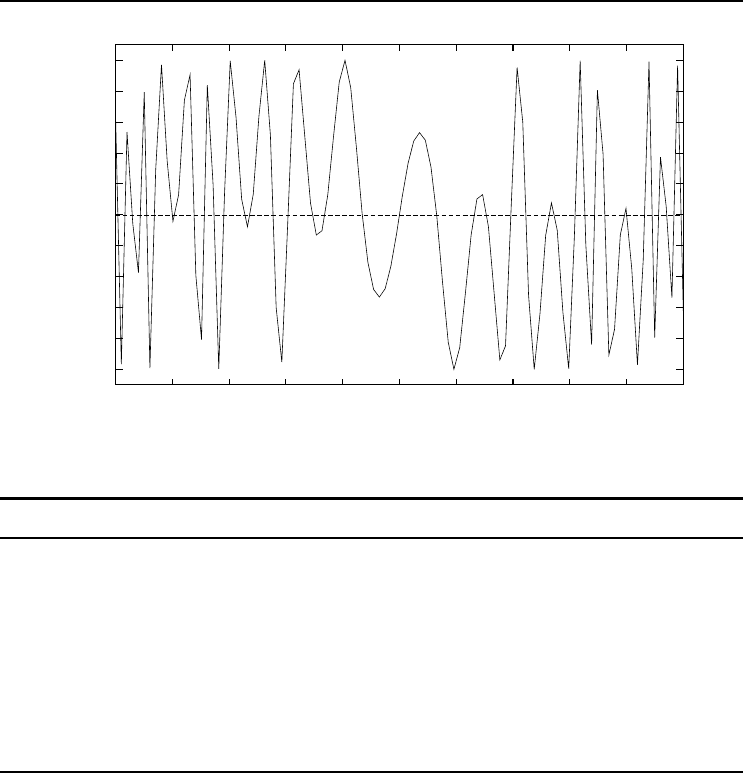
represents the vertical shift of the generating function. Figure 13.2 illustrates the
function for a =0,b =1,c =1,andd =0,withx ∈ [−2, 2]. The AMDE evolves
values for the four coefficients, a, b, c,andd. Solving a binary-valued problem thus
reverts to solving a 4-dimensional problem in a continuous-valued space. After each
iteration of the AMDE, the fitness of each individual in the population is determined by
substituting the evolved values for the coefficients (as represented by the individual)
into equation (13.28). The resulting function is sampled at evenly spaced intervals
and a bit value is recorded for each interval. If the output of the function in equation
(13.28) is positive, a bit-value of 1 is recorded; otherwise, a bit-value of 0 is recorded.
The resulting bit string is then evaluated by the fitness function defined in the original
binary-valued space in order to determine the quality of the solution.
The AMDE is summarized in Algorithm 13.9.
Pampar´a et al. [653] show that the AMDE is very efficient and provides accurate
solutions to binary-valued problems. Furthermore, the AMDE has the advantage that
254 13. Differential Evolution
-1
-0.8
-0.6
-0.4
-0.2
0
0.2
0.4
0.6
0.8
1
-2 -1.6 -1.2 -0.8 -0.4 0 0.4 0.8 1.2 1.6 2
g(x)
x
Figure 13.2 Angle Modulation Illustrated
Algorithm 13.9 Angle Modulated Differential Evolution
Generate a population of 4-dimensional individuals;
repeat
Apply any DE strategy for one iteration;
for each individual do
Substitute evolved values for coefficients a, b, c and d into equation (13.28);
Produce n
x
bit-values to form a bit-vector solution;
Calculate the fitness of the bit-vector solution in the original bit-valued space;
end
until a convergence criterion is satisfied;
an n
x
-dimensional binary-valued problem is transformed into a smaller 4-dimensional
continuous-valued problem.
13.4.2 Binary Differential Evolution
The binary DE (binDE) borrows concepts from the binary particle swarm optimizer
(binPSO), developed by Kennedy and Eberhart [450] (also refer to Section 16.5.7). As
with DE, particle swarm optimization (PSO; refer to Chapter 16) uses vector algebra
to calculate new search positions, and was therefore developed for continuous-valued
problems. In PSO, a velocity vector represents the mutation step sizes as stochastically
weighted difference vectors (i.e. the social and cognitive components). The binPSO
does not interpret the velocity as a step size vector. Rather, each component of the
velocity vector is used to compute the probability that the corresponding component
of the solution vector is bit 0 or bit 1.

13.5 Advanced Topics 255
In a similar way, the binDE uses the floating-point DE individuals to determine a
probability for each component. These probabilities are then used to generate a bit-
string solution from the floating-point vector. This bitstring is used by the fitness
function to determine its quality. The resulting fitness is then associated with the
floating-point representation of the individual.
Let x
i
(t) represent a DE individual, with each x
ij
(t)(j =1,...,n
x
,wheren
x
is
the dimension of the binary-valued problem) floating-point number. Then, the corre-
sponding bitstring solution, y
i
(t), is calcualted using
y
ij
=
0iff(x
ij
(t)) ≥ 0.5
1iff(x
ij
(t)) < 0.5
(13.29)
where f is the sigmoid function,
f(x)=
1
1+e
−x
(13.30)
The fitness of the individual x
i
(t) is then simply the fitness obtained using the binary
representation, y
i
(t).
The binDE algorithm is summarized in Algorithm 13.10.
Algorithm 13.10 Binary Differential Evolution Algorithm
Initialize a population and set control parameter values;
t =0;
while stopping condition(s) not true do
t = t +1;
Select parent x
i
(t);
Select individuals for reproduction;
Produce one offspring, x
(t);
y
i
(t) = generated bitstring from x
i
(t);
y
i
(t) = generated bitstring from x
i
(t);
if f(y
i
(t)) is better than f(x
i
(t)) then
Replace parent, x
i
(t), with offspring, x
i
(t);
end
else
Retain parent, x
i
(t);
end
end
13.5 Advanced Topics
The discussions in the previous sections considered application of DE to unconstrained,
single-objective optimization problems, where the fitness landscape remains static.
This section provides a compact overview of adaptations to the DE such that different
types of optimization problems as summarized in Appendix A can be solved using DE.

256 13. Differential Evolution
13.5.1 Constraint Handling Approaches
With reference to Section A.6, the following methods have been used to apply DE to
solve constrained optimization problems as defined in Definition A.5:
• Penalty methods (refer to Section A.6.2), where the objective function is adapted
by adding a function to penalize solutions that violate constraints [113, 394, 499,
810, 884].
• Converting the constrained problem to an unconstrained problem by embedding
constraints in an augmented Lagrangian (refer to Section A.6.2) [125, 390, 528,
758]. Lin et al. [529] combines both the penalty and the augmented Lagrangian
functions to convert a constrained problem to an unconstrained one.
• In order to preserve the feasibility of initial solutions, Chang and Wu [114] used
feasible directions to determine step sizes and search directions.
• By changing the selection operator of DE, infeasible solutions can be rejected,
and the repair of infeasible solutions facilitated. In order to achieve this, the
selection operator accepts an offspring, x
i
, under the following conditions [34,
56, 498]:
– if x
i
satisfies all the constraints, and f(x
i
) ≤ f(x
i
), then x
i
replaces the
parent, x
i
(assuming minimization);
– if x
i
is feasible and x
i
is infeasible, then x
i
replaces x
i
;
– if both x
i
and x
i
are infeasible, then if the number of constraints violated
by x
i
is less than or equal to the number of constraints violated by x
i
,then
x
i
replaces x
i
.
In the case that both the parent and the offspring represent infeasible solutions,
there is no selection pressure towards better parts of the fitness landscape; rather,
towards solutions with the smallest number of violated constraints.
Boundary constraints are easily enforced by clamping offspring to remain within the
given boundaries [34, 164, 498, 499]:
x
ij
(t)=
#
x
min,j
+ U(0, 1)(x
max,j
− x
min,j
)ifx
ij
(t) <x
min,j
or x
ij
>x
max,j
x
ij
(t)otherwise
(13.31)
This restarts the offspring to a random position within the boundaries of the search
space.
13.5.2 Multi-Objective Optimization
As defined in Definition A.10, multi-objective optimization requires multiple, conflict-
ing objectives to be simultaneously optimized. A number of adaptations have been
made to DE in order to solve multiple objectives, most of which make use of the
concept of dominance as defined in Definition A.11.
Multi-objective DE approaches include:

13.5 Advanced Topics 257
• Converting the problem into a minimax problem [390, 925].
• Weight aggregation methods [35].
• Population-based methods, such as the vector evaluated DE (VEDE) [659],
based on the vector evaluated GA (VEGA) [761] (also refer to Section 9.6.3). If
K objectives have to be optimized, K sub-populations are used, where each sub-
population optimizes one of the objectives. These sub-populations are organized
in a ring topology (as illustrated in Figure 16.4(b)). At each iteration, before
application of the DE reproduction operators, the best individual, C
k
.
ˆ
x(t), of
population C
k
migrates to population C
k+1
(that of C
k+1
migrates to C
0
), and is
used in population C
k+1
to produce the trial vectors for that population.
• Pareto-based methods, which change the DE operators to include the dominance
concept.
Mutation: Abbass et al. [2, 3] applied mutation only on non-dominated solu-
tions within the current generation. Xue et al. [928] computed the differential
as the difference between a randomly selected individual, x
i
1
, and a randomly
selected vector, x
i
2
, that dominates x
i
1
;thatis,x
i
1
x
i
2
.Ifx
i
1
is not domi-
nated by any other individual of the current generation, the differential is set to
zero.
Selection: A simple change to the selection operator is to replace the parent, x
i
,
with the offspring x
i
,onlyifx
i
x
i
[3, 2, 659]. Alternatively, ideas from non-
dominated sorting genetic algorithms [197] can be used, where non-dominated
sorting and ranking is applied to parents and offspring [545, 928]. The next
population is then selected with preference to those individuals with a higher
rank.
13.5.3 Dynamic Environments
Not much research has been done in applying DE to dynamically changing landscapes
(refer to Section A.9). Chiou and Wang [125] applied the DE with acceleration and
migration (refer to Algorithm 13.4) to dynamic environments, due to the improved
exploration as provided by the migration phase. Magoulas et al. [550] applied the
SGDDE (refer to Algorithm 13.6) to slowly changing fitness landscapes.
Mendes and Mohais [577] develop a DE algorithm, referred to as DynDE, to locate
and maintain multiple solutions in dynamically changing landscapes. Firstly, it is
important to note the following assumptions:
1. It is assumed that the number of peaks, n
X
, to be found are known, and that
these peaks are evenly distributed through the search space.
2. Changes in the fitness landscape are small and gradual.
DynDE uses multiple populations, with each population maintaining one of the peaks.
To ensure that each peak represents a different solution, an exclusion strategy is fol-
lowed: At each iteration, the best individuals of each pair of sub-populations are com-
pared. If these global best positions are too close to one another, the sub-population